

Jojoba Oil Market Size and Forecast (2025 – 2033), Global and Regional Growth, Trend, Share and Industry Analysis Report Coverage: By Type (Cold-pressed, Refined, Others); By Application (Cosmetics & Personal Care, Pharmaceutical, Industrial, Others); By Sales Channel (B2B, B2C); and Geography.
2025-11-26
Consumer Products
Jaya Bundele (Research Analyst)
Description
Jojoba
Oil Market Overview
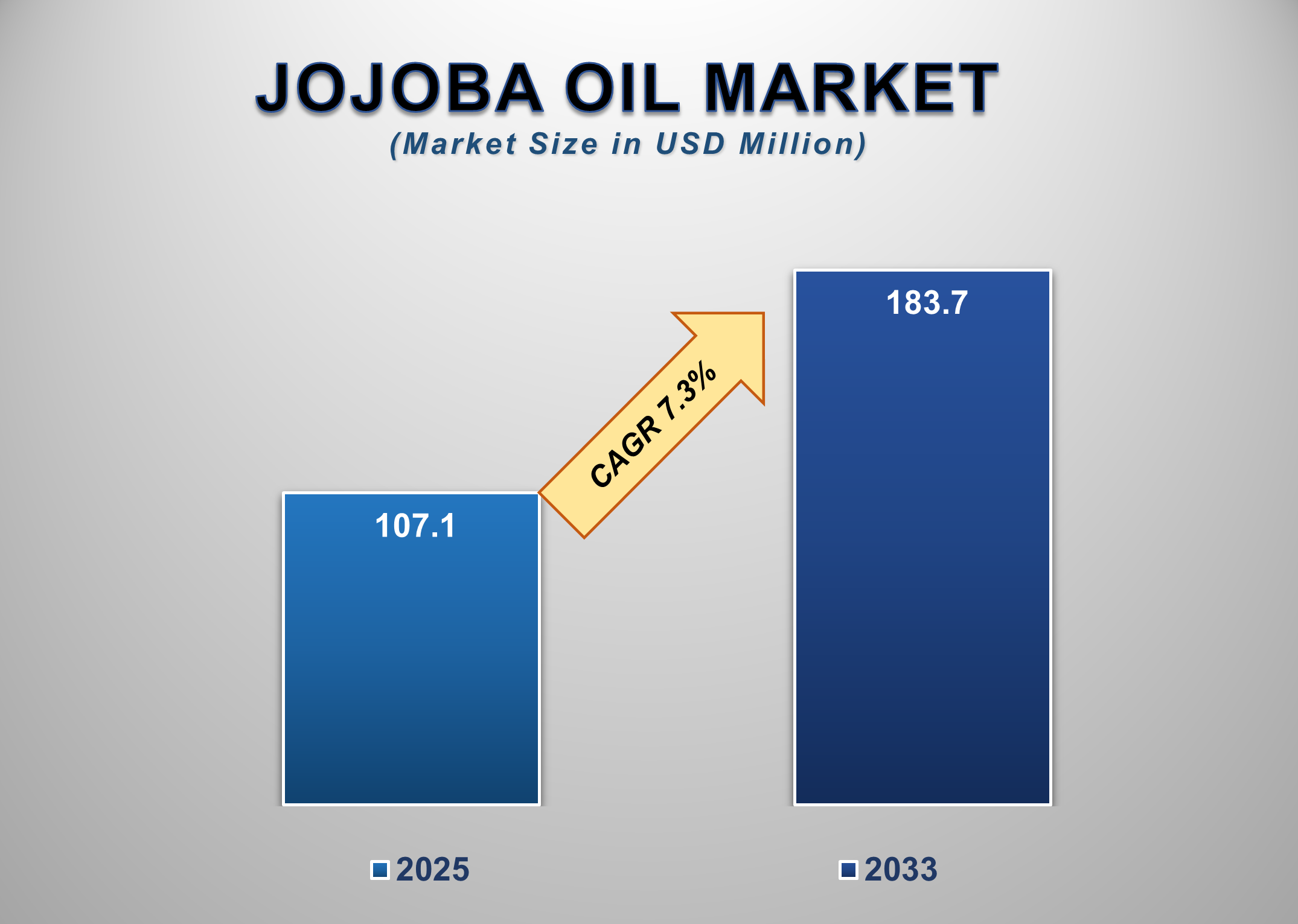
The Global Jojoba Oil Market is experiencing steady expansion driven by rising consumer demand for natural, sustainable, and multifunctional oils in personal care and industrial formulations. Valued at USD 107.1 million in 2025, the market is projected to reach USD 183.7 million by 2033, growing at a CAGR of 7.3% during 2025–2033.
Jojoba oil, derived from the
seeds of Simmondsia chinensis, is prized for its stability, similarity to human
sebum, and rich content of wax esters, which make it suitable for moisturizers,
hair care products, therapeutic formulations, and specialty industrial
lubricants. The cosmetics and personal care segment accounts for the largest
application share as formulators increasingly replace synthetic emollients with
naturally derived alternatives. Cold-pressed jojoba oil dominates the market
due to its retained bioactive compounds and consumer preference for minimally
processed, clean-label ingredients.
Jojoba
Oil Market Drivers and Opportunities
Rising consumer preference for
natural and clean-label personal care ingredients boosts jojoba oil demand
Growing consumer awareness about
ingredient transparency, sustainability, and clean beauty formulations is a
major driver for the jojoba oil market. Modern consumers, especially
millennials and Gen Z, prefer products with natural, minimally processed
ingredients and clear supply-chain provenance. Jojoba oil’s profile as a
naturally derived wax ester that closely mimics human sebum makes it highly
attractive for moisturizers, serums, hair oils, and anti-aging formulations.
Cosmetic manufacturers are reformulating to remove silicones and
petroleum-derived emollients in favor of botanical oils; cold-pressed jojoba
oil, which retains more phytochemicals and sensory qualities than refined
variants, benefits directly from this shift. Additionally, regulatory scrutiny
on certain synthetic preservatives and plastic-derived residues has prompted
formulators to seek plant-based alternatives, reinforcing jojoba’s role in
hypoallergenic and sensitive-skin product lines. The trend is equally strong in
premium and mass-market segments, expanding the addressable market for both
branded and private-label players.
Growing applications in
pharmaceuticals and niche industrial uses expand market scope
Beyond cosmetics, jojoba oil’s
chemical stability, low rancidity, and skin-compatibility are driving adoption
in pharmaceutical and specialty industrial applications. In pharmaceuticals,
jojoba oil is used as a carrier in topical drug delivery systems, ointments,
and dermatological preparations due to its biocompatibility and
penetration-enhancing properties. Research and formulation work into
jojoba-based transdermal carriers and therapeutic nutraceuticals is increasing
interest among pharmaceutical manufacturers and compounding pharmacies.
Industrially, jojoba oil’s lubricity, thermal stability, and biodegradability
make it suitable for high-performance lubricants, metalworking fluids, and
specialty coatings where environmental regulations limit the use of mineral
oils. These non-cosmetic applications provide higher-margin opportunities and
reduce dependence on seasonal cosmetic demand cycles, supporting steady market
expansion and encouraging diversification among producers and processors.
Opportunity for the Jojoba Oil
Market
Scaling production and
traceability in APAC unlocks new growth and margin expansion
The rapid expansion of personal
care manufacturing and growing middle-class consumption across the Asia Pacific
presents a significant opportunity for market players. Localizing production of
cold-pressed jojoba oil through contracted cultivation, processing hubs, and
quality-control laboratories can reduce logistical costs, shorten lead times,
and improve margin capture for suppliers. Establishing traceable supply chains
and certification programs (organic, fair trade, sustainable agriculture)
tailored to APAC export markets will enhance credibility with global buyers and
premium brands. Additionally, investing in education and co-development with
regional formulators to create localized, culturally relevant product formats
(e.g., hair oils popular in South Asia, multifunctional balms in Southeast
Asia) can accelerate adoption. Strategic partnerships between established
global players and regional growers/processors can also foster capacity
building and technology transfer, enabling scalable, sustainable supply to meet
projected demand growth in APAC and beyond.
Jojoba Oil Market Scope
|
Report Attributes |
Description |
|
Market Size in 2025 |
USD 107.1 Million |
|
Market Forecast in 2033 |
USD 183.7 Million |
|
CAGR % 2025-2033 |
7.3% |
|
Base Year |
2024 |
|
Historic Data |
2020-2024 |
|
Forecast Period |
2025-2033 |
|
Report USP |
Production, Consumption,
Company Share, Company Heatmap, Company Production Capacity, Growth Factors,
and more |
|
Segments Covered |
●
By Type ●
By Application ●
By Sales Channel |
|
Regional Scope |
●
North America ●
Europe ●
APAC ●
Latin America ●
Middle East and
Africa |
|
Country Scope |
1)
U.S. 2)
Canada 3)
Germany 4)
UK 5)
France 6)
Spain 7)
Italy 8)
Switzerland 9)
China 10)
Japan 11)
India 12)
Australia 13)
South Korea 14)
Brazil 15)
Mexico 16)
Argentina 17)
South Africa 18)
Saudi Arabia 19)
UAE |
Jojoba Oil Market Report Segmentation Analysis
The global Jojoba Oil Market
industry analysis is segmented into Type, Application, Sales Channel, and
Region.
Cold-pressed type accounted
for the largest market share in the global jojoba oil market
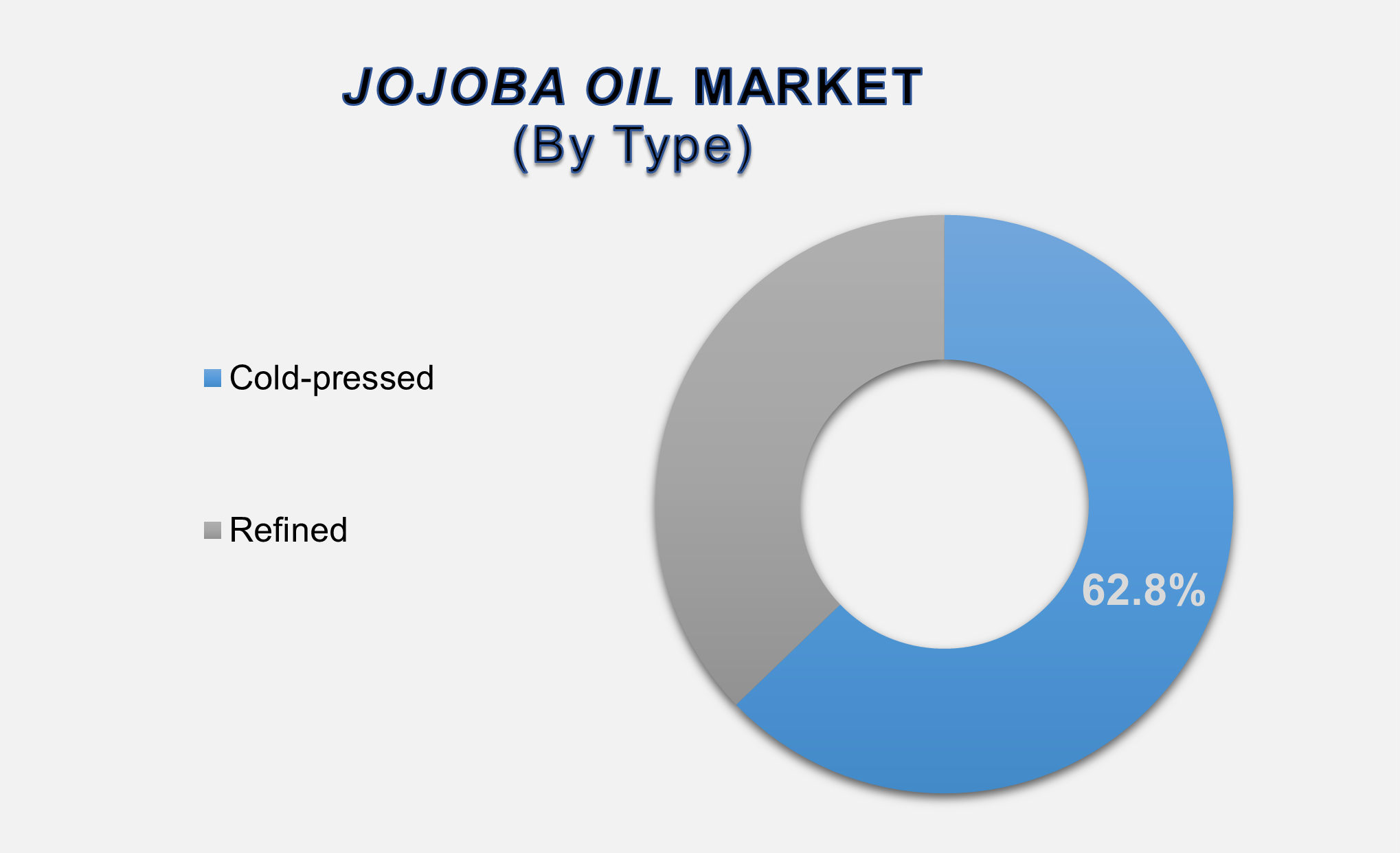
The Cold-pressed segment dominated the market with a 62.8% share in 2025, reflecting strong demand for minimally processed oils that retain natural actives and sensory attributes. Cold-pressing preserves wax esters, vitamins, and antioxidants, offering superior skin feel and stability compared with refined alternatives. Premium beauty brands and natural-product formulators preferentially source cold-pressed jojoba for face oils, serums, and hair treatments where efficacy and clean-label claims influence purchase decisions. While refined jojoba oil serves price-sensitive industrial and some mass-market applications, the cold-pressed segment’s higher unit value and alignment with sustainability narratives drive its leading revenue contribution.
Cosmetics & Personal Care
accounted for the largest application share in the global jojoba oil market
Cosmetics & Personal Care is
the largest application vertical, reflecting jojoba oil’s extensive use in
moisturizers, foundations, balms, hair conditioners, and specialty treatments.
Its emollient properties, low comedogenicity, and long shelf life make it a
favored ingredient among formulators targeting dry, sensitive, or aging skin.
The rise of multifunctional products—combining skincare, sun care, and color
cosmetics—also increases jojoba inclusion rates. In parallel, demand from
natural and organic brands, indie beauty labels, and established personal-care
conglomerates supports steady volume growth. Specialty segments such as male
grooming and natural baby-care products are emerging as incremental
opportunities.
The B2B sales channel
accounted for the largest market share in the global jojoba oil market
B2B channels dominate sales as
bulk purchasers—contract manufacturers, cosmetics companies, pharmaceutical
formulators, and industrial clients—buy jojoba oil at commercial volumes. B2B
procurement emphasizes consistent quality, certification, and supply reliability,
which benefits established growers and processors that can offer traceability
and scalable logistics. B2C channels, including specialty retailers and
e-commerce brands selling consumer-packaged jojoba oil, contribute to brand
visibility and direct margins, but overall market value remains concentrated in
business-to-business transactions where larger volumes and long-term contracts
are prevalent.
The following segments are
part of an in-depth analysis of the global Jojoba Oil Market:
|
Market
Segments |
|
|
By Type |
●
Cold-pressed ●
Refined |
|
By Application |
●
Cosmetics &
Personal Care ●
Pharmaceutical ●
Industrial ●
Others |
|
By Sales
Channel |
●
B2B ●
B2C |
Jojoba
Oil Market Share Analysis by Region
The North America region is
projected to hold the largest share of the global Jojoba Oil Market over the
forecast period.
North America dominated the
global jojoba oil market in 2025, holding approximately 39.5% share, supported
by a large cosmetics and personal care industry, strong consumer preference for
natural ingredients, and established distribution networks. The U.S. is the
primary consumption hub, driven by premium beauty brands and sizable contract
manufacturing activity. Regulatory frameworks favoring natural-product claims
and eco-conscious marketing further bolster market size. Europe represents
another mature market with robust demand from natural cosmetics and specialty
personal care producers.
The Asia Pacific region is
projected to grow at the fastest CAGR over the forecast period as rising
disposable incomes, urbanization, and expanding beauty and wellness industries
increase product demand. Countries such as China, India, South Korea, and Southeast
Asian nations are rapidly scaling both consumption and local manufacturing
capabilities. APAC’s growth is also driven by increased adoption of imported
premium ingredients and growing domestic brands seeking high-quality raw
materials. Latin America and MEA show steady growth with niche opportunities in
organic and sustainable product segments. Supply-side dynamics such as
cultivation shifts, climate impacts on yields, and processing capacities will
influence regional supply-demand balances.
Jojoba
Oil Market Competition Landscape Analysis
The jojoba oil
market is moderately fragmented with a mix of specialized producers, commodity
processors, and ingredient distributors. Key players include Jojoba Desert, Eco
Oil Argentina, Purcell Jojoba, Jojoba Israel, The Jojoba Company, Desert Whale
Jojoba, Egyptian Natural Oil, Jedwards International, Proteco Gold, Inca Oil
SA, A&E Connock, SMA Collaboratives, Jojoba Growers and Processors,
Mountain Rose Herbs, The Lebermuth Company, Hallstar, Provital Group, Aakula,
Natural Sourcing, and Aura Cacia.
Global Jojoba Oil Market Recent Developments News:
- In September 2024,
Jojoba Desert, Inc., a premier jojoba oil producer, reinforced its
commitment to ethical and sustainable operations by receiving its fifth
consecutive Fair for Life Certification in 2024. The company continues to
prioritize environmental stewardship, fair labor practices, and human
rights across its supply chain while delivering high-quality jojoba oil
and derivatives.
- In June 2024,
Saraya inaugurated its Middle East Factory in Egypt’s Suez Canal Economic
Zone, an 8,000-square-meter facility dedicated to producing jojoba oil for
cosmetics and industrial lubricants. The plant supports Sustainable
Development Goals (SDGs) by greening desert areas, fostering local
enterprise, and strengthening Japanese-Egyptian collaboration, with an
annual production target of 100 tons of jojoba oil and other natural
products.
- In May 2024, Boots launched
Clinique’s Black Honey Pop Lip and Cheek Oil, a multitasking beauty
product enriched with hydrating jojoba oil. Designed for a lightweight,
blendable application, it offers a natural flush of color while
moisturizing both lips and cheeks, seamlessly integrating into daily
beauty regimens.
The Global Jojoba Oil Market is dominated by a few
large companies, such as
●
Jojoba Desert
●
Eco Oil Argentina
●
Purcell Jojoba
●
Jojoba Israel
●
The Jojoba Company
●
Desert Whale Jojoba
●
Egyptian Natural Oil
●
Jedwards International
●
Proteco Gold
●
Inca Oil SA
●
A&E Connock
●
SMA Collaboratives
●
Jojoba Growers and
Processors
●
Mountain Rose Herbs
●
The Lebermuth Company
●
Hallstar
●
Provital Group
●
Aakula
●
Natural Sourcing
●
Aura Cacia
● Other Prominent Players
Frequently Asked Questions
Jaya Bundele (Research Analyst)
Jaya Bundele is a skilled Research Analyst with 4+ years of experience in market intelligence, consumer insights, competitive analysis, and industry forecasting across the consumer goods, agriculture, and food & beverage sectors. She specializes in market sizing, trend analysis, growth opportunity mapping, and strategic secondary research for global and regional markets.
Her expertise lies in transforming complex industry data into actionable business strategies that help organizations identify emerging trends, understand customer behavior, and gain a competitive edge. With a strong focus on data-driven insights, business intelligence, and future market trends, Jaya delivers high-quality research solutions aligned with evolving industry demands and market dynamics.
1. Global Jojoba Oil Market
Introduction and Market Overview
1.1.
Objectives
of the Study
1.2.
Global
Jojoba Oil Market Scope and Market Estimation
1.2.1.Global Jojoba Oil Market Overall
Market Size (US$ Bn), Market CAGR (%), Market forecast (2025 - 2033)
1.2.2.Global Jojoba Oil Market
Revenue Share (%) and Growth Rate (Y-o-Y) from 2020 - 2033
1.3.
Market
Segmentation
1.3.1.Type of Global Jojoba Oil
Market
1.3.2.Application of Global Jojoba
Oil Market
1.3.3.Sales Channel of Global Jojoba
Oil Market
1.3.4.Region of Global Jojoba
Oil Market
2. Executive
Summary
2.1.
Demand
Side Trends
2.2.
Key
Market Trends
2.3.
Market
Demand (US$ Bn) Analysis 2020 – 2024 and Forecast, 2025 – 2033
2.4.
Demand
and Opportunity Assessment
2.5.
Demand
Supply Scenario
2.6.
Market
Dynamics
2.6.1.Drivers
2.6.2.Limitations
2.6.3.Opportunities
2.6.4.Impact Analysis of Drivers
and Restraints
2.7.
Emerging
Trends for Jojoba Oil Market
2.8.
Porter’s
Five Forces Analysis
2.9.
PEST
Analysis
2.10.
Key
Regulation
3. Global
Jojoba Oil Market Estimates
& Historical Trend Analysis (2020 - 2024)
4.
Global Jojoba Oil Market Estimates & Forecast Trend Analysis, by
Type
4.1.
Global
Jojoba Oil Market Revenue (US$ Bn) Estimates and Forecasts, by Type, 2020 - 2033
4.1.1.Cold-pressed
4.1.2.Refined
5.
Global Jojoba Oil Market Estimates & Forecast Trend Analysis, by
Application
5.1.
Global
Jojoba Oil Market Revenue (US$ Bn) Estimates and Forecasts, by Application, 2020
- 2033
5.1.1.Cosmetics & Personal
Care
5.1.2.Pharmaceutical
5.1.3.Industrial
5.1.4.Others
6.
Global Jojoba Oil Market Estimates & Forecast Trend Analysis, by
Sales Channel
6.1.
Global
Jojoba Oil Market Revenue (US$ Bn) Estimates and Forecasts, by Sales Channel, 2020
- 2033
6.1.1.B2B
6.1.2.B2C
7. Global
Jojoba Oil Market Estimates
& Forecast Trend Analysis, by region
1.1.
Global
Jojoba Oil Market Revenue (US$ Bn) Estimates and Forecasts, by region, 2020 - 2033
1.1.1.North America
1.1.2.Europe
1.1.3.Asia Pacific
1.1.4.Middle East & Africa
1.1.5.Latin America
8. North America Jojoba
Oil Market: Estimates & Forecast
Trend Analysis
8.1. North America Jojoba Oil
Market Assessments & Key Findings
8.1.1.North America Jojoba Oil
Market Introduction
8.1.2.North America Jojoba Oil
Market Size Estimates and Forecast (US$ Billion) (2020 - 2033)
8.1.2.1. By Type
8.1.2.2. By Application
8.1.2.3. By Sales
Channel
8.1.2.4.
By
Country
8.1.2.4.1.
The
U.S.
8.1.2.4.2.
Canada
9. Europe Jojoba
Oil Market: Estimates & Forecast
Trend Analysis
9.1.
Europe
Jojoba Oil Market Assessments & Key Findings
9.1.1.Europe Jojoba Oil Market
Introduction
9.1.2.Europe Jojoba Oil Market
Size Estimates and Forecast (US$ Billion) (2020 - 2033)
9.1.2.1. By Type
9.1.2.2. By Application
9.1.2.3. By Sales
Channel
9.1.2.4.
By
Country
9.1.2.4.1. Germany
9.1.2.4.2. Italy
9.1.2.4.3. U.K.
9.1.2.4.4. France
9.1.2.4.5. Spain
9.1.2.4.6. Switzerland
9.1.2.4.7.
Rest of Europe
10. Asia Pacific Jojoba
Oil Market: Estimates & Forecast
Trend Analysis
10.1.
Asia
Pacific Market Assessments & Key Findings
10.1.1.
Asia
Pacific Jojoba Oil Market Introduction
10.1.2.
Asia
Pacific Jojoba Oil Market Size Estimates and Forecast (US$ Billion) (2020 - 2033)
10.1.2.1. By Type
10.1.2.2. By Application
10.1.2.3. By Sales
Channel
10.1.2.4.
By
Country
10.1.2.4.1. China
10.1.2.4.2. Japan
10.1.2.4.3. India
10.1.2.4.4. Australia
10.1.2.4.5. South Korea
10.1.2.4.6.
Rest
of Asia Pacific
11. Middle East & Africa Jojoba
Oil Market: Estimates & Forecast
Trend Analysis
11.1.
Middle
East & Africa Market Assessments & Key Findings
11.1.1.
Middle East & Africa Jojoba Oil Market Introduction
11.1.2.
Middle East & Africa Jojoba Oil Market Size Estimates and
Forecast (US$ Billion) (2020 - 2033)
11.1.2.1. By Type
11.1.2.2. By Application
11.1.2.3. By Sales
Channel
11.1.2.4.
By
Country
11.1.2.4.1. South
Africa
11.1.2.4.2. UAE
11.1.2.4.3. Saudi
Arabia
11.1.2.4.4.
Rest of MEA
12. Latin America
Jojoba Oil Market: Estimates &
Forecast Trend Analysis
12.1.
Latin
America Market Assessments & Key Findings
12.1.1.
Latin
America Jojoba Oil Market Introduction
12.1.2.
Latin
America Jojoba Oil Market Size Estimates and Forecast (US$ Billion) (2020 - 2033)
12.1.2.1. By Type
12.1.2.2. By Application
12.1.2.3. By Sales
Channel
12.1.2.4.
By
Country
12.1.2.4.1. Brazil
12.1.2.4.2. Mexico
12.1.2.4.3. Argentina
12.1.2.4.4.
Rest of LATAM
13. Country Wise Market:
Introduction
14.
Competition
Landscape
14.1.
Global
Jojoba Oil Market Product Mapping
14.2.
Global
Jojoba Oil Market Concentration Analysis, by Leading Players / Innovators /
Emerging Players / New Entrants
14.3.
Global
Jojoba Oil Market Tier Structure Analysis
14.4.
Global
Jojoba Oil Market Concentration & Company Market Shares (%) Analysis, 2023
15.
Company
Profiles
15.1. Jojoba
Desert
15.1.1.
Company
Overview & Key Stats
15.1.2.
Financial
Performance & KPIs
15.1.3.
Product
Portfolio
15.1.4.
SWOT
Analysis
15.1.5.
Business
Strategy & Recent Developments
* Similar details would be provided for all
the players mentioned below
15.2. Eco Oil
Argentina
15.3. Purcell
Jojoba
15.4. Jojoba Israel
15.5. The Jojoba
Company
15.6. Desert Whale
Jojoba
15.7. Egyptian
Natural Oil
15.8. Jedwards
International
15.9. Proteco Gold
15.10. Inca Oil SA
15.11. A&E
Connock
15.12. SMA
Collaboratives
15.13. Jojoba
Growers and Processors
15.14. Mountain Rose
Herbs
15.15. The Lebermuth
Company
15.16. Hallstar
15.17. Provital
Group
15.18. Aakula
15.19. Natural
Sourcing
15.20. Aura Cacia
15.21. Other
Prominent Players
16. Research
Methodology
16.1.
External
Transportations / Databases
16.2.
Internal
Proprietary Database
16.3.
Primary
Research
16.4.
Secondary
Research
16.5.
Assumptions
16.6.
Limitations
16.7.
Report
FAQs
17. Research
Findings & Conclusion
Our Research Methodology
"Insight without rigor is just noise."
We follow a comprehensive, multi-phase research framework designed to deliver accurate, strategic, and decision-ready intelligence. Our process integrates primary and secondary research , both quantitative and qualitative , along with dual modeling techniques ( top-down and bottom-up) and a final layer of validation through our proprietary in-house repository.
PRIMARY RESEARCH
Primary research captures real-time, firsthand insights from the market to understand behaviors, motivations, and emerging trends.
1. Quantitative Primary Research
Objective: Generate statistically significant data directly from market participants.
Approaches:- Structured surveys with customers, distributors, and field agents
- Mobile-based data collection for point-of-sale audits and usage behavior
- Phone-based interviews (CATI) for market sizing and product feedback
- Online polling around industry events and digital campaigns
- Purchase frequency by customer type
- Channel performance across geographies
- Feature demand by application or demographic
2. Qualitative Primary Research
Objective: Explore decision-making drivers, pain points, and market readiness.
Approaches:- In-depth interviews (IDIs) with executives, product managers, and key decision-makers
- Focus groups among end users and early adopters
- Site visits and observational research for consumer products
- Informal field-level discussions for regional and cultural nuances
SECONDARY RESEARCH
This phase helps establish a macro-to-micro understanding of market trends, size, regulation, and competitive dynamics, sourced from credible and public domain information.
1. Quantitative Secondary Research
Objective: Model market value and segment-level forecasts based on published data.
Sources include:- Financial reports and investor summaries
- Government trade data, customs records, and regulatory statistics
- Industry association publications and economic databases
- Channel performance and pricing data from marketplace listings
- Revenue splits, pricing trends, and CAGR estimates
- Supply-side capacity and volume tracking
- Investment analysis and funding benchmarks
2. Qualitative Secondary Research
Objective: Capture strategic direction, innovation signals, and behavioral trends.
Sources include:- Company announcements, roadmaps, and product pipelines
- Publicly available whitepapers, conference abstracts, and academic research
- Regulatory body publications and policy briefs
- Social and media sentiment scanning for early-stage shifts
- Strategic shifts in market positioning
- Unmet needs and white spaces
- Regulatory triggers and compliance impact
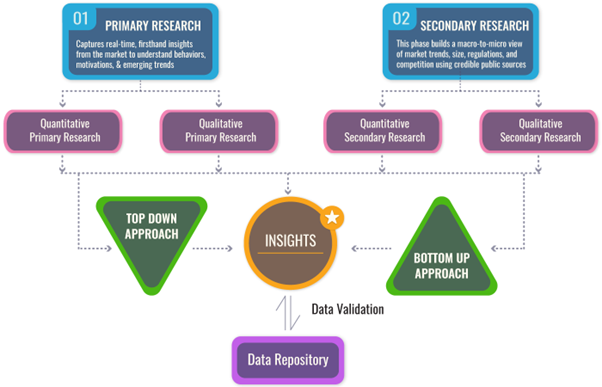
DUAL MODELING: TOP-DOWN + BOTTOM-UP
To ensure robust market estimation, we apply two complementary sizing approaches:
Top-Down Modeling:- Start with broader industry value (e.g., global or regional TAM)
- Apply filters by segment, geography, end-user, or use case
- Adjust with primary insights and validation benchmarks
- Ideal for investor-grade market scans and opportunity mapping
- Aggregate from the ground up using sales volumes, pricing, and unit economics
- Use internal modeling templates aligned with stakeholder data
- Incorporate distributor-level or region-specific inputs
- Most accurate for emerging segments and granular sub-markets
DATA VALIDATION: IN-HOUSE REPOSITORY
We close the loop with proprietary data intelligence built from ongoing projects, industry monitoring, and historical benchmarking. This repository includes:
- Multi-sector market and pricing models
- Key trendlines from past interviews and forecasts
- Benchmarked adoption rates, churn patterns, and ROI indicators
- Industry-specific deviation flags and cross-check logic
- Catches inconsistencies early
- Aligns projections across studies
- Enables consistent, high-trust deliverables