

Laser Hair Removal Market Size and Forecast (2026–2034), Global and Regional Growth, Trend, Share and Industry Analysis Report Coverage: By Laser Type (Diode Laser, Alexandrite Laser, Nd:YAG Laser, Ruby Laser, and Intense Pulsed Light Devices), By Product Type (Standalone Laser Devices and Multi-Functional Laser Devices), By End User (Beauty Clinics/MedSpas, Dermatology Clinics, Hospitals, and Others) and Geography
2026-08-11
Healthcare
Swetal (Research Analyst)
Description
Laser Hair Removal Market
Overview
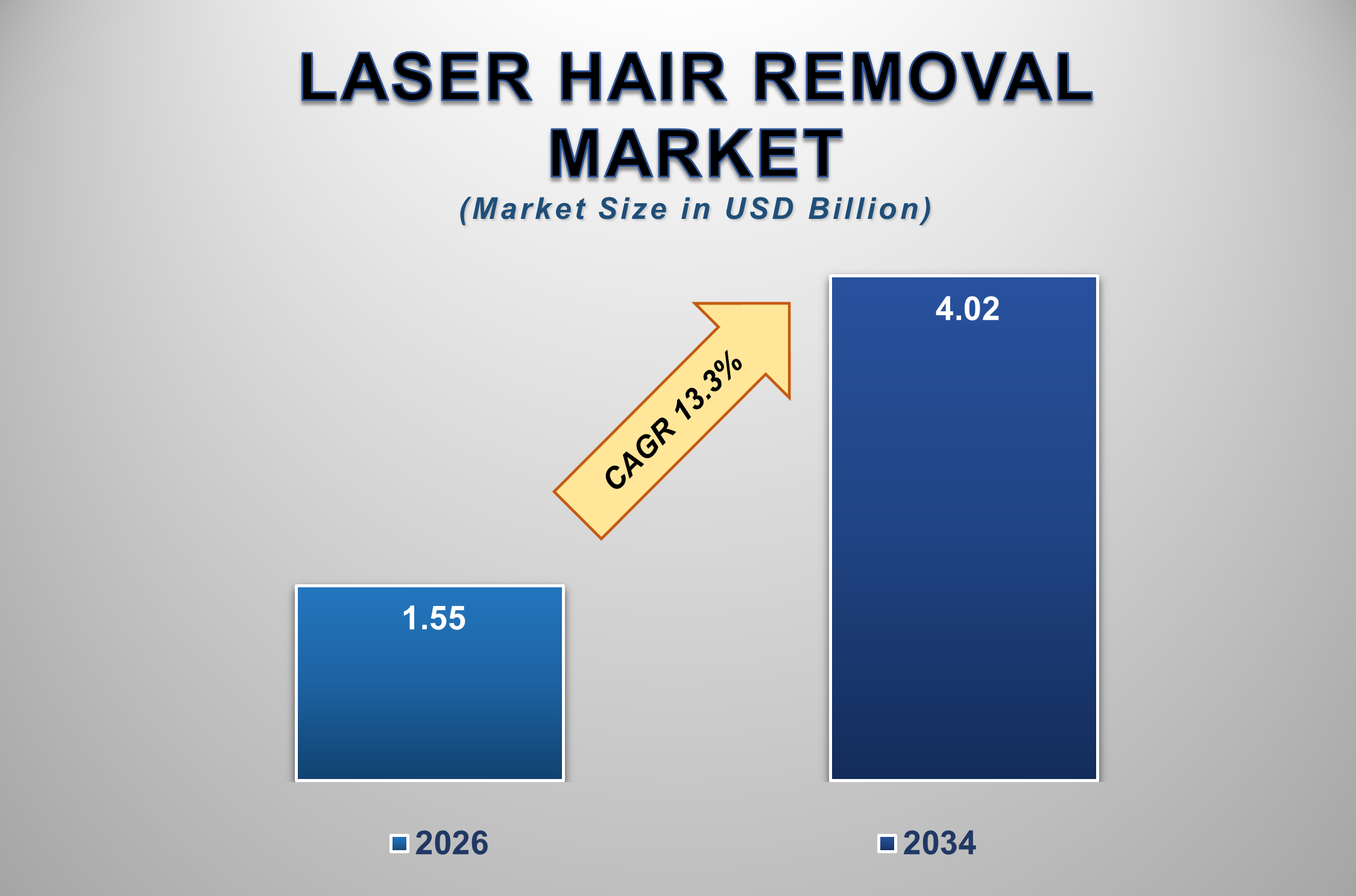
The Global Laser Hair Removal Market was valued at USD 1.55 billion in 2026 and is projected to
reach USD 4.02 billion by 2034, expanding at a CAGR of 13.3% during the
forecast period. The global market for
laser hair removal is witnessing steady growth due to rising consumer
preferences for permanent hair removal options, ever-rising aesthetic
awareness, and constant advancements in laser technology that enhance the
safety, efficiency, and efficacy of treatment. The market covers professional
laser systems used in dermatology clinics, beauty salons, and hospitals, along
with an array of home-use laser and IPL hair removal devices that provide ease
of use for consumers. Technological innovations, such as multi-wavelength
platforms, improved cooling systems, artificial intelligence-based treatment
personalization, and faster treatment protocols, are widening the “patient
pool” ready for treatment. Also, rising disposable income supports demand along
with the popularity of minimally invasive cosmetic procedures, growing medical
aesthetic services providers in emerging economies, and increasing acceptance
of aesthetic treatment by both genders. However, the market has challenges such
as high costs of advanced laser systems, the need for specialists, and stiff competition
from alternative methods for hair removal. However, continuing product
innovations and growing food production capacity, as well as rising acceptance
of beauty services, continue to create favorable prospects for stable market
growth.
Laser Hair Removal Market Drivers and
Opportunities
Rising Demand for
Non-Invasive Aesthetic Procedures Driving Market Growth
The market for
laser hair removal is being significantly affected by the rising demand for
minimally invasive aesthetic procedures. Consumers have started choosing
aesthetic procedures that have long-lasting effects while causing minimal pain,
have a shorter recovery time, and less risk than other invasive procedures.
Laser hair removal is one of the most popular aesthetic procedures because it
provides a very efficient long-term solution for hair removal while adding more
convenience compared to other techniques like waxing or shaving. The increase
in laser hair removal popularity can also be attributed to the fact that people
have started caring more about their looks, have larger disposable incomes,
better medical aesthetics facilities, and are open to using cosmetic procedures
both by women and by men. According to a report published by Longwood Plastic
Surgery in May 2026, over 13 million minimally invasive medical procedures were
performed in the USA, which means that there is a growing demand for aesthetic
procedures that involve no surgery. The growing demand for the service
encourages dermatology clinics, beauty centers, and medical spas to invest in
laser hair removal equipment.
Advancements in
Laser and IPL Technologies Fueling Market Expansion
Laser technology
and Intense Pulsed Light (IPL) innovation are continuously advancing and
improving the growth of the laser hair removal market. This has increased
efficiency, ensured patient comfort, and improved health services. Companies
are producing next-generation technologies that use several wavelengths, work
at high speed, feature improved cooling systems, and allow care providers to
treat different types of skin and hair. The introduction of the new
technologies leads to improved effectiveness of procedures in the laser hair
removal field. This is why aesthetic clinics and dermatology offices keep
updating their machines and technologies. Additionally, the industry is
experiencing a tendency toward multi-purpose technologies that allow different aesthetic
operations and increase profits for medical sector representatives. Similarly,
in June 2026, Cartessa Aesthetics introduced Prisma in Canada, introducing its
cutting-edge Intense Pulsed Light (IPL) technology, which had previously only
been available in the United States, into the Canadian arena. This type of
innovative product development and international expansion helps facilitate
technology penetration while bolstering the growth opportunities within the
global laser hair removal industry.
Expansion of
Home-Use Laser Hair Removal Devices Creates Significant Growth Opportunities
The widespread
proliferation of laser hair removal appliances for domestic application
provides the global laser hair removal sector with a unique chance to grow. The
advancement in at-home laser and IPL technology is predominantly caused by
rising consumer demand for convenient and affordable services. These appliances
have become incrementally safer, more reliable, and easier to use due to
technical advancements enabling users to achieve salon-like results without
regularly visiting their healthcare providers. The market growth is further
fueled by the increasing penetration of e-commerce and growing public awareness
and confidence in home technologies developed on a clinical testing basis. For
example, in December of year 2025, DermRays introduced the upcoming launch of
the DermRays V8S Enhanced Edition model, which happened to be the very first
home-use hair removal device featuring Vertical-Cavity Surface-Emitting Laser
(VCSEL) diode laser technology with a patent for a European Union invention
registered. The entity mentioned that this launch is an important technological
breakthrough in terms of home diode laser hair removal for more than 10 years.
Such innovations are expected to lead to growth in terms of market penetration
by consumers as well as an increase in the efficiency and strength of the
upgraded home device segment.
Laser Hair Removal Market Scope
|
Report Attributes |
Description |
|
Market Size in 2026 |
USD 1.55 Billion |
|
Market Forecast in 2034 |
USD 4.02 Billion |
|
CAGR % 2026-2034 |
13.3% |
|
Base Year |
2025 |
|
Historic Data |
2021-2025 |
|
Forecast Period |
2026-2034 |
|
Report USP |
Pricing and Cost Structure Analysis, Product
Innovation Benchmarking, Whitespace Assessment, Company Share, Company
Heatmap, Growth Factors, and more |
|
Segments Covered |
●
By Laser
Type ●
By
Product Type ●
By End
User |
|
Regional Scope |
●
North
America ●
Europe ●
APAC ●
Latin
America ●
Middle
East and Africa |
|
Country Scope |
●
U.S. ●
Canada ●
U.K. ●
Germany ●
France ●
Italy ●
Spain ●
Russia ●
China ●
India ●
Japan ●
South
Korea ●
Australia
●
Mexico ●
Brazil ●
Saudi
Arabia ●
UAE ●
South
Africa
|
Laser Hair Removal Market Report
Segmentation Analysis
The global laser
hair removal market industry analysis is segmented by laser type, by product
type, by end user, and by region.
Diode Laser
Segment Is Expected to Dominate the Laser Hair Removal Market During the
Forecast Period
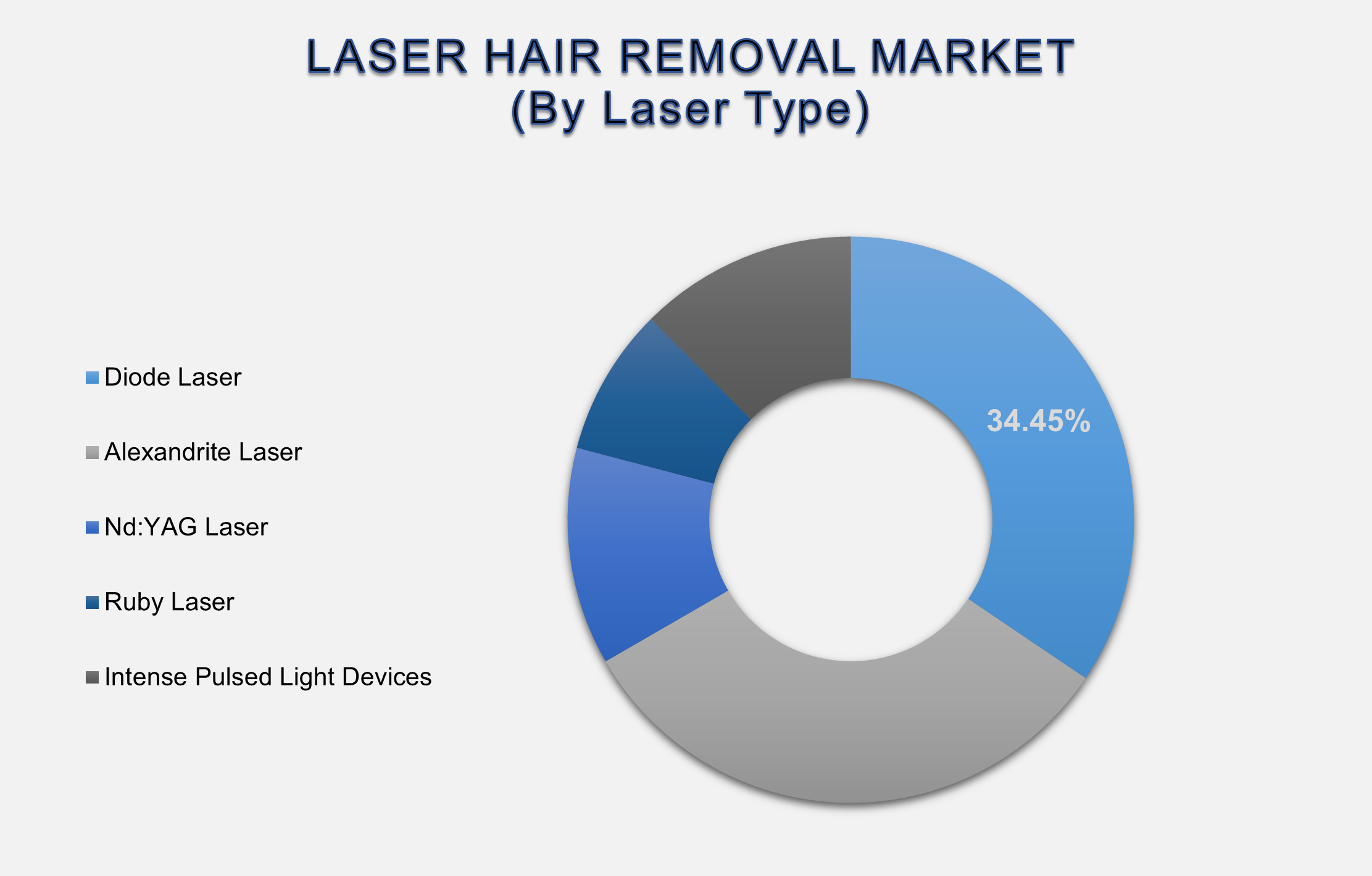
The diode laser
segment is projected to lead the global laser hair removal market by virtue of
its remarkable combination of efficacy, safety, speed of treatment, and
effectiveness on a variety of different skin types. Typically operating at a
wavelength of 800–810 nm, diode lasers provide excellent penetration of the
hair follicle while limiting damage in surrounding tissues, thus making them
highly effective for the purpose of permanent hair removal. The capability to
safely treat Fitzpatrick skin types I to VI, including darker skin, thanks to
advanced cooling systems, has enabled wider use of diode laser solutions. In
comparison to other technologies, diode lasers are capable of providing quicker
treatments thanks to their larger spot sizes and greater repetition rates.
Different advances in technologies, such as utilizing multi-wavelength diode
systems and autonomous energy delivery systems, as well as the inclusion of
contact cooling methods, have enabled to improve comfort level of procedures
and results achieved in the clinic even more. Innovative diode platform
developers, including Alma Lasers (Soprano Titanium), Lumenis (LightSheer),
Asclepion (MeDioStar), and InMode (Triton), are launching various systems with
innovative diodes in the market, which implies that this technology will be
widely adopted in the dermatological and aesthetic medicine sphere as time
passes.
Standalone Laser
Devices Segment Is Expected to Lead the Laser Hair Removal Market by Product
Type
The category of
independent laser equipment is anticipated to dominate the global laser hair
removal market from the standpoint of product types during the forecast period
since the use of such equipment in dermatology clinics, beauty salons, and
medical spas, which primarily carry out hair removal procedures, is widespread.
These dedicated devices are engineered to produce precise treatments, be
consistent in their operation, and maintain high performance levels; therefore,
they are the favored option for clinics with high patient numbers. Compared to
multifunctional aesthetic platforms, independent laser equipment usually
provides higher treatment speed, lower complexity of usage, lower maintenance
effort required, and lower overall investment. Because they are available in
several laser technologies such as diode, Nd: YAG, and Alexandrite,
practitioners can opt for a suitable device based on skin and hair
characteristics to achieve effective and safe treatment. Furthermore,
manufacturers do not stop enhancing their devices by including several new
features, such as improved cooling systems, larger spot sizes, high repetition
rates, and more comfortable-to-operate devices and settings. Application of
independent laser devices will continue to grow due to the emergence of more
aesthetic clinics and consumers’ desire for long-term hair removal.
Hospital Segment
Is Expected to Lead the Laser Hair Removal Market by End User
The hospital
segment is anticipated to dominate the global laser hair removal sector due to
the use of advanced laser technology, trained dermatologists and plastic
surgeons, and full patient care infrastructure. Hospitals have started to add
aesthetic dermatology to their services to meet the growing demand for cosmetic
medical procedures, compared to patients who want to get safely treated for any
skin type irrespective of their skin condition. Their capacity to use
sophisticated lasers machines such as diode, Alexandrite, Nd: YAG, and
multi-wavelength systems makes it possible for hospitals to provide high-level
treatments in terms of safety and clinical results. Moreover, hospitals follow
strict regulations regarding infection control and have emergency systems,
which boosts patients' confidence. The increasing incorporation of cosmetic
dermatology into multi-specialty hospitals, along with the rising adoption of
minimally invasive cosmetic procedures and high investment in modern medical
technologies, is predicted to enhance the number of procedures in hospital
facilities. These benefits render hospitals one of the key end-user segments in
the market for laser hair removal during the period of forecast.
The following
segments are part of an in-depth analysis of the global laser hair removal
market:
|
Market Segments |
|
|
By Laser Type |
●
Diode Laser ●
Alexandrite
Laser ●
Nd:YAG Laser ●
Ruby Laser ●
Intense Pulsed
Light Devices |
|
By Product Type |
●
Standalone
Laser Devices ●
Multi-Functional
Laser Devices |
|
By End User |
●
Beauty
Clinics/MedSpas ●
Dermatology
Clinics ●
Hospitals ●
Others |
Laser Hair Removal Market Share
Analysis by Region
North America is
projected to hold the largest share of the global Laser Hair Removal Market
over the forecast period
The field of
aesthetics is evolving with the regular emergence of new laser systems that
have enhanced the effectiveness of procedures and patient safety, speed of hair
removal, and suitability of the treatment for different skin types. Innovative
devices from manufacturers work on the development of new-generation devices
that use dual and multiple wavelengths, advanced pulse delivery mechanisms,
intelligent digital controls, advanced cooling systems, as well as ergonomic
designs, which give dentists the possibility to perform individual and
efficient procedures. For instance, in April 2025, Lumenis Ltd. launched the
newest version of its SPLENDOR X dual-wavelength laser hair removal system.
This improved apparatus features the BLEND X technology as well as a newly
developed user interface and high-tech instruments that help with treatment
accuracy, working process productivity, and user experience. Additionally, in
July 2026, Rejuva Fresh reported that their PicoPretty Q-Switched Nd: YAG Laser
Machine was granted approval by Health Canada and can be used in medical spas
and beauty clinics operating across the country. The system enables effective
treatment for different skin types without any serious risks and provides a
long pulse Nd: YAG mode. These product innovations and regulatory approvals
indicate the industry’s commitment to increasing the availability of
treatments, improving clinical performance, and contributing to the usage of
cutting-edge laser technologies. As manufacturers work on creating new multifunctional,
intelligent, and patient-oriented systems, technological development will keep
being one of the most important factors in the long-term growth of the global
laser hair removal market.
Laser Hair
Removal Market Competition Landscape Analysis
Manufacturers of
aesthetic medical devices, companies specializing in laser technologies, and
inventors of consumer beauty gadgets create a highly competitive environment in
the laser hair removal market. All players have been putting significant effort
into developing and improving laser systems and Intense Pulsed Light
technologies by utilizing multi-wavelength laser technology, effective cooling
mechanisms, AI-based treatment optimization, and improved safety of treatments
for patients with different skin types. Continuous innovation in products,
legislative approvals, technological advancements, cooperation agreements,
geographical expansion, mergers, and acquisitions, as well as growing R&D
budgets, lead to the emergence of competition.
Global Laser
Hair Removal Market Recent Developments News:
●
In June 2025 -
Sciton Inc., a global leader in laser and light-powered technology, launched
its latest innovation, OMNI laser hair removal, at its Skin CEO: Boosted event
in Washington, D.C., on June 21.
●
In June 2025 -
Sciton Inc., a global leader in laser and light-powered technology, launched
its latest innovation, OMNI laser hair removal, at its Skin CEO: Boosted event
in Washington, D.C., on June 21.
●
In April 2025 -
Lumenis Be. Ltd., a leading energy-based medical device company, unveiled the
newest edition of its breakthrough dual-wavelength laser hair removal solution,
SPLENDOR X.
●
In November
2024 - DermRays announced a groundbreaking addition to its product line aimed
specifically at male users.
●
In March 2024
- Alma, a Sisram Medical company and a global leader in energy-based medical
and aesthetic solutions, announced the launch of a special edition of Soprano
Titanium to enable faster and more efficient hair removal sessions.
The global
laser hair removal market is dominated by a few large companies, such as
●
Alma Lasers Ltd.
●
Asclepion Laser Technologies GmbH
●
Bison Medical Co., Ltd.
●
Braun GmbH
●
Candela Corporation
●
Cutera, Inc.
●
Cynosure, LLC
●
DEKA M.E.L.A. S.r.l.
●
Fotona d.o.o.
●
Home Skinovations Ltd.
●
InMode Ltd.
●
Koninklijke Philips N.V.
●
Lumenis Ltd.
●
Lutronic Corporation
●
Lynton Lasers Ltd.
●
Quanta System S.p.A.
●
Sciton, Inc.
●
Tria Beauty, Inc.
●
Viora Ltd.
● Other Prominent Players
Frequently Asked Questions
Swetal (Research Analyst)
Swetal is a Research Analyst with 4+ years of experience specializing in healthcare market research, medical devices, healthcare IT, and medical technology industry analysis. Her expertise includes competitive intelligence, secondary research, market trend forecasting, and healthcare business insights across global healthcare ecosystems.
She contributes to advanced market research reports by analyzing regulatory frameworks, emerging healthcare technologies, competitive landscapes, and innovation trends shaping the medical industry. With a strong focus on accurate market intelligence, strategic insights, and healthcare industry trends, Swetal supports businesses in making informed, data-backed decisions in a rapidly transforming healthcare environment.
1.
Global
Laser Hair Removal Market Introduction and Market Overview
1.1. Objectives of the Study
1.2. Market Segmentation
1.2.1.Laser Type of the Global Laser
Hair Removal Market
1.2.2.Product Type of the Global Laser
Hair Removal Market
1.2.3.End User of the Global Laser
Hair Removal Market
1.2.4.Region of the Global Laser Hair
Removal Market
1.3. Competition Coverage List of
Market Participants
1.4. Market Definition: Laser Hair
Removal Market
2.
Executive Summary
2.1. Global Laser Hair Removal Market
Estimation & Forecast
2.1.1.Global Laser Hair Removal Market
Size (US$ Million) Estimates & Historical Trend Analysis (2021 - 2025)
2.1.2.Global Laser Hair Removal Overall
Market Size (US$ Million), Growth Rate (Y-o-Y), Market CAGR (%), Market
Forecast (2026 - 2034)
2.2. Snapshot of Global Laser Hair
Removal Market
2.3. Global Laser Hair Removal Market
Revenue Share (%) 2025
2.4. REGIONAL OUTLINE: Revenue CAGR,
by Region
2.5. Key Competitors & Key
Insights
3.
Market Overview (Qualitative
Analysis)
3.1. Demand Side Trends
3.2. Supply Side Trends /
Manufacturing Trends
3.3. Demand and Opportunity
Assessment, 2026 - 2034
3.4. Market Dynamics
3.4.1.Drivers
3.4.2.Limitations
3.4.3.Opportunities
3.4.4.Impact Analysis of Drivers and
Restraints
3.5. Key Developments
3.6. Regulatory Landscape
3.7. Pricing Analysis
3.8. Supply Chain Analysis
3.9. Porter’s Five Forces Analysis
3.9.1.Bargaining Power of Suppliers
3.9.2.Bargaining Power of Buyers
3.9.3.Threat of Substitutes
3.9.4.Threat of New Entrants
3.9.5.Competitive Rivalry
3.10. PEST Analysis
3.10.1. Political Factors
3.10.2. Economic Factors
3.10.3. Social Factors
3.10.4. Technology Factors
4.
Global Laser Hair Removal Market
Estimates & Forecast Trend Analysis, by Laser Type
4.1. Global Laser Hair Removal Market
Assessments & Key Findings, by Laser Type
4.2. Global Laser Hair Removal Market
Revenue (US$ Million) Estimates and Forecasts, by Laser Type, 2021 - 2034
4.2.1.Diode Laser
4.2.2.Alexandrite Laser
4.2.3.Nd:YAG Laser
4.2.4.Ruby Laser
4.2.5.Intense Pulsed Light Devices
5.
Global Laser Hair Removal Market
Estimates & Forecast Trend Analysis, by Product Type
5.1. Global Laser Hair Removal Market
Assessments & Key Findings, by Product Type
5.2. Global Laser Hair Removal Market
Revenue (US$ Million) Estimates and Forecasts, by Product Type, 2021 - 2034
5.2.1.Standalone Laser Devices
5.2.2.Multi-Functional Laser Devices
6.
Global Laser Hair Removal Market
Estimates & Forecast Trend Analysis, by End User
6.1. Global Laser Hair Removal Market
Assessments & Key Findings, by End User
6.2. Global Laser Hair Removal Market
Revenue (US$ Million) Estimates and Forecasts, by End User, 2021 - 2034
6.2.1.Beauty Clinics/MedSpas
6.2.2.Dermatology Clinics
6.2.3.Hospitals
6.2.4.Others
7.
Global Laser Hair Removal Market
Estimates & Forecast Trend Analysis, by Region
7.1.
Global
Laser Hair Removal Market Assessments & Key Findings, by Region
7.2.
Global
Laser Hair Removal Market Revenue (US$ Million) Estimates and Forecasts, by
Region, 2021 - 2034
7.2.1.North America
7.2.2.Europe
7.2.3.Asia Pacific
7.2.4.Middle East & Africa
7.2.5.Latin America
8.
North
America Laser Hair Removal Market: Estimates & Forecast Trend Analysis
8.1. North America Laser Hair Removal
Market Assessments & Key Findings
8.1.1.North America Laser Hair Removal
Market Introduction
8.1.2.North America Laser Hair Removal
Market Size Estimates and Forecast (US$ Million) (2021 - 2034)
8.1.2.2. By Product Type
8.1.2.3. By End User
8.1.2.4. By Country
8.1.2.4.1. The U.S.
8.1.2.4.2. Canada
9.
Europe
Laser Hair Removal Market: Estimates & Forecast Trend Analysis
9.1. Europe Laser Hair Removal Market
Assessments & Key Findings
9.1.1.Europe Laser Hair Removal Market
Introduction
9.1.2.Europe Laser Hair Removal Market
Size Estimates and Forecast (US$ Million) (2021 - 2034)
9.1.2.1. By Laser Type
9.1.2.2. By Product Type
9.1.2.3. By End User
9.1.2.4. By Country
9.1.2.4.1.
Germany
9.1.2.4.2.
Italy
9.1.2.4.3.
U.K.
9.1.2.4.4.
France
9.1.2.4.5.
Spain
9.1.2.4.6.
Switzerland
9.1.2.4.7. Rest
of Europe
10. Asia Pacific Laser
Hair Removal Market: Estimates &
Forecast Trend Analysis
10.1. Asia Pacific Market Assessments
& Key Findings
10.1.1. Asia Pacific Laser Hair Removal
Market Introduction
10.1.2. Asia Pacific Laser Hair Removal
Market Size Estimates and Forecast (US$ Million) (2021 - 2034)
10.1.2.1. By Laser Type
10.1.2.2. By Product Type
10.1.2.3. By End User
10.1.2.4. By Country
10.1.2.4.1. China
10.1.2.4.2. Japan
10.1.2.4.3. India
10.1.2.4.4. Australia
10.1.2.4.5. South Korea
10.1.2.4.6. Rest of Asia Pacific
11. Middle East & Africa Laser
Hair Removal Market: Estimates &
Forecast Trend Analysis
11.1. Middle East & Africa Market
Assessments & Key Findings
11.1.1. Middle
East & Africa Laser
Hair Removal Market Introduction
11.1.2. Middle
East & Africa Laser
Hair Removal Market Size Estimates and Forecast (US$ Million) (2021 - 2034)
11.1.2.1. By Laser Type
11.1.2.2. By Product Type
11.1.2.3. By End User
11.1.2.4. By Country
11.1.2.4.1. South Africa
11.1.2.4.2. UAE
11.1.2.4.3. Saudi Arabia
11.1.2.4.4. Rest of MEA
12. Latin America
Laser Hair Removal Market: Estimates
& Forecast Trend Analysis
12.1. Latin America Market Assessments
& Key Findings
12.1.1. Latin America Laser Hair Removal
Market Introduction
12.1.2. Latin America Laser Hair Removal
Market Size Estimates and Forecast (US$ Million) (2021 - 2034)
12.1.2.1. By Laser Type
12.1.2.2. By Product Type
12.1.2.3. By End User
12.1.2.4. By Country
12.1.2.4.1. Brazil
12.1.2.4.2. Mexico
12.1.2.4.3. Argentina
12.1.2.4.4. Rest of LATAM
13. Competition Landscape
13.1. Global Laser Hair Removal Market
Product Mapping
13.2. Global Laser Hair Removal Market
Concentration Analysis, by Leading Players / Innovators / Emerging Players /
New Entrants
13.3. Global Laser Hair Removal Market
Tier Structure Analysis
13.4. Global Laser Hair Removal Market
Concentration & Company Market Shares (%) Analysis, 2025
14. Company Profiles
14.1. Alma Lasers Ltd.
14.1.1. Company Overview & Key Stats
14.1.2. Financial Performance & KPIs
14.1.3. Product Portfolio
14.1.4. SWOT Analysis
14.1.5. Business Strategy & Recent
Developments
* Similar details would be provided
for all the players mentioned below
14.2. Asclepion Laser Technologies
GmbH
14.3. Bison Medical Co., Ltd.
14.4. Braun GmbH
14.5. Candela Corporation
14.6. Cutera, Inc.
14.7. Cynosure, LLC
14.8. DEKA M.E.L.A. S.r.l.
14.9. Fotona d.o.o.
14.10. Home Skinovations Ltd.
14.11. InMode Ltd.
14.12. Koninklijke Philips N.V.
14.13. Lumenis Ltd.
14.14. Lutronic Corporation
14.15. Lynton Lasers Ltd.
14.16. Quanta System S.p.A.
14.17. Sciton, Inc.
14.18. Tria Beauty, Inc.
14.19. Viora Ltd.
14.20. Other Prominent Players
15. Research
Findings & Conclusion
16. Assumptions & Acronyms Used
17. Research
Methodology
17.1. External Transportation /
Databases
17.2. Internal Proprietary Database
17.3. Primary Research
17.4. Secondary Research
17.5. Assumptions
17.6. Limitations
17.7. Report FAQs
Our Research Methodology
"Insight without rigor is just noise."
We follow a comprehensive, multi-phase research framework designed to deliver accurate, strategic, and decision-ready intelligence. Our process integrates primary and secondary research , both quantitative and qualitative , along with dual modeling techniques ( top-down and bottom-up) and a final layer of validation through our proprietary in-house repository.
PRIMARY RESEARCH
Primary research captures real-time, firsthand insights from the market to understand behaviors, motivations, and emerging trends.
1. Quantitative Primary Research
Objective: Generate statistically significant data directly from market participants.
Approaches:- Structured surveys with customers, distributors, and field agents
- Mobile-based data collection for point-of-sale audits and usage behavior
- Phone-based interviews (CATI) for market sizing and product feedback
- Online polling around industry events and digital campaigns
- Purchase frequency by customer type
- Channel performance across geographies
- Feature demand by application or demographic
2. Qualitative Primary Research
Objective: Explore decision-making drivers, pain points, and market readiness.
Approaches:- In-depth interviews (IDIs) with executives, product managers, and key decision-makers
- Focus groups among end users and early adopters
- Site visits and observational research for consumer products
- Informal field-level discussions for regional and cultural nuances
SECONDARY RESEARCH
This phase helps establish a macro-to-micro understanding of market trends, size, regulation, and competitive dynamics, sourced from credible and public domain information.
1. Quantitative Secondary Research
Objective: Model market value and segment-level forecasts based on published data.
Sources include:- Financial reports and investor summaries
- Government trade data, customs records, and regulatory statistics
- Industry association publications and economic databases
- Channel performance and pricing data from marketplace listings
- Revenue splits, pricing trends, and CAGR estimates
- Supply-side capacity and volume tracking
- Investment analysis and funding benchmarks
2. Qualitative Secondary Research
Objective: Capture strategic direction, innovation signals, and behavioral trends.
Sources include:- Company announcements, roadmaps, and product pipelines
- Publicly available whitepapers, conference abstracts, and academic research
- Regulatory body publications and policy briefs
- Social and media sentiment scanning for early-stage shifts
- Strategic shifts in market positioning
- Unmet needs and white spaces
- Regulatory triggers and compliance impact
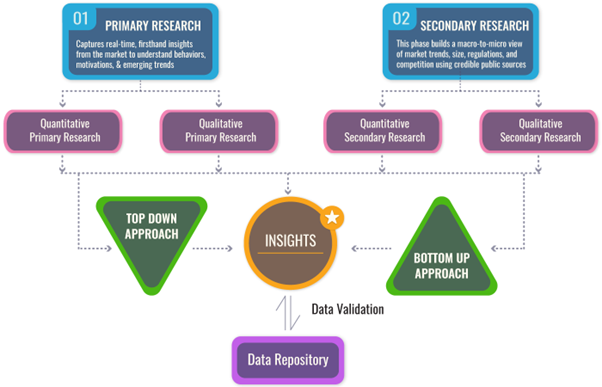
DUAL MODELING: TOP-DOWN + BOTTOM-UP
To ensure robust market estimation, we apply two complementary sizing approaches:
Top-Down Modeling:- Start with broader industry value (e.g., global or regional TAM)
- Apply filters by segment, geography, end-user, or use case
- Adjust with primary insights and validation benchmarks
- Ideal for investor-grade market scans and opportunity mapping
- Aggregate from the ground up using sales volumes, pricing, and unit economics
- Use internal modeling templates aligned with stakeholder data
- Incorporate distributor-level or region-specific inputs
- Most accurate for emerging segments and granular sub-markets
DATA VALIDATION: IN-HOUSE REPOSITORY
We close the loop with proprietary data intelligence built from ongoing projects, industry monitoring, and historical benchmarking. This repository includes:
- Multi-sector market and pricing models
- Key trendlines from past interviews and forecasts
- Benchmarked adoption rates, churn patterns, and ROI indicators
- Industry-specific deviation flags and cross-check logic
- Catches inconsistencies early
- Aligns projections across studies
- Enables consistent, high-trust deliverables