

Global Legumes Market Size and Forecast (2025–2033), Global and Regional Growth, Trend, Share and Industry Analysis Report Coverage: By Type (Beans, Peas, Chickpeas, Lentils, Others), By Nature (Conventional, Organic), By Processing Type (Whole/Unprocessed, Frozen, Canned), By Application (Food & Beverages, Dietary Supplements, Personal Care & Cosmetics, Animal Feed, Others), and Geography.
2026-01-02
Consumer Products
Jaya Bundele (Research Analyst)
Description
Global Legumes Market Overview
The global legumes market is witnessing steady growth as consumers increasingly shift toward high-protein, plant-based, and nutritionally dense food sources. Valued at USD 1.9 billion in 2025, the market is projected to reach USD 2.7 billion by 2033, reflecting a CAGR of 4.2% during the forecast period. Legumes, including beans, peas, lentils, chickpeas, and others, are essential dietary staples in many regions due to their rich protein content, high fiber levels, and low-fat nutritional profile. Their role in supporting digestive health, reducing cardiovascular risk, and enriching plant-based diets has significantly strengthened demand across food and beverage, dietary supplement, personal care, and animal feed applications.
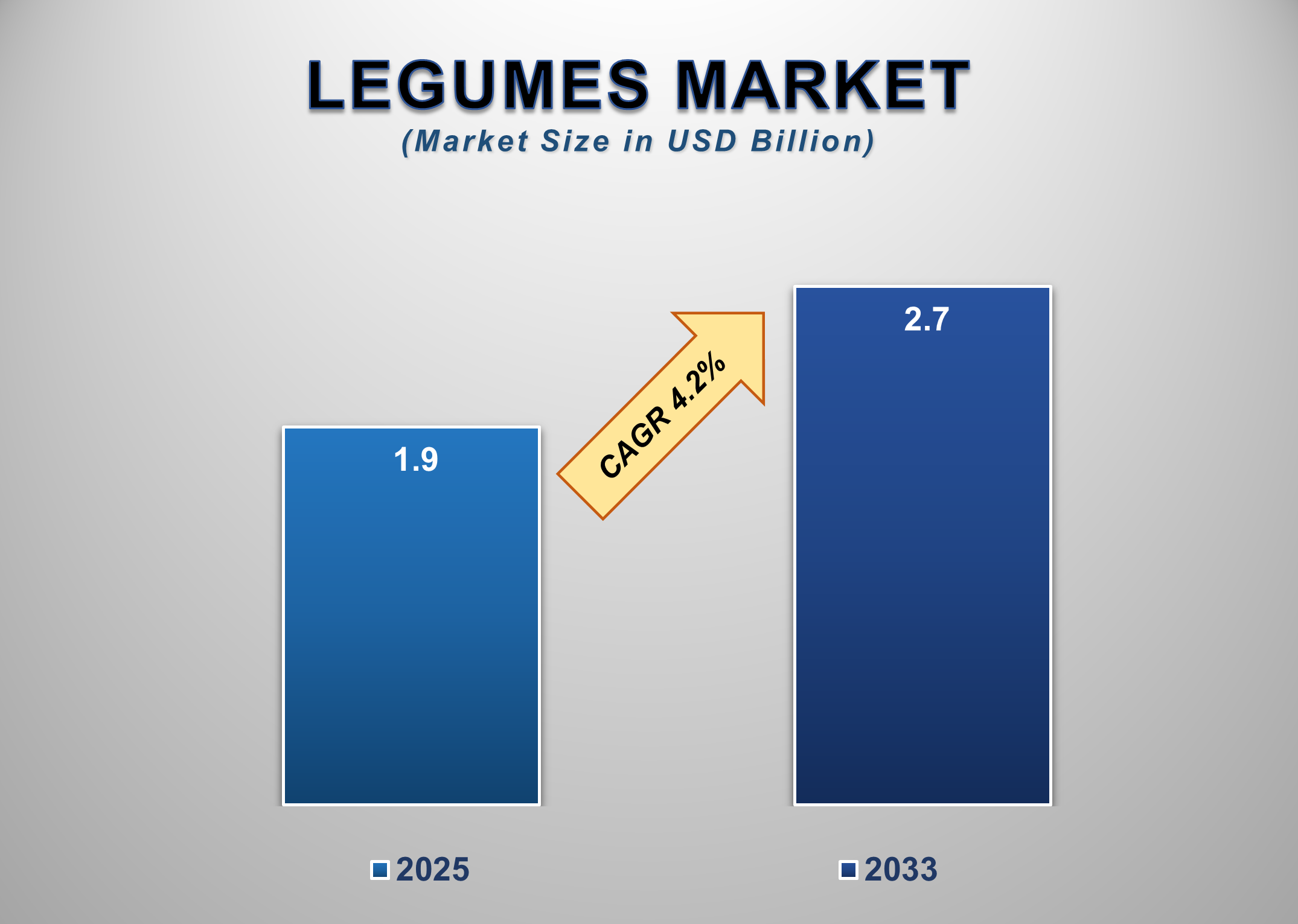
The market’s expansion is
strongly influenced by rising global interest in sustainable agriculture.
Legumes enrich soil through nitrogen fixation, reducing the need for chemical
fertilizers and promoting environmentally friendly farming practices. Consequently,
they are increasingly recognized as vital components of regenerative
agriculture programs. Furthermore, the growing popularity of vegetarian, vegan,
and flexitarian lifestyles, particularly in North America and Europe, has
amplified demand for legumes as key ingredients in meat alternatives,
functional foods, and high-protein snacks. The introduction of ready-to-eat
canned, frozen, and precooked legume products continues to support consumption
in both household and out-of-home dining settings.
Global Legumes Market
Drivers and Opportunities
Rising Demand for Plant-Based Proteins Is Driving the Legumes
Market Growth
The rapid global shift toward plant-based diets is one of the most
influential factors accelerating the growth of the legumes market. As consumers
become more aware of the health and sustainability implications of meat
consumption, demand for plant-derived proteins has surged dramatically.
Legumes, especially beans, lentils, and chickpeas, are widely recognized as
complete, nutrient-rich protein sources that support muscle health, weight
management, digestive wellness, and long-term disease prevention. Health
organizations worldwide continue to highlight legumes as vital inclusions in
balanced diets due to their high amino acid content, dietary fiber, essential
minerals, and low glycemic index. The expanding availability of plant-based
meat alternatives has significantly contributed to legume consumption, as many
of these products rely on pea, mung bean, lentil, or chickpea proteins for
texture and nutritional density. Innovations in pulse-based flours are also
increasing their application in baked goods, snacks, cereals, and dairy
alternatives. Additionally, growing interest in clean-label, organic,
gluten-free, and allergen-free food categories has further accelerated the
uptake of legumes across global markets. This trend is expected to intensify as
food manufacturers and consumers continue prioritizing nutrient-rich,
sustainable, and health-forward ingredient options.
Growing Usage of Legumes in Processed Foods, Snacks, and
Functional Food Applications
The incorporation of legumes into processed foods and functional
food products has become a major growth catalyst in recent years. With
consumers seeking healthier alternatives to traditional carbohydrate-heavy
snacks, food manufacturers are increasingly introducing legume-based chips,
crackers, puffs, extruded snacks, and baked products. These offerings appeal to
consumers seeking high-protein, high-fiber options that support weight loss,
digestive health, and stable blood sugar levels. Additionally, legumes play an
important role in the rising functional food category, where their natural
antioxidants, micronutrients, and bioactive compounds enhance immune function
and reduce chronic disease risks. Pulse flours are witnessing widespread
adoption due to their versatility, nutrient density, and ability to replace
wheat flour in gluten-free applications. They are increasingly used in pasta,
bakery mixes, ready-to-eat meals, beverages, and infant nutrition products. The
addition of legume extracts and isolates in sports nutrition and dietary
supplements has further expanded their commercial utility. Moreover, consumer
demand for convenience foods has boosted the popularity of canned and frozen
legumes, which offer long shelf life, minimal preparation time, and high
nutritional retention. These developments collectively underscore the
significant opportunities emerging within the processed and functional food
industries.
Expanding Legume Cultivation and Sustainable Farming
Practices Are Creating New Market Opportunities Worldwide
The promotion of sustainable agriculture practices is opening
substantial growth opportunities for the global legumes market. Legumes
naturally improve soil fertility through nitrogen fixation, making them a
preferred crop among farmers adopting low-input and eco-friendly cultivation
techniques. As governments and agricultural bodies introduce policies promoting
crop rotation, soil health improvement, and chemical fertilizer reduction,
legumes are increasingly viewed as essential components in climate-smart
farming systems. These trends are particularly strong in Asia, Africa, and
Latin America, where food security and sustainable land management remain
national priorities. Several countries are also supporting legume production
through subsidies, farmer training programs, and enhanced seed quality
initiatives. The rising adoption of organic farming has contributed to greater
demand for organic legumes, especially in Europe and North America. The growth
of export markets for chickpeas, lentils, beans, and peas, particularly from
Canada, India, and Australia, offers additional development opportunities for
growers. Furthermore, increasing investments in advanced processing
technologies, such as dry fractionation and protein extraction, are enabling
the creation of high-value legume-based ingredients for the food, beverage,
nutraceutical, and cosmetic industries. Collectively, these factors position
legumes as a cornerstone for future agricultural sustainability and food system
resilience.
Global Legumes Market
Scope
|
Report Attributes |
Description |
|
Market Size in 2025 |
USD 1.9 Billion |
|
Market Forecast in 2033 |
USD 2.7 Billion |
|
CAGR % 2025-2033 |
4.2% |
|
Base Year |
2024 |
|
Historic Data |
2020-2024 |
|
Forecast Period |
2025-2033 |
|
Report USP |
Production, Consumption,
Company Share, Company Heatmap, Company Production Capacity, Growth Factors
and more |
|
Segments Covered |
●
By Type, By
Nature, By Processing Type, By Application |
|
Regional Scope |
●
North America, ●
Europe, ●
APAC, ●
Latin America ●
Middle East and
Africa |
|
Country Scope |
1)
U.S. 2)
Canada 3)
Germany 4)
UK 5)
France 6)
Spain 7)
Italy 8)
Switzerland 9)
China 10)
Japan 11)
India 12)
Australia 13)
South Korea 14)
Brazil 15)
Mexico 16)
Argentina 17)
South Africa 18)
Saudi Arabia 19)
UAE |
Legumes Market Report
Segmentation Analysis
The Global Legumes Market
Industry Analysis is Segmented by Type, Nature, Processing Type, and
Application, and by Region.
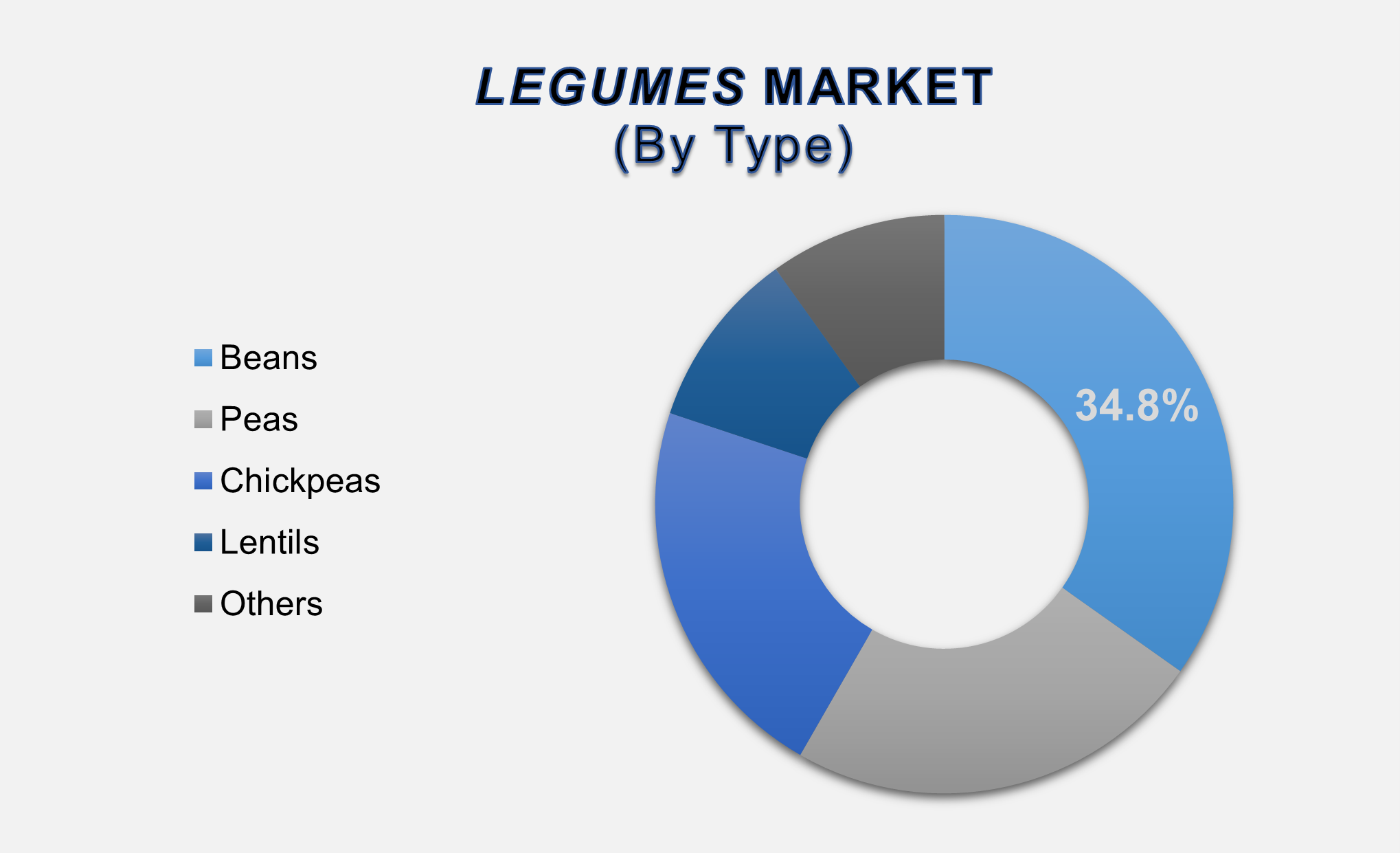
Beans Segment Accounted
for the Largest Market Share in the Global Legumes Market
Beans
accounted for the largest segment share, about
30.8%, driven by exceptional versatility, affordability, and widespread
consumption across global cuisines. Varieties such as kidney beans, black
beans, mung beans, and pinto beans are extensively used in soups, stews,
salads, snacks, ready meals, and traditional dishes across Asia, Latin America,
Africa, and North America. Increased adoption of canned and frozen bean
products has boosted demand in the convenience food segment, as consumers
increasingly prioritize quick and healthy meal options. Beans also serve as
vital ingredients in plant-based meat analogues due to their superior protein
quality and texturizing properties. Robust supply chains, high shelf stability,
and diverse processing applications such as pulse flours and extruded snacks
further support their dominance. The segment is expected to maintain its
leadership as global interest in vegetarian and protein-rich dietary patterns
continues to increase.
Conventional Legumes
Segment Held the Dominant Share in the Global Legumes Market
Conventional legumes dominated the market owing to their cost-effective production, established cultivation practices, and wide availability across retail and wholesale channels. Farmers across Asia Pacific, Africa, and Latin America predominantly rely on conventional farming techniques due to economic feasibility and access to established seed varieties. This has resulted in strong supply volumes for regional and global distribution. Conventional legumes appeal to consumers looking for affordable sources of protein and dietary fiber, making them popular for household cooking, institutional catering, and processed food applications. Although the organic segment is growing rapidly due to rising health consciousness and demand for chemical-free foods, the price sensitivity of consumers in emerging markets continues to support conventional products. With broad usage across packaged foods, canned legumes, and restaurant dishes, the conventional segment is expected to maintain its leading share throughout the forecast period.
Whole/Unprocessed Legumes
Accounted for the Largest Share in the Global Legumes Market
Whole/unprocessed
legumes hold the largest share, driven by strong cultural preference in Asia
Pacific, the Middle East, and Africa for traditional cooking methods that
utilize dried pulses, beans, and lentils. Consumers prefer whole legumes
because they retain their natural nutrient composition, offering high fiber,
protein, vitamins, and minerals without additives. Additionally, whole legumes
offer flexibility for preparing soups, curries, salads, hummus, dals, and
stews. Their affordability, long shelf life, and availability through both
online and offline retail channels continue to reinforce segment leadership.
While demand for processed forms such as canned and frozen legumes is rising in
North America and Europe due to convenience, whole/unprocessed variants remain
globally dominant. The trend toward natural, minimally processed foods further
strengthens the position of this segment in both emerging and developed markets.
The following segments are
part of an in-depth analysis of the global Legumes market:
|
Market Segments |
|
|
By Type |
●
Beans o
Kidney Beans o
Black Beans o
Mung Beans o
Others ●
Peas o
Fresh o
Frozen o
Canned ●
Chickpeas ●
Lentils ●
Others |
|
By Nature |
●
Conventional ●
Organic |
|
By Processing
Type |
●
Whole/Unprocessed ●
Frozen ●
Canned |
|
By Application |
●
Food & Beverages ●
Dietary Supplements ●
Personal Care &
Cosmetics ●
Animal Feed ●
Others |
Global Legumes Market
Share Analysis by Region
Asia Pacific is
anticipated to hold the biggest portion of the Legumes Market globally
throughout the forecast period.
Asia Pacific dominated the market
with a 49.6% share, primarily driven by the heavy incorporation of legumes in
daily diets across India, China, Bangladesh, Indonesia, and Southeast Asian
countries. The region’s robust agricultural production systems, large
population base, and cultural importance of legumes as a staple protein source
support sustained demand. Legumes such as lentils, chickpeas, kidney beans, and
mung beans are integral to regional cuisines, while increasing modernization of
retail channels further boosts market accessibility. Government programs
promoting pulse cultivation for food security also enhance market stability.
North America is expected to
witness the fastest CAGR during the forecast period, fueled by the rising
popularity of plant-based diets and consumers’ growing preference for
high-protein, gluten-free, and functional foods. The region also leads in
innovations involving pulse flours, protein concentrates, and legume-based
snacks, with companies actively expanding their portfolio of clean-label,
organic, and non-GMO legume products. Europe shows strong demand due to
sustainability initiatives, increased adoption of vegan and vegetarian
lifestyles, and growing reliance on legumes in meat alternatives. Meanwhile,
Latin America and the Middle East & Africa present emerging opportunities
driven by the increasing availability of packaged legumes and growing awareness
of their health benefits.
Legumes Market
Competition Landscape Analysis
The global legumes market is
moderately fragmented, with leading players expanding their product offerings,
improving supply chain capabilities, and investing in sustainable sourcing
practices. Major companies include AGT Food and Ingredients, Archer Daniels
Midland, Cargill, Bunge, Louis Dreyfus Company, Ingredion, General Mills,
Conagra Brands, Kraft Heinz, Nestlé, Unilever, and others.
Global Legumes Market
Recent Developments News:
- In May 2025,
Heyday Canning Co., a U.S. food startup, launched “Perfectly Seasoned
Beans,” a line of beans canned in vegetable broth. Varieties include pinto
beans, chickpeas, and cannellini beans, offering convenient,
flavor-forward plant-based options.
- In July 2024,
Masala Mama, a U.S. cooking sauce brand, introduced a range of
ready-to-eat legumes in four flavors, including Rah Rah red beans and Cha
Cha chickpeas. Containing 9–15 grams of fiber per serving, the products
are available at Earth Fare and The Fresh Market.
- In September 2023,
Symrise AG launched aquafaba and chickpea-based ingredients for enhancing
juiciness and texture in healthy snacks, dips, and falafels, supporting
the growing demand for plant-based and clean-label food formulations.
The Global Legumes Market Is
Dominated by a Few Large Companies, such as
●
AGT Food and
Ingredients
●
Archer Daniels Midland
●
Cargill
●
Bunge
●
Louis Dreyfus Company
●
Ingredion
●
General Mills
●
Conagra Brands
●
The Kraft Heinz
Company
●
Nestlé
●
Unilever
●
Pulmuone
●
Hain Celestial Group
●
Eden Foods
●
Bush Brothers &
Company
●
Faribault Foods
●
Sokol and Company
●
Dakota Dry Bean
●
Vermont Bean Crafters
●
Harbor Harvest
● Others
Frequently Asked Questions
Jaya Bundele (Research Analyst)
Jaya Bundele is a skilled Research Analyst with 4+ years of experience in market intelligence, consumer insights, competitive analysis, and industry forecasting across the consumer goods, agriculture, and food & beverage sectors. She specializes in market sizing, trend analysis, growth opportunity mapping, and strategic secondary research for global and regional markets.
Her expertise lies in transforming complex industry data into actionable business strategies that help organizations identify emerging trends, understand customer behavior, and gain a competitive edge. With a strong focus on data-driven insights, business intelligence, and future market trends, Jaya delivers high-quality research solutions aligned with evolving industry demands and market dynamics.
1. Global Legumes Market
Introduction and Market Overview
1.1.
Objectives
of the Study
1.2.
Global
Legumes Market Scope and Market Estimation
1.2.1.Global Legumes Overall
Market Size (US$ Bn), Market CAGR (%), Market forecast (2025 - 2033)
1.2.2.Global Legumes Market
Revenue Share (%) and Growth Rate (Y-o-Y) from 2020 - 2033
1.3.
Market
Segmentation
1.3.1.Type of Global Legumes
Market
1.3.2.Nature of Global Legumes
Market
1.3.3.Processing Type of Global Legumes
Market
1.3.4.Application of Global Legumes
Market
1.3.5.Region of Global Legumes
Market
2. Executive
Summary
2.1.
Demand
Side Trends
2.2.
Key
Market Trends
2.3.
Market
Demand (US$ Bn) Analysis 2020 – 2024 and Forecast, 2025 – 2033
2.4.
Demand
and Opportunity Assessment
2.5.
Key
Developments
2.6.
Overview
of Tariff, Regulatory Landscape and Standards
2.7.
Market
Entry Strategies
2.8.
Market
Dynamics
2.8.1.Drivers
2.8.2.Limitations
2.8.3.Opportunities
2.8.4.Impact Analysis of Drivers
and Restraints
2.9.
Porter’s
Five Forces Analysis
2.10.
PEST
Analysis
3. Global
Legumes Market Estimates
& Historical Trend Analysis (2020 - 2024)
4. Global
Legumes Market Estimates
& Forecast Trend Analysis, by Type
4.1.
Global
Legumes Market Revenue (US$ Bn) Estimates and Forecasts, by Type, 2020 - 2033
4.1.1.Beans
4.1.1.1.
Kidney
Beans
4.1.1.2.
Black
Beans
4.1.1.3.
Mung
Beans
4.1.1.4.
Others
4.1.2.Peas
4.1.2.1.
Fresh
4.1.2.2.
Frozen
4.1.2.3.
Canned
4.1.3.Chickpeas
4.1.4.Lentils
4.1.5.Others
5. Global
Legumes Market Estimates
& Forecast Trend Analysis, by Nature
5.1.
Global
Legumes Market Revenue (US$ Bn) Estimates and Forecasts, by Nature, 2020 - 2033
5.1.1.Conventional
5.1.2.Organic
6. Global
Legumes Market Estimates
& Forecast Trend Analysis, by Processing Type
6.1.
Global
Legumes Market Revenue (US$ Bn) Estimates and Forecasts, by Processing Type,
2020 - 2033
6.1.1.Whole/Unprocessed
6.1.2.Frozen
6.1.3.Canned
7. Global
Legumes Market Estimates
& Forecast Trend Analysis, by Application
7.1.
Global
Legumes Market Revenue (US$ Bn) Estimates and Forecasts, by Application, 2020 -
2033
7.1.1.Food & Beverages
7.1.2.Dietary Supplements
7.1.3.Personal Care &
Cosmetics
7.1.4.Animal Feed
7.1.5.Others
8. Global
Legumes Market Estimates
& Forecast Trend Analysis, by Region
8.1.
Global
Legumes Market Revenue (US$ Bn) Estimates and Forecasts, by Region, 2020 - 2033
8.1.1.North America
8.1.2.Europe
8.1.3.Asia Pacific
8.1.4.Middle East & Africa
8.1.5.Latin America
9. North America Legumes
Market: Estimates & Forecast Trend
Analysis
9.1.
North
America Legumes Market Assessments & Key Findings
9.1.1.North America Legumes
Market Introduction
9.1.2.North America Legumes
Market Size Estimates and Forecast (US$ Billion) (2020 - 2033)
9.1.2.1. By Type
9.1.2.2. By Nature
9.1.2.3. By Processing
Type
9.1.2.4. By Application
9.1.2.5.
By
Country
9.1.2.5.1. The U.S.
9.1.2.5.2. Canada
10. Europe Legumes
Market: Estimates & Forecast Trend
Analysis
10.1.
Europe
Legumes Market Assessments & Key Findings
10.1.1.
Europe
Legumes Market Introduction
10.1.2.
Europe
Legumes Market Size Estimates and Forecast (US$ Billion) (2020 - 2033)
10.1.2.1. By Type
10.1.2.2. By Nature
10.1.2.3. By Processing
Type
10.1.2.4. By Application
10.1.2.5.
By
Country
10.1.2.5.1.
Germany
10.1.2.5.2.
Italy
10.1.2.5.3.
U.K.
10.1.2.5.4.
France
10.1.2.5.5.
Spain
10.1.2.5.6.
Switzerland
10.1.2.5.7. Rest
of Europe
11. Asia Pacific Legumes
Market: Estimates & Forecast Trend
Analysis
11.1.
Asia
Pacific Market Assessments & Key Findings
11.1.1.
Asia
Pacific Legumes Market Introduction
11.1.2.
Asia
Pacific Legumes Market Size Estimates and Forecast (US$ Billion) (2020 - 2033)
11.1.2.1. By Type
11.1.2.2. By Nature
11.1.2.3. By Processing
Type
11.1.2.4. By Application
11.1.2.5.
By
Country
11.1.2.5.1. China
11.1.2.5.2. Japan
11.1.2.5.3. India
11.1.2.5.4. Australia
11.1.2.5.5. South Korea
11.1.2.5.6. Rest of Asia Pacific
12. Middle East & Africa Legumes
Market: Estimates & Forecast Trend
Analysis
12.1.
Middle
East & Africa Market Assessments & Key Findings
12.1.1.
Middle East & Africa Legumes Market Introduction
12.1.2.
Middle East & Africa Legumes Market Size Estimates and
Forecast (US$ Billion) (2020 - 2033)
12.1.2.1. By Type
12.1.2.2. By Nature
12.1.2.3. By Processing
Type
12.1.2.4. By Application
12.1.2.5.
By
Country
12.1.2.5.1. UAE
12.1.2.5.2. Saudi
Arabia
12.1.2.5.3. South
Africa
12.1.2.5.4. Rest
of MEA
13. Latin America
Legumes Market: Estimates &
Forecast Trend Analysis
13.1.
Latin
America Market Assessments & Key Findings
13.1.1.
Latin
America Legumes Market Introduction
13.1.2.
Latin
America Legumes Market Size Estimates and Forecast (US$ Billion) (2020 - 2033)
13.1.2.1. By Type
13.1.2.2. By Nature
13.1.2.3. By Processing
Type
13.1.2.4. By Application
13.1.2.5.
By
Country
13.1.2.5.1. Brazil
13.1.2.5.2. Argentina
13.1.2.5.3. Mexico
13.1.2.5.4. Rest
of LATAM
14. Country Wise Market:
Introduction
15.
Competition
Landscape
15.1.
Global
Legumes Market Product Mapping
15.2.
Global
Legumes Market Concentration Analysis, by Leading Players / Innovators /
Emerging Players / New Entrants
15.3.
Global
Legumes Market Tier Structure Analysis
15.4.
Global
Legumes Market Concentration & Company Market Shares (%) Analysis, 2024
16.
Company
Profiles
16.1.
AGT Food and Ingredients
16.1.1.
Company
Overview & Key Stats
16.1.2.
Financial
Performance & KPIs
16.1.3.
Product
Portfolio
16.1.4.
SWOT
Analysis
16.1.5.
Business
Strategy & Recent Developments
* Similar details would be provided for all the players
mentioned below
16.2. Archer
Daniels Midland
16.3. Cargill
16.4. Bunge
16.5. Louis
Dreyfus Company
16.6. Ingredion
16.7. General
Mills
16.8. Conagra
Brands
16.9. The
Kraft Heinz Company
16.10. Nestlé
16.11. Unilever
16.12. Pulmuone
16.13. Hain
Celestial Group
16.14. Eden
Foods
16.15. Bush
Brothers & Company
16.16. Faribault
Foods
16.17. Sokol
and Company
16.18. Dakota
Dry Bean
16.19. Vermont
Bean Crafters
16.20. Harbor
Harvest
16.21. Others
17. Research
Methodology
17.1.
External
Transportations / Databases
17.2.
Internal
Proprietary Database
17.3.
Primary
Research
17.4.
Secondary
Research
17.5.
Assumptions
17.6.
Limitations
17.7.
Report
FAQs
18. Research
Findings & Conclusion
Our Research Methodology
"Insight without rigor is just noise."
We follow a comprehensive, multi-phase research framework designed to deliver accurate, strategic, and decision-ready intelligence. Our process integrates primary and secondary research , both quantitative and qualitative , along with dual modeling techniques ( top-down and bottom-up) and a final layer of validation through our proprietary in-house repository.
PRIMARY RESEARCH
Primary research captures real-time, firsthand insights from the market to understand behaviors, motivations, and emerging trends.
1. Quantitative Primary Research
Objective: Generate statistically significant data directly from market participants.
Approaches:- Structured surveys with customers, distributors, and field agents
- Mobile-based data collection for point-of-sale audits and usage behavior
- Phone-based interviews (CATI) for market sizing and product feedback
- Online polling around industry events and digital campaigns
- Purchase frequency by customer type
- Channel performance across geographies
- Feature demand by application or demographic
2. Qualitative Primary Research
Objective: Explore decision-making drivers, pain points, and market readiness.
Approaches:- In-depth interviews (IDIs) with executives, product managers, and key decision-makers
- Focus groups among end users and early adopters
- Site visits and observational research for consumer products
- Informal field-level discussions for regional and cultural nuances
SECONDARY RESEARCH
This phase helps establish a macro-to-micro understanding of market trends, size, regulation, and competitive dynamics, sourced from credible and public domain information.
1. Quantitative Secondary Research
Objective: Model market value and segment-level forecasts based on published data.
Sources include:- Financial reports and investor summaries
- Government trade data, customs records, and regulatory statistics
- Industry association publications and economic databases
- Channel performance and pricing data from marketplace listings
- Revenue splits, pricing trends, and CAGR estimates
- Supply-side capacity and volume tracking
- Investment analysis and funding benchmarks
2. Qualitative Secondary Research
Objective: Capture strategic direction, innovation signals, and behavioral trends.
Sources include:- Company announcements, roadmaps, and product pipelines
- Publicly available whitepapers, conference abstracts, and academic research
- Regulatory body publications and policy briefs
- Social and media sentiment scanning for early-stage shifts
- Strategic shifts in market positioning
- Unmet needs and white spaces
- Regulatory triggers and compliance impact
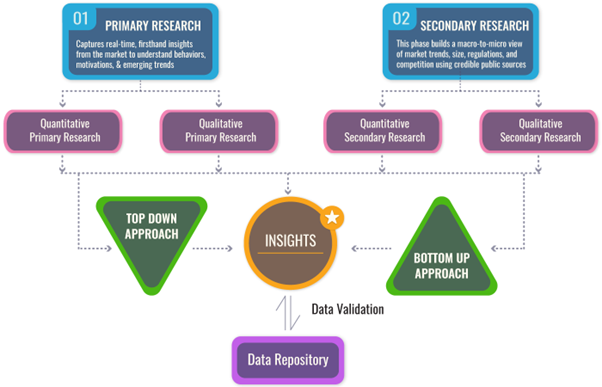
DUAL MODELING: TOP-DOWN + BOTTOM-UP
To ensure robust market estimation, we apply two complementary sizing approaches:
Top-Down Modeling:- Start with broader industry value (e.g., global or regional TAM)
- Apply filters by segment, geography, end-user, or use case
- Adjust with primary insights and validation benchmarks
- Ideal for investor-grade market scans and opportunity mapping
- Aggregate from the ground up using sales volumes, pricing, and unit economics
- Use internal modeling templates aligned with stakeholder data
- Incorporate distributor-level or region-specific inputs
- Most accurate for emerging segments and granular sub-markets
DATA VALIDATION: IN-HOUSE REPOSITORY
We close the loop with proprietary data intelligence built from ongoing projects, industry monitoring, and historical benchmarking. This repository includes:
- Multi-sector market and pricing models
- Key trendlines from past interviews and forecasts
- Benchmarked adoption rates, churn patterns, and ROI indicators
- Industry-specific deviation flags and cross-check logic
- Catches inconsistencies early
- Aligns projections across studies
- Enables consistent, high-trust deliverables