

Liposuction Devices Market Size and Forecast (2026–2034), Global and Regional Growth, Trend, Share and Industry Analysis Report Coverage: By Product Type (Standalone and Portable) By Technology (Tumescent Liposuction, Suction-Assisted Liposuction (SAL), Power-Assisted Liposuction (PAL), Ultrasound-Assisted Liposuction (UAL), Laser-Assisted Liposuction (LAL), Water-Assisted Liposuction (WAL), Radiofrequency-Assisted Liposuction (RFAL), and Others) By End User (Hospitals, Cosmetic Surgery Clinics, Ambulatory Surgical Centers (ASCs), Specialty Aesthetic Clinics, and Others) and Geography
2026-08-11
Healthcare
Swetal (Research Analyst)
Description
Liposuction Devices Market
Overview
The Global Liposuction
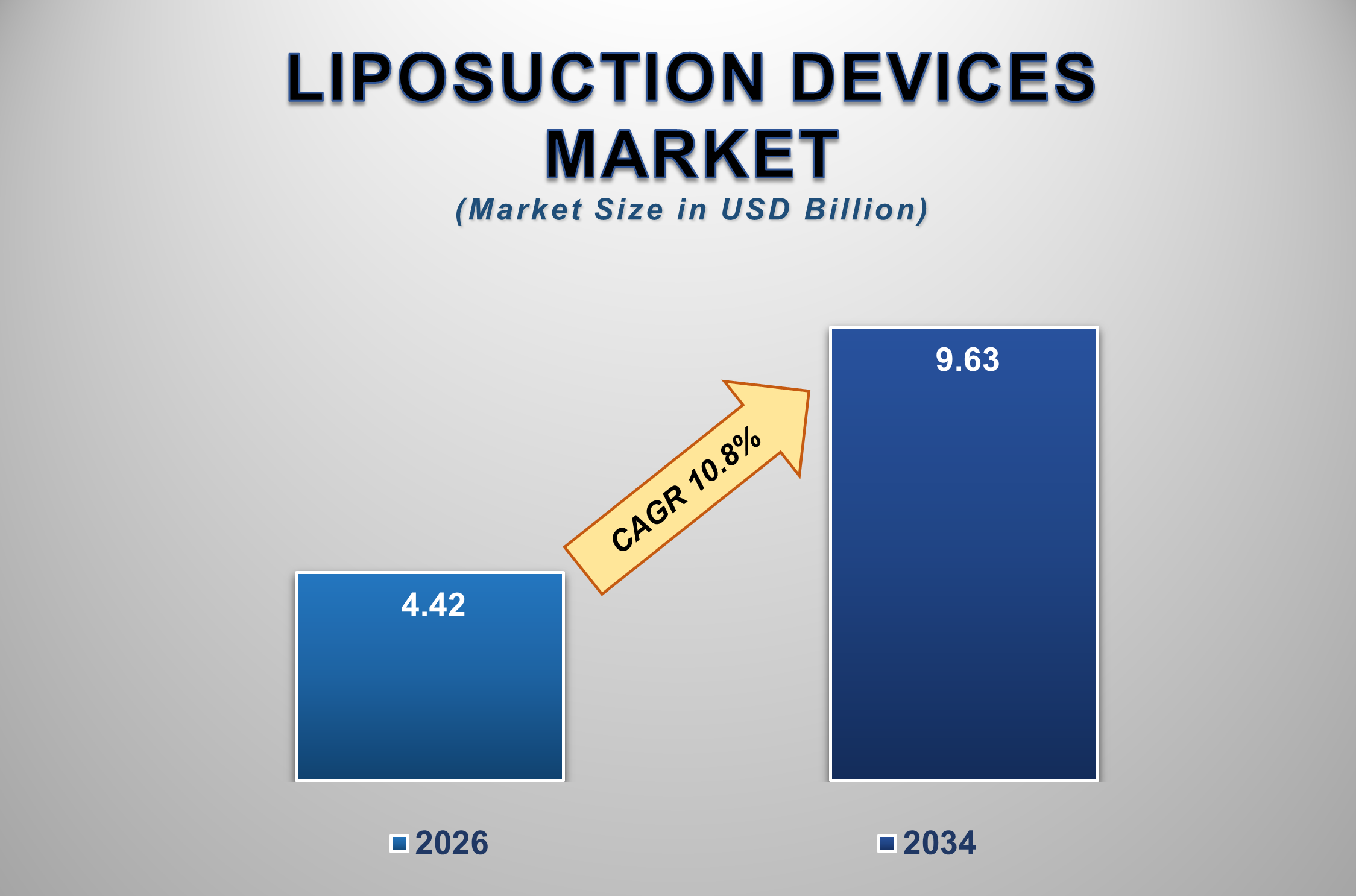
Devices Market Size was valued at USD 4.42 Billion in 2026 and is projected to
reach USD 9.63 Billion by 2034, expanding at a CAGR of 10.8% during the
forecast period. The liposuction devices industry comprises tools and
technologies utilized in the extraction of fat from specific areas of the body
to achieve improved structure and, in rare circumstances, for reconstructive
purposes. It entails both standalone and portable versions of liposuction
apparatus that perform types of liposuction: suction-assisted, power-assisted,
ultrasound-assisted, laser-assisted, water-assisted, and
radiofrequency-assisted. The factors driving market change include the high
demand for minimally invasive surgeries, increasing number of obesity cases,
high level of awareness regarding body contouring, and multiple technological
advancements that are decreasing the period of surgeries and recovery. The
increasing network of cosmetic surgery institutes, growth of disposable income
in developing countries, and the emergence of advanced body sculpting
technologies among plastic surgeons are contributing to further growth of the
industry.
Liposuction Devices Market Drivers
and Opportunities
Growing Demand for
Minimally Invasive Body Contouring Procedures Driving Market Growth
The rise in
preference for less scar-forming body-molding procedures is the primary reason
behind the growth of the liposuction gadgets market. A greater number of
consumers want body therapies that provide good fat burning with fewer scars
than other traditional methods; patients also expect shorter recovery times and
not so many side effects. Thus, the new technological developments in the
liposuction area are becoming more popular, including laser and other advanced
methods, which allow achieving better results in fat-burning procedures with
minimal damage to the human organism. Besides, more people have become
interested in cosmetic procedures because of changes in social attitudes
through the media, their incomes are rising, and the number of specialized
aesthetic clinics is growing. Altogether, modern technology developments have
turned out to be useful for the whole industry.
Continuous
Technological Advancements in Liposuction Systems Fueling Market Expansion
Ongoing
technological innovations related to liposuction systems lead to improvements
in the precision of the procedures, as well as patient safety and results,
contributing to market growth for liposuction devices. Manufacturers develop
highly advanced energy-assisted systems such as power-assisted,
ultrasound-assisted, water-assisted, laser-assisted, and
radiofrequency-assisted liposuction systems, as well as ergonomic handpieces,
thus producing highly advanced aspiration devices and body contouring systems.
All innovations make it possible to extract fat more efficiently, give surgeons
maximum control over the devices, lower the trauma of tissues and blood loss,
and decrease the length of surgeries, thus facilitating more patient
satisfaction. In line with these trends, in May 2026, Apyx Medical Corporation
received extended FDA 510(k) clearance for its AYON Body Contouring System to
include the second generation of power-assisted systems, thus making it
possible for this system to work with a reciprocating cannula, which improves
fat extraction and maintains minimal effort on the side of surgeons and the
time spent in the Operating Room. Such approval of the product and its current
changes demonstrates how innovations in liposuction systems help to achieve
high clinical results and promote industry development.
Expanding Demand
in Emerging Aesthetic Markets Creates Significant Growth Opportunities
Several emerging
nations from Asia-Pacific, Latin America, the Middle East, and some countries
in Eastern Europe play a vital role in offering lucrative business growth
opportunities to the liposuction devices market. The rise in disposable incomes
among the people, rapid growth in urbanization, increasing beauty awareness,
and the growing acceptance of cosmetic procedures among the masses are some
factors that boost the demand for body contouring treatments. Besides, the
emergence of private aesthetic clinics, easy access to board-certified plastic
surgeons, and availability of advanced medical technologies are influencing the
adoption of modern liposuction devices in these regions. The consistent rise in
the medical tourism industry in nations such as Thailand, South Korea, Turkey,
UAE, Brazil, and Mexico is also contributing to the increase in the number of
procedures being performed, as international customers are attracted to
high-quality aesthetic procedures at lower prices. Besides, the rising investments
from manufacturers in the establishment of distributor networks, training of
doctors, and launching of new products have positively impacted the market. The
increasing number of young and middle-aged people undergoing minimally invasive
procedures provides further opportunities for growth for manufacturers in these
developing markets.
Liposuction Devices Market Scope
|
Report Attributes |
Description |
|
Market Size in 2026 |
USD 4.42 Billion |
|
Market Forecast in 2034 |
USD 9.63 Billion |
|
CAGR % 2026-2034 |
10.8% |
|
Base Year |
2025 |
|
Historic Data |
2021-2025 |
|
Forecast Period |
2026-2034 |
|
Report USP |
Pricing and Cost Structure Analysis, Product
Innovation Benchmarking, Whitespace Assessment, Company Share, Company
Heatmap, Growth Factors, and more |
|
Segments Covered |
●
By
Product Type ●
By
Technology ●
By End
User |
|
Regional Scope |
●
North
America ●
Europe ●
APAC ●
Latin
America ●
Middle
East and Africa |
|
Country Scope |
●
U.S. ●
Canada ●
U.K. ●
Germany ●
France ●
Italy ●
Spain ●
Russia ●
China ●
India ●
Japan ●
South
Korea ●
Australia
●
Mexico ●
Brazil ●
Saudi
Arabia ●
UAE ●
South
Africa
|
Liposuction Devices Market Report
Segmentation Analysis
The global
liposuction devices market industry analysis is segmented by product type, by
technology, by end user, and by region.
Portable Segment
Is Expected to Dominate the Liposuction Devices Market During the Forecast
Period
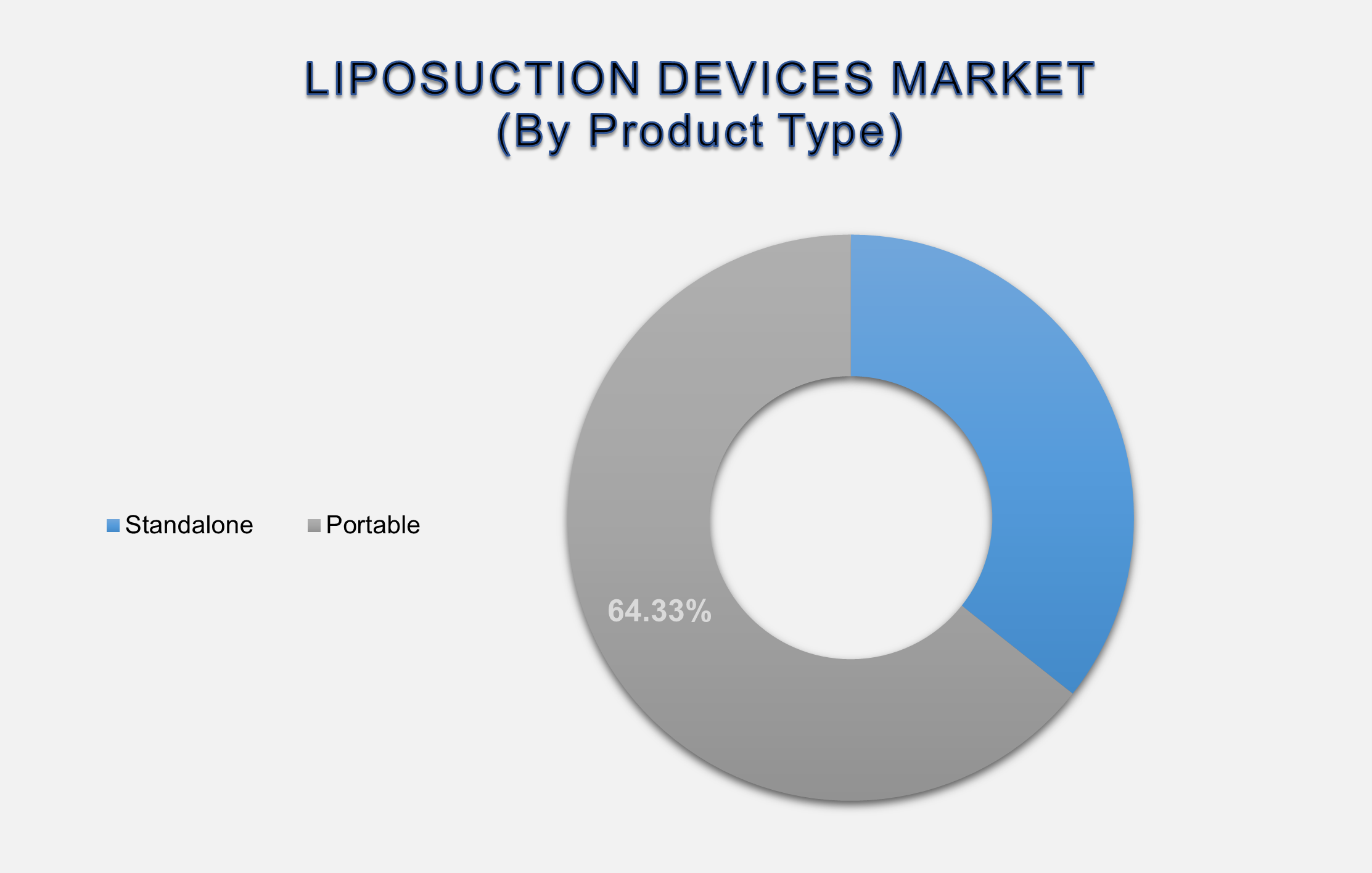
The portable
segment of liposuction devices is predicted to hold the largest share in the
market during the forecast period, as a result of the rising demand for
user-friendly devices that can be used anywhere in cosmetic surgery clinics as
well as in outpatient surgical centers. The reason for the suitability of
portable systems for those practices lies in the ability of these devices to
provide more workflow efficiency, require less installation area, and give a
greater degree of flexibility. The manufacturers have started embedding
advanced technologies such as power-assisted, ultrasound-assisted,
laser-assisted, and radio-frequency-assisted liposuction into the systems,
further contributing to the enhancement of accuracy during procedures and to
the minimization of any potential damage to the tissue. The widespread use of
portable devices that allow for conducting minimally invasive procedures and
that offer benefits of reduced costs and quick recovery times will lead to the
rise in adoption of those systems in the near future.
Suction-Assisted
Liposuction (SAL) Segment Is Expected to Lead the Liposuction Devices Market by
Technology
The
suction-assisted liposuction (SAL) segment will dominate the liposuction
devices market by technology. This is attributed to the broad clinical
acceptance of SAL, its safety record, and the cost-effectiveness of the
procedure. Belonging to the oldest and most commonly used liposuction
techniques, SAL can be used in various aesthetic procedures for the removal of
localized fat pockets from different parts of the body. Surgeons opt for SAL to
perform the liposuction procedure because of the simplicity of this technique,
its excellent clinical effectiveness, and its ability to combine it with
tumescent anesthesia and avoid postoperative complications like blood loss.
Furthermore, the SAL procedure is relatively inexpensive compared to modern
energy-assisted techniques of liposuction, which allows hospitals, surgical
centers, and clinics to use it in clinical practice. Technological advances in
aspiration techniques, cannula designs, and ergonomic syringes have played a
role in the increasing effectiveness of liposuction procedures, thus
influencing the growth of the SAL segment leader market.
Cosmetic Surgery
Clinics Segment Is Expected to Lead the Liposuction Devices Market by End User
The cosmetic
surgery clinics segment is expected to dominate the liposuction devices market
based on end user during the forecast period due to the increasing demand for
minimally invasive body contouring processes, an increase in customer spending
on beauty treatments, and the increasing number of specialized cosmetic clinics
globally. These clinics are the main places for liposuction procedures, as they
provide advanced technology, qualified specialists, and individual treatment
methods in an outpatient environment. Continuous investments in opening new
clinics contribute to market improvement. For example, in January 2026, PURE
111 Medical Aesthetics, led by Amy Katsikas, MSN, ACNS-BC, opened its second
clinic in Columbia, Illinois, which began to operate for its clients on
February 2, 2026. These expansions are evidence of the increasing demand for
beauty services and growing possibilities of specialized clinics to offer
advanced body contouring services. Thus, the development of the aesthetic
clinic network and implementation of new technologies in liposuction devices
will determine the leadership of the stated segment during the forecast period.
The following
segments are part of an in-depth analysis of the global liposuction devices
market:
|
Market Segments |
|
|
By Product Type |
●
Standalone ●
Portable |
|
By Technology |
●
Tumescent
Liposuction ●
Suction-Assisted
Liposuction (SAL) ●
Power-Assisted
Liposuction (PAL) ●
Ultrasound-Assisted
Liposuction (UAL) ●
Laser-Assisted
Liposuction (LAL) ●
Water-Assisted
Liposuction (WAL) ●
Radiofrequency-Assisted
Liposuction (RFAL) ●
Others |
|
By End User |
●
Hospitals ●
Cosmetic
Surgery Clinics ●
Ambulatory
Surgical Centers (ASCs) ●
Specialty
Aesthetic Clinics ●
Others |
Liposuction Devices Market Share
Analysis by Region
North America is
projected to hold the largest share of the global liposuction devices market
over the forecast period
North America is
expected to have the biggest share in the global market for liposuction
devices, mainly because of the high use of cosmetic treatments, sophisticated
healthcare systems, availability of leading manufacturers in the aesthetics
sector, and a lot of spending on elective treatments. The region, especially
the U.S., has the highest number of liposuction procedures performed, which
leads to the increased need for sophisticated devices. According to the
Cleveland Clinic, liposuction is one of the most commonly performed surgeries,
with more than 200,000 procedures performed each year in the U.S. In the whole
world, liposuction is responsible for around 15% to 20% of all plastic
surgeries, which shows that it is widely used as a body contouring procedure.
Moreover, the increase in the number of cosmetic surgery clinics, continuing
development of new technologies in the field of liposuction, favorable
regulations for such surgeries, and growing popularity of minimally invasive
cosmetic procedures should allow North America to remain a leader in the world
market for liposuction devices during the forecast period.
Liposuction
Devices Market Competition Landscape Analysis
The liposuction
devices market is fiercely contested by the presence of various global
manufacturers of medical devices, aesthetic technology firms, and specialized
surgical instrument providers that provide advances in body shape-changing
technologies. The market players are actively increasing their product range
through the introduction of innovative liposuction systems based on the usage
of technologies such as power-assisted, ultrasound-assisted, laser-assisted,
water-assisted, and radiofrequency-assisted liposuction, which makes the
procedures more accurate and safer for the patients and improves clinical
results. Companies invest a lot of funds into research and development for the
purpose of introducing innovative devices with better ergonomics and energy
sources incorporated. This competition grows with the brand-new products on the
market, getting approvals from regulatory bodies, innovations, agreements,
mergers and acquisitions, etc.
Global
Liposuction Devices Market Recent Developments News:
●
In May 2026 -
Apyx Medical Corporation the leader in surgical aesthetics products marketed
and sold as Renuvion and the AYON Body Contouring System (AYON), announced it
received expanded 510(k) clearance from the U.S. Food and Drug Administration
(the “FDA”) for the AYON Body Contouring System (“AYON”) to include power
liposuction, an advanced form of liposuction that uses a reciprocating cannula
to enhance efficiency of fat removal to reduce a surgeon’s effort and operating
room time.
●
In July 2026 -
Lawton Plastic Surgery announced the launch of its Comprehensive Mommy Makeover
Program, an integrated surgical experience designed to combine advanced breast
and body contouring procedures with evidence-based Enhanced Recovery After
Surgery (ERAS) protocols, personalized treatment planning, and comprehensive
perioperative care. A mommy makeover combines procedures such as tummy tuck,
breast augmentation, breast lift, breast reduction, liposuction, or breast
revision surgery into a single operative plan tailored to each patient's
anatomy, goals, and stage of life.
●
In January
2025 - MicroAire Surgical Instruments, the global leader in power-assisted
liposuction, is pleased to announce the acquisition of NEOSYAD, an innovative
medical device company that developed a breakthrough technology for adipose
tissue engineering. This strategic move reinforces MicroAire's commitment to
advancing medical innovation and strengthening its leadership in the adipose
tissue market.
The global
liposuction devices market is dominated by a few large companies, such as
●
Alma Lasers
●
Apyx Medical
●
Black & Black Surgical
●
CHEIRON
●
Cynosure
●
DEKA
●
Euromi
●
Human Med AG
●
InMode
●
MicroAire Surgical Instruments
●
Möller Medical
●
Nouvag
●
Solta Medical
●
Tulip Medical Products
●
Wells Johnson
● Other Prominent Players
Frequently Asked Questions
Swetal (Research Analyst)
Swetal is a Research Analyst with 4+ years of experience specializing in healthcare market research, medical devices, healthcare IT, and medical technology industry analysis. Her expertise includes competitive intelligence, secondary research, market trend forecasting, and healthcare business insights across global healthcare ecosystems.
She contributes to advanced market research reports by analyzing regulatory frameworks, emerging healthcare technologies, competitive landscapes, and innovation trends shaping the medical industry. With a strong focus on accurate market intelligence, strategic insights, and healthcare industry trends, Swetal supports businesses in making informed, data-backed decisions in a rapidly transforming healthcare environment.
1.
Global
Liposuction Devices Market Introduction and Market Overview
1.1. Objectives of the Study
1.2. Market Segmentation
1.2.1.Product Type of the Global Liposuction
Devices Market
1.2.2.Technology of the Global Liposuction
Devices Market
1.2.3.End User of the Global Liposuction
Devices Market
1.2.4.Region of the Global Liposuction
Devices Market
1.3. Competition Coverage List of
Market Participants
1.4. Market Definition: Liposuction
Devices Market
2.
Executive Summary
2.1. Global Liposuction Devices
Market Estimation & Forecast
2.1.1.Global Liposuction Devices
Market Size (US$ Million) Estimates & Historical Trend Analysis (2021 -
2025)
2.1.2.Global Liposuction Devices Overall
Market Size (US$ Million), Growth Rate (Y-o-Y), Market CAGR (%), Market
Forecast (2026 - 2034)
2.2. Snapshot of Global Liposuction
Devices Market
2.3. Global Liposuction Devices
Market Revenue Share (%) 2025
2.4. REGIONAL OUTLINE: Revenue CAGR,
by Region
2.5. Key Competitors & Key
Insights
3.
Market Overview (Qualitative
Analysis)
3.1. Demand Side Trends
3.2. Supply Side Trends / Manufacturing
Trends
3.3. Demand and Opportunity
Assessment, 2026 - 2034
3.4. Market Dynamics
3.4.1.Drivers
3.4.2.Limitations
3.4.3.Opportunities
3.4.4.Impact Analysis of Drivers and
Restraints
3.5. Key Developments
3.6. Regulatory Landscape
3.7. Pricing Analysis
3.8. Supply Chain Analysis
3.9. Porter’s Five Forces Analysis
3.9.1.Bargaining Power of Suppliers
3.9.2.Bargaining Power of Buyers
3.9.3.Threat of Substitutes
3.9.4.Threat of New Entrants
3.9.5.Competitive Rivalry
3.10. PEST Analysis
3.10.1. Political Factors
3.10.2. Economic Factors
3.10.3. Social Factors
3.10.4. Technology Factors
4.
Global Liposuction Devices
Market Estimates & Forecast Trend Analysis, by Product Type
4.1. Global Liposuction Devices
Market Assessments & Key Findings, by Product Type
4.2. Global Liposuction Devices
Market Revenue (US$ Million) Estimates and Forecasts, by Product Type, 2021 -
2034
4.2.1.Standalone
4.2.2.Portable
5.
Global Liposuction Devices
Market Estimates & Forecast Trend Analysis, by Technology
5.1. Global Liposuction Devices
Market Assessments & Key Findings, by Technology
5.2. Global Liposuction Devices
Market Revenue (US$ Million) Estimates and Forecasts, by Technology, 2021 -
2034
5.2.1.Tumescent Liposuction
5.2.2.Suction-Assisted Liposuction
(SAL)
5.2.3.Power-Assisted Liposuction (PAL)
5.2.4.Ultrasound-Assisted Liposuction
(UAL)
5.2.5.Laser-Assisted Liposuction (LAL)
5.2.6.Water-Assisted Liposuction (WAL)
5.2.7.Radiofrequency-Assisted
Liposuction (RFAL)
5.2.8.Others
6.
Global Liposuction Devices
Market Estimates & Forecast Trend Analysis, by End User
6.1. Global Liposuction Devices
Market Assessments & Key Findings, by End User
6.2. Global Liposuction Devices
Market Revenue (US$ Million) Estimates and Forecasts, by End User, 2021 - 2034
6.2.1.Hospitals
6.2.2.Cosmetic Surgery Clinics
6.2.3.Ambulatory Surgical Centers
(ASCs)
6.2.4.Specialty Aesthetic Clinics
6.2.5.Others
7.
Global Liposuction Devices
Market Estimates & Forecast Trend Analysis, by Region
7.1.
Global
Liposuction Devices Market Assessments & Key Findings, by Region
7.2.
Global
Liposuction Devices Market Revenue (US$ Million) Estimates and Forecasts, by
Region, 2021 - 2034
7.2.1.North America
7.2.2.Europe
7.2.3.Asia Pacific
7.2.4.Middle East & Africa
7.2.5.Latin America
8.
North
America Liposuction Devices Market: Estimates & Forecast Trend Analysis
8.1. North America Liposuction
Devices Market Assessments & Key Findings
8.1.1.North America Liposuction
Devices Market Introduction
8.1.2.North America Liposuction
Devices Market Size Estimates and Forecast (US$ Million) (2021 - 2034)
8.1.2.2. By Technology
8.1.2.3. By End User
8.1.2.4. By Country
8.1.2.4.1. The U.S.
8.1.2.4.2. Canada
9.
Europe
Liposuction Devices Market: Estimates & Forecast Trend Analysis
9.1. Europe Liposuction Devices
Market Assessments & Key Findings
9.1.1.Europe Liposuction Devices
Market Introduction
9.1.2.Europe Liposuction Devices
Market Size Estimates and Forecast (US$ Million) (2021 - 2034)
9.1.2.1. By Product Type
9.1.2.2. By Technology
9.1.2.3. By End User
9.1.2.4. By Country
9.1.2.4.1.
Germany
9.1.2.4.2.
Italy
9.1.2.4.3.
U.K.
9.1.2.4.4.
France
9.1.2.4.5.
Spain
9.1.2.4.6.
Switzerland
9.1.2.4.7. Rest
of Europe
10. Asia Pacific Liposuction
Devices Market: Estimates &
Forecast Trend Analysis
10.1. Asia Pacific Market Assessments
& Key Findings
10.1.1. Asia Pacific Liposuction Devices
Market Introduction
10.1.2. Asia Pacific Liposuction Devices
Market Size Estimates and Forecast (US$ Million) (2021 - 2034)
10.1.2.1. By Product Type
10.1.2.2. By Technology
10.1.2.3. By End User
10.1.2.4. By Country
10.1.2.4.1. China
10.1.2.4.2. Japan
10.1.2.4.3. India
10.1.2.4.4. Australia
10.1.2.4.5. South Korea
10.1.2.4.6. Rest of Asia Pacific
11. Middle East & Africa Liposuction
Devices Market: Estimates &
Forecast Trend Analysis
11.1. Middle East & Africa Market
Assessments & Key Findings
11.1.1. Middle
East & Africa Liposuction
Devices Market Introduction
11.1.2. Middle
East & Africa Liposuction
Devices Market Size Estimates and Forecast (US$ Million) (2021 - 2034)
11.1.2.1. By Product Type
11.1.2.2. By Technology
11.1.2.3. By End User
11.1.2.4. By Country
11.1.2.4.1. South Africa
11.1.2.4.2. UAE
11.1.2.4.3. Saudi Arabia
11.1.2.4.4. Rest of MEA
12. Latin America
Liposuction Devices Market: Estimates
& Forecast Trend Analysis
12.1. Latin America Market Assessments
& Key Findings
12.1.1. Latin America Liposuction
Devices Market Introduction
12.1.2. Latin America Liposuction
Devices Market Size Estimates and Forecast (US$ Million) (2021 - 2034)
12.1.2.1. By Product Type
12.1.2.2. By Technology
12.1.2.3. By End User
12.1.2.4. By Country
12.1.2.4.1. Brazil
12.1.2.4.2. Mexico
12.1.2.4.3. Argentina
12.1.2.4.4. Rest of LATAM
13. Competition Landscape
13.1. Global Liposuction Devices
Market Product Mapping
13.2. Global Liposuction Devices
Market Concentration Analysis, by Leading Players / Innovators / Emerging
Players / New Entrants
13.3. Global Liposuction Devices
Market Tier Structure Analysis
13.4. Global Liposuction Devices
Market Concentration & Company Market Shares (%) Analysis, 2025
14. Company Profiles
14.1. Alma Lasers
14.1.1. Company Overview & Key Stats
14.1.2. Financial Performance & KPIs
14.1.3. Product Portfolio
14.1.4. SWOT Analysis
14.1.5. Business Strategy & Recent
Developments
* Similar details would be provided
for all the players mentioned below
14.2. Apyx Medical
14.3. Black & Black Surgical
14.4. CHEIRON
14.5. Cynosure
14.6. DEKA
14.7. Euromi
14.8. Human Med AG
14.9. InMode
14.10. MicroAire Surgical Instruments
14.11. Möller Medical
14.12. Nouvag
14.13. Solta Medical
14.14. Tulip Medical Products
14.15. Wells Johnson
14.16. Other Prominent Players
15. Research
Findings & Conclusion
16. Assumptions & Acronyms Used
17. Research
Methodology
17.1. External Transportation /
Databases
17.2. Internal Proprietary Database
17.3. Primary Research
17.4. Secondary Research
17.5. Assumptions
17.6. Limitations
17.7. Report FAQs
Our Research Methodology
"Insight without rigor is just noise."
We follow a comprehensive, multi-phase research framework designed to deliver accurate, strategic, and decision-ready intelligence. Our process integrates primary and secondary research , both quantitative and qualitative , along with dual modeling techniques ( top-down and bottom-up) and a final layer of validation through our proprietary in-house repository.
PRIMARY RESEARCH
Primary research captures real-time, firsthand insights from the market to understand behaviors, motivations, and emerging trends.
1. Quantitative Primary Research
Objective: Generate statistically significant data directly from market participants.
Approaches:- Structured surveys with customers, distributors, and field agents
- Mobile-based data collection for point-of-sale audits and usage behavior
- Phone-based interviews (CATI) for market sizing and product feedback
- Online polling around industry events and digital campaigns
- Purchase frequency by customer type
- Channel performance across geographies
- Feature demand by application or demographic
2. Qualitative Primary Research
Objective: Explore decision-making drivers, pain points, and market readiness.
Approaches:- In-depth interviews (IDIs) with executives, product managers, and key decision-makers
- Focus groups among end users and early adopters
- Site visits and observational research for consumer products
- Informal field-level discussions for regional and cultural nuances
SECONDARY RESEARCH
This phase helps establish a macro-to-micro understanding of market trends, size, regulation, and competitive dynamics, sourced from credible and public domain information.
1. Quantitative Secondary Research
Objective: Model market value and segment-level forecasts based on published data.
Sources include:- Financial reports and investor summaries
- Government trade data, customs records, and regulatory statistics
- Industry association publications and economic databases
- Channel performance and pricing data from marketplace listings
- Revenue splits, pricing trends, and CAGR estimates
- Supply-side capacity and volume tracking
- Investment analysis and funding benchmarks
2. Qualitative Secondary Research
Objective: Capture strategic direction, innovation signals, and behavioral trends.
Sources include:- Company announcements, roadmaps, and product pipelines
- Publicly available whitepapers, conference abstracts, and academic research
- Regulatory body publications and policy briefs
- Social and media sentiment scanning for early-stage shifts
- Strategic shifts in market positioning
- Unmet needs and white spaces
- Regulatory triggers and compliance impact
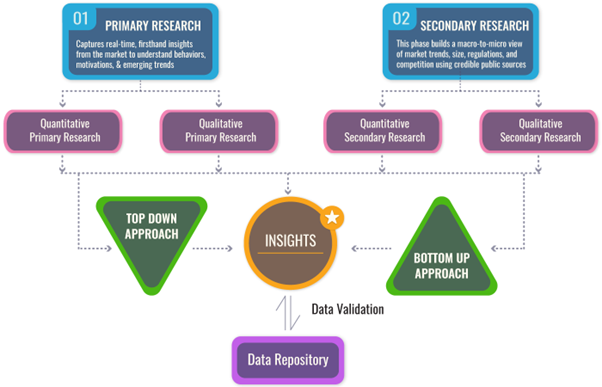
DUAL MODELING: TOP-DOWN + BOTTOM-UP
To ensure robust market estimation, we apply two complementary sizing approaches:
Top-Down Modeling:- Start with broader industry value (e.g., global or regional TAM)
- Apply filters by segment, geography, end-user, or use case
- Adjust with primary insights and validation benchmarks
- Ideal for investor-grade market scans and opportunity mapping
- Aggregate from the ground up using sales volumes, pricing, and unit economics
- Use internal modeling templates aligned with stakeholder data
- Incorporate distributor-level or region-specific inputs
- Most accurate for emerging segments and granular sub-markets
DATA VALIDATION: IN-HOUSE REPOSITORY
We close the loop with proprietary data intelligence built from ongoing projects, industry monitoring, and historical benchmarking. This repository includes:
- Multi-sector market and pricing models
- Key trendlines from past interviews and forecasts
- Benchmarked adoption rates, churn patterns, and ROI indicators
- Industry-specific deviation flags and cross-check logic
- Catches inconsistencies early
- Aligns projections across studies
- Enables consistent, high-trust deliverables