

Loitering Munition System Market Size and Forecast (2020 - 2033), Global and Regional Growth, Trend, Share and Industry Analysis Report Coverage; Operation Type (Autonomous and Manual), Platform (Land, Air, and Navy), Type (Recoverable and Expendable), Launch Mode (Air Launched Effect, Vertical Take-off, Catapult Launched, Canister Launched, and Hand Launched), Range (Short, Medium, and Long), and Geography
2026-02-23
Aerospace & Defense
Ekta Chaurasia (Team Lead)
Description
Loitering
Munition System Market Overview
The global
loitering munition system market is experiencing strong growth, driven by
rising geopolitical tensions, increasing defense modernization programs,
growing adoption of autonomous weapon systems, and advancements in AI-enabled
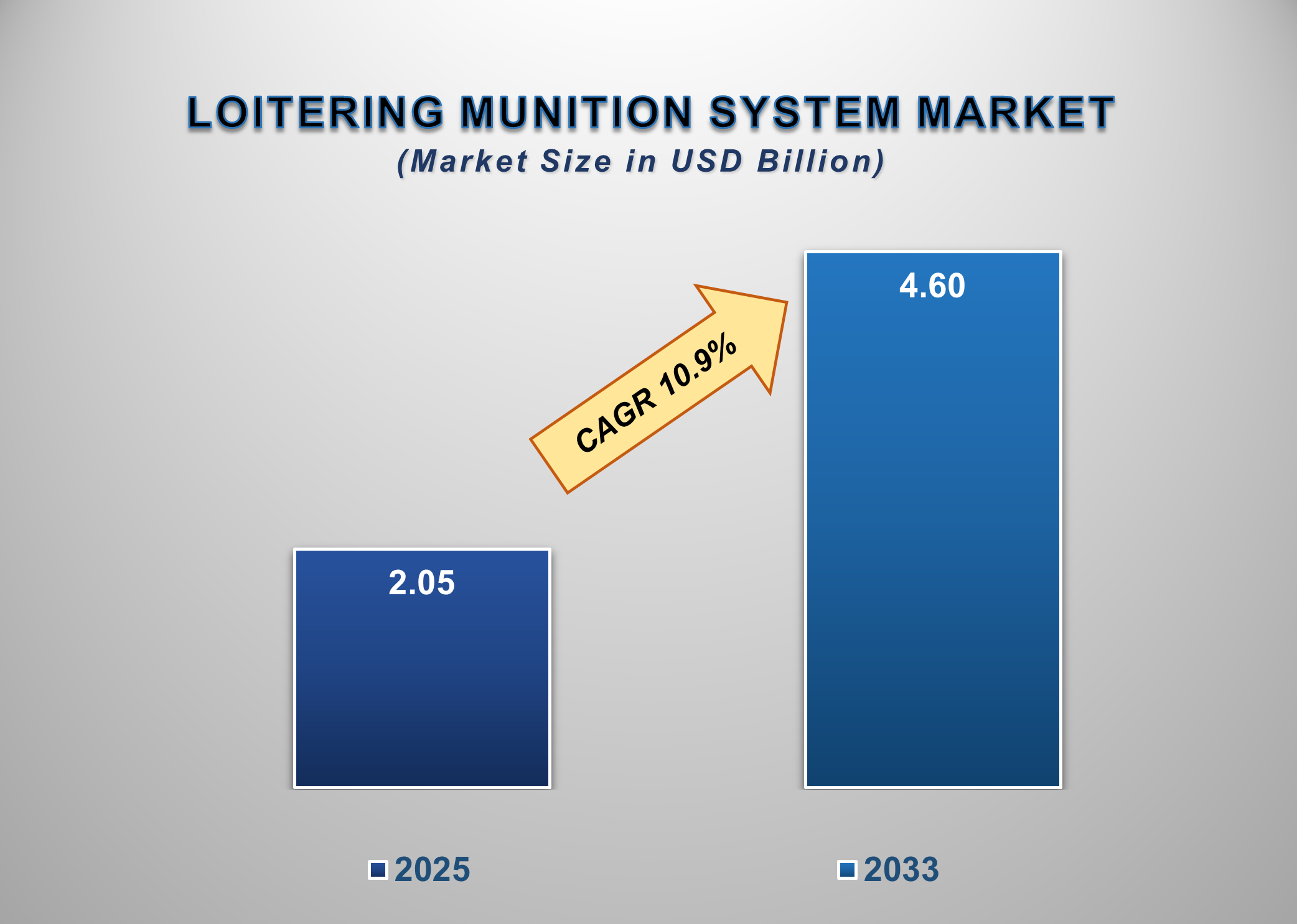
targeting technologies. Valued at USD 2.05 billion in 2025, the market is
projected to reach USD 4.60 billion by 2033, growing at a CAGR of 10.9% during
the forecast period.
The loitering munition system market is one of
the fastest-growing segments within the global defense and unmanned systems
industry. Known as "kamikaze drones," loitering munitions combine the
capabilities of precision-guided missiles with unmanned aerial vehicles (UAVs).
These systems are made to hover over a target area for a long time, use onboard
sensors to detect hazards, and carry out precision strikes either automatically
or in response to commands. Their widespread use in contemporary military forces
has been greatly accelerated by their capacity to provide high-accuracy
engagement with minimal collateral damage.
Asymmetric warfare situations, rising
geopolitical tensions, and a growing need for affordable precision strike
options are the main factors propelling the market's growth. Loitering
munitions provide faster deployment, more battlefield flexibility, and cheaper
operating costs than conventional missile systems. They are extensively
employed in border security, counterterrorism operations, tactical strike
missions, and information, surveillance, and reconnaissance (ISR) activities.
The market outlook is being further strengthened by technological developments,
including greater endurance, secure communication linkages, improved warhead
capabilities, and target recognition based on artificial intelligence. In
addition to their sophisticated guiding systems and decreased need for
operators, autonomous versions are becoming more and more popular. Their
operational scope is also being expanded by integration with real-time data
transmission platforms and network-centric warfare systems.
Regionally, the Asia-Pacific is expanding at a
faster rate due to growing military modernization initiatives, while North
America and Europe continue to be significant markets because of strong defense
spending and technological advancement. Growing procurement by emerging
economies looking for cutting-edge yet affordable combat solutions also helps
the industry.
Despite strong growth prospects, export restrictions, regulatory obstacles, and
ethical concerns surrounding autonomous weapon systems could affect market
dynamics in the future. However, the market is anticipated to continue growing
steadily over the forecast period due to ongoing innovation, growing military
budgets, and the strategic advantages provided by loitering munitions,
establishing the industry as a vital part of next-generation combat systems.
Loitering
Munition System Market Drivers and Opportunities
Rising Geopolitical
Tensions and Asymmetric Warfare
The need for Loitering Munition Systems has
increased dramatically as a result of growing border disputes and geopolitical
crises. Asymmetric warfare, in which conventional troops engage non-state
entities or employ unconventional fighting strategies, is becoming more
prevalent on contemporary battlefields. Without requiring extensive air
operations, loitering weapons offer an affordable precision attack capability.
For instance, AeroVironment's Switchblade system was used in recent battles and
proved to be efficient at hitting armored vehicles and reinforced positions
with little collateral damage. These systems are being actively purchased by
nations in the Asia-Pacific, the Middle East, and Eastern Europe in order to
improve their capacity for quick responses. They are ideal for dynamic combat
situations because of their portability, ease of launch preparation, and
capacity to hover before hitting.
Advancements in Autonomous and AI-Based Targeting Technologies
One of the main factors propelling the
loitering munition system market's expansion is technological innovation.
Real-time target recognition and strike precision have increased thanks to
developments in artificial intelligence (AI), electro-optical sensors, and
secure communication systems. Operators can observe targets before engagement
thanks to the integration of autonomous navigation and sophisticated ISR
capabilities in contemporary systems like IAI's Harop. AI-powered object
detection increases mission success rates while lowering operator workload.
Additionally, longer flying times and greater operational range are being
achieved through lightweight composite materials and better battery durability.
Defense organizations are spending more money on network-centric warfare
systems, which increase the strategic value of loitering munitions by
integrating them into larger battlefield management platforms.
Growing Demand from Emerging Economies for Cost-Effective
Precision Strike Systems
Emerging economies are offering significant
development prospects due to growing defense modernization initiatives and
constrained funding for expensive missile systems. Loitering munitions are a
reasonably priced substitute for manned airstrikes and conventional guided
missiles. To improve tactical attack capabilities, countries like India,
Turkey, and a number of Southeast Asian countries are expanding their
procurement or creating their own systems. For example, Turkish defense
companies are now exporting loitering drone systems to more areas. Over the
course of the projection period, partnerships, technology transfers, and
localized manufacturing agreements are anticipated to generate significant
growth prospects as armed forces look for striking solutions that are
technologically advanced, scalable, and portable.
Loitering Munition System Market Scope
|
Report Attributes |
Description |
|
Market Size in
2025 |
USD 2.05
Billion |
|
Market Forecast
in 2033 |
USD 4.60
Billion |
|
CAGR % 2025-2033 |
10.9% |
|
Base Year |
2024 |
|
Historic Data |
2020-2024 |
|
Forecast Period |
2025-2033 |
|
Report USP |
Comprehensive
global Loitering Munition System Market size and forecast analysis, product
technology and operation type assessment, range performance evaluation,
launch mode and deployment trends, type vs recoverable and expendable segment
insights, regional and country-level market dynamics, competitive landscape
and market share analysis, technological advancements, growth drivers,
challenges, opportunities, and strategic insights for defense OEMs, system
integrators, military procurement agencies, armed forces, defense
contractors, investors, and policy makers |
|
Segments Covered |
●
By
Operation Type ●
By
Platform ●
By Type ●
By Launch
Mode ●
Range |
|
Regional Scope |
●
North
America ●
Europe ●
APAC ●
Latin
America ●
Middle
East and Africa |
|
Country Scope |
1)
U.S. 2)
Canada
3)
U.K. 4)
Germany
5)
France
6)
Italy 7)
Spain 8)
Switzerland
9)
China
10)
India
11)
Japan 12)
South
Korea 13)
Australia 14)
Mexico
15)
Brazil
16)
Argentina
17)
Saudi
Arabia 18)
UAE 19)
South
Africa |
Loitering
Munition System Market Report Segmentation Analysis
The global
loitering munition system market analysis is segmented by Operation Type,
Platform, Type, Launch Mode, Range, and Region.
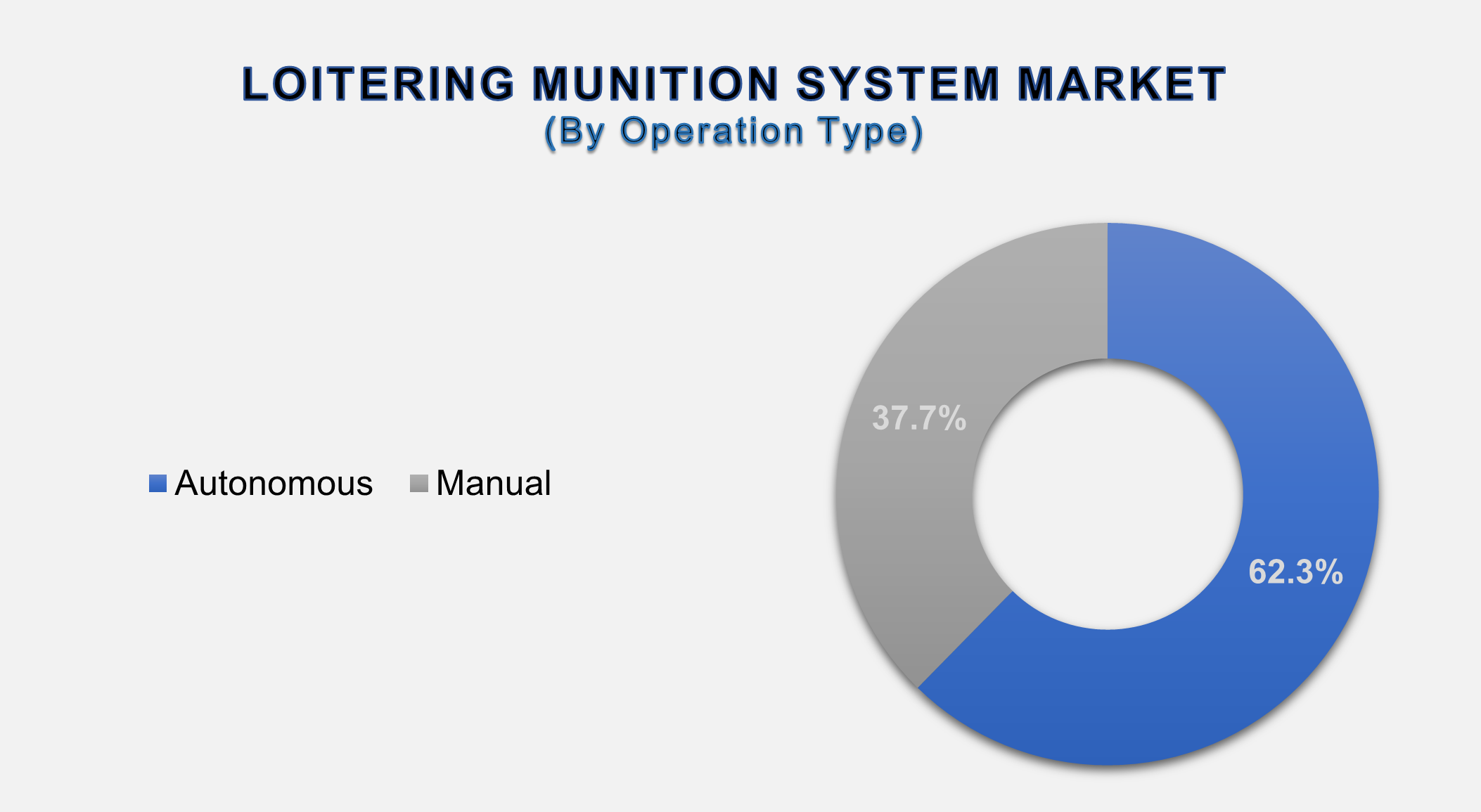
The Autonomous segment dominated the market in 2025 and is projected to
grow at the highest CAGR during the forecast period.
By Operation Type,
the loitering munition system market is segmented into autonomous and manual.
The autonomous segment accounts for the largest share of the global loitering
munition system market. These systems use infrared and electro-optical sensors to
identify, track, and engage targets autonomously, which reduces response time
and operator workload. While reducing collateral damage, autonomous loitering
weapons increase the effectiveness of precision strikes. The need for rapid
decisions in contemporary combat, enhanced real-time data processing, and
growing integration with C4ISR networks are all factors propelling acceptance
among highly developed military forces worldwide.
Land holds the
highest share of the Platform Segment over the forecast period
Based on the Platform, the market is bifurcated into land, air, and sea.
The land segment accounts for the largest share of the market. Land-based
systems are ideal for infantry units, armored divisions, and special forces
since they are very portable and simple to deploy. In dynamic combat scenarios,
they offer real-time intelligence, surveillance, and precision strike
capabilities. Land platforms are the main operational option for many
contemporary armed forces due to their efficacy in counter-insurgency, border
security, and urban warfare scenarios.
Expendable Segment will
probably dominate the market during the forecast period
In terms of Type,
the loitering munition system market is segmented into recoverable and
expendable. The expendable segment holds the largest share of the Loitering
Munition System Market. These systems are intended to be used only once, with
the munition loitering, identifying the target, and destroying itself when it
hits it. Because they require less maintenance and recovery logistics,
expendable variants are frequently chosen for tactical strike missions.
Military forces around the world find them very appealing due to their
precision aiming, quick deployment capability, and adaptability to
high-intensity combat situations.
Canister Launched holds the highest share of the
Launch Mode Segment over the forecast period
Based on Launch
Mode, the market is bifurcated into air-launched, hand-launched, vertical
take-off, catapult-launched, and canister-launched. The canister-launched
segment accounts for the largest share of the market. The sealed launch
canisters in which these devices are kept and carried guarantee their
robustness, portability, and prompt activation in combat situations. Canister
launching increases operational flexibility by enabling interaction with
armored platforms, ground vehicles, and naval vessels. Additionally, the design
minimizes setup time and improves storage safety, making it ideal for
high-readiness military operations and contemporary, fast-paced tactical
missions.
Short holds the highest share of the Range
Segment over the forecast period
Based on Range, the
market is bifurcated into short, medium, and long. The short segment accounts
for the largest share of the market. Short-range systems are lightweight,
portable, and made to be quickly deployed by special forces and infantry
troops. They perform exceptionally well in border security operations,
counter-insurgency missions, and close-combat assistance. They are extensively
used in military forces due to their reduced cost, simplicity of use, and rapid
reaction time. The market position of this area is further strengthened by the
growing need for accurate, real-time striking solutions in dynamic combat
scenarios.
The following
segments are part of an in-depth analysis of the global loitering munition
system market:
|
Market Segments |
|
|
By
Operation Type |
●
Autonomous ●
Manual |
|
By
Platform |
●
Land ●
Air ●
Navy |
|
By
Type |
●
Recoverable ●
Expendable |
|
By
Launch Mode |
●
Air
Launched Effect ●
Hand
Launched ●
Vertical
Take-off ●
Catapult
Launched ●
Canister
Launched |
|
By
Range |
●
Short ●
Medium ●
Long |
Loitering Munition System Market Share
Analysis by Region
The North America
region is projected to hold the largest share of the global Loitering Munition
System Market over the forecast period.
The
North America region is projected to hold the largest share of the global
loitering munition system market over the forecast period and is also expected
to be the fastest-growing region. The market for loitering munition systems is
dominated by North America due to its robust procurement programs, high defense
budget, and technological superiority. With the help of modernization programs
from the US Department of Defense and the growing use of autonomous
precision-strike systems, the US is leading the region in growth. Systems like
the Switchblade series are supplied by companies like AeroVironment, Inc., and
have been used extensively in recent military actions. Additionally, major
defense companies such as Raytheon Technologies Corporation and Lockheed Martin
Corporation are investing in advanced autonomous strike technologies and
sophisticated loitering capabilities. North America continues to dominate this
industry due to growing military budgets, AI-based targeting, and integration
with C4ISR networks.
Global
Loitering Munition System Market Recent Developments News:
●
In October
2025, UVision and AeroVironment announced a strategic alliance to jointly
develop next-generation loitering munitions with network-centric capabilities
and shared AI targeting, promoting cross-platform interoperability and sensor
fusion.
●
In September
2025, UVision unveiled the Hero-1200 loitering munition, featuring a
high-payload configuration and a range of more than 200 kilometers aimed at
deep-strike operations for ground forces.
●
In August
2025, rapid procurement cycles were demonstrated when Taiwan got its first
shipment of Anduril Altius-600M loitering munitions six months after the
contract was signed.
The
Global Loitering Munition System Market is dominated by a few large companies,
such as
●
AeroVironment, Inc.
●
Israel
Aerospace Industries (IAI)
●
Raytheon
Technologies Corporation
●
Lockheed
Martin Corporation
●
Northrop
Grumman Corporation
●
Textron Inc.
●
General
Atomics Aeronautical Systems, Inc.
●
Elbit Systems
Ltd.
●
Thales Group
●
BAE Systems
plc
●
L3Harris
Technologies, Inc.
●
Kubicek
Defence s.r.o. (part of Group)
●
UVision Air
Ltd.
●
Taiyo Remote
Technology Co., Ltd.
●
Denel Dynamics
(South Africa)
●
Kongsberg
Defence & Aerospace
●
Rheinmetall AG
●
Aselsan A.S.
●
ADASI
(Advanced Systems & Technologies Company)
● Leonardo S.p.A.
Frequently Asked Questions
Ekta Chaurasia (Team Lead)
Ekta Chaurasia is a highly experienced Team Lead at M2Square Consultancy with over 7 years of expertise in market research, strategic consulting, competitive benchmarking, and business intelligence solutions. She specializes in ICT, semiconductors & electronics, automotive & transportation, and industrial machinery markets.
She leads end-to-end global research projects focused on market trends, industry analysis, growth forecasting, customer insights, and strategic decision-making. Known for her analytical leadership and industry expertise, Ekta helps businesses uncover growth opportunities, evaluate competitive landscapes, and stay ahead in rapidly evolving markets through accurate and insight-driven research.
1.
Global Loitering Munition System Market Introduction and Market
Overview
1.1.
Objectives of the Study
1.2.
Global Loitering Munition System Market Scope and Market
Estimation
1.2.1.Global Loitering
Munition System Overall Market Size (US$ Bn), Market CAGR (%), Market forecast
(2025 - 2033)
1.2.2.Global Loitering
Munition System Market Revenue Share (%) and Growth Rate (Y-o-Y) from 2020 - 2033
1.3.
Market Segmentation
1.3.1.Operation
Type of Global Loitering Munition System Market
1.3.2.Platform of
Global Loitering Munition System Market
1.3.3.Type of
Global Loitering Munition System Market
1.3.4.Launch Mode of
Global Loitering Munition System Market
1.3.5.Range of
Global Loitering Munition System Market
1.3.6.Region of
Global Loitering Munition System Market
2.
Executive
Summary
2.1.
Demand Side Trends
2.2.
Key Market Trends
2.3.
Market Demand (US$ Bn) Analysis 2020 – 2024 and Forecast, 2025 – 2033
2.4.
Demand and Opportunity Assessment
2.5.
Market Dynamics
2.5.1.Drivers
2.5.2.Limitations
2.5.3.Opportunities
2.5.4.Impact
Analysis of Drivers and Restraints
2.6.
Porter’s Five Forces Analysis
2.7.
PEST Analysis
2.8.
Key Regulation
2.9.
Key Developments
2.10. Value
Chain / Ecosystem Analysis
3.
Global
Loitering Munition System Market Estimates & Historical Trend Analysis (2020 - 2024)
4. Global Loitering Munition System Market Estimates & Forecast Trend Analysis, by Operation Type
4.1.
Global Loitering Munition System Market Revenue (US$ Bn) Estimates
and Forecasts, by Operation Type, 2020 - 2033
4.1.1.Autonomous
4.1.2.Manual
5. Global Loitering Munition System Market Estimates & Forecast Trend Analysis, by Platform
5.1.
Global Loitering Munition System Market Revenue (US$ Bn) Estimates
and Forecasts, by Platform, 2020 - 2033
5.1.1.Land
5.1.2.Air
5.1.3.Navy
6. Global Loitering Munition System Market Estimates & Forecast Trend Analysis, by Type
6.1.
Global Loitering Munition System Market Revenue (US$ Bn) Estimates
and Forecasts, by Type, 2020 - 2033
6.1.1.Recoverable
6.1.2.Expendable
7. Global Loitering Munition System Market Estimates & Forecast Trend Analysis, by Launch Mode
7.1.
Global Loitering Munition System Market Revenue (US$ Bn) Estimates
and Forecasts, by Launch Mode, 2020 - 2033
7.1.1.Air Launched
Effect
7.1.2.Hand Launched
7.1.3.Vertical
Take-off
7.1.4.Catapault
Launched
7.1.5.Canister
Launched
8. Global Loitering Munition System Market Estimates & Forecast Trend Analysis, by Range
8.1.
Global Loitering Munition System Market Revenue (US$ Bn) Estimates
and Forecasts, by Range, 2020 - 2033
8.1.1.Short
8.1.2.Medium
8.1.3.Long
9.
Global
Loitering Munition System Market Estimates & Forecast Trend Analysis, by Region
9.1.
Global Loitering Munition System Market Revenue (US$ Bn) Estimates
and Forecasts, by Region, 2020 - 2033
9.1.1.North America
9.1.2.Europe
9.1.3.Asia Pacific
9.1.4.Middle East
& Africa
9.1.5.Latin America
10.
North America Loitering
Munition System Market: Estimates &
Forecast Trend Analysis
10.1.
North America Loitering Munition System Market Assessments &
Key Findings
10.1.1.
North America Loitering Munition System Market Introduction
10.1.2.
North America Loitering Munition System Market Size Estimates and
Forecast (US$ Billion) (2020 - 2033)
10.1.2.1. By Operation Type
10.1.2.2. By Platform
10.1.2.3. By Type
10.1.2.4. By Launch Mode
10.1.2.5. By Range
10.1.2.6.
By Country
10.1.2.6.1. The
U.S.
10.1.2.6.2. Canada
11.
Europe Loitering
Munition System Market: Estimates &
Forecast Trend Analysis
11.1. Europe
Loitering Munition System Market Assessments & Key Findings
11.1.1.
Europe Loitering Munition System Market Introduction
11.1.2.
Europe Loitering Munition System Market Size Estimates and Forecast
(US$ Billion) (2020 - 2033)
11.1.2.1. By Operation Type
11.1.2.2. By Platform
11.1.2.3. By Type
11.1.2.4. By Launch Mode
11.1.2.5. By Range
11.1.2.6. By
Country
11.1.2.6.1.
Germany
11.1.2.6.2.
Italy
11.1.2.6.3.
U.K.
11.1.2.6.4.
France
11.1.2.6.5.
Spain
11.1.2.6.6.
Russia
11.1.2.6.7. Rest of Europe
12.
Asia Pacific Loitering
Munition System Market: Estimates &
Forecast Trend Analysis
12.1. Asia
Pacific Loitering Munition System Market Assessments & Key Findings
12.1.1.
Asia Pacific Loitering Munition System Market Introduction
12.1.2.
Asia Pacific Loitering Munition System Market Size Estimates and
Forecast (US$ Billion) (2020 - 2033)
12.1.2.1. By Operation Type
12.1.2.2. By Platform
12.1.2.3. By Type
12.1.2.4. By Launch Mode
12.1.2.5. By Range
12.1.2.6.
By Country
12.1.2.6.1.
China
12.1.2.6.2.
Japan
12.1.2.6.3.
India
12.1.2.6.4.
Australia
12.1.2.6.5.
South Korea
12.1.2.6.6. Rest
of Asia Pacific
13.
Middle East & Africa Loitering Munition System Market: Estimates & Forecast Trend Analysis
13.1. Middle
East & Africa Loitering Munition System Market Assessments & Key
Findings
13.1.1.
Middle East & Africa Loitering
Munition System Market Introduction
13.1.2.
Middle East & Africa Loitering
Munition System Market Size Estimates and Forecast (US$ Billion) (2020 - 2033)
13.1.2.1. By Operation Type
13.1.2.2. By Platform
13.1.2.3. By Type
13.1.2.4. By Launch Mode
13.1.2.5. By Range
13.1.2.6.
By Country
13.1.2.6.1.
UAE
13.1.2.6.2.
Saudi Arabia
13.1.2.6.3.
South Africa
13.1.2.6.4. Rest of MEA
14.
Latin America Loitering
Munition System Market: Estimates &
Forecast Trend Analysis
14.1. Latin
America Event Industry Assessments & Key Findings
14.1.1.
Latin America Loitering Munition System Market Introduction
14.1.2.
Latin America Loitering Munition System Market Size Estimates and
Forecast (US$ Billion) (2020 - 2033)
14.1.2.1. By Operation Type
14.1.2.2. By Platform
14.1.2.3. By Type
14.1.2.4. By Launch Mode
14.1.2.5. By Range
14.1.2.6.
By Country
14.1.2.6.1.
Brazil
14.1.2.6.2.
Mexico
14.1.2.6.3.
Argentina
14.1.2.6.4. Rest of LATAM
15.
Country Wise Market: Introduction
16. Competition
Landscape
16.1. Global
Loitering Munition System Market Product Mapping
16.2. Global
Loitering Munition System Market Concentration Analysis, by Leading Players /
Innovators / Emerging Players / New Entrants
16.3. Global
Loitering Munition System Market Tier Structure Analysis
16.4. Global
Loitering Munition System Market Concentration & Company Market Shares (%)
Analysis, 2024
17. Company
Profiles
17.1.
Aerovironment, Inc.
17.1.1.
Company Overview & Key Stats
17.1.2.
Financial Performance & KPIs
17.1.3.
Product Portfolio
17.1.4.
SWOT Analysis
17.1.5.
Business Strategy & Recent Developments
*
Similar details would be provided for all the players mentioned below
17.2. Israel
Aerospace Industries (IAI)
17.3. Raytheon
Technologies Corporation
17.4. Lockheed
Martin Corporation
17.5. Northrop
Grumman Corporation
17.6. Textron
Inc.
17.7. General
Atomics Aeronautical Systems, Inc.
17.8. Elbit
Systems Ltd.
17.9. Thales
Group
17.10. BAE
Systems plc
17.11. L3Harris
Technologies, Inc.
17.12. Kubicek
Defence s.r.o. (part of Group)
17.13. UVision
Air Ltd.
17.14. Taiyo
Remote Technology Co., Ltd.
17.15. Denel
Dynamics (South Africa)
17.16. Kongsberg
Defence & Aerospace
17.17. Rheinmetall
AG
17.18. Aselsan
A.S.
17.19.
ADASI (Advanced Systems &
Technologies Company)
17.20.
Other Prominent Players
18.
Research
Methodology
18.1. External
Transportations / Databases
18.2. Internal
Proprietary Database
18.3. Primary
Research
18.4. Secondary
Research
18.5. Assumptions
18.6. Limitations
18.7. Report
FAQs
19.
Research
Findings & Conclusion
Our Research Methodology
"Insight without rigor is just noise."
We follow a comprehensive, multi-phase research framework designed to deliver accurate, strategic, and decision-ready intelligence. Our process integrates primary and secondary research , both quantitative and qualitative , along with dual modeling techniques ( top-down and bottom-up) and a final layer of validation through our proprietary in-house repository.
PRIMARY RESEARCH
Primary research captures real-time, firsthand insights from the market to understand behaviors, motivations, and emerging trends.
1. Quantitative Primary Research
Objective: Generate statistically significant data directly from market participants.
Approaches:- Structured surveys with customers, distributors, and field agents
- Mobile-based data collection for point-of-sale audits and usage behavior
- Phone-based interviews (CATI) for market sizing and product feedback
- Online polling around industry events and digital campaigns
- Purchase frequency by customer type
- Channel performance across geographies
- Feature demand by application or demographic
2. Qualitative Primary Research
Objective: Explore decision-making drivers, pain points, and market readiness.
Approaches:- In-depth interviews (IDIs) with executives, product managers, and key decision-makers
- Focus groups among end users and early adopters
- Site visits and observational research for consumer products
- Informal field-level discussions for regional and cultural nuances
SECONDARY RESEARCH
This phase helps establish a macro-to-micro understanding of market trends, size, regulation, and competitive dynamics, sourced from credible and public domain information.
1. Quantitative Secondary Research
Objective: Model market value and segment-level forecasts based on published data.
Sources include:- Financial reports and investor summaries
- Government trade data, customs records, and regulatory statistics
- Industry association publications and economic databases
- Channel performance and pricing data from marketplace listings
- Revenue splits, pricing trends, and CAGR estimates
- Supply-side capacity and volume tracking
- Investment analysis and funding benchmarks
2. Qualitative Secondary Research
Objective: Capture strategic direction, innovation signals, and behavioral trends.
Sources include:- Company announcements, roadmaps, and product pipelines
- Publicly available whitepapers, conference abstracts, and academic research
- Regulatory body publications and policy briefs
- Social and media sentiment scanning for early-stage shifts
- Strategic shifts in market positioning
- Unmet needs and white spaces
- Regulatory triggers and compliance impact
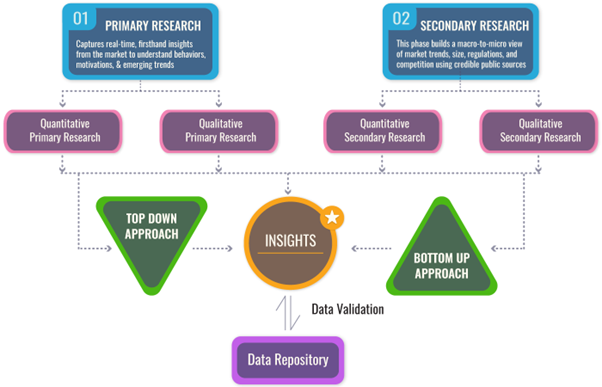
DUAL MODELING: TOP-DOWN + BOTTOM-UP
To ensure robust market estimation, we apply two complementary sizing approaches:
Top-Down Modeling:- Start with broader industry value (e.g., global or regional TAM)
- Apply filters by segment, geography, end-user, or use case
- Adjust with primary insights and validation benchmarks
- Ideal for investor-grade market scans and opportunity mapping
- Aggregate from the ground up using sales volumes, pricing, and unit economics
- Use internal modeling templates aligned with stakeholder data
- Incorporate distributor-level or region-specific inputs
- Most accurate for emerging segments and granular sub-markets
DATA VALIDATION: IN-HOUSE REPOSITORY
We close the loop with proprietary data intelligence built from ongoing projects, industry monitoring, and historical benchmarking. This repository includes:
- Multi-sector market and pricing models
- Key trendlines from past interviews and forecasts
- Benchmarked adoption rates, churn patterns, and ROI indicators
- Industry-specific deviation flags and cross-check logic
- Catches inconsistencies early
- Aligns projections across studies
- Enables consistent, high-trust deliverables