

Lyophilization Equipment and Services Market Size and Forecast (2026–2034), Global and Regional Growth, Trend, Share and Industry Analysis Report Coverage: By Modality (Devices (Tray Lyophilizers, Shelf Lyophilizers, Rotary Lyophilizers, and Others), Consumables & Accessories, Services), By Scale of Operation (Laboratory Scale, Pilot Scale, and Industry Scale), By End User (Pharmaceutical & Biotechnology Companies, Research & Diagnostic Laboratories, Food Processing Industry, and Others (Nutraceuticals, Chemicals, Cosmetics, Academic Institutes)) and Geography
2026-07-23
Healthcare
Swetal (Research Analyst)
Description
Lyophilization Equipment and Services
Market Overview
The global
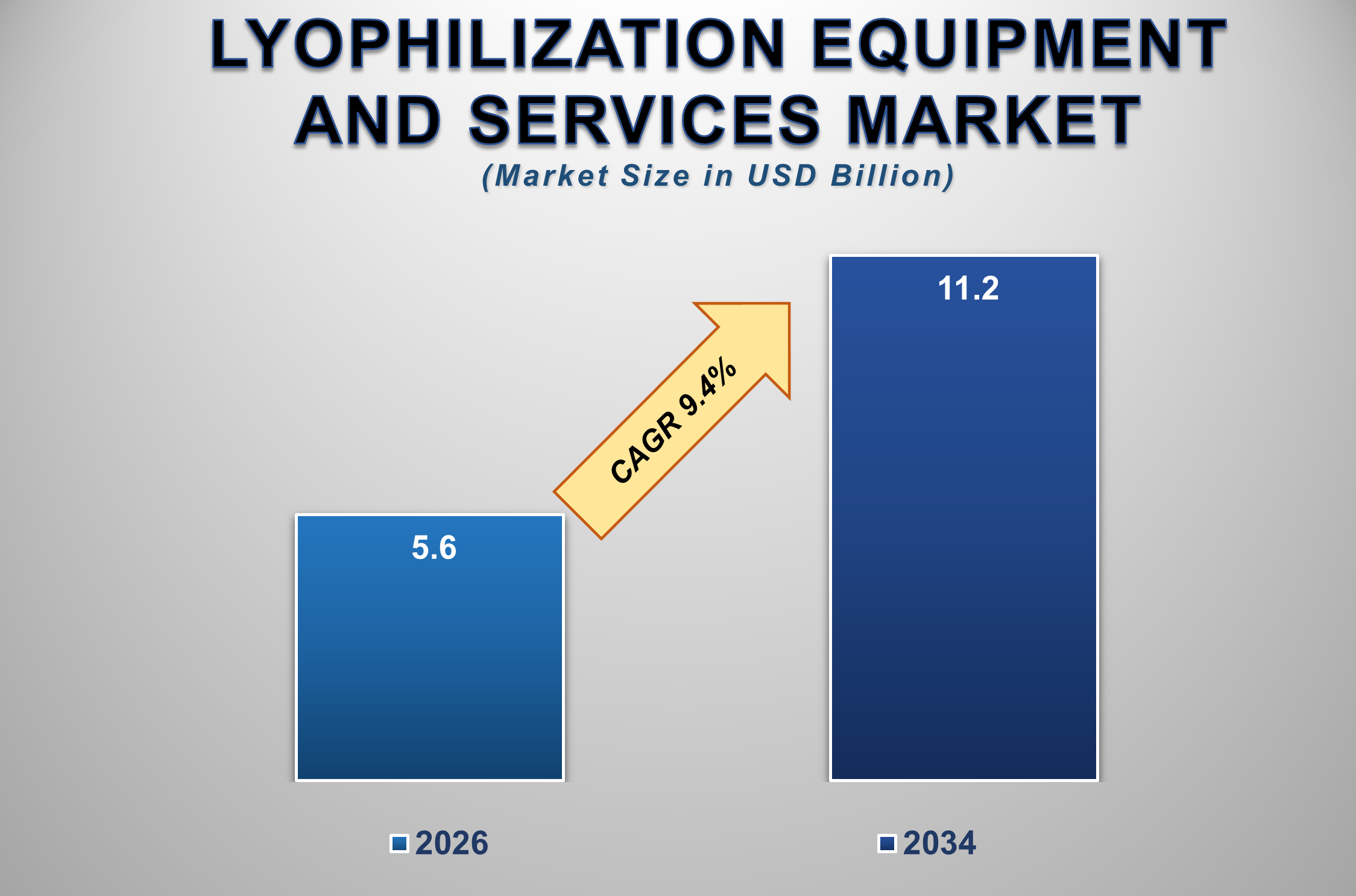
lyophilization equipment and services market was valued at USD 5.6 billion in
2026 and is projected to reach USD 11.2 billion by 2034, expanding at a CAGR of
9.4% during the forecast period. The
lyophilization equipment & services market is composed of assorted
materials such as freeze-drying equipment, consumables, and accessories linked
to the preservation of pharmaceuticals, biologics, diagnostics, and food
products from being spoiled. The growth of this market is attributed to
increasing demand for biologics and vaccines, injectable drugs, as well as
contract manufacturing services, and enhanced capacity to manufacture
pharmaceuticals and biotechnology products.
Advancements in
technology such as automatic lyophilization systems, energy-efficient systems,
digital control systems, and maintenance/validation services have also
contributed to the growth of this market.
Lyophilization Equipment and Services
Market Drivers and Opportunities
Growing Demand
for Biologics and Injectable Therapeutics is Driving Market Growth
The growth in the
development and production of biologics, vaccines, monoclonal antibodies, cell
& gene therapy products, and other sensitive and injectable drug products
will play a crucial role in the increased demand for lyophilization equipment. Lyophilization
technology has an essential contribution to the preservation of stability,
efficacy, and shelf life of such drugs without continuous cold chain
transportation requirements, thus facilitating global shipment of these
products. With the growing pipeline of biologics by the pharmaceuticals and
biotechnology firms and investment in scale-up manufacturing, there is a
growing demand for more efficient lyophilization systems. For example, in July
2026, a subsidiary of Teva Pharmaceutical Industries Ltd., Teva Pharmaceuticals
International GmbH, and Polpharma Biologics International AG signed a global
licensing agreement, according to which Teva received exclusive
commercialization rights for both formulations of Polpharma Biologics'
biosimilar to Ocrevus (ocrelizumab), provided that all regulatory approvals
have been received. This partnership demonstrates an expansion in the market
for biosimilars and biologics that is anticipated to result in increased demand
for aseptic manufacturing and lyophilization technologies.
Expansion of
Pharmaceutical and Biotechnology Manufacturing Capacity Fueling Market
Expansion
There is an
increasing number of investments in pharmaceutical manufacturing facilities,
CDMOs/CRDMOs, and sterile production equipment. With the expansion of capacity
for the production of biologics, peptides, injectables, and other high-value
therapies, there is also an increasing demand for lyophilization systems on
laboratory, pilot, and industrial scales, along with installation, validation,
qualification, and maintenance services. For example, Lupin Manufacturing
Solutions (LMS), the global CRDMO belonging to Lupin Limited and specializing
in the peptide building blocks platform and CRDMO services, announced the
expansion of its Dabhasa manufacturing facility in March 2026. In particular,
the company will expand its facilities with a new manufacturing block and two
peptide production units, which demonstrates the current tendency towards the
development of specialized pharmaceutical manufacturing facilities.
Increasing
Adoption of Automated and Continuous Lyophilization Technologies Presents
Significant Opportunities
The increasing
focus on production efficiency, automated processes, and regulatory adherence
is providing significant opportunities for manufacturers of advanced
lyophilization equipment. More and more pharmaceutical and biotechnology
companies are utilizing automated and continuously operating freeze-drying
technologies that feature real-time process monitoring capabilities, use of PAT
technology, and robotic systems for loading and unloading processes to ensure
better batch consistency and speed of production while cutting costs. Moreover,
the growing need for energy-efficient and sustainable manufacturing processes
increases the demand for next-generation lyophilizers characterized by less
energy usage and a smaller environmental footprint.
Lyophilization Equipment and Services
Market Scope
|
Report Attributes |
Description |
|
Market Size in
2026 |
USD 5.6
Billion |
|
Market Forecast
in 2034 |
USD 11.2
Billion |
|
CAGR % 2026-2034 |
9.4% |
|
Base Year |
2025 |
|
Historic Data |
2021-2025 |
|
Forecast Period |
2026-2034 |
|
Report USP |
Pricing and
Cost Structure Analysis, Product Innovation Benchmarking, Whitespace
Assessment, Company Share, Company Heatmap, Growth Factors and more |
|
Segments Covered |
●
By
Modality ●
By Scale
of Operation ●
By End
User |
|
Regional Scope |
●
North
America ●
Europe ●
APAC ●
Latin
America ●
Middle
East and Africa |
|
Country Scope |
●
U.S. ●
Canada ●
U.K. ●
Germany ●
France ●
Italy ●
Spain ●
Russia ●
China ●
India ●
Japan ●
South
Korea ●
Australia
●
Mexico ●
Brazil ●
Saudi
Arabia ●
UAE ●
South
Africa
|
Lyophilization Equipment and Services
Market Report Segmentation Analysis
The global
lyophilization equipment and services market industry analysis is segmented by
modality, scale of operation, end user, and region.
Consumables
& Accessories Segment Is Expected to Dominate the Lyophilization Equipment
and Services Market During the Forecast Period
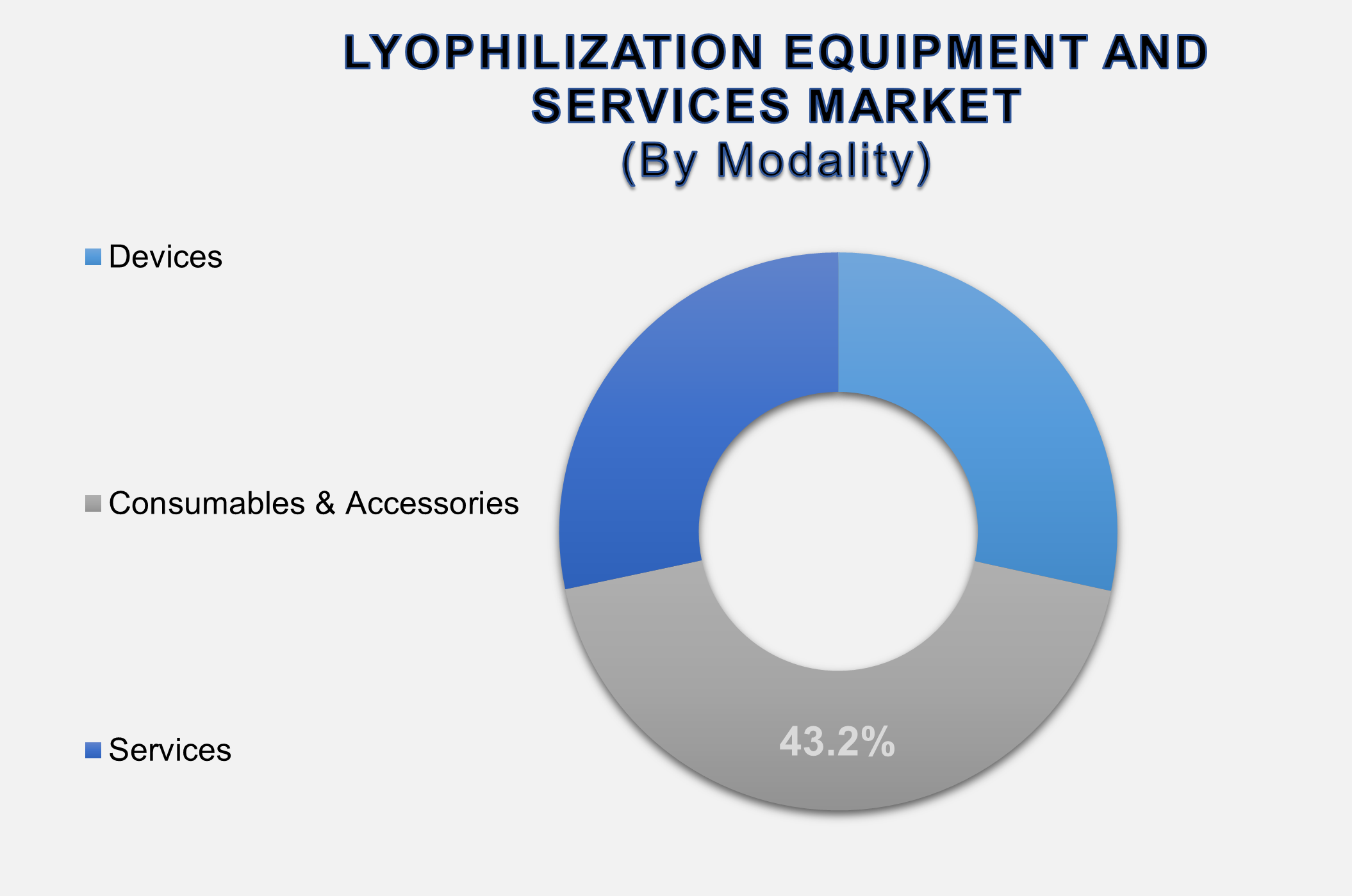
The lyophilization
equipment and services market is anticipated to be dominated by the consumables
and accessories segment due to the recurring requirement of trays, vials,
stoppers, filters, seals, manifolds, and other replacement parts used in each
freeze-drying cycle. The increase in the production of biologics, vaccines,
injectable medicines, and other sterile pharmaceuticals is the driving force
behind the continuing use of these products in compliance with GMP regulations,
as well as in ensuring efficiency and quality in manufacturing processes.
Moreover, it is expected that the growing capacity of pharmaceutical
manufacturing and continuous CDMO development, as well as the regular
maintenance and validation of equipment, will ensure stable demand for
consumables and accessories during the entire forecast period.
Industry Scale
Segment Is Expected to Lead the Lyophilization Equipment and Services Market by
Scale of Operation
The segment of
lyophilization equipment and services most likely to become the leader is
Industry Scale. This arises from the increase in the commercial production of
biologics, vaccines, injectable pharmaceutical products, etc. Different major
biotech and pharmaceutical companies invest in high-capacity lyophilization
systems to enhance their production efficiency and ensure compliance with
regulations in the area of the production of biopharmaceuticals. The expansion
of commercial manufacturing activities, CDMO operations, and CRDMO activities
is likely to strengthen the position of the Industry Scale segment as well.
Pharmaceutical
& Biotechnology Companies Segment Is Expected to Dominate the End User
Segment
The pharmaceutical
and biotechnology segment is projected to account for the largest share of the
lyophilization equipment & services market, attributable to the growing
need for the utilization of freeze-drying in the development and
commercialization of biologics, vaccines, injectable drugs, peptides, and
advanced therapy products. These companies are focusing on making significant
investments in the expansion of sterile production capabilities and adoption of
modern technology in lyophilization. For example, in March 2026, OFD Life
Sciences, Inc., a division of Oregon Freeze Dry, was granted a patent for its
LyoPastille oral delivery system. This technology has over six decades of
experience in lyophilization and is used for producing orally dissolving tablets
that are more absorbable and easily bioavailable than other products. The
technology shows the wide application of lyophilization technologies in
biopharmaceuticals, medtech, animal health, and consumer health.
The following
segments are part of an in-depth analysis of the global lyophilization
equipment and services market:
|
Market Segments |
|
|
By
Modality |
●
Devices o
Tray
Lyophilizers o
Shelf
Lyophilizers o
Rotary
Lyophilizers o
Others ●
Consumables
& Accessories ●
Services |
|
By
Scale of Operation |
●
Laboratory
Scale ●
Pilot Scale ●
Industry
Scale |
|
By End
User |
●
Pharmaceutical
& Biotechnology Companies ●
Research
& Diagnostic Laboratories ●
Food
Processing Industry ●
Others (Nutraceuticals,
Chemicals, Cosmetics, Academic Institutes) |
Lyophilization Equipment and Services
Market Share Analysis by Region
North America is
projected to hold the largest share of the global lyophilization equipment and
services market over the forecast period
North America is
predicted to hold major shares of the global market for lyophilization
equipment and services due to the existence of key pharmaceutical and biotech
companies, state-of-the-art biologics manufacturing infrastructure, and high
investments in sterile injection production. The reason for the advantage of
this market is the continuous development of biologics and biosimilars, along
with a well-established CDMO network and stringent regulations, contributing to
the growth of advanced GMP-compliant lyophilization technologies. It is also
worth mentioning the continuous investment made to manufacture more, innovate
technologies, and prosper with various equipment and service producers.
Lyophilization
Equipment and Services Market Competition Landscape Analysis
The market for
lyophilization equipment and services comprises major producers of
freeze-drying hardware and supplies, offering solutions and services primarily
to biopharma companies, CROs/CDMOs, laboratory researchers, diagnostics
companies, food producers, and other businesses in the life sciences sector. In
order to strengthen their competitive position on the market, companies are
implementing innovations in automated and continuous lyophilization systems,
power-efficient freeze-drying technologies, robotic loading/unloading systems,
PAT solutions, and digital monitoring systems for optimization of processes and
compliance with regulations.
Organizations are
increasing their market share through various ways, including joint ventures,
launching new products, expanding production capacities, obtaining licenses,
merging with other organizations, and enhancing investments in R&D
activities.
Global
Lyophilization Equipment and Services Market Recent Developments News:
●
In March 2026
- BioTechnique, a full-service CRDMO, announced expanded aseptic fill-finish
and lyophilization capabilities supporting pharmaceutical programs from
development through commercial supply. These services are integrated with
BioTechnique’s third-party logistics and storage platform, offering controlled
warehousing across ambient (15–25°C), refrigerated (2–8°C), frozen (−20°C),
ultralow (−80°C), and cryogenic (−190°C) conditions.
●
In August 2025
- Cytiva and Argonaut Manufacturing
Services announced a strategic collaboration across the U.S. and Europe to
expand lyophilization and reagent stabilization services, enhancing localized
manufacturing capabilities, improving production scalability, and increasing
cost efficiency for diagnostic developers.
●
In July 2024 -
GEA showcased its latest pharmaceutical freeze-drying innovations at ACHEMA
2024 in Frankfurt, Germany, featuring LYOAIR, LYOVAC ECO Mode, and
microwave-assisted freeze-drying technologies designed to improve energy
efficiency, enhance sustainability, and optimize pharmaceutical production
performance.
The global
lyophilization equipment and services market is dominated by a few large
companies, such as
●
Biopharma Process Systems
●
Büchi Labortechnik
●
Cryotec FR
●
Cuddon Freeze Dry
●
GEA Group AG
●
GEA Group Aktiengesellschaft
●
Harvest Right
●
HOF Sonderanlagenbau
●
IMA S.p.A.
●
IMA S.p.A.
●
Labconco Corporation
●
Martin Christ Gefriertrocknungsanlagen GmbH
●
Millrock Technology
●
Optima Packaging Group GmbH
●
SP Industries (ATS Scientific Products)
●
SP Industries (ATS)
●
Tofflon Science & Technology
●
Tofflon Science & Technology Co., Ltd.
●
Vikumer Freeze-Dry
●
ZIRBUS Technology
● Other Prominent Players
Frequently Asked Questions
Swetal (Research Analyst)
Swetal is a Research Analyst with 4+ years of experience specializing in healthcare market research, medical devices, healthcare IT, and medical technology industry analysis. Her expertise includes competitive intelligence, secondary research, market trend forecasting, and healthcare business insights across global healthcare ecosystems.
She contributes to advanced market research reports by analyzing regulatory frameworks, emerging healthcare technologies, competitive landscapes, and innovation trends shaping the medical industry. With a strong focus on accurate market intelligence, strategic insights, and healthcare industry trends, Swetal supports businesses in making informed, data-backed decisions in a rapidly transforming healthcare environment.
1.
Global
Lyophilization Equipment and Services Market Introduction and Market Overview
1.1. Objectives of the Study
1.2. Market Segmentation
1.2.1.Modality of the Global Lyophilization
Equipment and Services Market
1.2.2.Scale of Operation of the Global
Lyophilization Equipment and Services Market
1.2.3.End User of the Global Lyophilization
Equipment and Services Market
1.2.4.Region of Global Lyophilization
Equipment and Services Market
1.3. Competition Coverage List of
Market Participants
1.4. Market Definition: Lyophilization
Equipment and Services Market
2.
Executive Summary
2.1. Global Lyophilization Equipment
and Services Market Estimation & Forecast
2.1.1.Global Lyophilization Equipment
and Services Market Size (US$ Million) Estimates & Historical Trend
Analysis (2021 - 2025)
2.1.2.Global Lyophilization Equipment
and Services Overall Market Size (US$ Million), Growth Rate (Y-o-Y), Market
CAGR (%), Market Forecast (2026 - 2034)
2.2. Snapshot of Global Lyophilization
Equipment and Services Market
2.3. Global Lyophilization Equipment
and Services Market Revenue Share (%) 2025
2.4. REGIONAL OUTLINE: Revenue CAGR,
by Region
2.5. Key Competitors & Key
Insights
3.
Market Overview (Qualitative
Analysis)
3.1. Demand Side Trends
3.2. Supply Side Trends /
Manufacturing Trends
3.3. Demand and Opportunity
Assessment, 2026 - 2034
3.4. Market Dynamics
3.4.1.Drivers
3.4.2.Limitations
3.4.3.Opportunities
3.4.4.Impact Analysis of Drivers and
Restraints
3.5. Key Developments
3.6. Regulatory Landscape
3.7. Pricing Analysis
3.8. Supply Chain Analysis
3.9. Porter’s Five Forces Analysis
3.9.1.Bargaining Power of Suppliers
3.9.2.Bargaining Power of Buyers
3.9.3.Threat of Substitutes
3.9.4.Threat of New Entrants
3.9.5.Competitive Rivalry
3.10. PEST Analysis
3.10.1. Political Factors
3.10.2. Economic Factors
3.10.3. Social Factors
3.10.4. Technology Factors
4.
Global Lyophilization Equipment
and Services Market Estimates & Forecast Trend Analysis, by Modality
4.1. Global Lyophilization Equipment
and Services Market Assessments & Key Findings, by Modality
4.2. Global Lyophilization Equipment
and Services Market Revenue (US$ Million) Estimates and Forecasts, by Modality,
2021 - 2034
4.2.1.Devices
4.2.1.1.
Tray
Lyophilizers
4.2.1.2.
Shelf
Lyophilizers
4.2.1.3.
Rotary
Lyophilizers
4.2.1.4.
Others
4.2.2.Consumables & Accessories
4.2.3.Services
5.
Global Lyophilization Equipment
and Services Market Estimates & Forecast Trend Analysis, by Scale of
Operation
5.1. Global Lyophilization Equipment
and Services Market Assessments & Key Findings, by Scale of Operation
5.2. Global Lyophilization Equipment
and Services Market Revenue (US$ Million) Estimates and Forecasts, by Scale of
Operation, 2021 - 2034
5.2.1.Laboratory Scale
5.2.2.Pilot Scale
5.2.3.Industry Scale
6.
Global Lyophilization Equipment
and Services Market Estimates & Forecast Trend Analysis, by End User
6.1. Global Lyophilization Equipment
and Services Market Assessments & Key Findings, by End User
6.2. Global Lyophilization Equipment
and Services Market Revenue (US$ Million) Estimates and Forecasts, by End User,
2021 - 2034
6.2.1.Pharmaceutical &
Biotechnology Companies
6.2.2.Research & Diagnostic
Laboratories
6.2.3.Food Processing Industry
6.2.4.Others (Nutraceuticals,
Chemicals, Cosmetics, Academic Institutes)
7.
Global Lyophilization Equipment
and Services Market Estimates & Forecast Trend Analysis, by Region
7.1. Global Lyophilization Equipment
and Services Market Assessments & Key Findings, by Region
7.2. Global Lyophilization Equipment
and Services Market Revenue (US$ Million) Estimates and Forecasts, by Region, 2021
- 2034
7.2.1.North America
7.2.2.Europe
7.2.3.Asia Pacific
7.2.4.Middle East & Africa
7.2.5.Latin America
8.
North
America Lyophilization Equipment and Services
Market: Estimates & Forecast Trend
Analysis
8.1.
North
America Lyophilization Equipment and Services Market Assessments & Key
Findings
8.1.1.North America Lyophilization
Equipment and Services Market Introduction
8.1.2.North America Lyophilization
Equipment and Services Market Size Estimates and Forecast (US$ Million) (2021 -
2034)
8.1.2.2.
By
Scale of Operation
8.1.2.3.
By
End User
8.1.2.4. By Country
8.1.2.4.1. The U.S.
8.1.2.4.2. Canada
9.
Europe
Lyophilization Equipment and Services
Market: Estimates & Forecast Trend
Analysis
9.1. Europe Lyophilization Equipment
and Services Market Assessments & Key Findings
9.1.1.Europe Lyophilization Equipment
and Services Market Introduction
9.1.2.Europe Lyophilization Equipment
and Services Market Size Estimates and Forecast (US$ Million) (2021 - 2034)
9.1.2.1. By Modality
9.1.2.2. By Scale of Operation
9.1.2.3. By End User
9.1.2.4. By Country
9.1.2.4.1.
Germany
9.1.2.4.2.
Italy
9.1.2.4.3.
U.K.
9.1.2.4.4.
France
9.1.2.4.5.
Spain
9.1.2.4.6.
Switzerland
9.1.2.4.7. Rest
of Europe
10. Asia Pacific Lyophilization
Equipment and Services Market:
Estimates & Forecast Trend Analysis
10.1. Asia Pacific Market Assessments
& Key Findings
10.1.1. Asia Pacific Lyophilization
Equipment and Services Market Introduction
10.1.2. Asia Pacific Lyophilization
Equipment and Services Market Size Estimates and Forecast (US$ Million) (2021 -
2034)
10.1.2.1. By Modality
10.1.2.2. By Scale of Operation
10.1.2.3. By End User
10.1.2.4. By Country
10.1.2.4.1. China
10.1.2.4.2. Japan
10.1.2.4.3. India
10.1.2.4.4. Australia
10.1.2.4.5. South Korea
10.1.2.4.6. Rest of Asia Pacific
11. Middle East & Africa Lyophilization
Equipment and Services Market:
Estimates & Forecast Trend Analysis
11.1. Middle East & Africa Market
Assessments & Key Findings
11.1.1. Middle
East & Africa Lyophilization
Equipment and Services Market Introduction
11.1.2. Middle
East & Africa Lyophilization
Equipment and Services Market Size Estimates and Forecast (US$ Million) (2021 -
2034)
11.1.2.1. By Modality
11.1.2.2. By Scale of Operation
11.1.2.3. By End User
11.1.2.4. By Country
11.1.2.4.1. South Africa
11.1.2.4.2. UAE
11.1.2.4.3. Saudi Arabia
11.1.2.4.4. Rest of MEA
12. Latin America
Lyophilization Equipment and Services Market: Estimates & Forecast Trend Analysis
12.1. Latin America Market Assessments
& Key Findings
12.1.1. Latin America Lyophilization
Equipment and Services Market Introduction
12.1.2. Latin America Lyophilization
Equipment and Services Market Size Estimates and Forecast (US$ Million) (2021 -
2034)
12.1.2.1. By Modality
12.1.2.2. By Scale of Operation
12.1.2.3. By End User
12.1.2.4. By Country
12.1.2.4.1. Brazil
12.1.2.4.2. Mexico
12.1.2.4.3. Argentina
12.1.2.4.4. Rest of LATAM
13. Competition Landscape
13.1. Global Lyophilization Equipment
and Services Market Product Mapping
13.2. Global Lyophilization Equipment
and Services Market Concentration Analysis, by Leading Players / Innovators /
Emerging Players / New Entrants
13.3. Global Lyophilization Equipment
and Services Market Tier Structure Analysis
13.4. Global Lyophilization Equipment
and Services Market Concentration & Company Market Shares (%) Analysis, 2025
14. Company Profiles
14.1. Thermo Fisher Scientific
14.1.1. Company Overview & Key Stats
14.1.2. Financial Performance & KPIs
14.1.3. Product Portfolio
14.1.4. SWOT Analysis
14.1.5. Business Strategy & Recent
Developments
* Similar details would be provided
for all the players mentioned below
14.2. Büchi Labortechnik
14.3. Cryotec FR
14.4. Cuddon Freeze Dry
14.5. GEA Group AG
14.6. GEA Group Aktiengesellschaft
14.7. Harvest Right
14.8. HOF Sonderanlagenbau
14.9. IMA S.p.A.
14.10. IMA S.p.A.
14.11. Labconco Corporation
14.12. Martin Christ
Gefriertrocknungsanlagen GmbH
14.13. Millrock Technology
14.14. Optima Packaging Group Gmbh
14.15. SP Industries (ATS Scientific
Products)
14.16. SP Industries (ATS)
14.17. Tofflon Science & Technology
14.18. Tofflon Science & Technology
Co., Ltd.
14.19. Vikumer Freeze Dry
14.20. ZIRBUS Technology
14.21. Other Prominent Players
15. Research
Findings & Conclusion
16. Assumption & Acronyms Used
17. Research
Methodology
17.1. External Transportations /
Databases
17.2. Internal Proprietary Database
17.3. Primary Research
17.4. Secondary Research
17.5. Assumptions
17.6. Limitations
17.7. Report FAQs
Our Research Methodology
"Insight without rigor is just noise."
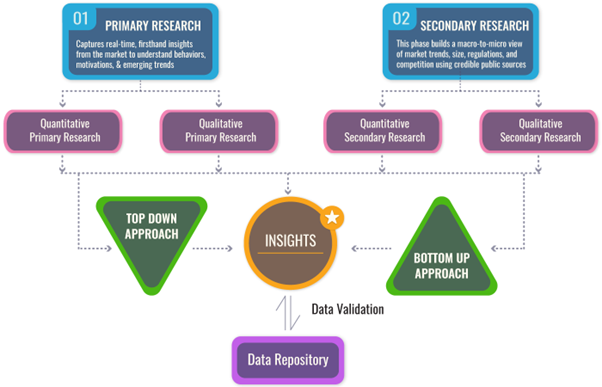
We follow a comprehensive, multi-phase research framework designed to deliver accurate, strategic, and decision-ready intelligence. Our process integrates primary and secondary research , both quantitative and qualitative , along with dual modeling techniques ( top-down and bottom-up) and a final layer of validation through our proprietary in-house repository.
PRIMARY RESEARCH
Primary research captures real-time, firsthand insights from the market to understand behaviors, motivations, and emerging trends.
1. Quantitative Primary Research
Objective: Generate statistically significant data directly from market participants.
Approaches:- Structured surveys with customers, distributors, and field agents
- Mobile-based data collection for point-of-sale audits and usage behavior
- Phone-based interviews (CATI) for market sizing and product feedback
- Online polling around industry events and digital campaigns
- Purchase frequency by customer type
- Channel performance across geographies
- Feature demand by application or demographic
2. Qualitative Primary Research
Objective: Explore decision-making drivers, pain points, and market readiness.
Approaches:- In-depth interviews (IDIs) with executives, product managers, and key decision-makers
- Focus groups among end users and early adopters
- Site visits and observational research for consumer products
- Informal field-level discussions for regional and cultural nuances
SECONDARY RESEARCH
This phase helps establish a macro-to-micro understanding of market trends, size, regulation, and competitive dynamics, sourced from credible and public domain information.
1. Quantitative Secondary Research
Objective: Model market value and segment-level forecasts based on published data.
Sources include:- Financial reports and investor summaries
- Government trade data, customs records, and regulatory statistics
- Industry association publications and economic databases
- Channel performance and pricing data from marketplace listings
- Revenue splits, pricing trends, and CAGR estimates
- Supply-side capacity and volume tracking
- Investment analysis and funding benchmarks
2. Qualitative Secondary Research
Objective: Capture strategic direction, innovation signals, and behavioral trends.
Sources include:- Company announcements, roadmaps, and product pipelines
- Publicly available whitepapers, conference abstracts, and academic research
- Regulatory body publications and policy briefs
- Social and media sentiment scanning for early-stage shifts
- Strategic shifts in market positioning
- Unmet needs and white spaces
- Regulatory triggers and compliance impact
DUAL MODELING: TOP-DOWN + BOTTOM-UP
To ensure robust market estimation, we apply two complementary sizing approaches:
Top-Down Modeling:- Start with broader industry value (e.g., global or regional TAM)
- Apply filters by segment, geography, end-user, or use case
- Adjust with primary insights and validation benchmarks
- Ideal for investor-grade market scans and opportunity mapping
- Aggregate from the ground up using sales volumes, pricing, and unit economics
- Use internal modeling templates aligned with stakeholder data
- Incorporate distributor-level or region-specific inputs
- Most accurate for emerging segments and granular sub-markets
DATA VALIDATION: IN-HOUSE REPOSITORY
We close the loop with proprietary data intelligence built from ongoing projects, industry monitoring, and historical benchmarking. This repository includes:
- Multi-sector market and pricing models
- Key trendlines from past interviews and forecasts
- Benchmarked adoption rates, churn patterns, and ROI indicators
- Industry-specific deviation flags and cross-check logic
- Catches inconsistencies early
- Aligns projections across studies
- Enables consistent, high-trust deliverables