

Manual Toothbrush Market Size and Forecast (2025–2033), Global and Regional Growth, Trend, Share and Industry Analysis Report Coverage: By Bristle Type (Ultra Soft, Medium, Firm), By End-User (Adults, Children), By Distribution Channel (Supermarkets & Hypermarkets, Convenience Stores, Department Stores, Online Retail, Others), and Geography
2026-02-25
Consumer Products
Jaya Bundele (Research Analyst)
Description
Manual Toothbrush Market Overview
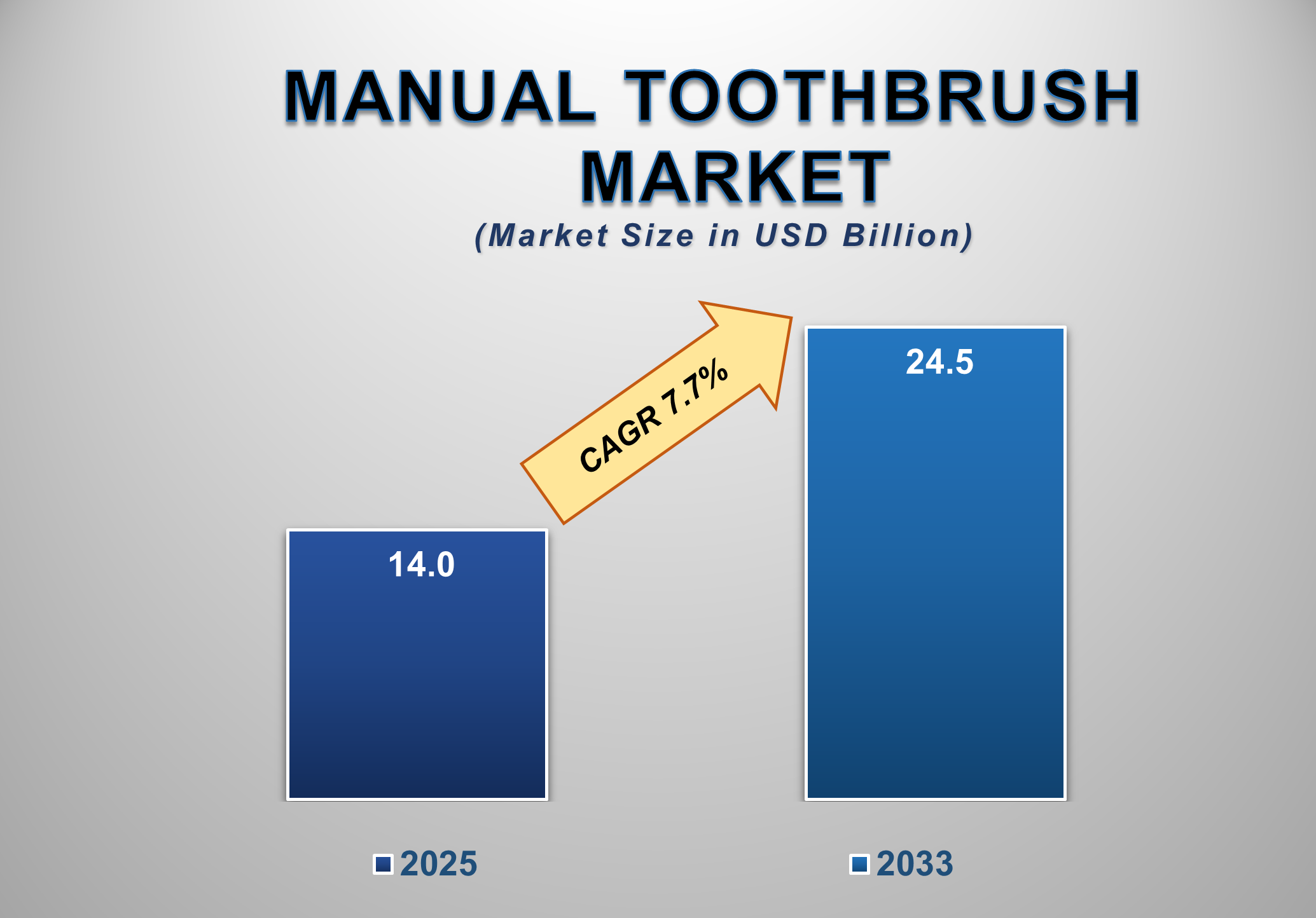
The global manual toothbrush market was valued at USD 14.0 billion in 2025 and is projected to reach USD 24.5 billion by 2033, expanding at a CAGR of 7.7% during the forecast period. Market growth is primarily driven by rising oral hygiene awareness, the increasing prevalence of dental disorders, growing adoption of preventive healthcare, and the affordability and accessibility of manual toothbrushes across both developed and emerging economies. Despite the growing penetration of electric toothbrushes, manual toothbrushes continue to dominate global oral care routines due to their low cost, ease of use, and wide availability.
Manual toothbrushes are
considered an essential daily-use personal care product, with demand supported
by recurring replacement cycles and widespread consumer acceptance. Dental
professionals continue to recommend manual toothbrushes, particularly ultra-soft
and soft bristle variants, for gum protection and enamel safety. Expanding
public health campaigns, school-based oral care programs, and government-led
hygiene initiatives are further reinforcing market demand.
Manual Toothbrush Market
Drivers and Opportunities
Rising Oral Hygiene
Awareness and Preventive Dental Care Are Driving Market Growth
Increasing awareness regarding oral hygiene and preventive dental
care is a key driver of the manual toothbrush market. Rising incidences of
dental caries, gingivitis, periodontal diseases, and tooth sensitivity have
encouraged consumers to adopt regular brushing habits. Healthcare professionals
and dental associations worldwide emphasize brushing twice daily as a
fundamental preventive measure, sustaining consistent demand for manual
toothbrushes. Government-led oral health awareness programs, especially in
developing regions, are expanding toothbrush adoption among rural and
low-income populations. School dental hygiene programs targeting children
further contribute to long-term market growth by instilling early brushing
habits. Manual toothbrushes remain the preferred choice in these initiatives
due to their affordability and ease of distribution. Furthermore, rising
healthcare expenditure and the growing emphasis on preventive healthcare are
prompting consumers to prioritize daily oral care routines. As awareness of the
link between oral health and systemic conditions such as cardiovascular disease
and diabetes grows, demand for reliable and accessible oral hygiene tools such
as manual toothbrushes continues to strengthen.
Affordability and Wide Distribution Networks Are Supporting
Market Expansion
The affordability of manual toothbrushes compared to electric
alternatives remains a critical growth driver. Manual toothbrushes are widely
available across supermarkets, convenience stores, pharmacies, department
stores, and online platforms, ensuring high product penetration across income
groups. This extensive distribution network makes manual toothbrushes the
default choice for a majority of consumers worldwide. Emerging markets, in
particular, rely heavily on manual toothbrushes due to price sensitivity and
limited access to electric alternatives. Manufacturers continue to offer a wide
range of products at different price points, catering to diverse consumer
needs. Bulk packaging, promotional pricing, and private-label offerings further
enhance market reach. Additionally, rapid growth in e-commerce and
direct-to-consumer sales channels is expanding product visibility and
availability. Online platforms allow consumers to access a wider variety of
toothbrush designs and brands, supporting market expansion even in remote
regions.
Sustainable and Eco-Friendly Toothbrushes Present a Key
Market Opportunity
Sustainability trends represent a significant opportunity for the manual toothbrush market. Growing environmental awareness is driving demand for eco-friendly toothbrushes made from biodegradable materials such as bamboo, recycled plastics, and plant-based polymers. Consumers are increasingly seeking sustainable alternatives to traditional plastic toothbrushes, creating new growth avenues for manufacturers. Several brands are introducing recyclable packaging, replaceable brush heads, and carbon-neutral production processes to align with sustainability goals. Regulatory pressure to reduce plastic waste is further encouraging innovation in eco-friendly toothbrush design. As sustainability becomes a key purchasing criterion, manufacturers that invest in green product development and transparent sourcing practices are expected to gain a competitive advantage. This shift toward environmentally responsible oral care products is anticipated to generate long-term growth opportunities in the manual toothbrush market
Manual Toothbrush Market
Scope
|
Report Attributes |
Description |
|
Market Size in 2025 |
USD 14.0 Billion |
|
Market Forecast in 2035 |
USD 24.5 Billion |
|
CAGR % 2025-2035 |
7.7% |
|
Base Year |
2024 |
|
Historic Data |
2020-2024 |
|
Forecast Period |
2025-2035 |
|
Report USP |
Production, Consumption,
Company Share, Company Heatmap, Company Production Capacity, Growth Factors,
and more |
|
Segments Covered |
●
By Bristle Type ●
By End-User ●
By Distribution
Channel |
|
Regional Scope |
●
North America, ●
Europe, ●
APAC, ●
Latin America ●
Middle East and
Africa |
|
Country Scope |
1)
U.S. 2)
Canada 3)
Germany 4)
UK 5)
France 6)
Spain 7)
Italy 8)
Switzerland 9)
China 10)
Japan 11)
India 12)
Australia 13)
South Korea 14)
Brazil 15)
Mexico 16)
Argentina 17)
South Africa 18)
Saudi Arabia 19)
UAE |
Manual Toothbrush Market
Report Segmentation Analysis
The Global Manual Toothbrush
Market Industry Analysis Is Segmented By Bristle Type, By End-User, By
Distribution Channel, and By Region.
Ultra Soft Bristle Segment Is Expected to Dominate the
Manual Toothbrush Market During the Forecast Period
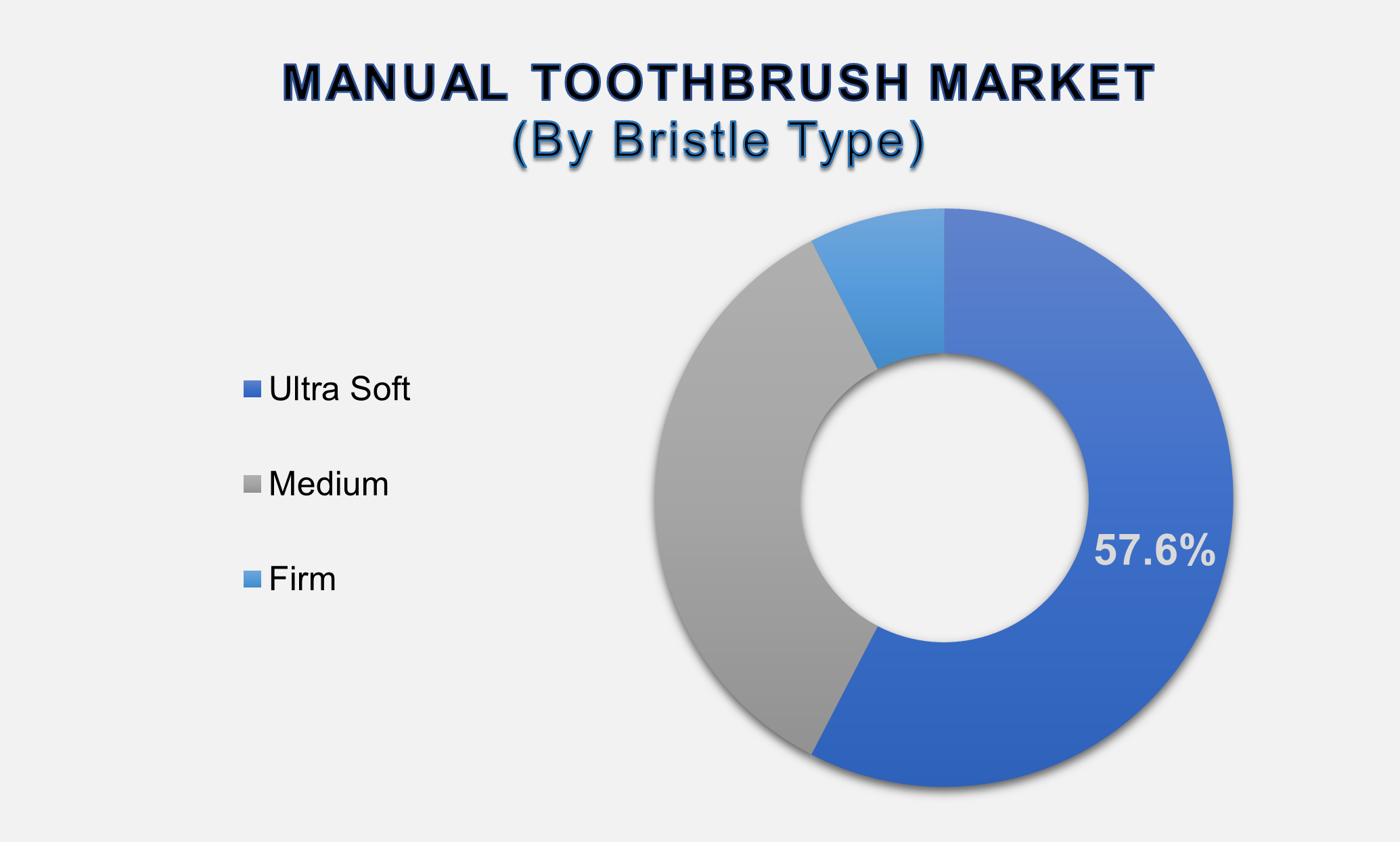
The ultra-soft bristle segment accounted for approximately 57.6% of the global manual toothbrush market, making it the dominant segment. This leadership is driven by increasing dental recommendations favoring ultra-soft bristles to prevent gum recession, enamel erosion, and tooth sensitivity. Consumers with sensitive gums, orthodontic appliances, and post-dental procedures increasingly prefer ultra-soft toothbrushes. Manufacturers are enhancing product designs with tapered bristles, flexible necks, and ergonomic handles to improve comfort and cleaning efficiency. As awareness of gentle oral care continues to grow, the ultra-soft segment is expected to maintain its dominance throughout the forecast period.
The Adult End-User Segment Is Expected to Lead Market Demand Through
2033
The adult segment is expected to hold the largest share of the
manual toothbrush market, supported by higher consumption frequency and routine
replacement cycles. Adults are more likely to purchase multiple toothbrush
variants for different oral care needs, including sensitivity, whitening, and
gum protection. Rising disposable income, increased focus on personal grooming,
and growing awareness of preventive dental care are driving demand among adult
consumers. Premium manual toothbrush offerings targeting adults further support
revenue growth in this segment.
Supermarkets
and Hypermarkets Are Expected to Remain the Leading Distribution Channel
Supermarkets
and hypermarkets are expected to dominate the distribution channel segment due
to their wide product assortment, competitive pricing, and high consumer
footfall. These retail formats allow consumers to compare brands and product
features easily, supporting purchase decisions. However, online retail is
emerging as a high-growth channel, driven by convenience, subscription models,
and access to premium and eco-friendly toothbrush options.
The following segments are
part of an in-depth analysis of the global Manual Toothbrush market:
|
Market Segments |
|
|
By Bristle
Type |
●
Ultra Soft ●
Medium ●
Firm |
|
By End-User |
●
Adults ●
Children |
|
By
Distribution Channel |
●
Supermarkets &
Hypermarkets ●
Convenience Stores ●
Department Stores ●
Online Retail ●
Others |
Manual Toothbrush Market
Share Analysis by Region
North America is
anticipated to hold the biggest portion of the Manual Toothbrush Market
globally throughout the forecast period.
North America accounted for
approximately 37.1% of the global manual toothbrush market in 2025, making it
the largest regional market. The region’s dominance is attributed to high oral
hygiene awareness, the strong presence of leading oral care brands, and
widespread access to dental healthcare services. Consumers in the United States
and Canada follow regular brushing routines and frequently replace
toothbrushes, supporting stable demand. Additionally, premium toothbrush
variants and dentist-recommended products witness strong adoption in the
region, further reinforcing North America’s leading position.
Asia Pacific is expected to
register the highest CAGR during the forecast period, driven by increasing
population, rising urbanization, and growing awareness of oral hygiene.
Government-led dental health initiatives, expanding middle-class population, and
rapid growth of organized retail are improving toothbrush penetration across
countries such as China, India, and Southeast Asian nations. Rising disposable
incomes and improved access to healthcare information are accelerating
adoption, positioning the Asia Pacific as the fastest-growing regional market.
Manual Toothbrush Market
Competition Landscape Analysis
The manual toothbrush market is
highly competitive, with global oral care brands and regional manufacturers
competing on product quality, pricing, innovation, and distribution reach.
Companies focus on product differentiation through bristle technology, ergonomic
design, sustainability, and branding. Strategic partnerships with retailers,
expansion of online presence, and eco-friendly product launches remain key
competitive strategies.
Global Manual Toothbrush
Market Recent Developments News:
- In September 2024 – FRESH 32, a Slovenian oral care
company, launched replaceable, 100% recyclable toothbrush heads made from
Desmopan thermoplastic polyurethanes (TPUs) supplied by Covestro. The
interchangeable heads are lightweight, durable, and resistant to abrasion
and microbial growth, contributing to significant plastic waste reduction.
- In November 2023 – Colgate-Palmolive introduced a
new bamboo toothbrush featuring natural antimicrobial properties and fully
recyclable packaging. The launch reinforces the company's sustainability
commitment and aims to strengthen its market position among eco-conscious
consumers.
- In October 2021 – Oral-B (Procter & Gamble)
launched DROP SWAP SMILE, a nationwide Australian initiative in
partnership with Shaver Shop and Veolia. The program provides consumers
with a sustainable disposal option for used toothbrushes, promoting responsible
oral care waste management.
- In September 2021 – GSK Consumer Healthcare
(GSKCH), a joint venture between GSK and Pfizer, launched the Dr. BEST
GreenClean toothbrush, a carbon-neutral toothbrush. The handle is made
from renewable cellulose derived from birch, pine, and spruce from sustainable
forests, while the bristles are made from 100% renewable castor oil. The
product is packaged in 100% plastic-free materials.
- In February 2021 – Colgate-Palmolive launched a
manual toothbrush featuring a replaceable head and reusable aluminum
handle, containing 80% less plastic than previous models. The 100%
reusable handle is lightweight and available in silver and navy colors.
The Global Manual Toothbrush Market
Is Dominated by a Few Large Companies, such as
●
Colgate-Palmolive
●
Procter & Gamble
●
Unilever
●
Sunstar Group (GUM)
●
Lion Corporation
●
Curaprox
●
Sensodyne
(GlaxoSmithKline)
●
Dr. Fresh
●
Church & Dwight
(Arm & Hammer)
●
Nimbus
●
Boie USA
●
Dr. Collins
●
Dabur
●
Patanjali Ayurved
Limited
●
Wellness Oral Care
●
Perrigo
●
Johnson & Johnson
●
Henkel
●
LG Household &
Health Care
●
GC Corporation
● Others
Frequently Asked Questions
Jaya Bundele (Research Analyst)
Jaya Bundele is a skilled Research Analyst with 4+ years of experience in market intelligence, consumer insights, competitive analysis, and industry forecasting across the consumer goods, agriculture, and food & beverage sectors. She specializes in market sizing, trend analysis, growth opportunity mapping, and strategic secondary research for global and regional markets.
Her expertise lies in transforming complex industry data into actionable business strategies that help organizations identify emerging trends, understand customer behavior, and gain a competitive edge. With a strong focus on data-driven insights, business intelligence, and future market trends, Jaya delivers high-quality research solutions aligned with evolving industry demands and market dynamics.
1. Global Manual Toothbrush
Market Introduction and Market Overview
1.1.
Objectives
of the Study
1.2.
Global
Manual Toothbrush Market Scope and Market Estimation
1.2.1.Global Manual Toothbrush Overall
Market Size (US$ Bn), Market CAGR (%), Market forecast (2025 - 2033)
1.2.2.Global Manual Toothbrush
Market Revenue Share (%) and Growth Rate (Y-o-Y) from 2020 - 2033
1.3.
Market
Segmentation
1.3.1.Bristle Type of Global Manual
Toothbrush Market
1.3.2.End-User of Global Manual
Toothbrush Market
1.3.3.Distribution Channel of
Global Manual Toothbrush Market
1.3.4.Region of Global Manual
Toothbrush Market
2. Executive
Summary
2.1.
Demand
Side Trends
2.2.
Key
Market Trends
2.3.
Market
Demand (US$ Bn) Analysis 2020 – 2024 and Forecast, 2025 – 2033
2.4.
Demand
and Opportunity Assessment
2.5.
Key
Developments
2.6.
Overview
of Tariff, Regulatory Landscape and Standards
2.7.
Market
Entry Strategies
2.8.
Market
Dynamics
2.8.1.Drivers
2.8.2.Limitations
2.8.3.Opportunities
2.8.4.Impact Analysis of Drivers
and Restraints
2.9.
Porter’s
Five Forces Analysis
2.10.
PEST
Analysis
3. Global
Manual Toothbrush Market Estimates
& Historical Trend Analysis (2020 - 2024)
4. Global
Manual Toothbrush Market Estimates
& Forecast Trend Analysis, by Bristle Type
4.1.
Global
Manual Toothbrush Market Revenue (US$ Bn) Estimates and Forecasts, by Bristle
Type, 2020 - 2033
4.1.1.Ultra Soft
4.1.2.Medium
4.1.3.Firm
5. Global
Manual Toothbrush Market Estimates
& Forecast Trend Analysis, by End-User
5.1.
Global
Manual Toothbrush Market Revenue (US$ Bn) Estimates and Forecasts, by End-User,
2020 - 2033
5.1.1.Adults
5.1.2.Children
6. Global
Manual Toothbrush Market Estimates
& Forecast Trend Analysis, by Distribution Channel
6.1.
Global
Manual Toothbrush Market Revenue (US$ Bn) Estimates and Forecasts, by Distribution
Channel, 2020 - 2033
6.1.1.Supermarkets &
Hypermarkets
6.1.2.Convenience Stores
6.1.3.Department Stores
6.1.4.Online Retail
6.1.5.Others
7. Global
Manual Toothbrush Market Estimates
& Forecast Trend Analysis, by Region
7.1.
Global
Manual Toothbrush Market Revenue (US$ Bn) Estimates and Forecasts, by Region, 2020
- 2033
7.1.1.North America
7.1.2.Europe
7.1.3.Asia Pacific
7.1.4.Middle East & Africa
7.1.5.Latin America
8. North America Manual
Toothbrush Market: Estimates &
Forecast Trend Analysis
8.1.
North
America Manual Toothbrush Market Assessments & Key Findings
8.1.1.North America Manual
Toothbrush Market Introduction
8.1.2.North America Manual
Toothbrush Market Size Estimates and Forecast (US$ Billion) (2020 - 2033)
8.1.2.1. By Bristle
Type
8.1.2.2. By End-User
8.1.2.3. By Distribution
Channel
8.1.2.4.
By
Country
8.1.2.4.1. The U.S.
8.1.2.4.2. Canada
9. Europe Manual
Toothbrush Market: Estimates &
Forecast Trend Analysis
9.1.
Europe
Manual Toothbrush Market Assessments & Key Findings
9.1.1.Europe Manual Toothbrush
Market Introduction
9.1.2.Europe Manual Toothbrush
Market Size Estimates and Forecast (US$ Billion) (2020 - 2033)
9.1.2.1. By Bristle
Type
9.1.2.2. By End-User
9.1.2.3. By Distribution
Channel
9.1.2.4.
By
Country
9.1.2.4.1.
Germany
9.1.2.4.2.
Italy
9.1.2.4.3.
U.K.
9.1.2.4.4.
France
9.1.2.4.5.
Spain
9.1.2.4.6.
Switzerland
9.1.2.4.7. Rest
of Europe
10. Asia Pacific Manual
Toothbrush Market: Estimates &
Forecast Trend Analysis
10.1.
Asia
Pacific Market Assessments & Key Findings
10.1.1.
Asia
Pacific Manual Toothbrush Market Introduction
10.1.2.
Asia
Pacific Manual Toothbrush Market Size Estimates and Forecast (US$ Billion) (2020
- 2033)
10.1.2.1. By Bristle
Type
10.1.2.2. By End-User
10.1.2.3. By Distribution
Channel
10.1.2.4.
By
Country
10.1.2.4.1. China
10.1.2.4.2. Japan
10.1.2.4.3. India
10.1.2.4.4. Australia
10.1.2.4.5. South Korea
10.1.2.4.6. Rest of Asia Pacific
11. Middle East & Africa Manual
Toothbrush Market: Estimates &
Forecast Trend Analysis
11.1.
Middle
East & Africa Market Assessments & Key Findings
11.1.1.
Middle East & Africa Manual Toothbrush Market
Introduction
11.1.2.
Middle East & Africa Manual Toothbrush Market Size Estimates
and Forecast (US$ Billion) (2020 - 2033)
11.1.2.1. By Bristle
Type
11.1.2.2. By End-User
11.1.2.3. By Distribution
Channel
11.1.2.4.
By
Country
11.1.2.4.1. UAE
11.1.2.4.2. Saudi
Arabia
11.1.2.4.3. South
Africa
11.1.2.4.4. Rest
of MEA
12. Latin America
Manual Toothbrush Market: Estimates
& Forecast Trend Analysis
12.1.
Latin
America Market Assessments & Key Findings
12.1.1.
Latin
America Manual Toothbrush Market Introduction
12.1.2.
Latin
America Manual Toothbrush Market Size Estimates and Forecast (US$ Billion) (2020
- 2033)
12.1.2.1. By Bristle
Type
12.1.2.2. By End-User
12.1.2.3. By Distribution
Channel
12.1.2.4.
By
Country
12.1.2.4.1. Brazil
12.1.2.4.2. Argentina
12.1.2.4.3. Mexico
12.1.2.4.4. Rest
of LATAM
13. Country Wise Market:
Introduction
14.
Competition
Landscape
14.1.
Global
Manual Toothbrush Market Product Mapping
14.2.
Global
Manual Toothbrush Market Concentration Analysis, by Leading Players /
Innovators / Emerging Players / New Entrants
14.3.
Global
Manual Toothbrush Market Tier Structure Analysis
14.4.
Global
Manual Toothbrush Market Concentration & Company Market Shares (%)
Analysis, 2024
15.
Company
Profiles
15.1.
Colgate-Palmolive
15.1.1.
Company
Overview & Key Stats
15.1.2.
Financial
Performance & KPIs
15.1.3.
Product
Portfolio
15.1.4.
SWOT
Analysis
15.1.5.
Business
Strategy & Recent Developments
* Similar details would be provided for all the players
mentioned below
15.2. Procter
& Gamble
15.3. Unilever
15.4. Sunstar
Group (GUM)
15.5. Lion
Corporation
15.6. Curaprox
15.7. Sensodyne
(GlaxoSmithKline)
15.8. Dr.
Fresh
15.9. Church
& Dwight (Arm & Hammer)
15.10. Nimbus
15.11. Boie USA
15.12. Dr.
Collins
15.13. Dabur
15.14. Patanjali
Ayurved Limited
15.15. Wellness
Oral Care
15.16. Perrigo
15.17. Johnson
& Johnson
15.18. Henkel
15.19. LG
Household & Health Care
15.20. GC
Corporation
15.21. Others
16. Research
Methodology
16.1.
External
Transportations / Databases
16.2.
Internal
Proprietary Database
16.3.
Primary
Research
16.4.
Secondary
Research
16.5.
Assumptions
16.6.
Limitations
16.7.
Report
FAQs
17. Research
Findings & Conclusion
Our Research Methodology
"Insight without rigor is just noise."
We follow a comprehensive, multi-phase research framework designed to deliver accurate, strategic, and decision-ready intelligence. Our process integrates primary and secondary research , both quantitative and qualitative , along with dual modeling techniques ( top-down and bottom-up) and a final layer of validation through our proprietary in-house repository.
PRIMARY RESEARCH
Primary research captures real-time, firsthand insights from the market to understand behaviors, motivations, and emerging trends.
1. Quantitative Primary Research
Objective: Generate statistically significant data directly from market participants.
Approaches:- Structured surveys with customers, distributors, and field agents
- Mobile-based data collection for point-of-sale audits and usage behavior
- Phone-based interviews (CATI) for market sizing and product feedback
- Online polling around industry events and digital campaigns
- Purchase frequency by customer type
- Channel performance across geographies
- Feature demand by application or demographic
2. Qualitative Primary Research
Objective: Explore decision-making drivers, pain points, and market readiness.
Approaches:- In-depth interviews (IDIs) with executives, product managers, and key decision-makers
- Focus groups among end users and early adopters
- Site visits and observational research for consumer products
- Informal field-level discussions for regional and cultural nuances
SECONDARY RESEARCH
This phase helps establish a macro-to-micro understanding of market trends, size, regulation, and competitive dynamics, sourced from credible and public domain information.
1. Quantitative Secondary Research
Objective: Model market value and segment-level forecasts based on published data.
Sources include:- Financial reports and investor summaries
- Government trade data, customs records, and regulatory statistics
- Industry association publications and economic databases
- Channel performance and pricing data from marketplace listings
- Revenue splits, pricing trends, and CAGR estimates
- Supply-side capacity and volume tracking
- Investment analysis and funding benchmarks
2. Qualitative Secondary Research
Objective: Capture strategic direction, innovation signals, and behavioral trends.
Sources include:- Company announcements, roadmaps, and product pipelines
- Publicly available whitepapers, conference abstracts, and academic research
- Regulatory body publications and policy briefs
- Social and media sentiment scanning for early-stage shifts
- Strategic shifts in market positioning
- Unmet needs and white spaces
- Regulatory triggers and compliance impact
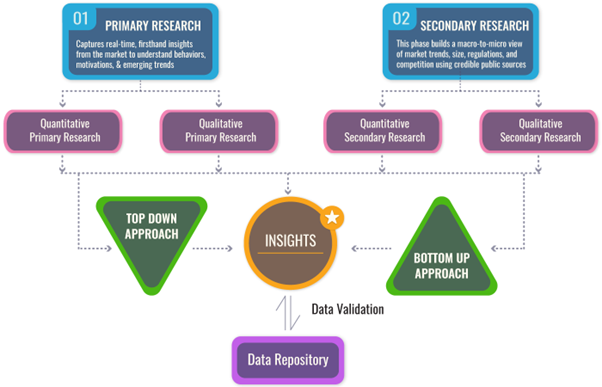
DUAL MODELING: TOP-DOWN + BOTTOM-UP
To ensure robust market estimation, we apply two complementary sizing approaches:
Top-Down Modeling:- Start with broader industry value (e.g., global or regional TAM)
- Apply filters by segment, geography, end-user, or use case
- Adjust with primary insights and validation benchmarks
- Ideal for investor-grade market scans and opportunity mapping
- Aggregate from the ground up using sales volumes, pricing, and unit economics
- Use internal modeling templates aligned with stakeholder data
- Incorporate distributor-level or region-specific inputs
- Most accurate for emerging segments and granular sub-markets
DATA VALIDATION: IN-HOUSE REPOSITORY
We close the loop with proprietary data intelligence built from ongoing projects, industry monitoring, and historical benchmarking. This repository includes:
- Multi-sector market and pricing models
- Key trendlines from past interviews and forecasts
- Benchmarked adoption rates, churn patterns, and ROI indicators
- Industry-specific deviation flags and cross-check logic
- Catches inconsistencies early
- Aligns projections across studies
- Enables consistent, high-trust deliverables