

Marble Tile Market Size and Forecast (2026–2034), Global and Regional Growth, Trend, Share and Industry Analysis Report Coverage; By Product Type, By Color, By Finish, By Application, By Distribution Channel, and Geography
2026-09-28
Real Estate & Infrastructure
Ekta Chaurasia (Team Lead)
Description
Marble Tile Market Overview
The global Marble
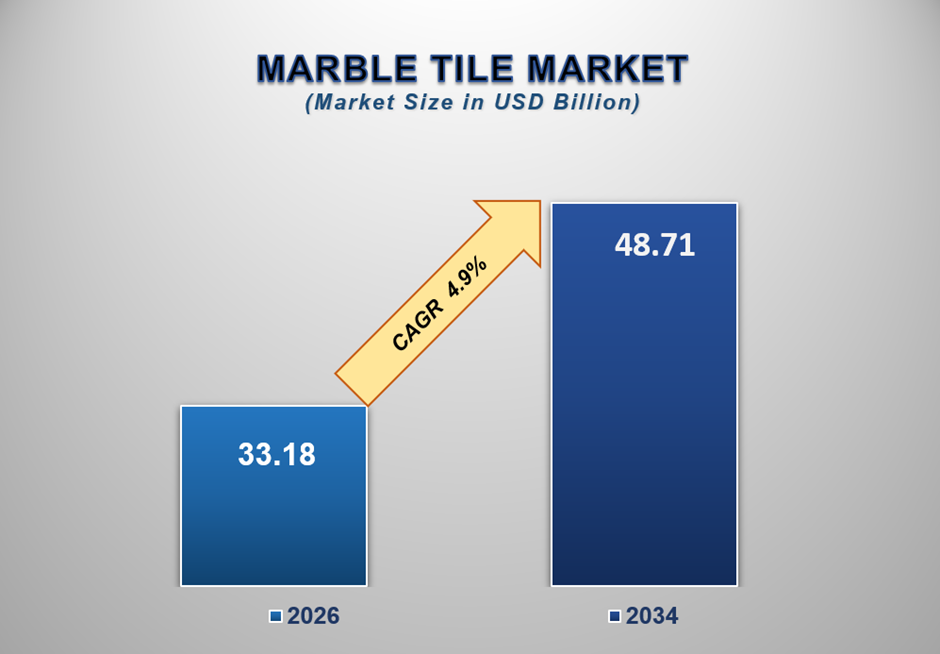
Tile Market is estimated at USD 33.18 billion in 2026 and is
projected to reach approximately USD 48.71 billion by 2034, registering
a CAGR of approximately 4.9% during 2026–2034. The calculation is
mathematically consistent with the supplied market values. The market includes
natural marble tiles manufactured, cut, processed and finished for flooring,
walls, bathrooms, kitchens, commercial interiors, hospitality projects and other
architectural applications.
Marble tiles
occupy a premium position within the broader flooring industry because they
combine natural veining, color variation, durability, and a distinctive visual
appearance. Demand is closely associated with residential construction, luxury
housing, hospitality, commercial real estate, and renovation activity. Unlike
standardized ceramic or porcelain products, natural marble provides
considerable variation between slabs and batches, making stone selection,
finishing, and fabrication important parts of the purchasing decision.
The market is
increasingly influenced by premiumization in interior design.
Residential consumers and commercial developers are using marble not only for
conventional flooring but also for feature walls, bathrooms, entrance areas,
countertops, staircases and integrated interior surfaces. White and
light-colored marble varieties remain particularly attractive because they can
create a visually larger and brighter interior while fitting contemporary
design styles.
Technological
improvements in cutting, polishing, calibration, and surface treatment are also
expanding the usable range of marble tiles. Precision cutting allows
manufacturers to supply more consistent dimensions, while modern finishing
technologies can produce honed, polished, brushed, leathered, and other surface
effects. These processes help suppliers serve both traditional architectural
requirements and contemporary interior-design preferences.
The market also
benefits from renovation and remodeling. Existing residential and commercial
properties increasingly undergo flooring replacement and interior refurbishment
rather than complete reconstruction. Marble tiles can therefore capture demand
from both new construction and replacement cycles, particularly in
higher-income residential markets and premium hospitality properties.
Sustainability
is becoming a more important purchasing consideration. Natural stone has a long
service life, but its environmental profile is affected by quarrying, water
consumption, processing energy, and transportation distances. This is
encouraging producers and fabricators to improve resource efficiency, optimize
cutting yields, and increase the utilization of processing residues.
The
international nature of the marble supply chain creates another important
market dynamic. Italy, Turkey, India, Spain, Greece and other producing
countries supply distinctive marble varieties to construction and interior
markets globally. However, transportation costs, shipping disruptions, currency
movements and geopolitical conditions can affect landed prices. India's tile
and marble industry, for example, continued to report strong domestic demand in
2026 despite higher freight costs and supply-chain pressure associated with Red
Sea disruptions.
Demand is also
moving toward larger formats, customized dimensions and distinctive stone
patterns. Architects and designers increasingly specify particular marble
varieties based on veining, color consistency and finish rather than treating
marble simply as a commodity flooring material. This creates opportunities for
suppliers that can provide digital cataloging, sample visualization, customized
cutting and reliable quality grading.
Asia Pacific
remains an important production and consumption center because of its
construction activity, manufacturing capabilities and expanding residential and
commercial development. India and China have substantial domestic
stone-processing ecosystems, while Japan, South Korea and Australia represent
higher-value architectural and renovation markets.
Europe maintains
strong influence through its historic marble-processing industry, design
heritage and premium stone varieties. Italy and Spain in particular remain
associated with high-end natural stone products, while demand across European
markets is supported by renovation, hospitality and architectural applications.
North America
represents an attractive market for premium marble tiles, especially in luxury
residential construction, hospitality, retail and high-end remodeling. Latin
America and the Middle East & Africa also provide opportunities through
residential development, hotels, commercial projects and luxury construction.
The market
nevertheless faces competition from porcelain slabs, engineered stone,
ceramic tiles and other stone-look surfaces. Improvements in digital
printing have enabled alternative materials to reproduce marble-like textures
with greater consistency and, in some applications, lower maintenance
requirements. Consequently, marble suppliers increasingly compete on
authenticity, exclusivity, natural variation and premium design rather than
price alone.
Marble Tile Market Drivers and
Opportunities
Growth in
Premium Residential and Commercial Construction
Increasing
investment in high-end residential construction is one of the strongest demand
drivers for marble tiles. Luxury homes, villas, apartments and custom-built
residences frequently use marble in flooring, bathrooms, entrance areas and
decorative walls because of its premium appearance.
Commercial
construction also supports demand through hotels, resorts, corporate offices,
upscale retail stores, and restaurants. Hospitality projects are particularly
important because designers often use natural stone to create distinctive
interiors that reinforce a property's premium positioning.
India provides
an example of this broader construction-driven demand. Recent industry
reporting indicates that strong domestic housing activity has helped India's
tiles and marble sector remain resilient despite increased freight and
logistics costs.
Renovation,
Remodeling and Interior Premiumization
Renovation is
expanding the addressable market beyond new construction. Homeowners are
replacing older flooring, upgrading bathrooms and kitchens and incorporating
natural stone into selective architectural features.
Premiumization
is especially relevant because marble tiles can be used selectively rather than
throughout an entire property. Designers may combine marble flooring with wood,
engineered surfaces, or ceramic products, allowing consumers to use premium stone
in visually important areas without absorbing the cost of an entire marble
interior.
The growing
preference for natural textures and individually distinctive materials also
favors marble over highly standardized flooring products. Each marble variety
offers different veining and tonal characteristics, providing designers with a
degree of exclusivity that digitally printed alternatives cannot fully
replicate.
Processing
Innovation and New Design Opportunities
Advances in
stone processing are creating opportunities for manufacturers to deliver more
precise and design-oriented products. Automated cutting, computer-controlled
polishing, water-jet processing and improved surface treatments enable more
consistent dimensions and customized designs.
Manufacturers
are also improving yield from quarried blocks by optimizing cutting patterns
and developing smaller-format or decorative products from material that may
previously have been less commercially attractive. This can improve resource
utilization while creating additional product categories.
Another
opportunity is the development of premium finished marble tiles with
specialized textures and surface treatments. Polished, honed, brushed and other
finishes allow the same underlying stone to serve different architectural
styles and functional requirements.
Marble Tile Market Scope
|
Report Attributes |
Description |
|
Market Size in 2026 |
USD 33.18 Billion |
|
Market Forecast in 2034 |
USD 48.71 Billion |
|
CAGR % 2026-2034 |
4.9% |
|
Base Year |
2025 |
|
Historic Data |
2021-2025 |
|
Forecast Period |
2026-2034 |
|
Report USP |
Production, Consumption,
Company Share, Company Heatmap, Company Production, Service Type, Growth
Factors and more |
|
Segments Covered |
By Product Type By Distribution Channel |
|
Regional Scope |
● North America |
|
Country Scope |
U.S. |
Marble Tile Market Report
Segmentation Analysis
The Marble Tile
Market is segmented according to product format, color, surface finish,
application and distribution channel. Product specifications and architectural
preferences have a direct influence on purchasing decisions, while construction
activity and renovation spending determine overall demand.
By Product
Type
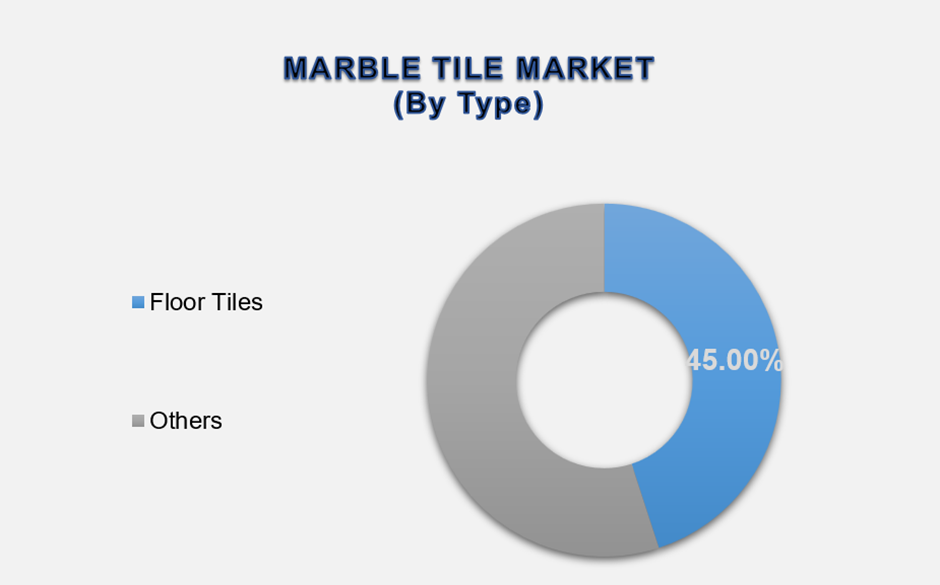
Floor Tiles represent the leading product category because flooring remains one
of the most established applications for marble. Marble flooring is widely used
in premium residential properties, hotels, offices, retail environments and
entrance areas where durability and visual impact are important.
Wall tiles and
decorative marble tiles are increasingly used in bathrooms, kitchens, feature
walls, and commercial interiors. Large-format tiles are also gaining attention
because they reduce the number of visible joints and can create a continuous
stone appearance.
Mosaic products
occupy a more specialized segment, particularly in decorative interiors,
bathrooms and hospitality projects. Their smaller dimensions allow designers to
incorporate intricate patterns and customized layouts.
By Color
White marble
remains highly sought after because of its association with luxury, brightness
and contemporary interior design. Varieties with pronounced veining are
particularly valued for feature applications.
Black and
dark-colored marble provides contrast and is commonly used for statement walls,
flooring, bathrooms and commercial interiors. Beige and cream varieties remain
versatile choices for residential and hospitality projects because they
complement a wide range of furniture and architectural finishes.
Green, red, pink
and other distinctive colors serve more specialized design requirements and can
command premium pricing when the stone has unusual patterns or limited
availability.
By Finish
Polished marble
remains widely used where a reflective, high-luxury appearance is desired.
Honed finishes offer a softer appearance and can be preferred in applications
where a less reflective surface is appropriate.
Brushed, tumbled
and leathered finishes provide additional textural choices and allow natural
stone to be incorporated into contemporary, rustic and heritage-inspired
interiors. Surface treatment also affects maintenance characteristics, slip
behavior and the suitability of marble for different locations.
By
Application
Residential
applications represent an important source of demand because marble is used in
flooring, bathrooms, kitchens, staircases and entrance areas. High-income
households and luxury housing projects provide particularly strong
opportunities.
Commercial and
hospitality applications emphasize visual differentiation. Hotels, resorts,
restaurants, retail stores and corporate properties use marble to establish a
premium architectural identity.
Institutional
projects, including upscale healthcare, educational and public facilities,
provide additional opportunities where design, durability and long service life
are prioritized.
By
Distribution Channel
Direct sales are
important for large construction and architectural projects because buyers
often require customized dimensions, specific stone varieties and project-level
technical support.
Specialty stone
dealers and distributors remain important for residential and smaller
commercial projects. These channels provide access to multiple varieties and
allow customers to physically inspect stone characteristics before purchase.
Home improvement
stores and online channels are becoming more relevant as consumers research
materials digitally and increasingly compare products, finishes, and prices
before visiting a physical showroom.
The following
segments are part of an in-depth analysis of the Marble Tile Market:
|
Market Segments |
|
|
By Type |
●
Floor Tiles ●
Wall Tiles ●
Mosaic Tiles ●
Large-Format Marble Tiles ●
Other Marble Tiles |
|
By
Color |
●
White ●
Black ●
Beige/Cream ●
Brown ●
Green ●
Red/Pink ●
Others |
|
By Finish |
●
Polished ●
Honed ●
Brushed ●
Tumbled ●
Leathered ●
Others |
|
By Application |
●
Residential ●
Commercial ●
Hospitality ●
Retail ●
Institutional ●
Others |
|
By
Distribution Channel |
●
Direct Sales ●
Specialty Stone Dealers ●
Distributors ●
Home Improvement Stores ●
Online Channels ●
Others |
Marble Tile Market Share Analysis By
Region
North America is
supported by luxury residential construction, commercial remodeling and
hospitality development. The U.S. remains the principal regional market, with
demand concentrated in premium interiors and renovation projects.
Europe has a
strong relationship with natural stone because of its architectural heritage
and established processing industry. Italy and Spain are particularly important
within the European marble ecosystem, while renovation and restoration projects
provide recurring demand.
Asia Pacific is
a major production and consumption region. China and India combine substantial
construction demand with large stone-processing capabilities. Japan, South
Korea, and Australia contribute demand through premium residential, commercial
and hospitality applications. Broader marble-market research identifies Asia
Pacific as a major regional market, supported by construction activity and
natural-stone resources.
Latin America
offers growth opportunities through residential construction, commercial
development and hospitality projects. Brazil and Mexico are the most
significant markets within the region.
The Middle East and Africa provide opportunities through luxury hotels, resorts, high-end residential developments, and large-scale commercial projects. Demand is particularly influenced by premium architectural projects in Gulf economies.
Marble Tile
Market Competition Landscape Analysis
The marble tile
market remains highly fragmented compared with standardized ceramic flooring
because products differ by quarry, stone variety, processing quality, color,
veining, and finish. Competition therefore occurs at both the manufacturing and
distribution levels.
Major
participants include Antolini Luigi & C., Levantina, Temmer Marble,
Daltile, MSI Surfaces, Polycor, Marmoles Arca, Fox Marble Holdings, Topalidis,
and Mumal Marbles, along with numerous regional quarry operators,
processors, tile manufacturers and specialty distributors.
Italian and
Spanish suppliers compete strongly in premium natural stone, while Turkish,
Indian, and Chinese producers benefit from large quarry resources and
processing capabilities. Indian suppliers are particularly relevant to the
international market because the country combines domestic stone availability
with an established processing and export ecosystem.
The competitive
environment is increasingly influenced by quality consistency, processing
precision, logistics reliability, product traceability, and customized
fabrication. Suppliers that can combine distinctive stone varieties with
reliable dimensional accuracy and shorter delivery cycles are better positioned
to serve architects, contractors, and premium residential buyers.
Competition from porcelain and engineered surfaces remains a strategic challenge. These alternatives can offer more predictable dimensions, lower maintenance requirements, and digitally reproduced marble aesthetics. Natural-marble companies therefore increasingly emphasize authenticity, unique veining, material longevity, and premium craftsmanship.
Global Marble
Tile Market Recent Developments News
July 2026 –
Indian tiles and marble industry: India's tiles and
marble sector remained resilient despite increased freight rates and
supply-chain disruption linked to Red Sea shipping conditions. Strong domestic
housing demand provided an important buffer for the industry.
2026 –
Premium natural-stone demand: Current marble-market
research identifies premium residential interiors, hospitality, construction
and renovation as important demand areas, with increasing consumer preference
for aesthetic and distinctive natural materials.
2026 –
Processing and product innovation: The industry
continues to invest in precision fabrication, surface finishing, and customized
natural-stone products. These capabilities are becoming increasingly important
as architects specify particular colors, textures, dimensions and veining
patterns rather than generic marble products.
2026 – Competitive pressure from alternative surfaces: Marble suppliers increasingly compete with porcelain, ceramic and engineered surfaces that reproduce marble aesthetics. This is encouraging natural-stone suppliers to differentiate through authenticity, exclusive varieties, premium finishing and customized fabrication.
The Global
Marble Tile Market is Dominated by a Few Large Companies, Such As
●
Antolini Luigi & C.
●
Levantina
●
Temmer Marble
●
Daltile
●
MSI Surfaces
●
Polycor
●
Marmoles Arca
●
Fox Marble Holdings
●
Topalidis
●
Mumal Marbles
●
Margraf
●
Marmi Rossi
●
TINO Natural Stone
●
Best Cheer Stone
● Others
Frequently Asked Questions
Ekta Chaurasia (Team Lead)
Ekta Chaurasia is a highly experienced Team Lead at M2Square Consultancy with over 7 years of expertise in market research, strategic consulting, competitive benchmarking, and business intelligence solutions. She specializes in ICT, semiconductors & electronics, automotive & transportation, and industrial machinery markets.
She leads end-to-end global research projects focused on market trends, industry analysis, growth forecasting, customer insights, and strategic decision-making. Known for her analytical leadership and industry expertise, Ekta helps businesses uncover growth opportunities, evaluate competitive landscapes, and stay ahead in rapidly evolving markets through accurate and insight-driven research.
1.
Global Marble Tile
Market Introduction and Market Overview
1.1. Objectives of the Study
1.2. Global Marble Tile Market Scope and Market Estimation
1.2.1.
Global Marble Tile Market
Market Size (US$ Million), Market CAGR (%), Market Forecast (2026 - 2034)
1.2.2.
Global Marble Tile Market
Revenue Share (%) and Growth Rate (Y-o-Y) Analysis (2021 - 2034)
1.3. Market Segmentation
1.3.1.
Product Type of Global Marble
Tile Market
1.3.2.
Color of Global Marble Tile
Market
1.3.3.
Finish of Global Marble Tile
Market
1.3.4.
Application of Global Marble
Tile Market
1.3.5.
Distribution Channel of Global
Marble Tile Market
1.3.6.
Region of Global Marble Tile
Market
1.4. Competition Coverage List of Market Participants
1.5. Market Definition: Marble Tile Market
2.
Executive Summary
2.1. Demand Side Trends
2.2. Key Market Trends
2.3. Market Demand (US$ Million) Analysis 2021 – 2025 and Forecast, 2026
– 2034
2.4. Demand and Opportunity Assessment
2.5. Key Developments
2.6. Overview of Regulatory Landscape, Compliance Framework, and Industry
Standards
2.7. Market Entry Strategies
2.8. Market Dynamics
2.8.1.
Drivers
2.8.2.
Limitations
2.8.3.
Opportunities
2.8.4.
Impact Analysis of Drivers and
Restraints
2.9. Porter's Five Forces Analysis
2.10.
PEST Analysis
3.
Global Marble Tile
Market Estimates & Historical Trend Analysis (2021 - 2025)
4.
Global Marble Tile
Market Estimates & Forecast Trend Analysis, by Product Type
4.1. Global Marble Tile Market Revenue (US$ Million) Estimates and
Forecasts, by Product Type, 2021 - 2034
4.1.1.
Floor Tiles
4.1.2.
Wall Tiles
4.1.3.
Mosaic Tiles
4.1.4.
Large-Format Marble Tiles
4.1.5.
Other Marble Tiles
5.
Global Marble Tile
Market Estimates & Forecast Trend Analysis, by Color
5.1. Global Marble Tile Market Revenue (US$ Million) Estimates and
Forecasts, by Color, 2021 - 2034
5.1.1.
White
5.1.2.
Black
5.1.3.
Beige/Cream
5.1.4.
Brown
5.1.5.
Green
5.1.6.
Red/Pink
5.1.7.
Others
6.
Global Marble Tile
Market Estimates & Forecast Trend Analysis, by Finish
6.1. Global Marble Tile Market Revenue (US$ Million) Estimates and
Forecasts, by Finish, 2021 - 2034
6.1.1.
Polished
6.1.2.
Honed
6.1.3.
Brushed
6.1.4.
Tumbled
6.1.5.
Leathered
6.1.6.
Others
7.
Global Marble Tile
Market Estimates & Forecast Trend Analysis, by Application
7.1. Global Marble Tile Market Revenue (US$ Million) Estimates and
Forecasts, by Application, 2021 - 2034
7.1.1.
Residential
7.1.2.
Commercial
7.1.3.
Hospitality
7.1.4.
Retail
7.1.5.
Institutional
7.1.6.
Others
8.
Global Marble Tile
Market Estimates & Forecast Trend Analysis, by Distribution Channel
8.1. Global Marble Tile Market Revenue (US$ Million) Estimates and
Forecasts, by Distribution Channel, 2021 - 2034
8.1.1.
Direct Sales
8.1.2.
Specialty Stone Dealers
8.1.3.
Distributors
8.1.4.
Home Improvement Stores
8.1.5.
Online Channels
8.1.6.
Others
9.
Global Marble Tile
Market Estimates & Forecast Trend Analysis, by Region
9.1. Global Marble Tile Market Revenue (US$ Million) Estimates and
Forecasts, by Region, 2021 - 2034
9.1.1.
North America
9.1.2.
Europe
9.1.3.
Asia Pacific
9.1.4.
Middle East & Africa
9.1.5.
Latin America
10. North America Marble Tile Market: Estimates & Forecast Trend
Analysis
10.1.
North America Marble Tile
Market Assessments & Key Findings
10.1.1.
North America Marble Tile
Market Introduction
10.1.2.
North America Marble Tile
Market Size Estimates and Forecast (US$ Million) (2021 - 2034)
10.1.2.1.
By Product Type
10.1.2.2.
By Color
10.1.2.3.
By Finish
10.1.2.4.
By Application
10.1.2.5.
By Distribution Channel
10.1.2.6.
By Country
10.1.2.6.1.
The U.S.
10.1.2.6.2.
Canada
11. Europe Marble Tile Market: Estimates & Forecast Trend Analysis
11.1.
Europe Marble Tile Market
Assessments & Key Findings
11.1.1.
Europe Marble Tile Market
Introduction
11.1.2.
Europe Marble Tile Market Size
Estimates and Forecast (US$ Million) (2021 - 2034)
11.1.2.1.
By Product Type
11.1.2.2.
By Color
11.1.2.3.
By Finish
11.1.2.4.
By Application
11.1.2.5.
By Distribution Channel
11.1.2.6.
By Country
11.1.2.6.1.
Germany
11.1.2.6.2.
Italy
11.1.2.6.3.
The U.K.
11.1.2.6.4.
France
11.1.2.6.5.
Spain
11.1.2.6.6.
Switzerland
11.1.2.6.7.
Rest of Europe
12. Asia Pacific Marble Tile Market: Estimates & Forecast Trend Analysis
12.1.
Asia Pacific Marble Tile Market
Assessments & Key Findings
12.1.1.
Asia Pacific Marble Tile Market
Introduction
12.1.2.
Asia Pacific Marble Tile Market
Size Estimates and Forecast (US$ Million) (2021 - 2034)
12.1.2.1.
By Product Type
12.1.2.2.
By Color
12.1.2.3.
By Finish
12.1.2.4.
By Application
12.1.2.5.
By Distribution Channel
12.1.2.6.
By Country
12.1.2.6.1.
China
12.1.2.6.2.
Japan
12.1.2.6.3.
India
12.1.2.6.4.
Australia
12.1.2.6.5.
South Korea
12.1.2.6.6.
Rest of Asia Pacific
13. Middle East & Africa Marble Tile Market: Estimates &
Forecast Trend Analysis
13.1.
Middle East & Africa Marble
Tile Market Assessments & Key Findings
13.1.1.
Middle East & Africa Marble
Tile Market Introduction
13.1.2.
Middle East & Africa Marble
Tile Market Size Estimates and Forecast (US$ Million) (2021 - 2034)
13.1.2.1.
By Product Type
13.1.2.2.
By Color
13.1.2.3.
By Finish
13.1.2.4.
By Application
13.1.2.5.
By Distribution Channel
13.1.2.6.
By Country
13.1.2.6.1.
UAE
13.1.2.6.2.
Saudi Arabia
13.1.2.6.3.
South Africa
13.1.2.6.4.
Rest of Middle East &
Africa
14. Latin America Marble Tile Market: Estimates & Forecast Trend
Analysis
14.1.
Latin America Marble Tile
Market Assessments & Key Findings
14.1.1.
Latin America Marble Tile
Market Introduction
14.1.2.
Latin America Marble Tile
Market Size Estimates and Forecast (US$ Million) (2021 - 2034)
14.1.2.1.
By Product Type
14.1.2.2.
By Color
14.1.2.3.
By Finish
14.1.2.4.
By Application
14.1.2.5.
By Distribution Channel
14.1.2.6.
By Country
14.1.2.6.1.
Brazil
14.1.2.6.2.
Mexico
14.1.2.6.3.
Argentina
14.1.2.6.4.
Rest of Latin America
15. Competition Landscape
15.1.
Global Marble Tile Market
Product Mapping
15.2.
Global Marble Tile Market
Concentration Analysis, by Leading Players / Innovators / Emerging Players /
New Entrants
15.3.
Global Marble Tile Market Tier
Structure Analysis
15.4.
Global Marble Tile Market
Concentration & Company Market Shares (%) Analysis, 2026
16. Company Profiles
16.1.
Antolini Luigi & C.
16.1.1.
Company Overview & Key
Stats
16.1.2.
Financial Performance &
KPIs
16.1.3.
Product Portfolio
16.1.4.
SWOT Analysis
16.1.5.
Business Strategy & Recent
Developments
*Similar details would be provided for all
the players mentioned below
16.2.
Levantina
16.3.
Temmer Marble
16.4.
Daltile
16.5.
MSI Surfaces
16.6.
Polycor
16.7.
Marmoles Arca
16.8.
Fox Marble Holdings
16.9.
Topalidis
16.10.
Mumal Marbles
16.11.
Margraf
16.12.
Marmi Rossi
16.13.
TINO Natural Stone
16.14.
Best Cheer Stone
16.15.
Others
17. Research Findings & Conclusion
18. Assumptions & Acronyms Used
19. Research Methodology
19.1.
External Databases
19.2.
Internal Proprietary Database
19.3.
Primary Research
19.4.
Secondary Research
19.5.
Assumptions
19.6.
Limitations
19.7.
Report FAQs
Our Research Methodology
"Insight without rigor is just noise."
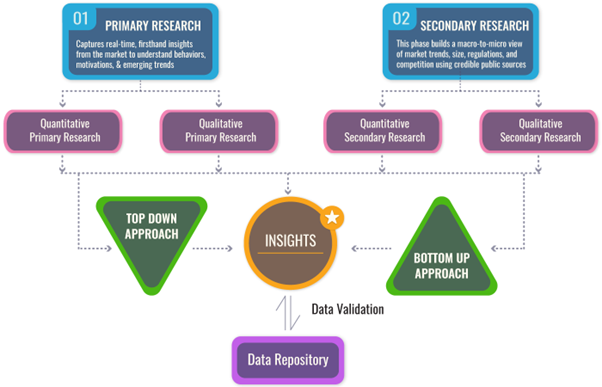
We follow a comprehensive, multi-phase research framework designed to deliver accurate, strategic, and decision-ready intelligence. Our process integrates primary and secondary research , both quantitative and qualitative , along with dual modeling techniques ( top-down and bottom-up) and a final layer of validation through our proprietary in-house repository.
PRIMARY RESEARCH
Primary research captures real-time, firsthand insights from the market to understand behaviors, motivations, and emerging trends.
1. Quantitative Primary Research
Objective: Generate statistically significant data directly from market participants.
Approaches:- Structured surveys with customers, distributors, and field agents
- Mobile-based data collection for point-of-sale audits and usage behavior
- Phone-based interviews (CATI) for market sizing and product feedback
- Online polling around industry events and digital campaigns
- Purchase frequency by customer type
- Channel performance across geographies
- Feature demand by application or demographic
2. Qualitative Primary Research
Objective: Explore decision-making drivers, pain points, and market readiness.
Approaches:- In-depth interviews (IDIs) with executives, product managers, and key decision-makers
- Focus groups among end users and early adopters
- Site visits and observational research for consumer products
- Informal field-level discussions for regional and cultural nuances
SECONDARY RESEARCH
This phase helps establish a macro-to-micro understanding of market trends, size, regulation, and competitive dynamics, sourced from credible and public domain information.
1. Quantitative Secondary Research
Objective: Model market value and segment-level forecasts based on published data.
Sources include:- Financial reports and investor summaries
- Government trade data, customs records, and regulatory statistics
- Industry association publications and economic databases
- Channel performance and pricing data from marketplace listings
- Revenue splits, pricing trends, and CAGR estimates
- Supply-side capacity and volume tracking
- Investment analysis and funding benchmarks
2. Qualitative Secondary Research
Objective: Capture strategic direction, innovation signals, and behavioral trends.
Sources include:- Company announcements, roadmaps, and product pipelines
- Publicly available whitepapers, conference abstracts, and academic research
- Regulatory body publications and policy briefs
- Social and media sentiment scanning for early-stage shifts
- Strategic shifts in market positioning
- Unmet needs and white spaces
- Regulatory triggers and compliance impact
DUAL MODELING: TOP-DOWN + BOTTOM-UP
To ensure robust market estimation, we apply two complementary sizing approaches:
Top-Down Modeling:- Start with broader industry value (e.g., global or regional TAM)
- Apply filters by segment, geography, end-user, or use case
- Adjust with primary insights and validation benchmarks
- Ideal for investor-grade market scans and opportunity mapping
- Aggregate from the ground up using sales volumes, pricing, and unit economics
- Use internal modeling templates aligned with stakeholder data
- Incorporate distributor-level or region-specific inputs
- Most accurate for emerging segments and granular sub-markets
DATA VALIDATION: IN-HOUSE REPOSITORY
We close the loop with proprietary data intelligence built from ongoing projects, industry monitoring, and historical benchmarking. This repository includes:
- Multi-sector market and pricing models
- Key trendlines from past interviews and forecasts
- Benchmarked adoption rates, churn patterns, and ROI indicators
- Industry-specific deviation flags and cross-check logic
- Catches inconsistencies early
- Aligns projections across studies
- Enables consistent, high-trust deliverables