

Marine Nutraceutical Market Size and Forecast (2020 - 2033), Global and Regional Growth, Trend, Share, and Industry Analysis Report Coverage: By Product (Omega-3 Fatty Acids, Fish Proteins & Peptides, Chitosan, Minerals, Seaweed Extracts, Others), By Source (Fishes, Crustaceans, Mollusks, Marine Algae), By Distribution Channel (Pharmacies & Drug Stores, Online Retail, Supermarkets/Hypermarkets, Specialty Stores) And Geography
2025-12-17
Consumer Products
Jaya Bundele (Research Analyst)
Description
Marine
Nutraceutical Market Overview
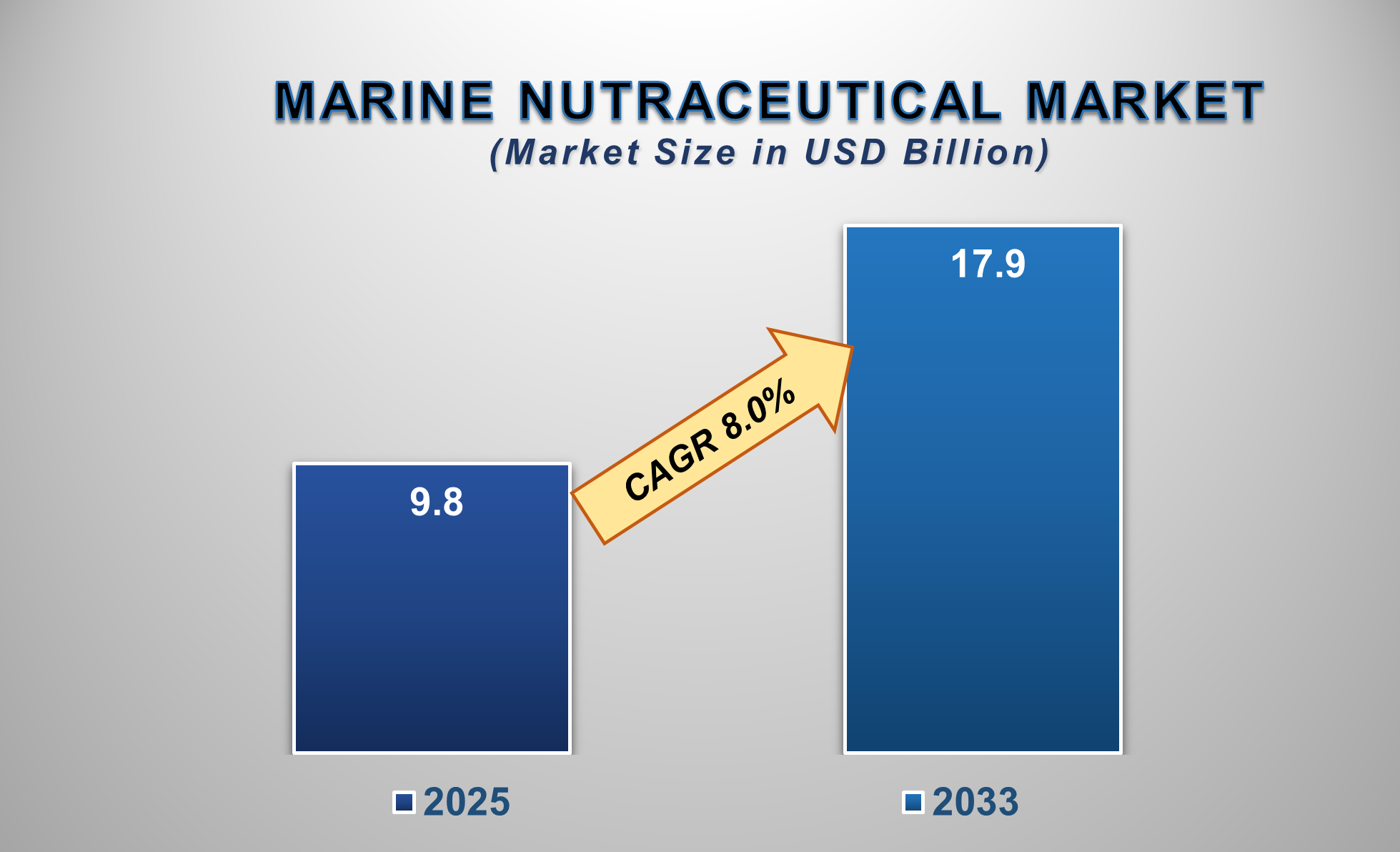
The Marine Nutraceutical Market is set for robust growth from 2025 to 2033, propelled by rising consumer awareness of preventive healthcare, the proven health benefits of marine-derived ingredients, and growing disposable incomes. The market is projected to be valued at approximately USD 9.8 billion in 2025 and is forecasted to reach nearly USD 17.9 billion by 2033, exhibiting a compound annual growth rate (CAGR) of 8.0% during this period.
Marine nutraceuticals are bioactive compounds
derived from marine resources such as fish, algae, mollusks, and crustaceans.
These ingredients are renowned for their high nutritional value and therapeutic
properties, including supporting cardiovascular health, reducing inflammation,
improving joint health, and enhancing cognitive function. The market's
expansion is primarily fuelled by the scientific validation of the health
benefits of omega-3 fatty acids (EPA and DHA), which remain the cornerstone of
this industry. Furthermore, the growing vegan and vegetarian population is
driving demand for plant-based omega-3 sourced from algae, creating a
significant new growth avenue. Innovations in extraction technologies are also
enabling the discovery and commercialization of novel compounds from
underutilized marine sources. North America holds the largest market share,
while the Asia-Pacific region is expected to witness the fastest growth, driven
by its vast coastline, traditional use of marine products, and an increasingly
health-conscious middle class.
Marine Nutraceutical Market Drivers and
Opportunities
Rising Consumer Focus on Preventive Health and Proven
Efficacy of Omega-3s is the Primary Market Driver
The pivotal role of the global shift towards
preventive healthcare is the primary driver for the marine nutraceutical
market. Consumers are increasingly seeking natural and effective ways to manage
health and wellness, moving away from a purely treatment-oriented approach.
Within this trend, the extensive scientific research and widespread recognition
of the health benefits of marine-derived omega-3 fatty acids (EPA and DHA) are
paramount.
The evidence base is substantial; numerous
clinical trials and meta-analyses have consistently demonstrated that omega-3s
significantly reduce the risk of cardiovascular diseases, lower triglyceride
levels, and support brain development and cognitive function. This strong
scientific backing has made omega-3 supplements one of the most trusted and
consumed dietary supplements globally. Regulatory bodies like the European Food
Safety Authority (EFSA) and the U.S. Food and Drug Administration (FDA) have approved
health claims for EPA and DHA, further cementing consumer confidence. Beyond
heart and brain health, ongoing research into other marine compounds, such as
fish-derived collagen peptides for skin and joint health and astaxanthin from algae for its potent antioxidant
properties, is expanding the market's scope. This confluence of a proactive
health mindset and robust scientific validation creates a powerful, sustained
demand for marine nutraceuticals, establishing a foundational growth pillar for
the entire market.
Growth of the Plant-Based Trend and Sustainability Concerns
are Driving Market Evolution
The rapid growth of the vegan, vegetarian, and
flexitarian populations is creating a significant shift in the market. While
fish oil remains a dominant source of omega-3s, concerns about overfishing,
ocean pollutants (like heavy metals), and dietary preferences are fueling demand for sustainable, plant-based alternatives.
Algae-derived omega-3 oils, which are bio-identical to those from fish but
produced sustainably in controlled environments, are experiencing explosive
growth. This trend is not just a niche but a major catalyst for market
evolution, pushing manufacturers to innovate and diversify their sourcing
strategies to cater to a broader, more environmentally conscious consumer base.
Exploration of Novel Marine Sources and Personalized
Nutrition Present Significant Opportunities
The vast biodiversity of the ocean presents a
largely untapped reservoir of novel bioactive compounds, offering substantial
growth frontiers. A key opportunity lies in the exploration of underutilized
sources like krill, squid, and specific marine algae species for unique
proteins, peptides, and antioxidants. The convergence of marine nutraceuticals
with the personalized nutrition trend represents another significant leap
forward. Companies can develop targeted solutions—for example, combining
specific marine peptides for muscle health in active adults or algal omega-3s
for prenatal health—delivered through subscription models. For manufacturers,
investing in R&D for sustainable sourcing, advanced extraction techniques
for novel compounds, and developing targeted, evidence-based products for
specific health conditions and demographics are key strategies for capturing
future market share.
Marine Nutraceutical Market Scope
|
Report Attributes |
Description |
|
Market Size in 2025 |
USD 9.8 Billion |
|
Market Forecast in 2033 |
USD 17.9 Billion |
|
CAGR % 2025-2033 |
8.0% |
|
Base Year |
2024 |
|
Historic Data |
2020-2024 |
|
Forecast Period |
2025-2033 |
|
Report USP |
Product Portfolio,
Technological Analysis, Company Market Share, Company Heatmap, Pricing
Analysis, Growth Factors and more |
|
Segments Covered |
●
By Product ●
By Source ●
By Distribution
Channel |
|
Regional Scope |
●
North America, ●
Europe, ●
APAC, ●
Latin America ●
Middle East and
Africa |
|
Country Scope |
1)
U.S. 2)
Canada 3)
Germany 4)
UK 5)
France 6)
Spain 7)
Italy 8)
Switzerland 9)
China 10)
Japan 11)
India 12)
Australia 13)
South Korea 14)
Brazil 15)
Mexico 16)
Argentina 17)
South Africa 18)
Saudi Arabia 19)
UAE |
Marine Nutraceutical Market Report Segmentation
Analysis
The global Marine Nutraceutical
Market industry analysis is segmented by Product, by Source, by Distribution
Channel, and by Region.
Omega-3 Fatty Acids
Segment Dominates in Marine Nutraceutical Market
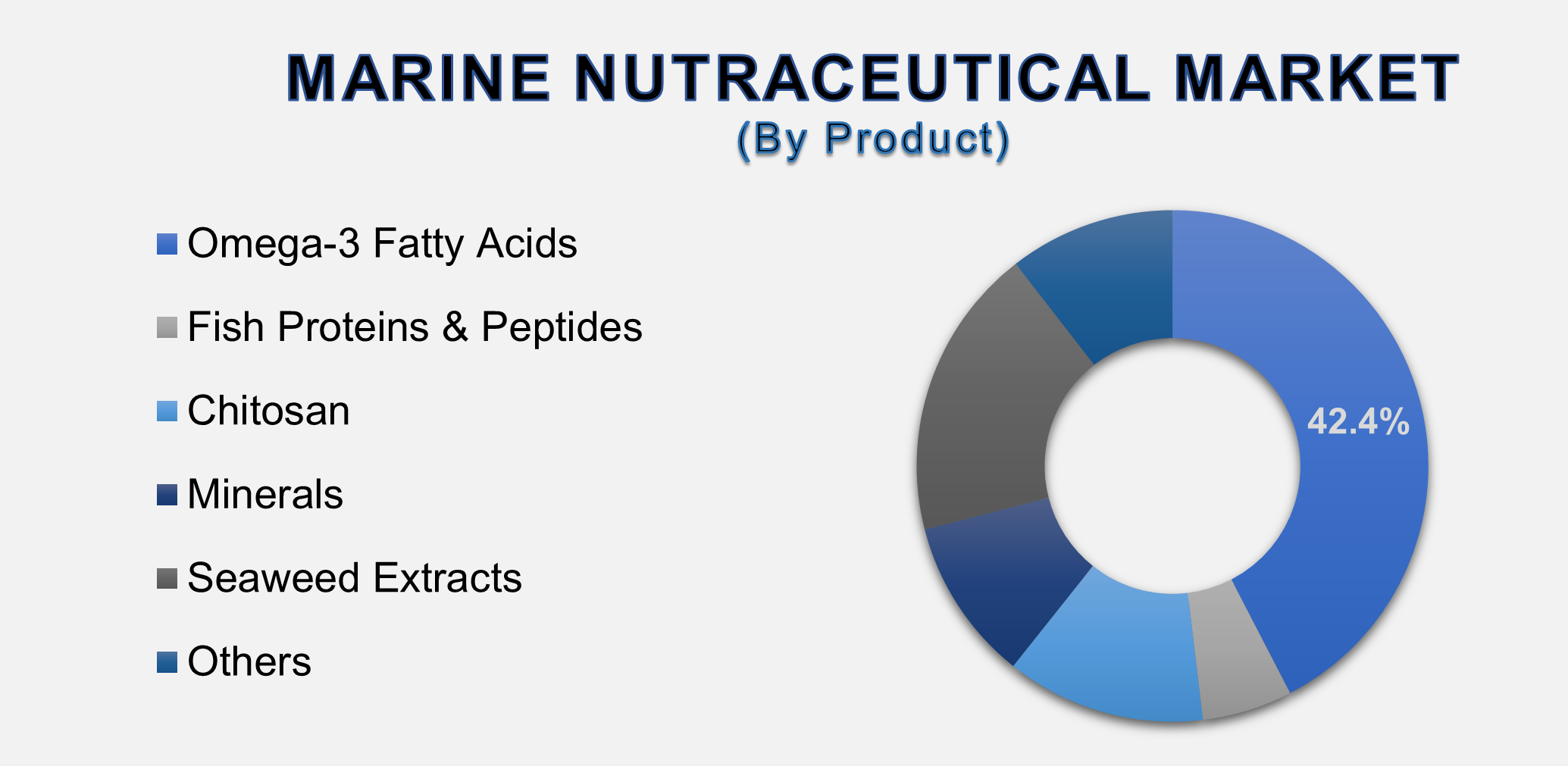
The Omega-3 Fatty Acids segment is poised to command a dominant market share in 2025, solidifying its position as the cornerstone of the marine nutraceutical industry. This dominance is primarily driven by decades of robust scientific validation and widespread consumer awareness of its critical health benefits, particularly for cardiovascular and cognitive function. Omega-3s, specifically EPA and DHA, are extensively incorporated into a diverse range of products, from ubiquitous dietary supplements and infant formula to fortified functional foods and beverages, ensuring massive market penetration. Their proven role in reducing triglycerides, supporting brain development, and mitigating inflammation creates a sustained, global demand that far surpasses other marine-derived ingredients. As chronic lifestyle diseases rise and preventive healthcare becomes a priority for consumers, the deeply entrenched reputation and versatile application of omega-3s ensure their continued reign as the market's flagship product category, with consistent growth underpinned by both existing users and new consumers entering the market.
The Fishes Segment as the
Largest Source Category for the Marine Nutraceutical Market
The
Fishes segment is projected to remain the largest source category for marine nutraceuticals, a status rooted in its traditional role as the most
abundant and economically viable reservoir of key bioactive compounds. For
decades, pelagic fish species like anchovies, sardines, and mackerel have been
the industrial backbone for producing fish oil, which is the primary and most
efficient source of the highly sought-after omega-3 fatty acids EPA and DHA.
Beyond oils, fish are also a major source of fish protein hydrolysates and
peptides, valued for their nutritional and therapeutic properties. The
established, large-scale global fishing and processing infrastructure for these
species ensures a consistent and high-volume supply chain that newer sources
cannot yet match. While sustainability concerns are prompting innovation, the
current scale of production, coupled with the unmatched efficiency of
extracting concentrated Omega-3s directly from fish tissue, secures the
segment's leading position, though its growth rate is being challenged by
plant-based alternatives.
Online Retail Segment's
High Growth Rate over the forecast period
The
Online Retail segment is projected to exhibit the highest growth rate among all
distribution channels, fundamentally reshaping how consumers access marine
nutraceuticals. This explosive growth is fueled by the unparalleled
convenience, extensive product selection, and competitive pricing offered by
e-commerce platforms and specialty health websites. Unlike physical stores,
online channels provide consumers with the ability to deeply research products,
compare brands, read reviews, and access detailed ingredient information, which
is crucial for informed supplement purchases. Furthermore, digital platforms
empower brands to educate consumers directly through rich content like blogs
and videos, building trust and community. The direct-to-consumer (D2C) model
allows for personalized subscriptions and targeted marketing, enhancing
customer loyalty. The post-pandemic acceleration of e-commerce adoption,
combined with the desire for discreet home delivery of health products,
positions online retail as the dynamic and rapidly expanding frontier for
market growth, steadily drawing share from traditional brick-and-mortar
outlets.
The following segments are
part of an in-depth analysis of the global Marine Nutraceutical Market:
|
Market
Segments |
|
|
By Product |
●
Omega-3 Fatty Acids ●
Fish Proteins &
Peptides ●
Chitosan ●
Minerals ●
Seaweed Extracts ●
Others |
|
By Source |
●
Fishes ●
Crustaceans ●
Mollusks ●
Marine Algae ●
Others |
|
By Distribution Channel |
●
Pharmacies &
Drug Stores ●
Online Retail ●
Supermarkets/Hypermarkets ●
Specialty Stores |
Marine Nutraceutical Market Share Analysis by
Region
The North America region
is anticipated to hold the largest portion of the Marine Nutraceutical Market
globally throughout the forecast period.
North
America's dominance is attributed to high consumer health awareness, high disposable income, and a well-established dietary
supplement industry. The region has a high prevalence of lifestyle-related
diseases, driving the demand for preventive healthcare solutions like omega-3
supplements. Strict regulatory standards from the FDA and a dense network of
retailers and online platforms further solidify North America's position as the
largest regional market.
The
U.S. is the single largest market within North America, driven by its massive
health and wellness industry and a culture deeply ingrained with dietary
supplement consumption. The presence of major global players like DSM-Firmenich
and BASF SE ensures a steady supply of high-quality ingredients and finished
products. High consumer literacy regarding the benefits of marine nutraceuticals, particularly for heart health, and extensive marketing
and product availability across all distribution channels underpin the
consistent growth of the market in the U.S.
Marine Nutraceutical Market Competition Landscape
Analysis
The global marine
nutraceutical market is fragmented and features a mix of large, diversified
ingredient suppliers, specialized biotechnology companies, and consumer health
brands. Competition is based on product purity, sustainability credentials,
scientific backing, brand reputation, and global supply chain capabilities. Key
strategies include vertical integration (from sourcing to finished products),
partnerships with research institutions for novel compound discovery, and a
strong focus on marketing and branding to differentiate products in a crowded
marketplace.
Global Marine
Nutraceutical Market Recent Developments News:
- In January 2025, DSM-Firmenich (now part of Firmenich) launched a
new, high-concentration algal oil targeting the prenatal and infant
nutrition segment.
- In October 2024, BASF SE expanded its production capacity for omega-3
oils from krill to meet growing demand for sustainable sources.
- In June 2024, Aker BioMarine received a new patent for its
proprietary technology for extracting phospholipid-bound omega-3s from
Antarctic krill.
- In March 2024, Corbion N.V. (through its Algae Ingredients business)
partnered with a major food brand to incorporate algal omega-3s into a new
line of plant-based dairy products.
The Global Marine
Nutraceutical Market Is Dominated by a Few Large Companies, such as
●
DSM-Firmenich
●
BASF SE
●
Corbion N.V.
●
Aker BioMarine
●
Omega Protein
Corporation (Part of Cooke Inc.)
●
GC Rieber Oils
●
Polaris
●
Lonza Group
●
Nordic Naturals
●
Pharmavite LLC (Nature
Made)
●
Now Foods
●
Nutrigold Inc.
●
Seaherble
●
AlgaeCytes
● Other Prominent Players
Frequently Asked Questions
Jaya Bundele (Research Analyst)
Jaya Bundele is a skilled Research Analyst with 4+ years of experience in market intelligence, consumer insights, competitive analysis, and industry forecasting across the consumer goods, agriculture, and food & beverage sectors. She specializes in market sizing, trend analysis, growth opportunity mapping, and strategic secondary research for global and regional markets.
Her expertise lies in transforming complex industry data into actionable business strategies that help organizations identify emerging trends, understand customer behavior, and gain a competitive edge. With a strong focus on data-driven insights, business intelligence, and future market trends, Jaya delivers high-quality research solutions aligned with evolving industry demands and market dynamics.
1. Global Marine
Nutraceutical Market Introduction and Market Overview
1.1.
Objectives
of the Study
1.2.
Global
Marine Nutraceutical Market Scope and Market Estimation
1.2.1.Global Electronic Toll
Collection Overall Market Size (US$ Mn), Market CAGR (%), Market forecast (2025
- 2033)
1.2.2.Global Marine
Nutraceutical Market Revenue Share (%) and Growth Rate (Y-o-Y) from 2020 - 2033
1.3.
Market
Segmentation
1.3.1.Product of Global Marine
Nutraceutical Market
1.3.2.Source of Global Marine
Nutraceutical Market
1.3.3.Distribution Channel of Global
Marine Nutraceutical Market
1.3.4.Region of Global Marine
Nutraceutical Market
2. Executive
Summary
2.1.
Demand
Side Trends
2.2.
Key
Market Trends
2.3.
Market
Demand (US$ Mn) Analysis 2020 – 2024 and forecast, 2025 – 2033
2.4.
Demand
and Opportunity Assessment
2.5.
Technological
Advancements
2.6.
Regulatory
Scenario by Region
2.7.
Key
Developments
2.8.
Market
Entry Strategies
2.9.
Market
Dynamics
2.9.1.Drivers
2.9.2.Limitations
2.9.3.Opportunities
2.9.4.Impact Analysis of Drivers
and Restraints
2.10.
Porter’s
Five Forces Analysis
2.11.
PEST
Analysis
3. Global
Marine Nutraceutical Market Estimates
& Historical Trend Analysis (2020 - 2024)
4. Global
Marine Nutraceutical Market Estimates
& Forecast Trend Analysis, by Product
4.1.
Global
Marine Nutraceutical Market Revenue (US$ Mn) Estimates and Forecasts, by Product,
2020 - 2033
4.1.1.Omega-3 Fatty Acids
4.1.2.Fish Proteins &
Peptides
4.1.3.Chitosan
4.1.4.Minerals
4.1.5.Seaweed Extracts
4.1.6.Others
5. Global
Marine Nutraceutical Market Estimates
& Forecast Trend Analysis, by Source
5.1.
Global
Marine Nutraceutical Market Revenue (US$ Mn) Estimates and Forecasts, by Source,
2020 - 2033
5.1.1.Fishes
5.1.2.Crustaceans
5.1.3.Mollusks
5.1.4.Marine Algae
5.1.5.Others
6. Global
Marine Nutraceutical Market Estimates
& Forecast Trend Analysis, by Distribution Channel
6.1.
Global
Marine Nutraceutical Market Revenue (US$ Mn) Estimates and Forecasts, by Distribution
Channel 2020 - 2033
6.1.1.Pharmacies & Drug
Stores
6.1.2.Online Retail
6.1.3.Supermarkets/Hypermarkets
6.1.4.Specialty Stores
7. Global
Marine Nutraceutical Market Estimates
& Forecast Trend Analysis, by region
7.1.
Global
Marine Nutraceutical Market Revenue (US$ Mn) Estimates and Forecasts, by region,
2020 - 2033
7.1.1.North America
7.1.2.Europe
7.1.3.Asia Pacific
7.1.4.Middle East & Africa
7.1.5.Latin America
8. North America Marine
Nutraceutical Market: Estimates &
Forecast Trend Analysis
8.1.
North
America Marine Nutraceutical Market Assessments & Key Findings
8.1.1.North America Marine
Nutraceutical Market Introduction
8.1.2.North America Marine
Nutraceutical Market Size Estimates and Forecast (US$ Billion) (2020 - 2033)
8.1.2.1. By Product
8.1.2.2. By Source
8.1.2.3. By Distribution
Channel
8.1.2.4.
By
Country
8.1.2.4.1. The U.S.
8.1.2.4.2. Canada
9. Europe Marine
Nutraceutical Market: Estimates &
Forecast Trend Analysis
9.1.
Europe
Marine Nutraceutical Market Assessments & Key Findings
9.1.1.Europe Marine
Nutraceutical Market Introduction
9.1.2.Europe Marine
Nutraceutical Market Size Estimates and Forecast (US$ Billion) (2020 - 2033)
9.1.2.1. By Product
9.1.2.2. By Source
9.1.2.3. By Distribution
Channel
9.1.2.4.
By
Country
9.1.2.4.1.
Germany
9.1.2.4.2.
Italy
9.1.2.4.3.
U.K.
9.1.2.4.4.
France
9.1.2.4.5.
Spain
9.1.2.4.6.
Switzerland
9.1.2.4.7. Rest
of Europe
10. Asia Pacific Marine
Nutraceutical Market: Estimates &
Forecast Trend Analysis
10.1.
Asia
Pacific Market Assessments & Key Findings
10.1.1.
Asia
Pacific Marine Nutraceutical Market Introduction
10.1.2.
Asia
Pacific Marine Nutraceutical Market Size Estimates and Forecast (US$ Billion) (2020
- 2033)
10.1.2.1. By Product
10.1.2.2. By Source
10.1.2.3. By Distribution
Channel
10.1.2.4.
By
Country
10.1.2.4.1. China
10.1.2.4.2. Japan
10.1.2.4.3. India
10.1.2.4.4. Australia
10.1.2.4.5. South Korea
10.1.2.4.6. Rest of Asia Pacific
11. Middle East & Africa Marine
Nutraceutical Market: Estimates &
Forecast Trend Analysis
11.1.
Middle
East & Africa Market Assessments & Key Findings
11.1.1.
Middle East & Africa Marine Nutraceutical Market
Introduction
11.1.2.
Middle East & Africa Marine Nutraceutical Market Size Estimates
and Forecast (US$ Billion) (2020 - 2033)
11.1.2.1. By Product
11.1.2.2. By Source
11.1.2.3. By Distribution
Channel
11.1.2.4.
By
Country
11.1.2.4.1. UAE
11.1.2.4.2. Saudi
Arabia
11.1.2.4.3. South
Africa
11.1.2.4.4. Rest
of MEA
12. Latin America
Marine Nutraceutical Market: Estimates
& Forecast Trend Analysis
12.1.
Latin
America Market Assessments & Key Findings
12.1.1.
Latin
America Marine Nutraceutical Market Introduction
12.1.2.
Latin
America Marine Nutraceutical Market Size Estimates and Forecast (US$ Billion) (2020
- 2033)
12.1.2.1. By Product
12.1.2.2. By Source
12.1.2.3. By Distribution
Channel
12.1.2.4.
By
Country
12.1.2.4.1. Brazil
12.1.2.4.2. Argentina
12.1.2.4.3. Mexico
12.1.2.4.4. Rest
of LATAM
13. Country Wise Market:
Introduction
14.
Competition
Landscape
14.1.
Global
Marine Nutraceutical Market Product Mapping
14.2.
Global
Marine Nutraceutical Market Concentration Analysis, by Leading Players /
Innovators / Emerging Players / New Entrants
14.3.
Global
Marine Nutraceutical Market Tier Structure Analysis
14.4.
Global
Marine Nutraceutical Market Concentration & Company Market Shares (%)
Analysis, 2024
15.
Company
Profiles
15.1.
DSM-Firmenich
15.1.1.
Company
Overview & Key Stats
15.1.2.
Financial
Performance & KPIs
15.1.3.
Product
Portfolio
15.1.4.
SWOT
Analysis
15.1.5.
Business
Strategy & Recent Developments
* Similar details would be provided for all the players
mentioned below
15.2. BASF SE
15.3. Corbion N.V.
15.4. Aker
BioMarine
15.5. Omega Protein
Corporation (Part of Cooke Inc.)
15.6. GC Rieber
Oils
15.7. Polaris
15.8. Lonza Group
15.9. Nordic
Naturals
15.10. Pharmavite
LLC (Nature Made)
15.11. Now Foods
15.12. Nutrigold
Inc.
15.13. Seaherble
15.14. AlgaeCytes
15.15. Other
Prominent Players
16. Research
Methodology
16.1.
External
Transportations / Databases
16.2.
Internal
Proprietary Database
16.3.
Primary
Research
16.4.
Secondary
Research
16.5.
Assumptions
16.6.
Limitations
16.7.
Report
FAQs
17. Research
Findings & Conclusion
Our Research Methodology
"Insight without rigor is just noise."
We follow a comprehensive, multi-phase research framework designed to deliver accurate, strategic, and decision-ready intelligence. Our process integrates primary and secondary research , both quantitative and qualitative , along with dual modeling techniques ( top-down and bottom-up) and a final layer of validation through our proprietary in-house repository.
PRIMARY RESEARCH
Primary research captures real-time, firsthand insights from the market to understand behaviors, motivations, and emerging trends.
1. Quantitative Primary Research
Objective: Generate statistically significant data directly from market participants.
Approaches:- Structured surveys with customers, distributors, and field agents
- Mobile-based data collection for point-of-sale audits and usage behavior
- Phone-based interviews (CATI) for market sizing and product feedback
- Online polling around industry events and digital campaigns
- Purchase frequency by customer type
- Channel performance across geographies
- Feature demand by application or demographic
2. Qualitative Primary Research
Objective: Explore decision-making drivers, pain points, and market readiness.
Approaches:- In-depth interviews (IDIs) with executives, product managers, and key decision-makers
- Focus groups among end users and early adopters
- Site visits and observational research for consumer products
- Informal field-level discussions for regional and cultural nuances
SECONDARY RESEARCH
This phase helps establish a macro-to-micro understanding of market trends, size, regulation, and competitive dynamics, sourced from credible and public domain information.
1. Quantitative Secondary Research
Objective: Model market value and segment-level forecasts based on published data.
Sources include:- Financial reports and investor summaries
- Government trade data, customs records, and regulatory statistics
- Industry association publications and economic databases
- Channel performance and pricing data from marketplace listings
- Revenue splits, pricing trends, and CAGR estimates
- Supply-side capacity and volume tracking
- Investment analysis and funding benchmarks
2. Qualitative Secondary Research
Objective: Capture strategic direction, innovation signals, and behavioral trends.
Sources include:- Company announcements, roadmaps, and product pipelines
- Publicly available whitepapers, conference abstracts, and academic research
- Regulatory body publications and policy briefs
- Social and media sentiment scanning for early-stage shifts
- Strategic shifts in market positioning
- Unmet needs and white spaces
- Regulatory triggers and compliance impact
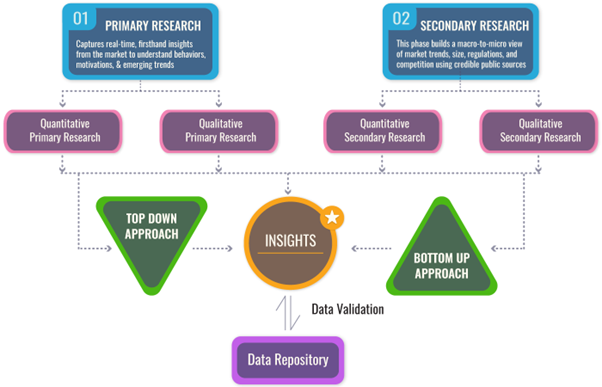
DUAL MODELING: TOP-DOWN + BOTTOM-UP
To ensure robust market estimation, we apply two complementary sizing approaches:
Top-Down Modeling:- Start with broader industry value (e.g., global or regional TAM)
- Apply filters by segment, geography, end-user, or use case
- Adjust with primary insights and validation benchmarks
- Ideal for investor-grade market scans and opportunity mapping
- Aggregate from the ground up using sales volumes, pricing, and unit economics
- Use internal modeling templates aligned with stakeholder data
- Incorporate distributor-level or region-specific inputs
- Most accurate for emerging segments and granular sub-markets
DATA VALIDATION: IN-HOUSE REPOSITORY
We close the loop with proprietary data intelligence built from ongoing projects, industry monitoring, and historical benchmarking. This repository includes:
- Multi-sector market and pricing models
- Key trendlines from past interviews and forecasts
- Benchmarked adoption rates, churn patterns, and ROI indicators
- Industry-specific deviation flags and cross-check logic
- Catches inconsistencies early
- Aligns projections across studies
- Enables consistent, high-trust deliverables