

Medical Automation Market Size and Forecast (2026–2034), Global and Regional Growth, Trend, Share and Industry Analysis Report Coverage: By Component (Hardware, Software, and Services), By Application Type (Imaging & Diagnostic Automation, Laboratory Automation, Pharmacy & Medication Management Automation, and Others (Surgical & Therapeutic Automation, Hospital Workflow & Logistics Automation, etc.)), By End User (Hospitals, Diagnostic Laboratories, Research & Academic Institutes, and Others (Pharmacies, Ambulatory Surgical Centers (ASCs), etc.) and Geography
2026-07-30
Healthcare
Swetal (Research Analyst)
Description
Medical Automation Market Overview
The global medical
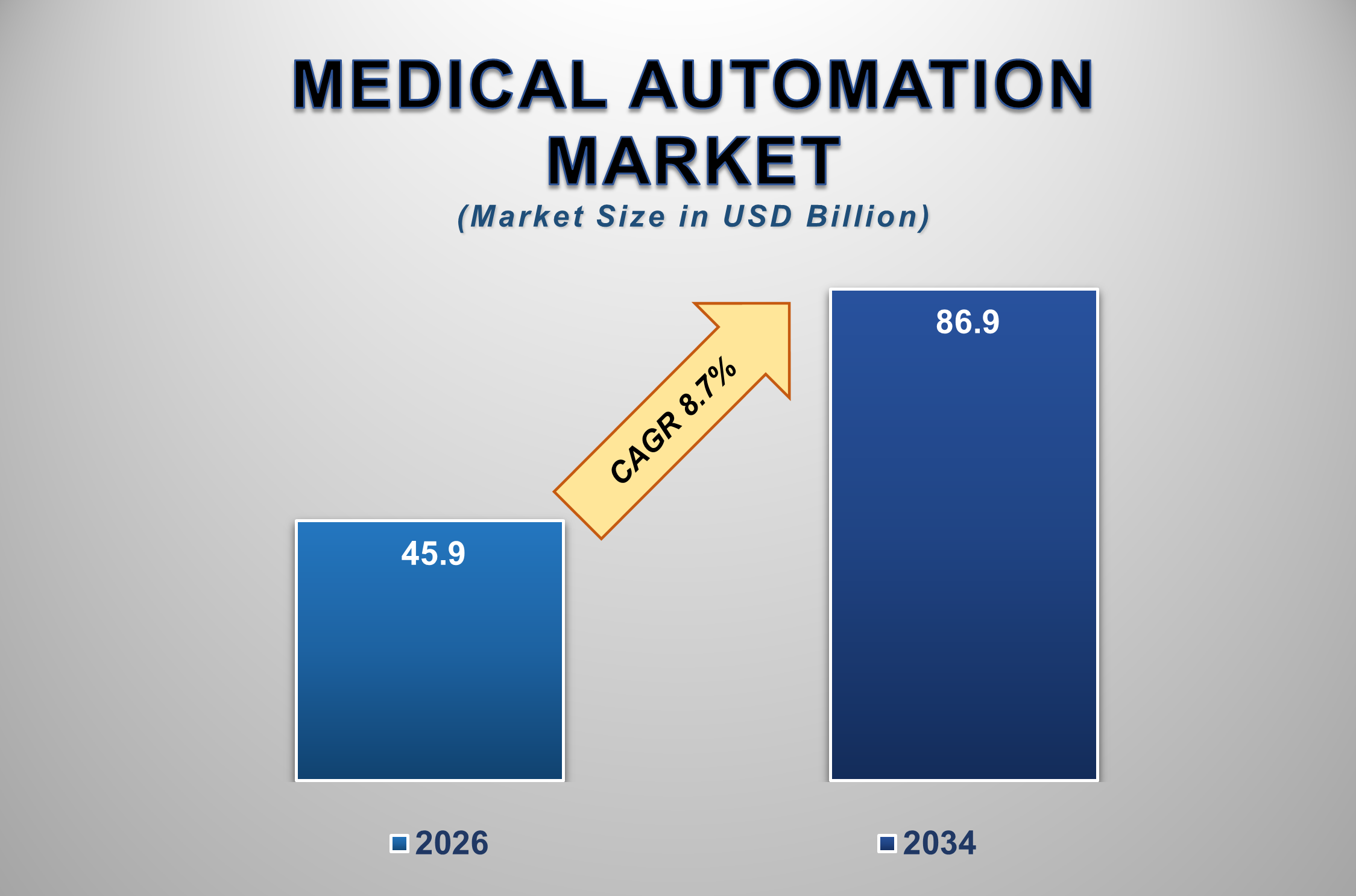
automation market was valued at USD 45.9 billion in 2026 and is projected to
reach USD 86.9 billion by 2034, expanding at a CAGR of 8.7% during the forecast
period. The market is experiencing significant growth as healthcare facilities
increasingly adopt advanced technologies to improve efficiency, clinical
accuracy, and the quality of patient care. Automation technology integrates
robotics, artificial intelligence, machine learning, computer vision, medical
devices, and other software solutions to automate clinical processes,
laboratory testing, pharmacy operations, imaging, and administrative functions.
With the growing need for high-quality health care facilities, rising patient
volumes, labor shortages, and a desire to limit human error, the trend toward
automation is accelerating across hospitals, diagnostic labs, ambulatory
surgical centers, pharmacies, and research facilities.
Other contributing
drivers for the market include continuous technological innovation, the growing
trend of digitization within the healthcare sector, and the use of EHRs, IoMT,
cloud computing, and AI-powered diagnostic and treatment devices. Hospitals are
using automation tools such as imaging techniques, robotic surgery tools, lab
automation, pharmacy dispensing tools, and remote patient monitoring systems to
improve efficiency and address the challenges posed by an aging population and
chronic diseases. Additional drivers, such as investments in healthcare
digitization, smart hospitals, and advancements in precision medicine, will
offer prospects for growth. Medical automation will play an essential part in
transforming the healthcare sector, supported by further advancements in areas
like interoperability, cybersecurity, and intelligent automation.
Medical Automation Market Drivers and
Opportunities
Rising Demand
for Operational Efficiency and Workflow Automation in Healthcare Is Driving
Market Growth
The use of
automated medical technology is increasingly embraced by healthcare
practitioners to boost efficiency, reduce manual handling, and optimize
clinical processes. The rise in the number of patients, along with the shortage
of qualified medical practitioners and the rising burden of administration, has
created a greater need for automated systems that will help increase the
efficiency of clinical and non-clinical processes. Automated laboratory
analysis machines, robotic dispensing machines for pharmacies, artificial
intelligence imaging software, workflow management software, and intelligent
revenue cycle management systems allow health facilities to increase efficiency
and patient safety and save time.
The same trend is
reinforced by constant innovations in product development by technological
vendors. In February 2026, UiPath revealed agentic AI solutions for the
healthcare sector at the ViVE 2026 event. The vendor launched purpose-designed
and compliant agentic AI assistants for medical record summaries, claims
denials processing and prevention, and prior authorizations, utilizing agentic
automation and business orchestration capabilities to integrate disjointed
healthcare data, enhance efficiency of administrative processes, and speed up
revenue cycle management. These innovations prove how intelligent automation is
increasingly applied not only in clinical operations but also in healthcare
administration to cut costs, improve decision-making, and increase
productivity.
As the healthcare
ecosystem players like hospitals, diagnostic labs, and healthcare insurers keep
moving towards digital transformation and building interoperable healthcare
ecosystems, the incorporation of AI-based automation, robotics, and workflow
platforms is anticipated to emerge as an important priority area. The
increasing focus on efficiency and cost-effectiveness, along with better
clinical outcomes, is anticipated to be an important factor driving the global
medical automation market over the forecast period.
Increasing
Adoption of AI, Robotics, and Smart Healthcare Technologies Fueling Market
Expansion
The development of
AI, robotics, machine learning, and interconnected medical devices is
revolutionizing the practice of delivering healthcare services and hastening
the implementation of medical automation systems across the world. The use of
AI-enabled diagnostic systems leads to higher accuracy in disease diagnosis,
robotics-assisted surgery improves the precision of surgeries, and intelligent
laboratory automation saves time on tests while decreasing expenses. IoMT,
cloud computing, and predictive analysis allow monitoring patients in
real-time, making evidence-based decisions regarding their treatment, and
delivering healthcare services remotely.
Initiatives of the
Government too have been making their way towards fostering the faster adoption
of AI within the healthcare domain. In April 2026, IndiaAI, which operates as a
joint initiative of the Digital India Corporation and the Ministry of Electronics
and Information Technology, launched the CDSCO-IndiaAI Health Innovation
Acceleration Hackathon in association with the Central Drugs Standard Control
Organisation. Introduced as part of the IndiaAI Application Development
Initiative (IADI), the project encourages participants to develop end-to-end AI
solutions that help in simplifying regulatory processes, thereby emphasizing
the government's efforts towards speeding up the pace of adopting AI solutions
within healthcare.
With healthcare
providers, technology companies, and governments still pouring money into smart
hospitals, intelligent healthcare infrastructures, robotics systems, and other
digital health technologies, the use of intelligent automation is set to increase
significantly in clinical settings, laboratories, and administrative areas. It
will likely be one of the key factors driving growth in the worldwide medical
automation market in the years to come.
Expansion of
Automation in Outpatient Care and Home Healthcare Presents Significant
Opportunities
There is an
emerging trend towards decentralized delivery of healthcare, which presents a
huge opportunity to medical automation companies. With an increasing preference
for home healthcare services, ambulatory surgical centers, and remote patient
monitoring, there is rising demand for portable automated diagnostic equipment,
artificial intelligence-enabled monitoring equipment, automated medication
dispensing systems, and telehealth integration software. With the current
emphasis on cutting down on hospitalizations, reducing treatment costs, and
enhancing patient convenience, there is strong demand for automation solutions
for continuous monitoring and remote clinical management of patients.
The industry
stakeholders have reacted to this development through investments in
technologies that increase automation for outpatient and home health care
needs. AlayaCare released updates on their platform in March 2026 that included
features such as AI-driven autonomous agents and improvements in mobility and
workflow. These new features would help increase care quality while minimizing
the workload by 80% for home care agencies. Similarly, in June 2026,
TigerConnect rolled out several AI-driven functionalities into its platform for
automated hospital scheduling and coordination. Furthermore, it has improved
its Smart Room module by introducing a touch-enabled whiteboard where care
teams can engage in collaboration with their patients and families. This
example shows how automation is now going past the standard clinical functions
and becoming involved in workforce management and care coordination processes.
With the growing trend of moving from hospitals to homes and other non-hospital environments as the sites of health delivery, there is going to be increasing demand for smart automation systems that can easily integrate caregivers, clinicians, patients, and all health data in one place. The move offers many chances for companies dealing with automation in medicine to come up with innovative AI-based solutions.
Medical Automation Market Scope
|
Report Attributes |
Description |
|
Market Size in
2026 |
USD 45.9
Billion |
|
Market Forecast
in 2034 |
USD 86.9
Billion |
|
CAGR % 2026-2034 |
8.7% |
|
Base Year |
2025 |
|
Historic Data |
2021-2025 |
|
Forecast Period |
2026-2034 |
|
Report USP |
Pricing and
Cost Structure Analysis, Technology and Product Innovation Benchmarking,
Whitespace Assessment, Company Share, Company Heatmap, Growth Factors and
more |
|
Segments Covered |
●
By Component ●
By
Application Type ●
By End
User |
|
Regional Scope |
●
North
America ●
Europe ●
APAC ●
Latin
America ●
Middle
East and Africa |
|
Country Scope |
●
U.S. ●
Canada ●
U.K. ●
Germany ●
France ●
Italy ●
Spain ●
Russia ●
China ●
India ●
Japan ●
South
Korea ●
Australia
●
Mexico ●
Brazil ●
Saudi
Arabia ●
UAE ●
South
Africa
|
Medical Automation Market Report
Segmentation Analysis
The global medical
automation market industry analysis is segmented by component, by application
type, by end user, and by region.
Hardware Segment
Is Expected to Dominate the Medical Automation Market During the Forecast
Period
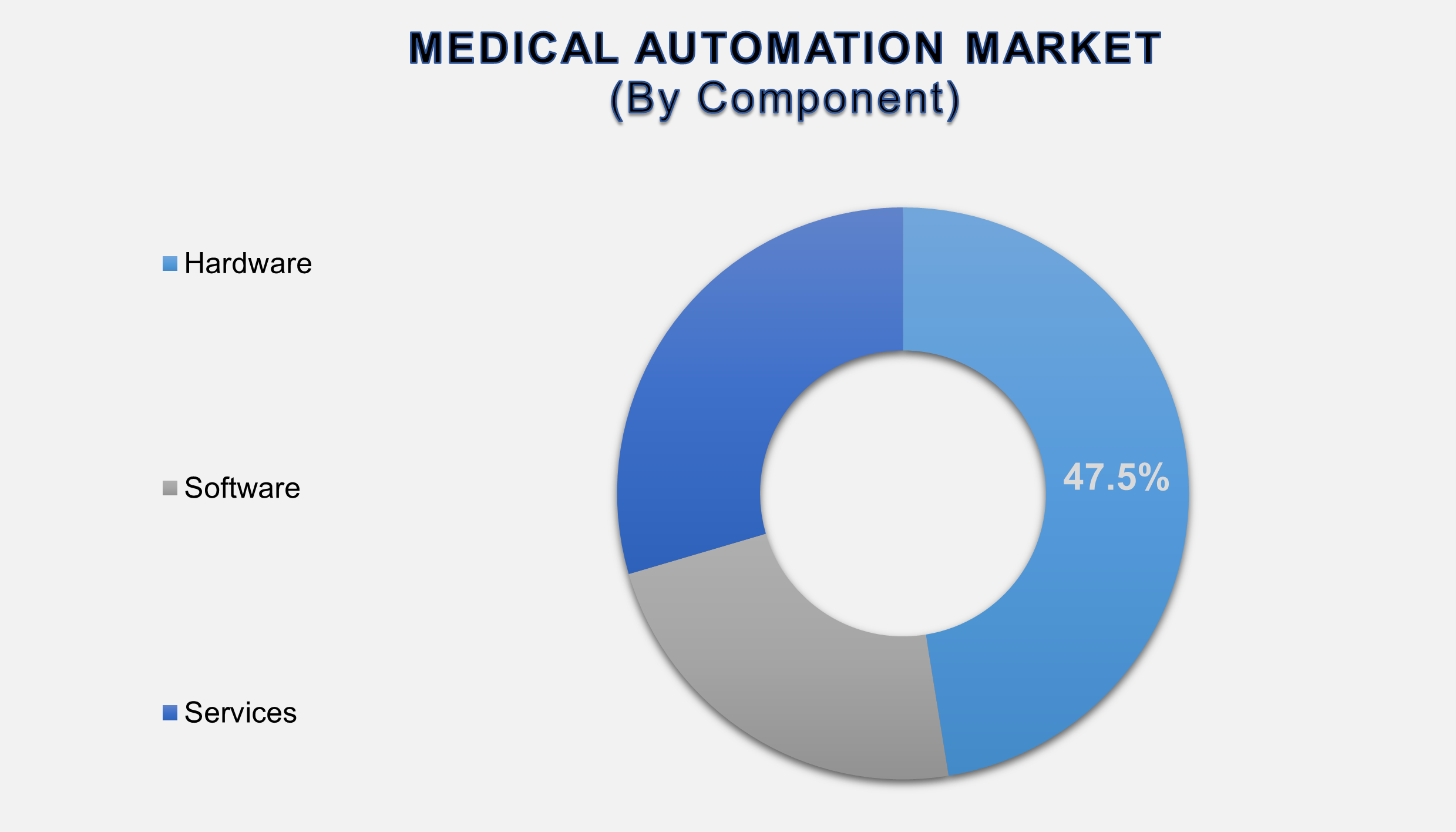
The hardware
category is expected to capture the biggest market share for the global medical
automation market over the forecast period, owing to the increasing use of
advanced medical devices, robotic technology, automated lab equipment,
diagnostic imaging machines, pharmacy automation systems, and patient
monitoring machines in healthcare facilities. Hospitals, laboratories, and
ambulatory care centers are constantly making large investments in automation
hardware for enhancing clinical precision, optimizing efficiency, avoiding
errors, and handling increasing patient load. Increasing implementation of
robotic surgery systems, specimen handling equipment, infusion pumps, sensors,
and medical devices is adding to the dominance of hardware, considering that
the physical systems constitute the core of an automated healthcare system.
Innovations within automation technology are also aiding the growth of the
market. Movemedical released an update on its June 2026 platform, which
included AI-based workflow solutions in July 2026. This innovation allows
medical device companies and healthcare institutions to streamline their
inventory management and field operations and increase efficiency by leveraging
the power of AI with medical device hardware and inventory systems. This
indicates how the trend towards integrating smart software and connected
medical devices has gained momentum in recent times. In addition to this,
rising investments in smart hospitals, digital operating theaters, automated
labs, and intelligent health infrastructure will help sustain the growth in the
market for advanced medical automation hardware in the coming years. With an
emphasis on real-time data capture, interoperability, and AI-enabled workflows
in the healthcare sector, hardware will continue to be the mainstay behind
automation in areas such as diagnostics, treatment, lab processes,
pharmacology, and patient care, keeping it at the forefront of the medical
automation market.
Laboratory
Automation Segment Is Expected to Lead the Medical Automation Market by Type
Laboratory
automation is predicted to hold the largest share in the medical automation
market on the basis of types over the forecasted period, owing to the
escalating requirement of high-throughput diagnostics, efficient testing, and
rapid results in hospitals, diagnostic laboratories, and research institutes.
The escalation in the number of tests, scarcity of lab technicians, and the
requirement to eliminate human errors have led to the rapid adoption of
automated analyzers, robotic handling, automated liquid handling systems,
molecular diagnostic instruments, and laboratory information management systems
(LIMS). Innovation within the field of AI-powered laboratory automation is
continually driving growth within this market segment. In July 2026, Genoria
AI, an MGI subsidiary, together with the Shanghai Artificial Intelligence
Laboratory, unveiled the development of ProtoPilot, which is a self-improving
multi-agent system tailored for real-world application within laboratory
settings. The company also launched the BioLab Bench, which is the first-ever
evaluation framework for AI agents covering all aspects from user requirements
to the actual execution of lab devices. This innovation bridges digital
intelligence with actual physical laboratory execution in order to optimize
laboratory operations.
Geographic
extension by the key players involved in the laboratory automation industry is
yet another development that has played a part in boosting the adoption of
laboratory automation systems in developing nations. An example is the
announcement made by Tecan on the 15th of May, 2026, concerning the launch of
its own operations in India through the establishment of a sales and services
team that will be based in Gurugram, which is near New Delhi. With increasing
volumes of tests performed and AI-based connectivity being adopted by
laboratories in greater numbers, laboratory automation is expected to maintain
its position as the leading segment within the medical automation market.
Advancements in technology, investment in infrastructure of life sciences, and
focus on laboratory efficiency and diagnostics will drive this trend through
the forecast period.
Diagnostic
Laboratories Segment Is Expected to Dominate the End User Segment
The diagnostic laboratories segment is predicted to be the most dominant segment in the global medical automation market for the forecast period, owing to the increase in the number of tests being performed, demand for quick and precise results, and adoption of high-throughput lab automation technology. Laboratories have been increasingly using automated analyzers, robotized sample handling systems, LIMS, and diagnostic tools powered by artificial intelligence to streamline their processes, eliminate human error, and reduce time to results. In addition, the increasing trend of molecular diagnostics, precision medicine, and preventive medicine is contributing to the increased demand for sophisticated lab automation. As labs continue to adopt automation to boost their efficiency, meet regulatory requirements, and cope with labor shortages, the segment will continue to be the leader of the global medical automation market during the forecast period.
The following
segments are part of an in-depth analysis of the global medical automation
market:
|
Market Segments |
|
|
By
Component |
●
Hardware ●
Software ●
Services |
|
By
Application Type |
●
Imaging
& Diagnostic Automation ●
Laboratory
Automation ●
Pharmacy
& Medication Management Automation ●
Others
(Surgical & Therapeutic Automation, Hospital Workflow & Logistics
Automation, etc.) |
|
By End
User |
●
Hospitals ●
Diagnostic
Laboratories ●
Research
& Academic Institutes ●
Others
(Pharmacies, Ambulatory Surgical Centers (ASCs), etc.) |
Medical Automation Market Share
Analysis by Region
North America is
projected to hold the largest share of the global medical automation market
over the forecast period
North America is
predicted to have the largest share of the global medical automation market
during the forecast period owing to its superior healthcare infrastructure,
increased adoption of medical technologies involving the use of artificial
intelligence and robotics, and significant investments towards digitalizing the
healthcare sector. This region also has an established presence of prominent
medical device makers, healthcare information technology firms, and laboratory
automation providers. Apart from that, the growing need for workflow automation
and increased investments in smart hospitals and diagnostics are further
propelling market growth in the US and Canada.
Asia Pacific is
anticipated to be the most rapidly growing region in the medical automation
market owing to the growth in the healthcare infrastructure, growth in
healthcare spending, and the implementation of numerous government initiatives
for promoting digital health and the adoption of AI. The rapid growth of
diagnostic labs, hospitals, and drug production facilities in countries like
China, India, Japan, and South Korea has increased the need for automation
technology. Additionally, the increase in patient population and investment by
global medical device players is anticipated to drive demand for automation
technology during the forecast period.
Medical
Automation Market Competition Landscape Analysis
The market for
medical automation is highly competitive and consists of leading medical device
companies, healthcare technology firms, and laboratory automation players
concentrating on the development of artificial intelligence (AI), robotics, and
intelligent workflows. These players are growing via product launches,
strategic collaborations, mergers and acquisitions, and regional expansions,
among others, while growing investments in smart hospitals and connected
healthcare infrastructures are offering ample growth opportunities.
Global Medical
Automation Market Recent Developments News:
●
In May 2026, Tata Elxsi, a global leader in design
and technology services, announced the launch of AnaTel, an AI-native software
development platform for healthcare and medical technology companies,
co-developed with OpenAna, a provider of autonomous AI engineering platforms.
AnaTel makes its debut at DeviceTalks Boston 2026, where Tata Elxsi is
presenting its latest advances in AI-powered MedTech engineering and
compliance.
●
In March 2026, MiniMed,
a global leader in diabetes technology, announced U.S. Food and Drug
Administration (FDA) clearance of MiniMed Flex, a next-generation discreet,
smartphone-controlled insulin pump designed to fit seamlessly into everyday
life. It's designed to work quietly and reliably in the background, with advanced automation wrapped in a compact, smartphone‑controlled pump.
●
In February
2026, symplr, a leading provider
of enterprise healthcare operations software, announced new AI-powered
innovations across its Operations Platform at ViVE 2026. Spanning workforce
management, contract lifecycle management, and vendor credentialing, the
enhancements target critical back-end workflows where fragmented systems and
manual processes continue to strain health systems.
● In February 2026, Fujitsu Limited announced the development and launch of its AI-Driven Software Development Platform, a new initiative to bring software development into the AI age and contribute to the sustainable growth of its customers and society. This platform automates the entire software development process, from requirements definition and design to implementation and integration testing. Fujitsu aims to use this AI-Driven Software Development Platform to carry out revisions to all 67 types of medical and government business software products provided by Fujitsu Japan Limited by the end of fiscal year 2026.
The Global
Medical Automation Market is dominated by a few large companies, such as
●
Accuray Incorporated
●
Baxter International Inc.
●
Becton, Dickinson and Company
●
Danaher Corporation
●
GE HealthCare Technologies Inc.
●
Intuitive Surgical, Inc.
●
Johnson and Johnson
●
Koninklijke Philips N.V.
●
Medtronic plc
●
Olympus Corporation
●
Omnicell, Inc.
●
Oracle Health
●
Roche Diagnostics
●
Siemens Healthineers AG
●
Stryker Corporation
●
Swisslog Healthcare
●
Tecan Group Ltd.
●
Terumo Corporation
● Other Prominent Players
Frequently Asked Questions
Swetal (Research Analyst)
Swetal is a Research Analyst with 4+ years of experience specializing in healthcare market research, medical devices, healthcare IT, and medical technology industry analysis. Her expertise includes competitive intelligence, secondary research, market trend forecasting, and healthcare business insights across global healthcare ecosystems.
She contributes to advanced market research reports by analyzing regulatory frameworks, emerging healthcare technologies, competitive landscapes, and innovation trends shaping the medical industry. With a strong focus on accurate market intelligence, strategic insights, and healthcare industry trends, Swetal supports businesses in making informed, data-backed decisions in a rapidly transforming healthcare environment.
1.
Global
Medical Automation Market Introduction and Market Overview
1.1. Objectives of the Study
1.2. Market Segmentation
1.2.1.Component of the Global Medical
Automation Market
1.2.2.Component of the Global Medical
Automation Market
1.2.3.End User of Global Medical Automation
Market
1.2.4.Region of Global Medical
Automation Market
1.3. Competition Coverage List of
Market Participants
1.4. Market Definition: Medical
Automation Market
2.
Executive Summary
2.1. Global Medical Automation Market
Estimation & Forecast
2.1.1.Global Medical Automation Market
Size (US$ Million) Estimates & Historical Trend Analysis (2021 - 2025)
2.1.2.Global Medical Automation
Overall Market Size (US$ Million), Growth Rate (Y-o-Y), Market CAGR (%), Market
forecast (2026 - 2034)
2.2. Snapshot of Global Medical Automation
Market
2.3. Global Medical Automation Market
Revenue Share (%) 2025
2.4. REGIONAL OUTLINE: Revenue CAGR,
by Region
2.5. Key Competitors & Key
Insights
3.
Market Overview (Qualitative
Analysis)
3.1. Demand Side Trends
3.2. Supply Side Trends /
Manufacturing Trends
3.3. Demand and Opportunity
Assessment, 2026 - 2034
3.4. Market Dynamics
3.4.1.Drivers
3.4.2.Limitations
3.4.3.Opportunities
3.4.4.Impact Analysis of Drivers and
Restraints
3.5. Key Developments
3.6. Regulatory Landscape
3.7. Pricing Analysis
3.8. Supply Chain Analysis
3.9. Porter’s Five Forces Analysis
3.9.1.Bargaining Power of Suppliers
3.9.2.Bargaining Power of Buyers
3.9.3.Threat of Substitutes
3.9.4.Threat of New Entrants
3.9.5.Competitive Rivalry
3.10. PEST Analysis
3.10.1. Political Factors
3.10.2. Economic Factors
3.10.3. Social Factors
3.10.4. Technology Factors
4.
Global Medical Automation Market
Estimates & Forecast Trend Analysis, by Component
4.1. Global Medical Automation Market
Assessments & Key Findings, by Component
4.2. Global Medical Automation Market
Revenue (US$ Million) Estimates and Forecasts, by Component, 2021 - 2034
4.2.1.Hardware
4.2.2.Software
4.2.3.Services
5.
Global Medical Automation Market
Estimates & Forecast Trend Analysis, by Application Type
5.1. Global Medical Automation Market
Assessments & Key Findings, by Application Type
5.2. Global Medical Automation Market
Revenue (US$ Million) Estimates and Forecasts, by Application Type, 2021 - 2034
5.2.1.Imaging & Diagnostic
Automation
5.2.2.Laboratory Automation
5.2.3.Pharmacy & Medication
Management Automation
5.2.4.Others (Surgical &
Therapeutic Automation, Hospital Workflow & Logistics Automation, etc.)
6.
Global Medical Automation Market
Estimates & Forecast Trend Analysis, by End User
6.1. Global Medical Automation Market
Assessments & Key Findings, by End User
6.2. Global Medical Automation Market
Revenue (US$ Million) Estimates and Forecasts, by End User, 2021 - 2034
6.2.1.Hospitals
6.2.2.Diagnostic Laboratories
6.2.3.Research & Academic
Institutes
6.2.4.Others (Pharmacies, Ambulatory
Surgical Centers (ASCs), etc.)
7.
Global Medical Automation Market
Estimates & Forecast Trend Analysis, by Region
7.1. Global Medical Automation Market
Assessments & Key Findings, by Region
7.2. Global Medical Automation Market
Revenue (US$ Million) Estimates and Forecasts, by Region, 2021 - 2034
7.2.1.North America
7.2.2.Europe
7.2.3.Asia Pacific
7.2.4.Middle East & Africa
7.2.5.Latin America
8.
North
America Medical Automation Market: Estimates & Forecast Trend Analysis
8.1.
North
America Medical Automation Market Assessments & Key Findings
8.1.1.North America Medical Automation
Market Introduction
8.1.2.North America Medical Automation
Market Size Estimates and Forecast (US$ Million) (2021 - 2034)
8.1.2.1. By Component
8.1.2.2. By Application Type
8.1.2.3. By End User
8.1.2.4. By Country
8.1.2.4.1. The U.S.
8.1.2.4.2. Canada
9.
Europe
Medical Automation Market: Estimates & Forecast Trend Analysis
9.1. Europe Medical Automation Market
Assessments & Key Findings
9.1.1.Europe Medical Automation Market
Introduction
9.1.2.Europe Medical Automation Market
Size Estimates and Forecast (US$ Million) (2021 - 2034)
9.1.2.1. By Component
9.1.2.2. By Application Type
9.1.2.3.
By
End User
9.1.2.4.
By
Country
9.1.2.4.1.
Germany
9.1.2.4.2.
Italy
9.1.2.4.3.
U.K.
9.1.2.4.4.
France
9.1.2.4.5.
Spain
9.1.2.4.6.
Switzerland
9.1.2.4.7. Rest
of Europe
10. Asia Pacific Medical
Automation Market: Estimates &
Forecast Trend Analysis
10.1. Asia Pacific Market Assessments
& Key Findings
10.1.1. Asia Pacific Medical Automation
Market Introduction
10.1.2. Asia Pacific Medical Automation
Market Size Estimates and Forecast (US$ Million) (2021 - 2034)
10.1.2.1. By Component
10.1.2.2. By Application Type
10.1.2.3. By End User
10.1.2.4. By Country
10.1.2.4.1. China
10.1.2.4.2. Japan
10.1.2.4.3. India
10.1.2.4.4. Australia
10.1.2.4.5. South Korea
10.1.2.4.6. Rest of Asia Pacific
11. Middle East & Africa Medical
Automation Market: Estimates &
Forecast Trend Analysis
11.1. Middle East & Africa Market
Assessments & Key Findings
11.1.1. Middle
East & Africa Medical
Automation Market Introduction
11.1.2. Middle
East & Africa Medical
Automation Market Size Estimates and Forecast (US$ Million) (2021 - 2034)
11.1.2.1. By Component
11.1.2.2. By Application Type
11.1.2.3. By End User
11.1.2.4. By Country
11.1.2.4.1. South Africa
11.1.2.4.2. UAE
11.1.2.4.3. Saudi Arabia
11.1.2.4.4. Rest of MEA
12. Latin America
Medical Automation Market: Estimates
& Forecast Trend Analysis
12.1. Latin America Market Assessments
& Key Findings
12.1.1. Latin America Medical Automation
Market Introduction
12.1.2. Latin America Medical Automation
Market Size Estimates and Forecast (US$ Million) (2021 - 2034)
12.1.2.1. By Component
12.1.2.2. By Application Type
12.1.2.3. By End User
12.1.2.4. By Country
12.1.2.4.1. Brazil
12.1.2.4.2. Mexico
12.1.2.4.3. Argentina
12.1.2.4.4. Rest of LATAM
13. Competition Landscape
13.1. Global Medical Automation Market
Product Mapping
13.2. Global Medical Automation Market
Concentration Analysis, by Leading Players / Innovators / Emerging Players /
New Entrants
13.3. Global Medical Automation Market
Tier Structure Analysis
13.4. Global Medical Automation Market
Concentration & Company Market Shares (%) Analysis, 2025
14. Company Profiles
14.1. Accuray Incorporated
14.1.1. Company Overview & Key Stats
14.1.2. Financial Performance & KPIs
14.1.3. Product Portfolio
14.1.4. SWOT Analysis
14.1.5. Business Strategy & Recent
Developments
* Similar details would be provided
for all the players mentioned below
14.2.
Baxter International Inc.
14.3.
Becton, Dickinson and Company
14.4.
Danaher Corporation
14.5.
GE HealthCare Technologies Inc.
14.6.
Intuitive Surgical, Inc.
14.7.
Johnson and Johnson
14.8.
Koninklijke Philips N.V.
14.9.
Medtronic plc
14.10.
Olympus Corporation
14.11.
Omnicell, Inc.
14.12.
Oracle Health
14.13.
Roche Diagnostics
14.14.
Siemens Healthineers AG
14.15.
Stryker Corporation
14.16.
Swisslog Healthcare
14.17.
Tecan Group Ltd.
14.18. Terumo Corporation
14.19. Other Prominent Players
15. Research
Findings & Conclusion
16. Assumption & Acronyms Used
17. Research
Methodology
17.1. External Transportations /
Databases
17.2. Internal Proprietary Database
17.3. Primary Research
17.4. Secondary Research
17.5. Assumptions
17.6. Limitations
17.7. Report FAQs
Our Research Methodology
"Insight without rigor is just noise."
We follow a comprehensive, multi-phase research framework designed to deliver accurate, strategic, and decision-ready intelligence. Our process integrates primary and secondary research , both quantitative and qualitative , along with dual modeling techniques ( top-down and bottom-up) and a final layer of validation through our proprietary in-house repository.
PRIMARY RESEARCH
Primary research captures real-time, firsthand insights from the market to understand behaviors, motivations, and emerging trends.
1. Quantitative Primary Research
Objective: Generate statistically significant data directly from market participants.
Approaches:- Structured surveys with customers, distributors, and field agents
- Mobile-based data collection for point-of-sale audits and usage behavior
- Phone-based interviews (CATI) for market sizing and product feedback
- Online polling around industry events and digital campaigns
- Purchase frequency by customer type
- Channel performance across geographies
- Feature demand by application or demographic
2. Qualitative Primary Research
Objective: Explore decision-making drivers, pain points, and market readiness.
Approaches:- In-depth interviews (IDIs) with executives, product managers, and key decision-makers
- Focus groups among end users and early adopters
- Site visits and observational research for consumer products
- Informal field-level discussions for regional and cultural nuances
SECONDARY RESEARCH
This phase helps establish a macro-to-micro understanding of market trends, size, regulation, and competitive dynamics, sourced from credible and public domain information.
1. Quantitative Secondary Research
Objective: Model market value and segment-level forecasts based on published data.
Sources include:- Financial reports and investor summaries
- Government trade data, customs records, and regulatory statistics
- Industry association publications and economic databases
- Channel performance and pricing data from marketplace listings
- Revenue splits, pricing trends, and CAGR estimates
- Supply-side capacity and volume tracking
- Investment analysis and funding benchmarks
2. Qualitative Secondary Research
Objective: Capture strategic direction, innovation signals, and behavioral trends.
Sources include:- Company announcements, roadmaps, and product pipelines
- Publicly available whitepapers, conference abstracts, and academic research
- Regulatory body publications and policy briefs
- Social and media sentiment scanning for early-stage shifts
- Strategic shifts in market positioning
- Unmet needs and white spaces
- Regulatory triggers and compliance impact
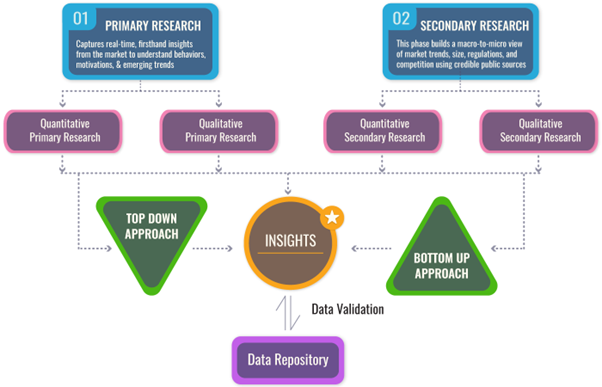
DUAL MODELING: TOP-DOWN + BOTTOM-UP
To ensure robust market estimation, we apply two complementary sizing approaches:
Top-Down Modeling:- Start with broader industry value (e.g., global or regional TAM)
- Apply filters by segment, geography, end-user, or use case
- Adjust with primary insights and validation benchmarks
- Ideal for investor-grade market scans and opportunity mapping
- Aggregate from the ground up using sales volumes, pricing, and unit economics
- Use internal modeling templates aligned with stakeholder data
- Incorporate distributor-level or region-specific inputs
- Most accurate for emerging segments and granular sub-markets
DATA VALIDATION: IN-HOUSE REPOSITORY
We close the loop with proprietary data intelligence built from ongoing projects, industry monitoring, and historical benchmarking. This repository includes:
- Multi-sector market and pricing models
- Key trendlines from past interviews and forecasts
- Benchmarked adoption rates, churn patterns, and ROI indicators
- Industry-specific deviation flags and cross-check logic
- Catches inconsistencies early
- Aligns projections across studies
- Enables consistent, high-trust deliverables