

Medical Spa Market Size and Forecast (2020–2033), Global and Regional Growth, Trend, Share, and Industry Analysis Report Coverage: By Service Type (Injection-Based Treatments, Skin Rejuvenation & Resurfacing, Body Contouring & Fat Reduction, Hair Removal, Anti-Aging & Regenerative Medicine, Others), By Age Group (Below 30, 30–50, Above 50), By Facility Type (Single-Owner/Solo Practices, Franchised Spas, Medical Group & Hospital-Affiliated Spas), By Distribution Channel (Direct Sales/In-clinic, Online Booking Platforms, Third-Party Aggregators), and Geography
2025-12-19
Healthcare
Swetal (Research Analyst)
Description
Medical Spa
Market Overview
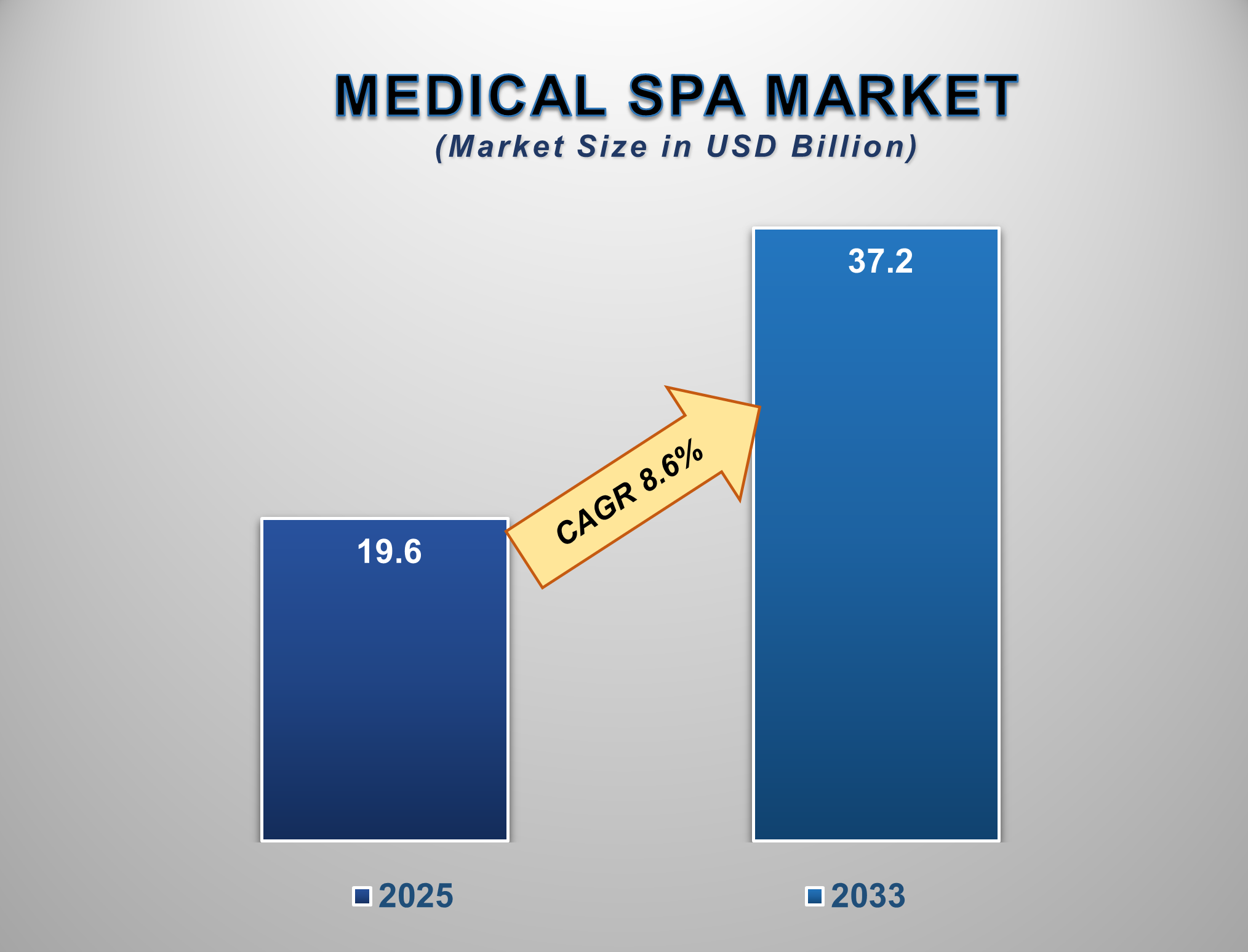
The Medica Spa Market is poised for robust growth between 2025 and 2033, fueled by rising consumer demand for minimally invasive aesthetic procedures, increasing disposable income, and growing awareness of appearance enhancement and wellness. The market is expected to be valued at USD 19.6 billion in 2025 and is projected to reach USD 37.2 billion by 2033, registering a CAGR of 8.6% during the forecast period.
Medical spas integrate clinical medical treatments with
traditional spa services, offering procedures such as Botox, dermal fillers,
laser hair removal, chemical peels, microdermabrasion, and non-surgical body
sculpting under medical supervision. These facilities bridge the gap between
dermatology clinics and luxury spas, providing a safe, results-driven
environment for cosmetic and wellness services. Advancements in energy-based
devices, injectable technologies, and personalized treatment protocols have expanded
the range of services and improved outcomes, attracting a diverse clientele.
The market is driven by a cultural shift towards proactive aging management,
social media influence, and the destigmatization of aesthetic treatments. North
America leads in revenue due to high adoption rates and advanced healthcare
infrastructure, while Asia-Pacific is witnessing explosive growth driven by
medical tourism, rising beauty consciousness, and expanding middle-class
populations.
Medical Spa Market Drivers and Opportunities
Rising Demand for
Non-Invasive and Minimally Invasive Aesthetic Procedures Is the Primary Market
Driver
The global surge in preference for non-surgical cosmetic
treatments is the most influential driver of medical spa growth. Consumers increasingly seek procedures with
minimal downtime, lower risk, and natural-looking results compared to
traditional surgery. Treatments like neuromodulator injections (Botox),
hyaluronic acid fillers, laser skin resurfacing, and non-invasive fat reduction
(e.g., CoolSculpting, ultrasound cavitation) are highly popular due to their
effectiveness and convenience. The aging global population, particularly baby
boomers and Generation X, is actively investing in anti-aging solutions to
maintain a youthful appearance.
Additionally, younger demographics (millennials and Gen Z)
are engaging in preventative treatments earlier in life. The growing influence
of social media, celebrity endorsements, and visual platforms like Instagram
and TikTok has normalized aesthetic enhancements, making them more accessible
and desirable. The medical oversight offered by medical spas assures safety and efficacy, further boosting
consumer confidence and driving market expansion.
Increasing Disposable Income and Expanding Middle-Class
Population in Emerging Economies Are Accelerating Market Adoption
Rising per capita income, especially in developing regions,
has made aesthetic treatments more affordable and accessible. As disposable
incomes grow, consumers are more willing to spend on premium wellness and
beauty services that were previously considered luxuries. The expanding
middle-class population in countries such as China, India, Brazil, and Mexico
is demonstrating heightened interest in personal grooming, appearance
enhancement, and self-care.
Medical spas are capitalizing on this trend by offering tiered
pricing, package deals, and membership models to attract a broader clientele.
Furthermore, the medical tourism industry is fueling cross-border travel for
high-quality, cost-effective aesthetic procedures, particularly in destinations
like Thailand, South Korea, Turkey, and Mexico. The combination of economic
growth, increased beauty consciousness, and the availability of advanced
technologies at competitive prices is creating a sustainable demand pipeline
for medical spa services worldwide.
Technological Advancements and Integration of AI and
Personalized Medicine Present Significant Opportunities
Continuous innovation in aesthetic devices and treatment
protocols is a major opportunity for market differentiation. The advent of
AI-driven skin analysis tools, personalized treatment planning software, and
advanced energy-based devices (e.g., fractional lasers, RF microneedling, HIFU)
allow for more precise, effective, and
tailored outcomes. The integration of regenerative medicine—such as
platelet-rich plasma (PRP) therapy, stem cell treatments, and exosome
therapy—into medical spa offerings is attracting
clients seeking holistic anti-aging and rejuvenation solutions. Additionally,
the rise of telemedicine and virtual consultations enables medical spas to expand their reach, provide follow-up care, and
engage with clients remotely.
Sustainability and eco-conscious practices are also
emerging as differentiators, with spas adopting green technologies, organic
products, and waste-reduction initiatives to appeal to environmentally aware
consumers. Franchising and partnership models with hospitals, dermatology
clinics, and wellness centers offer scalable growth avenues, especially in
underserved regions. For investors and operators, opportunities lie in
developing integrated wellness ecosystems, incorporating nutraceuticals and
holistic health services, and leveraging data analytics to enhance customer
retention and treatment outcomes.
Medical Spa Market Scope
|
Report Attributes |
Description |
|
Market Size in 2025 |
USD 19.6 Billion |
|
Market Forecast in 2033 |
USD 37.2 Billion |
|
CAGR % 2025-2033 |
8.6% |
|
Base Year |
2024 |
|
Historic Data |
2020-2024 |
|
Forecast Period |
2025-2033 |
|
Report USP |
Service Portfolio,
Technological Analysis, Company Market Share, Company Heatmap, Pricing
Analysis, Growth Factors and more |
|
Segments Covered |
●
By Service Type ●
By Age Group ●
By Facility Type ●
By Distribution
Channel |
|
Regional Scope |
●
North America, ●
Europe, ●
APAC, ●
Latin America ●
Middle East and
Africa |
|
Country Scope |
1)
U.S. 2)
Canada 3)
Germany 4)
UK 5)
France 6)
Spain 7)
Italy 8)
Switzerland 9)
China 10)
Japan 11)
India 12)
Australia 13)
South Korea 14)
Brazil 15)
Mexico 16)
Argentina 17)
South Africa 18)
Saudi Arabia 19)
UAE |
Medical Spa Market Report Segmentation Analysis
The
global Medica Spa Market is segmented by Service Type, End-user, Age Group,
Facility Type, Distribution Channel, and Region.
Injection-Based
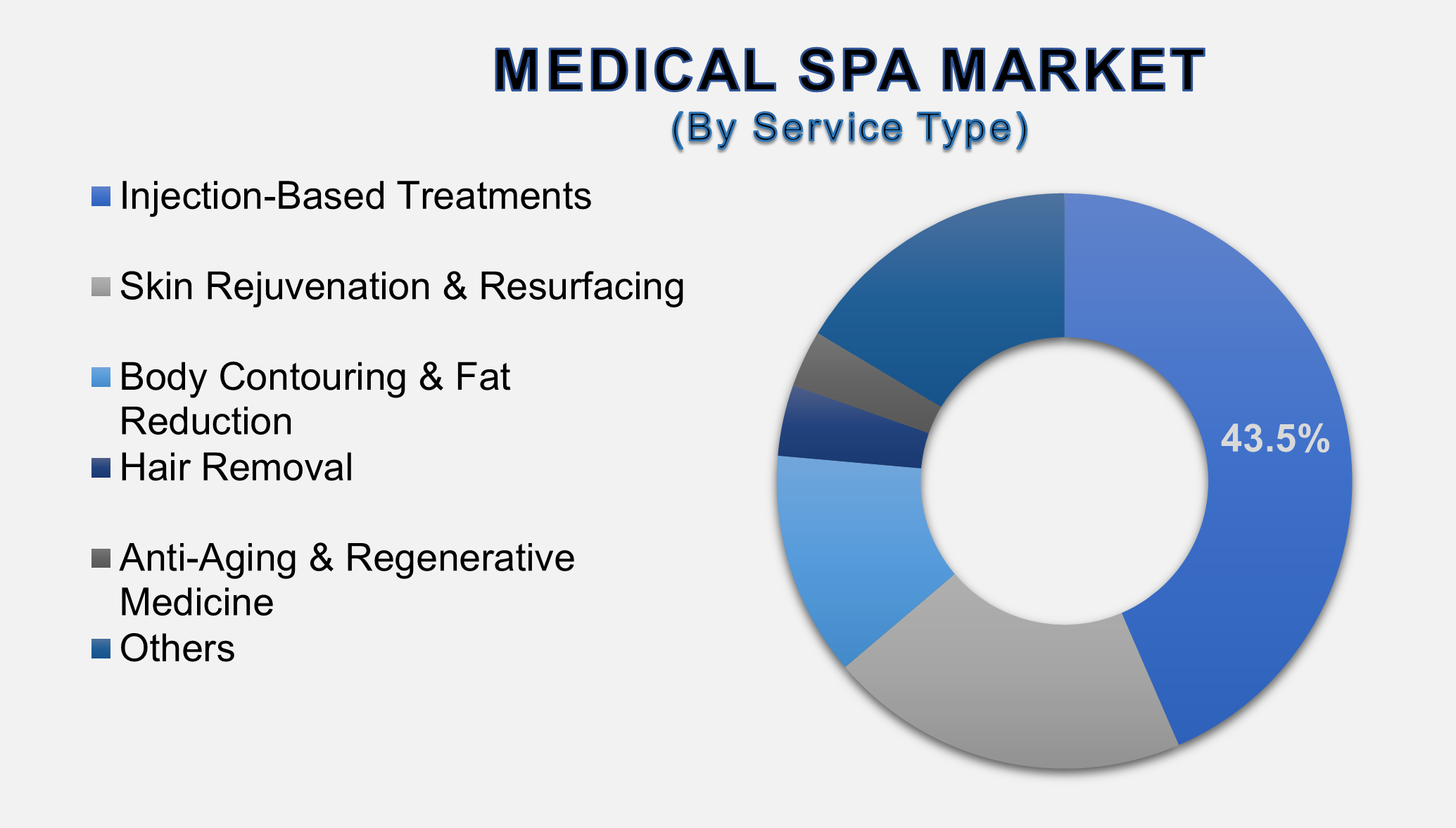
Treatments Are Anticipated to Command the Largest Market Share in 2025
Injection-based treatments, including neuromodulators (e.g., Botox, Dysport) and dermal fillers, dominate the Service Type segment due to their high popularity, quick procedure time, and immediate, noticeable results. Their market leadership is anchored in widespread use for addressing wrinkles, volume loss, and facial contouring with minimal recovery. Continuous innovation in product formulations—such as longer-lasting fillers, bio-stimulatory agents, and targeted micro-injectables—has expanded their applications and improved safety profiles. The growing acceptance among both female and male clients, coupled with increased training and certification for practitioners, has made these procedures more accessible. Rising demand for preventative “tweakments” among younger adults and the recurring nature of treatments (requiring maintenance every 6–12 months) ensure consistent revenue streams. The strong presence of established pharmaceutical brands (Allergan, Galderma) and medical spa partnerships further solidifies injection-based treatments as the leading service category globally.
The Female Segment Holds
the Largest Share by End-user
Females
represent the primary end-user segment, accounting for the majority of medical spa clients. This dominance stems from historically higher
engagement in cosmetic procedures, greater sensitivity to aging signs, and
stronger influence from beauty and wellness marketing. Women are more likely to
seek a comprehensive range of services, from
injectables and laser treatments to body contouring and skin rejuvenation, often combining multiple procedures for enhanced results.
Societal pressures, media representation, and the desire for self-confidence
continue to drive female participation. However, the male segment is growing
rapidly, fueled by increasing grooming consciousness, workplace
competitiveness, and the rise of “brotox” and male-specific aesthetic packages.
Despite this, females remain the core demographic due to higher lifetime
spending, earlier adoption of treatments, and greater openness to discussing
aesthetic enhancements, ensuring their continued leadership in the market.
Direct Sales/In-clinic
Channels Lead the Distribution Channel Segment
Direct
sales or in-clinic consultations dominate the Distribution Channel segment, as medical spa services require personalized assessments, treatment
planning, and clinical oversight. Clients prefer face-to-face interactions with
medical professionals (doctors, nurse practitioners, and aestheticians) to evaluate their needs, discuss
expectations, and ensure safety. The consultative nature of aesthetic
treatments builds trust and allows for upselling and cross-selling of
complementary services or products.
In-clinic
sales also include retail skincare lines, post-treatment care products, and
package memberships that enhance customer loyalty and recurring revenue. While
online booking platforms and third-party aggregators (e.g., Groupon, Treatwell)
are gaining traction for discovery and appointment scheduling, the final
decision and treatment delivery remain firmly rooted in the physical clinic.
The integration of digital tools for virtual consultations and follow-ups
complements rather than replaces the direct channel, reinforcing its central
role in the medical spa ecosystem.
The following segments are
part of an in-depth analysis of the global Medical Spa Market:
|
Market
Segments |
|
|
By Service
Type |
●
Injection-Based
Treatments ●
Skin Rejuvenation
& Resurfacing ●
Body Contouring
& Fat Reduction ●
Hair Removal ●
Anti-Aging &
Regenerative Medicine ●
Others |
|
By Age Group |
●
Below 30 ●
30–50 ●
Above 50 |
|
By Distribution Channel |
●
Direct
Sales/In-clinic ●
Online Booking
Platforms ●
Third-Party
Aggregators |
|
By Facility Type |
●
Single-Owner/Solo
Practices ●
Franchised Spas ●
Medical Group &
Hospital-Affiliated Spas |
Medical Spa
Market Share Analysis by Region
North America is
anticipated to hold the largest portion of the Medical Spa Market globally
throughout the forecast period.
North
America’s leadership is driven by high consumer spending power, advanced
medical aesthetics technology, strong regulatory frameworks, and widespread
cultural acceptance of cosmetic enhancements. The United States represents the
largest contributor, supported by a dense network of medical spas, prominent key players, and aggressive marketing. The
region benefits from a well-established healthcare infrastructure, extensive
insurance coverage for certain medically necessary procedures, and high
awareness of anti-aging solutions. Canada is also experiencing steady growth
due to increasing demand for non-invasive treatments and rising medical
tourism. The presence of leading device manufacturers, pharmaceutical
companies, and training academies in North America fosters continuous
innovation and practitioner expertise. While Asia-Pacific is the
fastest-growing region—fueled by South Korea’s advanced beauty industry and
China’s expanding middle class—North America maintains its dominance due to
maturity, high procedure volumes, and premium service pricing.
Medical Spa Market Competition Landscape Analysis
The global market is
fragmented, with a mix of large corporate chains, hospital-affiliated centers,
franchise networks, and independent boutique spas. Competition centers on
service quality, technological advancement, practitioner credentials, clinic
ambiance, and customer experience. Leading players invest in state-of-the-art
devices, staff training, and loyalty programs to retain clients. Strategic
collaborations with dermatologists, plastic surgeons, and wellness brands are
common to expand service portfolios. Digital marketing, social media
engagement, and online reputation management are critical for client
acquisition. Mergers and acquisitions are frequent as larger entities seek to
consolidate regional markets and expand geographic presence.
Global Medical Spa Market Recent Developments News:
- In February 2025, Allergan Aesthetics launched a new digital
consultation platform integrating AI skin analysis for personalized
treatment plans in partner medical
spas.
- In November 2024, The HydraFacial Company expanded its flagship
device offerings to include regenerative boosters, targeting medical spa partnerships in Europe and
Asia.
- In September 2024, Scientis partnered with leading U.S. medical spa chains to introduce its
next-generation hyaluronic acid filler with an
improved longevity and safety profile.
- In June 2024, LaserAway announced the acquisition of five independent
medical spas in Texas, strengthening
its footprint in the southern United States.
The Global Medical Spa Market Is Dominated by a
Few Large Companies, such as
●
Allergan Aesthetics
(AbbVie Inc.)
●
Galderma Laboratories,
L.P.
●
Cynosure, LLC
(Hologic, Inc.)
●
Lumenis Ltd.
●
Sciton, Inc.
●
Cutera, Inc.
●
Solta Medical (Bausch
Health Companies Inc.)
●
Alma Lasers Ltd.
●
El.En. S.p.A.
●
Candela Corporation
●
Syneron Medical Ltd.
●
Lutronic Corporation
●
Venus Concept Inc.
●
Merz Pharma GmbH &
Co. KGaA
●
Revance Therapeutics,
Inc.
● Other Prominent Players
Frequently Asked Questions
Swetal (Research Analyst)
Swetal is a Research Analyst with 4+ years of experience specializing in healthcare market research, medical devices, healthcare IT, and medical technology industry analysis. Her expertise includes competitive intelligence, secondary research, market trend forecasting, and healthcare business insights across global healthcare ecosystems.
She contributes to advanced market research reports by analyzing regulatory frameworks, emerging healthcare technologies, competitive landscapes, and innovation trends shaping the medical industry. With a strong focus on accurate market intelligence, strategic insights, and healthcare industry trends, Swetal supports businesses in making informed, data-backed decisions in a rapidly transforming healthcare environment.
1. Global Medical Spa Market
Introduction and Market Overview
1.1.
Objectives
of the Study
1.2.
Global
Medical Spa Market Scope and Market Estimation
1.2.1.Global Electronic Toll
Collection Overall Market Size (US$ Bn), Market CAGR (%), Market forecast (2025
- 2033)
1.2.2.Global Medical Spa Market
Revenue Share (%) and Growth Rate (Y-o-Y) from 2020 - 2033
1.3.
Market
Segmentation
1.3.1.Service Type of Global Medical
Spa Market
1.3.2.Age Group of Global Medical
Spa Market
1.3.3.Faculty Type of Global Medical
Spa Market
1.3.4.Distribution Channel of Global
Medical Spa Market
1.3.5.Region of Global Medical
Spa Market
2. Executive
Summary
2.1.
Demand
Side Trends
2.2.
Key
Market Trends
2.3.
Market
Demand (US$ Bn) Analysis 2020 – 2024 and forecast, 2025 – 2033
2.4.
Demand
and Opportunity Assessment
2.5.
Key
Developments
2.6.
Market
Entry Strategies
2.7.
Market
Dynamics
2.7.1.Drivers
2.7.2.Limitations
2.7.3.Opportunities
2.7.4.Impact Analysis of Drivers
and Restraints
2.8.
Porter’s
Five Forces Analysis
2.9.
Pricing
Analysis
2.10.
PEST
Analysis
3. Global
Medical Spa Market Estimates
& Historical Trend Analysis (2020 - 2024)
4. Global
Medical Spa Market Estimates
& Forecast Trend Analysis, by Service Type
4.1.
Global
Medical Spa Market Revenue (US$ Bn) Estimates and Forecasts, by Service Type,
2020 - 2033
4.1.1.Injection-Based Treatments
4.1.2.Skin Rejuvenation &
Resurfacing
4.1.3.Body Contouring & Fat
Reduction
4.1.4.Hair Removal
4.1.5.Anti-Aging &
Regenerative Medicine
4.1.6.Others
5. Global
Medical Spa Market Estimates
& Forecast Trend Analysis, by Age Group
5.1.
Global
Medical Spa Market Revenue (US$ Bn) Estimates and Forecasts, by Age Group, 2020
- 2033
5.1.1.Below 30
5.1.2.30–50
5.1.3.Above 50
6. Global
Medical Spa Market Estimates
& Forecast Trend Analysis, by Facility Type
6.1.
Global
Medical Spa Market Revenue (US$ Bn) Estimates and Forecasts, by Facility Type
2020 - 2033
6.1.1.Single-Owner/Solo
Practices
6.1.2.Franchised Spas
6.1.3.Medical Group &
Hospital-Affiliated Spas
7. Global
Medical Spa Market Estimates
& Forecast Trend Analysis, by Distribution Channel
7.1.
Global
Medical Spa Market Revenue (US$ Bn) Estimates and Forecasts, by Distribution
Channel 2020 - 2033
7.1.1.Direct Sales/In-clinic
7.1.2.Online Booking Platforms
7.1.3.Third-Party Aggregators
8. Global
Medical Spa Market Estimates
& Forecast Trend Analysis, by region
8.1.
Global
Medical Spa Market Revenue (US$ Bn) Estimates and Forecasts, by region, 2020 - 2033
8.1.1.North America
8.1.2.Europe
8.1.3.Asia Pacific
8.1.4.Middle East & Africa
8.1.5.Latin America
9. North America Medical
Spa Market: Estimates & Forecast
Trend Analysis
9.1.
North
America Medical Spa Market Assessments & Key Findings
9.1.1.North America Medical Spa
Market Introduction
9.1.2.North America Medical Spa
Market Size Estimates and Forecast (US$ Billion) (2020 - 2033)
9.1.2.1. By Service
Type
9.1.2.2. By Age Group
9.1.2.3. By Distribution
Channel
9.1.2.4. By Facility
Type
9.1.2.5.
By
Country
9.1.2.5.1. The U.S.
9.1.2.5.2. Canada
10. Europe Medical
Spa Market: Estimates & Forecast
Trend Analysis
10.1.
Europe
Medical Spa Market Assessments & Key Findings
10.1.1.
Europe
Medical Spa Market Introduction
10.1.2.
Europe
Medical Spa Market Size Estimates and Forecast (US$ Billion) (2020 - 2033)
10.1.2.1. By Service
Type
10.1.2.2. By Age Group
10.1.2.3. By Distribution
Channel
10.1.2.4. By Facility
Type
10.1.2.5.
By
Country
10.1.2.5.1.
Germany
10.1.2.5.2.
Italy
10.1.2.5.3.
U.K.
10.1.2.5.4.
France
10.1.2.5.5.
Spain
10.1.2.5.6.
Switzerland
10.1.2.5.7. Rest
of Europe
11. Asia Pacific Medical
Spa Market: Estimates & Forecast
Trend Analysis
11.1.
Asia
Pacific Market Assessments & Key Findings
11.1.1.
Asia
Pacific Medical Spa Market Introduction
11.1.2.
Asia
Pacific Medical Spa Market Size Estimates and Forecast (US$ Billion) (2020 - 2033)
11.1.2.1. By Service
Type
11.1.2.2. By Age Group
11.1.2.3. By Distribution
Channel
11.1.2.4. By Facility
Type
11.1.2.5.
By
Country
11.1.2.5.1. China
11.1.2.5.2. Japan
11.1.2.5.3. India
11.1.2.5.4. Australia
11.1.2.5.5. South Korea
11.1.2.5.6. Rest of Asia Pacific
12. Middle East & Africa Medical
Spa Market: Estimates & Forecast
Trend Analysis
12.1.
Middle
East & Africa Market Assessments & Key Findings
12.1.1.
Middle East & Africa Medical Spa Market Introduction
12.1.2.
Middle East & Africa Medical Spa Market Size Estimates
and Forecast (US$ Billion) (2020 - 2033)
12.1.2.1. By Service
Type
12.1.2.2. By Age Group
12.1.2.3. By Distribution
Channel
12.1.2.4. By End User
12.1.2.5.
By
Country
12.1.2.5.1. UAE
12.1.2.5.2. Saudi
Arabia
12.1.2.5.3. South
Africa
12.1.2.5.4. Rest
of MEA
13. Latin America
Medical Spa Market: Estimates &
Forecast Trend Analysis
13.1.
Latin
America Market Assessments & Key Findings
13.1.1.
Latin
America Medical Spa Market Introduction
13.1.2.
Latin
America Medical Spa Market Size Estimates and Forecast (US$ Billion) (2020 - 2033)
13.1.2.1. By Service
Type
13.1.2.2. By Age Group
13.1.2.3. By Distribution
Channel
13.1.2.4. By Facility
Type
13.1.2.5.
By
Country
13.1.2.5.1. Brazil
13.1.2.5.2. Argentina
13.1.2.5.3. Mexico
13.1.2.5.4. Rest
of LATAM
14. Country Wise Market:
Introduction
15.
Competition
Landscape
15.1.
Global
Medical Spa Market Product Mapping
15.2.
Global
Medical Spa Market Concentration Analysis, by Leading Players / Innovators /
Emerging Players / New Entrants
15.3.
Global
Medical Spa Market Tier Structure Analysis
15.4.
Global
Medical Spa Market Concentration & Company Market Shares (%) Analysis, 2024
16.
Company
Profiles
16.1.
Allergan Aesthetics (AbbVie Inc.)
16.1.1.
Company
Overview & Key Stats
16.1.2.
Financial
Performance & KPIs
16.1.3.
Product
Portfolio
16.1.4.
SWOT
Analysis
16.1.5.
Business
Strategy & Recent Developments
* Similar details would be provided for all the players
mentioned below
16.2. Galderma
Laboratories, L.P.
16.3. Cynosure, LLC
(Hologic, Inc.)
16.4. Lumenis Ltd.
16.5. Sciton, Inc.
16.6. Cutera, Inc.
16.7. Solta Medical
(Bausch Health Companies Inc.)
16.8. Alma Lasers
Ltd. (Sisram Medical Ltd)
16.9. El.En. S.p.A.
16.10. Candela
Corporation
16.11. Syneron
Medical Ltd.
16.12. Lutronic
Corporation
16.13. Venus Concept
Inc.
16.14. Merz Pharma
GmbH & Co. KGaA
16.15. Revance
Therapeutics, Inc.
16.16. Other
Prominent Players
17. Research
Methodology
17.1.
External
Transportations / Databases
17.2.
Internal
Proprietary Database
17.3.
Primary
Research
17.4.
Secondary
Research
17.5.
Assumptions
17.6.
Limitations
17.7.
Report
FAQs
18. Research
Findings & Conclusion
Our Research Methodology
"Insight without rigor is just noise."
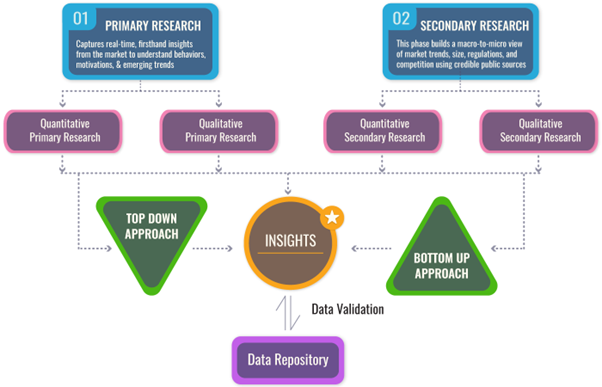
We follow a comprehensive, multi-phase research framework designed to deliver accurate, strategic, and decision-ready intelligence. Our process integrates primary and secondary research , both quantitative and qualitative , along with dual modeling techniques ( top-down and bottom-up) and a final layer of validation through our proprietary in-house repository.
PRIMARY RESEARCH
Primary research captures real-time, firsthand insights from the market to understand behaviors, motivations, and emerging trends.
1. Quantitative Primary Research
Objective: Generate statistically significant data directly from market participants.
Approaches:- Structured surveys with customers, distributors, and field agents
- Mobile-based data collection for point-of-sale audits and usage behavior
- Phone-based interviews (CATI) for market sizing and product feedback
- Online polling around industry events and digital campaigns
- Purchase frequency by customer type
- Channel performance across geographies
- Feature demand by application or demographic
2. Qualitative Primary Research
Objective: Explore decision-making drivers, pain points, and market readiness.
Approaches:- In-depth interviews (IDIs) with executives, product managers, and key decision-makers
- Focus groups among end users and early adopters
- Site visits and observational research for consumer products
- Informal field-level discussions for regional and cultural nuances
SECONDARY RESEARCH
This phase helps establish a macro-to-micro understanding of market trends, size, regulation, and competitive dynamics, sourced from credible and public domain information.
1. Quantitative Secondary Research
Objective: Model market value and segment-level forecasts based on published data.
Sources include:- Financial reports and investor summaries
- Government trade data, customs records, and regulatory statistics
- Industry association publications and economic databases
- Channel performance and pricing data from marketplace listings
- Revenue splits, pricing trends, and CAGR estimates
- Supply-side capacity and volume tracking
- Investment analysis and funding benchmarks
2. Qualitative Secondary Research
Objective: Capture strategic direction, innovation signals, and behavioral trends.
Sources include:- Company announcements, roadmaps, and product pipelines
- Publicly available whitepapers, conference abstracts, and academic research
- Regulatory body publications and policy briefs
- Social and media sentiment scanning for early-stage shifts
- Strategic shifts in market positioning
- Unmet needs and white spaces
- Regulatory triggers and compliance impact
DUAL MODELING: TOP-DOWN + BOTTOM-UP
To ensure robust market estimation, we apply two complementary sizing approaches:
Top-Down Modeling:- Start with broader industry value (e.g., global or regional TAM)
- Apply filters by segment, geography, end-user, or use case
- Adjust with primary insights and validation benchmarks
- Ideal for investor-grade market scans and opportunity mapping
- Aggregate from the ground up using sales volumes, pricing, and unit economics
- Use internal modeling templates aligned with stakeholder data
- Incorporate distributor-level or region-specific inputs
- Most accurate for emerging segments and granular sub-markets
DATA VALIDATION: IN-HOUSE REPOSITORY
We close the loop with proprietary data intelligence built from ongoing projects, industry monitoring, and historical benchmarking. This repository includes:
- Multi-sector market and pricing models
- Key trendlines from past interviews and forecasts
- Benchmarked adoption rates, churn patterns, and ROI indicators
- Industry-specific deviation flags and cross-check logic
- Catches inconsistencies early
- Aligns projections across studies
- Enables consistent, high-trust deliverables