

Medical Specialty Bag Market Size and Forecast (2020 - 2033), Global and Regional Growth, Trend, Share, and Industry Analysis Report Coverage: By Product (Enteral Feeding Bags, Intravenous Fluid Bags, Urinary Collection Bags, Ostomy Bags, Blood Bags, Others), By Material (Plastics (PVC, Non-PVC), Rubber), By End-User (Hospitals, Ambulatory Surgical Centers, Home Care Settings) And Geography
2025-12-17
Healthcare
Swetal (Research Analyst)
Description
Medical
Specialty Bag Market Overview
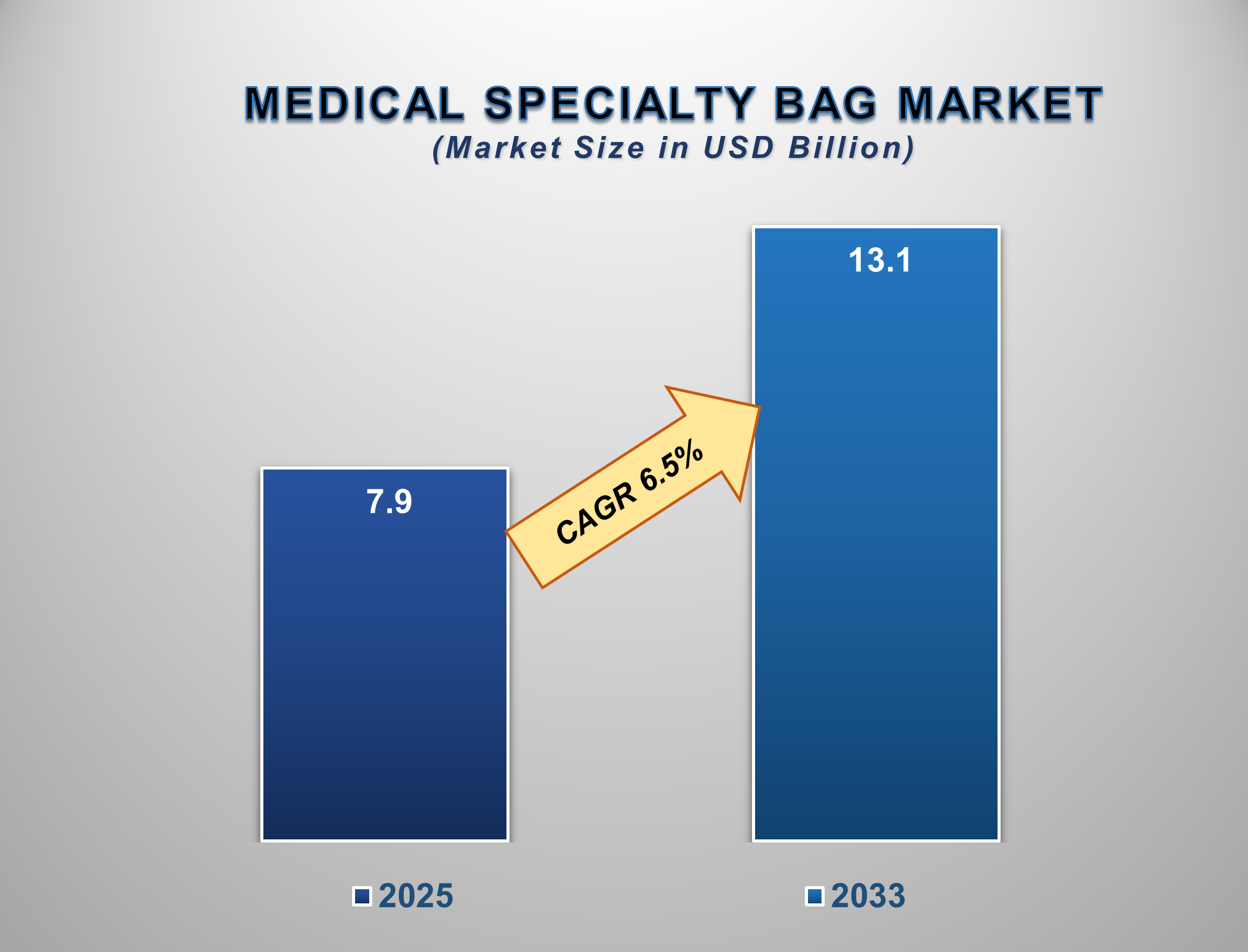
The Medical Specialty Bag Market is poised for substantial growth from 2025 to 2033, driven by the rising global prevalence of chronic diseases, an increasing number of surgical procedures, and a growing shift towards home-based healthcare. The market is projected to be valued at approximately USD 7.9 billion in 2025 and is forecasted to reach nearly USD 13.1 billion by 2033, exhibiting a compound annual growth rate (CAGR) of 6.5% during this period.
Medical specialty bags are critical single-use
medical devices designed for the containment, administration, or collection of
bodily fluids and waste. They play a vital role in patient care across various
therapeutic areas, including urology, ostomy care, enteral nutrition, and
intravenous therapy. The market's expansion is primarily fuelled by the growing
geriatric population, which is more susceptible to conditions requiring these
devices, such as urinary incontinence, colorectal cancer, and mobility issues.
Furthermore, technological advancements leading to more comfortable,
skin-friendly, and discreet bags are improving patient compliance and quality
of life. The increasing preference for minimally invasive surgeries and the
cost-effectiveness of home care are also significant contributors. North
America holds the largest market share, while the Asia-Pacific region is
expected to witness the fastest growth, driven by improving healthcare
infrastructure, rising medical awareness, and expanding healthcare access.
Medical Specialty Bag Market Drivers and
Opportunities
Aging Population and Rising Chronic Disease Burden Are the
Primary Market Drivers
The
pivotal role of the aging population as the primary driver for the medical
specialty bag market is irrefutably linked to the escalating global incidence
and prevalence of chronic diseases that disproportionately affect older adults.
As life expectancy increases, so does the pool of individuals living for
extended periods with multiple chronic conditions.
The
statistical burden is substantial; for instance, the prevalence of urinary
incontinence, a key driver for urinary collection bags, affects over 50% of
elderly women and a significant proportion of men, creating a massive,
sustained demand. Similarly, the incidence of colorectal cancer, which often
necessitates life-saving ostomy surgery, is heavily age-related, with over 90%
of new cases diagnosed in individuals aged 50 and above. This translates to a
growing number of ostomates requiring a continuous supply of ostomy bags for
daily management.
Furthermore,
the prevalence of neurological disorders like Parkinson's disease and dementia,
which can impair swallowing and mobility, fuels the need for enteral feeding
bags and urinary products. Chronic conditions such as diabetes and
cardiovascular diseases also contribute indirectly, as they increase the risk
of complications and hospitalizations, where
intravenous fluid bags and other specialty bags are essential. This demographic
and epidemiological shift is not a transient trend but a fundamental transformation
of the patient landscape. The rising incidence of these age-associated
conditions ensures a consistent and expanding patient base that relies on
medical specialty bags not for acute, short-term episodes, but for long-term,
often permanent, management, thereby creating a foundational and growing demand
that underpins the entire market's expansion.
Growth in Surgical Procedures and Shift Towards Home
Healthcare is Driving Market Evolution
The rising volume of surgical interventions,
particularly abdominal and pelvic surgeries that can result in temporary or
permanent ostomies, directly fuels the demand for ostomy products.
Concurrently, there is a strong trend towards dehospitalization and home-based care, as it reduces healthcare costs and
improves patient satisfaction. Medical specialty bags, such as those for
urinary drainage, enteral feeding, and IV therapy, are designed for safe use in
the home setting, empowering patients and reducing the burden on institutional
care facilities. This dual trend of more surgeries and the transition to home
care is a major catalyst for market expansion.
Material Innovation and Development of Smart Bags Present
Significant Opportunities
Continuous innovation in materials and
technology presents substantial growth frontiers. A key opportunity lies in the
development of advanced non-PVC materials, addressing concerns over plasticizer
toxicity and environmental impact. The emergence of "smart" bags
integrated with sensors represents a significant leap forward. These devices
can monitor fill level, detect infections
(e.g., in urinary bags), or track nutrient delivery, enabling proactive care
and reducing complications. For manufacturers, investing in R&D for
biocompatible, eco-friendly materials,
developing connected health solutions for remote patient monitoring, and expanding product portfolios to cater to the vast
unmet needs in emerging economies are key strategies for future growth.
Medical Specialty Bag Market Scope
|
Report Attributes |
Description |
|
Market Size in 2025 |
USD 7.9 Billion |
|
Market Forecast in 2033 |
USD 13.1 Billion |
|
CAGR % 2025-2033 |
6.5% |
|
Base Year |
2024 |
|
Historic Data |
2020-2024 |
|
Forecast Period |
2025-2033 |
|
Report USP |
Product Portfolio,
Technological Analysis, Company Market Share, Company Heatmap, Pricing
Analysis, Growth Factors and more |
|
Segments Covered |
●
By Product ●
By Material ●
By End-user |
|
Regional Scope |
●
North America, ●
Europe, ●
APAC, ●
Latin America ●
Middle East and
Africa |
|
Country Scope |
1)
U.S. 2)
Canada 3)
Germany 4)
UK 5)
France 6)
Spain 7)
Italy 8)
Switzerland 9)
China 10)
Japan 11)
India 12)
Australia 13)
South Korea 14)
Brazil 15)
Mexico 16)
Argentina 17)
South Africa 18)
Saudi Arabia 19)
UAE |
Medical Specialty Bag Market Report Segmentation
Analysis
The global Medical Specialty Bag
Market industry analysis is segmented by Product, by Material, by End-User, and
by Region.
The Urinary Collection
Bags segment is anticipated to command a dominant market share in 2025.
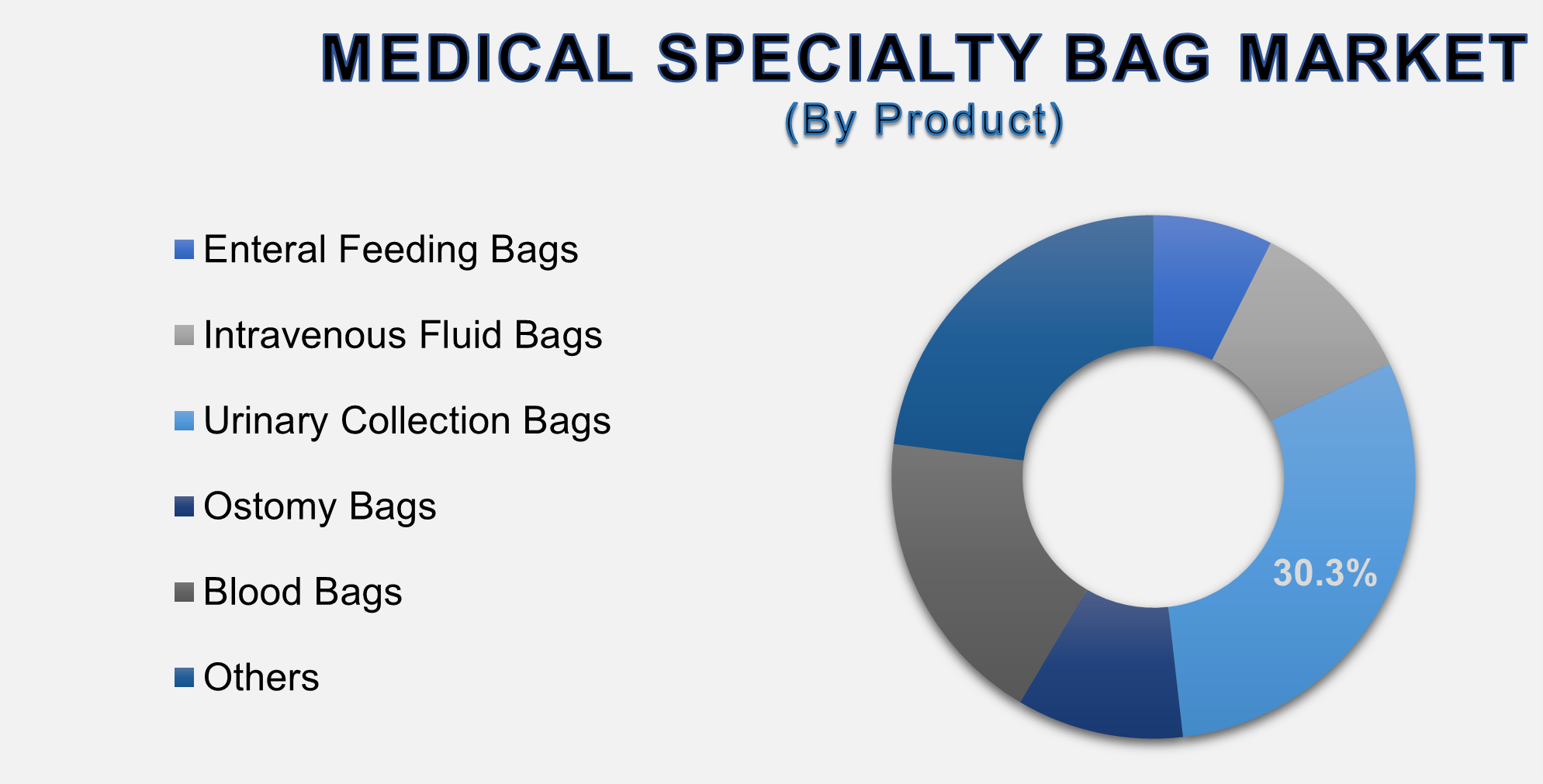
The Product segment is categorized into Enteral Feeding Bags, Intravenous (IV) Fluid Bags, Urinary Collection Bags, Ostomy Bags, Blood Bags, and Others. The Urinary Collection Bags segment commands the largest market share. This is attributed to the high prevalence of urinary incontinence, especially among the elderly and post-surgical patients, and the essential nature of these bags in hospital settings for catheterized patients. The recurring need for these bags, both in clinical and home care environments, ensures consistent and high-volume demand.
The Plastics segment is
projected to be the largest and fastest-growing.
The
Material segment is divided into Plastics (PVC and Non-PVC) and Rubber. The
Plastics segment is the largest and fastest-growing. Plastic, particularly PVC
and its newer non-PVC alternatives, is the material of choice due to its
durability, flexibility, transparency, and cost-effectiveness. The shift
towards non-PVC materials, such as Ethylene Vinyl Acetate (EVA) and
Polyolefins, driven by regulatory and environmental concerns, is a key factor
propelling innovation and growth within this segment.
The Hospitals segment is
projected to exhibit the highest usage.
The
End-User segment includes Hospitals, Ambulatory Surgical Centers (ASCs), and
Home Care Settings. The Hospitals segment currently exhibits the highest usage
due to the high inpatient volume, intensive care units, and the wide range of
surgical and therapeutic procedures performed that require specialty bags.
However, the Home Care Settings segment is expected to be the fastest-growing,
fueled by the global trend of managing chronic conditions outside the hospital
to reduce costs and improve patient quality of life.
The following segments are
part of an in-depth analysis of the global Medical Specialty Bag Market:
|
Market
Segments |
|
|
By Product |
●
Enteral Feeding Bags ●
Intravenous Fluid
Bags ●
Urinary Collection
Bags ●
Ostomy Bags ●
Blood Bags ●
Others |
|
By
Material |
●
Plastics (PVC,
Non-PVC) ●
Rubber |
|
By End-user |
●
Hospitals ●
Ambulatory Surgical
Centers ●
Home Care Settings |
Medical Specialty Bag Market Share Analysis by
Region
The North America region
is anticipated to hold the largest portion of the Medical Specialty Bag Market
globally throughout the forecast period.
North
America's dominance is attributed to its well-established healthcare
infrastructure, high healthcare expenditure, and early adoption of advanced
medical technologies. The region has a high prevalence of chronic diseases and
a significant geriatric population, creating a substantial demand for medical
specialty bags. Stringent regulatory standards ensuring product quality and
high patient awareness further solidify North America's position as the largest
regional market.
The
U.S. is the single largest market within North America, driven by its massive
healthcare spending, which exceeds $4.5 trillion annually. The country's
advanced hospital network and a strong, well-reimbursed home care sector create
a robust demand for all types of medical bags. The presence of major global
players like Baxter International and B. Braun Melsungen AG ensures a steady
stream of product innovation and widespread availability. Furthermore, high
patient awareness about available care options and favourable insurance
coverage for disposable medical devices underpin the consistent growth of the
market in the U.S.
Medical Specialty Bag Market Competition
Landscape Analysis
The global medical specialty
bag market is moderately consolidated and features a mix of large, diversified
medical device conglomerates and specialized players. Competition is based on
product quality, reliability, material innovation, price, and global
distribution network. Key strategies include product portfolio expansion
through R&D, strategic acquisitions to enter new geographic or product
markets, and a strong focus on providing holistic patient care solutions,
particularly in the ostomy and continence care segments.
Global Medical Specialty
Bag Market Recent Developments News:
- In February 2025, ConvaTec Group PLC launched a new range of ostomy
bags with integrated skin health sensors to monitor peristomal skin
condition.
- In November 2024, Coloplast A/S acquired a company specializing in
discreet and eco-friendly urinary incontinence products for women.
- In July 2024, Baxter International Inc. received FDA clearance for a
new non-PVC IV fluid bag with improved barrier properties.
- In April 2024, Hollister Incorporated introduced a new digital health
platform that connects to their urology products, allowing for remote
patient monitoring.
The Global Medical
Specialty Bag Market Is Dominated by a Few Large Companies, such as
●
Coloplast A/S
●
ConvaTec Group PLC
●
Hollister Incorporated
●
Braun Melsungen AG
●
Baxter International
Inc.
●
Terumo Corporation
●
Medline Industries, LP
●
Smiths Medical (Part
of ICU Medical, Inc.)
●
Maco Pharma
●
Fresenius Kabi AG
●
3M Company
●
Cardinal Health, Inc.
●
Cook Medical Inc.
●
Pennine Healthcare
●
Amsino International,
Inc.
● Other Prominent Players
Frequently Asked Questions
Swetal (Research Analyst)
Swetal is a Research Analyst with 4+ years of experience specializing in healthcare market research, medical devices, healthcare IT, and medical technology industry analysis. Her expertise includes competitive intelligence, secondary research, market trend forecasting, and healthcare business insights across global healthcare ecosystems.
She contributes to advanced market research reports by analyzing regulatory frameworks, emerging healthcare technologies, competitive landscapes, and innovation trends shaping the medical industry. With a strong focus on accurate market intelligence, strategic insights, and healthcare industry trends, Swetal supports businesses in making informed, data-backed decisions in a rapidly transforming healthcare environment.
1. Global Medical Specialty
Bag Market Introduction and Market Overview
1.1.
Objectives
of the Study
1.2.
Global
Medical Specialty Bag Market Scope and Market Estimation
1.2.1.Global Electronic Toll
Collection Overall Market Size (US$ Mn), Market CAGR (%), Market forecast (2025
- 2033)
1.2.2.Global Medical Specialty
Bag Market Revenue Share (%) and Growth Rate (Y-o-Y) from 2020 - 2033
1.3.
Market
Segmentation
1.3.1.Product of Global Medical
Specialty Bag Market
1.3.2.Material of Global Medical
Specialty Bag Market
1.3.3.End-user of Global Medical
Specialty Bag Market
1.3.4.Region of Global Medical
Specialty Bag Market
2. Executive
Summary
2.1.
Demand
Side Trends
2.2.
Key
Market Trends
2.3.
Market
Demand (US$ Mn) Analysis 2020 – 2024 and forecast, 2025 – 2033
2.4.
Demand
and Opportunity Assessment
2.5.
Technological
Advancements
2.6.
Regulatory
Scenario by Region
2.7.
Key
Developments
2.8.
Market
Entry Strategies
2.9.
Market
Dynamics
2.9.1.Drivers
2.9.2.Limitations
2.9.3.Opportunities
2.9.4.Impact Analysis of Drivers
and Restraints
2.10.
Porter’s
Five Forces Analysis
2.11.
PEST
Analysis
3. Global
Medical Specialty Bag Market Estimates
& Historical Trend Analysis (2020 - 2024)
4. Global
Medical Specialty Bag Market Estimates
& Forecast Trend Analysis, by Product
4.1.
Global
Medical Specialty Bag Market Revenue (US$ Mn) Estimates and Forecasts, by Product,
2020 - 2033
4.1.1.Enteral Feeding Bags
4.1.2.Intravenous Fluid Bags
4.1.3.Urinary Collection Bags
4.1.4.Ostomy Bags
4.1.5.Blood Bags
4.1.6.Others
5. Global
Medical Specialty Bag Market Estimates
& Forecast Trend Analysis, by Material
5.1.
Global
Medical Specialty Bag Market Revenue (US$ Mn) Estimates and Forecasts, by Material,
2020 - 2033
5.1.1.Plastics (PVC, Non-PVC)
5.1.2.Rubber
6. Global
Medical Specialty Bag Market Estimates
& Forecast Trend Analysis, by End-user
6.1.
Global
Medical Specialty Bag Market Revenue (US$ Mn) Estimates and Forecasts, by End-user
2020 - 2033
6.1.1.Hospitals
6.1.2.Ambulatory Surgical
Centers
6.1.3.Home Care Settings
7. Global
Medical Specialty Bag Market Estimates
& Forecast Trend Analysis, by region
7.1.
Global
Medical Specialty Bag Market Revenue (US$ Mn) Estimates and Forecasts, by region,
2020 - 2033
7.1.1.North America
7.1.2.Europe
7.1.3.Asia Pacific
7.1.4.Middle East & Africa
7.1.5.Latin America
8. North America Medical
Specialty Bag Market: Estimates &
Forecast Trend Analysis
8.1.
North
America Medical Specialty Bag Market Assessments & Key Findings
8.1.1.North America Medical
Specialty Bag Market Introduction
8.1.2.North America Medical
Specialty Bag Market Size Estimates and Forecast (US$ Billion) (2020 - 2033)
8.1.2.1. By Product
8.1.2.2. By Material
8.1.2.3. By End-user
8.1.2.4.
By
Country
8.1.2.4.1. The U.S.
8.1.2.4.2. Canada
9. Europe Medical
Specialty Bag Market: Estimates &
Forecast Trend Analysis
9.1.
Europe
Medical Specialty Bag Market Assessments & Key Findings
9.1.1.Europe Medical Specialty
Bag Market Introduction
9.1.2.Europe Medical Specialty
Bag Market Size Estimates and Forecast (US$ Billion) (2020 - 2033)
9.1.2.1. By Product
9.1.2.2. By Material
9.1.2.3. By End-user
9.1.2.4.
By
Country
9.1.2.4.1.
Germany
9.1.2.4.2.
Italy
9.1.2.4.3.
U.K.
9.1.2.4.4.
France
9.1.2.4.5.
Spain
9.1.2.4.6.
Switzerland
9.1.2.4.7. Rest
of Europe
10. Asia Pacific Medical
Specialty Bag Market: Estimates &
Forecast Trend Analysis
10.1.
Asia
Pacific Market Assessments & Key Findings
10.1.1.
Asia
Pacific Medical Specialty Bag Market Introduction
10.1.2.
Asia
Pacific Medical Specialty Bag Market Size Estimates and Forecast (US$ Billion)
(2020 - 2033)
10.1.2.1. By Product
10.1.2.2. By Material
10.1.2.3. By End-user
10.1.2.4.
By
Country
10.1.2.4.1. China
10.1.2.4.2. Japan
10.1.2.4.3. India
10.1.2.4.4. Australia
10.1.2.4.5. South Korea
10.1.2.4.6. Rest of Asia Pacific
11. Middle East & Africa Medical
Specialty Bag Market: Estimates &
Forecast Trend Analysis
11.1.
Middle
East & Africa Market Assessments & Key Findings
11.1.1.
Middle East & Africa Medical Specialty Bag Market
Introduction
11.1.2.
Middle East & Africa Medical Specialty Bag Market Size Estimates
and Forecast (US$ Billion) (2020 - 2033)
11.1.2.1. By Product
11.1.2.2. By Material
11.1.2.3. By End-user
11.1.2.4.
By
Country
11.1.2.4.1. UAE
11.1.2.4.2. Saudi
Arabia
11.1.2.4.3. South
Africa
11.1.2.4.4. Rest
of MEA
12. Latin America
Medical Specialty Bag Market: Estimates
& Forecast Trend Analysis
12.1.
Latin
America Market Assessments & Key Findings
12.1.1.
Latin
America Medical Specialty Bag Market Introduction
12.1.2.
Latin
America Medical Specialty Bag Market Size Estimates and Forecast (US$ Billion)
(2020 - 2033)
12.1.2.1. By Product
12.1.2.2. By Material
12.1.2.3. By End-user
12.1.2.4.
By
Country
12.1.2.4.1. Brazil
12.1.2.4.2. Argentina
12.1.2.4.3. Mexico
12.1.2.4.4. Rest
of LATAM
13. Country Wise Market:
Introduction
14.
Competition
Landscape
14.1.
Global
Medical Specialty Bag Market Product Mapping
14.2.
Global
Medical Specialty Bag Market Concentration Analysis, by Leading Players /
Innovators / Emerging Players / New Entrants
14.3.
Global
Medical Specialty Bag Market Tier Structure Analysis
14.4.
Global
Medical Specialty Bag Market Concentration & Company Market Shares (%)
Analysis, 2024
15.
Company
Profiles
15.1.
Coloplast A/S
15.1.1.
Company
Overview & Key Stats
15.1.2.
Financial
Performance & KPIs
15.1.3.
Product
Portfolio
15.1.4.
SWOT
Analysis
15.1.5.
Business
Strategy & Recent Developments
* Similar details would be provided for all the players
mentioned below
15.2. ConvaTec
Group PLC
15.3. Hollister
Incorporated
15.4. Braun
Melsungen AG
15.5. Baxter
International Inc.
15.6. Terumo
Corporation
15.7. Medline
Industries, LP
15.8. Smiths
Medical (Part of ICU Medical, Inc.)
15.9. Maco Pharma
15.10. Fresenius
Kabi AG
15.11. 3M Company
15.12. Cardinal
Health, Inc.
15.13. Cook Medical
Inc.
15.14. Pennine
Healthcare
15.15. Amsino
International, Inc.
15.16. Other
Prominent Players
16. Research
Methodology
16.1.
External
Transportations / Databases
16.2.
Internal
Proprietary Database
16.3.
Primary
Research
16.4.
Secondary
Research
16.5.
Assumptions
16.6.
Limitations
16.7.
Report
FAQs
17. Research
Findings & Conclusion
Our Research Methodology
"Insight without rigor is just noise."
We follow a comprehensive, multi-phase research framework designed to deliver accurate, strategic, and decision-ready intelligence. Our process integrates primary and secondary research , both quantitative and qualitative , along with dual modeling techniques ( top-down and bottom-up) and a final layer of validation through our proprietary in-house repository.
PRIMARY RESEARCH
Primary research captures real-time, firsthand insights from the market to understand behaviors, motivations, and emerging trends.
1. Quantitative Primary Research
Objective: Generate statistically significant data directly from market participants.
Approaches:- Structured surveys with customers, distributors, and field agents
- Mobile-based data collection for point-of-sale audits and usage behavior
- Phone-based interviews (CATI) for market sizing and product feedback
- Online polling around industry events and digital campaigns
- Purchase frequency by customer type
- Channel performance across geographies
- Feature demand by application or demographic
2. Qualitative Primary Research
Objective: Explore decision-making drivers, pain points, and market readiness.
Approaches:- In-depth interviews (IDIs) with executives, product managers, and key decision-makers
- Focus groups among end users and early adopters
- Site visits and observational research for consumer products
- Informal field-level discussions for regional and cultural nuances
SECONDARY RESEARCH
This phase helps establish a macro-to-micro understanding of market trends, size, regulation, and competitive dynamics, sourced from credible and public domain information.
1. Quantitative Secondary Research
Objective: Model market value and segment-level forecasts based on published data.
Sources include:- Financial reports and investor summaries
- Government trade data, customs records, and regulatory statistics
- Industry association publications and economic databases
- Channel performance and pricing data from marketplace listings
- Revenue splits, pricing trends, and CAGR estimates
- Supply-side capacity and volume tracking
- Investment analysis and funding benchmarks
2. Qualitative Secondary Research
Objective: Capture strategic direction, innovation signals, and behavioral trends.
Sources include:- Company announcements, roadmaps, and product pipelines
- Publicly available whitepapers, conference abstracts, and academic research
- Regulatory body publications and policy briefs
- Social and media sentiment scanning for early-stage shifts
- Strategic shifts in market positioning
- Unmet needs and white spaces
- Regulatory triggers and compliance impact
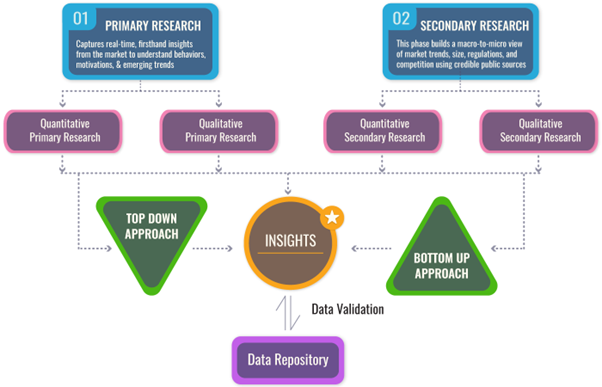
DUAL MODELING: TOP-DOWN + BOTTOM-UP
To ensure robust market estimation, we apply two complementary sizing approaches:
Top-Down Modeling:- Start with broader industry value (e.g., global or regional TAM)
- Apply filters by segment, geography, end-user, or use case
- Adjust with primary insights and validation benchmarks
- Ideal for investor-grade market scans and opportunity mapping
- Aggregate from the ground up using sales volumes, pricing, and unit economics
- Use internal modeling templates aligned with stakeholder data
- Incorporate distributor-level or region-specific inputs
- Most accurate for emerging segments and granular sub-markets
DATA VALIDATION: IN-HOUSE REPOSITORY
We close the loop with proprietary data intelligence built from ongoing projects, industry monitoring, and historical benchmarking. This repository includes:
- Multi-sector market and pricing models
- Key trendlines from past interviews and forecasts
- Benchmarked adoption rates, churn patterns, and ROI indicators
- Industry-specific deviation flags and cross-check logic
- Catches inconsistencies early
- Aligns projections across studies
- Enables consistent, high-trust deliverables