

Medical Tourism Market Size and Forecast (2025–2033), Global and Regional Growth, Trend, Share, and Industry Analysis Report Coverage: By Healthcare Services (Medical Treatment, Cardiac Procedures, Oncology Procedures, Orthopedic & Spine Procedures, Dental Procedures, Wellness Treatment, Cosmetic Procedures, Rejuvenation Procedures, Alternative Treatment, Others), By Service Provider (Public, Private), and Geography
2026-02-17
Travel & Hospitality
Ekta Chaurasia (Team Lead)
Description
Medical Tourism Market Overview
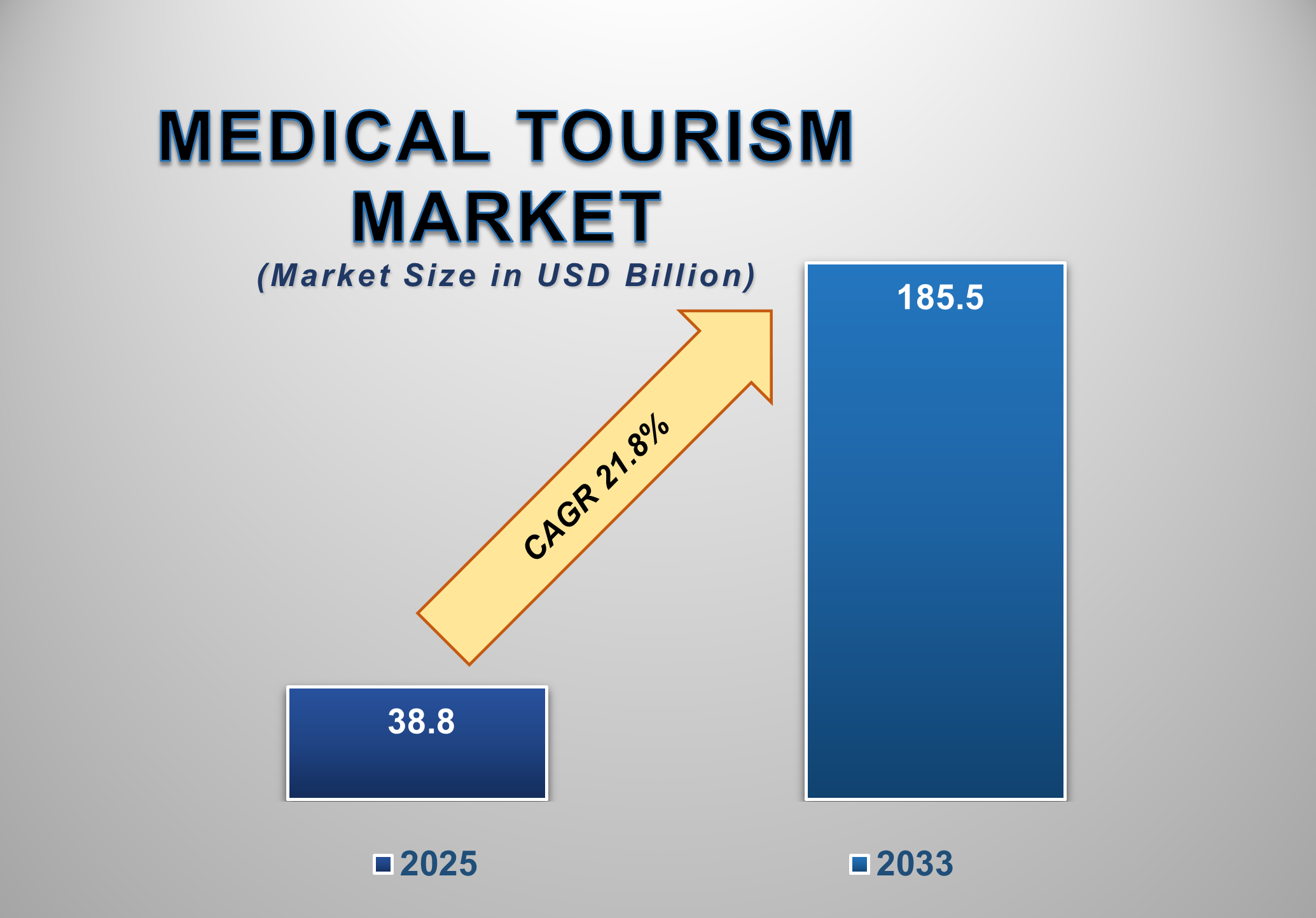
The global Medical Tourism Market is undergoing rapid transformation and expansion, driven by widening cost differentials in healthcare services, growing cross-border mobility, and increasing patient willingness to seek high-quality medical care outside their home countries. Valued at USD 38.8 billion in 2025, the market is projected to reach USD 185.5 billion by 2033, registering a remarkable CAGR of 21.8% during the forecast period. Medical tourism encompasses a broad range of healthcare services, including complex medical treatments, elective surgeries, wellness therapies, and cosmetic and rejuvenation procedures.
Patients increasingly travel
internationally to access advanced medical treatments at significantly lower
costs, often combined with shorter waiting times and access to internationally
accredited hospitals. The market benefits from advancements in medical
technology, teleconsultation, digital health records, and coordinated patient
facilitation services, which simplify cross-border treatment journeys. Private
healthcare providers, in particular, have emerged as major beneficiaries,
offering bundled treatment packages that combine medical procedures,
accommodation, post-operative care, and travel assistance.
Medical Tourism Market
Drivers and Opportunities
Rising Healthcare Costs
and Long Waiting Times in Developed Economies Are Driving Medical Tourism
Growth
Escalating healthcare costs and prolonged waiting periods in
developed economies are among the most significant drivers fueling growth in
the global medical tourism market. In regions such as North America and parts
of Europe, patients face high out-of-pocket expenses, limited insurance
coverage for elective procedures, and extended wait times for surgeries such as
orthopedic, cardiac, and diagnostic interventions. These challenges are
prompting patients to seek treatment in countries offering comparable or
superior care at substantially lower costs. Medical tourism destinations in the
Asia Pacific and parts of the Middle East offer savings of 40–80% on major
procedures, even after accounting for travel and accommodation expenses. For
example, cardiac surgeries, orthopedic replacements, and oncology treatments
are available at a fraction of the cost charged in the United States or Western
Europe. Shorter waiting times further enhance the appeal, particularly for
patients requiring timely intervention.
In addition, international accreditation standards such as JCI and
ISO certifications have strengthened patient confidence in overseas healthcare
providers. Hospitals actively market their expertise, outcomes, and cost
advantages to international patients, reinforcing cross-border demand. As
healthcare affordability challenges persist in developed economies, medical
tourism is expected to remain a compelling alternative for millions of patients
worldwide.
Improving Healthcare Infrastructure and Government Support in
Destination Countries Is Accelerating Market Expansion
Significant investments in healthcare infrastructure and proactive
government support in key destination countries are accelerating the expansion
of the medical tourism market. Governments across the Asia Pacific and the
Middle East are actively positioning medical tourism as a strategic economic
sector, offering policy incentives, streamlined medical visas, and
international marketing initiatives. Countries such as India, Thailand,
Malaysia, and Turkey have invested heavily in state-of-the-art hospitals, advanced
diagnostic equipment, and specialized treatment centers. These facilities are
staffed by internationally trained physicians and surgeons, many of whom have
practiced in the U.S. or Europe. The presence of multilingual staff and
dedicated international patient departments further enhances the treatment
experience.
Public-private collaboration is also strengthening market growth.
While private healthcare providers dominate medical tourism flows, public
hospitals in certain regions are increasingly participating through specialized
departments and partnerships. As destination countries continue to enhance
healthcare quality, transparency, and patient facilitation services,
international patient volumes are expected to rise steadily.
Growth of Specialized Treatments and Wellness Tourism Is
Creating Significant Market Opportunities
The expanding demand for specialized medical treatments and
integrated wellness tourism is creating substantial growth opportunities in the
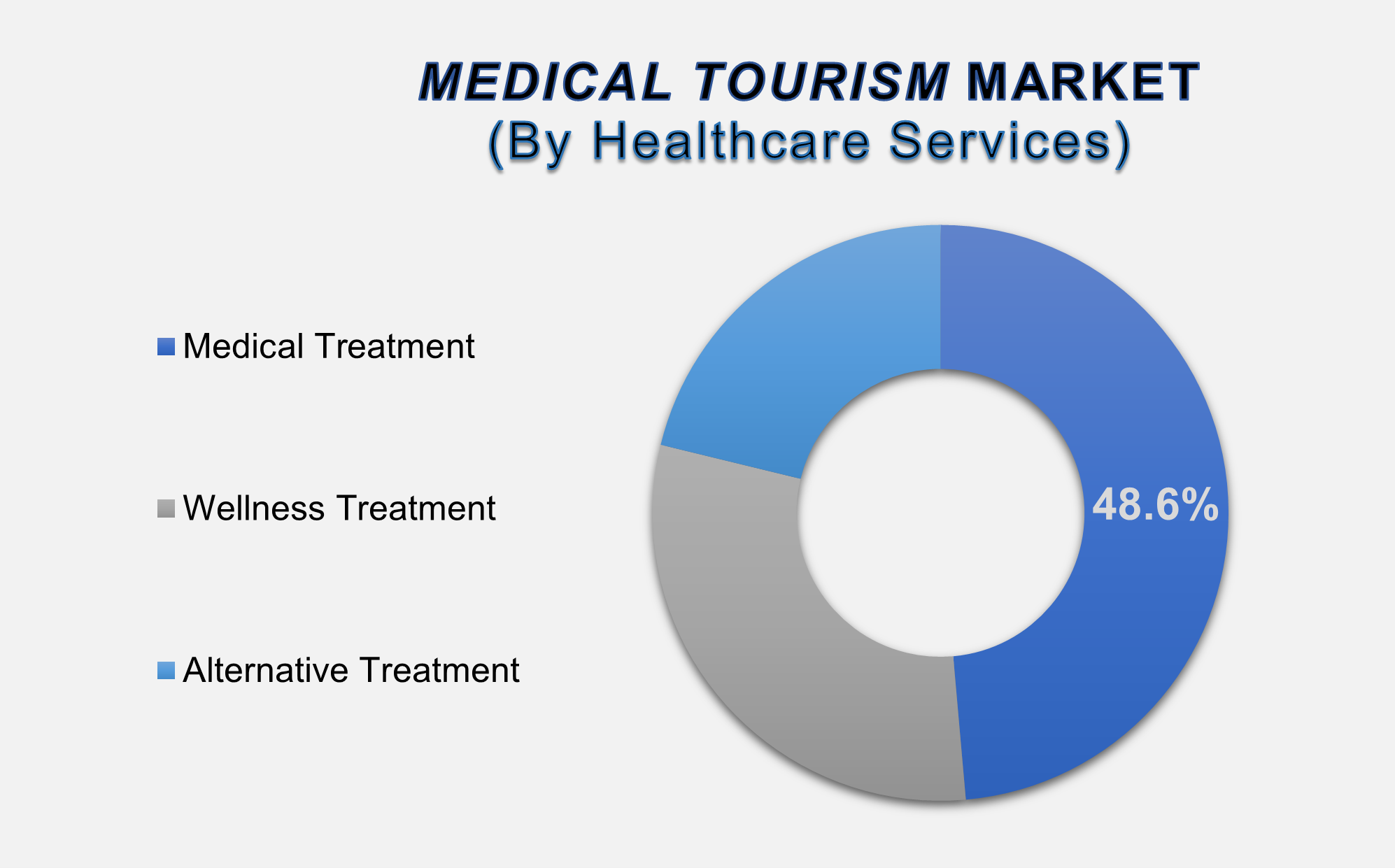
global medical tourism market. Medical treatment services account for 48.6% of
the market, reflecting strong demand for core healthcare services such as
cardiac, orthopedic, oncology, and neurological procedures. In parallel,
wellness, cosmetic, rejuvenation, and alternative treatments are gaining
popularity among international travelers seeking preventive and lifestyle-oriented
care. Procedures such as cosmetic surgery, dental treatments, fertility
services, and regenerative therapies are increasingly bundled with wellness
programs and post-treatment recovery packages.
This convergence of medical and wellness tourism enables providers to diversify revenue streams and attract a broader patient base. Emerging treatments, personalized medicine, and integrative healthcare models are expected to further expand market scope. As global populations age and health awareness rises, demand for both curative and preventive medical tourism services is expected to grow substantially
Medical Tourism Market
Scope
|
Report Attributes |
Description |
|
Market Size in 2025 |
USD 38.8 Billion |
|
Market Forecast in 2035 |
USD 185.5 Billion |
|
CAGR % 2025-2035 |
21.8% |
|
Base Year |
2024 |
|
Historic Data |
2020-2024 |
|
Forecast Period |
2025-2035 |
|
Report USP |
Production, Consumption,
Company Share, Company Heatmap, Company Production Capacity, Growth Factors,
and more |
|
Segments Covered |
● Healthcare Services, Service Provider |
|
Regional Scope |
● North America, ● Europe, ● APAC, ● Latin America ● Middle East and Africa |
|
Country Scope |
1)
U.S. 2)
Canada 3)
Germany 4)
UK 5)
France 6)
Spain 7)
Italy 8)
Switzerland 9)
China 10)
Japan 11)
India 12)
Australia 13)
South Korea 14)
Brazil 15)
Mexico 16)
Argentina 17)
South Africa 18)
Saudi Arabia 19)
UAE |
Medical Tourism Market
Report Segmentation Analysis
The Global Medical Tourism Market
Industry Analysis Is Segmented by Healthcare Services, by Service Provider, and
by Region.
The
Medical Treatment Segment Accounted for the Largest
Market Share in the Global Medical Tourism Market
The medical treatment segment accounted for the largest market share, contributing 48.6% of the global medical tourism market. This dominance is driven by high demand for essential and life-saving procedures, including cardiac surgeries, oncology treatments, orthopedic and spine interventions, and complex diagnostics. Patients primarily travel abroad to access cost-effective yet high-quality medical treatment that may be unavailable or unaffordable in their home countries. Advanced clinical expertise, modern infrastructure, and internationally accredited hospitals reinforce the leadership of this segment. As chronic disease prevalence rises globally, medical treatment services are expected to remain the cornerstone of medical tourism demand.
Private
Service Provider Segment Dominated the Global Medical Tourism Market
The
private service provider segment dominated the global medical tourism market,
driven by flexible pricing, advanced facilities, and strong international
patient support systems. Private hospitals actively invest in technology,
specialized departments, and patient-centric services tailored for
international visitors. These providers offer end-to-end treatment packages,
multilingual support, and coordinated care pathways, making them highly
attractive to medical tourists. While public hospitals play a supporting role
in certain regions, private healthcare providers continue to lead in attracting
international patient flows and generating revenue.
The following segments are
part of an in-depth analysis of the global Medical Tourism market:
|
Market Segments |
|
|
By Healthcare
Services |
●
Medical Treatment o
Cardiac Procedures o
Oncology Procedures o
Orthopedic &
Spine Procedures o
Dental Procedures o
Others ●
Wellness Treatment o
Cosmetic Procedures o
Rejuvenation
Procedures o
Others ●
Alternative
Treatment |
|
By Service
Provider |
●
Public ●
Private |
Medical Tourism Market
Share Analysis by Region
Asia Pacific is
anticipated to hold the biggest portion of the Medical Tourism Market globally
throughout the forecast period.
Asia Pacific dominated the global
medical tourism market, accounting for 45.6% of the total market share. The
region’s leadership is driven by cost competitiveness, high-quality healthcare
infrastructure, and strong government support. Countries such as India,
Thailand, Malaysia, and South Korea serve as major hubs, offering advanced
medical procedures at significantly lower costs. The availability of
internationally accredited hospitals, skilled medical professionals, and
integrated tourism infrastructure further strengthens regional dominance.
North America is expected to
register the highest CAGR during the forecast period, driven by increasing
outbound medical tourism, demand for specialized treatments, and rising
healthcare costs. Patients from the U.S.and Canada increasingly seek overseas treatment
for elective and high-cost procedures, accelerating outbound medical travel and
contributing to global market growth.
Medical Tourism Market
Competition Landscape Analysis
The global medical tourism market
is highly competitive and fragmented, with participation from multinational
hospital groups, specialty care centers, and integrated healthcare networks.
Market players compete based on treatment quality, international accreditation,
pricing transparency, and patient experience. Strategic partnerships,
international marketing, and service diversification are key competitive
strategies.
Global Medical Tourism
Market Recent Developments News:
- In October 2024 – KPJ Healthcare and Malaysia
International Healthcare co-organized the
Malaysia International Healthcare Megatrends 2024 event at the Kuala
Lumpur Convention Centre, showcasing the latest advancements in medical
technology and healthcare solutions.
- In October 2024 – Apollo Hospitals Group reached a
significant milestone by completing 500 robotic cardiac care procedures,
marking a major advancement in its precision cardiology services.
- In September 2024 – Bumrungrad International
Hospital in Thailand opened a new wellness center to cater to the growing
demand for wellness treatments, strengthening its brand and expanding its
service offerings.
- In August 2024 – Bangkok Chain Hospital Public
Company Limited opened the new "Kasetsart Aree Radiotherapy
Specialist Clinic," a comprehensive cancer treatment center in
Bangkok aimed at enhancing patient care and treatment outcomes.
The Global Medical Tourism Market
Is Dominated by a Few Large Companies, such as
●
Bumrungrad
International Hospital
●
Apollo Hospitals
Enterprise
●
Bangkok Hospital
●
Anadolu Medical Center
●
Fortis Healthcare
●
Prince Court Medical
Centre
●
Asklepios Kliniken
●
Shouldice Hospital
●
Samitivej Hospital
●
Gleneagles Hospital
●
Raffles Medical Group
●
KPJ Healthcare Berhad
●
Clemenceau Medical
Center
●
Asian Heart Institute
●
Burjeel Hospital
●
Christus Muguerza
●
Hospital Clínic de
Barcelona
●
UZ Leuven
●
Johns Hopkins Medicine
International
●
Mayo Clinic
● Others
Frequently Asked Questions
Ekta Chaurasia (Team Lead)
Ekta Chaurasia is a highly experienced Team Lead at M2Square Consultancy with over 7 years of expertise in market research, strategic consulting, competitive benchmarking, and business intelligence solutions. She specializes in ICT, semiconductors & electronics, automotive & transportation, and industrial machinery markets.
She leads end-to-end global research projects focused on market trends, industry analysis, growth forecasting, customer insights, and strategic decision-making. Known for her analytical leadership and industry expertise, Ekta helps businesses uncover growth opportunities, evaluate competitive landscapes, and stay ahead in rapidly evolving markets through accurate and insight-driven research.
1. Global Medical Tourism
Market Introduction and Market Overview
1.1.
Objectives
of the Study
1.2.
Global
Medical Tourism Market Scope and Market Estimation
1.2.1.Global Medical Tourism Overall
Market Size (US$ Bn), Market CAGR (%), Market forecast (2025 - 2033)
1.2.2.Global Medical Tourism
Market Revenue Share (%) and Growth Rate (Y-o-Y) from 2020 - 2033
1.3.
Market
Segmentation
1.3.1.Healthcare Services of
Global Medical Tourism Market
1.3.2.Service Provider of Global
Medical Tourism Market
1.3.3.Region of Global Medical
Tourism Market
2. Executive
Summary
2.1.
Demand
Side Trends
2.2.
Key
Market Trends
2.3.
Market
Demand (US$ Bn) Analysis 2020 – 2024 and Forecast, 2025 – 2033
2.4.
Demand
and Opportunity Assessment
2.5.
Key
Developments
2.6.
Overview
of Tariff, Regulatory Landscape and Standards
2.7.
Market
Entry Strategies
2.8.
Market
Dynamics
2.8.1.Drivers
2.8.2.Limitations
2.8.3.Opportunities
2.8.4.Impact Analysis of Drivers
and Restraints
2.9.
Porter’s
Five Forces Analysis
2.10.
PEST
Analysis
3. Global
Medical Tourism Market Estimates
& Historical Trend Analysis (2020 - 2024)
4. Global
Medical Tourism Market Estimates
& Forecast Trend Analysis, by Healthcare Services
4.1.
Global
Medical Tourism Market Revenue (US$ Bn) Estimates and Forecasts, by Healthcare
Services, 2020 - 2033
4.1.1.Medical Treatment
4.1.1.1.
Cardiac
Procedures
4.1.1.2.
Oncology
Procedures
4.1.1.3.
Orthopedic
& Spine Procedures
4.1.1.4.
Dental
Procedures
4.1.1.5.
Others
4.1.2.Wellness Treatment
4.1.2.1.
Cosmetic
Procedures
4.1.2.2.
Rejuvenation
Procedures
4.1.2.3.
Others
4.1.3.Alternative Treatment
5. Global
Medical Tourism Market Estimates
& Forecast Trend Analysis, by Service Provider
5.1.
Global
Medical Tourism Market Revenue (US$ Bn) Estimates and Forecasts, by Service
Provider, 2020 - 2033
5.1.1.Public
5.1.2.Private
6. Global
Medical Tourism Market Estimates
& Forecast Trend Analysis, by Region
6.1.
Global
Medical Tourism Market Revenue (US$ Bn) Estimates and Forecasts, by Region, 2020
- 2033
6.1.1.North America
6.1.2.Europe
6.1.3.Asia Pacific
6.1.4.Middle East & Africa
6.1.5.Latin America
7. North America Medical
Tourism Market: Estimates &
Forecast Trend Analysis
7.1.
North
America Medical Tourism Market Assessments & Key Findings
7.1.1.North America Medical
Tourism Market Introduction
7.1.2.North America Medical
Tourism Market Size Estimates and Forecast (US$ Billion) (2020 - 2033)
7.1.2.1. By Healthcare
Services
7.1.2.2. By Service
Provider
7.1.2.3.
By
Country
7.1.2.3.1. The U.S.
7.1.2.3.2. Canada
8. Europe Medical
Tourism Market: Estimates &
Forecast Trend Analysis
8.1.
Europe
Medical Tourism Market Assessments & Key Findings
8.1.1.Europe Medical Tourism
Market Introduction
8.1.2.Europe Medical Tourism
Market Size Estimates and Forecast (US$ Billion) (2020 - 2033)
8.1.2.1. By Healthcare
Services
8.1.2.2. By Service
Provider
8.1.2.3.
By
Country
8.1.2.3.1.
Germany
8.1.2.3.2.
Italy
8.1.2.3.3.
U.K.
8.1.2.3.4.
France
8.1.2.3.5.
Spain
8.1.2.3.6.
Switzerland
8.1.2.3.7. Rest
of Europe
9. Asia Pacific Medical
Tourism Market: Estimates &
Forecast Trend Analysis
9.1.
Asia
Pacific Market Assessments & Key Findings
9.1.1.Asia Pacific Medical
Tourism Market Introduction
9.1.2.Asia Pacific Medical
Tourism Market Size Estimates and Forecast (US$ Billion) (2020 - 2033)
9.1.2.1. By Healthcare
Services
9.1.2.2. By Service
Provider
9.1.2.3.
By
Country
9.1.2.3.1.
China
9.1.2.3.2.
Japan
9.1.2.3.3.
India
9.1.2.3.4.
Australia
9.1.2.3.5.
South
Korea
9.1.2.3.6. Rest of Asia Pacific
10. Middle East & Africa Medical
Tourism Market: Estimates &
Forecast Trend Analysis
10.1.
Middle
East & Africa Market Assessments & Key Findings
10.1.1.
Middle East & Africa Medical Tourism Market Introduction
10.1.2.
Middle East & Africa Medical Tourism Market Size Estimates
and Forecast (US$ Billion) (2020 - 2033)
10.1.2.1. By Healthcare
Services
10.1.2.2. By Service
Provider
10.1.2.3.
By
Country
10.1.2.3.1. UAE
10.1.2.3.2. Saudi
Arabia
10.1.2.3.3. South
Africa
10.1.2.3.4. Rest
of MEA
11. Latin America
Medical Tourism Market: Estimates &
Forecast Trend Analysis
11.1.
Latin
America Market Assessments & Key Findings
11.1.1.
Latin
America Medical Tourism Market Introduction
11.1.2.
Latin
America Medical Tourism Market Size Estimates and Forecast (US$ Billion) (2020
- 2033)
11.1.2.1. By Healthcare
Services
11.1.2.2. By Service
Provider
11.1.2.3.
By
Country
11.1.2.3.1. Brazil
11.1.2.3.2. Argentina
11.1.2.3.3. Mexico
11.1.2.3.4. Rest
of LATAM
12. Country Wise Market:
Introduction
13.
Competition
Landscape
13.1.
Global
Medical Tourism Market Product Mapping
13.2.
Global
Medical Tourism Market Concentration Analysis, by Leading Players / Innovators
/ Emerging Players / New Entrants
13.3.
Global
Medical Tourism Market Tier Structure Analysis
13.4.
Global
Medical Tourism Market Concentration & Company Market Shares (%) Analysis,
2024
14.
Company
Profiles
14.1.
Bumrungrad International Hospital
14.1.1.
Company
Overview & Key Stats
14.1.2.
Financial
Performance & KPIs
14.1.3.
Product
Portfolio
14.1.4.
SWOT
Analysis
14.1.5.
Business
Strategy & Recent Developments
* Similar details would be provided for all the players
mentioned below
14.2. Apollo
Hospitals Enterprise
14.3. Bangkok
Hospital
14.4. Anadolu
Medical Center
14.5. Fortis
Healthcare
14.6. Prince
Court Medical Centre
14.7. Asklepios
Kliniken
14.8. Shouldice
Hospital
14.9. Samitivej
Hospital
14.10. Gleneagles
Hospital
14.11. Raffles
Medical Group
14.12. KPJ
Healthcare Berhad
14.13. Clemenceau
Medical Center
14.14. Asian
Heart Institute
14.15. Burjeel
Hospital
14.16. Christus
Muguerza
14.17. Hospital
Clínic de Barcelona
14.18. UZ
Leuven
14.19. Johns
Hopkins Medicine International
14.20. Mayo
Clinic
14.21. Others
15. Research
Methodology
15.1.
External
Transportations / Databases
15.2.
Internal
Proprietary Database
15.3.
Primary
Research
15.4.
Secondary
Research
15.5.
Assumptions
15.6.
Limitations
15.7.
Report
FAQs
16. Research
Findings & Conclusion
Our Research Methodology
"Insight without rigor is just noise."
We follow a comprehensive, multi-phase research framework designed to deliver accurate, strategic, and decision-ready intelligence. Our process integrates primary and secondary research , both quantitative and qualitative , along with dual modeling techniques ( top-down and bottom-up) and a final layer of validation through our proprietary in-house repository.
PRIMARY RESEARCH
Primary research captures real-time, firsthand insights from the market to understand behaviors, motivations, and emerging trends.
1. Quantitative Primary Research
Objective: Generate statistically significant data directly from market participants.
Approaches:- Structured surveys with customers, distributors, and field agents
- Mobile-based data collection for point-of-sale audits and usage behavior
- Phone-based interviews (CATI) for market sizing and product feedback
- Online polling around industry events and digital campaigns
- Purchase frequency by customer type
- Channel performance across geographies
- Feature demand by application or demographic
2. Qualitative Primary Research
Objective: Explore decision-making drivers, pain points, and market readiness.
Approaches:- In-depth interviews (IDIs) with executives, product managers, and key decision-makers
- Focus groups among end users and early adopters
- Site visits and observational research for consumer products
- Informal field-level discussions for regional and cultural nuances
SECONDARY RESEARCH
This phase helps establish a macro-to-micro understanding of market trends, size, regulation, and competitive dynamics, sourced from credible and public domain information.
1. Quantitative Secondary Research
Objective: Model market value and segment-level forecasts based on published data.
Sources include:- Financial reports and investor summaries
- Government trade data, customs records, and regulatory statistics
- Industry association publications and economic databases
- Channel performance and pricing data from marketplace listings
- Revenue splits, pricing trends, and CAGR estimates
- Supply-side capacity and volume tracking
- Investment analysis and funding benchmarks
2. Qualitative Secondary Research
Objective: Capture strategic direction, innovation signals, and behavioral trends.
Sources include:- Company announcements, roadmaps, and product pipelines
- Publicly available whitepapers, conference abstracts, and academic research
- Regulatory body publications and policy briefs
- Social and media sentiment scanning for early-stage shifts
- Strategic shifts in market positioning
- Unmet needs and white spaces
- Regulatory triggers and compliance impact
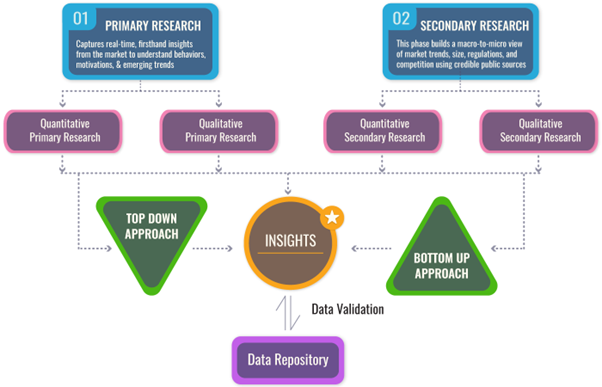
DUAL MODELING: TOP-DOWN + BOTTOM-UP
To ensure robust market estimation, we apply two complementary sizing approaches:
Top-Down Modeling:- Start with broader industry value (e.g., global or regional TAM)
- Apply filters by segment, geography, end-user, or use case
- Adjust with primary insights and validation benchmarks
- Ideal for investor-grade market scans and opportunity mapping
- Aggregate from the ground up using sales volumes, pricing, and unit economics
- Use internal modeling templates aligned with stakeholder data
- Incorporate distributor-level or region-specific inputs
- Most accurate for emerging segments and granular sub-markets
DATA VALIDATION: IN-HOUSE REPOSITORY
We close the loop with proprietary data intelligence built from ongoing projects, industry monitoring, and historical benchmarking. This repository includes:
- Multi-sector market and pricing models
- Key trendlines from past interviews and forecasts
- Benchmarked adoption rates, churn patterns, and ROI indicators
- Industry-specific deviation flags and cross-check logic
- Catches inconsistencies early
- Aligns projections across studies
- Enables consistent, high-trust deliverables