

Men's Personal Care Market Size and Forecast (2020 - 2033), Global and Regional Growth, Trend, Share, and Industry Analysis Report Coverage: By Product Type (Skincare, Hair Care, Toiletries, Fragrances), By Distribution Channel (Supermarkets/Hypermarkets, Convenience Stores, Online/E-commerce, Specialty Stores, Pharmacies/Drug Stores), and by Geography
2025-12-04
Healthcare
Swetal (Research Analyst)
Description
Men's Personal Care Market Overview
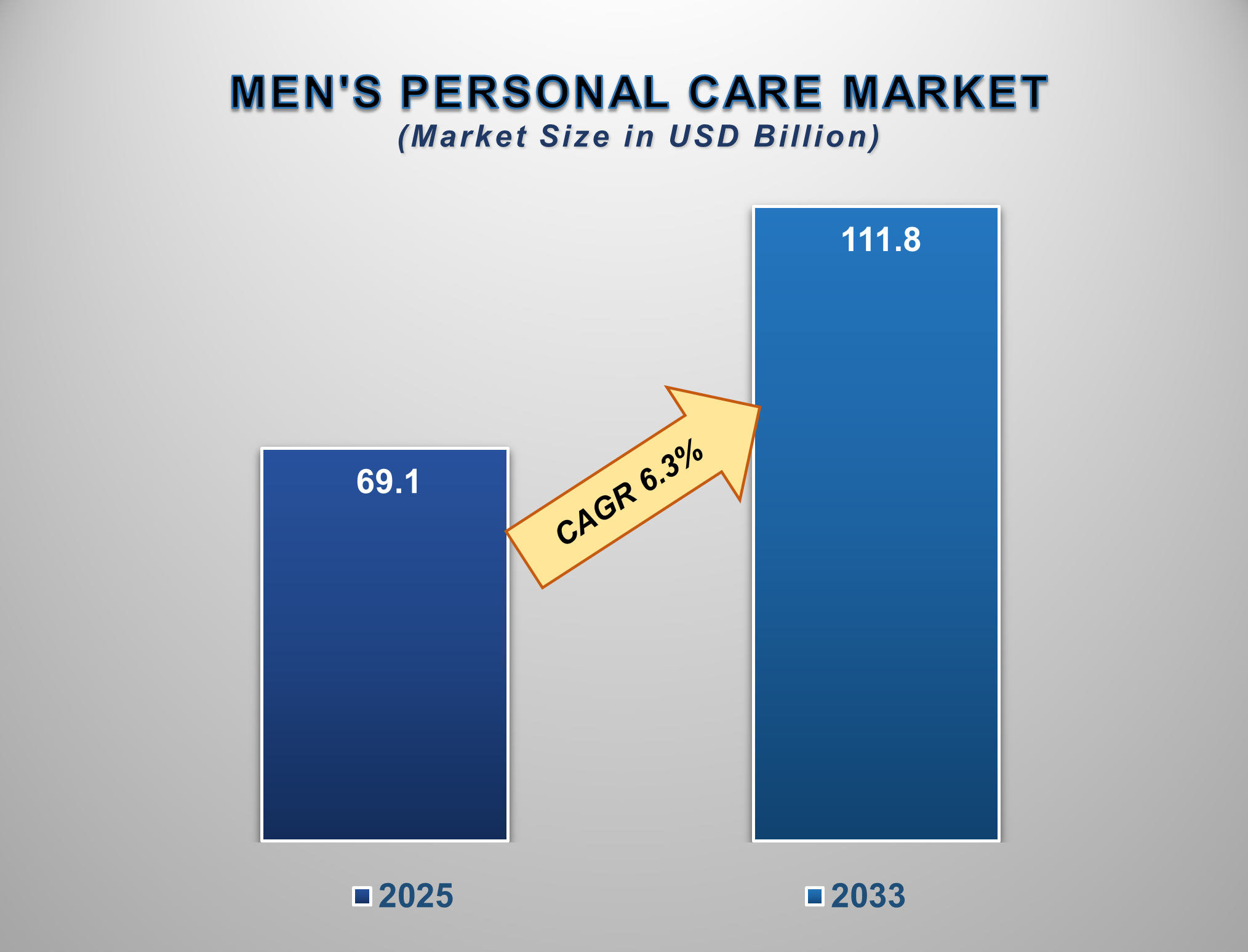
The Men's Personal Care Market is experiencing a significant transformation and is set for robust growth from 2025 to 2033, driven by evolving male grooming standards, increased disposable income, and a growing emphasis on personal wellness and appearance. The market is projected to be valued at approximately USD 69.1 billion in 2025 and is forecasted to reach nearly USD 111.8 billion by 2033, exhibiting a compound annual growth rate (CAGR) of 6.3% during this period.
Men's
personal care encompasses a wide range of products specifically formulated for
men, including skincare, hair care, toiletries, and fragrances. The market's
expansion is primarily fueled by the destigmatization of male grooming, fueled
by social media influence, celebrity endorsements, and targeted marketing
campaigns that redefine masculinity to include self-care. The rise of the
millennial and Gen Z male demographic, which is more informed and experimental
with grooming products, is a key contributor.
Furthermore, the increasing prevalence of skin
and hair concerns due to pollution, stress, and hectic lifestyles is driving
demand for specialized solutions. Technological advancements in product
formulations, such as multi-functional products, natural/organic ingredients,
and solutions for specific issues like anti-aging and acne, are also propelling
market growth. North America and Europe currently hold significant market
shares due to high consumer awareness and established retail landscapes, while
the Asia-Pacific region is expected to witness the fastest growth due to its
vast youth population, urbanization, and increasing westernization of grooming
habits.
Men's Personal Care Market Drivers and Opportunities
Shifting Societal Norms and Rising Male
Grooming Consciousness are the Primary Market Drivers
The
most powerful driver for the men's personal care market is the fundamental
shift in societal attitudes towards male grooming. Traditional stereotypes are
eroding, making it more acceptable and even expected for men to invest in their
appearance and personal care routines. This cultural transformation is
amplified by digital media, where influencers and celebrities openly discuss
and promote grooming products, normalizing their use. This increased
consciousness is not just about basic hygiene but extends to detailed skincare
regimens, premium hair styling, and signature fragrances, creating a sustained
and expanding demand for a diverse range of products.
Product
Innovation and Premiumization are Driving Market Sophistication and Value
The
market is being significantly catalyzed by continuous product innovation and
the trend towards premiumization. Brands are moving beyond basic soaps and
shaving creams to develop sophisticated, scientifically backed products tailored to men's specific skin and hair biology.
This includes serums, moisturizers with SPF, anti-aging creams, and specialized
beard care kits. The demand for clean-label, natural, and organic products is
also on the rise. As men become more knowledgeable, they are willing to pay a
premium for high-efficacy, multi-functional, and brand-name products that
deliver visible results, thereby increasing the overall average selling price
and market value.
Untapped
Potential in Emerging Markets and the Digital-First Sales Channel Present
Significant Opportunities
The
strategic expansion into emerging economies and the dominance of online retail
are creating substantial growth frontiers. A key opportunity lies in the vast,
unsaturated markets of Asia-Pacific, Latin America, and the Middle East, where
rising disposable incomes and growing fashion consciousness are driving
adoption. Furthermore, the e-commerce channel offers a massive opportunity for
brands to directly engage with consumers, offer personalized recommendations,
and build communities through social media and content marketing. For vendors,
developing affordable product lines for price-sensitive regions, creating
subscription-based models, and leveraging digital platforms for education and
brand building are key strategies to capture new market share and foster brand
loyalty.
Men's Personal Care
Market Scope
|
Report
Attributes |
Description |
|
Market Size in
2025 |
USD 69.1
Billion |
|
Market
Forecast in 2033 |
USD 111.8
Billion |
|
CAGR %
2025-2033 |
6.3% |
|
Base Year |
2024 |
|
Historic Data |
2020-2024 |
|
Forecast
Period |
2025-2033 |
|
Report USP |
Product
Portfolio, Technological Analysis, Company Market Share, Company Heatmap,
Pricing Analysis, Growth Factors and more |
|
Segments
Covered |
●
By Product Type ●
By Distribution
Channel |
|
Regional Scope |
●
North America, ●
Europe, ●
APAC, ●
Latin America ●
Middle East and
Africa |
|
Country Scope |
1)
U.S. 2)
Canada 3)
Germany 4)
UK 5)
France 6)
Spain 7)
Italy 8)
Switzerland 9)
China 10)
Japan 11)
India 12)
Australia 13)
South Korea 14)
Brazil 15)
Mexico 16)
Argentina 17)
South Africa 18)
Saudi Arabia 19)
UAE |
Men's Personal Care
Market Report Segmentation Analysis
The global Men's Personal Care Market
industry analysis is segmented by Product Type, by Distribution Channel, and by
Region.
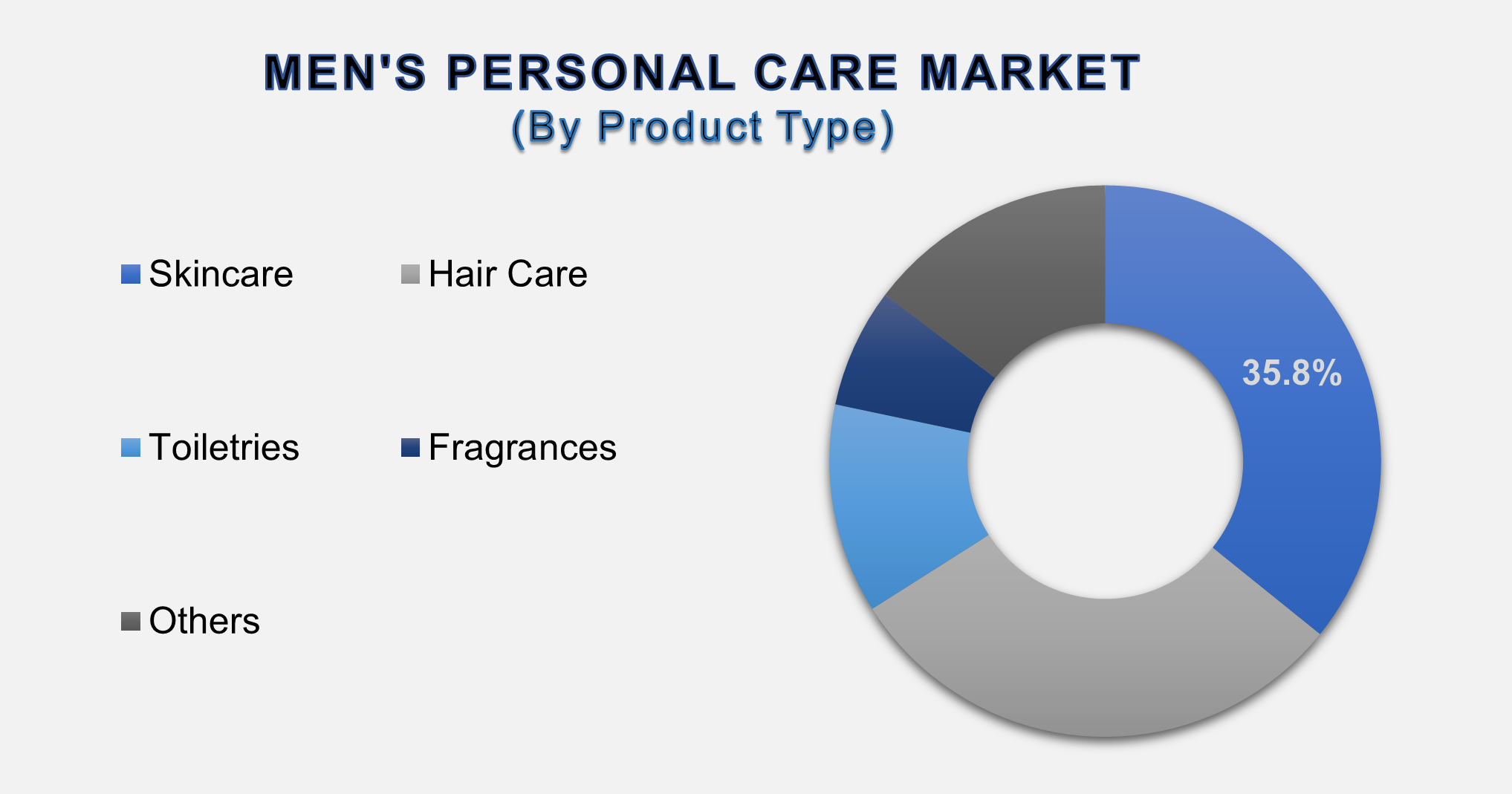
The Skincare segment is projected to grow at the highest
CAGR
The skincare
segment's position as the category with the highest projected Compound Annual
Growth Rate (CAGR) is a definitive indicator of a profound shift in male
grooming habits, moving from basic hygiene to dedicated self-care rituals. This
explosive growth is fueled by a confluence of social, environmental, and
commercial factors. The longstanding stigma around men's skincare has
significantly eroded, replaced by a new cultural narrative that champions
self-presentation and wellness, heavily promoted by influencers, celebrities,
and digital media.
Men are now more knowledgeable and proactive, seeking solutions for specific concerns like photo-aging from sun exposure, damage from urban pollution, and stress-induced acne. This educated demand drives the market beyond generic face washes towards a sophisticated, multi-step regimen. Consumers actively seek out specialized products such as antioxidant serums, daily moisturizers with high SPF, dedicated eye creams, and targeted anti-aging treatments.
In response,
brands are investing heavily in research and development to create
gender-specific formulations that address biological differences, such as
thicker, oilier skin and the unique irritation caused by frequent shaving. This
transition from a few staple items to a diverse portfolio of performance-driven
solutions makes skincare the most dynamic and rapidly expanding frontier in the
men's personal care landscape, reflecting its evolution from a niche interest
to a mainstream pillar of the modern male identity.
The
Online/E-commerce Segment is contributing the
Largest Market Share in the market over the forecast period
The dominance of
the Online/E-commerce distribution channel, commanding the largest market
share, is a direct consequence of its perfect alignment with the modern male
consumer's preferences for convenience, discretion, and information. Unlike the
often-overwhelming and impersonal experience of in-store aisles, online
shopping offers a private, pressure-free environment where men can research and
purchase products at their own pace, a key factor for those still navigating
personal care routines. E-commerce platforms excel by providing a wealth of
crucial information, detailed ingredient
lists, clinical claims, and, most importantly, vast libraries of authentic
customer reviews that empower informed decision-making.
This is further
amplified by the rise of Direct-to-Consumer (D2C) brands, which use engaging
digital content and social media marketing to build community and brand
loyalty, often bypassing traditional retail entirely. The subscription model,
popularized by brands in shaving and grooming, locks in customer loyalty
through unparalleled convenience. Furthermore, sophisticated digital marketing
allows for hyper-targeted advertising, placing relevant products directly in
front of interested consumers based on their online behavior. By combining
privacy, education, direct engagement, and seamless home delivery, the online
channel has not just become a sales avenue but the primary ecosystem for
discovery, education, and purchase in the men's personal care market.
The following segments are part of an
in-depth analysis of the global Men's Personal Care Market:
|
Market Segments |
|
|
By
Product Type |
●
Skincare ●
Hair Care ●
Toiletries ●
Fragrances ●
Others |
|
By
Distribution Channel |
●
Supermarkets/Hypermarkets ●
Convenience Stores ●
Online Platforms ●
Specialty Stores ●
Pharmacies/Drug
Stores ●
Others |
Men's Personal Care
Market Share Analysis by Region
The
Asia-Pacific region is projected to witness the highest growth rate
The Asia-Pacific
region's projection as the fastest-growing market for men's personal care is
driven by a powerful synergy of demographic, economic, and cultural forces that
create an unparalleled growth engine. This region is home to a massive,
increasingly affluent youth population whose purchasing power is expanding
rapidly due to robust economic development. Culturally, the influence is
profound; the global "K-Beauty" phenomenon from South Korea has
legitimized and popularized elaborate skincare routines for men, while Japan's
long-standing history of grooming sophistication sets a high standard.
In densely
populated, urbanizing countries like China and India, rising pollution levels
have pragmatically increased awareness of skincare as a necessary form of
protection, not just vanity. This is coupled with the widespread penetration of
social media and digital marketing, which effectively spreads global trends and
cultivates a grooming-conscious mindset among millions of young Asian men.
Global brands are aggressively targeting these consumers with localized
campaigns and products, while nimble local players quickly capitalize on
emerging trends. This combination of a vast addressable market, rising
disposable income, deep cultural receptivity, and intense commercial activity
makes Asia-Pacific the epicenter of future growth, poised to reshape the global
men's personal care industry in the coming decade.
Men's Personal Care
Market Competition Landscape Analysis
The global men's personal care market is
highly competitive and fragmented, featuring a mix of global consumer goods
giants, specialized men's grooming brands, and a surge of agile
direct-to-consumer (D2C) startups. Competition is based on brand image, product
innovation, pricing, marketing effectiveness, and distribution network
strength. Key strategies include celebrity endorsements and influencer
partnerships, portfolio expansion into niche segments (e.g., beard care,
organic products), strategic acquisitions of emerging brands, and a strong
focus on digital and social media marketing to engage directly with the target
audience.
Global Men's Personal
Care Market Recent Developments News:
o In March 2025, L'Oréal
Men Expert launched a new line of probiotic-based skincare products focused on
strengthening the skin barrier.
o In January 2025, Harry's
Inc. expanded into the premium haircare market with a new range of thickening
shampoos and conditioners, available through its D2C platform and major retail
partners.
o In November 2024, Procter
& Gamble's Gillette acquired a D2C startup specializing in natural
ingredient-based deodorants for men to bolster its natural product portfolio.
o In September 2024,
Bulldog Skincare announced a major partnership with a leading European
drugstore chain to expand its physical retail presence across the continent.
The Global Men's Personal Care Market Is Dominated by a Few Large
Companies, such as
●
L'Oréal S.A.
●
Procter & Gamble
Co.
●
Unilever PLC
●
Beiersdorf AG (NIVEA)
●
Edgewell Personal Care
Co.
●
Coty Inc.
●
Estée Lauder Companies
Inc.
●
Johnson & Johnson
●
Shiseido Company
Limited
●
Kao Corporation
●
Harry's Inc.
●
Dollar Shave Club
●
Bulldog Skincare
●
Old Spice (P&G)
●
American Crew
● Other Prominent Players
Frequently Asked Questions
Swetal (Research Analyst)
Swetal is a Research Analyst with 4+ years of experience specializing in healthcare market research, medical devices, healthcare IT, and medical technology industry analysis. Her expertise includes competitive intelligence, secondary research, market trend forecasting, and healthcare business insights across global healthcare ecosystems.
She contributes to advanced market research reports by analyzing regulatory frameworks, emerging healthcare technologies, competitive landscapes, and innovation trends shaping the medical industry. With a strong focus on accurate market intelligence, strategic insights, and healthcare industry trends, Swetal supports businesses in making informed, data-backed decisions in a rapidly transforming healthcare environment.
1. Global Men Personal Care
Market Introduction and Market Overview
1.1.
Objectives
of the Study
1.2.
Global
Men Personal Care Market Scope and Market Estimation
1.2.1.Global Electronic Toll
Collection Overall Market Size (US$ Bn), Market CAGR (%), Market forecast (2025
- 2033)
1.2.2.Global Men Personal Care
Market Revenue Share (%) and Growth Rate (Y-o-Y) from 2020 - 2033
1.3.
Market
Segmentation
1.3.1.Product Type of Global Men
Personal Care Market
1.3.2.Distribution Channel of
Global Men Personal Care Market
1.3.3.Region of Global Men
Personal Care Market
2.
Executive Summary
2.1.
Demand
Side Trends
2.2.
Key
Market Trends
2.3.
Market
Demand (US$ Bn) Analysis 2020 – 2024 and forecast, 2025 – 2033
2.4.
Demand
and Opportunity Assessment
2.5.
Key
Developments
2.6.
Market
Entry Strategies
2.7.
Market
Dynamics
2.7.1.Drivers
2.7.2.Limitations
2.7.3.Opportunities
2.7.4.Impact Analysis of Drivers
and Restraints
2.8.
Porter’s
Five Forces Analysis
2.9.
PEST
Analysis
3. Global
Men Personal Care Market Estimates
& Historical Trend Analysis (2020 - 2024)
4. Global
Men Personal Care Market Estimates
& Forecast Trend Analysis, by Product Type
4.1.
Global
Men Personal Care Market Revenue (US$ Bn) Estimates and Forecasts, by Product
Type, 2020 - 2033
4.1.1.Skincare
4.1.2.Hair Care
4.1.3.Toiletries
4.1.4.Fragrances
4.1.5.Others
5. Global
Men Personal Care Market Estimates
& Forecast Trend Analysis, by Distribution Channel
5.1.
Global
Men Personal Care Market Revenue (US$ Bn) Estimates and Forecasts, by Distribution
Channel, 2020 - 2033
5.1.1.Supermarkets/Hypermarkets
5.1.2.Convenience Stores
5.1.3.Online Platforms
5.1.4.Specialty Stores
5.1.5.Pharmacies/Drug Stores
5.1.6.Others
6. Global
Men Personal Care Market Estimates
& Forecast Trend Analysis, by region
6.1.
Global
Men Personal Care Market Revenue (US$ Bn) Estimates and Forecasts, by region, 2020
- 2033
6.1.1.North America
6.1.2.Europe
6.1.3.Asia Pacific
6.1.4.Middle East & Africa
6.1.5.Latin America
7. North America Men
Personal Care Market: Estimates &
Forecast Trend Analysis
7.1. North America Men Personal
Care Market Assessments & Key Findings
7.1.1.North America Men Personal
Care Market Introduction
7.1.2.North America Men Personal
Care Market Size Estimates and Forecast (US$ Billion) (2020 - 2033)
7.1.2.1.
By Product Type
7.1.2.2.
By Distribution Channel
7.1.2.3. By Country
7.1.2.3.1. The U.S.
7.1.2.3.2. Canada
8. Europe Men
Personal Care Market: Estimates &
Forecast Trend Analysis
8.1. Europe Men Personal Care
Market Assessments & Key Findings
8.1.1.Europe Men Personal Care
Market Introduction
8.1.2.Europe Men Personal Care
Market Size Estimates and Forecast (US$ Billion) (2020 - 2033)
8.1.2.1.
By Product Type
8.1.2.2.
By Distribution Channel
8.1.2.3. By Country
8.1.2.3.1.
Germany
8.1.2.3.2.
Italy
8.1.2.3.3.
U.K.
8.1.2.3.4.
France
8.1.2.3.5.
Spain
8.1.2.3.6.
Switzerland
8.1.2.3.7. Rest
of Europe
9. Asia Pacific Men
Personal Care Market: Estimates &
Forecast Trend Analysis
9.1. Asia Pacific Market
Assessments & Key Findings
9.1.1.Asia Pacific Men Personal
Care Market Introduction
9.1.2.Asia Pacific Men Personal
Care Market Size Estimates and Forecast (US$ Billion) (2020 - 2033)
9.1.2.1.
By Product Type
9.1.2.2.
By Distribution Channel
9.1.2.3. By Country
9.1.2.3.1.
China
9.1.2.3.2.
Japan
9.1.2.3.3.
India
9.1.2.3.4.
Australia
9.1.2.3.5.
South
Korea
9.1.2.3.6. Rest of Asia Pacific
10. Middle East & Africa Men
Personal Care Market: Estimates &
Forecast Trend Analysis
10.1. Middle East & Africa
Market Assessments & Key Findings
10.1.1. Middle
East & Africa
Men Personal Care Market Introduction
10.1.2. Middle
East & Africa
Men Personal Care Market Size Estimates and Forecast (US$ Billion) (2020 - 2033)
10.1.2.1.
By Product Type
10.1.2.2.
By Distribution Channel
10.1.2.3. By Country
10.1.2.3.1. UAE
10.1.2.3.2. Saudi
Arabia
10.1.2.3.3. South
Africa
10.1.2.3.4. Rest
of MEA
11. Latin America
Men Personal Care Market: Estimates
& Forecast Trend Analysis
11.1. Latin America Market
Assessments & Key Findings
11.1.1. Latin America Men Personal
Care Market Introduction
11.1.2. Latin America Men Personal
Care Market Size Estimates and Forecast (US$ Billion) (2020 - 2033)
11.1.2.1.
By Product Type
11.1.2.2.
By Distribution Channel
11.1.2.3. By Country
11.1.2.3.1. Brazil
11.1.2.3.2. Argentina
11.1.2.3.3. Mexico
11.1.2.3.4. Rest
of LATAM
12.
Country
Wise Market: Introduction
13.
Competition
Landscape
13.1. Global Men Personal Care
Market Product Mapping
13.2. Global Men Personal Care
Market Concentration Analysis, by Leading Players / Innovators / Emerging
Players / New Entrants
13.3. Global Men Personal Care
Market Tier Structure Analysis
13.4. Global Men Personal Care
Market Concentration & Company Market Shares (%) Analysis, 2024
14.
Company
Profiles
14.1.
L'Oréal S.A.
14.1.1.
Company
Overview & Key Stats
14.1.2.
Financial
Performance & KPIs
14.1.3.
Product
Portfolio
14.1.4.
SWOT
Analysis
14.1.5.
Business
Strategy & Recent Developments
* Similar details would be provided for all the players
mentioned below
14.2.
Procter & Gamble Co.
14.3.
Unilever PLC
14.4.
Beiersdorf AG (NIVEA)
14.5.
Edgewell Personal Care Co.
14.6.
Coty Inc.
14.7.
Estée Lauder Companies Inc.
14.8.
Johnson & Johnson
14.9.
Shiseido Company Limited
14.10.
Kao Corporation
14.11.
Harry's Inc.
14.12.
Dollar Shave Club
14.13.
Bulldog Skincare
14.14.
Old Spice (P&G)
14.15.
American Crew
14.16.
Other Prominent Players
15. Research
Methodology
15.1. External Transportations /
Databases
15.2. Internal Proprietary
Database
15.3. Primary Research
15.4. Secondary Research
15.5. Assumptions
15.6. Limitations
15.7. Report FAQs
16. Research
Findings & Conclusion
Our Research Methodology
"Insight without rigor is just noise."
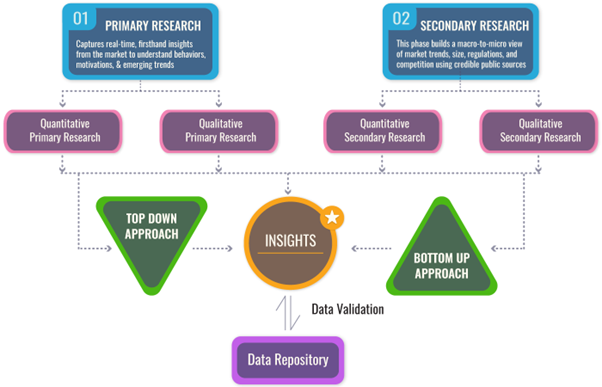
We follow a comprehensive, multi-phase research framework designed to deliver accurate, strategic, and decision-ready intelligence. Our process integrates primary and secondary research , both quantitative and qualitative , along with dual modeling techniques ( top-down and bottom-up) and a final layer of validation through our proprietary in-house repository.
PRIMARY RESEARCH
Primary research captures real-time, firsthand insights from the market to understand behaviors, motivations, and emerging trends.
1. Quantitative Primary Research
Objective: Generate statistically significant data directly from market participants.
Approaches:- Structured surveys with customers, distributors, and field agents
- Mobile-based data collection for point-of-sale audits and usage behavior
- Phone-based interviews (CATI) for market sizing and product feedback
- Online polling around industry events and digital campaigns
- Purchase frequency by customer type
- Channel performance across geographies
- Feature demand by application or demographic
2. Qualitative Primary Research
Objective: Explore decision-making drivers, pain points, and market readiness.
Approaches:- In-depth interviews (IDIs) with executives, product managers, and key decision-makers
- Focus groups among end users and early adopters
- Site visits and observational research for consumer products
- Informal field-level discussions for regional and cultural nuances
SECONDARY RESEARCH
This phase helps establish a macro-to-micro understanding of market trends, size, regulation, and competitive dynamics, sourced from credible and public domain information.
1. Quantitative Secondary Research
Objective: Model market value and segment-level forecasts based on published data.
Sources include:- Financial reports and investor summaries
- Government trade data, customs records, and regulatory statistics
- Industry association publications and economic databases
- Channel performance and pricing data from marketplace listings
- Revenue splits, pricing trends, and CAGR estimates
- Supply-side capacity and volume tracking
- Investment analysis and funding benchmarks
2. Qualitative Secondary Research
Objective: Capture strategic direction, innovation signals, and behavioral trends.
Sources include:- Company announcements, roadmaps, and product pipelines
- Publicly available whitepapers, conference abstracts, and academic research
- Regulatory body publications and policy briefs
- Social and media sentiment scanning for early-stage shifts
- Strategic shifts in market positioning
- Unmet needs and white spaces
- Regulatory triggers and compliance impact
DUAL MODELING: TOP-DOWN + BOTTOM-UP
To ensure robust market estimation, we apply two complementary sizing approaches:
Top-Down Modeling:- Start with broader industry value (e.g., global or regional TAM)
- Apply filters by segment, geography, end-user, or use case
- Adjust with primary insights and validation benchmarks
- Ideal for investor-grade market scans and opportunity mapping
- Aggregate from the ground up using sales volumes, pricing, and unit economics
- Use internal modeling templates aligned with stakeholder data
- Incorporate distributor-level or region-specific inputs
- Most accurate for emerging segments and granular sub-markets
DATA VALIDATION: IN-HOUSE REPOSITORY
We close the loop with proprietary data intelligence built from ongoing projects, industry monitoring, and historical benchmarking. This repository includes:
- Multi-sector market and pricing models
- Key trendlines from past interviews and forecasts
- Benchmarked adoption rates, churn patterns, and ROI indicators
- Industry-specific deviation flags and cross-check logic
- Catches inconsistencies early
- Aligns projections across studies
- Enables consistent, high-trust deliverables