

Micro Lending Market Size and Forecast (2025–2033), Global and Regional Growth, Trend, Share and Industry Analysis Report Coverage: By Providers (Banks, Microfinance Institutions, Non-Banking Financial Companies, Others), By End User (Individuals, Women Entrepreneurs, Micro Enterprises, Others), and Geography
2026-02-25
Business & Financial Services
Ekta Chaurasia (Team Lead)
Description
Micro Lending Market Overview
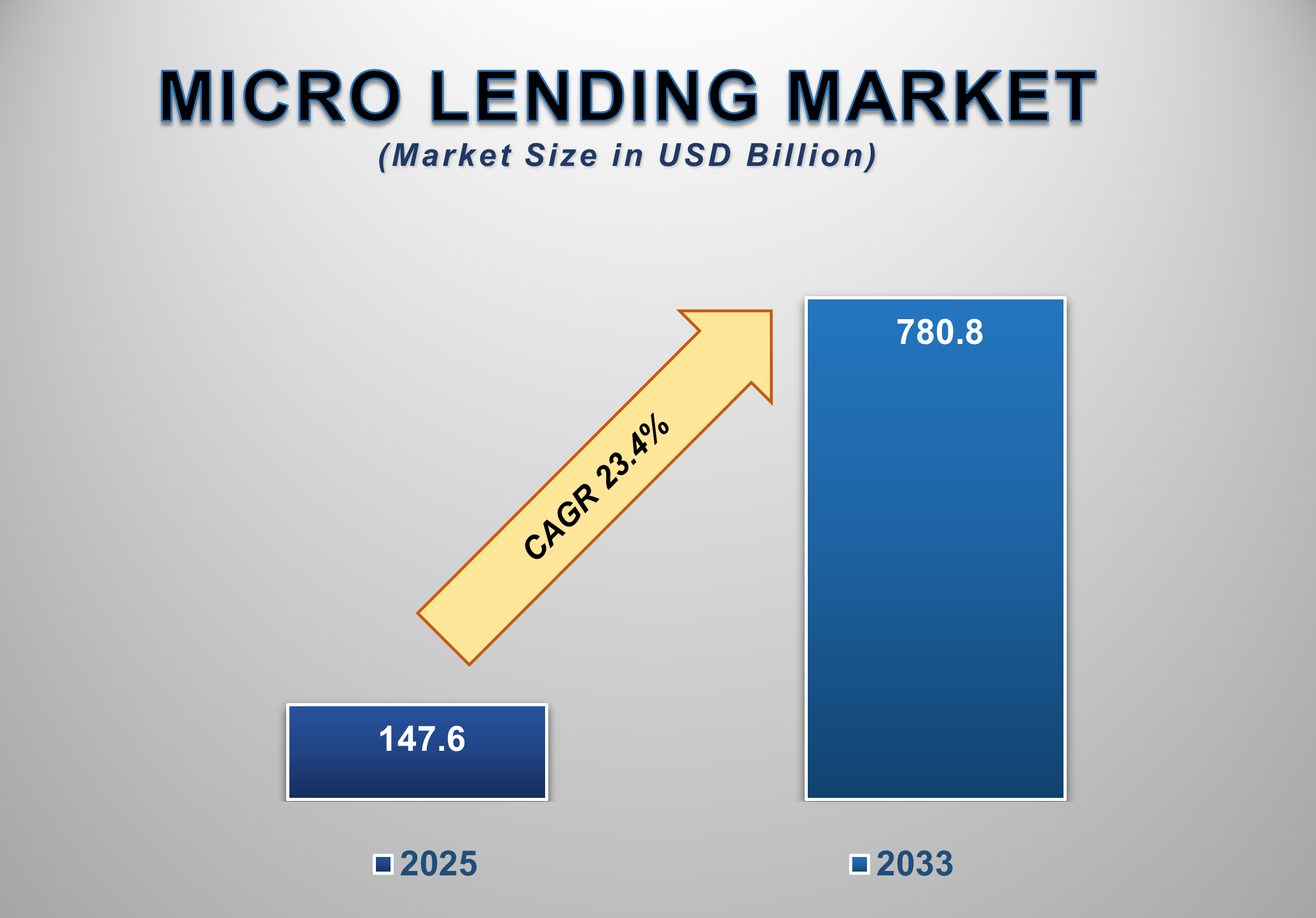
The global micro lending market was valued at USD 147.6 billion in 2025 and is projected to reach USD 780.8 billion by 2033, expanding at a robust CAGR of 23.4% during the forecast period. This exceptional growth is driven by increasing financial inclusion initiatives, rising demand for small-ticket credit among underserved populations, rapid digitalization of lending platforms, and strong support from governments and development finance institutions worldwide. Micro lending has emerged as a critical financial mechanism for individuals and small businesses lacking access to traditional banking services.
Micro
lending provides short-term, low-value loans to individuals,
micro-entrepreneurs, and small businesses to support income generation, working
capital needs, and livelihood sustainability. The market plays a vital role in
poverty alleviation, women's empowerment, and economic resilience, particularly
in developing and emerging economies. Growing smartphone penetration, fintech
innovation, and alternative credit scoring models have significantly improved
loan accessibility and repayment efficiency. Additionally, the integration of
digital payment systems, mobile wallets, and AI-driven credit assessment tools
has expanded the reach of micro lenders while reducing operational costs.
Traditional banks, microfinance institutions, and non-banking financial companies
are increasingly collaborating with fintech platforms to enhance customer
outreach. As financial inclusion remains a global priority, the micro lending
market is expected to witness sustained and diversified growth through 2033.
Micro Lending Market Drivers and Opportunities
Financial Inclusion
Initiatives and Digital Lending Are Driving Market Growth
One of the primary drivers of the
micro lending market is the global push toward financial inclusion.
Governments, central banks, and international development organizations are
actively promoting access to basic financial services for unbanked and underbanked
populations. Micro lending serves as a foundational tool in these initiatives
by providing affordable credit to individuals who lack formal credit histories
or collateral. Digital lending platforms have further accelerated market growth
by simplifying loan application processes, reducing approval times, and
enabling remote access to credit. Mobile-based lending apps and online
microfinance platforms have eliminated geographical barriers, allowing lenders
to reach rural and semi-urban populations efficiently. Alternative data sources
such as transaction histories, mobile usage patterns, and digital payment
behavior are increasingly used for credit assessment, improving loan approval
rates while managing risk. Moreover, public-private partnerships and policy-backed
funding programs have strengthened the operational capacity of micro lenders.
As financial inclusion policies continue to expand globally, micro lending is
expected to remain a key pillar of inclusive economic development.
Rising Demand from Micro
Enterprises and Women Entrepreneurs Is Strengthening Market Expansion
The growing reliance of micro
enterprises and women entrepreneurs on small-scale financing is another major
growth driver for the micro lending market. Micro enterprises form the backbone
of many developing economies, yet they often face challenges in accessing
formal credit due to limited documentation and perceived risk. Micro lending
bridges this gap by offering flexible repayment structures and tailored loan
products. Women entrepreneurs represent a rapidly expanding borrower segment,
supported by targeted government programs and NGO-led initiatives. Microloans
enable women to start or expand small businesses, improve household income, and
gain financial independence. Many microfinance institutions have specifically
designed lending products for women borrowers, resulting in higher repayment
rates and long-term customer loyalty. Additionally, the rise of
self-employment, gig economy participation, and informal retail activities has
increased demand for short-term working capital loans. As entrepreneurial activity
continues to grow across emerging and developed markets, demand for micro
lending solutions is expected to rise significantly.
Fintech Integration Is
Creating Significant Growth Opportunities
Technological innovation presents
a major opportunity for the micro lending market. Fintech integration has
transformed traditional microfinance models by enabling data-driven lending,
automated risk assessment, and real-time loan disbursement. Artificial
intelligence and machine learning algorithms are increasingly used to predict
borrower behavior, reduce default risk, and optimize loan pricing.
Blockchain-based lending platforms and digital identity systems are further
enhancing transparency and trust in micro lending ecosystems. These
technologies reduce fraud, improve compliance, and enable seamless cross-border
microfinance operations. Additionally, embedded finance solutions are allowing
microloans to be offered directly within e-commerce platforms, payment apps,
and supply chain ecosystems. The expansion of digital infrastructure in
emerging markets, combined with supportive regulatory frameworks, is expected
to unlock new growth avenues for micro lenders. As fintech adoption
accelerates, technology-enabled micro lending models will play a crucial role
in shaping the future of the market.
Micro Lending Market
Scope
|
Report Attributes |
Description |
|
Market Size in 2025 |
USD 147.6 Billion |
|
Market Forecast in 2035 |
USD 780.8 Billion |
|
CAGR % 2025-2035 |
23.4% |
|
Base Year |
2024 |
|
Historic Data |
2020-2024 |
|
Forecast Period |
2025-2035 |
|
Report USP |
Production, Consumption,
Company Share, Company Heatmap, Company Production Capacity, Growth Factors,
and more |
|
Segments Covered |
●
By Providers ●
By End User |
|
Regional Scope |
●
North America, ●
Europe, ●
APAC, ●
Latin America ●
Middle East and
Africa |
|
Country Scope |
1)
U.S. 2)
Canada 3)
Germany 4)
UK 5)
France 6)
Spain 7)
Italy 8)
Switzerland 9)
China 10)
Japan 11)
India 12)
Australia 13)
South Korea 14)
Brazil 15)
Mexico 16)
Argentina 17)
South Africa 18)
Saudi Arabia 19)
UAE |
Micro Lending Market
Report Segmentation Analysis
The Global Micro Lending Market
Industry Analysis Is Segmented by Providers, by End User, and by Region.
Banks Segment Accounts for the Largest Market Share
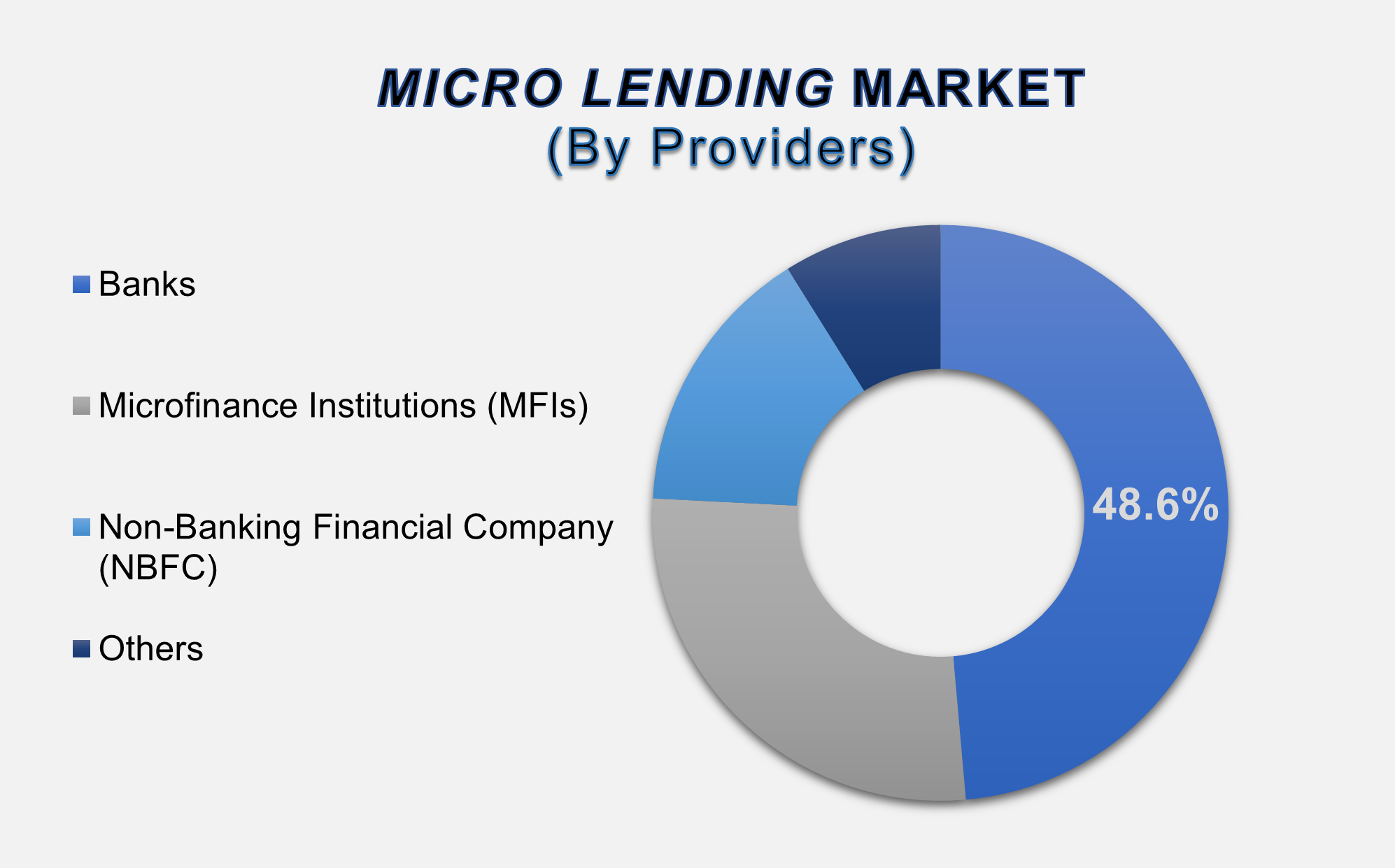
The banks segment accounted for approximately 48.6% of the global micro lending market, driven by their extensive financial infrastructure, access to low-cost capital, and regulatory support. Commercial and small finance banks have increasingly entered the micro lending space to expand customer bases and fulfill financial inclusion mandates. Banks benefit from strong balance sheets, enabling them to scale micro lending operations while maintaining risk controls. Digital transformation initiatives have allowed banks to streamline loan origination and servicing processes, making microloans more accessible and cost-effective. Partnerships with fintech firms and MFIs further enhance outreach and operational efficiency. As banks continue to prioritize inclusive banking strategies, they are expected to maintain their dominant position in the micro lending market.
Individuals
Segment Represents the Largest End-User Share
The
individuals segment holds the largest share of the micro lending market, driven
by demand for personal livelihood financing, emergency expenses, and
self-employment activities. Individual borrowers typically utilize microloans for income-generating purposes, healthcare expenses,
education, and household needs. The rise of digital micro lending apps has
significantly increased loan accessibility for individuals, particularly in
rural and low-income urban areas. Flexible repayment schedules and minimal documentation
requirements have made microloans an
attractive alternative to informal lending sources. As income instability and
cost-of-living pressures persist globally, individual borrowers are expected to
remain the largest end-user segment in the market.
The following segments are
part of an in-depth analysis of the global Micro Lending market:
|
Market Segments |
|
|
By Providers |
●
Banks ●
Microfinance
Institutions (MFIs) ●
Non-Banking
Financial Company (NBFC) ●
Others (Small
Finance Banks, etc.) |
|
By End User |
●
Individuals o
Contractors o
Shop
owners/Retailers o
Restaurant/Franchise o
Others (Small Bank) ●
Women Entrepreneurs ●
Micro Enterprises |
Micro Lending Market
Share Analysis by Region
North America is
anticipated to hold the biggest portion of the Micro Lending Market globally
throughout the forecast period.
North America accounted for
approximately 42.7% of the global micro lending market in 2025, making it the
largest regional market. The region’s dominance is driven by advanced financial
infrastructure, widespread adoption of digital lending platforms, and strong
participation from banks and fintech companies. The United States leads
regional growth due to high penetration of online lending solutions, favorable
regulatory frameworks, and increasing demand for small-ticket loans among gig
workers, freelancers, and micro businesses. Additionally, government-backed
small business financing programs and community development financial
institutions play a key role in supporting micro lending activity across the
region.
Asia Pacific is expected to
register the highest CAGR during the forecast period, supported by rapid
economic development, large unbanked populations, and expanding fintech
ecosystems. Countries such as India, China, Indonesia, and the Philippines are
witnessing strong growth in microfinance adoption due to government-led
financial inclusion programs and mobile-based lending platforms. Rising
entrepreneurial activity, increasing smartphone penetration, and supportive
regulatory reforms are accelerating micro lending penetration across rural and
semi-urban areas. As digital infrastructure continues to expand, Asia Pacific
is poised to emerge as the fastest-growing regional market.
Micro Lending Market
Competition Landscape Analysis
The micro lending market is
highly fragmented, with the presence of global microfinance organizations,
regional banks, fintech startups, and nonprofit institutions. Competition is
based on interest rates, loan processing speed, digital capabilities, customer
outreach, and repayment flexibility. Strategic partnerships, technology
adoption, and geographic expansion remain key competitive strategies.
Global Micro Lending
Market Recent Developments News:
- In June 2025 – The Social Security System (SSS) of
the Philippines agreed in principle to partner with UnionDigital Bank, Inc., to develop a micro-lending program
focused on technical assistance and ongoing digitalization efforts to
enhance service delivery.
- In April 2025 – The European Bank for
Reconstruction and Development (EBRD) and Jordan's Microfund for Women
signed a USD 4 million agreement under the Green Economy Financing
Facility (GEFF) to expand green lending to MSMEs. The package includes USD
1 million in co-financing from the Green Climate Fund (GCF).
- In July 2024 – Indonesia initiated a comprehensive
review of its microloan subsidy program following regulatory resistance to
proposed loan restructuring measures. The policy revisions aim to improve
liquidity in the financial system during periods of capital outflow.
- In March 2024 – Mizuho Americas, the U.S. banking
arm of Japan's Mizuho Financial Group, announced a USD 5 million loan to
Grameen America to support low-income women entrepreneurs in building
small businesses. The debt capital will fund Grameen America's
microlending program and reflects Mizuho's ongoing commitment to CDFIs and
financial inclusion.
- In January 2024 – Windmill Microlending announced a
USD 1.1 million partnership with the Definity Insurance Foundation to
expand access to low-interest career loans for skilled newcomers in
Canada. The initiative supports career advancement and addresses barriers
to socioeconomic prosperity through innovative blended and peer-to-peer
financing.
The Global Micro Lending Market
Is Dominated by a Few Large Companies, such as
●
Grameen Bank
●
Accion International
●
Opportunity
International
●
BRAC Bank
●
Kiva
●
Banco Compartamos
●
SKS Microfinance
●
Bandhan Bank
●
FINCA International
●
Ujjivan Financial
Services
●
Pro Mujer
●
Equitas Small Finance
Bank
●
Women's World Banking
●
VisionFund
International
●
ASA International
●
Janalakshmi Financial
Services
●
Mibanco
●
CredAmigo
●
Bhartiya Samruddhi
Finance
●
Friendship Bridge
● Others
Frequently Asked Questions
Ekta Chaurasia (Team Lead)
Ekta Chaurasia is a highly experienced Team Lead at M2Square Consultancy with over 7 years of expertise in market research, strategic consulting, competitive benchmarking, and business intelligence solutions. She specializes in ICT, semiconductors & electronics, automotive & transportation, and industrial machinery markets.
She leads end-to-end global research projects focused on market trends, industry analysis, growth forecasting, customer insights, and strategic decision-making. Known for her analytical leadership and industry expertise, Ekta helps businesses uncover growth opportunities, evaluate competitive landscapes, and stay ahead in rapidly evolving markets through accurate and insight-driven research.
1. Global Micro Lending
Market Introduction and Market Overview
1.1.
Objectives
of the Study
1.2.
Global
Micro Lending Market Scope and Market Estimation
1.2.1.Global Micro Lending Overall
Market Size (US$ Bn), Market CAGR (%), Market forecast (2025 - 2033)
1.2.2.Global Micro Lending
Market Revenue Share (%) and Growth Rate (Y-o-Y) from 2020 - 2033
1.3.
Market
Segmentation
1.3.1.Providers of Global Micro
Lending Market
1.3.2.End User of Global Micro
Lending Market
1.3.3.Region of Global Micro
Lending Market
2. Executive
Summary
2.1.
Demand
Side Trends
2.2.
Key
Market Trends
2.3.
Market
Demand (US$ Bn) Analysis 2020 – 2024 and Forecast, 2025 – 2033
2.4.
Demand
and Opportunity Assessment
2.5.
Key
Developments
2.6.
Overview
of Tariff, Regulatory Landscape and Standards
2.7.
Market
Entry Strategies
2.8.
Market
Dynamics
2.8.1.Drivers
2.8.2.Limitations
2.8.3.Opportunities
2.8.4.Impact Analysis of Drivers
and Restraints
2.9.
Porter’s
Five Forces Analysis
2.10.
PEST
Analysis
3. Global
Micro Lending Market Estimates
& Historical Trend Analysis (2020 - 2024)
4. Global
Micro Lending Market Estimates
& Forecast Trend Analysis, by Providers
4.1.
Global
Micro Lending Market Revenue (US$ Bn) Estimates and Forecasts, by Providers, 2020
- 2033
4.1.1.Banks
4.1.2.Microfinance Institutions
(MFIs)
4.1.3.Non-Banking Financial
Company (NBFC)
4.1.4.Others (Small Finance
Banks, etc.)
5. Global
Micro Lending Market Estimates
& Forecast Trend Analysis, by End User
5.1.
Global
Micro Lending Market Revenue (US$ Bn) Estimates and Forecasts, by End User,
2020 - 2033
5.1.1.Individuals
5.1.1.1.
Contractors
5.1.1.2.
Shop
owners/Retailers
5.1.1.3.
Restaurant/Franchise
5.1.1.4.
Others
(Small Bank)
5.1.2.Women Entrepreneurs
5.1.3.Micro Enterprises
6. Global
Micro Lending Market Estimates
& Forecast Trend Analysis, by Region
6.1.
Global
Micro Lending Market Revenue (US$ Bn) Estimates and Forecasts, by Region, 2020
- 2033
6.1.1.North America
6.1.2.Europe
6.1.3.Asia Pacific
6.1.4.Middle East & Africa
6.1.5.Latin America
7. North America Micro
Lending Market: Estimates &
Forecast Trend Analysis
7.1.
North
America Micro Lending Market Assessments & Key Findings
7.1.1.North America Micro
Lending Market Introduction
7.1.2.North America Micro
Lending Market Size Estimates and Forecast (US$ Billion) (2020 - 2033)
7.1.2.1. By Providers
7.1.2.2. By End User
7.1.2.3.
By
Country
7.1.2.3.1. The U.S.
7.1.2.3.2. Canada
8. Europe Micro
Lending Market: Estimates &
Forecast Trend Analysis
8.1.
Europe
Micro Lending Market Assessments & Key Findings
8.1.1.Europe Micro Lending
Market Introduction
8.1.2.Europe Micro Lending
Market Size Estimates and Forecast (US$ Billion) (2020 - 2033)
8.1.2.1. By Providers
8.1.2.2. By End User
8.1.2.3.
By
Country
8.1.2.3.1.
Germany
8.1.2.3.2.
Italy
8.1.2.3.3.
U.K.
8.1.2.3.4.
France
8.1.2.3.5.
Spain
8.1.2.3.6.
Switzerland
8.1.2.3.7. Rest
of Europe
9. Asia Pacific Micro
Lending Market: Estimates &
Forecast Trend Analysis
9.1.
Asia
Pacific Market Assessments & Key Findings
9.1.1.Asia Pacific Micro Lending
Market Introduction
9.1.2.Asia Pacific Micro Lending
Market Size Estimates and Forecast (US$ Billion) (2020 - 2033)
9.1.2.1. By Providers
9.1.2.2. By End User
9.1.2.3.
By
Country
9.1.2.3.1.
China
9.1.2.3.2.
Japan
9.1.2.3.3.
India
9.1.2.3.4.
Australia
9.1.2.3.5.
South
Korea
9.1.2.3.6. Rest of Asia Pacific
10. Middle East & Africa Micro
Lending Market: Estimates &
Forecast Trend Analysis
10.1.
Middle
East & Africa Market Assessments & Key Findings
10.1.1.
Middle East & Africa Micro Lending Market Introduction
10.1.2.
Middle East & Africa Micro Lending Market Size Estimates
and Forecast (US$ Billion) (2020 - 2033)
10.1.2.1. By Providers
10.1.2.2. By End User
10.1.2.3.
By
Country
10.1.2.3.1. UAE
10.1.2.3.2. Saudi
Arabia
10.1.2.3.3. South
Africa
10.1.2.3.4. Rest
of MEA
11. Latin America
Micro Lending Market: Estimates &
Forecast Trend Analysis
11.1.
Latin
America Market Assessments & Key Findings
11.1.1.
Latin
America Micro Lending Market Introduction
11.1.2.
Latin
America Micro Lending Market Size Estimates and Forecast (US$ Billion) (2020 - 2033)
11.1.2.1. By Providers
11.1.2.2. By End User
11.1.2.3.
By
Country
11.1.2.3.1. Brazil
11.1.2.3.2. Argentina
11.1.2.3.3. Mexico
11.1.2.3.4. Rest
of LATAM
12. Country Wise Market:
Introduction
13.
Competition
Landscape
13.1.
Global
Micro Lending Market Product Mapping
13.2.
Global
Micro Lending Market Concentration Analysis, by Leading Players / Innovators /
Emerging Players / New Entrants
13.3.
Global
Micro Lending Market Tier Structure Analysis
13.4.
Global
Micro Lending Market Concentration & Company Market Shares (%) Analysis,
2024
14.
Company
Profiles
14.1.
Grameen Bank
14.1.1.
Company
Overview & Key Stats
14.1.2.
Financial
Performance & KPIs
14.1.3.
Product
Portfolio
14.1.4.
SWOT
Analysis
14.1.5.
Business
Strategy & Recent Developments
* Similar details would be provided for all the players
mentioned below
14.2. Accion
International
14.3. Opportunity
International
14.4. BRAC
Bank
14.5. Kiva
14.6. Banco
Compartamos
14.7. SKS
Microfinance
14.8. Bandhan
Bank
14.9. FINCA
International
14.10. Ujjivan
Financial Services
14.11. Pro
Mujer
14.12. Equitas
Small Finance Bank
14.13. Women's
World Banking
14.14. VisionFund
International
14.15. ASA
International
14.16. Janalakshmi
Financial Services
14.17. Mibanco
14.18. CredAmigo
14.19. Bhartiya
Samruddhi Finance
14.20. Friendship
Bridge
14.21. Others
15. Research
Methodology
15.1.
External
Transportations / Databases
15.2.
Internal
Proprietary Database
15.3.
Primary
Research
15.4.
Secondary
Research
15.5.
Assumptions
15.6.
Limitations
15.7.
Report
FAQs
16. Research
Findings & Conclusion
Our Research Methodology
"Insight without rigor is just noise."
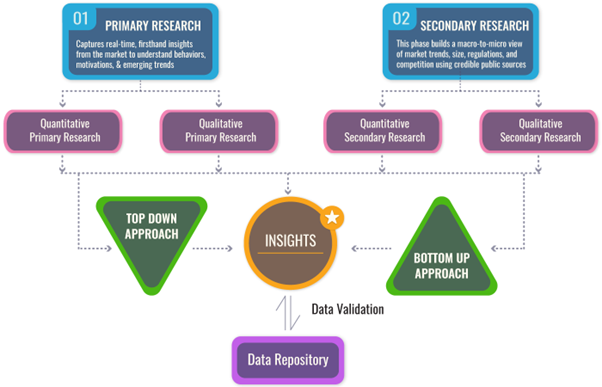
We follow a comprehensive, multi-phase research framework designed to deliver accurate, strategic, and decision-ready intelligence. Our process integrates primary and secondary research , both quantitative and qualitative , along with dual modeling techniques ( top-down and bottom-up) and a final layer of validation through our proprietary in-house repository.
PRIMARY RESEARCH
Primary research captures real-time, firsthand insights from the market to understand behaviors, motivations, and emerging trends.
1. Quantitative Primary Research
Objective: Generate statistically significant data directly from market participants.
Approaches:- Structured surveys with customers, distributors, and field agents
- Mobile-based data collection for point-of-sale audits and usage behavior
- Phone-based interviews (CATI) for market sizing and product feedback
- Online polling around industry events and digital campaigns
- Purchase frequency by customer type
- Channel performance across geographies
- Feature demand by application or demographic
2. Qualitative Primary Research
Objective: Explore decision-making drivers, pain points, and market readiness.
Approaches:- In-depth interviews (IDIs) with executives, product managers, and key decision-makers
- Focus groups among end users and early adopters
- Site visits and observational research for consumer products
- Informal field-level discussions for regional and cultural nuances
SECONDARY RESEARCH
This phase helps establish a macro-to-micro understanding of market trends, size, regulation, and competitive dynamics, sourced from credible and public domain information.
1. Quantitative Secondary Research
Objective: Model market value and segment-level forecasts based on published data.
Sources include:- Financial reports and investor summaries
- Government trade data, customs records, and regulatory statistics
- Industry association publications and economic databases
- Channel performance and pricing data from marketplace listings
- Revenue splits, pricing trends, and CAGR estimates
- Supply-side capacity and volume tracking
- Investment analysis and funding benchmarks
2. Qualitative Secondary Research
Objective: Capture strategic direction, innovation signals, and behavioral trends.
Sources include:- Company announcements, roadmaps, and product pipelines
- Publicly available whitepapers, conference abstracts, and academic research
- Regulatory body publications and policy briefs
- Social and media sentiment scanning for early-stage shifts
- Strategic shifts in market positioning
- Unmet needs and white spaces
- Regulatory triggers and compliance impact
DUAL MODELING: TOP-DOWN + BOTTOM-UP
To ensure robust market estimation, we apply two complementary sizing approaches:
Top-Down Modeling:- Start with broader industry value (e.g., global or regional TAM)
- Apply filters by segment, geography, end-user, or use case
- Adjust with primary insights and validation benchmarks
- Ideal for investor-grade market scans and opportunity mapping
- Aggregate from the ground up using sales volumes, pricing, and unit economics
- Use internal modeling templates aligned with stakeholder data
- Incorporate distributor-level or region-specific inputs
- Most accurate for emerging segments and granular sub-markets
DATA VALIDATION: IN-HOUSE REPOSITORY
We close the loop with proprietary data intelligence built from ongoing projects, industry monitoring, and historical benchmarking. This repository includes:
- Multi-sector market and pricing models
- Key trendlines from past interviews and forecasts
- Benchmarked adoption rates, churn patterns, and ROI indicators
- Industry-specific deviation flags and cross-check logic
- Catches inconsistencies early
- Aligns projections across studies
- Enables consistent, high-trust deliverables