

Microneedling Market Size and Forecast (2026–2034), Global and Regional Growth, Trend, Share and Industry Analysis Report Coverage: By Product Type (Manual Dermarollers, Automated Microneedling Pens, RF Microneedling Systems, Hydro / Infusion Microneedling Devices, Dissolving Microneedle Patches, and Others), By Application (Skin Rejuvenation & Anti-aging, Acne & Surgical Scar Revision, Hyperpigmentation & Melasma, Alopecia / Hair Restoration, Stretch Marks & Cellulite, Transdermal Drug / Vaccine Delivery, and Others), By End User (Dermatology & Plastic Surgery Clinics, Aesthetic MedSpas, Hospitals, Home-use Consumers, and Others) and Geography
2026-08-11
Healthcare
Swetal (Research Analyst)
Description
Microneedling Market Overview
The Global Microneedling
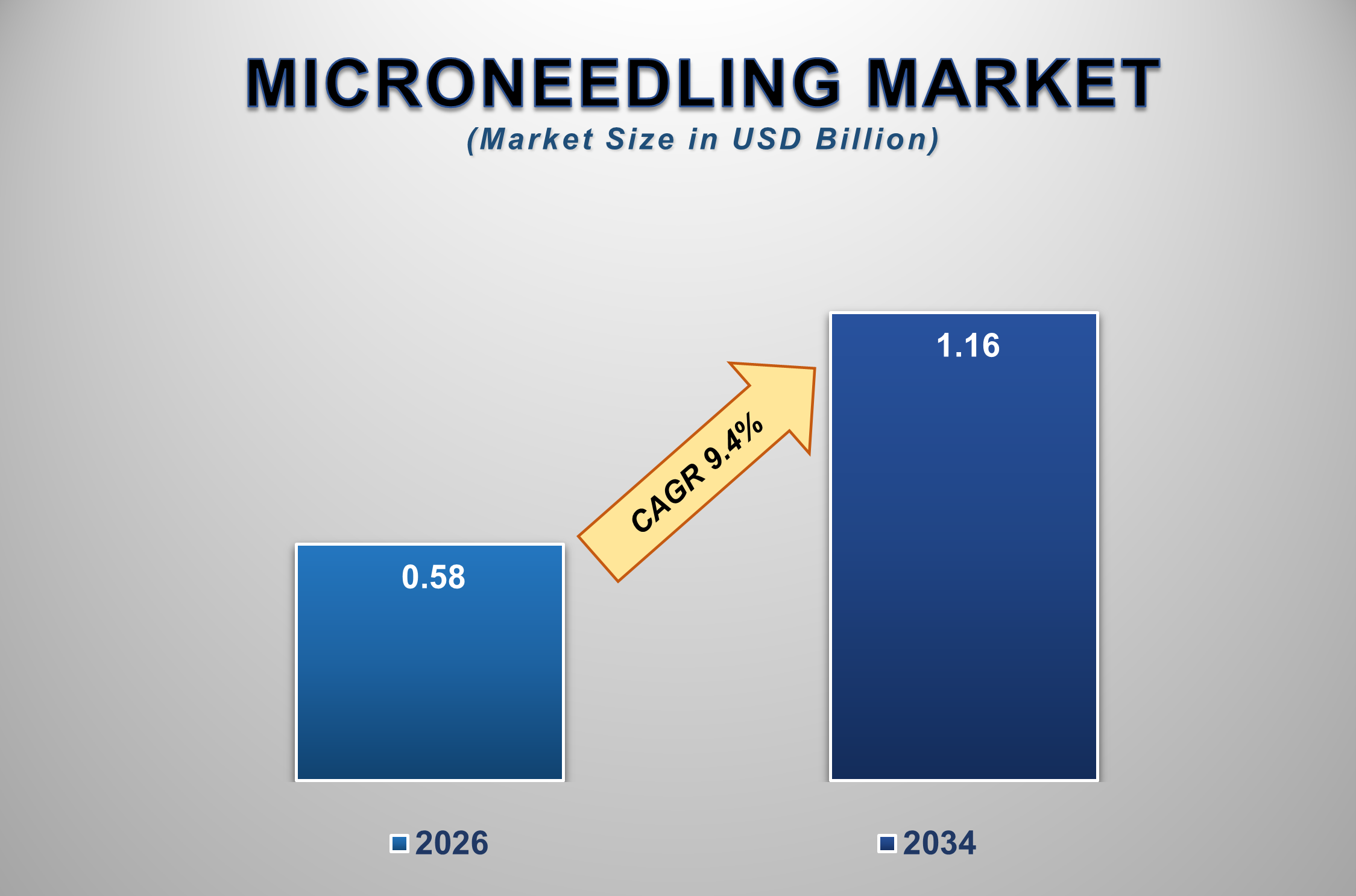
Market Size was valued at USD 0.58 Billion in 2026 and is projected to reach
USD 1.16 Billion by 2034, expanding at a CAGR of 9.4% during the forecast
period. The microneedling market worldwide continues to make steady progress.
The major factors promoting market growth are rising consumer interest in
non-invasive aesthetic treatments, growing interest in skin rejuvenation
procedures, and product innovations in the Microneedling devices market.
Microneedling is now widely accepted for treating the skin and improving its
texture, reducing wrinkles, treating acne scars, hyperpigmentation, and stretch
marks, and stimulating hair growth, thanks to its ability to stimulate collagen
and elastin production with minimal downtime. As the market is progressing in
various aspects, starting from manual rollers to automatic Microneedling pens,
RF Microneedling systems, and hydro/infuse devices, the market is continuously
evolving towards advanced procedures having better precision, efficacy, and
safety. Moreover, the applications of microneedles have been expanded with the
introduction of new dissolving microneedles for drug and vaccine
administration.
Microneedling Market Drivers and
Opportunities
Rising Demand for
Minimally Invasive Aesthetic Procedures Driving Market Growth
One of the leading
causes of the expansion of the global microneedling industry is the growing
demand for less intrusive cosmetic processes. Users prefer non-injection
procedures that guarantee solutions to a variety of issues like wrinkles, fine
lines, acne scars, enlarged pores, hyperpigmentation, etc. Moreover, these
procedures do not take too much time to perform, have short recovery periods,
and incur few expenses. Microneedling influences the production of elastin and
collagen, and it remains an appealing method of skin rejuvenation. The rise of
social media also plays an important role in the use of microneedling
procedures, as people are more aware of beauty programs with the help of
dermatologists and social media. Also, the emergence of new modern RF
microneedling technology has made numerous microneedling therapies more
available for use.
Technological
Advancements in RF and Automated Microneedling Systems Fueling Market Expansion
The growth of the
global microneedling market is being propelled forward by the continuous
advancements made in automated and radiofrequency microneedling devices.
Manufacturers are rolling out next-generation machines that are equipped with
adjustable needle depth, precise treatment control, integrated RF energy, and
improved safety systems, among other functions. With the help of these systems,
doctors can offer more effective and personalized solutions to skin issues like
wrinkles, acne scarring, skin laxity, pigmentation, and skin rejuvenation.
Regulatory approvals and product innovation are driving the market growth even
further. In July 2026, the Hydrafacial company SkinHealth Systems Inc.
announced that the U. S. Food and Drug Administration (FDA) has cleared its
Skin Stylus microneedling device to treat the appearance of periorbital
wrinkles in adults over 22 years old of Fitzpatrick phototypes I to VI. This
regulatory milestone underscores the industry’s goal of broadening clinical
indications, improving treatment efficacy, and verifying the safety of devices
for wider patient populations. As microneedling device manufacturers keep
developing advanced technology and obtaining regulatory approvals, healthcare
practitioners and aesthetic clinics are quick to incorporate the innovative
systems driving the steady growth of the market worldwide.
Expansion of
Microneedle-Based Drug Delivery and Cosmeceutical Applications Create
Significant Growth Opportunities
With microneedle
technology revolutionizing the delivery of medicines through the skin, the
microneedling market can see a growth surge. With dissolving and hollow
microneedles making their way into painless administration of vaccines,
biologics, insulin, and skin diseases, it also improves patient compliance for
self-administration. In addition, there is a growing trend of integrating
microneedling with powerful skincare compounds such as hyaluronic acid,
peptides, exosomes, and platelet-rich plasma (PRP) in order to maximize the
treatment outcome. Ongoing funds spent on drug delivery research, regenerative
aesthetics, and personalized skin care could broaden the applications of
microneedle technology outside of cosmetic spheres.
Microneedling Market Scope
|
Report Attributes |
Description |
|
Market Size in 2026 |
USD 0.58 Billion |
|
Market Forecast in 2034 |
USD 1.16 Billion |
|
CAGR % 2026-2034 |
9.4% |
|
Base Year |
2025 |
|
Historic Data |
2021-2025 |
|
Forecast Period |
2026-2034 |
|
Report USP |
Pricing and Cost Structure Analysis, Product
Innovation Benchmarking, Whitespace Assessment, Company Share, Company
Heatmap, Growth Factors, and more |
|
Segments Covered |
●
By
Product Type ●
By
Application ●
By End
User |
|
Regional Scope |
●
North
America ●
Europe ●
APAC ●
Latin
America ●
Middle
East and Africa |
|
Country Scope |
●
U.S. ●
Canada ●
U.K. ●
Germany ●
France ●
Italy ●
Spain ●
Russia ●
China ●
India ●
Japan ●
South
Korea ●
Australia
●
Mexico ●
Brazil ●
Saudi
Arabia ●
UAE ●
South
Africa
|
Microneedling Market Report
Segmentation Analysis
The global
microneedling market industry analysis is segmented by product type, by
application, by end user, and by region.
Automated
Microneedling Pens Segment Is Expected to Lead the Microneedling Market by
Product Type
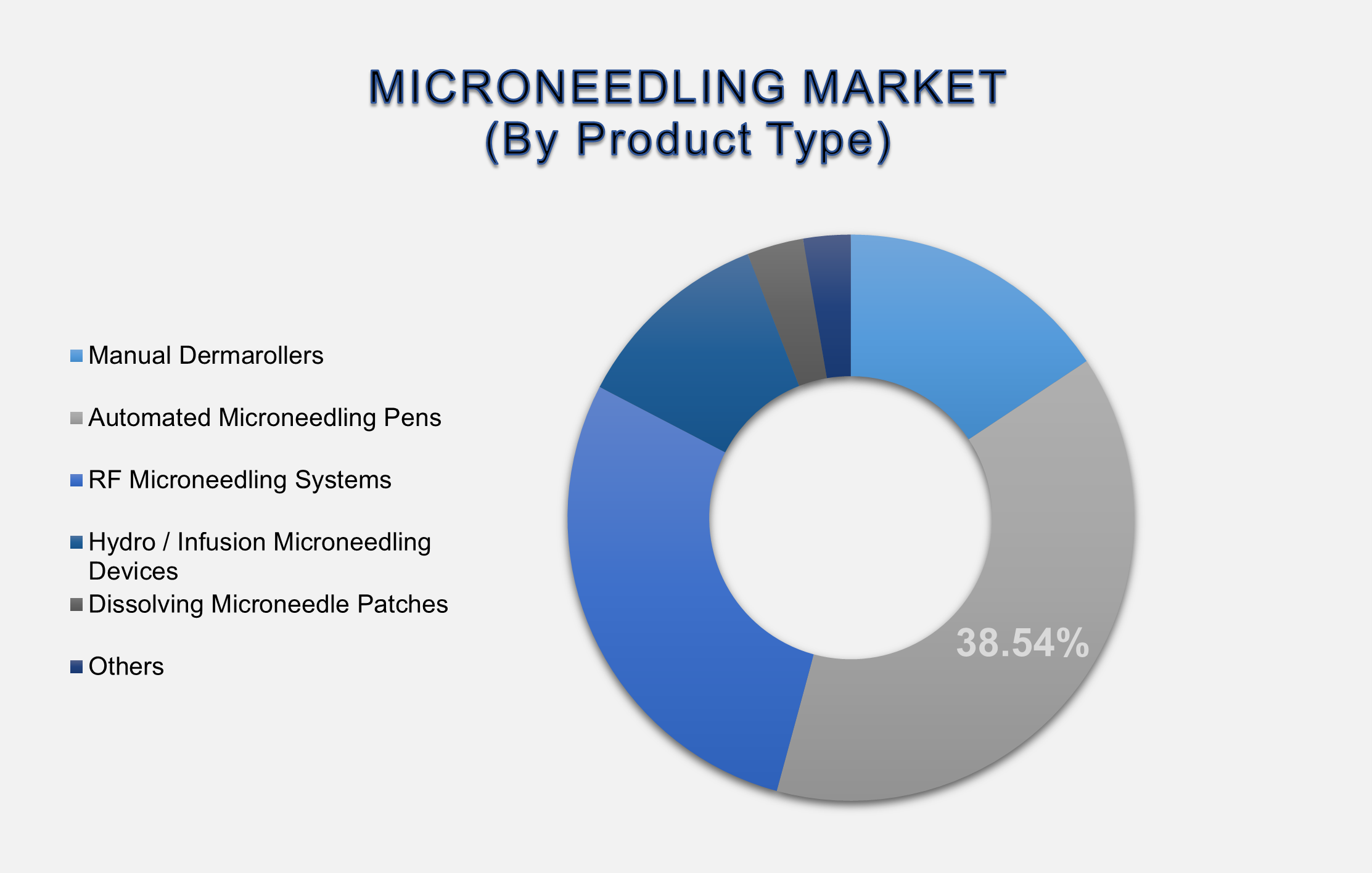
The segment of
automated microneedling pens is anticipated to account for the largest portion
of the global microneedling sector, as they exhibit a higher degree of
accuracy, adjustable depth of a needle, higher safety, and effective treatment
results in comparison to manual dermarollers. The application of these tools is
widespread among dermatologists, clinics treating cosmetic defects of the skin,
and medical spas for handling acne scars as well as fine wrinkles and
rejuvenation of skin with minimal possibility of downtime and with enhanced
comfort of patients. Continuous innovations in the field are further promoting
the growth of the segment. For example, Dermalogica entered the market of
medical devices through the introduction of the PRO Pen Microneedling System
after getting approval from the U.S. FDA 510(k) in May, 2026. This device is
designated for treating facial acne scars in adults not younger than 22 years
old and represents an option for licensed professionals in the field to be used
in their work through appropriate channels. Such innovations from reputable
companies enhance the usage of microneedling pens in clinics worldwide.
Skin
Rejuvenation & Anti-aging Segment Is Expected to Lead the Microneedling
Market by Application
The skin
rejuvenation and anti-aging segment will likely hold the largest share in the
overall microneedling market. The increasing popularity of minimally invasive
procedures across the globe that help improve the quality of skin,
simultaneously with minimum downtime, is the driving factor behind this
development. Microneedling promotes the natural production of elastin and
collagen, which renders it effective in lessening the visibility of wrinkles,
fine lines, enlarged pores, and other issues associated with skin ageing.
Increasingly, people know about preventive skincare, thanks to the development
of disposable income levels and the influence of the Internet and social media.
The new developments in automated and RF microneedling technologies, combined
with different regenerative treatments, such as PRP, exosomes, and growth
factor serums, have all contributed to the effectiveness of microneedling
procedures and made them more widely applied in the dermatology sector. The
growing number of elderly people and their preference for natural results will
also work in favour of this segment.
Dermatology
& Plastic Surgery Clinics Segment Is Expected to Lead the Microneedling
Market by End User
The dermatology
& plastic surgery clinics sector is predicted to take a significant share
in the global microneedling market due to the increase in national cosmetic
surgeries and availability of upgraded microneedling products. The dermatology
clinic is fully equipped with the latest technology, including automated and RF
microneedling machines, providing effective, accurate, and clinical procedures
for revitalization of skin, acne scar removal, wrinkle treatment, pigmentation
therapy, and hair restoration treatment. Their qualified dermatologists and
plastic surgeons are able to offer personalized treatment plans based on the
client’s conditions, increasing the effectiveness of the therapy. Furthermore,
the rise in demand for minimally invasive aesthetic procedures, changing income
levels, and growth of the public understanding of qualified aesthetic
procedures increase the flow of patients to selective cosmetic surgery clinics.
Continuous investments in new devices and combined therapies, including plasma and
exosome therapies, enhance the use of microneedling techniques and strengthen
the position of this segment throughout the predicted period.
The following
segments are part of an in-depth analysis of the global microneedling market:
|
Market Segments |
|
|
By Product Type |
●
Manual
Dermarollers ●
Automated
Microneedling Pens ●
RF
Microneedling Systems ●
Hydro/Infusion Microneedling Devices ●
Dissolving
Microneedle Patches ●
Others |
|
By Application |
●
Skin
Rejuvenation & Anti-aging ●
Acne &
Surgical Scar Revision ●
Hyperpigmentation
& Melasma ●
Alopecia /
Hair Restoration ●
Stretch
Marks & Cellulite ●
Transdermal
Drug / Vaccine Delivery ●
Others |
|
By End User |
●
Dermatology
& Plastic Surgery Clinics ●
Aesthetic
MedSpas ●
Hospitals ●
Home-use
Consumers ●
Others |
Microneedling Market Share Analysis
by Region
North America is
projected to hold the largest share of the global microneedling market over the
forecast period
The North American
microneedling market will be the largest contributor to the global market as a
result of the proliferation of technologically advanced, minimally invasive
aesthetic procedures in the region, increasing consumer spending for aesthetic
procedures, advanced healthcare infrastructure, and the presence of many
prominent aesthetic device manufacturers. The availability of numerous
dermatology clinics, plastic surgery centers, and medical spas utilizing the
latest automated and RF microneedling methods would enable the region to gain a
lot from the availability of advanced technology. In addition, the favorable
regulatory approvals and constant innovation in the field are also making a
significant contribution to the market growth. For instance, in March 2026,
Revance indicated that in excess of one million SkinPen treatment kits were
already distributed across the United States as of January 2025, only a year
after the introduction of SkinPen Precision Elite. This significant event
indicates the increasing demand for professional microneedling procedures and
confirms the leading position of the SkinPen brand in the United States. The
increased adoption of clinically approved devices and rising awareness among
customers, as well as great investments in aesthetic medicine, will allow North
America to remain a leader in the global microneedling market during the
forecast period.
Microneedling
Market Competition Landscape Analysis
The microneedling
market is incredibly competitive due to the presence of companies from around
the world producing aesthetic instruments and creators of dermatology
technology and other medical instruments aimed at creating minimally invasive
skin rejuvenation solutions. Market players are altering their goods by
introducing new automated microneedling pens, radiofrequency (RF) devices for
microneedling, hydro/infusion microneedling machines, and technologies based on
dissolving microneedles, which improve the precision of treatments.
Corporations spend large sums of money to conduct research aimed at improving
the efficiency of devices, increasing their clinical significance in various
areas, such as removing scars caused by acne, anti-aging treatment, restoration
of hair, and transdermal drug delivery, as well as combining microneedling with
treatment strategies that use regenerative therapy approaches, for example,
making use of PRP (platelet-rich plasma) technology. The competition is
becoming even stronger due to regular launches of new products on the market,
licensing, technological innovations, strategic partnerships, and cooperation
agreements, mergers and acquisitions, and other business deals, as well as
prescribers’ education programs aimed at putting the advanced microneedling
technologies into practice.
Global
Microneedling Market Recent Developments News:
●
In April 2026 -
Dermalogica announced the launch
of the PRO Pen Microneedling System, its first FDA-cleared device, marking the
company’s entry into advanced in-office treatment technologies.
●
In May 2025 -
MDPen, a leader in advanced microneedling technology, is thrilled to announce
the launch of Corrective Microneedling, a groundbreaking approach that elevates
skin rejuvenation to new heights.
●
In December
2024 - Crown Aesthetics, a division of Crown Laboratories and a leader in the
dermatologic and aesthetic medical device industry, is excited to announce the
official launch of the SkinPen Precision Elite, a revolutionary FDA-cleared
device (Elite Cartridge Unit) that sets a new benchmark in microneedling.
The global
microneedling market is dominated by a few large companies, such as
●
DermapenWorld
●
3M
●
Aesthetics Biomedical
●
Alma Lasers
●
Becton Dickinson
●
Benev Company
●
Cartessa Aesthetics
●
Collagen P.I.N.
●
CosMED Pharmaceutical
●
Crown Aesthetics
●
Dermaroller GmbH
●
Dr. Pen
●
Eclipse Aesthetics
●
EndyMed Medical
●
Jeisys Medical
●
Lutronic
●
MDPen
●
NanoPass Technologies
●
Raphas Co., Ltd.
●
ShenB
● Other Prominent Players
Frequently Asked Questions
Swetal (Research Analyst)
Swetal is a Research Analyst with 4+ years of experience specializing in healthcare market research, medical devices, healthcare IT, and medical technology industry analysis. Her expertise includes competitive intelligence, secondary research, market trend forecasting, and healthcare business insights across global healthcare ecosystems.
She contributes to advanced market research reports by analyzing regulatory frameworks, emerging healthcare technologies, competitive landscapes, and innovation trends shaping the medical industry. With a strong focus on accurate market intelligence, strategic insights, and healthcare industry trends, Swetal supports businesses in making informed, data-backed decisions in a rapidly transforming healthcare environment.
1.
Global
Microneedling Market Introduction and Market Overview
1.1. Objectives of the Study
1.2. Market Segmentation
1.2.1.Product Type of the Global Microneedling
Market
1.2.2.Application of the Global Microneedling
Market
1.2.3.End User of the Global Microneedling
Market
1.2.4.Region of the Global Microneedling
Market
1.3. Competition Coverage List of
Market Participants
1.4. Market Definition: Microneedling
Market
2.
Executive Summary
2.1. Global Microneedling Market
Estimation & Forecast
2.1.1.Global Microneedling Market Size
(US$ Million) Estimates & Historical Trend Analysis (2021 - 2025)
2.1.2.Global Microneedling Overall
Market Size (US$ Million), Growth Rate (Y-o-Y), Market CAGR (%), Market
Forecast (2026 - 2034)
2.2. Snapshot of Global Microneedling
Market
2.3. Global Microneedling Market
Revenue Share (%) 2025
2.4. REGIONAL OUTLINE: Revenue CAGR,
by Region
2.5. Key Competitors & Key
Insights
3.
Market Overview (Qualitative
Analysis)
3.1. Demand Side Trends
3.2. Supply Side Trends /
Manufacturing Trends
3.3. Demand and Opportunity
Assessment, 2026 - 2034
3.4. Market Dynamics
3.4.1.Drivers
3.4.2.Limitations
3.4.3.Opportunities
3.4.4.Impact Analysis of Drivers and
Restraints
3.5. Key Developments
3.6. Regulatory Landscape
3.7. Pricing Analysis
3.8. Supply Chain Analysis
3.9. Porter’s Five Forces Analysis
3.9.1.Bargaining Power of Suppliers
3.9.2.Bargaining Power of Buyers
3.9.3.Threat of Substitutes
3.9.4.Threat of New Entrants
3.9.5.Competitive Rivalry
3.10. PEST Analysis
3.10.1. Political Factors
3.10.2. Economic Factors
3.10.3. Social Factors
3.10.4. Technology Factors
4.
Global Microneedling Market
Estimates & Forecast Trend Analysis, by Product Type
4.1. Global Microneedling Market
Assessments & Key Findings, by Product Type
4.2. Global Microneedling Market
Revenue (US$ Million) Estimates and Forecasts, by Product Type, 2021 - 2034
4.2.1.Manual Dermarollers
4.2.2.Automated Microneedling Pens
4.2.3.RF Microneedling Systems
4.2.4.Hydro / Infusion Microneedling
Devices
4.2.5.Dissolving Microneedle Patches
4.2.6.Others
5.
Global Microneedling Market
Estimates & Forecast Trend Analysis, by Application
5.1. Global Microneedling Market
Assessments & Key Findings, by Application
5.2. Global Microneedling Market
Revenue (US$ Million) Estimates and Forecasts, by Application, 2021 - 2034
5.2.1.Skin Rejuvenation &
Anti-aging
5.2.2.Acne & Surgical Scar
Revision
5.2.3.Hyperpigmentation & Melasma
5.2.4.Alopecia / Hair Restoration
5.2.5.Stretch Marks & Cellulite
5.2.6.Transdermal Drug / Vaccine
Delivery
5.2.7.Others
6.
Global Microneedling Market
Estimates & Forecast Trend Analysis, by End User
6.1. Global Microneedling Market
Assessments & Key Findings, by End User
6.2. Global Microneedling Market
Revenue (US$ Million) Estimates and Forecasts, by End User, 2021 - 2034
6.2.1.Dermatology & Plastic
Surgery Clinics
6.2.2.Aesthetic MedSpas
6.2.3.Hospitals
6.2.4.Home-use Consumers
6.2.5.Others
7.
Global Microneedling Market
Estimates & Forecast Trend Analysis, by Region
7.1.
Global
Microneedling Market Assessments & Key Findings, by Region
7.2.
Global
Microneedling Market Revenue (US$ Million) Estimates and Forecasts, by Region,
2021 - 2034
7.2.1.North America
7.2.2.Europe
7.2.3.Asia Pacific
7.2.4.Middle East & Africa
7.2.5.Latin America
8.
North
America Microneedling Market: Estimates & Forecast Trend Analysis
8.1. North America Microneedling
Market Assessments & Key Findings
8.1.1.North America Microneedling
Market Introduction
8.1.2.North America Microneedling
Market Size Estimates and Forecast (US$ Million) (2021 - 2034)
8.1.2.2. By Application
8.1.2.3. By End User
8.1.2.4. By Country
8.1.2.4.1. The U.S.
8.1.2.4.2. Canada
9.
Europe
Microneedling Market: Estimates & Forecast Trend Analysis
9.1. Europe Microneedling Market
Assessments & Key Findings
9.1.1.Europe Microneedling Market
Introduction
9.1.2.Europe Microneedling Market Size
Estimates and Forecast (US$ Million) (2021 - 2034)
9.1.2.1. By Product Type
9.1.2.2. By Application
9.1.2.3. By End User
9.1.2.4. By Country
9.1.2.4.1.
Germany
9.1.2.4.2.
Italy
9.1.2.4.3.
U.K.
9.1.2.4.4.
France
9.1.2.4.5.
Spain
9.1.2.4.6.
Switzerland
9.1.2.4.7. Rest
of Europe
10. Asia Pacific Microneedling
Market: Estimates & Forecast Trend
Analysis
10.1. Asia Pacific Market Assessments
& Key Findings
10.1.1. Asia Pacific Microneedling
Market Introduction
10.1.2. Asia Pacific Microneedling
Market Size Estimates and Forecast (US$ Million) (2021 - 2034)
10.1.2.1. By Product Type
10.1.2.2. By Application
10.1.2.3. By End User
10.1.2.4. By Country
10.1.2.4.1. China
10.1.2.4.2. Japan
10.1.2.4.3. India
10.1.2.4.4. Australia
10.1.2.4.5. South Korea
10.1.2.4.6. Rest of Asia Pacific
11. Middle East & Africa Microneedling
Market: Estimates & Forecast Trend
Analysis
11.1. Middle East & Africa Market
Assessments & Key Findings
11.1.1. Middle
East & Africa Microneedling
Market Introduction
11.1.2. Middle
East & Africa Microneedling
Market Size Estimates and Forecast (US$ Million) (2021 - 2034)
11.1.2.1. By Product Type
11.1.2.2. By Application
11.1.2.3. By End User
11.1.2.4. By Country
11.1.2.4.1. South Africa
11.1.2.4.2. UAE
11.1.2.4.3. Saudi Arabia
11.1.2.4.4. Rest of MEA
12. Latin America
Microneedling Market: Estimates &
Forecast Trend Analysis
12.1. Latin America Market Assessments
& Key Findings
12.1.1. Latin America Microneedling
Market Introduction
12.1.2. Latin America Microneedling
Market Size Estimates and Forecast (US$ Million) (2021 - 2034)
12.1.2.1. By Product Type
12.1.2.2. By Application
12.1.2.3. By End User
12.1.2.4. By Country
12.1.2.4.1. Brazil
12.1.2.4.2. Mexico
12.1.2.4.3. Argentina
12.1.2.4.4. Rest of LATAM
13. Competition Landscape
13.1. Global Microneedling Market
Product Mapping
13.2. Global Microneedling Market
Concentration Analysis, by Leading Players / Innovators / Emerging Players /
New Entrants
13.3. Global Microneedling Market Tier
Structure Analysis
13.4. Global Microneedling Market
Concentration & Company Market Shares (%) Analysis, 2025
14. Company Profiles
14.1. DermapenWorld
14.1.1. Company Overview & Key Stats
14.1.2. Financial Performance & KPIs
14.1.3. Product Portfolio
14.1.4. SWOT Analysis
14.1.5. Business Strategy & Recent
Developments
* Similar details would be provided
for all the players mentioned below
14.2. 3M
14.3. Aesthetics Biomedical
14.4. Alma Lasers
14.5. Becton Dickinson
14.6. Benev Company
14.7. Cartessa Aesthetics
14.8. Collagen P.I.N.
14.9. CosMED Pharmaceutical
14.10. Crown Aesthetics
14.11. Dermaroller GmbH
14.12. Dr. Pen
14.13. Eclipse Aesthetics
14.14. EndyMed Medical
14.15. Jeisys Medical
14.16. Lutronic
14.17. MDPen
14.18. NanoPass Technologies
14.19. Raphas Co., Ltd.
14.20. ShenB
14.21. Other Prominent Players
15. Research
Findings & Conclusion
16. Assumptions & Acronyms Used
17. Research
Methodology
17.1. External Transportation /
Databases
17.2. Internal Proprietary Database
17.3. Primary Research
17.4. Secondary Research
17.5. Assumptions
17.6. Limitations
17.7. Report FAQs
Our Research Methodology
"Insight without rigor is just noise."
We follow a comprehensive, multi-phase research framework designed to deliver accurate, strategic, and decision-ready intelligence. Our process integrates primary and secondary research , both quantitative and qualitative , along with dual modeling techniques ( top-down and bottom-up) and a final layer of validation through our proprietary in-house repository.
PRIMARY RESEARCH
Primary research captures real-time, firsthand insights from the market to understand behaviors, motivations, and emerging trends.
1. Quantitative Primary Research
Objective: Generate statistically significant data directly from market participants.
Approaches:- Structured surveys with customers, distributors, and field agents
- Mobile-based data collection for point-of-sale audits and usage behavior
- Phone-based interviews (CATI) for market sizing and product feedback
- Online polling around industry events and digital campaigns
- Purchase frequency by customer type
- Channel performance across geographies
- Feature demand by application or demographic
2. Qualitative Primary Research
Objective: Explore decision-making drivers, pain points, and market readiness.
Approaches:- In-depth interviews (IDIs) with executives, product managers, and key decision-makers
- Focus groups among end users and early adopters
- Site visits and observational research for consumer products
- Informal field-level discussions for regional and cultural nuances
SECONDARY RESEARCH
This phase helps establish a macro-to-micro understanding of market trends, size, regulation, and competitive dynamics, sourced from credible and public domain information.
1. Quantitative Secondary Research
Objective: Model market value and segment-level forecasts based on published data.
Sources include:- Financial reports and investor summaries
- Government trade data, customs records, and regulatory statistics
- Industry association publications and economic databases
- Channel performance and pricing data from marketplace listings
- Revenue splits, pricing trends, and CAGR estimates
- Supply-side capacity and volume tracking
- Investment analysis and funding benchmarks
2. Qualitative Secondary Research
Objective: Capture strategic direction, innovation signals, and behavioral trends.
Sources include:- Company announcements, roadmaps, and product pipelines
- Publicly available whitepapers, conference abstracts, and academic research
- Regulatory body publications and policy briefs
- Social and media sentiment scanning for early-stage shifts
- Strategic shifts in market positioning
- Unmet needs and white spaces
- Regulatory triggers and compliance impact
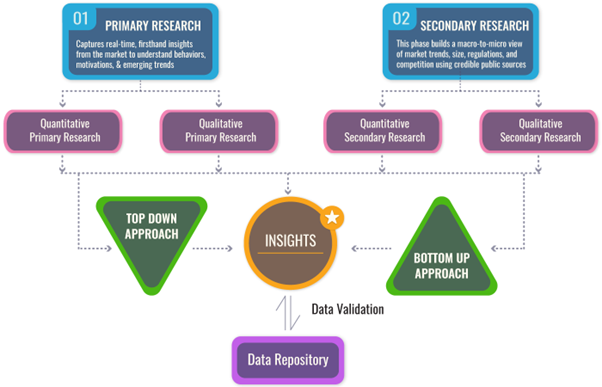
DUAL MODELING: TOP-DOWN + BOTTOM-UP
To ensure robust market estimation, we apply two complementary sizing approaches:
Top-Down Modeling:- Start with broader industry value (e.g., global or regional TAM)
- Apply filters by segment, geography, end-user, or use case
- Adjust with primary insights and validation benchmarks
- Ideal for investor-grade market scans and opportunity mapping
- Aggregate from the ground up using sales volumes, pricing, and unit economics
- Use internal modeling templates aligned with stakeholder data
- Incorporate distributor-level or region-specific inputs
- Most accurate for emerging segments and granular sub-markets
DATA VALIDATION: IN-HOUSE REPOSITORY
We close the loop with proprietary data intelligence built from ongoing projects, industry monitoring, and historical benchmarking. This repository includes:
- Multi-sector market and pricing models
- Key trendlines from past interviews and forecasts
- Benchmarked adoption rates, churn patterns, and ROI indicators
- Industry-specific deviation flags and cross-check logic
- Catches inconsistencies early
- Aligns projections across studies
- Enables consistent, high-trust deliverables