

Global Milk Mineral Concentrate Market Size and Forecast (2025–2033), Growth Trends, Share, and Industry Analysis Report Coverage: By Calcium Content (Less than 20%, 20% to 25%, 26% to 30%, Others), By Granularity (Standard Powder (>10 microns), Micronized Powder (<10 microns)), By Application (Infant Formula, Functional Food, Beverages, Sports Nutrition, Dietary Supplements, Others), and Geography
2026-01-02
Consumer Products
Jaya Bundele (Research Analyst)
Description
Milk Mineral Concentrate Market Overview
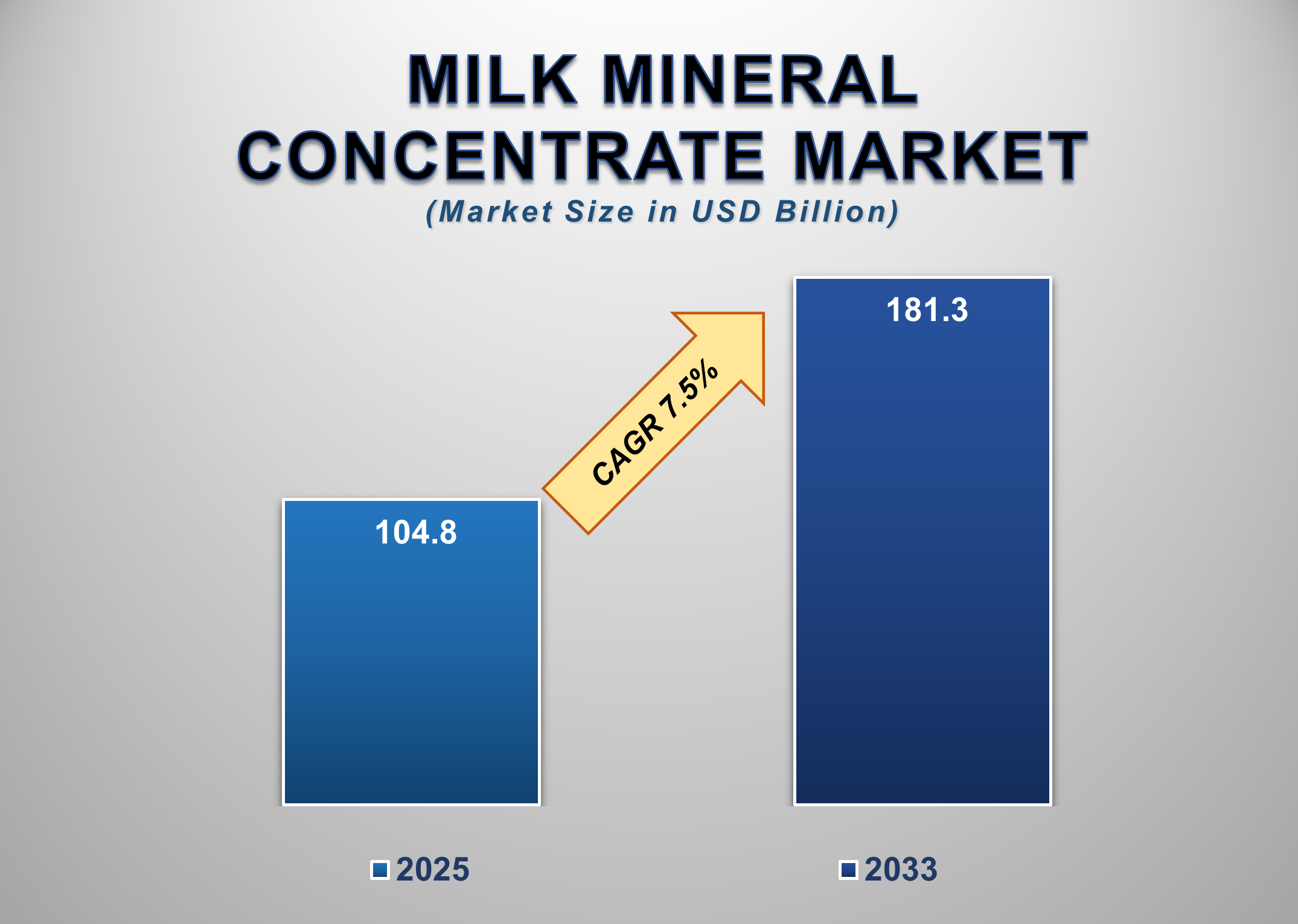
The Global Milk Mineral Concentrate Market is projected to grow from USD 104.8 billion in 2025 to USD 181.3 billion by 2033, registering a CAGR of 7.5% during the forecast period. Milk mineral concentrates, derived from milk permeate or whey streams, provide a highly bioavailable source of calcium, phosphorus, magnesium, and other essential minerals, making them increasingly valuable in the nutrition, food, and beverage sectors.
Growing consumer interest in bone
health, clean-label nutrition, and functional ingredients is driving widespread
industry adoption. The expanding demand for infant formula, sports nutrition,
and dietary supplements is elevating the market’s growth trajectory, as
manufacturers seek premium mineral sources aligned with safety, purity, and
regulatory compliance. The shift toward micronized powders is further improving
ingredient solubility and functionality in beverages and ready-to-mix
formulations.
Milk Mineral Concentrate
Market Drivers and Opportunities
Rising Demand for Nutrient-Dense Products Is Driving the Milk
Mineral Concentrate Market Growth
The global push toward nutrient-dense and functional foods
continues to be a major driver of the Milk Mineral Concentrate Market.
Consumers are increasingly prioritizing health and wellness, resulting in
heightened demand for products that support bone strength, muscle development,
metabolic functions, and overall wellness. Milk mineral concentrates,
containing bioavailable forms of calcium, phosphorus, and trace minerals, offer
superior absorption compared to synthetic alternatives. This advantage positions
them strongly in the evolving clean-label and natural ingredient landscape. The
growing elderly population, especially in Western markets, further accelerates
demand for mineral-enriched foods and supplements aimed at preventing
osteoporosis and age-related nutritional deficiencies. On the other hand,
manufacturers increasingly prefer milk-derived mineral blends because they
align with natural and minimally processed product claims. Rising fortification
trends across bakery, confectionery, beverage, and dairy products are expanding
commercial applications. As food brands reformulate products to meet stricter
nutritional standards, milk mineral concentrates are emerging as a preferred
functional ingredient that delivers health benefits without altering taste or
texture, strengthening market demand globally.
Expanding Applications in Infant Nutrition and Sports
Nutrition Are Supporting Market Growth
The rapid growth of the infant nutrition and sports nutrition
industries is creating strong momentum for the Milk Mineral Concentrate Market.
Infant formula manufacturers rely heavily on high-purity mineral ingredients to
replicate the nutritional composition of human milk, making milk mineral
concentrates a critical input for calcium and phosphorus fortification.
Increased birth rates in certain developing markets, along with higher demand
for premium and specialty formulas, are accelerating the ingredient’s adoption.
Additionally, micronized milk mineral powders improve dispersion and stability
in ready-to-feed formulations, further benefitting manufacturers. In parallel,
the sports nutrition market is witnessing unprecedented growth, driven by
rising fitness culture, professional sports participation, and increased
consumption of protein powders and recovery drinks. Athletes and active
consumers demand highly bioavailable minerals essential for bone strength,
muscle contraction, and electrolyte balance. Milk mineral concentrates meet
these needs effectively, offering natural mineral profiles that complement
protein-rich formulations. As sports nutrition continues to diversify into
mainstream consumer categories, the integration of milk-derived minerals is
expected to strengthen, creating sustained demand across global markets.
Emerging Opportunities in Clean-Label Beverages and
Functional Food Innovations
The growing clean-label
movement represents a major opportunity for the Milk Mineral Concentrate
Market. Consumers globally are shifting toward recognizable, simple, and
naturally sourced ingredients, prompting manufacturers to replace synthetic
mineral additives with dairy-derived alternatives. Milk mineral concentrates
are ideally positioned to meet this demand due to their natural origin,
superior bioavailability, and compatibility with clean-label claims. The
beverage industry is particularly poised for significant adoption, as companies
introduce mineral-enriched water, dairy-based drinks, and plant-based beverage
blends fortified with natural minerals. Next-generation product innovations,
including protein shakes, meal replacements, and functional hydration products,
are incorporating milk minerals to enhance nutritional density. Additionally,
advances in microencapsulation and particle-size reduction technologies are
enabling new product formats with improved solubility and sensory profiles. As
functional beverages continue to gain traction globally, the industry presents
a high-growth opportunity for suppliers of milk mineral concentrates. Beyond
beverages, applications in bakery, cereals, snacks, and fortified foods are
broadening, strengthening the ingredient’s outlook across multiple emerging
markets.
Milk Mineral Concentrate
Market Scope
|
Report Attributes |
Description |
|
Market Size in 2025 |
USD 104.8 Billion |
|
Market Forecast in 2033 |
USD 181.3 Billion |
|
CAGR % 2025-2033 |
7.5% |
|
Base Year |
2024 |
|
Historic Data |
2020-2024 |
|
Forecast Period |
2025-2033 |
|
Report USP |
Production, Consumption,
Company Share, Company Heatmap, Company Production Capacity, Growth Factors,
and more |
|
Segments Covered |
●
By Calcium
Content, By Granularity, By Application |
|
Regional Scope |
●
North America, ●
Europe, ●
APAC, ●
Latin America ●
Middle East and
Africa |
|
Country Scope |
1)
U.S. 2)
Canada 3)
Germany 4)
UK 5)
France 6)
Spain 7)
Italy 8)
Switzerland 9)
China 10)
Japan 11)
India 12)
Australia 13)
South Korea 14)
Brazil 15)
Mexico 16)
Argentina 17)
South Africa 18)
Saudi Arabia 19)
UAE |
Milk Mineral Concentrate
Market Report Segmentation Analysis
The global Milk Mineral Concentrate Market is segmented by Calcium
Content, by Granularity, by Application, and by Region.
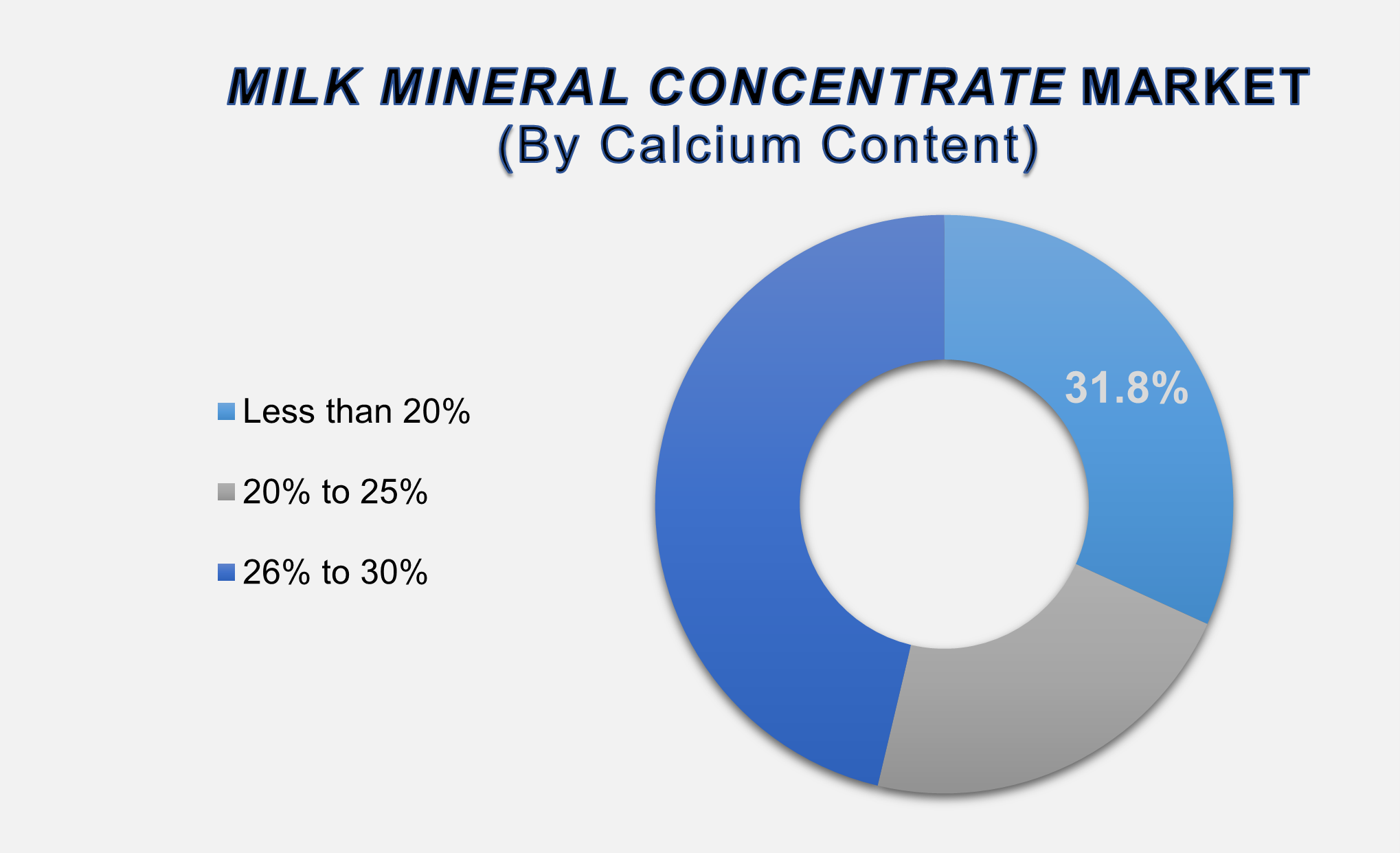
The less than 20% segment
accounted for the largest market share in the global milk mineral concentrate
market.
This dominance is attributed to the segment’s widespread use across infant formula, beverages, and functional food applications, where lower calcium concentrations support balanced mineral profiles and improved product stability. Formulators benefit from the segment’s versatility, as it provides an optimal ratio of calcium to phosphorus that closely mirrors natural milk composition, ensuring high bioavailability for consumers across all age groups. The segment is also preferred for products targeting general wellness, fortification, and dietary supplementation without altering the sensory properties of the end product. As demand for fortified beverages and dairy alternatives increases, the less than 20% calcium segment continues to gain prominence. Meanwhile, other segments, such as the 20%–25% and 26%–30% categories, are also expanding, supported by specialized applications in sports nutrition and therapeutic nutritional products. With evolving consumer preferences and regulatory approvals, the calcium content-based segmentation will remain crucial in shaping product innovation across global markets.
The Standard Powder
(>10 microns) segment accounted for the largest market share in the global
milk mineral concentrate market.
Standard powders remain the
preferred format for major applications such as bakery, dairy foods, cereals,
and infant formula, owing to their ease of handling, good dispersibility, and
cost efficiency. The segment benefits from broad product compatibility and
strong demand from large-scale food manufacturers who rely on stable,
consistent mineral sources for mass production. On the other hand, micronized
powder (<10 microns) is gaining momentum, driven by its superior solubility
and suitability for beverages, instant mixes, and sports nutrition
formulations. Micronized materials offer improved texture, reduced grittiness,
and enhanced bioavailability, making them ideal for premium functional food and
beverage products. As consumer preferences shift toward smooth,
ready-to-consume nutritional solutions, the micronized category is expected to
grow at a faster pace. The interplay between cost-efficiency and performance
benefits is shaping the growth dynamics within the granularity-based
segmentation.
The Infant Formula
segment accounted for the largest market share in the global milk mineral
concentrate market.
The rising demand for
nutritionally advanced infant formula products is driving strong adoption of
milk mineral concentrates, which serve as a critical source of calcium,
phosphorus, and trace minerals essential for infant development. Infant formula
manufacturers prioritize high-purity, safe, and bioavailable mineral inputs,
positioning milk-derived concentrates as the gold standard in this category.
Growing birth rates in the Asia Pacific, increasing adoption of premium
products, and rising awareness of infant nutrition are accelerating demand
within this segment. Additionally, functional food and sports nutrition
applications are expanding rapidly, supported by trends toward active
lifestyles and clean-label nutrition. Dietary supplements and beverages integrating
milk minerals are also witnessing growth, particularly in North America and
Europe. As product innovation expands in functional foods and drinks, milk
mineral concentrates will play a larger role across all application categories,
reinforcing their importance in the global nutrition ecosystem.
The following segments are
part of an in-depth analysis of the global Milk Mineral Concentrate market:
|
Market Segments |
|
|
By Calcium
Content |
●
Less than 20% ●
20% to 25% ●
26% to 30% |
|
By Granularity |
●
Standard Powder
(>10 microns) ●
Micronized Powder
(<10 microns) |
|
By Application |
●
Infant Formula ●
Functional Food ●
Beverages ●
Sports Nutrition ●
Dietary Supplements ●
Others |
Milk Mineral Concentrate
Market Share Analysis by Region
North America is
anticipated to hold the biggest portion of the Milk Mineral Concentrate Market
globally throughout the forecast period.
North America dominates the
global Milk Mineral Concentrate Market, accounting for 39.1% of the total share
in 2025, driven by high consumption of fortified foods, advanced dairy
processing capabilities, and strong regulatory support for nutritional enhancement.
The region benefits from robust demand across infant formula, sports nutrition,
and dietary supplements, supported by a large health-conscious population and
high household spending on premium nutrition products. Extensive R&D
investments from leading dairy companies in the U.S. and Canada further
contribute to innovation in milk mineral extraction and formulation
technologies. Europe also represents a significant market, with established
dairy cooperatives, strong functional food consumption, and growing interest in
clean-label products.
However, the Asia Pacific is
projected to record the highest CAGR during the forecast period. The region’s
growth is fueled by expanding infant formula markets in China, India, and
Southeast Asia, coupled with rising purchasing power and increasing adoption of
fortified foods. The shift toward active lifestyles and higher demand for
sports nutrition are reinforcing this trend. Latin America and the Middle East
& Africa are emerging markets, showing positive adoption as food
fortification initiatives expand across developing economies.
Milk Mineral Concentrate
Market Competition Landscape Analysis
The competitive landscape of the
Milk Mineral Concentrate Market is characterized by strong participation from
global dairy ingredient manufacturers, nutrition companies, and specialty
mineral processors. Key players are focusing on improving extraction technologies,
enhancing product purity, and expanding their micronized powder capabilities to
meet evolving industry needs.
Global Milk Mineral
Concentrate Market Recent Developments News:
- In June 2022,
Sachsenmilch Leppersdorf GmbH agreed
with FrieslandCampina DOMO to acquire five dairy brands and three
production facilities, expanding its product portfolio and manufacturing
capabilities in the European dairy market.
- In March 2022,
Arla Foods Ingredients launched two new organic products for early
life nutrition, reinforcing its commitment to the organic segment and
strengthening its market position in specialized infant and toddler
nutrition.
The Global Milk Mineral Concentrate Market Is Dominated by a Few Large Companies, such as
●
Armor Protéines
●
Arla Foods Ingredients
●
Glanbia
●
Hilmar Ingredients
●
Sachsenmilch
Leppersdorf
●
Erie Foods
International
●
Fonterra
●
Milk Specialties
Global
●
Ingredia
●
Kerry Group
●
FrieslandCampina
●
Saputo
●
Lactalis
●
Dairy Farmers of
America
●
Agropur
●
Valio
●
Südzucker
●
Meggle
●
Hoogwegt
●
Milk Powder Solutions
● Others
Frequently Asked Questions
Jaya Bundele (Research Analyst)
Jaya Bundele is a skilled Research Analyst with 4+ years of experience in market intelligence, consumer insights, competitive analysis, and industry forecasting across the consumer goods, agriculture, and food & beverage sectors. She specializes in market sizing, trend analysis, growth opportunity mapping, and strategic secondary research for global and regional markets.
Her expertise lies in transforming complex industry data into actionable business strategies that help organizations identify emerging trends, understand customer behavior, and gain a competitive edge. With a strong focus on data-driven insights, business intelligence, and future market trends, Jaya delivers high-quality research solutions aligned with evolving industry demands and market dynamics.
1. Global Milk Mineral
Concentrate Market Introduction and Market Overview
1.1.
Objectives
of the Study
1.2.
Global
Milk Mineral Concentrate Market Scope and Market Estimation
1.2.1.Global Milk Mineral
Concentrate Overall Market Size (US$ Bn), Market CAGR (%), Market forecast (2025
- 2033)
1.2.2.Global Milk Mineral
Concentrate Market Revenue Share (%) and Growth Rate (Y-o-Y) from 2020 - 2033
1.3.
Market
Segmentation
1.3.1.Calcium Content of Global Milk
Mineral Concentrate Market
1.3.2.Granularity of Global Milk
Mineral Concentrate Market
1.3.3.Application of Global Milk
Mineral Concentrate Market
1.3.4.Region of Global Milk
Mineral Concentrate Market
2. Executive
Summary
2.1.
Demand
Side Trends
2.2.
Key
Market Trends
2.3.
Market
Demand (US$ Bn) Analysis 2020 – 2024 and Forecast, 2025 – 2033
2.4.
Demand
and Opportunity Assessment
2.5.
Key
Developments
2.6.
Overview
of Tariff, Regulatory Landscape and Standards
2.7.
Market
Entry Strategies
2.8.
Market
Dynamics
2.8.1.Drivers
2.8.2.Limitations
2.8.3.Opportunities
2.8.4.Impact Analysis of Drivers
and Restraints
2.9.
Porter’s
Five Forces Analysis
2.10.
PEST
Analysis
3. Global
Milk Mineral Concentrate Market Estimates
& Historical Trend Analysis (2020 - 2024)
4. Global
Milk Mineral Concentrate Market Estimates
& Forecast Trend Analysis, by Calcium Content
4.1.
Global
Milk Mineral Concentrate Market Revenue (US$ Bn) Estimates and Forecasts, by Calcium
Content, 2020 - 2033
4.1.1.Less than 20%
4.1.2.20% to 25%
4.1.3.26% to 30%
5. Global
Milk Mineral Concentrate Market Estimates
& Forecast Trend Analysis, by Granularity
5.1.
Global
Milk Mineral Concentrate Market Revenue (US$ Bn) Estimates and Forecasts, by Granularity,
2020 - 2033
5.1.1.Standard Powder (>10
microns)
5.1.2.Micronized Powder (<10
microns)
6. Global
Milk Mineral Concentrate Market Estimates
& Forecast Trend Analysis, by Application
6.1.
Global
Milk Mineral Concentrate Market Revenue (US$ Bn) Estimates and Forecasts, by Application,
2020 - 2033
6.1.1.Infant Formula
6.1.2.Functional Food
6.1.3.Beverages
6.1.4.Sports Nutrition
6.1.5.Dietary Supplements
6.1.6.Others
7. Global
Milk Mineral Concentrate Market Estimates
& Forecast Trend Analysis, by Region
7.1.
Global
Milk Mineral Concentrate Market Revenue (US$ Bn) Estimates and Forecasts, by Region,
2020 - 2033
7.1.1.North America
7.1.2.Europe
7.1.3.Asia Pacific
7.1.4.Middle East & Africa
7.1.5.Latin America
8. North America Milk
Mineral Concentrate Market: Estimates
& Forecast Trend Analysis
8.1.
North
America Milk Mineral Concentrate Market Assessments & Key Findings
8.1.1.North America Milk Mineral
Concentrate Market Introduction
8.1.2.North America Milk Mineral
Concentrate Market Size Estimates and Forecast (US$ Billion) (2020 - 2033)
8.1.2.1. By Calcium
Content
8.1.2.2. By Granularity
8.1.2.3. By Application
8.1.2.4.
By
Country
8.1.2.4.1. The U.S.
8.1.2.4.2. Canada
9. Europe Milk
Mineral Concentrate Market: Estimates
& Forecast Trend Analysis
9.1.
Europe
Milk Mineral Concentrate Market Assessments & Key Findings
9.1.1.Europe Milk Mineral
Concentrate Market Introduction
9.1.2.Europe Milk Mineral
Concentrate Market Size Estimates and Forecast (US$ Billion) (2020 - 2033)
9.1.2.1. By Calcium
Content
9.1.2.2. By Granularity
9.1.2.3. By Application
9.1.2.4.
By
Country
9.1.2.4.1.
Germany
9.1.2.4.2.
Italy
9.1.2.4.3.
U.K.
9.1.2.4.4.
France
9.1.2.4.5.
Spain
9.1.2.4.6.
Switzerland
9.1.2.4.7. Rest
of Europe
10. Asia Pacific Milk
Mineral Concentrate Market: Estimates
& Forecast Trend Analysis
10.1.
Asia
Pacific Market Assessments & Key Findings
10.1.1.
Asia
Pacific Milk Mineral Concentrate Market Introduction
10.1.2.
Asia
Pacific Milk Mineral Concentrate Market Size Estimates and Forecast (US$ Billion)
(2020 - 2033)
10.1.2.1. By Calcium
Content
10.1.2.2. By Granularity
10.1.2.3. By Application
10.1.2.4.
By
Country
10.1.2.4.1. China
10.1.2.4.2. Japan
10.1.2.4.3. India
10.1.2.4.4. Australia
10.1.2.4.5. South Korea
10.1.2.4.6. Rest of Asia Pacific
11. Middle East & Africa Milk
Mineral Concentrate Market: Estimates
& Forecast Trend Analysis
11.1.
Middle
East & Africa Market Assessments & Key Findings
11.1.1.
Middle East & Africa Milk Mineral Concentrate Market
Introduction
11.1.2.
Middle East & Africa Milk Mineral Concentrate Market Size
Estimates and Forecast (US$ Billion) (2020 - 2033)
11.1.2.1. By Calcium
Content
11.1.2.2. By Granularity
11.1.2.3. By Application
11.1.2.4.
By
Country
11.1.2.4.1. UAE
11.1.2.4.2. Saudi
Arabia
11.1.2.4.3. South
Africa
11.1.2.4.4. Rest
of MEA
12. Latin America
Milk Mineral Concentrate Market:
Estimates & Forecast Trend Analysis
12.1.
Latin
America Market Assessments & Key Findings
12.1.1.
Latin
America Milk Mineral Concentrate Market Introduction
12.1.2.
Latin
America Milk Mineral Concentrate Market Size Estimates and Forecast (US$ Billion)
(2020 - 2033)
12.1.2.1. By Calcium
Content
12.1.2.2. By Granularity
12.1.2.3. By Application
12.1.2.4.
By
Country
12.1.2.4.1. Brazil
12.1.2.4.2. Argentina
12.1.2.4.3. Mexico
12.1.2.4.4. Rest
of LATAM
13. Country Wise Market:
Introduction
14.
Competition
Landscape
14.1.
Global
Milk Mineral Concentrate Market Product Mapping
14.2.
Global
Milk Mineral Concentrate Market Concentration Analysis, by Leading Players /
Innovators / Emerging Players / New Entrants
14.3.
Global
Milk Mineral Concentrate Market Tier Structure Analysis
14.4.
Global
Milk Mineral Concentrate Market Concentration & Company Market Shares (%)
Analysis, 2024
15.
Company
Profiles
15.1.
Armor Protéines
15.1.1.
Company
Overview & Key Stats
15.1.2.
Financial
Performance & KPIs
15.1.3.
Product
Portfolio
15.1.4.
SWOT
Analysis
15.1.5.
Business
Strategy & Recent Developments
* Similar details would be provided for all the players
mentioned below
15.2. Arla
Foods Ingredients
15.3. Glanbia
15.4. Hilmar
Ingredients
15.5. Sachsenmilch
Leppersdorf
15.6. Erie
Foods International
15.7. Fonterra
15.8. Milk
Specialties Global
15.9. Ingredia
15.10. Kerry
Group
15.11. FrieslandCampina
15.12. Saputo
15.13. Lactalis
15.14. Dairy
Farmers of America
15.15. Agropur
15.16. Valio
15.17. Südzucker
15.18. Meggle
15.19. Hoogwegt
15.20. Milk
Powder Solutions
15.21. Others
16. Research
Methodology
16.1.
External
Transportations / Databases
16.2.
Internal
Proprietary Database
16.3.
Primary
Research
16.4.
Secondary
Research
16.5.
Assumptions
16.6.
Limitations
16.7.
Report
FAQs
17. Research
Findings & Conclusion
Our Research Methodology
"Insight without rigor is just noise."
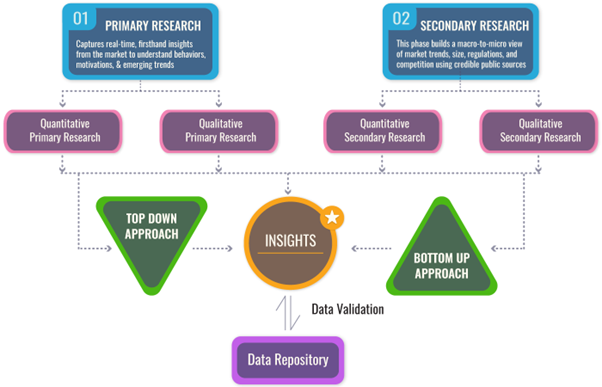
We follow a comprehensive, multi-phase research framework designed to deliver accurate, strategic, and decision-ready intelligence. Our process integrates primary and secondary research , both quantitative and qualitative , along with dual modeling techniques ( top-down and bottom-up) and a final layer of validation through our proprietary in-house repository.
PRIMARY RESEARCH
Primary research captures real-time, firsthand insights from the market to understand behaviors, motivations, and emerging trends.
1. Quantitative Primary Research
Objective: Generate statistically significant data directly from market participants.
Approaches:- Structured surveys with customers, distributors, and field agents
- Mobile-based data collection for point-of-sale audits and usage behavior
- Phone-based interviews (CATI) for market sizing and product feedback
- Online polling around industry events and digital campaigns
- Purchase frequency by customer type
- Channel performance across geographies
- Feature demand by application or demographic
2. Qualitative Primary Research
Objective: Explore decision-making drivers, pain points, and market readiness.
Approaches:- In-depth interviews (IDIs) with executives, product managers, and key decision-makers
- Focus groups among end users and early adopters
- Site visits and observational research for consumer products
- Informal field-level discussions for regional and cultural nuances
SECONDARY RESEARCH
This phase helps establish a macro-to-micro understanding of market trends, size, regulation, and competitive dynamics, sourced from credible and public domain information.
1. Quantitative Secondary Research
Objective: Model market value and segment-level forecasts based on published data.
Sources include:- Financial reports and investor summaries
- Government trade data, customs records, and regulatory statistics
- Industry association publications and economic databases
- Channel performance and pricing data from marketplace listings
- Revenue splits, pricing trends, and CAGR estimates
- Supply-side capacity and volume tracking
- Investment analysis and funding benchmarks
2. Qualitative Secondary Research
Objective: Capture strategic direction, innovation signals, and behavioral trends.
Sources include:- Company announcements, roadmaps, and product pipelines
- Publicly available whitepapers, conference abstracts, and academic research
- Regulatory body publications and policy briefs
- Social and media sentiment scanning for early-stage shifts
- Strategic shifts in market positioning
- Unmet needs and white spaces
- Regulatory triggers and compliance impact
DUAL MODELING: TOP-DOWN + BOTTOM-UP
To ensure robust market estimation, we apply two complementary sizing approaches:
Top-Down Modeling:- Start with broader industry value (e.g., global or regional TAM)
- Apply filters by segment, geography, end-user, or use case
- Adjust with primary insights and validation benchmarks
- Ideal for investor-grade market scans and opportunity mapping
- Aggregate from the ground up using sales volumes, pricing, and unit economics
- Use internal modeling templates aligned with stakeholder data
- Incorporate distributor-level or region-specific inputs
- Most accurate for emerging segments and granular sub-markets
DATA VALIDATION: IN-HOUSE REPOSITORY
We close the loop with proprietary data intelligence built from ongoing projects, industry monitoring, and historical benchmarking. This repository includes:
- Multi-sector market and pricing models
- Key trendlines from past interviews and forecasts
- Benchmarked adoption rates, churn patterns, and ROI indicators
- Industry-specific deviation flags and cross-check logic
- Catches inconsistencies early
- Aligns projections across studies
- Enables consistent, high-trust deliverables