

Mobile Point of Sale (POS) Market Size and Forecast (2026–2034), Global and Regional Growth, Trend, Share and Industry Analysis Report Coverage; By Component (Hardware, Software, Services); By Deployment Mode (Cloud-Based, On-Premise); By Enterprise Size (Large Enterprises, Small & Medium Enterprises); By Application (Retail, Hospitality, Healthcare, Transportation & Logistics, Entertainment, Restaurants, Others); By End User (Merchants, Retail Chains, Service Providers, E-commerce Businesses, Others), and Geography
2026-06-30
Business & Financial Services
Ekta Chaurasia (Team Lead)
Description
Mobile Point of Sale (POS) Market Overview
The global Mobile Point of Sale (POS)
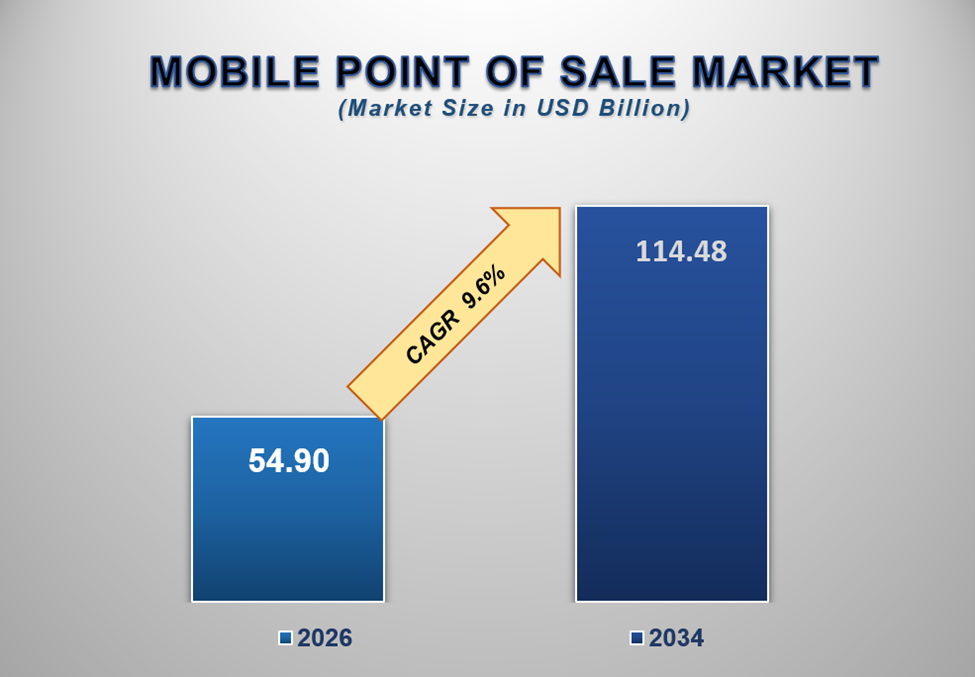
Market was valued at USD 54.90 billion in 2026 and is projected to
reach USD 114.48 billion by 2034, expanding at a CAGR of 9.6% during
the forecast period. The market is experiencing significant growth due to
the rapid adoption of digital payment technologies, increasing smartphone
penetration, rising demand for contactless transactions, expanding e-commerce
ecosystems, and growing digital transformation initiatives across the retail
and service industries.
Mobile Point of Sale systems have
fundamentally transformed how businesses process transactions, manage customer
interactions, and operate retail environments. Unlike traditional stationary
point-of-sale terminals, mobile POS solutions utilize smartphones, tablets, and
portable devices to facilitate payment processing, inventory management,
customer engagement, and business analytics from virtually any location.
The growing demand for flexible and
customer-centric payment experiences has accelerated the adoption of mobile POS
technologies worldwide. Businesses increasingly recognize the importance of
offering seamless, fast, and secure payment options that align with evolving
consumer expectations. Mobile POS systems enable merchants to complete
transactions anywhere within stores, at customer locations, during events, or
across remote sales environments.
The widespread adoption of smartphones and
mobile internet connectivity has created a favorable environment for market
expansion. Modern mobile devices possess advanced computing capabilities,
secure payment processing functionalities, and wireless connectivity features
that support sophisticated point-of-sale operations. This technological
foundation has enabled businesses of all sizes to implement cost-effective
payment solutions without investing in extensive infrastructure.
Small and medium-sized enterprises have
emerged as major adopters of mobile POS solutions. Traditional POS systems
often require significant upfront investments, specialized hardware, and
ongoing maintenance costs. Mobile POS platforms provide a more affordable
alternative, enabling smaller businesses to access advanced transaction
management capabilities while minimizing operational expenses.
The rise of contactless payments has
further accelerated market growth. Consumers increasingly prefer payment
methods that offer convenience, speed, and reduced physical contact. Mobile POS
systems support a wide range of payment options, including contactless cards,
mobile wallets, QR code payments, near-field communication (NFC) transactions,
and digital payment applications.
Retail businesses continue leading market
adoption, but mobile POS technologies are expanding rapidly across hospitality,
healthcare, transportation, field services, entertainment, and event management
sectors. These industries benefit from the mobility, flexibility, and customer
engagement capabilities offered by portable payment solutions.
Cloud computing technologies are also
playing a critical role in market development. Cloud-based mobile POS systems
provide real-time access to transaction data, inventory information, customer
insights, and business analytics. This functionality enables businesses to
improve operational efficiency, enhance decision-making, and deliver
personalized customer experiences.
Additionally, growing integration between
mobile POS platforms and business management software is creating new
opportunities. Modern solutions increasingly incorporate customer relationship
management, inventory tracking, loyalty programs, workforce management, and
analytics capabilities into unified platforms.
As digital payments continue gaining prominence and businesses prioritize operational flexibility, mobile POS solutions are expected to become increasingly important components of modern commerce ecosystems throughout the forecast period.
Mobile Point of Sale (POS) Market Drivers and Opportunities
Growing Adoption of Digital Payments Is
Driving Market Expansion
The increasing shift toward digital payment
methods is one of the most important factors supporting growth in the mobile
POS market.
Consumers worldwide are increasingly
adopting electronic payment methods due to their convenience, speed, security,
and accessibility. Mobile wallets, contactless cards, QR code payments, and
digital banking applications have become integral components of modern payment
ecosystems.
Businesses must accommodate these evolving
payment preferences to remain competitive and deliver positive customer
experiences. Mobile POS systems enable merchants to accept multiple payment
methods through a single platform, improving transaction efficiency and
customer satisfaction.
The growing popularity of cashless
transactions is particularly evident among younger consumers who prioritize
convenience and digital-first experiences. This demographic trend is
encouraging businesses to modernize payment infrastructures and adopt flexible
transaction solutions.
Furthermore, government initiatives
promoting financial inclusion and digital payment adoption are creating
favorable market conditions across both developed and emerging economies.
As digital payment ecosystems continue expanding globally, demand for mobile POS solutions is expected to increase significantly.
Rising Demand for Business Mobility and
Operational Flexibility Is Accelerating Market Growth
Modern businesses increasingly seek
technology solutions that support operational agility and workforce mobility.
Traditional checkout systems often restrict
employee interactions and create bottlenecks during peak business periods.
Mobile POS systems eliminate these limitations by allowing transactions to
occur throughout stores, restaurants, venues, and service environments.
Retail associates equipped with mobile POS
devices can assist customers more effectively, reduce checkout wait times, and
improve overall shopping experiences. Similarly, hospitality and service
businesses benefit from the ability to process transactions directly at
customer locations.
The flexibility offered by mobile POS
platforms is particularly valuable for businesses operating temporary
locations, pop-up stores, outdoor events, and mobile service environments.
These organizations require payment solutions that can be deployed quickly
without extensive infrastructure investments.
Additionally, businesses increasingly
recognize the productivity benefits associated with integrated mobile platforms
that combine payment processing, inventory management, customer engagement, and
reporting functions.
As operational efficiency and customer convenience become strategic priorities, mobile POS adoption is expected to continue growing.
Cloud-Based Solutions and Advanced
Analytics Present Significant Opportunities
Technological innovation is creating
substantial opportunities within the mobile POS market.
Cloud-based deployment models have become
increasingly popular because they provide scalability, remote accessibility,
automatic software updates, and reduced infrastructure requirements. Businesses
can access real-time operational data from multiple locations while maintaining
centralized control over transactions and business processes.
Advanced analytics capabilities are
emerging as a major differentiator among mobile POS solutions. Modern platforms
generate valuable insights regarding customer behavior, purchasing patterns,
inventory performance, employee productivity, and revenue trends. These
insights support more informed business decision-making and strategic planning.
Artificial intelligence and machine
learning technologies are also expanding market opportunities. Intelligent POS
systems can facilitate personalized promotions, demand forecasting, customer
segmentation, and predictive inventory management.
Integration with loyalty programs, customer
relationship management systems, and e-commerce platforms is further enhancing
the value proposition of mobile POS solutions. Businesses increasingly seek
unified commerce environments that connect online and offline customer
experiences.
Additionally, the expansion of financial
technology ecosystems is creating opportunities for embedded finance services,
including lending, installment payments, digital banking integrations, and
merchant financing solutions.
As businesses increasingly prioritize
data-driven operations and customer-centric commerce strategies, advanced
mobile POS platforms are expected to experience strong demand.
Mobile Point of Sale (POS) Market Scope
|
Report Attributes |
Description |
|
Market Size
in 2026 |
USD 54.90 Billion |
|
Market
Forecast in 2034 |
USD 114.48 Billion |
|
CAGR %
2026-2034 |
9.6% |
|
Base Year |
2025 |
|
Historic
Data |
2021-2025 |
|
Forecast
Period |
2026-2034 |
|
Report USP |
Production, Consumption,
Company Share, Company Heatmap, Company Production, Service Type, Growth
Factors and more |
|
Segments
Covered |
∙ By Component |
|
Regional
Scope |
● North America |
|
Country
Scope |
U.S. |
Mobile Point of Sale (POS) Market Report Segmentation Analysis
The global mobile point of sale market industry analysis is segmented into component, deployment mode, enterprise size, application, end user, and region.
The Hardware Segment Is Expected to
Dominate the Market During the Forecast Period
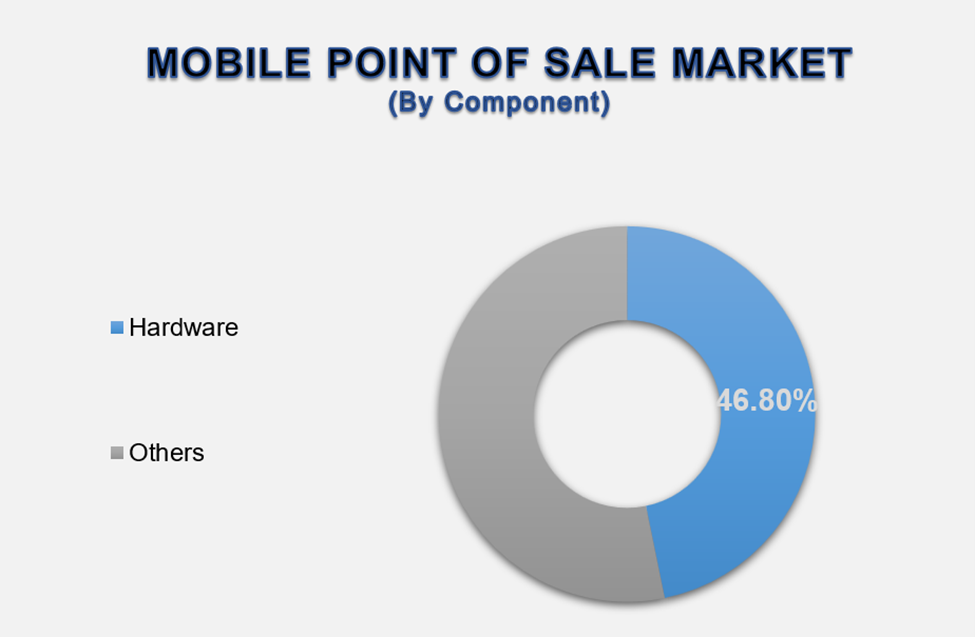
The hardware segment accounted for
approximately 46.8% of the global market, making it the largest
component category.
Mobile POS hardware includes card readers,
tablets, smartphones, barcode scanners, receipt printers, payment terminals,
and peripheral devices essential for transaction processing. The widespread
deployment of these devices across retail and service industries contributes
significantly to segment dominance.
Businesses continue investing in upgraded
hardware capable of supporting contactless payments, enhanced security
protocols, and improved transaction speeds. Hardware innovation remains crucial
for ensuring reliable and seamless customer experiences.
The growing adoption of portable payment
devices among small businesses and large enterprises alike continues to support
segment growth.
As digital payment acceptance expands globally, hardware demand is expected to remain strong throughout the forecast period.
Cloud-Based Segment Is Expected to Lead
the Market by Deployment Mode
Cloud-based mobile POS solutions represent
the largest deployment model within the market.
Organizations increasingly prefer cloud
deployments because they offer flexibility, scalability, lower upfront costs,
and simplified maintenance. Cloud platforms enable businesses to access
real-time operational data from multiple locations while reducing IT
infrastructure requirements.
Automatic software updates, remote
management capabilities, and integration flexibility further contribute to
widespread adoption. Small and medium-sized businesses particularly benefit
from the affordability and accessibility of cloud-based systems.
Additionally, cloud solutions support
centralized reporting, inventory management, and customer analytics across
distributed business networks.
As digital transformation initiatives continue accelerating, cloud-based deployments are expected to maintain their dominant position.
Retail Segment Is Expected to Dominate
the Market by Application
Retail represents the largest application
segment within the mobile POS market.
Retailers increasingly utilize mobile POS
systems to improve customer service, reduce checkout queues, enhance inventory
visibility, and facilitate omnichannel commerce experiences. Mobile checkout
capabilities enable associates to engage customers directly on sales floors,
improving transaction efficiency and customer satisfaction.
The rapid growth of organized retail,
specialty stores, supermarkets, and direct-to-consumer business models
continues driving demand for mobile payment technologies.
Furthermore, integration with loyalty
programs, personalized promotions, and customer engagement tools enhances the
value proposition of mobile POS solutions within retail environments.
As retailers continue modernizing operations, the segment is expected to maintain its leadership position.
The Small & Medium Enterprises
Segment Is Expected to Lead the Market by Enterprise Size
Small and medium enterprises account for
the largest share of mobile POS adoption globally.
Mobile POS systems provide SMEs with
affordable access to sophisticated payment processing and business management
capabilities without requiring substantial infrastructure investments. These
solutions enable smaller businesses to compete more effectively while improving
operational efficiency.
The growing availability of subscription-based
software models, portable hardware, and cloud-based platforms has made mobile
POS technology increasingly accessible to SMEs across various industries.
Additionally, the rise of entrepreneurial
ventures, independent retailers, food service operators, and mobile businesses
continues to support strong demand within this segment.
As SMEs increasingly embrace digital transformation, their contribution to market growth is expected to remain significant.
The following segments are part of an in-depth analysis of the global Mobile Point of Sale (POS) market:
|
Market Segments |
|
|
By
Component |
· Hardware |
|
By Deployment Mode |
∙ Cloud-Based |
|
By Enterprise Size |
∙ Large Enterprises |
|
By Application |
∙ Retail |
|
By End User |
∙ Merchants |
Mobile Point of Sale (POS) Market Share Analysis By Region
North America is projected to dominate the
global mobile POS market, accounting for approximately 36.4% of total market
revenue in 2026.
The region benefits from high digital
payment adoption, advanced retail infrastructure, widespread smartphone
penetration, and strong investments in financial technology innovation. The
United States remains the primary contributor due to its mature payment
ecosystem and extensive merchant adoption of mobile commerce technologies.
Asia-Pacific is expected to witness the fastest
growth during the forecast period, driven by expanding digital payment
ecosystems, increasing smartphone usage, rapid urbanization, and growing
adoption of cashless transactions in countries such as China, India, Japan, and
Southeast Asian nations.
Europe continues experiencing strong growth
due to increasing contactless payment adoption, supportive regulatory
frameworks, and ongoing retail digitalization initiatives.
Latin America and the Middle East & Africa are emerging as attractive markets as financial inclusion efforts and digital payment infrastructure investments continue expanding.
Mobile Point of Sale (POS) Market Competition Landscape Analysis
The global mobile POS market is highly
competitive and characterized by continuous innovation, strategic partnerships,
and expanding service ecosystems.
Market participants are focusing on
enhancing payment security, improving user interfaces, integrating advanced
analytics capabilities, and supporting a wider range of payment methods.
Companies are increasingly developing comprehensive commerce platforms that
combine transaction processing with customer engagement, inventory management,
and business intelligence functions.
Strategic collaborations between payment
processors, financial institutions, software developers, and hardware
manufacturers are becoming increasingly important for market expansion. Vendors
are also investing in artificial intelligence, cloud computing, and omnichannel
commerce capabilities to strengthen competitive positioning.
As digital commerce continues evolving, competition is expected to intensify among both established payment technology providers and emerging fintech companies.
Global Mobile Point of Sale (POS) Market
Recent Developments News:
∙ In April 2026, payment technology
providers introduced next-generation mobile POS platforms featuring AI-powered
business analytics capabilities.
∙ In February 2026, several fintech
companies expanded contactless payment acceptance solutions for small and
medium-sized merchants.
∙ In November 2025, cloud-based POS vendors
launched enhanced omnichannel commerce integration features.
∙ In August 2025, retail technology
providers introduced mobile POS systems supporting advanced customer engagement
and loyalty management tools.
∙ In June 2025, payment solution companies expanded embedded finance capabilities within mobile POS ecosystems.
The Global Mobile Point of Sale (POS)
Market is Dominated by a Few Large Companies, Such As
∙ Block, Inc. (Square)
∙ PayPal Holdings, Inc.
∙ Shopify Inc.
∙ Ingenico Group
∙ Verifone, Inc.
∙ NCR Voyix Corporation
∙ Oracle Corporation
∙ Toast, Inc.
∙ Clover Network, LLC
∙ SumUp Limited
∙ Lightspeed Commerce Inc.
∙ PAX Technology Limited
∙ Diebold Nixdorf, Incorporated
∙ Fujitsu Limited
∙ Hewlett Packard Enterprise Development LP
∙ Others
Frequently Asked Questions
Ekta Chaurasia (Team Lead)
Ekta Chaurasia is a highly experienced Team Lead at M2Square Consultancy with over 7 years of expertise in market research, strategic consulting, competitive benchmarking, and business intelligence solutions. She specializes in ICT, semiconductors & electronics, automotive & transportation, and industrial machinery markets.
She leads end-to-end global research projects focused on market trends, industry analysis, growth forecasting, customer insights, and strategic decision-making. Known for her analytical leadership and industry expertise, Ekta helps businesses uncover growth opportunities, evaluate competitive landscapes, and stay ahead in rapidly evolving markets through accurate and insight-driven research.
1.
Global Mobile Point of
Sale (POS) Market Introduction and Market Overview
1.1. Objectives of the Study
1.2. Global Mobile Point of Sale (POS) Market Scope and Market Estimation
1.2.1.
Global Mobile Point of Sale
(POS) Market Overall Market Size (US$ Billion), Market CAGR (%), Market
Forecast (2026 - 2034)
1.2.2.
Global Mobile Point of Sale
(POS) Market Revenue Share (%) and Growth Rate (Y-o-Y) from 2021 - 2034
1.3. Market Segmentation
1.3.1.
Component of Global Mobile
Point of Sale (POS) Market
1.3.2.
Deployment Mode of Global
Mobile Point of Sale (POS) Market
1.3.3.
Enterprise Size of Global
Mobile Point of Sale (POS) Market
1.3.4.
Application of Global Mobile
Point of Sale (POS) Market
1.3.5.
End User of Global Mobile Point
of Sale (POS) Market
1.3.6.
Region of Global Mobile Point
of Sale (POS) Market
2.
Executive Summary
2.1. Demand Side Trends
2.2. Key Market Trends
2.3. Market Demand (US$ Billion) Analysis 2021 – 2025 and Forecast, 2026
– 2034
2.4. Demand and Opportunity Assessment
2.5. Key Developments
2.6. Overview of Mobile POS Ecosystem and Digital Payment Framework
2.7. Market Entry Strategies
2.8. Market Dynamics
2.8.1.
Drivers
2.8.2.
Limitations
2.8.3.
Opportunities
2.8.4.
Impact Analysis of Drivers and
Restraints
2.9. Porter’s Five Forces Analysis
2.10.
PEST Analysis
3.
Global Mobile Point of
Sale (POS) Market Estimates & Historical Trend Analysis (2021 - 2025)
4.
Global Mobile Point of
Sale (POS) Market Estimates & Forecast Trend Analysis, by Component
4.1. Global Mobile Point of Sale (POS) Market Revenue (US$ Billion)
Estimates and Forecasts, by Component, 2021 - 2034
4.1.1.
Hardware
4.1.2.
Software
4.1.3.
Services
5.
Global Mobile Point of
Sale (POS) Market Estimates & Forecast Trend Analysis, by Deployment Mode
5.1. Global Mobile Point of Sale (POS) Market Revenue (US$ Billion)
Estimates and Forecasts, by Deployment Mode, 2021 - 2034
5.1.1.
Cloud-Based
5.1.2.
On-Premise
6.
Global Mobile Point of
Sale (POS) Market Estimates & Forecast Trend Analysis, by Enterprise Size
6.1. Global Mobile Point of Sale (POS) Market Revenue (US$ Billion)
Estimates and Forecasts, by Enterprise Size, 2021 - 2034
6.1.1.
Large Enterprises
6.1.2.
Small & Medium Enterprises
7.
Global Mobile Point of
Sale (POS) Market Estimates & Forecast Trend Analysis, by Application
7.1. Global Mobile Point of Sale (POS) Market Revenue (US$ Billion)
Estimates and Forecasts, by Application, 2021 - 2034
7.1.1.
Retail
7.1.2.
Hospitality
7.1.3.
Healthcare
7.1.4.
Transportation & Logistics
7.1.5.
Entertainment
7.1.6.
Restaurants
7.1.7.
Others
8.
Global Mobile Point of
Sale (POS) Market Estimates & Forecast Trend Analysis, by End User
8.1. Global Mobile Point of Sale (POS) Market Revenue (US$ Billion)
Estimates and Forecasts, by End User, 2021 - 2034
8.1.1.
Merchants
8.1.2.
Retail Chains
8.1.3.
Service Providers
8.1.4.
E-commerce Businesses
8.1.5.
Others
9.
Global Mobile Point of
Sale (POS) Market Estimates & Forecast Trend Analysis, by Region
9.1. Global Mobile Point of Sale (POS) Market Revenue (US$ Billion)
Estimates and Forecasts, by Region, 2021 - 2034
9.1.1.
North America
9.1.2.
Europe
9.1.3.
Asia Pacific
9.1.4.
Middle East & Africa
9.1.5.
Latin America
10. North America Mobile Point of Sale (POS) Market: Estimates &
Forecast Trend Analysis
10.1.
North America Mobile Point of
Sale (POS) Market Assessments & Key Findings
10.1.1.
North America Mobile Point of
Sale (POS) Market Introduction
10.1.2.
North America Mobile Point of
Sale (POS) Market Size Estimates and Forecast (2021 - 2034)
10.1.2.1.
By Component
10.1.2.2.
By Deployment Mode
10.1.2.3.
By Enterprise Size
10.1.2.4.
By Application
10.1.2.5.
By End User
10.1.2.6.
By Country
10.1.2.6.1.
U.S.
10.1.2.6.2.
Canada
11. Europe Mobile Point of Sale (POS) Market: Estimates & Forecast
Trend Analysis
11.1.
Europe Mobile Point of Sale
(POS) Market Assessments & Key Findings
11.1.1.
Europe Mobile Point of Sale
(POS) Market Introduction
11.1.2.
Europe Mobile Point of Sale
(POS) Market Size Estimates and Forecast (2021 - 2034)
11.1.2.1.
By Component
11.1.2.2.
By Deployment Mode
11.1.2.3.
By Enterprise Size
11.1.2.4.
By Application
11.1.2.5.
By End User
11.1.2.6.
By Country
11.1.2.6.1.
Germany
11.1.2.6.2.
Italy
11.1.2.6.3.
U.K.
11.1.2.6.4.
France
11.1.2.6.5.
Spain
11.1.2.6.6.
Switzerland
11.1.2.6.7.
Rest of Europe
12. Asia Pacific Mobile Point of Sale (POS) Market: Estimates &
Forecast Trend Analysis
12.1.
Asia Pacific Market Assessments
& Key Findings
12.1.1.
Asia Pacific Mobile Point of
Sale (POS) Market Introduction
12.1.2.
Asia Pacific Mobile Point of
Sale (POS) Market Size Estimates and Forecast (2021 - 2034)
12.1.2.1.
By Component
12.1.2.2.
By Deployment Mode
12.1.2.3.
By Enterprise Size
12.1.2.4.
By Application
12.1.2.5.
By End User
12.1.2.6.
By Country
12.1.2.6.1.
China
12.1.2.6.2.
Japan
12.1.2.6.3.
India
12.1.2.6.4.
Australia
12.1.2.6.5.
South Korea
12.1.2.6.6.
Rest of Asia Pacific
13. Middle East & Africa Mobile Point of Sale (POS) Market:
Estimates & Forecast Trend Analysis
13.1.
Middle East & Africa Market
Assessments & Key Findings
13.1.1.
Middle East & Africa Mobile
Point of Sale (POS) Market Introduction
13.1.2.
Middle East & Africa Mobile
Point of Sale (POS) Market Size Estimates and Forecast (2021 - 2034)
13.1.2.1.
By Component
13.1.2.2.
By Deployment Mode
13.1.2.3.
By Enterprise Size
13.1.2.4.
By Application
13.1.2.5.
By End User
13.1.2.6.
By Country
13.1.2.6.1.
UAE
13.1.2.6.2.
Saudi Arabia
13.1.2.6.3.
South Africa
13.1.2.6.4.
Rest of MEA
14. Latin America Mobile Point of Sale (POS) Market: Estimates &
Forecast Trend Analysis
14.1.
Latin America Market
Assessments & Key Findings
14.1.1.
Latin America Mobile Point of
Sale (POS) Market Introduction
14.1.2.
Latin America Mobile Point of
Sale (POS) Market Size Estimates and Forecast (2021 - 2034)
14.1.2.1.
By Component
14.1.2.2.
By Deployment Mode
14.1.2.3.
By Enterprise Size
14.1.2.4.
By Application
14.1.2.5.
By End User
14.1.2.6.
By Country
14.1.2.6.1.
Brazil
14.1.2.6.2.
Mexico
14.1.2.6.3.
Argentina
14.1.2.6.4.
Rest of LATAM
15. Competition Landscape
15.1.
Global Mobile Point of Sale
(POS) Market Product Mapping
15.2.
Global Mobile Point of Sale
(POS) Market Concentration Analysis
15.3.
Global Mobile Point of Sale
(POS) Market Tier Structure Analysis
15.4.
Global Mobile Point of Sale
(POS) Market Share Analysis (2025)
16. Company Profiles
16.1.
Block, Inc. (Square)
16.1.1.
Company Overview & Key
Stats
16.1.2.
Financial Performance &
KPIs
16.1.3.
Product Portfolio
16.1.4.
SWOT Analysis
16.1.5.
Business Strategy & Recent
Developments
16.2.
PayPal Holdings, Inc.
16.3.
Shopify Inc.
16.4.
Ingenico Group
16.5.
Verifone, Inc.
16.6.
NCR Voyix Corporation
16.7.
Oracle Corporation
16.8.
Toast, Inc.
16.9.
Clover Network, LLC
16.10.
SumUp Limited
16.11.
Lightspeed Commerce Inc.
16.12.
PAX Technology Limited
16.13.
Diebold Nixdorf, Incorporated
16.14.
Fujitsu Limited
16.15.
Hewlett Packard Enterprise
Development LP
16.16.
Others
17. Research Findings & Conclusion
18. Assumption & Acronyms Used
19. Research Methodology
19.1.
External Databases
19.2.
Internal Proprietary Database
19.3.
Primary Research
19.4.
Secondary Research
19.5.
Assumptions
19.6.
Limitations
19.7.
Report FAQs
Our Research Methodology
"Insight without rigor is just noise."
We follow a comprehensive, multi-phase research framework designed to deliver accurate, strategic, and decision-ready intelligence. Our process integrates primary and secondary research , both quantitative and qualitative , along with dual modeling techniques ( top-down and bottom-up) and a final layer of validation through our proprietary in-house repository.
PRIMARY RESEARCH
Primary research captures real-time, firsthand insights from the market to understand behaviors, motivations, and emerging trends.
1. Quantitative Primary Research
Objective: Generate statistically significant data directly from market participants.
Approaches:- Structured surveys with customers, distributors, and field agents
- Mobile-based data collection for point-of-sale audits and usage behavior
- Phone-based interviews (CATI) for market sizing and product feedback
- Online polling around industry events and digital campaigns
- Purchase frequency by customer type
- Channel performance across geographies
- Feature demand by application or demographic
2. Qualitative Primary Research
Objective: Explore decision-making drivers, pain points, and market readiness.
Approaches:- In-depth interviews (IDIs) with executives, product managers, and key decision-makers
- Focus groups among end users and early adopters
- Site visits and observational research for consumer products
- Informal field-level discussions for regional and cultural nuances
SECONDARY RESEARCH
This phase helps establish a macro-to-micro understanding of market trends, size, regulation, and competitive dynamics, sourced from credible and public domain information.
1. Quantitative Secondary Research
Objective: Model market value and segment-level forecasts based on published data.
Sources include:- Financial reports and investor summaries
- Government trade data, customs records, and regulatory statistics
- Industry association publications and economic databases
- Channel performance and pricing data from marketplace listings
- Revenue splits, pricing trends, and CAGR estimates
- Supply-side capacity and volume tracking
- Investment analysis and funding benchmarks
2. Qualitative Secondary Research
Objective: Capture strategic direction, innovation signals, and behavioral trends.
Sources include:- Company announcements, roadmaps, and product pipelines
- Publicly available whitepapers, conference abstracts, and academic research
- Regulatory body publications and policy briefs
- Social and media sentiment scanning for early-stage shifts
- Strategic shifts in market positioning
- Unmet needs and white spaces
- Regulatory triggers and compliance impact
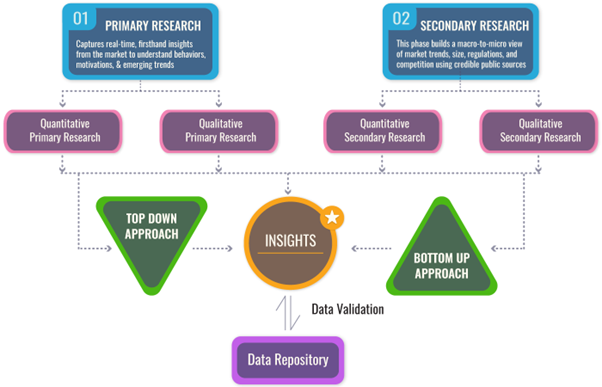
DUAL MODELING: TOP-DOWN + BOTTOM-UP
To ensure robust market estimation, we apply two complementary sizing approaches:
Top-Down Modeling:- Start with broader industry value (e.g., global or regional TAM)
- Apply filters by segment, geography, end-user, or use case
- Adjust with primary insights and validation benchmarks
- Ideal for investor-grade market scans and opportunity mapping
- Aggregate from the ground up using sales volumes, pricing, and unit economics
- Use internal modeling templates aligned with stakeholder data
- Incorporate distributor-level or region-specific inputs
- Most accurate for emerging segments and granular sub-markets
DATA VALIDATION: IN-HOUSE REPOSITORY
We close the loop with proprietary data intelligence built from ongoing projects, industry monitoring, and historical benchmarking. This repository includes:
- Multi-sector market and pricing models
- Key trendlines from past interviews and forecasts
- Benchmarked adoption rates, churn patterns, and ROI indicators
- Industry-specific deviation flags and cross-check logic
- Catches inconsistencies early
- Aligns projections across studies
- Enables consistent, high-trust deliverables