Mobile Water Treatment Market Size and Forecast (2026–2034), Global and Regional Growth, Trend, Share and Industry Analysis Report Coverage; By Type (Resin Mobile Water Treatment, Membrane Mobile Water Treatment, Filtration Mobile Water Treatment, Others); By Application (Clarification, Chemical Softening, Filtration, Reverse Osmosis, Demineralization, Ion Exchange, Others); By End User (Municipal, Construction, Chemical, Agriculture, Others); and Geography
2026-09-28
Consumer Products
Aishwarya Panbude (Research Analyst)
Description
Mobile Water Treatment Market Overview
The global Mobile Water Treatment Market
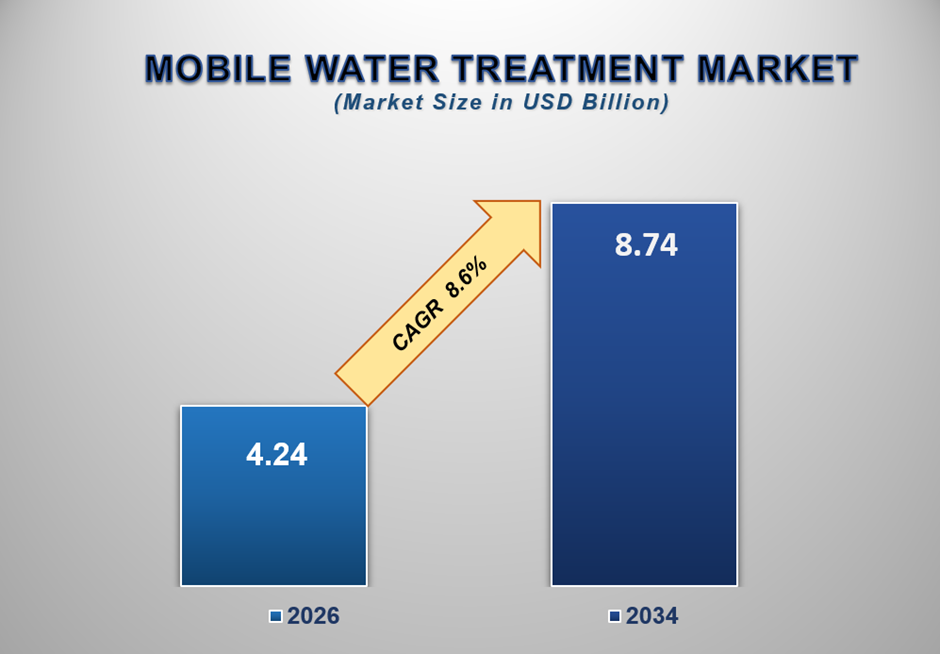
was valued at USD 4.24 billion in 2026 and is projected to reach USD
8.74 billion by 2034, expanding at a CAGR of 8.6% during the
forecast period. The market is being shaped by increasing water stress, aging
and capacity-constrained treatment infrastructure, tighter water-quality
requirements, industrial demand for uninterrupted process-water supplies,
emergency response requirements, and the growing preference for modular
treatment capacity that can be deployed without constructing a permanent plant.
Mobile water treatment refers to treatment
equipment designed to be transported and rapidly connected at the location
where water purification, wastewater treatment, water reuse, or process-water
production is required. Unlike conventional fixed treatment plants, these
systems can be mounted on trailers, skids, containers, or other transportable
platforms.
The commercial value of mobile treatment is
increasingly linked to time and operational continuity, rather than
simply portability. Industrial operators can use temporary treatment capacity
when an existing treatment train is shut down for maintenance, when feed-water
characteristics suddenly change, or when production expands faster than
permanent water infrastructure.
Rental and service models are consequently
becoming an important part of the market. Veolia, for example, offers mobile
systems on trailers, skids, and containers with modular configurations and flow
rates ranging from 5 to 1,000 cubic meters per hour. Its emergency-water
portfolio covers applications ranging from equipment failures and droughts to
PFAS contamination and changes in raw-water quality.
Mobile systems can combine several
treatment stages rather than functioning as a single piece of equipment.
Depending on the feed-water characteristics, configurations can incorporate
clarification, media filtration, activated carbon, ultrafiltration, reverse
osmosis, nanofiltration, ion exchange, demineralization, disinfection, or other
processes.
This flexibility is particularly relevant
to industries where water quality varies over time. Chemical plants, power
facilities, manufacturing sites, mining operations, and other process
industries may require different treatment configurations depending on whether
the objective is producing boiler-feed water, treating wastewater, removing
dissolved contaminants, or recovering water for reuse.
Municipal water operators represent another
important demand center. Mobile units can provide temporary treatment capacity
during plant rehabilitation, equipment failure, unexpected contamination,
seasonal demand peaks, or emergencies. They can also act as a bridge while a
permanent treatment facility is being constructed or expanded.
The emergency-response application is
becoming more sophisticated. The U.S. Environmental Protection Agency's Water-on-Wheels
(WOW) Cart, updated in June 2026, demonstrates the movement toward compact
modular emergency treatment systems. The system combines pre-filtration,
adsorption media, chlorine generation, UV-C treatment, alternative power
sources, and remote telemetry in a transportable unit intended to provide safe
water following emergencies.
Water scarcity is simultaneously expanding
the market beyond conventional emergency applications. Mobile treatment can
allow organizations to process alternative water sources such as brackish
water, seawater, groundwater, surface water, industrial wastewater, and other
sources that may not be suitable for direct use.
The market is also becoming increasingly
connected to water reuse and resource efficiency. Rather than treating
mobile systems solely as temporary substitutes for permanent infrastructure,
operators are using modular treatment capacity to test reuse schemes, manage
seasonal requirements, and supplement existing plants.
Digitalization is strengthening this
transition. Modern mobile systems can incorporate sensors, automated controls,
remote monitoring, and predictive analytics that allow operators to monitor
parameters such as flow, pressure, turbidity, conductivity, pH, and membrane
performance without maintaining a large permanent operating team.
Veolia's emergency mobile fleet, for
instance, incorporates remote monitoring and predictive asset-performance
capabilities through its digital platform while offering mobile deionization,
membrane, filtration, carbon, and other treatment technologies.
The technology is also becoming more
relevant to contaminants that have gained regulatory attention. PFAS treatment
is increasingly included within mobile-treatment portfolios because temporary
treatment can be deployed while contaminated sites or permanent treatment
infrastructure are being addressed. Veolia specifically lists PFAS
contamination among the emergencies supported by its mobile treatment services.
The expansion of semiconductor
manufacturing, data centers, pharmaceuticals, specialty chemicals, and other
water-intensive industries is creating another avenue for growth. These
facilities place stringent requirements on water quality and operational reliability,
increasing the value of treatment systems that can be deployed rapidly during
maintenance or capacity constraints.
Recent industry activity also demonstrates
that water-treatment investment is becoming more closely connected with
industrial expansion and water-security planning. In February 2026, Veolia
secured 15-year operation and maintenance contracts for two major Mumbai
water-treatment plants with a combined capacity of 2,910 million liters per
day, illustrating the scale of investment being directed toward water-security
infrastructure in major emerging markets.
As water utilities and industrial companies
increasingly balance resilience, capital expenditure, regulatory compliance,
and operational continuity, mobile treatment is evolving from an emergency-only
solution into a strategic component of flexible water infrastructure.
Mobile Water Treatment Market Drivers and Opportunities
Increasing Water Stress and
Infrastructure Constraints Are Driving Demand for Mobile Treatment Capacity
Water scarcity is becoming a structural
challenge for municipalities and industries rather than an issue limited to
individual drought events.
Population growth, industrialization,
climate variability, groundwater depletion, and uneven infrastructure
investment are increasing pressure on existing water-treatment capacity.
The problem is particularly acute when
treatment plants require maintenance or expansion. Building a new permanent
facility can involve lengthy engineering, permitting, construction,
commissioning, and capital-investment cycles, while water demand may need to be
addressed immediately.
Mobile systems provide a practical bridge
between immediate treatment requirements and long-term infrastructure
development. They can be transported to a site, connected to existing
utilities, and configured according to the required treatment objective.
This makes mobile treatment particularly
attractive for municipalities facing temporary capacity shortages and
industries where a treatment interruption can translate directly into
production losses.
The increasing emphasis on resilient and
decentralized water infrastructure is therefore strengthening the strategic
importance of mobile treatment.
Industrial Demand for Operational
Continuity and Water Reuse Is Accelerating Market Development
Industrial users increasingly view reliable
water treatment as a requirement for maintaining production rather than simply
an environmental compliance activity.
A treatment-plant failure can disrupt
boiler operations, cooling systems, manufacturing processes, wastewater
discharge, or product quality. Mobile treatment systems can reduce the duration
of such interruptions by providing temporary treatment capacity while permanent
equipment is repaired.
Rental models are particularly attractive
because they allow companies to convert part of their treatment expenditure
from capital expenditure into operating expenditure.
Grundfos, for example, positions mobile
treatment rental around planned maintenance, unexpected breakdowns,
contamination incidents, process trials, and temporary production requirements.
Water reuse is also strengthening the
opportunity. Industrial companies are increasingly evaluating wastewater
recovery and alternative water sources to reduce freshwater consumption.
Mobile treatment equipment can be used to pilot treatment configurations before permanent investments are made, making it useful not only as emergency infrastructure but also as a testing and transition platform.
Advanced Membranes, Digital Monitoring,
and Specialized Treatment Create Significant Opportunities
Technology development is expanding the
range of contaminants and water sources that can be treated through mobile
platforms.
Reverse osmosis, ultrafiltration,
nanofiltration, ion exchange, activated carbon, advanced oxidation, and
specialized adsorption technologies can be combined into modular treatment
trains.
The growing importance of PFAS and other
emerging contaminants is particularly significant because treatment
requirements can vary considerably by site. Mobile systems allow operators to
deploy specialized treatment capacity without immediately constructing a
dedicated permanent facility.
Digital monitoring provides another
opportunity. Sensors and cloud-connected controls can provide continuous
information on water quality and equipment performance, allowing operators to
identify membrane fouling, pressure changes, chemical requirements, and other
operational issues earlier.
The Insight Partners identifies increasing
integration of IoT and AI into mobile systems as an emerging trend,
particularly for monitoring parameters such as turbidity, pH, flow and membrane
integrity and supporting predictive maintenance.
The emergency-response segment also offers
opportunities for smaller, highly portable systems. The EPA's WOW Cart
illustrates how mobile treatment can be designed around alternative power,
field transportability, modular treatment stages, and remote telemetry rather
than conventional large-scale trailer systems.
Mobile Water Treatment Market Scope
|
Report Attributes |
Description |
|
Market Size in 2026 |
USD
4.24 Billion |
|
Market Forecast in 2034 |
USD 8.74 Billion |
|
CAGR % 2026-2034 |
8.6% |
|
Base Year |
2025 |
|
Historic Data |
2021-2025 |
|
Forecast Period |
2026-2034 |
|
Report USP |
Production, Consumption,
Company Share, Company Heatmap, Company Production, Service Type, Growth
Factors and more |
|
Segments Covered |
· By Type · By Application · By End User |
|
Regional Scope |
● North America |
|
Country Scope |
U.S. |
Mobile Water Treatment Market Report Segmentation Analysis
The global mobile water treatment market
industry analysis is segmented by type, application, end user, and region.
Membrane Mobile Water Treatment Segment
Is Expected to Dominate the Market During the Forecast Period
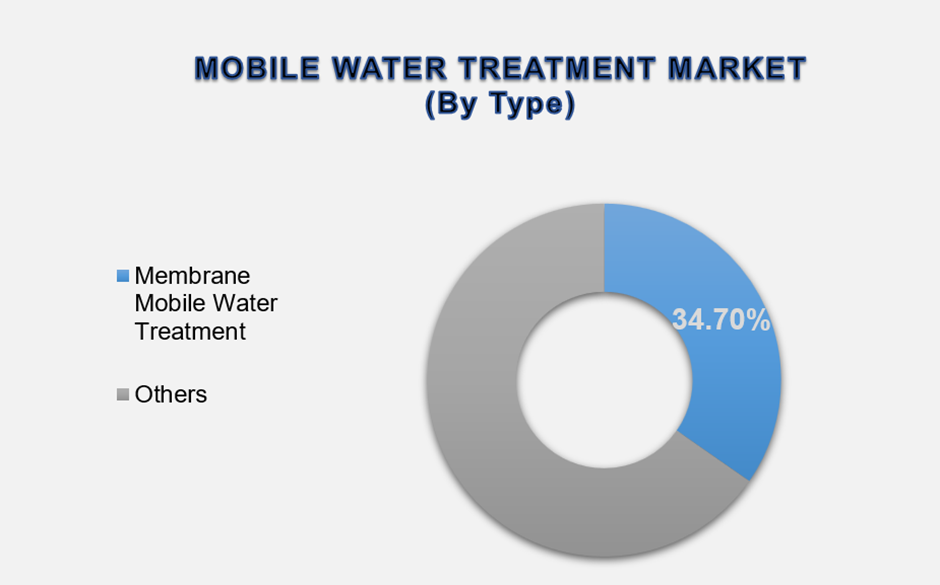
The Membrane Mobile Water Treatment
segment is expected to remain the leading technology category. A recent 2026
market analysis places membrane mobile treatment at approximately 34.7% of
the market in 2025.
Membrane systems are attractive because a
single mobile platform can be configured to address substantially different
water-quality requirements.
Reverse osmosis is particularly relevant
where dissolved salts and other contaminants need to be removed, while
ultrafiltration can provide pretreatment or removal of suspended solids and
larger contaminants.
The modularity of membrane equipment also
makes it suitable for trailer- and container-mounted configurations.
Mobile membrane systems are increasingly
being used for temporary industrial water supplies, wastewater treatment, water
reuse, emergency response, and treatment of difficult source waters.
Veolia's mobile fleet, for example,
includes RO, UF, and nanofiltration membrane trailers alongside
demineralization, filtration, and carbon systems.
The segment is expected to benefit from continuing improvements in membrane efficiency, pretreatment, automation, and fouling management.
Reverse Osmosis Segment Is Expected to
Lead the Market by Application
The Reverse Osmosis segment
represents one of the most important applications within mobile water
treatment.
RO is particularly valuable when mobile
systems need to remove dissolved salts and produce water with substantially
lower total dissolved solids.
Mobile RO systems are deployed across
industrial, municipal, emergency, construction and remote-site applications.
They can be used for brackish-water
treatment, seawater desalination, process-water production, and selected
wastewater-reuse configurations.
The ability to combine RO with pretreatment
and post-treatment stages allows suppliers to customize systems according to
feed-water characteristics rather than offering a one-size-fits-all solution.
Municipal Segment Is Expected to
Dominate the Market by End User
The Municipal segment remains a
major end-user category because public water systems must maintain service even
when fixed infrastructure is unavailable or operating below capacity.
Municipal operators can deploy mobile
treatment systems during plant maintenance, emergency contamination events,
infrastructure failures, and temporary increases in treatment requirements.
The role of mobile systems is also
expanding as municipalities seek greater resilience against extreme weather and
other disruptions.
The EPA's 2026 update of its WOW Cart
demonstrates how portable treatment technology is being incorporated into
emergency preparedness, including pre-positioning equipment near critical
infrastructure such as hospitals before anticipated natural events.
Longer-term municipal infrastructure investments can also create indirect opportunities for mobile treatment suppliers because temporary treatment capacity may be required during construction, rehabilitation and commissioning of permanent facilities.
The following segments are part of an in-depth analysis of the global Mobile Water Treatment Market:
|
Market Segments |
|
|
By
Type |
●
Resin Mobile Water Treatment ●
Membrane Mobile Water Treatment ●
Filtration Mobile Water Treatment ●
Others |
|
By Application |
●
Clarification ●
Chemical Softening ●
Filtration ●
Reverse Osmosis ●
Demineralization ●
Ion Exchange ●
Others |
|
By End User |
●
Municipal ●
Construction ●
Chemical ●
Agriculture ●
Others |
Mobile Water Treatment Market Share Analysis By Region
Asia Pacific
represents a major growth market for mobile water treatment, supported by rapid
industrialization, urban expansion, water-stress conditions, infrastructure
development, and increasing demand for flexible treatment capacity. One current
market assessment identifies Asia Pacific as the leading regional market,
although the precise regional ranking varies by market definition and study
methodology.
China has
significant demand potential because of its large industrial base, extensive
manufacturing activity, wastewater-management requirements, and continuing
investment in water infrastructure.
India
represents another important growth market. Rapid urbanization, industrial
development, water-quality challenges, and large-scale investment in municipal
water infrastructure are increasing the need for both permanent and temporary
treatment capacity.
The expansion of water infrastructure in
Mumbai provides an example of the scale of India's current water-security
investment. In February 2026, Veolia secured long-term contracts for two Mumbai
water-treatment plants with a combined capacity of 2,910 million liters per
day.
Japan, South Korea and Australia represent mature and technologically advanced markets where
industrial water quality, resource efficiency, and treatment reliability
support demand for sophisticated mobile solutions.
North America remains an important market because of its mature industrial base,
aging water infrastructure, stringent environmental requirements, and
established rental model for temporary treatment equipment.
The region also has significant demand for
specialized treatment related to industrial wastewater, PFAS, emergency
response, power generation, semiconductor manufacturing and water reuse.
The availability of large mobile-treatment
fleets and established rental providers strengthens adoption. Veolia, for
example, maintains a broad emergency fleet covering membrane, deionization,
filtration, carbon, and other treatment technologies across North America and
other regions.
Europe is
supported by stringent wastewater requirements, resource-efficiency objectives,
industrial water reuse and investment in resilient infrastructure.
Germany, the U.K., France, Italy, Spain,
and Switzerland represent important markets, with
demand increasingly linked to water reuse, industrial treatment, environmental
compliance and temporary treatment requirements.
Latin America presents substantial long-term potential because industrial,
mining, agricultural, and municipal users often operate across geographically
dispersed locations where permanent treatment infrastructure may not always be
economical.
Brazil, Mexico and Argentina are important markets, with mining, food processing, industrial
production, and municipal water requirements supporting demand.
Middle East & Africa represent structurally important markets because water scarcity,
desalination requirements, and industrial development create strong demand for
treatment technologies that can be deployed in locations with constrained
freshwater availability.
Saudi Arabia and the UAE are particularly relevant because of their investment in
desalination, industrial water infrastructure, and water-security programs.
South Africa also represents an important market due to water-stress concerns and the need to improve treatment resilience.
Mobile Water Treatment Market
Competition Landscape Analysis
The global mobile water treatment market is
increasingly characterized by competition between equipment manufacturers,
environmental-technology companies, water-treatment specialists, and
rental/service providers.
The competitive proposition is shifting
beyond the physical treatment unit. Customers increasingly evaluate suppliers
according to how quickly equipment can be mobilized, whether operators and
technicians are available, the ability to manage different water chemistries,
remote-monitoring capabilities, and the supplier's ability to assume
operational responsibility.
Rental and outsourced treatment models are
therefore becoming strategically important. Veolia offers mobile treatment
through emergency, temporary, and longer-term arrangements, while Grundfos
similarly positions rental systems as an alternative to permanent installations
for breakdowns, maintenance, trials, and temporary production requirements.
Technology portfolios are another
competitive differentiator. Companies offering combinations of RO, UF, NF, ion
exchange, demineralization, carbon filtration, clarification and disinfection
can build treatment trains around the customer's specific water-quality
requirements.
PFAS treatment, water reuse, high-purity
water, and industrial wastewater are creating additional areas for
specialization.
Digitalization is becoming increasingly
important as suppliers seek to differentiate through remote diagnostics,
predictive maintenance, automated control and performance monitoring.
The market is also seeing a stronger
emphasis on rapid deployment and resilience. Wigen Water Technologies,
for example, currently markets self-contained mobile rental trailers for
emergency response, plant maintenance, alternate water processing, and
raw-water quality excursions.
Companies that combine equipment
availability, engineering expertise, logistics, treatment technology and
after-sales service are therefore well positioned to capture higher-value
contracts.
Global Mobile Water Treatment Market
Recent Developments News
●
In August 2026, Wigen Water Technologies continued promoting rapid-start mobile
purification trailers incorporating ultrafiltration, reverse osmosis,
nanofiltration and media filtration for emergency response, plant maintenance,
and temporary processing requirements.
●
In June 2026, the U.S. EPA updated information on its Water-on-Wheels mobile
emergency water-treatment system, highlighting modular treatment, alternative
power supplies, UV-C disinfection, adsorption media, and remote telemetry for
emergency deployment.
●
In May 2026, Veolia introduced its Hydrotech Confidence cloth-filter series and
Ozonia S ozone generator at IFAT 2026, highlighting energy efficiency, modular
architecture, micropollutant removal, and treatment reliability. While these
are broader water-treatment technologies rather than mobile units specifically,
they illustrate the technology development feeding into modular and flexible
treatment solutions.
●
In February 2026, Veolia secured two 15-year O&M contracts for major Mumbai
water-treatment plants with a combined capacity of 2,910 million liters per
day, strengthening its position in India's expanding water-treatment
infrastructure market.
● In January 2026, Veolia and SBM Offshore announced a strategic alliance focused on a floating desalination solution intended to address water scarcity and improve resilience in water-constrained environments.
The Global Mobile Water Treatment Market
is Dominated by a Few Large Companies, Such As
●
Veolia Environnement S.A.
●
Xylem Inc.
●
Aquatech International LLC
●
SUEZ
●
Kurita Water Industries Ltd.
●
Ovivo Inc.
●
WesTech Engineering, LLC
●
Newterra
●
Pall Corporation
●
Evoqua Water Technologies
●
Fluence Corporation
●
Nijhuis Saur Industries
●
Ecolutia Services
●
Grundfos
●
Wigen Water Technologies
● Others
Frequently Asked Questions
Aishwarya Panbude (Research Analyst)
Aishwarya Panbude is a skilled Research Analyst with 4+ years of experience in market intelligence, consumer insights, competitive analysis, and industry forecasting across the consumer goods, agriculture, and food & beverage sectors. She specializes in market sizing, trend analysis, growth opportunity mapping, and strategic secondary research for global and regional markets.
Her expertise lies in transforming complex industry data into actionable business strategies that help organizations identify emerging trends, understand customer behavior, and gain a competitive edge. With a strong focus on data-driven insights, business intelligence, and future market trends, Jaya delivers high-quality research solutions aligned with evolving industry demands and market dynamics.
1.
Global Mobile Water
Treatment Market Introduction and Market Overview
1.1. Objectives of the Study
1.2. Global Mobile Water Treatment Market Scope and Market Estimation
1.2.1.
Global Mobile Water Treatment
Market Size (US$ Million), Market CAGR (%), Market Forecast (2026 - 2034)
1.2.2.
Global Mobile Water Treatment
Market Revenue Share (%) and Growth Rate (Y-o-Y) Analysis (2021 - 2034)
1.3. Market Segmentation
1.3.1.
Type of Global Mobile Water
Treatment Market
1.3.2.
Application of Global Mobile
Water Treatment Market
1.3.3.
End User of Global Mobile Water
Treatment Market
1.3.4.
Region of Global Mobile Water
Treatment Market
1.4. Competition Coverage List of Market Participants
1.5. Market Definition: Mobile Water Treatment Market
2.
Executive Summary
2.1. Demand Side Trends
2.2. Key Market Trends
2.3. Market Demand (US$ Million) Analysis 2021 – 2025 and Forecast, 2026
– 2034
2.4. Demand and Opportunity Assessment
2.5. Key Developments
2.6. Overview of Regulatory Landscape, Compliance Framework, and Industry
Standards
2.7. Market Entry Strategies
2.8. Market Dynamics
2.8.1.
Drivers
2.8.2.
Limitations
2.8.3.
Opportunities
2.8.4.
Impact Analysis of Drivers and
Restraints
2.9. Porter's Five Forces Analysis
2.10.
PEST Analysis
3.
Global Mobile Water
Treatment Market Estimates & Historical Trend Analysis (2021 - 2025)
4.
Global Mobile Water
Treatment Market Estimates & Forecast Trend Analysis, by Type
4.1. Global Mobile Water Treatment Market Revenue (US$ Million) Estimates
and Forecasts, by Type, 2021 - 2034
4.1.1.
Resin Mobile Water Treatment
4.1.2.
Membrane Mobile Water Treatment
4.1.3.
Filtration Mobile Water
Treatment
4.1.4.
Others
5.
Global Mobile Water
Treatment Market Estimates & Forecast Trend Analysis, by Application
5.1. Global Mobile Water Treatment Market Revenue (US$ Million) Estimates
and Forecasts, by Application, 2021 - 2034
5.1.1.
Clarification
5.1.2.
Chemical Softening
5.1.3.
Filtration
5.1.4.
Reverse Osmosis
5.1.5.
Demineralization
5.1.6.
Ion Exchange
5.1.7.
Others
6.
Global Mobile Water
Treatment Market Estimates & Forecast Trend Analysis, by End User
6.1. Global Mobile Water Treatment Market Revenue (US$ Million) Estimates
and Forecasts, by End User, 2021 - 2034
6.1.1.
Municipal
6.1.2.
Construction
6.1.3.
Chemical
6.1.4.
Agriculture
6.1.5.
Others
7.
Global Mobile Water
Treatment Market Estimates & Forecast Trend Analysis, by Region
7.1. Global Mobile Water Treatment Market Revenue (US$ Million) Estimates
and Forecasts, by Region, 2021 - 2034
7.1.1.
North America
7.1.2.
Europe
7.1.3.
Asia Pacific
7.1.4.
Middle East & Africa
7.1.5.
Latin America
8.
North America Mobile
Water Treatment Market: Estimates & Forecast Trend Analysis
8.1. North America Mobile Water Treatment Market Assessments & Key
Findings
8.1.1.
North America Mobile Water
Treatment Market Introduction
8.1.2.
North America Mobile Water
Treatment Market Size Estimates and Forecast (US$ Million) (2021 - 2034)
8.1.2.1.
By Type
8.1.2.2.
By Application
8.1.2.3.
By End User
8.1.2.4.
By Country
8.1.2.4.1.
The U.S.
8.1.2.4.2.
Canada
9.
Europe Mobile Water
Treatment Market: Estimates & Forecast Trend Analysis
9.1. Europe Mobile Water Treatment Market Assessments & Key Findings
9.1.1.
Europe Mobile Water Treatment
Market Introduction
9.1.2.
Europe Mobile Water Treatment
Market Size Estimates and Forecast (US$ Million) (2021 - 2034)
9.1.2.1.
By Type
9.1.2.2.
By Application
9.1.2.3.
By End User
9.1.2.4.
By Country
9.1.2.4.1.
Germany
9.1.2.4.2.
Italy
9.1.2.4.3.
The U.K.
9.1.2.4.4.
France
9.1.2.4.5.
Spain
9.1.2.4.6.
Switzerland
9.1.2.4.7.
Rest of Europe
10. Asia Pacific Mobile Water Treatment Market: Estimates & Forecast
Trend Analysis
10.1.
Asia Pacific Mobile Water
Treatment Market Assessments & Key Findings
10.1.1.
Asia Pacific Mobile Water
Treatment Market Introduction
10.1.2.
Asia Pacific Mobile Water
Treatment Market Size Estimates and Forecast (US$ Million) (2021 - 2034)
10.1.2.1.
By Type
10.1.2.2.
By Application
10.1.2.3.
By End User
10.1.2.4.
By Country
10.1.2.4.1.
China
10.1.2.4.2.
Japan
10.1.2.4.3.
India
10.1.2.4.4.
Australia
10.1.2.4.5.
South Korea
10.1.2.4.6.
Rest of Asia Pacific
11. Middle East & Africa Mobile Water Treatment Market: Estimates
& Forecast Trend Analysis
11.1.
Middle East & Africa Mobile
Water Treatment Market Assessments & Key Findings
11.1.1.
Middle East & Africa Mobile
Water Treatment Market Introduction
11.1.2.
Middle East & Africa Mobile
Water Treatment Market Size Estimates and Forecast (US$ Million) (2021 - 2034)
11.1.2.1.
By Type
11.1.2.2.
By Application
11.1.2.3.
By End User
11.1.2.4.
By Country
11.1.2.4.1.
UAE
11.1.2.4.2.
Saudi Arabia
11.1.2.4.3.
South Africa
11.1.2.4.4.
Rest of Middle East &
Africa
12. Latin America Mobile Water Treatment Market: Estimates &
Forecast Trend Analysis
12.1.
Latin America Mobile Water
Treatment Market Assessments & Key Findings
12.1.1.
Latin America Mobile Water
Treatment Market Introduction
12.1.2.
Latin America Mobile Water
Treatment Market Size Estimates and Forecast (US$ Million) (2021 - 2034)
12.1.2.1.
By Type
12.1.2.2.
By Application
12.1.2.3.
By End User
12.1.2.4.
By Country
12.1.2.4.1.
Brazil
12.1.2.4.2.
Mexico
12.1.2.4.3.
Argentina
12.1.2.4.4.
Rest of Latin America
13. Competition Landscape
13.1.
Global Mobile Water Treatment
Market Product Mapping
13.2.
Global Mobile Water Treatment
Market Concentration Analysis, by Leading Players / Innovators / Emerging
Players / New Entrants
13.3.
Global Mobile Water Treatment
Market Tier Structure Analysis
13.4.
Global Mobile Water Treatment
Market Concentration & Company Market Shares (%) Analysis, 2026
14. Company Profiles
14.1.
Veolia Environnement S.A.
14.1.1.
Company Overview & Key
Stats
14.1.2.
Financial Performance &
KPIs
14.1.3.
Product Portfolio
14.1.4.
SWOT Analysis
14.1.5.
Business Strategy & Recent
Developments
*Similar details would be provided for all
the players mentioned below
14.2.
Xylem Inc.
14.3.
Aquatech International LLC
14.4.
SUEZ
14.5.
Kurita Water Industries Ltd.
14.6.
Ovivo Inc.
14.7.
WesTech Engineering, LLC
14.8.
Newterra
14.9.
Pall Corporation
14.10.
Evoqua Water Technologies
14.11.
Fluence Corporation
14.12.
Nijhuis Saur Industries
14.13.
Ecolutia Services
14.14.
Grundfos
14.15.
Wigen Water Technologies
14.16.
Others
15. Research Findings & Conclusion
16. Assumptions & Acronyms Used
17. Research Methodology
17.1.
External Databases
17.2.
Internal Proprietary Database
17.3.
Primary Research
17.4.
Secondary Research
17.5.
Assumptions
17.6.
Limitations
17.7.
Report FAQs
Our Research Methodology
"Insight without rigor is just noise."
We follow a comprehensive, multi-phase research framework designed to deliver accurate, strategic, and decision-ready intelligence. Our process integrates primary and secondary research , both quantitative and qualitative , along with dual modeling techniques ( top-down and bottom-up) and a final layer of validation through our proprietary in-house repository.
PRIMARY RESEARCH
Primary research captures real-time, firsthand insights from the market to understand behaviors, motivations, and emerging trends.
1. Quantitative Primary Research
Objective: Generate statistically significant data directly from market participants.
Approaches:- Structured surveys with customers, distributors, and field agents
- Mobile-based data collection for point-of-sale audits and usage behavior
- Phone-based interviews (CATI) for market sizing and product feedback
- Online polling around industry events and digital campaigns
- Purchase frequency by customer type
- Channel performance across geographies
- Feature demand by application or demographic
2. Qualitative Primary Research
Objective: Explore decision-making drivers, pain points, and market readiness.
Approaches:- In-depth interviews (IDIs) with executives, product managers, and key decision-makers
- Focus groups among end users and early adopters
- Site visits and observational research for consumer products
- Informal field-level discussions for regional and cultural nuances
SECONDARY RESEARCH
This phase helps establish a macro-to-micro understanding of market trends, size, regulation, and competitive dynamics, sourced from credible and public domain information.
1. Quantitative Secondary Research
Objective: Model market value and segment-level forecasts based on published data.
Sources include:- Financial reports and investor summaries
- Government trade data, customs records, and regulatory statistics
- Industry association publications and economic databases
- Channel performance and pricing data from marketplace listings
- Revenue splits, pricing trends, and CAGR estimates
- Supply-side capacity and volume tracking
- Investment analysis and funding benchmarks
2. Qualitative Secondary Research
Objective: Capture strategic direction, innovation signals, and behavioral trends.
Sources include:- Company announcements, roadmaps, and product pipelines
- Publicly available whitepapers, conference abstracts, and academic research
- Regulatory body publications and policy briefs
- Social and media sentiment scanning for early-stage shifts
- Strategic shifts in market positioning
- Unmet needs and white spaces
- Regulatory triggers and compliance impact
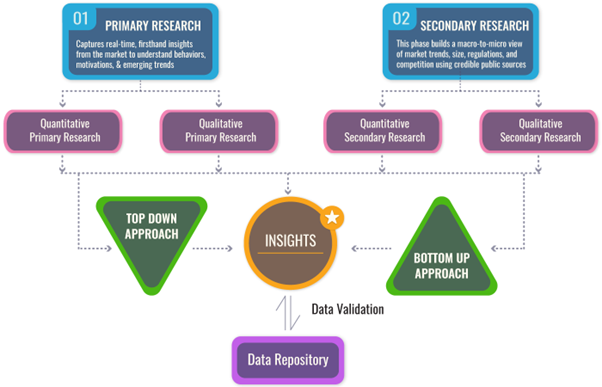
DUAL MODELING: TOP-DOWN + BOTTOM-UP
To ensure robust market estimation, we apply two complementary sizing approaches:
Top-Down Modeling:- Start with broader industry value (e.g., global or regional TAM)
- Apply filters by segment, geography, end-user, or use case
- Adjust with primary insights and validation benchmarks
- Ideal for investor-grade market scans and opportunity mapping
- Aggregate from the ground up using sales volumes, pricing, and unit economics
- Use internal modeling templates aligned with stakeholder data
- Incorporate distributor-level or region-specific inputs
- Most accurate for emerging segments and granular sub-markets
DATA VALIDATION: IN-HOUSE REPOSITORY
We close the loop with proprietary data intelligence built from ongoing projects, industry monitoring, and historical benchmarking. This repository includes:
- Multi-sector market and pricing models
- Key trendlines from past interviews and forecasts
- Benchmarked adoption rates, churn patterns, and ROI indicators
- Industry-specific deviation flags and cross-check logic
- Catches inconsistencies early
- Aligns projections across studies
- Enables consistent, high-trust deliverables