
Molecular Spectroscopy Market Size and Forecast (2026–2034), Global and Regional Growth, Trend, Share, and Industry Analysis Report Coverage; Technology (Infrared (IR), Near-Infrared (NIR), Raman, UV-Visible (UV-Vis), Nuclear Magnetic Resonance (NMR)), Component (Instruments, Software, Services), Application (Pharmaceutical & Biotechnology, Environmental Testing, Food & Beverage, Chemicals & Petrochemicals, Academic Research, Forensics, Others), and Geography
2026-03-11
Healthcare
Swetal (Research Analyst)
Description
Molecular Spectroscopy Market Overview
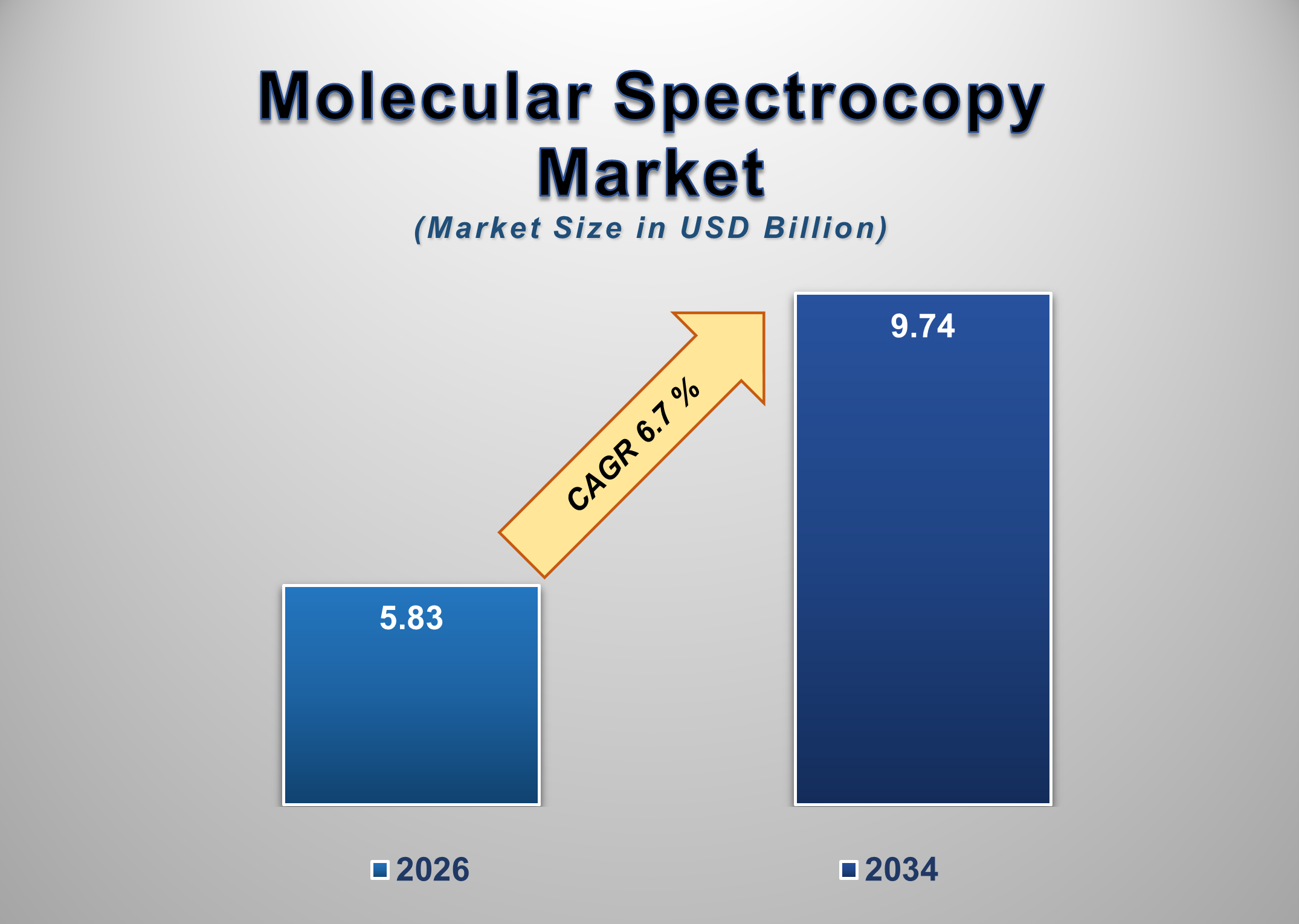
The global molecular spectroscopy market is experiencing steady growth, driven by increasing demand for precise analytical techniques across pharmaceuticals, biotechnology, environmental monitoring, food safety, and chemical industries. Valued at USD 5.83 billion in 2026, the market is projected to reach USD 9.74 billion by 2036, growing at a CAGR of 6.7% during the forecast period.
Molecular spectroscopy encompasses analytical techniques that measure the interaction between electromagnetic radiation and matter to determine molecular composition, structure, and concentration. Technologies such as IR, Raman, UV-Vis, and NMR spectroscopy are widely used for compound identification, impurity detection, structural elucidation, and quality assurance.
The pharmaceutical and biotechnology sectors represent the largest revenue contributors due to stringent regulatory standards and the need for advanced analytical validation methods. Spectroscopic techniques play a critical role in drug development pipelines, raw material verification, polymorphism analysis, and stability testing.
Technological advancements, including portable spectrometers, fiber-optic probes, and AI-driven spectral analysis software, have enhanced operational efficiency and expanded real-time process monitoring capabilities. Integration with automation systems and laboratory information management systems (LIMS) further strengthens deployment across industrial settings.
However, high capital investment, complex calibration requirements, and the need for skilled operators remain key challenges. Despite these constraints, expanding regulatory compliance requirements and increasing industrial automation are expected to sustain long-term market expansion.
As industries prioritize data-driven quality control and real-time analytical insights, molecular spectroscopy is evolving from a laboratory tool into a strategic process-monitoring solution.
Molecular Spectroscopy Market Drivers and Opportunities
Increasing Pharmaceutical R&D and Regulatory Compliance Requirements
Pharmaceutical and biopharmaceutical companies rely heavily on molecular spectroscopy for compound characterization, impurity profiling, and validation of drug formulations. Regulatory frameworks such as Good Manufacturing Practices (GMP) and quality-by-design (QbD) require validated analytical methods to ensure product safety and consistency.
Advanced biologics, biosimilars, and complex formulations demand high-resolution molecular analysis, boosting adoption of NMR and Raman systems. Additionally, process analytical technology (PAT) initiatives encourage real-time monitoring during manufacturing, reducing batch rejection rates and enhancing production efficiency. The continuous expansion of drug pipelines globally continues to reinforce demand for advanced spectroscopic instrumentation.
Expansion of Real-Time Industrial Process Monitoring
Industries such as petrochemicals, specialty chemicals, and materials science increasingly deploy spectroscopy systems for inline and at-line monitoring of chemical reactions and product composition. Real-time data acquisition improves yield optimization, reduces waste, and enhances operational safety.
Unlike traditional batch testing, spectroscopic monitoring enables immediate corrective action, minimizing production downtime. The integration of spectroscopy systems with Industry 4.0 platforms and digital manufacturing ecosystems further accelerates adoption in automated industrial environments.
AI-Enabled Spectral Analytics and Portable Systems
A significant opportunity lies in the integration of artificial intelligence and machine learning with spectroscopy platforms. AI-driven analytics automate peak detection, compound matching, and anomaly identification, reducing reliance on highly specialized analysts while improving analytical accuracy and speed.
Additionally, the commercialization of compact and portable spectrometers is expanding applications beyond centralized laboratories. Environmental agencies, food inspectors, and forensic teams increasingly use handheld devices for on-site testing. Emerging economies with limited laboratory infrastructure present strong growth potential for cost-efficient, portable spectroscopy solutions.
Molecular Spectroscopy Market Scope
Molecular Spectroscopy Market Report Segmentation Analysis
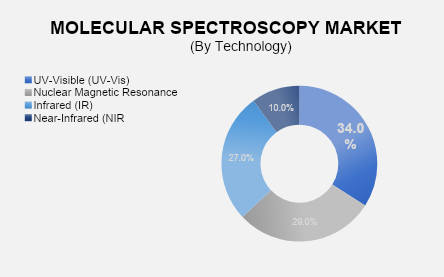
The global molecular spectroscopy market analysis is segmented by Technology, Component, Application, and Region. The Infrared (IR) segment dominated the market in 2025 and is projected to maintain strong growth during the forecast period.
By technology, IR spectroscopy accounts for the largest market share due to its widespread use in pharmaceutical analysis, food safety testing, and industrial quality control. Its cost-effectiveness, reliability, and broad application range support large-scale adoption. Meanwhile, Raman spectroscopy is gaining traction due to non-destructive testing capabilities and minimal sample preparation requirements.
Application Segment Analysis
The Pharmaceutical & Biotechnology segment holds the highest share of the application segment over the forecast period.
Drug development processes require rigorous structural analysis, impurity detection, and quality validation. Spectroscopic tools enable rapid compound characterization and compliance with regulatory standards. Increasing investments in biologics and personalized medicine further strengthen demand within this segment.
Molecular Spectroscopy Market Share Analysis by Region
North America is projected to hold a significant share of the global molecular spectroscopy market over the forecast period.
The region’s leadership is attributed to strong pharmaceutical R&D expenditure, established regulatory frameworks, and the presence of major analytical instrument manufacturers. The United States dominates the regional market due to advanced research infrastructure and continuous investment in laboratory modernization. Increasing focus on process analytical technology further supports regional growth.
Molecular Spectroscopy Market Recent Developments News
In January 2025, Thermo Fisher Scientific introduced an AI-integrated Raman spectroscopy platform designed for real-time pharmaceutical quality monitoring.
In May 2025, Agilent Technologies expanded its compact UV-Vis spectroscopy portfolio, targeting academic and environmental laboratories.
In September 2025, Bruker Corporation launched an advanced NMR system optimized for structural analysis of biologics.
Competitive Landscape
The Global Molecular Spectroscopy Market is dominated by a few large companies, such as:
Thermo Fisher Scientific Inc.
Agilent Technologies, Inc.
Bruker Corporation
PerkinElmer Inc.
Shimadzu Corporation
JEOL Ltd.
Horiba Ltd.
Danaher Corporation
ABB Ltd.
Mettler-Toledo International Inc.
Frequently Asked Questions
Swetal (Research Analyst)
Swetal is a Research Analyst with 4+ years of experience specializing in healthcare market research, medical devices, healthcare IT, and medical technology industry analysis. Her expertise includes competitive intelligence, secondary research, market trend forecasting, and healthcare business insights across global healthcare ecosystems.
She contributes to advanced market research reports by analyzing regulatory frameworks, emerging healthcare technologies, competitive landscapes, and innovation trends shaping the medical industry. With a strong focus on accurate market intelligence, strategic insights, and healthcare industry trends, Swetal supports businesses in making informed, data-backed decisions in a rapidly transforming healthcare environment.
Molecular Spectroscopy Market
Our Research Methodology
"Insight without rigor is just noise."
We follow a comprehensive, multi-phase research framework designed to deliver accurate, strategic, and decision-ready intelligence. Our process integrates primary and secondary research , both quantitative and qualitative , along with dual modeling techniques ( top-down and bottom-up) and a final layer of validation through our proprietary in-house repository.
PRIMARY RESEARCH
Primary research captures real-time, firsthand insights from the market to understand behaviors, motivations, and emerging trends.
1. Quantitative Primary Research
Objective: Generate statistically significant data directly from market participants.
Approaches:- Structured surveys with customers, distributors, and field agents
- Mobile-based data collection for point-of-sale audits and usage behavior
- Phone-based interviews (CATI) for market sizing and product feedback
- Online polling around industry events and digital campaigns
- Purchase frequency by customer type
- Channel performance across geographies
- Feature demand by application or demographic
2. Qualitative Primary Research
Objective: Explore decision-making drivers, pain points, and market readiness.
Approaches:- In-depth interviews (IDIs) with executives, product managers, and key decision-makers
- Focus groups among end users and early adopters
- Site visits and observational research for consumer products
- Informal field-level discussions for regional and cultural nuances
SECONDARY RESEARCH
This phase helps establish a macro-to-micro understanding of market trends, size, regulation, and competitive dynamics, sourced from credible and public domain information.
1. Quantitative Secondary Research
Objective: Model market value and segment-level forecasts based on published data.
Sources include:- Financial reports and investor summaries
- Government trade data, customs records, and regulatory statistics
- Industry association publications and economic databases
- Channel performance and pricing data from marketplace listings
- Revenue splits, pricing trends, and CAGR estimates
- Supply-side capacity and volume tracking
- Investment analysis and funding benchmarks
2. Qualitative Secondary Research
Objective: Capture strategic direction, innovation signals, and behavioral trends.
Sources include:- Company announcements, roadmaps, and product pipelines
- Publicly available whitepapers, conference abstracts, and academic research
- Regulatory body publications and policy briefs
- Social and media sentiment scanning for early-stage shifts
- Strategic shifts in market positioning
- Unmet needs and white spaces
- Regulatory triggers and compliance impact
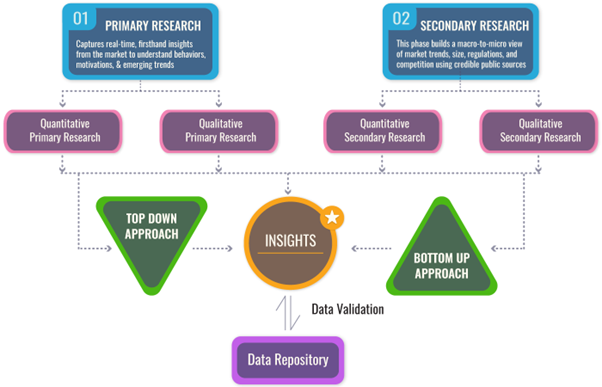
DUAL MODELING: TOP-DOWN + BOTTOM-UP
To ensure robust market estimation, we apply two complementary sizing approaches:
Top-Down Modeling:- Start with broader industry value (e.g., global or regional TAM)
- Apply filters by segment, geography, end-user, or use case
- Adjust with primary insights and validation benchmarks
- Ideal for investor-grade market scans and opportunity mapping
- Aggregate from the ground up using sales volumes, pricing, and unit economics
- Use internal modeling templates aligned with stakeholder data
- Incorporate distributor-level or region-specific inputs
- Most accurate for emerging segments and granular sub-markets
DATA VALIDATION: IN-HOUSE REPOSITORY
We close the loop with proprietary data intelligence built from ongoing projects, industry monitoring, and historical benchmarking. This repository includes:
- Multi-sector market and pricing models
- Key trendlines from past interviews and forecasts
- Benchmarked adoption rates, churn patterns, and ROI indicators
- Industry-specific deviation flags and cross-check logic
- Catches inconsistencies early
- Aligns projections across studies
- Enables consistent, high-trust deliverables