

Movable Swimming Pool Floors Market Size and Forecast (2026–2034), Global and Regional Growth, Trend, Share and Industry Analysis Report Coverage; By Type (Common Movable Floor, Functional Movable Floor); By Application (Private Pool, Public Pool); and Geography
2026-09-02
Consumer Products
Aishwarya Panbude (Research Analyst)
Description
Movable Swimming Pool Floors Market
Overview
The global Movable
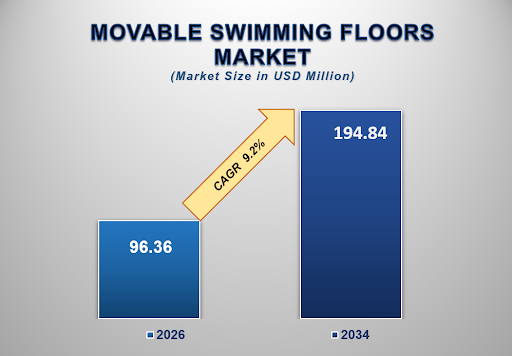
Swimming Pool Floors Market was valued at USD 96.36 million in 2026
and is projected to reach USD 194.84 million by 2034, expanding at a CAGR
of 9.2% during the forecast period. The market is experiencing strong
growth due to increasing demand for multifunctional swimming facilities, rising
adoption of adjustable-depth pool systems, expansion of luxury residential
developments, growing hospitality investments, and technological improvements
in automated pool-floor systems.
Movable swimming
pool floors are engineered pool-bottom systems that can be raised, lowered, or
repositioned to modify the usable depth and functionality of a swimming pool.
Depending on the design, these systems can transform a deep pool into a shallow
recreational area or create a substantially different usable configuration
within the same pool structure.
The primary
value proposition of movable pool floors is flexibility. A single pool can be
adapted for different activities, including swimming, children's recreation,
aquatic training, rehabilitation, leisure, and other water-based uses.
The technology
is particularly relevant where available space is limited. Instead of
constructing separate facilities for different water depths or activities,
property owners can use an adjustable floor to alter the pool configuration
according to changing requirements.
Luxury
residential properties represent an important area of adoption. Homeowners and
developers are increasingly incorporating multifunctional amenities into
premium properties, with movable pool systems providing both flexibility and a
differentiated architectural feature. The latest market research indicates that
residential applications account for a substantial portion of installations.
Hotels, resorts,
wellness centers, and sports facilities are also adopting movable pool floors
to increase the utility of aquatic spaces. Commercial operators can adjust pool
depths for different programs and, depending on system design, optimize the use
of the surrounding facility.
Adjustable-depth
technology also provides advantages for child-friendly and rehabilitation
applications. A shallower configuration can provide a more suitable environment
for beginners, children, therapy sessions, and aquatic training.
Technological
development is improving the operation of movable pool floors. Hydraulic and
mechanical systems, automated controls, sensors, and safety features are being
incorporated to improve positioning accuracy and operating convenience.
Hydraulic systems are identified as a leading technology category in current
market research.
The technology
can also contribute to efficient pool management. When the floor is positioned
near the surface, it can reduce the exposed water area and potentially limit
evaporation and heat loss, depending on the installation and operating
configuration.
The increasing
development of premium residential properties, hospitality projects, wellness
facilities, rehabilitation centers, and modern aquatic infrastructure is
creating additional opportunities for manufacturers.
As property
owners and facility operators increasingly seek flexible, space-efficient, and
technologically advanced pool solutions, the movable swimming pool floors
market is expected to maintain strong growth through 2034.
Movable Swimming Pool Floors Market
Drivers and Opportunities
Growing
Demand for Multifunctional Swimming Facilities Is Driving Market Growth
The increasing
demand for flexible recreational infrastructure is one of the major factors
supporting the movable swimming pool floors market.
Conventional
pools generally provide a fixed depth and are designed primarily for aquatic
activities. This can restrict their use when the facility needs to accommodate
different groups or activities.
Movable floors
address this limitation by allowing pool depth to be modified according to
operational requirements.
A single
installation can therefore support swimming, children's activities,
rehabilitation, training, leisure, and other programs without requiring
separate pools for each purpose.
The ability to
improve space utilization is particularly valuable in urban properties where
land availability and construction costs are significant considerations.
Expansion of
Luxury Residential and Hospitality Projects Is Supporting Market Expansion
Luxury
residential construction is an important source of demand for movable swimming
pool floor systems.
Premium
homeowners increasingly seek personalized amenities that combine recreation,
design, safety, and efficient use of available space.
Movable pool
floors allow residential pools to be configured for different family members
and activities while adding a technologically advanced feature to the property.
The hospitality
sector is also creating opportunities. Hotels and resorts can use adjustable
pools to support swimming, children's activities, wellness programs, events,
and other guest experiences.
Current market
research indicates that residential and hospitality applications represent
major areas of adoption, reinforcing the importance of premium real estate and
tourism infrastructure to future demand.
Technological
Improvements in Pool Automation Present Significant Opportunities
Advancements in
hydraulic systems, mechanical lifting mechanisms, automation, sensors, and
control technologies are creating opportunities for market participants.
Modern systems
can provide controlled vertical movement and adjustable pool depth, while
automated controls can simplify operation.
Safety
monitoring is also becoming increasingly important. Sensors and control systems
can help operators manage floor movement and ensure that the system operates
according to predefined conditions.
Manufacturers
are also focusing on modular designs and customized configurations that can
accommodate different pool dimensions and architectural requirements.
The growing
adoption of smart-building technologies presents another opportunity for
integration between movable pool floors and broader facility-management
systems.
Movable Swimming Pool Floors Market
Scope
|
Report Attributes |
Description |
|
Market Size in 2026 |
USD
96.36 Million |
|
Market Forecast in 2034 |
USD 194.84 Million |
|
CAGR % 2026-2034 |
9.2% |
|
Base Year |
2025 |
|
Historic Data |
2021-2025 |
|
Forecast Period |
2026-2034 |
|
Report USP |
Production, Consumption,
Company Share, Company Heatmap, Company Production, Service Type, Growth
Factors and more |
|
Segments Covered |
· By Type · By Application |
|
Regional Scope |
● North America |
|
Country Scope |
U.S. |
Movable Swimming Pool Floors Market
Report Segmentation Analysis
The global
movable swimming pool floors market industry analysis is segmented into type,
application, and region. The principal product categories identified in
available market research are Common Movable Floor and Functional
Movable Floor, while applications include Private Pool and Public
Pool.
The Common
Movable Floor Segment Is Expected to Dominate the Market During the Forecast
Period
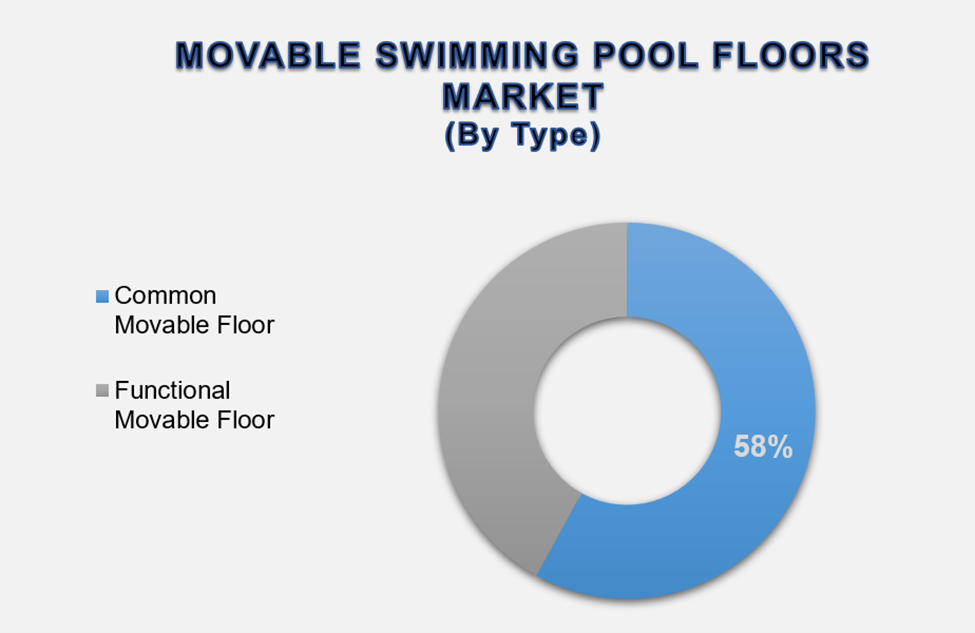
The Common
Movable Floor segment accounted for approximately 58% of the global
market in 2025, making it the leading product category in the available
market assessment. The source reports a 2025 segment value of USD 51.2
million.
Common movable
floors are widely used because they provide adjustable pool depth while
addressing the basic flexibility requirements of residential and hospitality
installations.
Their relatively
broad applicability makes them suitable for properties where a pool needs to
serve users with different swimming abilities and recreational requirements.
Residential
projects represent an important area of adoption. Homeowners can adjust the
pool depth according to children's activities, recreational swimming, exercise,
and other household requirements.
Hotels and other
leisure properties can similarly use common movable floors to provide greater
flexibility within a single aquatic facility.
The segment is
expected to retain its leading position as developers increasingly prioritize
multifunctional amenities and efficient utilization of premium property space.
The
Functional Movable Floor Segment Is Expected to Witness Strong Growth
The Functional
Movable Floor segment is gaining adoption in applications where adjustable
depth and specialized functionality are particularly important.
These systems
are relevant to rehabilitation centers, sports facilities, wellness projects,
and premium properties requiring more specialized pool configurations.
Functional
systems can provide greater flexibility for activities requiring specific water
depths and operating conditions.
The increasing use of swimming pools for rehabilitation, therapy, training, and wellness is expected to support demand for this category.
The Private
Pool Segment Is Expected to Dominate the Market by Application
The Private
Pool segment represents the leading application category.
According to
available market research, private pool applications accounted for
approximately 60% of installations in 2025, supported by demand from
luxury residential developments and homeowners seeking multifunctional pool
facilities.
Private movable
pool floors provide homeowners with the ability to adapt water depth for
different users and activities.
The technology
is particularly attractive for premium residences where pool areas represent a
significant investment and multifunctionality can increase the value of the
space.
Rising interest
in luxury residential amenities and personalized home recreation facilities is
expected to support continued demand.
The Public
Pool Segment Is Expected to Register Steady Growth
Public pools
include facilities such as aquatic centers, hotels, spas, rehabilitation
facilities, and other institutional or recreational installations.
Adjustable pool
floors can allow these facilities to modify water depth for different programs,
including swimming instruction, training, therapy, recreational use, and
children's activities.
The growing
development of wellness centers, sports facilities, and hospitality
infrastructure is expected to create additional opportunities for public pool
applications.
The following
segments are part of an in-depth analysis of the global Movable Swimming Pool
Floors Market:
|
Market Segments |
|
|
By Offering |
· Common Movable
Floor · Functional Movable
Floor |
|
By
Type |
· Private Pool · Public Pool |
Movable Swimming Pool Floors Market
Share Analysis By Region
Europe is projected to hold the largest share of the global movable
swimming pool floors market over the forecast period.
Europe accounted
for approximately 35% of the market in 2025, according to the available
market assessment. The region benefits from established manufacturers, premium
residential construction, hospitality investments, sports infrastructure, and
demand for technologically advanced pool systems.
Germany,
France, Italy, the U.K., Spain, and Switzerland
represent important European markets. Germany in particular has significant
demand for movable pool-floor systems across residential, sports, and premium
hospitality applications.
North America represents another significant market, accounting for approximately
30% of global market share in 2025 in the cited assessment. The region
benefits from luxury residential development, hospitality infrastructure,
wellness facilities, and consumer demand for premium recreational amenities.
The United
States remains the principal regional market, supported by luxury
residential properties, hotels, leisure facilities, and rehabilitation centers.
Asia Pacific is emerging as a significant growth market. The region accounted
for approximately 25% of the market in 2025, with China, Japan, and
Australia representing important contributors. Urbanization, premium
residential development, tourism infrastructure, wellness facilities, and
expanding commercial aquatic projects are supporting regional demand.
China is
benefiting from expanding residential and hospitality infrastructure, while
Japan has opportunities in rehabilitation and wellness applications. Australia
is supported by residential tourism and resort developments.
Latin America represents an emerging opportunity as premium residential
construction and tourism-related infrastructure develop. Brazil, Mexico, and
Argentina are important markets for future adoption.
Middle East
& Africa accounted for approximately 10% of
the market in 2025 in the cited market assessment. Demand is particularly
associated with luxury hospitality, resorts, premium residences, and wellness
developments. The UAE, Saudi Arabia, and South Africa represent
important markets.
Movable
Swimming Pool Floors Market Competition Landscape Analysis
The global
movable swimming pool floors market is a specialized market in which
competition is primarily influenced by engineering expertise, system
reliability, customization, installation capability, safety, automation, and
after-sales service.
Manufacturers
are developing movable floors for different pool dimensions, depths,
architectural configurations, and end-use requirements.
Hydraulic and
mechanical technologies remain important approaches for moving and positioning
pool floors. Automated controls and safety systems are increasingly being
incorporated to improve operating convenience and system management.
Customization is
particularly important because movable floors are generally engineered around
the physical characteristics of individual pools rather than sold as
standardized consumer products.
Companies are
also focusing on modular construction, improved materials, energy efficiency,
and integration with modern pool-management technologies.
The competitive
environment includes specialist movable-floor manufacturers as well as broader
swimming-pool technology companies. Available industry research identifies Variopool,
Myrtha Pools, AKVO Spiralift Inc., WI-POOL, Aqualift, Aquatic Development
Group, Lift'O, AGOR Engineering Enterprises, Tanby Pools, Firma Mazur, EWAC
Medical, Twinscape, and Malmsten AB among the companies active in this
market.
Global
Movable Swimming Pool Floors Market Recent Developments News
●
In 2024 – Variopool expanded its production capacity in Europe to address
increasing demand from hospitality and sports-facility projects, according to
the cited market assessment.
●
In 2024 – Myrtha Pools was reported to have introduced a modular
movable-floor system incorporating a lighter material design intended to
improve installation efficiency.
●
In 2024 – Aqualift was reported to have introduced hydraulic systems
designed to reduce energy consumption and improve sustainability.
●
In 2024 – Twinscape was reported to have introduced an automated
depth-adjustment system for private and public pool applications.
●
In 2024 – Aquatic Development Group was reported to have increased its
focus on public swimming-pool projects and commercial aquatic infrastructure.
The Global
Movable Swimming Pool Floors Market is Dominated by a Few Large Companies, Such
As
· Variopool
· Myrtha Pools
· AKVO Spiralift
Inc.
· WI-POOL
· Aqualift
· Aquatic
Development Group (ADG)
· Lift'O
· AGOR
Engineering Enterprises
· Tanby Pools
· Firma Mazur
· EWAC Medical
· Twinscape
· Malmsten AB
· Others
These companies are identified across recent market research covering movable swimming pool floor systems.
Frequently Asked Questions
Aishwarya Panbude (Research Analyst)
Aishwarya Panbude is a skilled Research Analyst with 4+ years of experience in market intelligence, consumer insights, competitive analysis, and industry forecasting across the consumer goods, agriculture, and food & beverage sectors. She specializes in market sizing, trend analysis, growth opportunity mapping, and strategic secondary research for global and regional markets.
Her expertise lies in transforming complex industry data into actionable business strategies that help organizations identify emerging trends, understand customer behavior, and gain a competitive edge. With a strong focus on data-driven insights, business intelligence, and future market trends, Jaya delivers high-quality research solutions aligned with evolving industry demands and market dynamics.
1.
Global Movable Swimming
Pool Floors Market Introduction and Market Overview
1.1. Objectives of the Study
1.2. Global Movable Swimming Pool Floors Market Scope and Market
Estimation
1.2.1.
Global Movable Swimming Pool
Floors Market Size (US$ Million), Market CAGR (%), Market Forecast (2026 -
2034)
1.2.2.
Global Movable Swimming Pool
Floors Market Revenue Share (%) and Growth Rate (Y-o-Y) Analysis (2021 - 2034)
1.3. Market Segmentation
1.3.1.
By Type of Global Movable
Swimming Pool Floors Market
1.3.2.
By Application of Global
Movable Swimming Pool Floors Market
1.3.3.
Region of Global Movable
Swimming Pool Floors Market
1.4. Competition Coverage List of Market Participants
1.5. Market Definition: Movable Swimming Pool Floors Market
2.
Executive Summary
2.1. Demand Side Trends
2.2. Key Market Trends
2.3. Market Demand (US$ Million) Analysis 2021 – 2025 and Forecast, 2026
– 2034
2.4. Demand and Opportunity Assessment
2.5. Key Developments
2.6. Overview of Regulatory Landscape, Compliance Framework, and Industry
Standards
2.7. Market Entry Strategies
2.8. Market Dynamics
2.8.1.
Drivers
2.8.2.
Limitations
2.8.3.
Opportunities
2.8.4.
Impact Analysis of Drivers and
Restraints
2.9. Porter's Five Forces Analysis
2.10.
PEST Analysis
3.
Global Movable Swimming
Pool Floors Market Estimates & Historical Trend Analysis (2021 - 2025)
4.
Global Movable Swimming
Pool Floors Market Estimates & Forecast Trend Analysis, by Type
4.1. Global Movable Swimming Pool Floors Market Revenue (US$ Million)
Estimates and Forecasts, by Type, 2021 - 2034
4.1.1.
Common Movable Floor
4.1.2.
Functional Movable Floor
5.
Global Movable Swimming
Pool Floors Market Estimates & Forecast Trend Analysis, by Application
5.1. Global Movable Swimming Pool Floors Market Revenue (US$ Million)
Estimates and Forecasts, by Application, 2021 - 2034
5.1.1.
Private Pool
5.1.2.
Public Pool
6.
Global Movable Swimming
Pool Floors Market Estimates & Forecast Trend Analysis, by Region
6.1. Global Movable Swimming Pool Floors Market Revenue (US$ Million)
Estimates and Forecasts, by Region, 2021 - 2034
6.1.1.
North America
6.1.2.
Europe
6.1.3.
Asia Pacific
6.1.4.
Middle East & Africa
6.1.5.
Latin America
7.
North America Movable
Swimming Pool Floors Market: Estimates & Forecast Trend Analysis
7.1. North America Movable Swimming Pool Floors Market Assessments &
Key Findings
7.1.1.
North America Movable Swimming
Pool Floors Market Introduction
7.1.2.
North America Movable Swimming
Pool Floors Market Size Estimates and Forecast (US$ Million) (2021 - 2034)
7.1.2.1.
By Type
7.1.2.2.
By Application
7.1.2.3.
By Country
7.1.2.3.1.
The U.S.
7.1.2.3.2.
Canada
8.
Europe Movable Swimming
Pool Floors Market: Estimates & Forecast Trend Analysis
8.1. Europe Movable Swimming Pool Floors Market Assessments & Key
Findings
8.1.1.
Europe Movable Swimming Pool
Floors Market Introduction
8.1.2.
Europe Movable Swimming Pool
Floors Market Size Estimates and Forecast (US$ Million) (2021 - 2034)
8.1.2.1.
By Type
8.1.2.2.
By Application
8.1.2.3.
By Country
8.1.2.3.1.
Germany
8.1.2.3.2.
The U.K.
8.1.2.3.3.
France
8.1.2.3.4.
Italy
8.1.2.3.5.
Spain
8.1.2.3.6.
Switzerland
8.1.2.3.7.
Rest of Europe
9.
Asia Pacific Movable
Swimming Pool Floors Market: Estimates & Forecast Trend Analysis
9.1. Asia Pacific Movable Swimming Pool Floors Market Assessments &
Key Findings
9.1.1.
Asia Pacific Movable Swimming
Pool Floors Market Introduction
9.1.2.
Asia Pacific Movable Swimming
Pool Floors Market Size Estimates and Forecast (US$ Million) (2021 - 2034)
9.1.2.1.
By Type
9.1.2.2.
By Application
9.1.2.3.
By Country
9.1.2.3.1.
China
9.1.2.3.2.
India
9.1.2.3.3.
Japan
9.1.2.3.4.
South Korea
9.1.2.3.5.
Australia
9.1.2.3.6.
Rest of Asia Pacific
10. Middle East & Africa Movable Swimming Pool Floors Market:
Estimates & Forecast Trend Analysis
10.1.
Middle East & Africa
Movable Swimming Pool Floors Market Assessments & Key Findings
10.1.1.
Middle East & Africa
Movable Swimming Pool Floors Market Introduction
10.1.2.
Middle East & Africa
Movable Swimming Pool Floors Market Size Estimates and Forecast (US$ Million)
(2021 - 2034)
10.1.2.1.
By Type
10.1.2.2.
By Application
10.1.2.3.
By Country
10.1.2.3.1.
Saudi Arabia
10.1.2.3.2.
UAE
10.1.2.3.3.
South Africa
10.1.2.3.4.
Rest of Middle East &
Africa
11. Latin America Movable Swimming Pool Floors Market: Estimates &
Forecast Trend Analysis
11.1.
Latin America Movable Swimming
Pool Floors Market Assessments & Key Findings
11.1.1.
Latin America Movable Swimming
Pool Floors Market Introduction
11.1.2.
Latin America Movable Swimming
Pool Floors Market Size Estimates and Forecast (US$ Million) (2021 - 2034)
11.1.2.1.
By Type
11.1.2.2.
By Application
11.1.2.3.
By Country
11.1.2.3.1.
Brazil
11.1.2.3.2.
Mexico
11.1.2.3.3.
Argentina
11.1.2.3.4.
Rest of Latin America
12. Competition Landscape
12.1.
Global Movable Swimming Pool
Floors Market Product Mapping
12.2.
Global Movable Swimming Pool
Floors Market Concentration Analysis, by Leading Players / Innovators /
Emerging Players / New Entrants
12.3.
Global Movable Swimming Pool
Floors Market Tier Structure Analysis
12.4.
Global Movable Swimming Pool
Floors Market Concentration & Company Market Shares (%) Analysis, 2026
12.5.
Global Movable Swimming Pool
Floors Market Recent Developments and News
13. Company Profiles
13.1.
Variopool
13.1.1.
Company Overview & Key
Stats
13.1.2.
Financial Performance &
KPIs
13.1.3.
Product Portfolio
13.1.4.
SWOT Analysis
13.1.5.
Business Strategy & Recent
Developments
*Similar details would be provided for all
the players mentioned below
13.2.
Myrtha Pools
13.3.
AKVO Spiralift Inc.
13.4.
WI-POOL
13.5.
Aqualift
13.6.
Aquatic Development Group (ADG)
13.7.
Lift'O
13.8.
AGOR Engineering Enterprises
13.9.
Tanby Pools
13.10.
Firma Mazur
13.11.
EWAC Medical
13.12.
Twinscape
13.13.
Malmsten AB
13.14.
Others
14. Research Findings & Conclusion
15. Assumptions & Acronyms Used
16. Research Methodology
16.1.
External Databases
16.2.
Internal Proprietary Database
16.3.
Primary Research
16.4.
Secondary Research
16.5.
Assumptions
16.6.
Limitations
16.7.
Report FAQs
Our Research Methodology
"Insight without rigor is just noise."
We follow a comprehensive, multi-phase research framework designed to deliver accurate, strategic, and decision-ready intelligence. Our process integrates primary and secondary research , both quantitative and qualitative , along with dual modeling techniques ( top-down and bottom-up) and a final layer of validation through our proprietary in-house repository.
PRIMARY RESEARCH
Primary research captures real-time, firsthand insights from the market to understand behaviors, motivations, and emerging trends.
1. Quantitative Primary Research
Objective: Generate statistically significant data directly from market participants.
Approaches:- Structured surveys with customers, distributors, and field agents
- Mobile-based data collection for point-of-sale audits and usage behavior
- Phone-based interviews (CATI) for market sizing and product feedback
- Online polling around industry events and digital campaigns
- Purchase frequency by customer type
- Channel performance across geographies
- Feature demand by application or demographic
2. Qualitative Primary Research
Objective: Explore decision-making drivers, pain points, and market readiness.
Approaches:- In-depth interviews (IDIs) with executives, product managers, and key decision-makers
- Focus groups among end users and early adopters
- Site visits and observational research for consumer products
- Informal field-level discussions for regional and cultural nuances
SECONDARY RESEARCH
This phase helps establish a macro-to-micro understanding of market trends, size, regulation, and competitive dynamics, sourced from credible and public domain information.
1. Quantitative Secondary Research
Objective: Model market value and segment-level forecasts based on published data.
Sources include:- Financial reports and investor summaries
- Government trade data, customs records, and regulatory statistics
- Industry association publications and economic databases
- Channel performance and pricing data from marketplace listings
- Revenue splits, pricing trends, and CAGR estimates
- Supply-side capacity and volume tracking
- Investment analysis and funding benchmarks
2. Qualitative Secondary Research
Objective: Capture strategic direction, innovation signals, and behavioral trends.
Sources include:- Company announcements, roadmaps, and product pipelines
- Publicly available whitepapers, conference abstracts, and academic research
- Regulatory body publications and policy briefs
- Social and media sentiment scanning for early-stage shifts
- Strategic shifts in market positioning
- Unmet needs and white spaces
- Regulatory triggers and compliance impact

DUAL MODELING: TOP-DOWN + BOTTOM-UP
To ensure robust market estimation, we apply two complementary sizing approaches:
Top-Down Modeling:- Start with broader industry value (e.g., global or regional TAM)
- Apply filters by segment, geography, end-user, or use case
- Adjust with primary insights and validation benchmarks
- Ideal for investor-grade market scans and opportunity mapping
- Aggregate from the ground up using sales volumes, pricing, and unit economics
- Use internal modeling templates aligned with stakeholder data
- Incorporate distributor-level or region-specific inputs
- Most accurate for emerging segments and granular sub-markets
DATA VALIDATION: IN-HOUSE REPOSITORY
We close the loop with proprietary data intelligence built from ongoing projects, industry monitoring, and historical benchmarking. This repository includes:
- Multi-sector market and pricing models
- Key trendlines from past interviews and forecasts
- Benchmarked adoption rates, churn patterns, and ROI indicators
- Industry-specific deviation flags and cross-check logic
- Catches inconsistencies early
- Aligns projections across studies
- Enables consistent, high-trust deliverables