

Non-stick Cookware Market Size and Forecast (2025–2033), Global and Regional Growth, Trend, Share and Industry Analysis Report Coverage: By Material Type (Teflon Coated, Anodized Aluminum Coated, Ceramic Coated, Enameled Iron Coated, Others), By End-use (Residential, Commercial), By Distribution Channel (Supermarkets & Hypermarkets, Specialty Stores, E-commerce Stores, Others), and Geography
2026-01-02
Consumer Products
Jaya Bundele (Research Analyst)
Description
Non-stick Cookware Market Overview
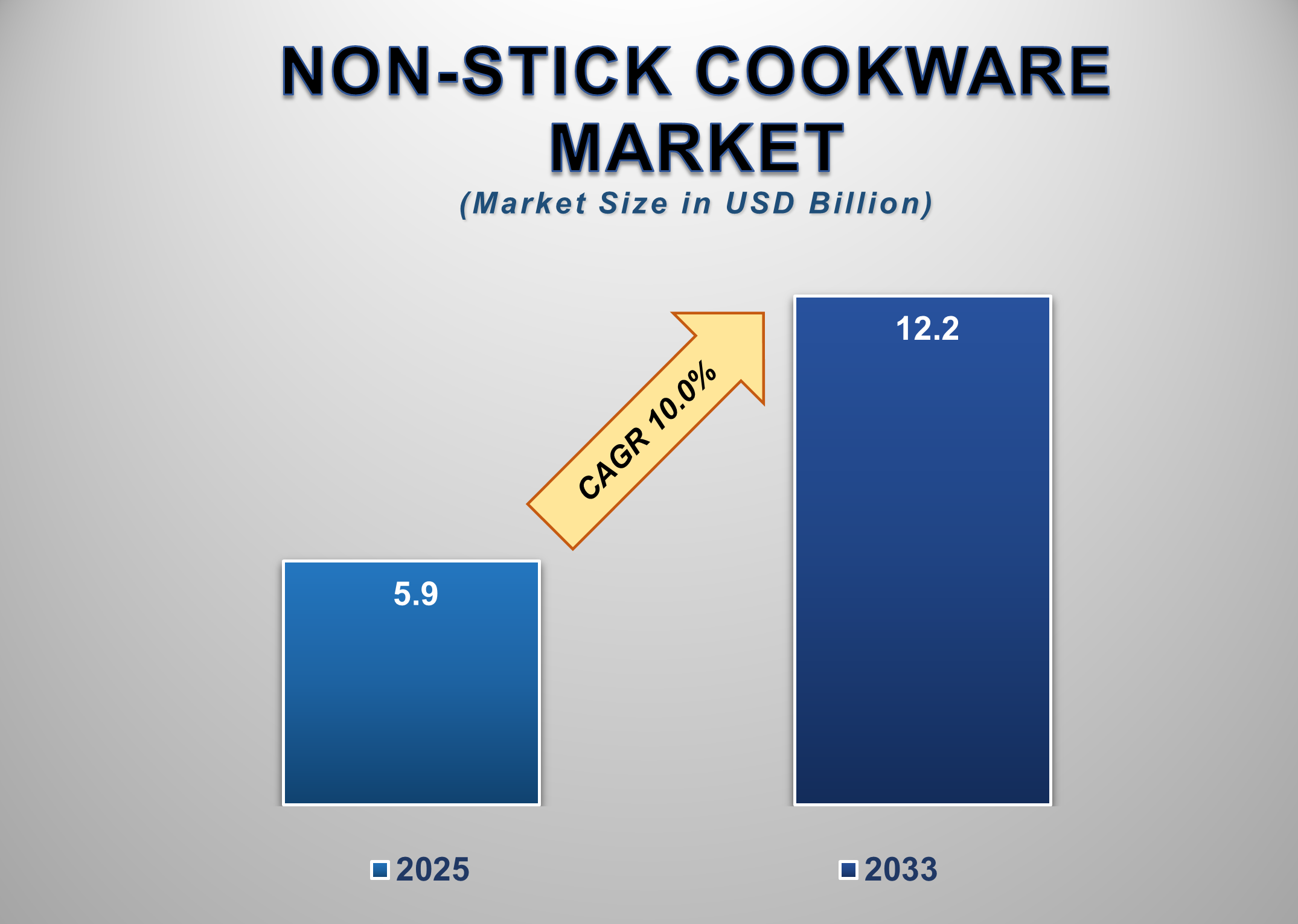
The Global Non-stick Cookware Market is projected to expand from USD 5.9 billion in 2025 to USD 12.2 billion by 2033, registering a robust CAGR of 10.0%. The market's growth is driven by rising consumer preference for convenient, easy-to-clean cookware and a shift toward healthier, low-oil cooking practices. Non-stick surfaces ranging from conventional PTFE (Teflon) to ceramic, anodized aluminum, and hybrid formulations continue to gain traction due to their ability to reduce cooking time, prevent food adhesion, and improve the overall cooking experience. Increasing household formation, expanding urban middle-class populations, and greater emphasis on kitchen aesthetics are further boosting product adoption across residential kitchens.
In addition, the market benefits
from a flourishing e-commerce ecosystem, enabling brands to expand visibility
and offer bundled cookware sets at competitive prices. Manufacturers are also
investing in advanced coatings that enhance durability, scratch resistance, and
heat distribution, addressing past concerns related to surface degradation and
chemical safety.
Non-stick Cookware Market Drivers and Opportunities Rising Demand for Convenient, Low-Oil Cooking Solutions Is Driving Global Market Growth
Growing health consciousness remains a pivotal factor accelerating
demand for non-stick cookware worldwide. Consumers today are actively reducing
oil consumption, supporting cookware surfaces that require minimal or no
cooking fats. Traditional stainless-steel cookware is less preferred for daily
frying or sautéing due to sticking issues, which non-stick materials
effectively overcome. This preference aligns with the surge in lifestyle
diseases, such as obesity and high cholesterol, prompting consumers to shift to
healthier cooking habits. The convenience offered by non-stick surfaces also
boosts adoption as they reduce cooking time, simplify cleaning, and minimize
food residue buildup. These benefits make such cookware particularly attractive
to working professionals and nuclear families seeking fast meal preparation.
Additionally, innovations in coating technology such as long-lasting ceramic
finishes, titanium reinforcement, and multi-layer PTFE further boost market
attractiveness by improving durability and heat retention. The integration of
non-stick surfaces into bakeware, induction cookware, and multifunctional
products broadens consumer applicability. Retail expansion, attractive pricing,
and easy access through e-commerce platforms amplify availability across
geographies. The increasing trend of home cooking and kitchen décor
modernization also influences consumers to upgrade to premium cookware sets,
thereby strengthening global demand.
Expansion of Residential Kitchens and Home Cooking Culture Is
Fueling Market Adoption
A significant shift in global culinary behavior marked by the
growing popularity of home cooking, food experimentation, and modern kitchen
aesthetics continues to propel the non-stick cookware market forward. The
COVID-era transformation in cooking habits persists, with consumers
increasingly investing in high-performance cookware that enhances cooking
results and aligns with contemporary kitchen designs. Rising residential
construction, increased modular kitchen installation, and growing household
disposable incomes further encourage the adoption of premium cookware
sets.Social media and digital food influencers have also played a
transformative role by popularizing home cooking trends, driving consumers
toward cookware that ensures professional-like results. The rise in multi-piece
cookware sets, color-coordinated kitchenware, and ergonomic designs aligns with
consumer demand for functionality paired with style. Residential users prefer
non-stick cookware for its versatility, enabling easy preparation of diverse
cuisines from Asian stir-fries to Western breakfasts without requiring
specialized skills.
Manufacturers are capitalizing on this trend by offering visually
appealing, scratch-resistant ceramic-coated pans, induction-ready cookware, and
lightweight aluminum products for everyday cooking. As a result, the
residential segment remains the largest end-use category and a core contributor
to sustained market expansion through 2033.
Growing Shift Toward Eco-friendly and Non-toxic Coating
Technologies Is Creating Significant Opportunities
Increasing consumer awareness about chemical safety in cookware
has created substantial growth opportunities for eco-friendly, non-toxic, and
PFAS-free non-stick solutions. Traditional PTFE-based Teflon coatings have
faced scrutiny due to concerns over overheating and chemical release, prompting
buyers to explore safer alternatives. Ceramic coatings, water-based sol-gel
technologies, and diamond- or titanium-reinforced non-stick surfaces are
rapidly gaining traction as viable, sustainable options.
Manufacturers now emphasize durability, scratch resistance,
metal-utensil tolerance, and high-temperature stability, features previously
considered limitations of non-toxic coatings. This shift aligns strongly with
environmental regulations and growing preference for recyclable and ethically
sourced materials. Additionally, consumer demand for premium cookware in
eco-conscious markets, particularly Europe and North America, opens avenues for
product differentiation and brand expansion. Companies focusing on sustainable
packaging, minimal-emission production processes, and recyclable base materials
such as anodized aluminum and enameled iron are gaining a competitive edge. As
PFAS restrictions tighten globally, brands offering certified toxic-free, safe
alternatives stand to capture significant market share. This trend defines a
major long-term opportunity that will reshape product innovation across the
nonstick cookware industry.
Non-stick Cookware Market
Scope
|
Report Attributes |
Description |
|
Market Size in 2025 |
USD 5.9 Billion |
|
Market Forecast in 2033 |
USD 12.2 Billion |
|
CAGR % 2025-2033 |
10.0% |
|
Base Year |
2024 |
|
Historic Data |
2020-2024 |
|
Forecast Period |
2025-2033 |
|
Report USP |
Production, Consumption,
Company Share, Company Heatmap, Company Production Capacity, Growth Factors,
and more |
|
Segments Covered |
●
By Material Type,
By End-use, By Distribution Channel |
|
Regional Scope |
●
North America, ●
Europe, ●
APAC, ●
Latin America ●
Middle East and
Africa |
|
Country Scope |
1)
U.S. 2)
Canada 3)
Germany 4)
UK 5)
France 6)
Spain 7)
Italy 8)
Switzerland 9)
China 10)
Japan 11)
India 12)
Australia 13)
South Korea 14)
Brazil 15)
Mexico 16)
Argentina 17)
South Africa 18)
Saudi Arabia 19)
UAE |
Non-stick Cookware Market
Report Segmentation Analysis
The Global Non-stick Cookware
Market is segmented by Material Type, End-use, Distribution Channel, and
Geography.
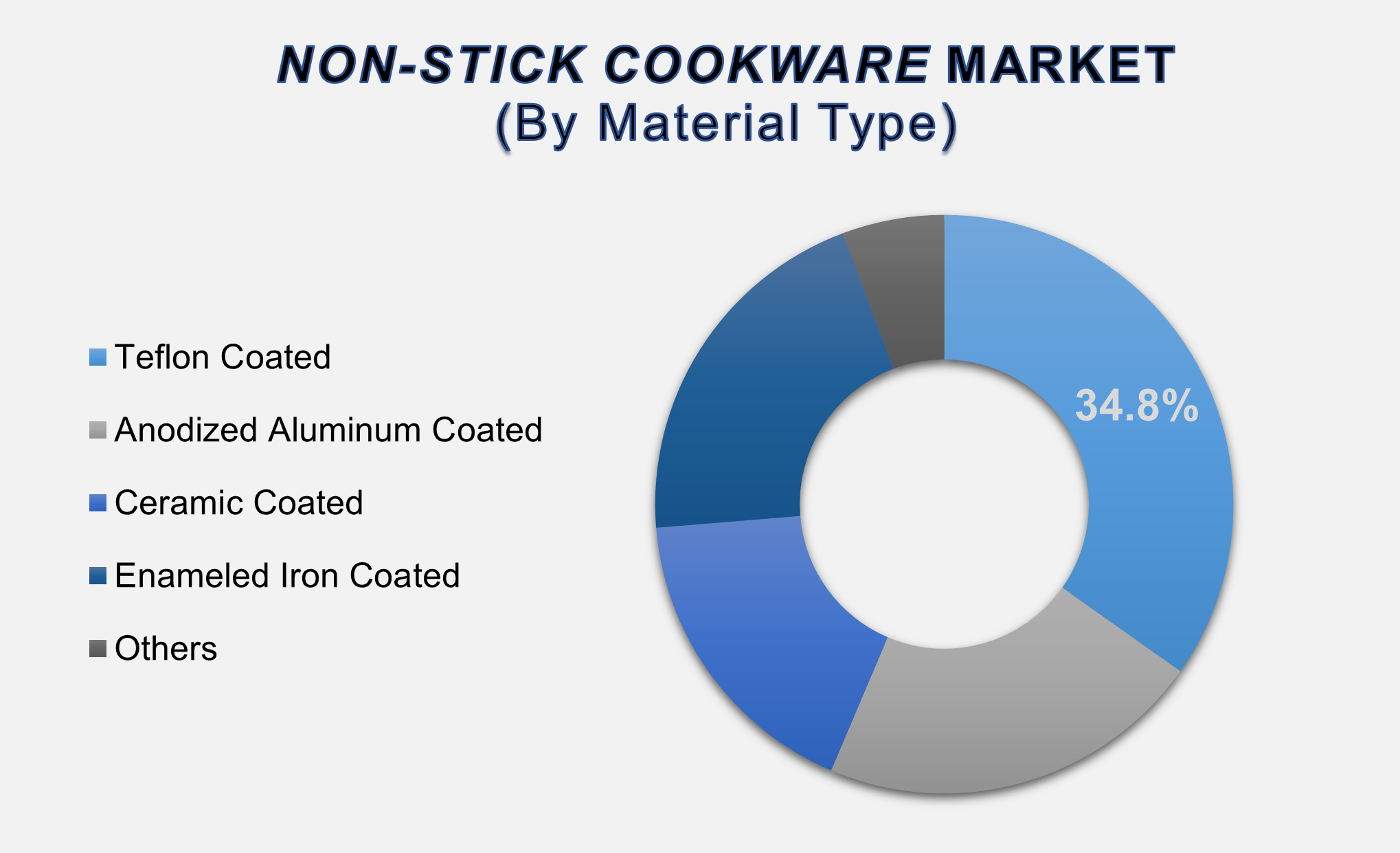
The Teflon-coated segment
accounted for the largest market share in the global Non-stick Cookware market.
This dominance is driven by the wide availability, cost-effectiveness, and strong non-stick performance offered by PTFE-based (Teflon) coatings. These products are highly preferred for everyday cooking due to their smooth surface, heat efficiency, and compatibility with a variety of stovetops. Manufacturers continue to invest in multi-layer reinforced PTFE coatings that enhance durability and scratch resistance while maintaining affordability for mass-market consumers. Although ceramic and anodized aluminum alternatives are gaining attention for their eco-friendly appeal, Teflon-coated cookware remains the most accessible option, particularly in developing regions where price sensitivity is high. The segment also benefits from strong retail penetration in supermarkets, hypermarkets, and online platforms. With ongoing innovations aimed at improving temperature resistance and extending product lifespan, Teflon-coated cookware is expected to maintain a considerable share throughout the forecast period.
The residential segment
accounted for the largest market share in the global Non-stick Cookware market.
Residential
consumers represent the core demand base, driven by rising household formation,
urbanization, and the popularity of home cooking. Non-stick cookware is
preferred in homes due to its convenience, low maintenance, and suitability for
daily meal preparation across diverse cuisines. Additionally, increasing
adoption of modular kitchens encourages consumers to invest in premium cookware
sets that complement modern interior aesthetics. E-commerce expansion has
further boosted product accessibility, enabling consumers to explore a wide
assortment of designs, colors, and material options. Residential demand is also
fueled by rising health awareness, with users opting for cookware that requires
minimal oil while ensuring superior heat distribution. Continuous product
innovation, such as ceramic-coated pans and
induction-compatible materials, further
enhances adoption. The shift toward healthier and more efficient cooking
practices ensures that the residential segment remains the primary growth
driver through 2033.
The Supermarkets &
Hypermarkets segment accounted for the largest market share in the global
Non-stick Cookware market.
These
retail formats offer consumers the advantage of physically evaluating cookware
quality, weight, coating texture, and brand comparisons before purchase,
an important factor for cookware selection.
Attractive pricing, seasonal promotions, and bundled deals further support
strong sales of non-stick pans, pots, and cookware sets through offline retail.
Major brands maintain a strong presence in supermarkets and hypermarkets due to
consistent footfall and broad visibility. These stores often feature dedicated
kitchenware aisles and curated product displays, which appeal to both
first-time buyers and repeat customers. Despite the rapid rise of e-commerce,
offline retail remains dominant in many regions, particularly in emerging
markets where consumers prefer hands-on product assessment. The continued
expansion of large-format retail chains across Asia, the Middle East, and
Europe is expected to sustain growth in this segment.
The following segments are
part of an in-depth analysis of the global Non-stick Cookware market:
|
Market Segments |
|
|
By Material
Type |
●
Teflon Coated ●
Anodized Aluminum
Coated ●
Ceramic Coated ●
Enameled Iron Coated ●
Others |
|
By End-use |
●
Residential ●
Commercial |
|
By
Distribution Channel |
●
Supermarkets &
Hypermarkets ●
Specialty Stores ●
E-commerce Stores ●
Others |
Non-stick Cookware Market
Share Analysis by Region
The North America region
is projected to hold the largest share of the global Non-stick Cookware market
over the forecast period
North
America remains the largest regional market, accounting for 39.3% of the global
non-stick cookware revenue in 2025. High consumer spending on kitchenware,
strong brand presence, and a well-established retail network underpin market
leadership. Consumers in the U.S. and Canada show a strong preference for premium, durable cookware, particularly anodized aluminum and ceramic-coated
products. Well-informed shoppers, coupled with high adoption of modular
kitchens and modern cookware sets, further contribute to regional dominance.
Asia-Pacific,
however, is projected to record the highest CAGR through 2033. Rising
disposable incomes, expanding urban populations, and the rapid growth of
residential construction significantly boost cookware adoption. Increasing
Western culinary influence and the rise of food delivery and cloud kitchens
further amplify market expansion. Countries such as China, India, Japan, and
Indonesia are becoming key manufacturing as well as consumption hubs.
Collectively, APAC's economic progress, coupled with high consumer replacement
cycles, positions it as the fastest-evolving regional market.
Non-stick Cookware Market
Competition Landscape Analysis
The Non-stick Cookware Market is
moderately fragmented, with global brands competing alongside regional
manufacturers offering cost-effective alternatives. Companies focus on advanced
coating technologies, heat-resistant materials, and induction-compatible
designs to enhance product differentiation. Sustainability-driven innovation,
especially PFAS-free coatings, is emerging as a major competitive driver among
premium brands. Strategic partnerships with retailers, influencer-led
marketing, and online channel expansion are key approaches adopted to
strengthen market penetration. Mergers, acquisitions, and product line
diversification remain prevalent as companies seek to broaden their consumer
reach across both developed and emerging markets.
Global Non-stick Cookware
Market Recent Developments News:
- In
November 2022, TTK
Prestige Ltd. launched a new range of hard-anodized non-stick cookware in
India, featuring its ‘DURASTONE’ six-layer coating. The collection
includes frying pans, tawas, casseroles, kadais, and tea pans, designed
for enhanced durability and performance.
- In April 2022,
Meyer Corporation introduced the Meyer Accent collection in the U.S.
market, featuring 16 hard-anodized aluminum non-stick and stainless steel
utensils. The launch expanded Meyer’s portfolio of premium, durable
kitchenware solutions.
The Global Non-stick Cookware Market Is Dominated by a Few Large Companies, such as
●
Tefal
●
Circulon
●
Scanpan
●
All-Clad
●
Calphalon
●
Woll
●
GreenPan
●
Anolon
●
Farberware
●
Cuisinart
●
Rachael Ray
●
Tramontina
●
Berndes
●
Bialetti
●
Meyer Corporation
●
Gibson
●
Nordic Ware
●
KitchenAid
●
Lagostina
●
Maxcook
Frequently Asked Questions
Jaya Bundele (Research Analyst)
Jaya Bundele is a skilled Research Analyst with 4+ years of experience in market intelligence, consumer insights, competitive analysis, and industry forecasting across the consumer goods, agriculture, and food & beverage sectors. She specializes in market sizing, trend analysis, growth opportunity mapping, and strategic secondary research for global and regional markets.
Her expertise lies in transforming complex industry data into actionable business strategies that help organizations identify emerging trends, understand customer behavior, and gain a competitive edge. With a strong focus on data-driven insights, business intelligence, and future market trends, Jaya delivers high-quality research solutions aligned with evolving industry demands and market dynamics.
1. Global Non-stick Cookware
Market Introduction and Market Overview
1.1.
Objectives
of the Study
1.2.
Global
Non-stick Cookware Market Scope and Market Estimation
1.2.1.Global Non-stick Cookware
Market Overall Market Size (US$ Bn), Market CAGR (%), Market forecast (2025 - 2033)
1.2.2.Global Non-stick Cookware
Market Revenue Share (%) and Growth Rate (Y-o-Y) from 2020 - 2033
1.3.
Market
Segmentation
1.3.1.Material Type of Global Non-stick
Cookware Market
1.3.2.End-use of Global Non-stick
Cookware Market
1.3.3.Distribution Channel of
Global Non-stick Cookware Market
1.3.4.Region of Global Non-stick
Cookware Market
2. Executive
Summary
2.1.
Demand
Side Trends
2.2.
Key
Market Trends
2.3.
Market
Demand (US$ Bn) Analysis 2020 – 2024 and Forecast, 2025 – 2033
2.4.
Demand
and Opportunity Assessment
2.5.
Demand
Supply Scenario
2.6.
Market
Dynamics
2.6.1.Drivers
2.6.2.Limitations
2.6.3.Opportunities
2.6.4.Impact Analysis of Drivers
and Restraints
2.7.
Emerging
Trends for Non-stick Cookware Market
2.8.
Porter’s
Five Forces Analysis
2.9.
PEST
Analysis
2.10.
Key
Regulation
3. Global
Non-stick Cookware Market Estimates
& Historical Trend Analysis (2020 - 2024)
4.
Global Non-stick Cookware
Market Estimates & Forecast Trend
Analysis, by Material Type
4.1.
Global
Non-stick Cookware Market Revenue (US$ Bn) Estimates and Forecasts, by Material
Type, 2020 - 2033
4.1.1.Teflon Coated
4.1.2.Anodized Aluminum Coated
4.1.3.Ceramic Coated
4.1.4.Enameled Iron Coated
4.1.5.Others
5.
Global Non-stick Cookware
Market Estimates & Forecast Trend
Analysis, by End-use
5.1.
Global
Non-stick Cookware Market Revenue (US$ Bn) Estimates and Forecasts, by End-use,
2020 - 2033
5.1.1.Residential
5.1.2.Commercial
6.
Global Non-stick Cookware
Market Estimates & Forecast Trend
Analysis, by Distribution Channel
6.1.
Global
Non-stick Cookware Market Revenue (US$ Bn) Estimates and Forecasts, by Distribution
Channel, 2020 - 2033
6.1.1.Supermarkets &
Hypermarkets
6.1.2.Specialty Stores
6.1.3.E-commerce Stores
6.1.4.Others
7. Global
Non-stick Cookware Market Estimates
& Forecast Trend Analysis, by region
1.1.
Global
Non-stick Cookware Market Revenue (US$ Bn) Estimates and Forecasts, by region, 2020
- 2033
1.1.1.North America
1.1.2.Europe
1.1.3.Asia Pacific
1.1.4.Middle East & Africa
1.1.5.Latin America
8. North America Non-stick
Cookware Market: Estimates &
Forecast Trend Analysis
8.1.
North
America Non-stick Cookware Market Assessments & Key Findings
8.1.1.North America Non-stick
Cookware Market Introduction
8.1.2.North America Non-stick
Cookware Market Size Estimates and Forecast (US$ Billion) (2020 - 2033)
8.1.2.1. By Material
Type
8.1.2.2. By End-use
8.1.2.3. By Distribution
Channel
8.1.2.4.
By
Country
8.1.2.4.1.
The
U.S.
8.1.2.4.2.
Canada
9. Europe Non-stick
Cookware Market: Estimates &
Forecast Trend Analysis
9.1.
Europe
Non-stick Cookware Market Assessments & Key Findings
9.1.1.Europe Non-stick Cookware
Market Introduction
9.1.2.Europe Non-stick Cookware
Market Size Estimates and Forecast (US$ Billion) (2020 - 2033)
9.1.2.1. By Material
Type
9.1.2.2. By End-use
9.1.2.3. By Distribution
Channel
9.1.2.4.
By
Country
9.1.2.4.1. Germany
9.1.2.4.2. Italy
9.1.2.4.3. U.K.
9.1.2.4.4. France
9.1.2.4.5. Spain
9.1.2.4.6. Switzerland
9.1.2.4.7.
Rest of Europe
10. Asia Pacific Non-stick
Cookware Market: Estimates &
Forecast Trend Analysis
10.1.
Asia
Pacific Market Assessments & Key Findings
10.1.1.
Asia
Pacific Non-stick Cookware Market Introduction
10.1.2.
Asia
Pacific Non-stick Cookware Market Size Estimates and Forecast (US$ Billion) (2020
- 2033)
10.1.2.1. By Material
Type
10.1.2.2. By End-use
10.1.2.3. By Distribution
Channel
10.1.2.4.
By
Country
10.1.2.4.1. China
10.1.2.4.2. Japan
10.1.2.4.3. India
10.1.2.4.4. Australia
10.1.2.4.5. South Korea
10.1.2.4.6.
Rest
of Asia Pacific
11. Middle East & Africa Non-stick
Cookware Market: Estimates &
Forecast Trend Analysis
11.1.
Middle
East & Africa Market Assessments & Key Findings
11.1.1.
Middle East & Africa Non-stick Cookware Market
Introduction
11.1.2.
Middle East & Africa Non-stick Cookware Market Size Estimates
and Forecast (US$ Billion) (2020 - 2033)
11.1.2.1. By Material
Type
11.1.2.2. By End-use
11.1.2.3. By Distribution
Channel
11.1.2.4.
By
Country
11.1.2.4.1. South
Africa
11.1.2.4.2. UAE
11.1.2.4.3. Saudi
Arabia
11.1.2.4.4.
Rest of MEA
12. Latin America
Non-stick Cookware Market: Estimates
& Forecast Trend Analysis
12.1.
Latin
America Market Assessments & Key Findings
12.1.1.
Latin
America Non-stick Cookware Market Introduction
12.1.2.
Latin
America Non-stick Cookware Market Size Estimates and Forecast (US$ Billion) (2020
- 2033)
12.1.2.1. By Material
Type
12.1.2.2. By End-use
12.1.2.3. By Distribution
Channel
12.1.2.4.
By
Country
12.1.2.4.1. Brazil
12.1.2.4.2. Mexico
12.1.2.4.3. Argentina
12.1.2.4.4.
Rest of LATAM
13. Country Wise Market:
Introduction
14.
Competition
Landscape
14.1.
Global
Non-stick Cookware Market Product Mapping
14.2.
Global
Non-stick Cookware Market Concentration Analysis, by Leading Players /
Innovators / Emerging Players / New Entrants
14.3.
Global
Non-stick Cookware Market Tier Structure Analysis
14.4.
Global
Non-stick Cookware Market Concentration & Company Market Shares (%)
Analysis, 2024
15.
Company
Profiles
15.1. Tefal
15.1.1.
Company
Overview & Key Stats
15.1.2.
Financial
Performance & KPIs
15.1.3.
Product
Portfolio
15.1.4.
SWOT
Analysis
15.1.5.
Business
Strategy & Recent Developments
* Similar details would be provided for all
the players mentioned below
15.2. Circulon
15.3. Scanpan
15.4. All-Clad
15.5. Calphalon
15.6. Woll
15.7. GreenPan
15.8. Anolon
15.9. Farberware
15.10. Cuisinart
15.11. Rachael Ray
15.12. Tramontina
15.13. Berndes
15.14. Bialetti
15.15. Meyer
Corporation
15.16. Gibson
15.17. Nordic Ware
15.18. KitchenAid
15.19. Lagostina
15.20. Maxcook
15.21. Other
Prominent Players
16. Research
Methodology
16.1.
External
Transportations / Databases
16.2.
Internal
Proprietary Database
16.3.
Primary
Research
16.4.
Secondary
Research
16.5.
Assumptions
16.6.
Limitations
16.7.
Report
FAQs
17. Research
Findings & Conclusion
Our Research Methodology
"Insight without rigor is just noise."
We follow a comprehensive, multi-phase research framework designed to deliver accurate, strategic, and decision-ready intelligence. Our process integrates primary and secondary research , both quantitative and qualitative , along with dual modeling techniques ( top-down and bottom-up) and a final layer of validation through our proprietary in-house repository.
PRIMARY RESEARCH
Primary research captures real-time, firsthand insights from the market to understand behaviors, motivations, and emerging trends.
1. Quantitative Primary Research
Objective: Generate statistically significant data directly from market participants.
Approaches:- Structured surveys with customers, distributors, and field agents
- Mobile-based data collection for point-of-sale audits and usage behavior
- Phone-based interviews (CATI) for market sizing and product feedback
- Online polling around industry events and digital campaigns
- Purchase frequency by customer type
- Channel performance across geographies
- Feature demand by application or demographic
2. Qualitative Primary Research
Objective: Explore decision-making drivers, pain points, and market readiness.
Approaches:- In-depth interviews (IDIs) with executives, product managers, and key decision-makers
- Focus groups among end users and early adopters
- Site visits and observational research for consumer products
- Informal field-level discussions for regional and cultural nuances
SECONDARY RESEARCH
This phase helps establish a macro-to-micro understanding of market trends, size, regulation, and competitive dynamics, sourced from credible and public domain information.
1. Quantitative Secondary Research
Objective: Model market value and segment-level forecasts based on published data.
Sources include:- Financial reports and investor summaries
- Government trade data, customs records, and regulatory statistics
- Industry association publications and economic databases
- Channel performance and pricing data from marketplace listings
- Revenue splits, pricing trends, and CAGR estimates
- Supply-side capacity and volume tracking
- Investment analysis and funding benchmarks
2. Qualitative Secondary Research
Objective: Capture strategic direction, innovation signals, and behavioral trends.
Sources include:- Company announcements, roadmaps, and product pipelines
- Publicly available whitepapers, conference abstracts, and academic research
- Regulatory body publications and policy briefs
- Social and media sentiment scanning for early-stage shifts
- Strategic shifts in market positioning
- Unmet needs and white spaces
- Regulatory triggers and compliance impact
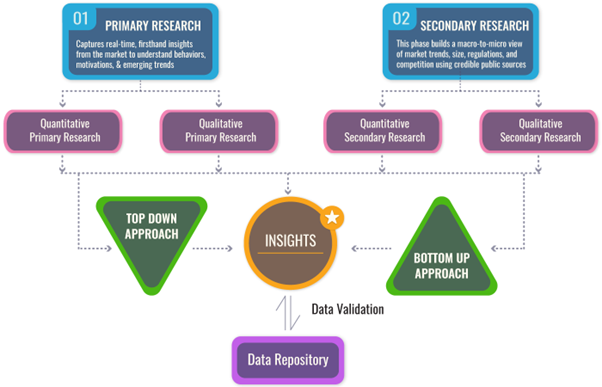
DUAL MODELING: TOP-DOWN + BOTTOM-UP
To ensure robust market estimation, we apply two complementary sizing approaches:
Top-Down Modeling:- Start with broader industry value (e.g., global or regional TAM)
- Apply filters by segment, geography, end-user, or use case
- Adjust with primary insights and validation benchmarks
- Ideal for investor-grade market scans and opportunity mapping
- Aggregate from the ground up using sales volumes, pricing, and unit economics
- Use internal modeling templates aligned with stakeholder data
- Incorporate distributor-level or region-specific inputs
- Most accurate for emerging segments and granular sub-markets
DATA VALIDATION: IN-HOUSE REPOSITORY
We close the loop with proprietary data intelligence built from ongoing projects, industry monitoring, and historical benchmarking. This repository includes:
- Multi-sector market and pricing models
- Key trendlines from past interviews and forecasts
- Benchmarked adoption rates, churn patterns, and ROI indicators
- Industry-specific deviation flags and cross-check logic
- Catches inconsistencies early
- Aligns projections across studies
- Enables consistent, high-trust deliverables