

Omega-3 in Animal Feed Market Size and Forecast (2020-2033), Global and Regional Growth, Trend, Share, and Industry Analysis Report Coverage: By Source (Fish Oil, Algae Oil, Flaxseed Oil, Others), By Livestock (Aquaculture, Pets, Poultry, Swine, Dairy & Ruminants, Others), And Geography
2025-12-17
Consumer Products
Jaya Bundele (Research Analyst)
Description
Omega-3 in
Animal Feed Market Overview
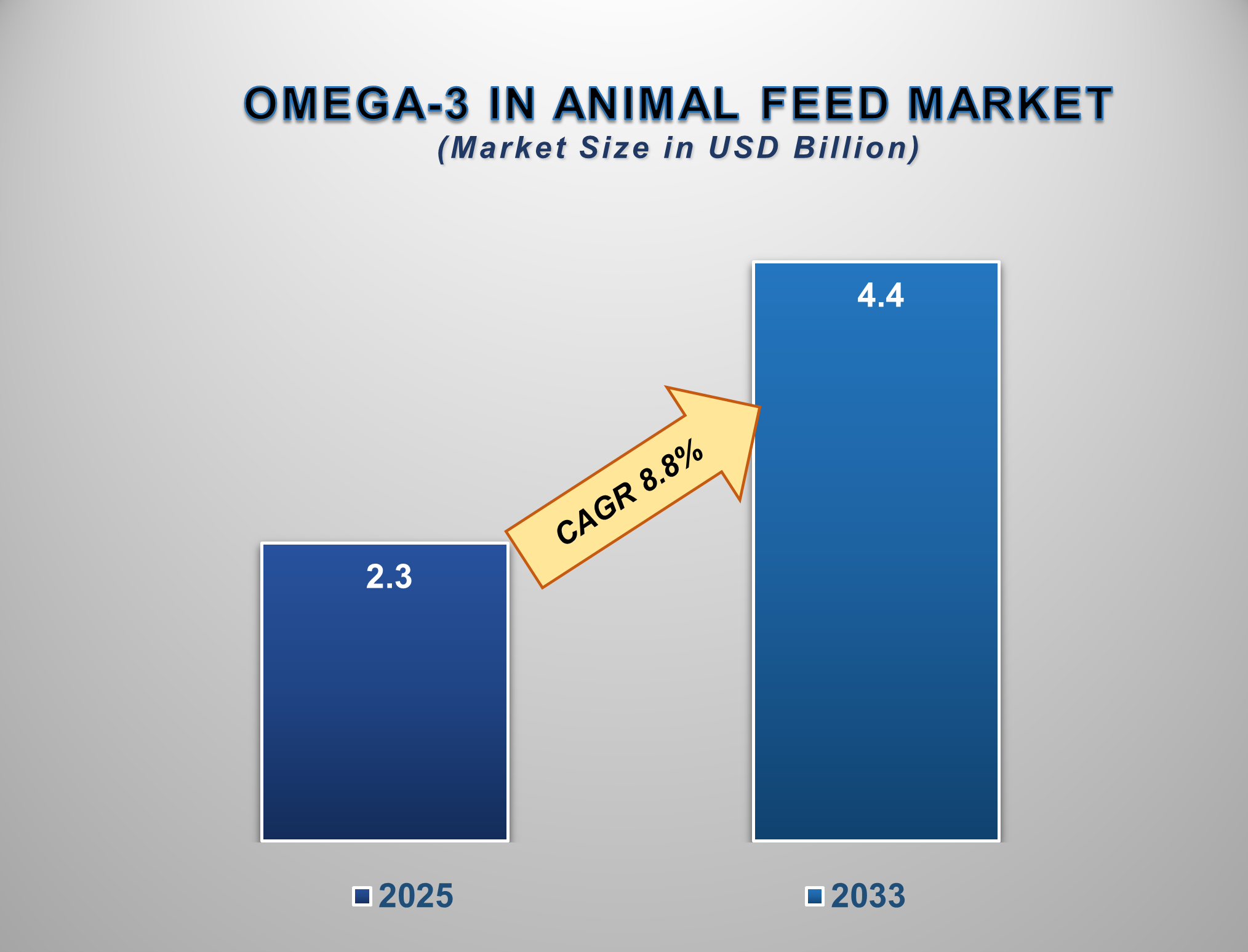
The Omega-3 in Animal Feed Market is poised for significant growth from 2025 to 2033, driven by the rising demand for enriched animal products, heightened awareness of animal health and welfare, and the proven benefits of omega-3s in improving livestock productivity. The market is projected to be valued at approximately USD 2.3 billion in 2025 and is forecasted to reach nearly USD 4.4 billion by 2033, exhibiting a compound annual growth rate (CAGR) of 8.8% during this period.
Omega-3 fatty acids, primarily EPA
(eicosapentaenoic acid) and DHA (docosahexaenoic acid), are essential
polyunsaturated fats incorporated into animal feed to enhance the nutritional
profile of the end products (meat, milk, and
eggs) and to promote the health, growth, and immunity of the animals
themselves. The market's expansion is primarily fueled by the growing consumer
demand for functional foods, such as omega-3-enriched eggs and meat, which offer human health benefits. In the
rapidly expanding aquaculture sector, omega-3s are a critical component of fish
feed, essential for fish development and health. Furthermore, the pet
humanization trend is driving demand for premium pet foods with functional
ingredients that support skin, coat, joint, and cognitive health.
Sustainability concerns regarding traditional fish oil sources are accelerating
the adoption of alternative sources like algae and genetically modified canola
oil. The Asia-Pacific region holds the largest market share, propelled by its
massive aquaculture industry, while North America and Europe are expected to
see robust growth due to stringent animal welfare standards and high consumer
awareness.
Omega-3 in Animal Feed Market Drivers and
Opportunities
Rising Demand for Enriched Animal Products and Focus on
Livestock Health Are the Primary Market Drivers
The pivotal driver for omega-3 in the
animal feed market is the dual demand for value-added
animal products and enhanced livestock health management. Consumers are
increasingly seeking out functional foods—such as eggs, milk, and meat with
higher levels of omega-3s—due to the associated human health benefits,
including improved cardiovascular and cognitive function. This consumer pull
incentivizes producers to incorporate omega-3s into animal diets to
differentiate their products and command premium prices.
Simultaneously, within the farming industry,
there is a growing focus on improving animal health, welfare, and productivity
through advanced nutrition. Omega-3 fatty acids are proven to confer
significant benefits across livestock: they enhance reproductive performance,
boost immune function, reduce inflammation, and improve overall growth rates.
In aquaculture, they are indispensable for fish larval development, survival,
and fillet quality. For pets, they address specific health concerns like
arthritis, skin allergies, and cognitive decline in aging animals. This
convergence of consumer demand for nutritious food and producer need for
efficient, healthy livestock creates a powerful, sustained demand for omega-3-fortified feed, establishing a foundational growth pillar for the
entire market.
Sustainability Challenges and the Pet Humanization Trend are
Driving Market Evolution
The reliance on fish oil, the traditional source
of omega-3s for aquaculture and animal feed, faces significant sustainability
challenges due to fluctuating wild fish stocks and environmental pressures.
This is catalyzing a major shift towards alternative, sustainable sources.
Algae-derived DHA and EPA oils represent the most promising alternative, as
they are produced at the base of the marine food chain in controlled
fermenters, bypassing the ocean ecosystem entirely. Furthermore, the powerful
"pet humanization" trend, where owners treat pets as family members,
is fueling the demand for premium, health-focused pet food. Pet owners are
actively seeking out products with functional ingredients like omega-3s for
their proven benefits, making the pet segment one of the fastest-growing in the
market.
Innovation in Alternative Sources and Precision Livestock
Farming Presents Significant Opportunities
The need for sustainable and scalable omega-3
sources presents a substantial growth frontier. A key opportunity lies in the
commercialization and cost reduction of novel
sources like algae, krill, and genetically engineered oilseed crops (e.g.,
camelina, canola) that produce EPA and DHA. The integration of omega-3s into
the broader trend of precision livestock farming represents another significant
leap forward. Feed formulations can be tailored to specific animal life stages,
health statuses, and production goals (e.g., enhancing DHA levels in laying
hens for enriched eggs). For ingredient suppliers and feed manufacturers,
investing in R&D for sustainable and cost-effective omega-3 sources,
developing targeted solutions for specific livestock segments, and forming
partnerships with food producers to create branded, enriched products are key
strategies for capturing future market share.
Omega-3 in the Animal Feed Market Scope
|
Report Attributes |
Description |
|
Market Size in 2025 |
USD 2.3 Billion |
|
Market Forecast in 2033 |
USD 4.4 Billion |
|
CAGR % 2025-2033 |
8.8% |
|
Base Year |
2024 |
|
Historic Data |
2020-2024 |
|
Forecast Period |
2025-2033 |
|
Report USP |
Product Portfolio,
Technological Analysis, Company Market Share, Company Heatmap, Pricing
Analysis, Growth Factors and more |
|
Segments Covered |
●
By Source ●
By Livestock |
|
Regional Scope |
●
North America, ●
Europe, ●
APAC, ●
Latin America ●
Middle East and
Africa |
|
Country Scope |
1)
U.S. 2)
Canada 3)
Germany 4)
UK 5)
France 6)
Spain 7)
Italy 8)
Switzerland 9)
China 10)
Japan 11)
India 12)
Australia 13)
South Korea 14)
Brazil 15)
Mexico 16)
Argentina 17)
South Africa 18)
Saudi Arabia 19)
UAE |
Omega-3 in Animal Feed Market Report Segmentation
Analysis
The global Omega-3 in Animal Feed
Market industry analysis is segmented by Source, by Livestock, and by region.
Fish Oil Segment to Hold
Dominant Market Share in 2025
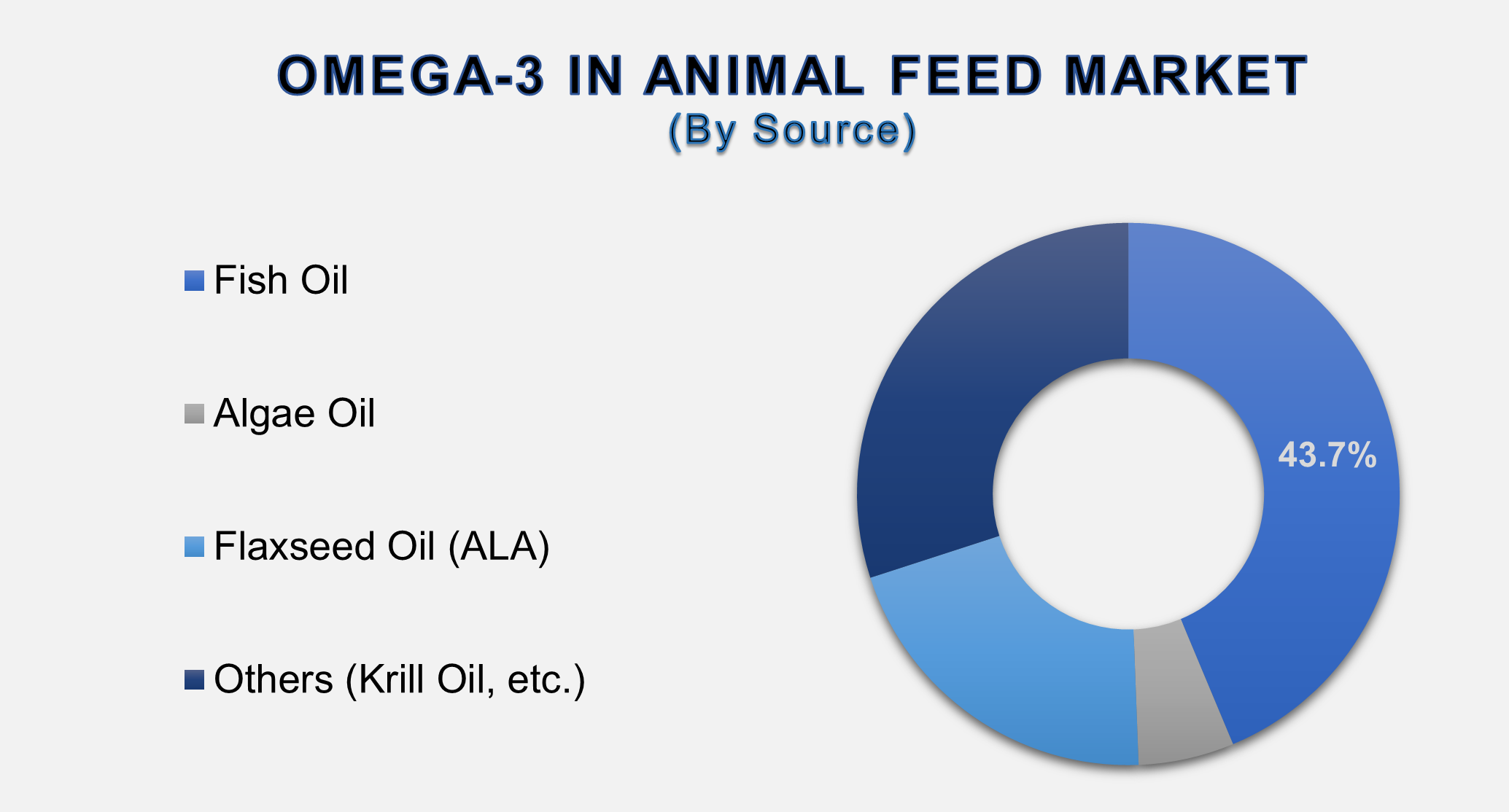
The Fish Oil segment is projected to command a dominant market share in 2025, remaining the cornerstone of the omega-3 feed ingredient industry, particularly in aquaculture. This dominance is rooted in its high concentration of the most bioavailable forms of EPA and DHA, which are essential for the health and development of farmed fish species like salmon and trout. The existing, well-established global supply chain and processing infrastructure for fish oil ensure its cost-effectiveness and widespread availability compared to newer alternatives. Despite growing sustainability concerns, its unparalleled efficiency in meeting the specific nutritional requirements of a massive and growing aquaculture sector secures its leading position in the short to medium term. However, its market share growth is expected to be tempered by the rapid ascent of alternative sources.
Aquaculture Segment as
the Largest Livestock Category for Omega-3 in Animal Feed Market
The
Aquaculture segment is projected to be the largest livestock category for
omega-3 consumption. This is an intrinsic requirement, not just a nutritional
enhancement. In the wild, fish obtain EPA and DHA by consuming algae or smaller
fish. In farmed settings, these essential fatty acids must be supplied through
the feed for proper growth, reproduction, bone development, and overall health.
The rapid global expansion of aquaculture to meet the world's growing demand
for seafood directly translates into increased consumption of omega-3
ingredients. As the most efficient and largest user of concentrated omega-3s,
the aquaculture industry's feed requirements form the bedrock of this market,
dwarfing the volumes used in other livestock sectors.
The following segments are
part of an in-depth analysis of the global Omega-3 in Animal Feed Market:
|
Market
Segments |
|
|
By Source |
●
Fish Oil ●
Algae Oil ●
Flaxseed Oil (ALA) ●
Others (Krill Oil,
etc.) |
|
By
Livestock |
●
Aquaculture ●
Pets ●
Poultry ●
Swine ●
Dairy &
Ruminants ●
Others |
Omega-3 in Animal Feed Market Share Analysis by
Region
The Asia Pacific region
is anticipated to hold the largest portion of the Omega-3 in the Animal Feed
Market globally throughout the forecast period.
Asia-Pacific's
dominance is directly attributed to its massive and rapidly growing aquaculture
industry, led by countries like China, India, and Vietnam. The region is the
world's largest producer and consumer of aquaculture products, creating an
immense, inherent demand for omega-3s in fish and shrimp feed. Rising
disposable incomes are also increasing the consumption of meat, eggs, and
dairy, prompting producers to use enhanced feed for better productivity and
product differentiation. Government initiatives supporting domestic aquaculture
and livestock production further solidify APAC's position as the largest
regional market.
China
is the single largest market within Asia-Pacific, driven by its unparalleled
scale in aquaculture and livestock production. The government's focus on food
security and self-sufficiency, coupled with a growing middle class demanding
higher-quality animal protein, fuels the demand for advanced animal nutrition,
including omega-3 fortified feed. The presence of large domestic feed
manufacturers and increasing investments in sustainable ingredient production
underscore the critical importance of the Chinese market.
Omega-3 in Animal Feed Market Competition
Landscape Analysis
The global omega-3 in animal
feed market is consolidated and features a mix of large, diversified
agribusinesses, specialized ingredient suppliers, and aquaculture nutrition
companies. Competition is based on product efficacy, sustainability
credentials, supply chain reliability, price, and technical support services.
Key strategies include vertical integration, securing sustainable raw material
sources (e.g., through fisheries partnerships or algae production), extensive
R&D to improve bioavailability and efficacy, and forming strategic
alliances with feed mills and large livestock producers.
Global Omega-3 in Animal
Feed Market Recent Developments News:
- In February 2025, DSM-Firmenich (now part of Firmenich) launched a
new, high-stability algae oil powder designed for inclusion in premixes
for poultry and swine feed.
- In November 2024, Cargill Incorporated expanded its partnership with
a biotechnology firm to scale up the use of algae-based omega-3s in its
salmon feed portfolios.
- In August 2024, BASF SE announced an investment to increase the
production capacity of its n-3 PUFA products for the animal nutrition
market.
- In May 2024, Veramaris (DSM-Evonik JV) reported a significant
increase in the use of its algal oil by major salmon farmers in Norway,
replacing marine-derived oils.
The Global Omega-3 in
Animal Feed Market Is Dominated by a Few Large Companies, such as
●
DSM-Firmenich
●
BASF SE
●
Cargill Incorporated
●
Archer Daniels Midland
Company (ADM)
●
Corbion N.V.
●
Veramaris (DSM &
Evonik JV)
●
Epax Norway AS
●
Olvea Group
●
Croda International
Plc
●
Omega Protein
Corporation (Part of Cooke Inc.)
●
GC Rieber Oils
●
Polaris
● Other Prominent Players
Frequently Asked Questions
Jaya Bundele (Research Analyst)
Jaya Bundele is a skilled Research Analyst with 4+ years of experience in market intelligence, consumer insights, competitive analysis, and industry forecasting across the consumer goods, agriculture, and food & beverage sectors. She specializes in market sizing, trend analysis, growth opportunity mapping, and strategic secondary research for global and regional markets.
Her expertise lies in transforming complex industry data into actionable business strategies that help organizations identify emerging trends, understand customer behavior, and gain a competitive edge. With a strong focus on data-driven insights, business intelligence, and future market trends, Jaya delivers high-quality research solutions aligned with evolving industry demands and market dynamics.
1. Global Omega-3 in Animal
Feed Market Introduction and Market Overview
1.1.
Objectives
of the Study
1.2.
Global
Omega-3 in Animal Feed Market Scope and Market Estimation
1.2.1.Global Electronic Toll
Collection Overall Market Size (US$ Mn), Market CAGR (%), Market forecast (2025
- 2033)
1.2.2.Global Omega-3 in Animal
Feed Market Revenue Share (%) and Growth Rate (Y-o-Y) from 2020 - 2033
1.3.
Market
Segmentation
1.3.1.Source of Global Omega-3
in Animal Feed Market
1.3.2.Livestock of Global Omega-3
in Animal Feed Market
1.3.3.Region of Global Omega-3
in Animal Feed Market
2. Executive
Summary
2.1.
Demand
Side Trends
2.2.
Key
Market Trends
2.3.
Market
Demand (US$ Mn) Analysis 2020 – 2024 and forecast, 2025 – 2033
2.4.
Demand
and Opportunity Assessment
2.5.
Technological
Advancements
2.6.
Regulatory
Scenario by Region
2.7.
Key
Developments
2.8.
Market
Entry Strategies
2.9.
Market
Dynamics
2.9.1.Drivers
2.9.2.Limitations
2.9.3.Opportunities
2.9.4.Impact Analysis of Drivers
and Restraints
2.10.
Porter’s
Five Forces Analysis
2.11.
PEST
Analysis
3. Global
Omega-3 in Animal Feed Market Estimates
& Historical Trend Analysis (2020 - 2024)
4. Global
Omega-3 in Animal Feed Market Estimates
& Forecast Trend Analysis, by Source
4.1.
Global
Omega-3 in Animal Feed Market Revenue (US$ Mn) Estimates and Forecasts, by Source,
2020 - 2033
4.1.1.Fish Oil
4.1.2.Algae Oil
4.1.3.Flaxseed Oil (ALA)
4.1.4.Others (Krill Oil, etc.)
5. Global
Omega-3 in Animal Feed Market Estimates
& Forecast Trend Analysis, by Livestock
5.1.
Global
Omega-3 in Animal Feed Market Revenue (US$ Mn) Estimates and Forecasts, by Livestock
2020 - 2033
5.1.1.Aquaculture
5.1.2.Pets
5.1.3.Poultry
5.1.4.Swine
5.1.5.Dairy & Ruminants
5.1.6.Others
6. Global
Omega-3 in Animal Feed Market Estimates
& Forecast Trend Analysis, by region
6.1.
Global
Omega-3 in Animal Feed Market Revenue (US$ Mn) Estimates and Forecasts, by region,
2020 - 2033
6.1.1.North America
6.1.2.Europe
6.1.3.Asia Pacific
6.1.4.Middle East & Africa
6.1.5.Latin America
7. North America Omega-3
in Animal Feed Market: Estimates &
Forecast Trend Analysis
7.1.
North
America Omega-3 in Animal Feed Market Assessments & Key Findings
7.1.1.North America Omega-3 in
Animal Feed Market Introduction
7.1.2.North America Omega-3 in
Animal Feed Market Size Estimates and Forecast (US$ Billion) (2020 - 2033)
7.1.2.1. By Source
7.1.2.2. By Livestock
7.1.2.3.
By
Country
7.1.2.3.1. The U.S.
7.1.2.3.2. Canada
8. Europe Omega-3
in Animal Feed Market: Estimates &
Forecast Trend Analysis
8.1.
Europe
Omega-3 in Animal Feed Market Assessments & Key Findings
8.1.1.Europe Omega-3 in Animal
Feed Market Introduction
8.1.2.Europe Omega-3 in Animal
Feed Market Size Estimates and Forecast (US$ Billion) (2020 - 2033)
8.1.2.1. By Source
8.1.2.2. By Livestock
8.1.2.3.
By
Country
8.1.2.3.1.
Germany
8.1.2.3.2.
Italy
8.1.2.3.3.
U.K.
8.1.2.3.4.
France
8.1.2.3.5.
Spain
8.1.2.3.6.
Switzerland
8.1.2.3.7. Rest
of Europe
9. Asia Pacific Omega-3
in Animal Feed Market: Estimates &
Forecast Trend Analysis
9.1.
Asia
Pacific Market Assessments & Key Findings
9.1.1.Asia Pacific Omega-3 in
Animal Feed Market Introduction
9.1.2.Asia Pacific Omega-3 in
Animal Feed Market Size Estimates and Forecast (US$ Billion) (2020 - 2033)
9.1.2.1. By Source
9.1.2.2. By Livestock
9.1.2.3.
By
Country
9.1.2.3.1.
China
9.1.2.3.2.
Japan
9.1.2.3.3.
India
9.1.2.3.4.
Australia
9.1.2.3.5.
South
Korea
9.1.2.3.6. Rest of Asia Pacific
10. Middle East & Africa Omega-3
in Animal Feed Market: Estimates &
Forecast Trend Analysis
10.1.
Middle
East & Africa Market Assessments & Key Findings
10.1.1.
Middle East & Africa Omega-3 in Animal Feed Market
Introduction
10.1.2.
Middle East & Africa Omega-3 in Animal Feed Market Size Estimates
and Forecast (US$ Billion) (2020 - 2033)
10.1.2.1. By Source
10.1.2.2. By Livestock
10.1.2.3.
By
Country
10.1.2.3.1. UAE
10.1.2.3.2. Saudi
Arabia
10.1.2.3.3. South
Africa
10.1.2.3.4. Rest
of MEA
11. Latin America
Omega-3 in Animal Feed Market:
Estimates & Forecast Trend Analysis
11.1.
Latin
America Market Assessments & Key Findings
11.1.1.
Latin
America Omega-3 in Animal Feed Market Introduction
11.1.2.
Latin
America Omega-3 in Animal Feed Market Size Estimates and Forecast (US$ Billion)
(2020 - 2033)
11.1.2.1. By Source
11.1.2.2. By Livestock
11.1.2.3.
By
Country
11.1.2.3.1. Brazil
11.1.2.3.2. Argentina
11.1.2.3.3. Mexico
11.1.2.3.4. Rest
of LATAM
12. Country Wise Market:
Introduction
13.
Competition
Landscape
13.1.
Global
Omega-3 in Animal Feed Market Product Mapping
13.2.
Global
Omega-3 in Animal Feed Market Concentration Analysis, by Leading Players /
Innovators / Emerging Players / New Entrants
13.3.
Global
Omega-3 in Animal Feed Market Tier Structure Analysis
13.4.
Global
Omega-3 in Animal Feed Market Concentration & Company Market Shares (%)
Analysis, 2024
14.
Company
Profiles
14.1.
DSM-Firmenich
14.1.1.
Company
Overview & Key Stats
14.1.2.
Financial
Performance & KPIs
14.1.3.
Product
Portfolio
14.1.4.
SWOT
Analysis
14.1.5.
Business
Strategy & Recent Developments
* Similar details would be provided for all the players
mentioned below
14.2. BASF SE
14.3. Cargill
Incorporated
14.4. Archer
Daniels Midland Company (ADM)
14.5. Corbion N.V.
14.6. Veramaris
(DSM & Evonik JV)
14.7. Epax Norway
AS
14.8. Olvea Group
14.9. Croda
International Plc
14.10. Omega Protein
Corporation (Part of Cooke Inc.)
14.11. GC Rieber
Oils
14.12. Polaris
14.13. Other
Prominent Players
15. Research
Methodology
15.1.
External
Transportations / Databases
15.2.
Internal
Proprietary Database
15.3.
Primary
Research
15.4.
Secondary
Research
15.5.
Assumptions
15.6.
Limitations
15.7.
Report
FAQs
16. Research
Findings & Conclusion
Our Research Methodology
"Insight without rigor is just noise."
We follow a comprehensive, multi-phase research framework designed to deliver accurate, strategic, and decision-ready intelligence. Our process integrates primary and secondary research , both quantitative and qualitative , along with dual modeling techniques ( top-down and bottom-up) and a final layer of validation through our proprietary in-house repository.
PRIMARY RESEARCH
Primary research captures real-time, firsthand insights from the market to understand behaviors, motivations, and emerging trends.
1. Quantitative Primary Research
Objective: Generate statistically significant data directly from market participants.
Approaches:- Structured surveys with customers, distributors, and field agents
- Mobile-based data collection for point-of-sale audits and usage behavior
- Phone-based interviews (CATI) for market sizing and product feedback
- Online polling around industry events and digital campaigns
- Purchase frequency by customer type
- Channel performance across geographies
- Feature demand by application or demographic
2. Qualitative Primary Research
Objective: Explore decision-making drivers, pain points, and market readiness.
Approaches:- In-depth interviews (IDIs) with executives, product managers, and key decision-makers
- Focus groups among end users and early adopters
- Site visits and observational research for consumer products
- Informal field-level discussions for regional and cultural nuances
SECONDARY RESEARCH
This phase helps establish a macro-to-micro understanding of market trends, size, regulation, and competitive dynamics, sourced from credible and public domain information.
1. Quantitative Secondary Research
Objective: Model market value and segment-level forecasts based on published data.
Sources include:- Financial reports and investor summaries
- Government trade data, customs records, and regulatory statistics
- Industry association publications and economic databases
- Channel performance and pricing data from marketplace listings
- Revenue splits, pricing trends, and CAGR estimates
- Supply-side capacity and volume tracking
- Investment analysis and funding benchmarks
2. Qualitative Secondary Research
Objective: Capture strategic direction, innovation signals, and behavioral trends.
Sources include:- Company announcements, roadmaps, and product pipelines
- Publicly available whitepapers, conference abstracts, and academic research
- Regulatory body publications and policy briefs
- Social and media sentiment scanning for early-stage shifts
- Strategic shifts in market positioning
- Unmet needs and white spaces
- Regulatory triggers and compliance impact
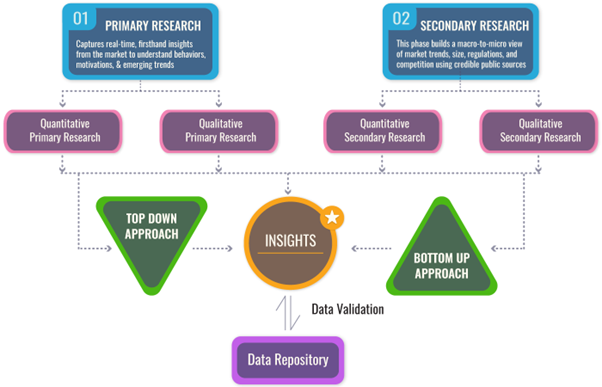
DUAL MODELING: TOP-DOWN + BOTTOM-UP
To ensure robust market estimation, we apply two complementary sizing approaches:
Top-Down Modeling:- Start with broader industry value (e.g., global or regional TAM)
- Apply filters by segment, geography, end-user, or use case
- Adjust with primary insights and validation benchmarks
- Ideal for investor-grade market scans and opportunity mapping
- Aggregate from the ground up using sales volumes, pricing, and unit economics
- Use internal modeling templates aligned with stakeholder data
- Incorporate distributor-level or region-specific inputs
- Most accurate for emerging segments and granular sub-markets
DATA VALIDATION: IN-HOUSE REPOSITORY
We close the loop with proprietary data intelligence built from ongoing projects, industry monitoring, and historical benchmarking. This repository includes:
- Multi-sector market and pricing models
- Key trendlines from past interviews and forecasts
- Benchmarked adoption rates, churn patterns, and ROI indicators
- Industry-specific deviation flags and cross-check logic
- Catches inconsistencies early
- Aligns projections across studies
- Enables consistent, high-trust deliverables