

Oncology Nutrition Market Size and Forecast (2020–2033), Global and Regional Growth, Trend, Share, and Industry Analysis Report Coverage: By Product Type (Oral Nutritional Supplements, Enteral Nutrition, Parenteral Nutrition), By Cancer Type (Head & Neck Cancer, Gastrointestinal Cancer, Lung Cancer, Breast Cancer, Others), By End User (Hospitals, Specialty Cancer Clinics, Homecare, Long-term Care Facilities), And Geography
2025-12-30
Healthcare
Swetal (Research Analyst)
Description
Oncology
Nutrition Market Overview
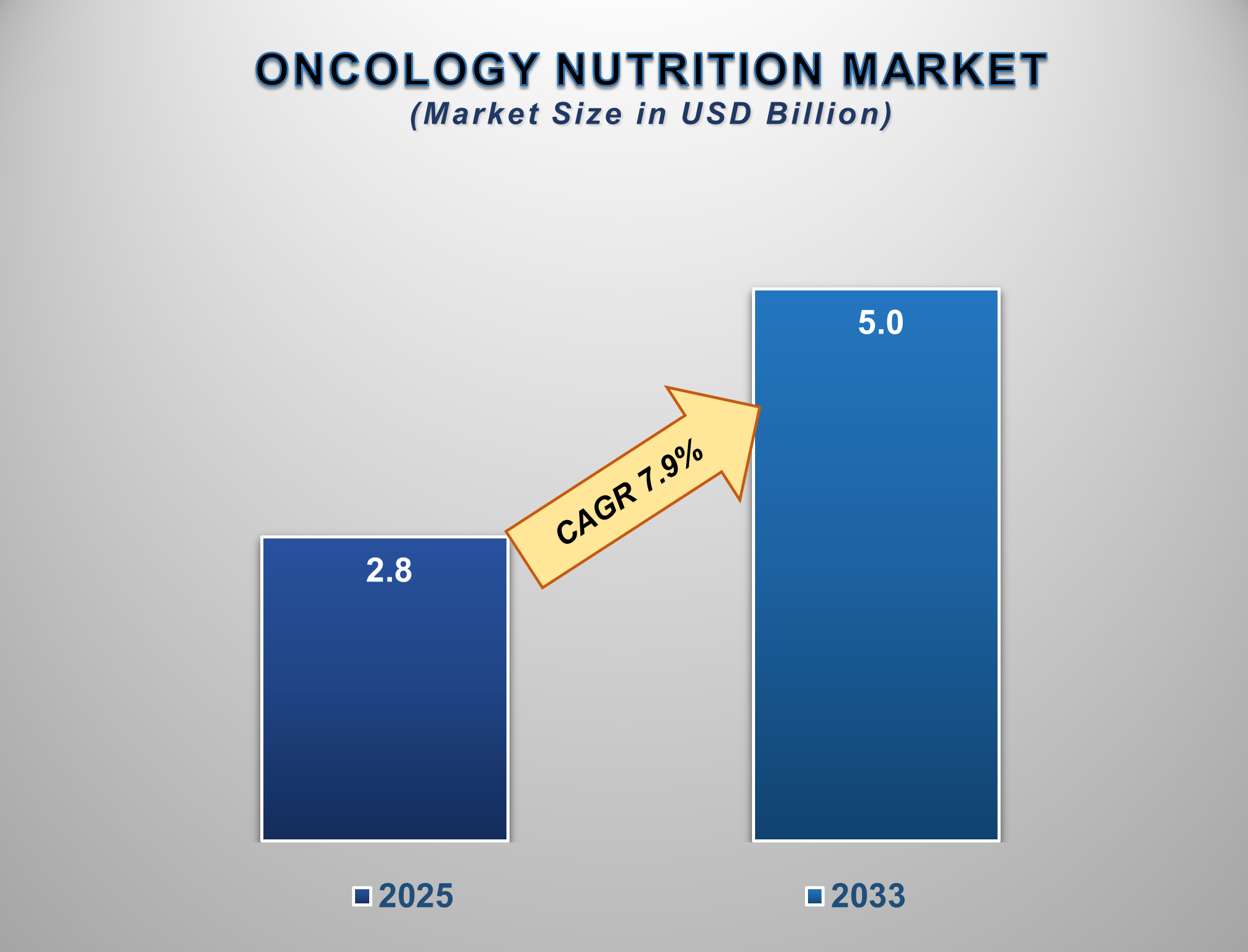
The global Oncology Nutrition Market is expected to witness robust growth from 2025 to 2033, driven by the rising global cancer burden, increasing prevalence of cancer-related malnutrition, growing awareness of the role of nutrition in cancer care, and expanding adoption of personalized nutritional therapies. The market was valued at USD 2.8 billion in 2024 and is projected to reach USD 5.0 billion by 2033, growing at a CAGR of 7.9% during the forecast period.
Oncology nutrition focuses on providing specialized
nutritional support to cancer patients to manage malnutrition, cachexia,
treatment-related side effects, and immune suppression. Cancer treatments such
as chemotherapy, radiotherapy, and surgery often impair appetite, digestion,
and nutrient absorption, increasing the need for targeted nutritional
interventions. Oncology nutrition products are formulated with high protein
content, omega-3 fatty acids, vitamins, minerals, and immunonutrients to
support treatment tolerance and improve quality of life. Market growth is
supported by increasing integration of nutritional therapy into oncology
treatment protocols, rising healthcare expenditure, and favourable
reimbursement policies in developed regions. North America currently dominates
the market due to high cancer prevalence and advanced clinical nutrition
practices, while Asia-Pacific is expected to register the fastest growth owing
to improving cancer care infrastructure and rising awareness across emerging economies.
Oncology Nutrition Market Drivers and
Opportunities
Rising Global Cancer Burden and High Prevalence of
Cancer-Related Malnutrition Are the Primary Market Drivers
The most significant driver of the oncology nutrition
market is the rapidly increasing incidence of cancer worldwide, coupled with a
high prevalence of malnutrition among cancer patients. Studies indicate that up
to 80% of cancer patients experience some degree of malnutrition during
treatment, which negatively impacts treatment outcomes, recovery rates, and
survival. Oncology nutrition plays a critical role in maintaining body weight,
muscle mass, and immune function, enabling patients to better tolerate aggressive
therapies. Healthcare providers are increasingly recognizing nutrition as an
essential component of comprehensive cancer care, leading to higher adoption of
oral and enteral nutritional solutions. As cancer incidence continues to rise
globally, the demand for specialized oncology nutrition products is expected to
grow steadily.
Advancements in Clinical Nutrition Formulations and
Personalized Oncology Care Drive Market Expansion
Technological advancements in clinical nutrition have
significantly enhanced the efficacy of oncology nutrition products.
Manufacturers are developing disease-specific formulations enriched with
high-quality proteins, anti-inflammatory nutrients, and immune-modulating
ingredients to meet the unique metabolic needs of cancer patients. Personalized
nutrition approaches based on cancer type, stage, and treatment regimen are
gaining traction, improving patient compliance and clinical outcomes.
Ready-to-consume oral nutritional supplements, improved flavor profiles, and
easy-to-digest formulations further support adoption across hospital and
homecare settings. These innovations are expanding the use of oncology
nutrition beyond supportive care into preventive and recovery-focused treatment
strategies.
Expansion of Homecare Nutrition and Emerging Markets Creates
New Growth Opportunities
The growing shift toward home-based cancer care presents
significant opportunities for the oncology nutrition market. Advances in oral
and enteral nutrition delivery systems allow patients to manage nutritional
intake at home, reducing hospital stays and healthcare costs. Emerging
economies in Asia-Pacific, Latin America, and the Middle East & Africa
offer substantial untapped potential due to increasing cancer diagnosis rates,
expanding oncology centers, and rising healthcare investments. Collaborations
with oncology clinics, nutritionists, and homecare providers further strengthen
market penetration. As awareness of nutrition-led cancer management improves,
demand for oncology nutrition solutions is expected to accelerate in both
developed and developing regions.
Oncology Nutrition Market Scope
|
Report Attributes |
Description |
|
Market Size in 2025 |
USD 2.8 Billion |
|
Market Forecast in 2033 |
USD 5.0 Billion |
|
CAGR % 2025-2033 |
7.9% |
|
Base Year |
2024 |
|
Historic Data |
2020-2024 |
|
Forecast Period |
2025-2033 |
|
Report USP |
Product Portfolio,
Technological Analysis, Company Market Share, Company Heatmap, Pricing
Analysis, Growth Factors and more |
|
Segments Covered |
●
By Product Type ●
By Cancer Type ●
By End-user |
|
Regional Scope |
●
North America, ●
Europe, ●
APAC, ●
Latin America ●
Middle East and
Africa |
|
Country Scope |
1)
U.S. 2)
Canada 3)
Germany 4)
UK 5)
France 6)
Spain 7)
Italy 8)
Switzerland 9)
China 10)
Japan 11)
India 12)
Australia 13)
South Korea 14)
Brazil 15)
Mexico 16)
Argentina 17)
South Africa 18)
Saudi Arabia 19)
UAE |
Oncology Nutrition Market Report Segmentation
Analysis
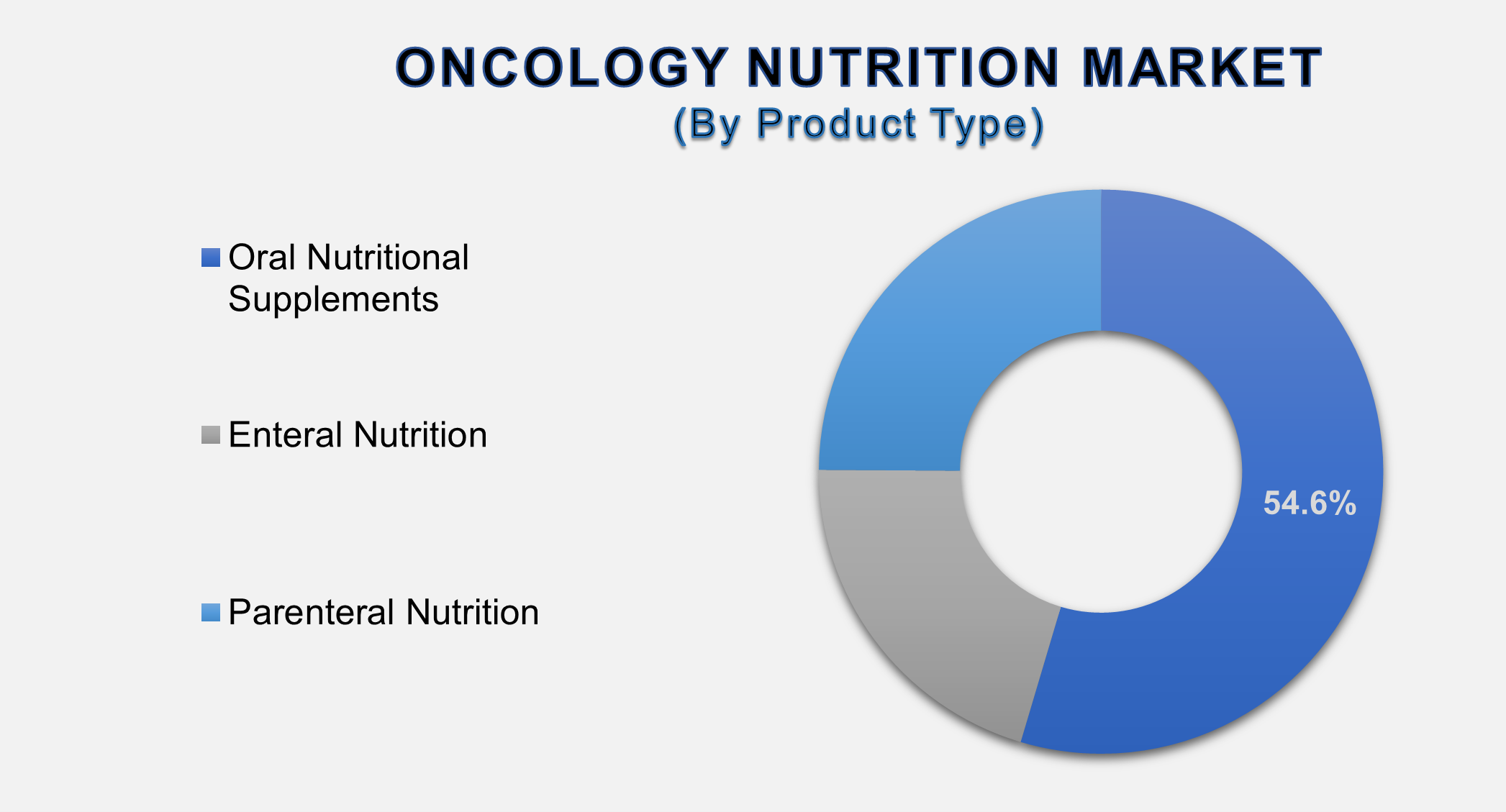
The Oral Nutritional
Supplements Segment Represents the Largest Share of the Market
The oral nutritional supplements (ONS) segment holds the largest share of the oncology nutrition market primarily due to its convenience, non-invasive administration, and strong patient acceptance across all stages of cancer treatment. ONS products are widely prescribed to cancer patients undergoing chemotherapy, radiotherapy, and post-surgical recovery to address treatment-induced weight loss, muscle wasting, fatigue, and reduced appetite. Their ready-to-consume formats, including liquids, powders, and semi-solid formulations, make them particularly suitable for outpatient and home care settings, supporting continuity of nutritional care beyond hospitals. Advancements in formulation have led to the development of high-protein, energy-dense, and immune-enhancing supplements enriched with omega-3 fatty acids, antioxidants, and micronutrients. Improved taste, texture, and digestibility have significantly increased patient compliance, especially among elderly and long-term oncology patients. Moreover, growing clinical evidence supporting the role of early nutritional intervention in improving treatment tolerance and reducing complications has increased physician and dietitian recommendations. The expanding home-based cancer care trend and availability of disease-specific ONS further reinforce the dominance of this segment globally.
Gastrointestinal and Head
& Neck Cancer Segments Dominate the Cancer Type Landscape
Gastrointestinal
and head & neck cancers dominate the oncology nutrition market due to the
high prevalence of nutrition-related complications associated with these cancer
types. Patients with gastrointestinal cancers often experience impaired digestion,
nutrient malabsorption, and altered metabolism, while those with head &
neck cancers frequently face swallowing difficulties, oral pain, and reduced
food intake as a result of tumors and aggressive treatments.
These
challenges significantly increase the risk of malnutrition and cachexia, making
specialized nutritional support a critical component of clinical management.
Oncology nutrition interventions help maintain body weight, preserve muscle
mass, and enhance immune function, thereby improving treatment tolerance and
overall quality of life. Healthcare providers increasingly integrate
nutritional assessment and intervention into standard care protocols for these
cancers, driving consistent demand for oral, enteral, and parenteral nutrition
solutions. Rising global incidence of gastrointestinal and head & neck
cancers, combined with improved diagnosis and longer survival rates, continue to support the sustained
growth of these segments within the oncology nutrition market.
The following segments are
part of an in-depth analysis of the global Oncology Nutrition Market:
|
Market
Segments |
|
|
By Product
Type |
●
Oral Nutritional
Supplements ●
Enteral Nutrition ●
Parenteral Nutrition |
|
By Cancer Type |
●
Head & Neck
Cancer ●
Gastrointestinal
Cancer ●
Lung Cancer ●
Breast Cancer ●
Others |
|
By End-user |
●
Hospitals ●
Specialty Cancer
Clinics ●
Homecare ●
Long-term Care
Facilities |
Oncology Nutrition Market Share Analysis by
Region
The North America region
is anticipated to hold the largest portion of the Oncology Nutrition Market
globally throughout the forecast period.
North America Holds the
Largest Share of the Global Oncology Nutrition Market
North
America is anticipated to hold the largest share of the global oncology
nutrition market throughout the forecast period, bolstered by mature healthcare
systems, advanced oncology treatment protocols, strong reimbursement
frameworks, and high clinical awareness of nutrition therapy’s role in cancer
care. The United States alone accounts for a significant cancer burden, with
over 2.3 million new cancer cases annually, making it one of the highest
incidence regions globally. World Cancer Research Fund. According to global cancer estimates, North America
contributes roughly 13–14% of all new cancer
cases worldwide, despite representing a much smaller share of the global
population, an indication of both high
detection rates and major clinical engagement. High cancer incidence coupled
with extensive screening efforts supports strong demand for oncology nutrition
solutions, particularly in hospital and homecare settings where multidisciplinary
cancer care protocols include early nutritional assessment.
Moreover,
well-established reimbursement systems frequently cover specialized nutrition
products, easing adoption by clinicians and patients alike. The widespread
presence of leading clinical nutrition and oncology companies enables rapid
product rollout and evidence-based clinical support. Advanced research
initiatives and cancer treatment networks also drive awareness of nutrition’s
importance in improving treatment tolerance, reducing complications, and
supporting quality of life, all of which contribute to North America’s dominant
market position.
Oncology Nutrition Market Competition Landscape
Analysis
The oncology nutrition market
is moderately consolidated, with key players focusing on specialized product
development, clinical validation, and strategic partnerships with oncology
centers. Companies are investing in research-driven formulations, patient-centric
packaging, and expansion into emerging markets to strengthen their competitive
position.
Global Oncology Nutrition Market Recent Developments News:
- In April 2025, Nestlé Health
Science launched an advanced oncology-focused oral nutritional supplement
designed to support muscle maintenance and immune health during
chemotherapy.
- In February 2025, Abbott
expanded its oncology nutrition portfolio in Asia-Pacific, targeting
hospital and homecare cancer patients.
- In October 2024, Fresenius Kabi
introduced an improved enteral nutrition formula for oncology patients
with gastrointestinal complications.
The Global Oncology Nutrition Market Is Dominated
by a Few Large Companies, such as
●
Nestlé Health Science
●
Abbott Laboratories
●
Danone S.A.
●
Fresenius Kabi
●
Baxter International
●
B. Braun Melsungen AG
●
Pfizer Inc.
●
Mead Johnson Nutrition
●
Victus Inc.
●
Smartfish AS
●
Global Health Products
●
Nutricia (Danone)
●
Hormel Health Labs
●
Ajinomoto Co., Inc.
● Otsuka Pharmaceutical
Frequently Asked Questions
Swetal (Research Analyst)
Swetal is a Research Analyst with 4+ years of experience specializing in healthcare market research, medical devices, healthcare IT, and medical technology industry analysis. Her expertise includes competitive intelligence, secondary research, market trend forecasting, and healthcare business insights across global healthcare ecosystems.
She contributes to advanced market research reports by analyzing regulatory frameworks, emerging healthcare technologies, competitive landscapes, and innovation trends shaping the medical industry. With a strong focus on accurate market intelligence, strategic insights, and healthcare industry trends, Swetal supports businesses in making informed, data-backed decisions in a rapidly transforming healthcare environment.
1. Global Oncology Nutrition
Market Introduction and Market Overview
1.1.
Objectives
of the Study
1.2.
Global
Oncology Nutrition Market Scope and Market Estimation
1.2.1.Global Electronic Toll
Collection Overall Market Size (US$ Bn), Market CAGR (%), Market forecast (2025
- 2033)
1.2.2.Global Oncology Nutrition
Market Revenue Share (%) and Growth Rate (Y-o-Y) from 2020 - 2033
1.3.
Market
Segmentation
1.3.1.Product Type of Global Oncology
Nutrition Market
1.3.2.Cancer Type of Global Oncology
Nutrition Market
1.3.3.End-user of Global Oncology
Nutrition Market
1.3.4.Region of Global Oncology
Nutrition Market
2. Executive
Summary
2.1.
Demand
Side Trends
2.2.
Key
Market Trends
2.3.
Market
Demand (US$ Bn) Analysis 2020 – 2024 and forecast, 2025 – 2033
2.4.
Demand
and Opportunity Assessment
2.5.
Key
Developments
2.6.
Market
Entry Strategies
2.7.
Market
Dynamics
2.7.1.Drivers
2.7.2.Limitations
2.7.3.Opportunities
2.7.4.Impact Analysis of Drivers
and Restraints
2.8.
Porter’s
Five Forces Analysis
2.9.
Pricing
Analysis
2.10.
PEST
Analysis
3. Global
Oncology Nutrition Market Estimates
& Historical Trend Analysis (2020 - 2024)
4. Global
Oncology Nutrition Market Estimates
& Forecast Trend Analysis, by Product Type
4.1.
Global
Oncology Nutrition Market Revenue (US$ Bn) Estimates and Forecasts, by Product
Type, 2020 - 2033
4.1.1.Oral Nutritional
Supplements
4.1.2.Enteral Nutrition
4.1.3.Parenteral Nutrition
5. Global
Oncology Nutrition Market Estimates
& Forecast Trend Analysis, by Cancer Type
5.1.
Global
Oncology Nutrition Market Revenue (US$ Bn) Estimates and Forecasts, by Cancer
Type, 2020 - 2033
5.1.1.Head & Neck Cancer
5.1.2.Gastrointestinal Cancer
5.1.3.Lung Cancer
5.1.4.Breast Cancer
5.1.5.Others
6. Global
Oncology Nutrition Market Estimates
& Forecast Trend Analysis, by End-user
6.1.
Global
Oncology Nutrition Market Revenue (US$ Bn) Estimates and Forecasts, by End-user,
2020 - 2033
6.1.1.Hospitals
6.1.2.Specialty Cancer Clinics
6.1.3.Homecare
6.1.4.Long-term Care Facilities
7. Global
Oncology Nutrition Market Estimates
& Forecast Trend Analysis, by region
7.1.
Global
Oncology Nutrition Market Revenue (US$ Bn) Estimates and Forecasts, by region, 2020
- 2033
7.1.1.North America
7.1.2.Europe
7.1.3.Asia Pacific
7.1.4.Middle East & Africa
7.1.5.Latin America
8. North America Oncology
Nutrition Market: Estimates &
Forecast Trend Analysis
8.1.
North
America Oncology Nutrition Market Assessments & Key Findings
8.1.1.North America Oncology
Nutrition Market Introduction
8.1.2.North America Oncology
Nutrition Market Size Estimates and Forecast (US$ Billion) (2020 - 2033)
8.1.2.1. By Product
Type
8.1.2.2. By Cancer
Type
8.1.2.3. By End-user
8.1.2.4.
By
Country
8.1.2.4.1. The U.S.
8.1.2.4.2. Canada
9. Europe Oncology
Nutrition Market: Estimates &
Forecast Trend Analysis
9.1.
Europe
Oncology Nutrition Market Assessments & Key Findings
9.1.1.Europe Oncology Nutrition
Market Introduction
9.1.2.Europe Oncology Nutrition
Market Size Estimates and Forecast (US$ Billion) (2020 - 2033)
9.1.2.1. By Product
Type
9.1.2.2. By Cancer
Type
9.1.2.3. By End-user
9.1.2.4.
By
Country
9.1.2.4.1.
Germany
9.1.2.4.2.
Italy
9.1.2.4.3.
U.K.
9.1.2.4.4.
France
9.1.2.4.5.
Spain
9.1.2.4.6.
Switzerland
9.1.2.4.7. Rest
of Europe
10. Asia Pacific Oncology
Nutrition Market: Estimates &
Forecast Trend Analysis
10.1.
Asia
Pacific Market Assessments & Key Findings
10.1.1.
Asia
Pacific Oncology Nutrition Market Introduction
10.1.2.
Asia
Pacific Oncology Nutrition Market Size Estimates and Forecast (US$ Billion) (2020
- 2033)
10.1.2.1. By Product
Type
10.1.2.2. By Cancer
Type
10.1.2.3. By End-user
10.1.2.4.
By
Country
10.1.2.4.1. China
10.1.2.4.2. Japan
10.1.2.4.3. India
10.1.2.4.4. Australia
10.1.2.4.5. South Korea
10.1.2.4.6. Rest of Asia Pacific
11. Middle East & Africa Oncology
Nutrition Market: Estimates &
Forecast Trend Analysis
11.1.
Middle
East & Africa Market Assessments & Key Findings
11.1.1.
Middle East & Africa Oncology Nutrition Market
Introduction
11.1.2.
Middle East & Africa Oncology Nutrition Market Size Estimates
and Forecast (US$ Billion) (2020 - 2033)
11.1.2.1. By Product
Type
11.1.2.2. By Cancer
Type
11.1.2.3. By End-user
11.1.2.4.
By
Country
11.1.2.4.1. UAE
11.1.2.4.2. Saudi
Arabia
11.1.2.4.3. South
Africa
11.1.2.4.4. Rest
of MEA
12. Latin America
Oncology Nutrition Market: Estimates
& Forecast Trend Analysis
12.1.
Latin
America Market Assessments & Key Findings
12.1.1.
Latin
America Oncology Nutrition Market Introduction
12.1.2.
Latin
America Oncology Nutrition Market Size Estimates and Forecast (US$ Billion) (2020
- 2033)
12.1.2.1. By Product
Type
12.1.2.2. By Cancer
Type
12.1.2.3. By End-user
12.1.2.4.
By
Country
12.1.2.4.1. Brazil
12.1.2.4.2. Argentina
12.1.2.4.3. Mexico
12.1.2.4.4. Rest
of LATAM
13. Country Wise Market:
Introduction
14.
Competition
Landscape
14.1.
Global
Oncology Nutrition Market Product Mapping
14.2.
Global
Oncology Nutrition Market Concentration Analysis, by Leading Players /
Innovators / Emerging Players / New Entrants
14.3.
Global
Oncology Nutrition Market Tier Structure Analysis
14.4.
Global
Oncology Nutrition Market Concentration & Company Market Shares (%)
Analysis, 2024
15.
Company
Profiles
15.1.
Nestlé Health Science
15.1.1.
Company
Overview & Key Stats
15.1.2.
Financial
Performance & KPIs
15.1.3.
Product
Portfolio
15.1.4.
SWOT
Analysis
15.1.5.
Business
Strategy & Recent Developments
* Similar details would be provided for all the players
mentioned below
15.2. Abbott
Laboratories
15.3. Danone S.A.
15.4. Fresenius
Kabi
15.5. Baxter
International
15.6. B. Braun
Melsungen AG
15.7. Pfizer Inc.
15.8. Mead Johnson
Nutrition
15.9. Victus Inc.
15.10. Smartfish AS
15.11. Global Health
Products
15.12. Nutricia
(Danone)
15.13. Hormel Health
Labs
15.14. Ajinomoto
Co., Inc.
15.15. Otsuka
Pharmaceutical
15.16. Other
Prominent Players
16. Research
Methodology
16.1.
External
Transportations / Databases
16.2.
Internal
Proprietary Database
16.3.
Primary
Research
16.4.
Secondary
Research
16.5.
Assumptions
16.6.
Limitations
16.7.
Report
FAQs
17. Research
Findings & Conclusion
Our Research Methodology
"Insight without rigor is just noise."
We follow a comprehensive, multi-phase research framework designed to deliver accurate, strategic, and decision-ready intelligence. Our process integrates primary and secondary research , both quantitative and qualitative , along with dual modeling techniques ( top-down and bottom-up) and a final layer of validation through our proprietary in-house repository.
PRIMARY RESEARCH
Primary research captures real-time, firsthand insights from the market to understand behaviors, motivations, and emerging trends.
1. Quantitative Primary Research
Objective: Generate statistically significant data directly from market participants.
Approaches:- Structured surveys with customers, distributors, and field agents
- Mobile-based data collection for point-of-sale audits and usage behavior
- Phone-based interviews (CATI) for market sizing and product feedback
- Online polling around industry events and digital campaigns
- Purchase frequency by customer type
- Channel performance across geographies
- Feature demand by application or demographic
2. Qualitative Primary Research
Objective: Explore decision-making drivers, pain points, and market readiness.
Approaches:- In-depth interviews (IDIs) with executives, product managers, and key decision-makers
- Focus groups among end users and early adopters
- Site visits and observational research for consumer products
- Informal field-level discussions for regional and cultural nuances
SECONDARY RESEARCH
This phase helps establish a macro-to-micro understanding of market trends, size, regulation, and competitive dynamics, sourced from credible and public domain information.
1. Quantitative Secondary Research
Objective: Model market value and segment-level forecasts based on published data.
Sources include:- Financial reports and investor summaries
- Government trade data, customs records, and regulatory statistics
- Industry association publications and economic databases
- Channel performance and pricing data from marketplace listings
- Revenue splits, pricing trends, and CAGR estimates
- Supply-side capacity and volume tracking
- Investment analysis and funding benchmarks
2. Qualitative Secondary Research
Objective: Capture strategic direction, innovation signals, and behavioral trends.
Sources include:- Company announcements, roadmaps, and product pipelines
- Publicly available whitepapers, conference abstracts, and academic research
- Regulatory body publications and policy briefs
- Social and media sentiment scanning for early-stage shifts
- Strategic shifts in market positioning
- Unmet needs and white spaces
- Regulatory triggers and compliance impact
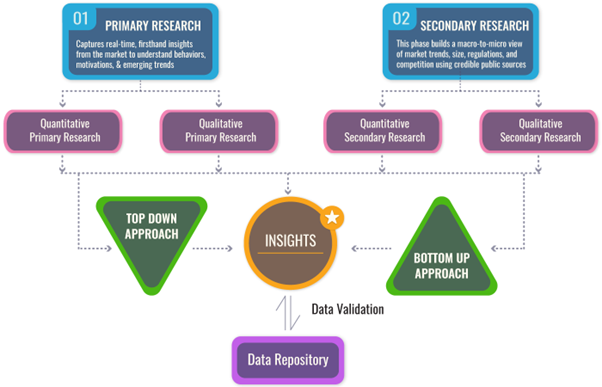
DUAL MODELING: TOP-DOWN + BOTTOM-UP
To ensure robust market estimation, we apply two complementary sizing approaches:
Top-Down Modeling:- Start with broader industry value (e.g., global or regional TAM)
- Apply filters by segment, geography, end-user, or use case
- Adjust with primary insights and validation benchmarks
- Ideal for investor-grade market scans and opportunity mapping
- Aggregate from the ground up using sales volumes, pricing, and unit economics
- Use internal modeling templates aligned with stakeholder data
- Incorporate distributor-level or region-specific inputs
- Most accurate for emerging segments and granular sub-markets
DATA VALIDATION: IN-HOUSE REPOSITORY
We close the loop with proprietary data intelligence built from ongoing projects, industry monitoring, and historical benchmarking. This repository includes:
- Multi-sector market and pricing models
- Key trendlines from past interviews and forecasts
- Benchmarked adoption rates, churn patterns, and ROI indicators
- Industry-specific deviation flags and cross-check logic
- Catches inconsistencies early
- Aligns projections across studies
- Enables consistent, high-trust deliverables