

Online Music Streaming Market Size and Forecast (2020 - 2033), Global and Regional Growth, Trend, Share, and Industry Analysis Report Coverage: By Service (On-Demand Streaming, Live Streaming), By Platform (Apps, Browsers), By Content Type (Audio, Video), By Subscription Model (Ad-Supported, Subscription-Based), By End-User (Individual, Commercial) And Geography
2025-12-04
Media & Entertainment
Jaya Bundele (Research Analyst)
Description
Online Music Streaming Market Overview
The Online Music Streaming Market is poised for dynamic growth from 2025 to 2033, fueled by the pervasive penetration of high-speed internet, the proliferation of smartphones, and the shifting consumer preference for access over ownership of music. The market is projected to be valued at approximately USD 25.5 billion in 2025 and is forecasted to reach nearly USD 62.3 billion by 2033, exhibiting a compound annual growth rate (CAGR) of 12.2% during this period.

Online music streaming provides users with instant access
to vast libraries of music content over the internet, eliminating the need for
downloads or physical media. The market's expansion is primarily driven by the
increasing affordability of mobile data, the integration of streaming services
with smart devices (like speakers, wearables, and automotive infotainment
systems), and strategic content acquisition,
including exclusive releases and podcasts.
The growing creator economy and the rise of algorithmic,
personalized music recommendations are enhancing user engagement and retention.
Furthermore, the expansion into emerging economies with young, digitally
native populations presents a massive, untapped user
base. Intense competition among key players is leading to constant innovation
in audio quality (such as spatial and lossless audio), user interface design,
and diversified content offerings, which in turn propels market growth. North
America currently holds the largest revenue share due to high disposable income
and early service adoption, while the Asia-Pacific region is expected to
witness the fastest growth, driven by rapid digitalization and rising
smartphone penetration.
Online
Music Streaming Market Drivers and Opportunities
Proliferation of High-Speed Internet and
Smartphone Penetration is the Primary Market Driver
The widespread availability and increasing
affordability of high-speed mobile broadband and fixed-line internet are the
most powerful drivers for the online music streaming market. Concurrently, the
global penetration of smartphones acts as the primary access point for these
services. This ubiquitous connectivity allows users to stream music seamlessly
anytime, anywhere, transforming how music is consumed. The shift from ownership
(digital downloads, CDs) to access-based streaming models is almost entirely dependent
on reliable and fast internet, making this technological infrastructure the
foundational element for the market's existence and growth.
The Rise of Personalized and Curated Content
is Driving User Engagement and Subscription Growth
The strategic use of artificial intelligence and
machine learning to deliver hyper-personalized music experiences is a critical
catalyst for market adoption and retention. Features like algorithmically
generated playlists, daily mixes, and music discovery radios cater to
individual user tastes, creating a sticky ecosystem that is difficult for users
to leave. This personalization, combined with exclusive content from top
artists, original podcasts, and live sessions, enhances the value proposition
of subscription plans. As services move beyond being mere music libraries to
becoming personalized audio companions, they successfully convert free,
ad-supported users into paying subscribers, directly driving revenue growth.
Expansion into New Audio Formats and
Integration with the Connected Ecosystem Present Significant Opportunities
The strategic expansion into new audio verticals
and deeper integration within the Internet of Things (IoT) landscape are
creating substantial growth frontiers. A key opportunity lies in the rapid
growth of podcasting, audiobooks, and live audio social platforms, allowing
streaming services to become all-in-one audio destinations. Furthermore, there
is immense potential in integrating streaming services more deeply into
connected cars, smart homes, and wearable devices, creating a seamless,
multi-device audio experience. For vendors, developing high-fidelity audio
tiers (like Hi-Res and Spatial Audio) to cater to audiophiles, creating
innovative family and student plans, and forging partnerships with telecom
operators for bundled data and subscription packages are key strategies to
capture new market share and increase average revenue per user (ARPU).
Online Music Streaming Market Scope
|
Report Attributes |
Description |
|
Market Size in 2025 |
USD 25.5 Billion |
|
Market Forecast in 2033 |
USD 62.3 Billion |
|
CAGR % 2025-2033 |
12.2% |
|
Base Year |
2024 |
|
Historic Data |
2020-2024 |
|
Forecast Period |
2025-2033 |
|
Report USP |
Product Portfolio,
Technological Analysis, Company Market Share, Company Heatmap, Pricing
Analysis, Growth Factors and more |
|
Segments Covered |
●
By Service ●
By Content Type ●
By Platform ●
By Subscription
Model ●
By End-user |
|
Regional Scope |
●
North America, ●
Europe, ●
APAC, ●
Latin America ●
Middle East and
Africa |
|
Country Scope |
1)
U.S. 2)
Canada 3)
Germany 4)
UK 5)
France 6)
Spain 7)
Italy 8)
Switzerland 9)
China 10)
Japan 11)
India 12)
Australia 13)
South Korea 14)
Brazil 15)
Mexico 16)
Argentina 17)
South Africa 18)
Saudi Arabia 19)
UAE |
Online Music Streaming Market Report Segmentation Analysis
The global
Online Music Streaming Market industry analysis is segmented by Service, by
Platform, by Content Type, by Subscription Model, by End-User, and by Region.
The On-Demand
Streaming segment is anticipated to command the largest market share in 2025.
The Service segment is categorized into On-Demand Streaming and Live Streaming. The dominance
of the On-Demand Streaming segment is attributed to its alignment with the core
consumer desire for control and convenience. This model allows users to play
any song, album, or playlist from the service's entire catalog at any time,
perfectly suiting modern listening habits. Its popularity is fueled by major
platforms like Spotify, Apple Music, and Amazon Music. While live streaming for
concerts and events is growing, on-demand remains the fundamental, most widely
used, and revenue-generating pillar of the music streaming industry, securing
its position as the segment with the largest market share.

The Subscription-Based model segment is projected to grow
at a significant CAGR.
The Subscription Model segment includes Ad-Supported and
Subscription-Based. The Subscription-Based segment's projected significant
growth is driven by its direct contribution to platform revenue and its
superior user experience. Subscription models offer users an ad-free listening
experience, higher audio quality, offline downloads, and often access to a
broader range of features. As platforms enhance their content libraries with
podcasts and exclusives, the value proposition of a paid subscription increases.
The continuous global push by streaming services to convert their massive
ad-supported user bases into paying subscribers through targeted marketing and
attractive pricing plans makes this the fastest-growing revenue segment.
The Individual end-user segment is projected to witness the
highest growth rate.
The End-User segment is divided into Individual and
Commercial. The Individual segment's position as the fastest-growing channel is
a result of the direct-to-consumer nature of streaming services. The primary
growth engine is the billions of potential individual users worldwide,
especially in emerging markets where smartphone and internet adoption are still accelerating. Services are increasingly tailored to
individual listening habits with personalized playlists and recommendations,
driving engagement. The introduction of diverse individual and family plans at
various price points makes these services accessible to a vast demographic,
propelling user acquisition and retention in this segment.
The
following segments are part of an in-depth analysis of the global Online Music
Streaming Market:
|
Market
Segments |
|
|
By
Service |
●
On-Demand Streaming ●
Live Streaming |
|
By Content
Type |
●
Audio ●
Video |
|
By Platform |
●
Apps ●
Browsers |
|
By
Subscription Model |
●
Ad-Supported ●
Subscription-Based |
|
By End-user |
●
Individual ●
Commercial |
Online Music Streaming Market Share Analysis by Region
The North America region is anticipated to hold the largest
portion of the Online Music Streaming Market globally throughout the forecast
period
North
America's dominance is driven by high disposable income, extensive 5G and
broadband infrastructure, and the early and widespread adoption of digital
services. The region is home to several of the world's largest streaming
platforms and has a mature market with a high rate of paid subscriptions per
capita. Strong copyright laws and a culture of paying for digital content
further solidify its leadership. High smartphone penetration and the deep
integration of streaming services into connected cars and smart home devices
continue to fuel market growth in this region.
The U.S. has
a highly competitive streaming landscape with intense rivalry between
platforms, leading to constant innovation in content and features. The country
has one of the highest ARPUs in the world, making it a highly lucrative market.
High consumer spending on entertainment, coupled with major labels and artists
based in the U.S., ensures a steady flow of new content. The presence of tech
giants like Apple, Amazon, and Google in the streaming space further
intensifies competition and drives market development.
Online Music Streaming Market Competition Landscape Analysis
The global online music streaming market is
highly competitive and characterized by the presence of global tech giants,
pure-play music streamers, and regional players. Competition is based on
content library size and exclusivity, audio quality, algorithm and
personalization effectiveness, user interface, pricing of subscription plans,
and brand strength. Key strategies include securing exclusive podcast deals and
artist partnerships, developing advanced recommendation algorithms, expanding
into new geographical markets, and forming bundling partnerships with mobile
carriers and other digital services.
Global Online Music Streaming Market Recent Developments
News:
- In January 2025, Spotify announced a new
partnership with a major record label to launch a dedicated "Spatial
Audio" hub, featuring exclusive artist content to drive premium
subscriptions.
- In November 2024, Apple Music integrated its
service deeper into the automotive sector, launching a native app with
enhanced voice control for a leading electric vehicle manufacturer's
fleet.
- In September 2024, YouTube Music expanded its
podcast catalog significantly, adding exclusive shows from popular
creators to compete directly with dedicated podcast platforms.
- In July 2024, Tencent Music Entertainment (TME)
reported a surge in monthly active users, attributed to its successful
live-streaming concert events and karaoke-style social features in the
Asian market.
The Global Online Music Streaming Market
Is Dominated by a Few Large Companies, such as
●
Spotify
●
Apple Inc.
●
Amazon.com, Inc.
●
Google LLC (YouTube
Music)
●
Tencent Music
Entertainment Group
●
NetEase Cloud Music
●
Deezer
●
SoundCloud
●
Pandora (SiriusXM)
●
Anghami
●
Yandex N.V. (Yandex
Music)
●
JioSaavn
●
Gaana
●
KKBox
● Other Prominent Players
Frequently Asked Questions
Jaya Bundele (Research Analyst)
Jaya Bundele is a skilled Research Analyst with 4+ years of experience in market intelligence, consumer insights, competitive analysis, and industry forecasting across the consumer goods, agriculture, and food & beverage sectors. She specializes in market sizing, trend analysis, growth opportunity mapping, and strategic secondary research for global and regional markets.
Her expertise lies in transforming complex industry data into actionable business strategies that help organizations identify emerging trends, understand customer behavior, and gain a competitive edge. With a strong focus on data-driven insights, business intelligence, and future market trends, Jaya delivers high-quality research solutions aligned with evolving industry demands and market dynamics.
1. Global Online Music
Streaming Market Introduction and Market Overview
1.1.
Objectives
of the Study
1.2.
Global
Online Music Streaming Market Scope and Market Estimation
1.2.1.Global Electronic Toll
Collection Overall Market Size (US$ Bn), Market CAGR (%), Market forecast (2025
- 2033)
1.2.2.Global Online Music
Streaming Market Revenue Share (%) and Growth Rate (Y-o-Y) from 2020 - 2033
1.3.
Market
Segmentation
1.3.1.Service of Global Online
Music Streaming Market
1.3.2.Content Type of Global Online
Music Streaming Market
1.3.3.Platform of Global Online
Music Streaming Market
1.3.4.Subscription Model of
Global Online Music Streaming Market
1.3.5.End-user of Global Online
Music Streaming Market
1.3.6.Region of Global Online
Music Streaming Market
2.
Executive Summary
2.1.
Demand
Side Trends
2.2.
Key
Market Trends
2.3.
Market
Demand (US$ Bn) Analysis 2020 – 2024 and forecast, 2025 – 2033
2.4.
Demand
and Opportunity Assessment
2.5.
Key
Developments
2.6.
Market
Entry Strategies
2.7.
Market
Dynamics
2.7.1.Drivers
2.7.2.Limitations
2.7.3.Opportunities
2.7.4.Impact Analysis of Drivers
and Restraints
2.8.
Porter’s
Five Forces Analysis
2.9.
PEST
Analysis
3. Global
Online Music Streaming Market Estimates
& Historical Trend Analysis (2020 - 2024)
4. Global
Online Music Streaming Market Estimates
& Forecast Trend Analysis, by Service
4.1.
Global
Online Music Streaming Market Revenue (US$ Bn) Estimates and Forecasts, by Service,
2020 - 2033
4.1.1.On-Demand Streaming
4.1.2.Live Streaming
5. Global
Online Music Streaming Market Estimates
& Forecast Trend Analysis, by Content Type
5.1.
Global
Online Music Streaming Market Revenue (US$ Bn) Estimates and Forecasts, by Content
Type, 2020 - 2033
5.1.1.Audio
5.1.2.Video
6. Global
Online Music Streaming Market Estimates
& Forecast Trend Analysis, by End-user
6.1.
Global
Online Music Streaming Market Revenue (US$ Bn) Estimates and Forecasts, by End-user
2020 - 2033
6.1.1.Individual
6.1.2.Commercial
7. Global
Online Music Streaming Market Estimates
& Forecast Trend Analysis, by region
7.1.
Global
Online Music Streaming Market Revenue (US$ Bn) Estimates and Forecasts, by region,
2020 - 2033
7.1.1.North America
7.1.2.Europe
7.1.3.Asia Pacific
7.1.4.Middle East & Africa
7.1.5.Latin America
8. North America Online
Music Streaming Market: Estimates &
Forecast Trend Analysis
8.1. North America Online Music
Streaming Market Assessments & Key Findings
8.1.1.North America Online Music
Streaming Market Introduction
8.1.2.North America Online Music
Streaming Market Size Estimates and Forecast (US$ Billion) (2020 - 2033)
8.1.2.1.
By Service
8.1.2.2.
By Content Type
8.1.2.3.
By Platform
8.1.2.4.
By Subscription Model
8.1.2.5.
By End-user
8.1.2.6. By Country
8.1.2.6.1. The U.S.
8.1.2.6.2. Canada
9. Europe Online
Music Streaming Market: Estimates &
Forecast Trend Analysis
9.1. Europe Online Music
Streaming Market Assessments & Key Findings
9.1.1.Europe Online Music
Streaming Market Introduction
9.1.2.Europe Online Music
Streaming Market Size Estimates and Forecast (US$ Billion) (2020 - 2033)
9.1.2.1.
By Service
9.1.2.2.
By Content Type
9.1.2.3.
By Platform
9.1.2.4.
By Subscription Model
9.1.2.5.
By End-user
9.1.2.6. By Country
9.1.2.6.1.
Germany
9.1.2.6.2.
Italy
9.1.2.6.3.
U.K.
9.1.2.6.4.
France
9.1.2.6.5.
Spain
9.1.2.6.6.
Switzerland
9.1.2.6.7. Rest
of Europe
10. Asia Pacific Online
Music Streaming Market: Estimates &
Forecast Trend Analysis
10.1. Asia Pacific Market
Assessments & Key Findings
10.1.1.
Asia
Pacific Online Music Streaming Market Introduction
10.1.2.
Asia
Pacific Online Music Streaming Market Size Estimates and Forecast (US$ Billion)
(2020 - 2033)
10.1.2.1.
By Service
10.1.2.2.
By Content Type
10.1.2.3.
By Platform
10.1.2.4.
By Subscription Model
10.1.2.5.
By End-user
10.1.2.6. By Country
10.1.2.6.1. China
10.1.2.6.2. Japan
10.1.2.6.3. India
10.1.2.6.4. Australia
10.1.2.6.5. South Korea
10.1.2.6.6. Rest of Asia Pacific
11. Middle East & Africa Online
Music Streaming Market: Estimates &
Forecast Trend Analysis
11.1. Middle East & Africa
Market Assessments & Key Findings
11.1.1. Middle
East & Africa
Online Music Streaming Market Introduction
11.1.2. Middle
East & Africa
Online Music Streaming Market Size Estimates and Forecast (US$ Billion) (2020 -
2033)
11.1.2.1.
By Service
11.1.2.2.
By Content Type
11.1.2.3.
By Platform
11.1.2.4.
By Subscription Model
11.1.2.5.
By End-user
11.1.2.6. By Country
11.1.2.6.1. UAE
11.1.2.6.2. Saudi
Arabia
11.1.2.6.3. South
Africa
11.1.2.6.4. Rest
of MEA
12. Latin America
Online Music Streaming Market:
Estimates & Forecast Trend Analysis
12.1. Latin America Market
Assessments & Key Findings
12.1.1. Latin America Online Music
Streaming Market Introduction
12.1.2. Latin America Online Music
Streaming Market Size Estimates and Forecast (US$ Billion) (2020 - 2033)
12.1.2.1.
By Service
12.1.2.2.
By Content Type
12.1.2.3.
By Platform
12.1.2.4.
By Subscription Model
12.1.2.5.
By End-user
12.1.2.6. By Country
12.1.2.6.1. Brazil
12.1.2.6.2. Argentina
12.1.2.6.3. Mexico
12.1.2.6.4. Rest
of LATAM
13.
Country
Wise Market: Introduction
14.
Competition
Landscape
14.1. Global Online Music
Streaming Market Product Mapping
14.2. Global Online Music
Streaming Market Concentration Analysis, by Leading Players / Innovators /
Emerging Players / New Entrants
14.3. Global Online Music
Streaming Market Tier Structure Analysis
14.4. Global Online Music
Streaming Market Concentration & Company Market Shares (%) Analysis, 2024
15.
Company
Profiles
15.1.
Spotify
15.1.1.
Company
Overview & Key Stats
15.1.2.
Financial
Performance & KPIs
15.1.3.
Product
Portfolio
15.1.4.
SWOT
Analysis
15.1.5.
Business
Strategy & Recent Developments
* Similar details would be provided for all the players
mentioned below
15.2.
Apple Inc.
15.3.
Amazon.com, Inc.
15.4.
Google LLC (YouTube Music)
15.5.
Tencent Music Entertainment Group
15.6.
NetEase Cloud Music
15.7.
Deezer
15.8.
SoundCloud
15.9.
Pandora (SiriusXM)
15.10.
Anghami
15.11.
Yandex N.V. (Yandex Music)
15.12.
JioSaavn
15.13.
Gaana
15.14.
KKBox
15.15.
Other Prominent Players
16. Research
Methodology
16.1. External Transportations /
Databases
16.2. Internal Proprietary
Database
16.3. Primary Research
16.4. Secondary Research
16.5. Assumptions
16.6. Limitations
16.7. Report FAQs
17. Research
Findings & Conclusion
Our Research Methodology
"Insight without rigor is just noise."
We follow a comprehensive, multi-phase research framework designed to deliver accurate, strategic, and decision-ready intelligence. Our process integrates primary and secondary research , both quantitative and qualitative , along with dual modeling techniques ( top-down and bottom-up) and a final layer of validation through our proprietary in-house repository.
PRIMARY RESEARCH
Primary research captures real-time, firsthand insights from the market to understand behaviors, motivations, and emerging trends.
1. Quantitative Primary Research
Objective: Generate statistically significant data directly from market participants.
Approaches:- Structured surveys with customers, distributors, and field agents
- Mobile-based data collection for point-of-sale audits and usage behavior
- Phone-based interviews (CATI) for market sizing and product feedback
- Online polling around industry events and digital campaigns
- Purchase frequency by customer type
- Channel performance across geographies
- Feature demand by application or demographic
2. Qualitative Primary Research
Objective: Explore decision-making drivers, pain points, and market readiness.
Approaches:- In-depth interviews (IDIs) with executives, product managers, and key decision-makers
- Focus groups among end users and early adopters
- Site visits and observational research for consumer products
- Informal field-level discussions for regional and cultural nuances
SECONDARY RESEARCH
This phase helps establish a macro-to-micro understanding of market trends, size, regulation, and competitive dynamics, sourced from credible and public domain information.
1. Quantitative Secondary Research
Objective: Model market value and segment-level forecasts based on published data.
Sources include:- Financial reports and investor summaries
- Government trade data, customs records, and regulatory statistics
- Industry association publications and economic databases
- Channel performance and pricing data from marketplace listings
- Revenue splits, pricing trends, and CAGR estimates
- Supply-side capacity and volume tracking
- Investment analysis and funding benchmarks
2. Qualitative Secondary Research
Objective: Capture strategic direction, innovation signals, and behavioral trends.
Sources include:- Company announcements, roadmaps, and product pipelines
- Publicly available whitepapers, conference abstracts, and academic research
- Regulatory body publications and policy briefs
- Social and media sentiment scanning for early-stage shifts
- Strategic shifts in market positioning
- Unmet needs and white spaces
- Regulatory triggers and compliance impact
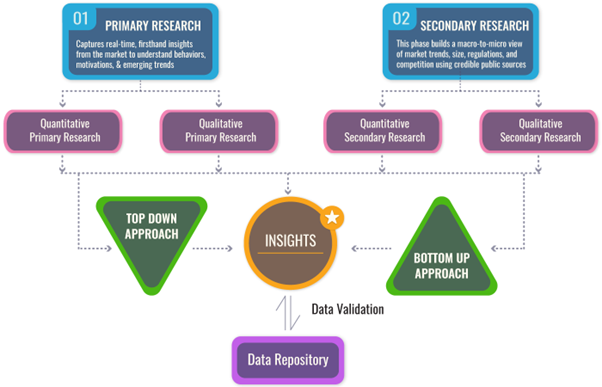
DUAL MODELING: TOP-DOWN + BOTTOM-UP
To ensure robust market estimation, we apply two complementary sizing approaches:
Top-Down Modeling:- Start with broader industry value (e.g., global or regional TAM)
- Apply filters by segment, geography, end-user, or use case
- Adjust with primary insights and validation benchmarks
- Ideal for investor-grade market scans and opportunity mapping
- Aggregate from the ground up using sales volumes, pricing, and unit economics
- Use internal modeling templates aligned with stakeholder data
- Incorporate distributor-level or region-specific inputs
- Most accurate for emerging segments and granular sub-markets
DATA VALIDATION: IN-HOUSE REPOSITORY
We close the loop with proprietary data intelligence built from ongoing projects, industry monitoring, and historical benchmarking. This repository includes:
- Multi-sector market and pricing models
- Key trendlines from past interviews and forecasts
- Benchmarked adoption rates, churn patterns, and ROI indicators
- Industry-specific deviation flags and cross-check logic
- Catches inconsistencies early
- Aligns projections across studies
- Enables consistent, high-trust deliverables