

Ophthalmology Devices Market Size and Forecast (2026–2034), Global and Regional Growth, Trend, Share, and Industry Analysis Report Coverage: By Device Type (Diagnostic & Monitoring Devices (OCT Scanners, Fundus & Retinal Cameras, Autorefractors & Keratometers, Corneal Topography Systems, Ultrasound Imaging Systems, Perimeters & Tonometers, and Other Diagnostic & Monitoring Devices), Surgical Devices (Cataract Surgical Devices, Vitreoretinal Surgical Devices, Refractive Surgical Devices, Glaucoma Surgical Devices, Other Surgical Devices); and Vision Care Devices (Spectacle Frames & Lenses, Contact Lenses), By Disease Indication (Cataract, Glaucoma, Diabetic Retinopathy, and Other Disease Indications), By End User (Hospitals, Specialty Ophthalmic Clinics, Ambulatory Surgery Centers (ASCs), Other End-Users) and Geography
2026-07-23
Healthcare
Swetal (Research Analyst)
Description
Ophthalmology Devices Market Overview
The global
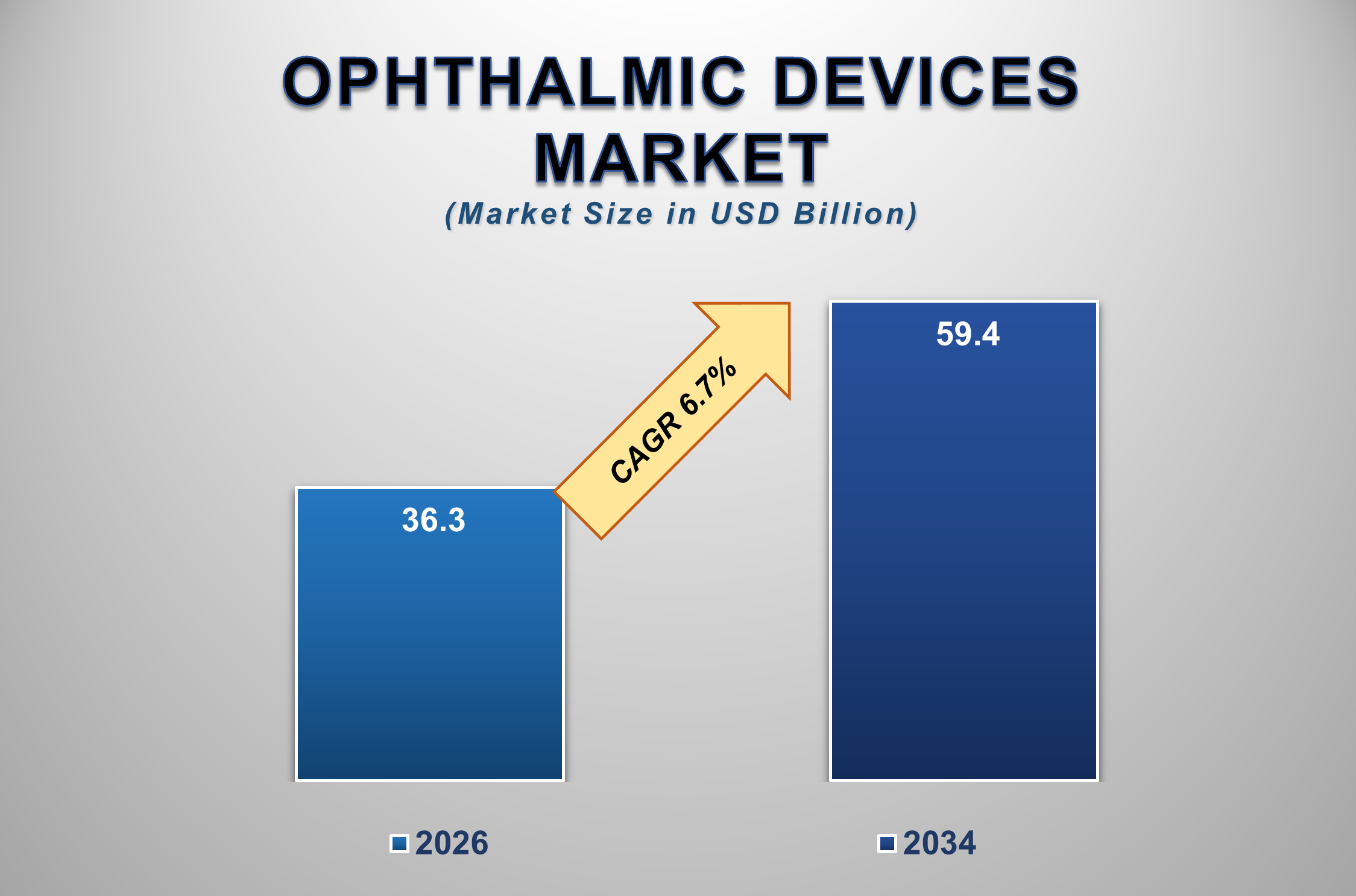
ophthalmology devices market was valued at USD 36.3 billion in 2026 and is
projected to reach USD 59.4 billion by 2034, expanding at a CAGR of 6.7% during
the forecast period. Growth of the market for ophthalmology tools is observed
because of the appearance of more cases of diseases like cataracts, glaucoma,
AMD, diabetic retinopathy, and refractive error, as well as the aging of the
population all around the world. Continuous development of new technology
related to diagnostic imaging, surgical instrumentation, intraocular lenses
(IOLs), laser treatment, and intelligent diagnostic instruments for
ophthalmology guarantees high efficiency and results for the eye care industry.
Rising popularity of the least invasive technologies in ophthalmology, rising
availability of specialized eye clinics, and increased awareness of vision
problems' prevention among people stimulate the development of the market.
Moreover, digital ophthalmology, teleophthalmology, and digital diagnostics are
expected to open new possibilities for better treatment of patients and
prevention of diseases.
Ophthalmology Devices Market Drivers
and Opportunities
Rising
Prevalence of Eye Disorders and Aging Population is Driving Market Growth
The increasing
cases of ocular diseases and the exponential increase in the number of elderly
populations are among the key factors driving the global ophthalmology devices
market. As per statistics from the World Health Organization in February 2026,
there are over 2.2 billion people across the world suffering from near or
distance vision problems, demonstrating the magnitude of the problem of vision
disorders globally. The rising incidence of cataracts, glaucoma, diabetic
retinopathy, age-related macular degeneration (AMD), and refractive disorders
is expected to drive the need for technologically sophisticated devices to
diagnose and treat ocular disorders. Moreover, the increasing elderly
population is more prone to suffer from ocular disorders.
Technological
Advancements in Ophthalmic Devices Fueling Market Expansion
The progress made
in the area of different ophthalmic devices contributes significantly to the
development of the market and increases the level of diagnostics and
effectiveness of the process for both medical professionals and patients.
Progress in different areas, including OCT devices, femtosecond laser systems,
premium IOLs, artificial intelligence-based diagnostic devices, and minimally
invasive surgeries, leads to early disease identification and customization of
the treatment plans. Following this trend, ZEISS Medical Technology showcased
its innovative ophthalmic technology and market developments at the ESCRS
Congress (European Society of Cataract and Refractive Surgeons) in Copenhagen,
Denmark, in September 2025. The company demonstrated its advanced optical and
digital technologies that were created to address the needs of cataract and
refractive surgeons working in different parts of Europe. The regular
introduction of new devices and technologies ensures their widespread use in
ophthalmic equipment.
Expansion of
AI-Enabled and Teleophthalmology Solutions Presents Significant Opportunities
The fast growth of
artificial intelligence (AI)-driven ophthalmic technologies and
teleophthalmology systems is a big chance for the global ophthalmology devices
market to grow. More and more AI technologies are used with retinal imaging
devices, OCT devices, and fundus cameras, allowing more precise and quick
diagnoses of illnesses such as diabetic retinopathy, glaucoma, age-related eye
disease (AMD), and retinal vascular diseases. Besides, teleophthalmology
technologies make remote eye examinations easier and smoother, as well as help
share images, consult with experts, and monitor people’s health conditions at a
distance, allowing people in rural and neglected areas where there are no eye
doctors to get access to better healthcare. With more interest in preventive
medicine, better digital health systems and cloud technologies, and support of
government plans and investments in healthcare, there will be faster growth in
the use of AI in diagnostics and teleophthalmology services, which opens many
possibilities for manufacturers, developers, and healthcare providers across
the world.
Ophthalmology Devices Market Scope
|
Report Attributes |
Description |
|
Market Size in
2026 |
USD 36.3 Billion |
|
Market Forecast
in 2034 |
USD 59.4
Billion |
|
CAGR % 2026-2034 |
6.7% |
|
Base Year |
2025 |
|
Historic Data |
2021-2025 |
|
Forecast Period |
2026-2034 |
|
Report USP |
Pricing and
Cost Structure Analysis, Product Innovation Benchmarking, Whitespace Assessment,
Company Share, Company Heatmap, Growth Factors and more |
|
Segments Covered |
●
By Device
Type ●
By
Disease Indication ●
By End
User |
|
Regional Scope |
●
North
America ●
Europe ●
APAC ●
Latin
America ●
Middle
East and Africa |
|
Country Scope |
●
U.S. ●
Canada ●
U.K. ●
Germany ●
France ●
Italy ●
Spain ●
Russia ●
China ●
India ●
Japan ●
South
Korea ●
Australia
●
Mexico ●
Brazil ●
Saudi
Arabia ●
UAE ●
South
Africa |
Ophthalmology Devices Market Report
Segmentation Analysis
The global
ophthalmology devices market industry analysis is segmented by device type, by
disease indication, by end user, and by region.
Vision Care
Devices Segment Is Expected to Dominate the Ophthalmology Devices Market During
the Forecast Period
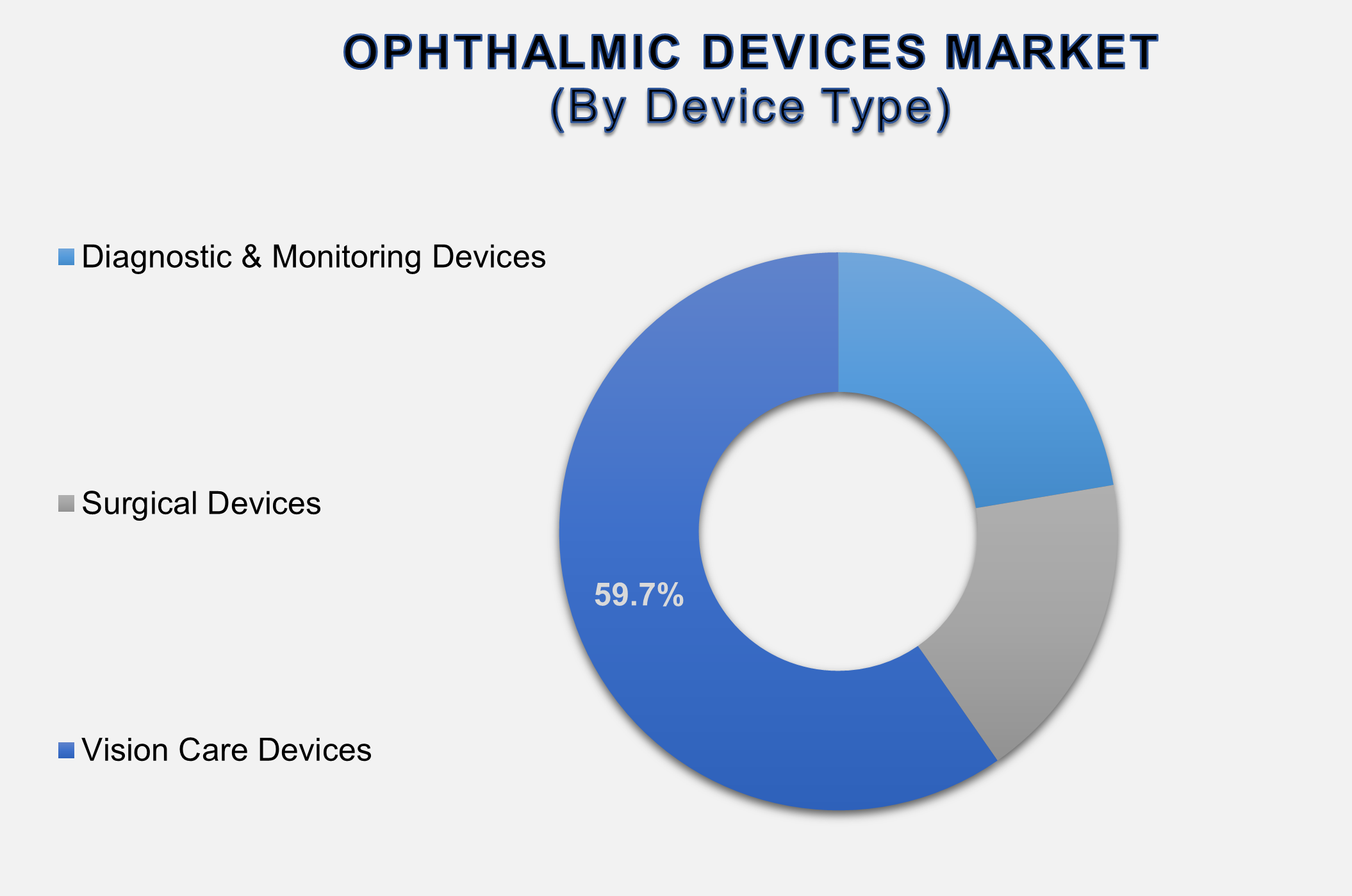
The Vision Care
Devices segment is projected to dominate the ophthalmology devices market
during the forecast period owing to the growing number of people suffering from
refractive errors, myopia, presbyopia, and other types of vision problems in
the world, apart from an increase in preventive eye care awareness and routine
eye screening. Increasing demand for sophisticated diagnostic equipment,
spectacle lenses, contact lenses, and vision correction technology, together
with consistent innovation in these products, is boosting the growth of this
segment even more. Moreover, the adoption of integrated eye care delivery
models is helping the market to grow even more. For example, in November 2025,
ZEISS Vision Care and ZEISS Medical Technology launched the ZEISS VISION CLINIC
concept, which is a novel business model integrating the services of
ophthalmology and optometry under one roof. This concept includes innovative
diagnostic equipment, premium vision care products, clinical research, and
treatment options. Such advancements, along with the growing requirement for
vision correction among the elderly and the technologically savvy population
segments, are projected to further boost the dominance of the vision care
devices segment during the forecast period.
Cataract Segment
Is Expected to Lead the Ophthalmology Devices Market by Disease Indication
When it comes to
disease indication, the Cataract segment is predicted to lead the global eye
devices industry throughout the projection time frame due to the great global
disease burden, the growing aging population, and the growing global number of
cataract surgeries conducted. According to the WHO (February 2026), cataracts,
meaning the clouding of the eye's natural lens and leading to visual impairment
and blindness, affect more than 94 million individuals worldwide. Moreover, the
organization registered a growth in cataract surgery coverage of about 15%
during the last twenty years due to better treatment, although the need for
treatment continues to rise because of the age of the population, in addition
to the growing prevalence of cataract disease. The growing number of patients
leads to the demand for modern devices such as phacoemulsification technology,
femtosecond lasers, lenses placed inside the eye, eye microscopes, and
technical systems for visual assistance during surgery.
Hospitals
Segment Is Expected to Dominate the End User Segment
The hospital
segment of the ocular devices market is projected to be the dominant segment
for the duration of the forecast period. Hospitals will continue to lead
globally in this segment because of the high rate of eye surgeries, the
availability of advanced devices, and the existence of good ophthalmologists.
The hospital operates as the main facility for diagnosis and treatment of
serious eye diseases such as cataract surgeries, glaucoma, retina diseases, and
corneal diseases with the help of modern technologies like optical coherence
tomography and advanced ophthalmic machines. Also, the increase in the number
of cataract surgeries around the world, the growing use of minimally invasive
methods, and the favorable payment conditions for such operations in developed
countries will boost the market in the following years.
The following
segments are part of an in-depth analysis of the global ophthalmology devices
market:
|
Market Segments |
|
|
By
Device Type |
●
Diagnostic
& Monitoring Devices o
OCT Scanners o
Fundus &
Retinal Cameras o
Autorefractors
& Keratometers o
Corneal
Topography Systems o
Ultrasound
Imaging Systems o
Perimeters
& Tonometers o
Other
Diagnostic & Monitoring Devices ●
Surgical
Devices o
Cataract
Surgical Devices o
Vitreoretinal
Surgical Devices o
Refractive
Surgical Devices o
Glaucoma
Surgical Devices o
Other
Surgical Devices ●
Vision Care
Devices o
Spectacle
Frames & Lenses o
Contact
Lenses |
|
By
Disease Indication |
●
Cataract ●
Glaucoma ●
Diabetic
Retinopathy ●
Other
Disease Indications |
|
By End
User |
●
Hospitals ●
Specialty
Ophthalmic Clinics ●
Ambulatory
Surgery Centers (ASCs) ●
Other
End-Users |
Ophthalmology Devices Market Share Analysis
by Region
North America is
projected to hold the largest share of the global ophthalmology devices market
over the forecast period
North America is
anticipated to retain the largest percentage of the global studies for
ophthalmic instruments, owing to the region’s high rate of incidence of eye
ailments as well as constant progress in ophthalmic technologies. Numerous
senior populations are affected by ailments such as cataracts, glaucoma, AMD,
and others, and therefore they have to undergo diagnostic and medical
processes. In addition, the situation in the domain of healthcare costs,
conditions for reimbursement for ophthalmic devices, and enhancement of
knowledge about eye diseases are likely to influence the speed of adoption of
these devices. The availability of numerous companies engaged in the production
of ophthalmic devices, such as Alcon, Bausch + Lomb, Johnson & Johnson Vision,
ZEISS, and Topcon, is also associated with the speed of implementation of
innovations in ophthalmic technology such as AI diagnosis, premium IOLs,
femtosecond laser systems, OCT, and minimally invasive ophthalmic operations.
Also, the achievement of approval from the FDA and the availability of
ambulatory surgery centers and specialized eye clinics have also positively
impacted the development of the ophthalmic market in North America.
Ophthalmology
Devices Market Competition Landscape Analysis
The major
manufacturers of the devices along with the organizations operating in the
field of vision care are engaged in producing complex systems for diagnostics,
surgery, and vision correction. These leading companies in the market become
more competitive due to consistent developments of optical coherence tomography
systems, ophthalmic imaging systems, femtosecond lasers, phacoemulsification
systems, premium intraocular lenses, retinal imaging devices, artificial
intelligence systems, and minimally invasive ophthalmic surgery equipment. At
the same time, these companies are using certain strategies to increase their
share in the sphere of eye care through collaboration, the launch of new
products, regulatory activities, business deals, expansion of activities, and
investments into R&D. Also, the high popularity of digital ophthalmology
and teleophthalmology, along with the prevalence of such disorders as
cataracts, glaucoma, diabetic retinopathy, macular degeneration, and other
visual disorders, results in strong growth potential of the ophthalmology
devices market.
Global
Ophthalmology Devices Market Recent Developments News:
●
In March 2026 -
Johnson & Johnson announced U.S. Food and Drug Administration (FDA)
approval of TECNIS PureSee IOL, an extended depth of focus (EDOF) intraocular
lens (IOL) intended for use in cataract surgery.
●
In February
2026 - BVI, a global leader in ophthalmic device innovation, announced the
first successful U.S. implantations of its FDA-approved FINEVISION HP
hydrophobic trifocal intraocular lens (IOL), marking the long-anticipated
arrival of one of the most established trifocal platforms in global cataract
surgery and a major milestone following the product’s U.S. regulatory clearance
in October 2025.
●
In March 2025 -
Bausch + Lomb Corporation, a
leading global eye health company dedicated to helping people see better to
live better, announced the U.S. launch of Arise, a lens fitting system that
uses intelligent, cloud-based technology to streamline the orthokeratology lens
design process.
●
In May 2024 -
ArcScan, Inc., a global medical technology company dedicated to helping
ophthalmologists improve vision with ultra-high frequency ultrasound images,
announced that ArcScan Insight 100 has received National Medical Products
Administration (NMPA) approval in China.
The Global
Ophthalmology Devices Market is dominated by a few large companies, such as
●
Alcon Inc.
●
Bausch + Lomb
●
Canon Medical Systems
●
CooperVision
●
Glaukos Corporation
●
HAAG-Streit Group
●
Heidelberg Engineering, Inc.
●
HOYA
●
Johnson & Johnson Vision Care
●
Leica Microsystems
●
Lumenis Be Ltd.
●
Lumibird Medical
●
Nidek Co., Ltd.
●
OCULUS
●
STAAR Surgical
●
Topcon Corporation
●
Visionix
●
Volk Optical
●
ZEISS Group
●
Ziemer Ophthalmic Systems AG
● Other Prominent Players
Frequently Asked Questions
Swetal (Research Analyst)
Swetal is a Research Analyst with 4+ years of experience specializing in healthcare market research, medical devices, healthcare IT, and medical technology industry analysis. Her expertise includes competitive intelligence, secondary research, market trend forecasting, and healthcare business insights across global healthcare ecosystems.
She contributes to advanced market research reports by analyzing regulatory frameworks, emerging healthcare technologies, competitive landscapes, and innovation trends shaping the medical industry. With a strong focus on accurate market intelligence, strategic insights, and healthcare industry trends, Swetal supports businesses in making informed, data-backed decisions in a rapidly transforming healthcare environment.
1.
Global
Ophthalmology Devices Market Introduction and Market Overview
1.1. Objectives of the Study
1.2. Market Segmentation
1.2.1.Device Type of the Global Ophthalmology
Devices Market
1.2.2.Disease Indication of the Global
Ophthalmology Devices Market
1.2.3.End User of the Global Ophthalmology
Devices Market
1.2.4.Region of Global Ophthalmology
Devices Market
1.3. Competition Coverage List of
Market Participants
1.4. Market Definition: Ophthalmology
Devices Market
2.
Executive Summary
2.1. Global Ophthalmology Devices
Market Estimation & Forecast
2.1.1.Global Ophthalmology Devices
Market Size (US$ Million) Estimates & Historical Trend Analysis (2021 -
2025)
2.1.2.Global Ophthalmology Devices
Overall Market Size (US$ Million), Growth Rate (Y-o-Y), Market CAGR (%), Market
forecast (2026 - 2034)
2.2. Snapshot of Global Ophthalmology
Devices Market
2.3. Global Ophthalmology Devices
Market Revenue Share (%) 2025
2.4. REGIONAL OUTLINE: Revenue CAGR,
by Region
2.5. Key Competitors & Key
Insights
3.
Market Overview (Qualitative
Analysis)
3.1. Demand Side Trends
3.2. Supply Side Trends / Manufacturing
Trends
3.3. Demand and Opportunity
Assessment, 2026 - 2034
3.4. Market Dynamics
3.4.1.Drivers
3.4.2.Limitations
3.4.3.Opportunities
3.4.4.Impact Analysis of Drivers and
Restraints
3.5. Key Developments
3.6. Regulatory Landscape
3.7. Pricing Analysis
3.8. Supply Chain Analysis
3.9. Porter’s Five Forces Analysis
3.9.1.Bargaining Power of Suppliers
3.9.2.Bargaining Power of Buyers
3.9.3.Threat of Substitutes
3.9.4.Threat of New Entrants
3.9.5.Competitive Rivalry
3.10. PEST Analysis
3.10.1. Political Factors
3.10.2. Economic Factors
3.10.3. Social Factors
3.10.4. Technology Factors
4.
Global Ophthalmology Devices
Market Estimates & Forecast Trend Analysis, by Device Type
4.1. Global Ophthalmology Devices
Market Assessments & Key Findings, by Device Type
4.2. Global Ophthalmology Devices
Market Revenue (US$ Million) Estimates and Forecasts, by Device Type, 2021 -
2034
4.2.1.Diagnostic & Monitoring
Devices
4.2.1.1.
OCT
Scanners
4.2.1.2.
Fundus
& Retinal Cameras
4.2.1.3.
Autorefractors
& Keratometers
4.2.1.4.
Corneal
Topography Systems
4.2.1.5.
Ultrasound
Imaging Systems
4.2.1.6.
Perimeters
& Tonometers
4.2.1.7.
Other
Diagnostic & Monitoring Devices
4.2.2.Surgical Devices
4.2.2.1.
Cataract
Surgical Devices
4.2.2.2.
Vitreoretinal
Surgical Devices
4.2.2.3.
Refractive
Surgical Devices
4.2.2.4.
Glaucoma
Surgical Devices
4.2.2.5.
Other
Surgical Devices
4.2.3.Vision Care Devices
4.2.3.1.
Spectacle
Frames & Lenses
4.2.3.2.
Contact
Lenses
5.
Global Ophthalmology Devices
Market Estimates & Forecast Trend Analysis, by Disease Indication
5.1. Global Ophthalmology Devices
Market Assessments & Key Findings, by Disease Indication
5.2. Global Ophthalmology Devices
Market Revenue (US$ Million) Estimates and Forecasts, by Disease Indication, 2021
- 2034
5.2.1.Cataract
5.2.2.Glaucoma
5.2.3.Diabetic Retinopathy
5.2.4.Other Disease Indications
6.
Global Ophthalmology Devices
Market Estimates & Forecast Trend Analysis, by End User
6.1. Global Ophthalmology Devices
Market Assessments & Key Findings, by End User
6.2. Global Ophthalmology Devices
Market Revenue (US$ Million) Estimates and Forecasts, by End User, 2021 - 2034
6.2.1.Hospitals
6.2.2.Specialty Ophthalmic Clinics
6.2.3.Ambulatory Surgery Centers
(ASCs)
6.2.4.Other End-Users
7.
Global Ophthalmology Devices
Market Estimates & Forecast Trend Analysis, by Region
7.1. Global Ophthalmology Devices
Market Assessments & Key Findings, by Region
7.2. Global Ophthalmology Devices
Market Revenue (US$ Million) Estimates and Forecasts, by Region, 2021 - 2034
7.2.1.North America
7.2.2.Europe
7.2.3.Asia Pacific
7.2.4.Middle East & Africa
7.2.5.Latin America
8.
North
America Ophthalmology Devices Market: Estimates & Forecast Trend Analysis
8.1.
North
America Ophthalmology Devices Market Assessments & Key Findings
8.1.1.North America Ophthalmology
Devices Market Introduction
8.1.2.North America Ophthalmology
Devices Market Size Estimates and Forecast (US$ Million) (2021 - 2034)
8.1.2.2.
By
Disease Indication
8.1.2.3.
By
End User
8.1.2.4. By Country
8.1.2.4.1. The U.S.
8.1.2.4.2. Canada
9.
Europe
Ophthalmology Devices Market: Estimates & Forecast Trend Analysis
9.1. Europe Ophthalmology Devices
Market Assessments & Key Findings
9.1.1.Europe Ophthalmology Devices
Market Introduction
9.1.2.Europe Ophthalmology Devices
Market Size Estimates and Forecast (US$ Million) (2021 - 2034)
9.1.2.1. By Device Type
9.1.2.2. By Disease Indication
9.1.2.3. By End User
9.1.2.4. By Country
9.1.2.4.1.
Germany
9.1.2.4.2.
Italy
9.1.2.4.3.
U.K.
9.1.2.4.4.
France
9.1.2.4.5.
Spain
9.1.2.4.6.
Switzerland
9.1.2.4.7. Rest
of Europe
10. Asia Pacific Ophthalmology
Devices Market: Estimates &
Forecast Trend Analysis
10.1. Asia Pacific Market Assessments
& Key Findings
10.1.1. Asia Pacific Ophthalmology
Devices Market Introduction
10.1.2. Asia Pacific Ophthalmology
Devices Market Size Estimates and Forecast (US$ Million) (2021 - 2034)
10.1.2.1. By Device Type
10.1.2.2. By Disease Indication
10.1.2.3. By End User
10.1.2.4. By Country
10.1.2.4.1. China
10.1.2.4.2. Japan
10.1.2.4.3. India
10.1.2.4.4. Australia
10.1.2.4.5. South Korea
10.1.2.4.6. Rest of Asia Pacific
11. Middle East & Africa Ophthalmology
Devices Market: Estimates &
Forecast Trend Analysis
11.1. Middle East & Africa Market
Assessments & Key Findings
11.1.1. Middle
East & Africa Ophthalmology
Devices Market Introduction
11.1.2. Middle
East & Africa Ophthalmology
Devices Market Size Estimates and Forecast (US$ Million) (2021 - 2034)
11.1.2.1. By Device Type
11.1.2.2. By Disease Indication
11.1.2.3. By End User
11.1.2.4. By Country
11.1.2.4.1. South Africa
11.1.2.4.2. UAE
11.1.2.4.3. Saudi Arabia
11.1.2.4.4. Rest of MEA
12. Latin America
Ophthalmology Devices Market: Estimates
& Forecast Trend Analysis
12.1. Latin America Market Assessments
& Key Findings
12.1.1. Latin America Ophthalmology
Devices Market Introduction
12.1.2. Latin America Ophthalmology
Devices Market Size Estimates and Forecast (US$ Million) (2021 - 2034)
12.1.2.1. By Device Type
12.1.2.2. By Disease Indication
12.1.2.3. By End User
12.1.2.4. By Country
12.1.2.4.1. Brazil
12.1.2.4.2. Mexico
12.1.2.4.3. Argentina
12.1.2.4.4. Rest of LATAM
13. Competition Landscape
13.1. Global Ophthalmology Devices
Market Product Mapping
13.2. Global Ophthalmology Devices
Market Concentration Analysis, by Leading Players / Innovators / Emerging
Players / New Entrants
13.3. Global Ophthalmology Devices
Market Tier Structure Analysis
13.4. Global Ophthalmology Devices
Market Concentration & Company Market Shares (%) Analysis, 2025
14. Company Profiles
14.1. Alcon Inc.
14.1.1. Company Overview & Key Stats
14.1.2. Financial Performance & KPIs
14.1.3. Product Portfolio
14.1.4. SWOT Analysis
14.1.5. Business Strategy & Recent
Developments
* Similar details would be provided
for all the players mentioned below
14.2. Bausch + Lomb
14.3. Canon Medical Systems
14.4. CooperVision
14.5. Glaukos Corporation
14.6. HAAG-Streit Group
14.7. Heidelberg Engineering, Inc.
14.8. HOYA
14.9. Johnson & Johnson Vision
Care
14.10. Leica Microsystems
14.11. Lumenis Be Ltd.
14.12. Lumibird Medical
14.13. Nidek Co., Ltd.
14.14. OCULUS
14.15. STAAR Surgical
14.16. Topcon Corporation
14.17. Visionix
14.18. Volk Optical
14.19. ZEISS Group
14.20. Ziemer Ophthalmic Systems AG
14.21. Other Prominent Players
15. Research
Findings & Conclusion
16. Assumption & Acronyms Used
17. Research
Methodology
17.1. External Transportations /
Databases
17.2. Internal Proprietary Database
17.3. Primary Research
17.4. Secondary Research
17.5. Assumptions
17.6. Limitations
17.7. Report FAQs
Our Research Methodology
"Insight without rigor is just noise."
We follow a comprehensive, multi-phase research framework designed to deliver accurate, strategic, and decision-ready intelligence. Our process integrates primary and secondary research , both quantitative and qualitative , along with dual modeling techniques ( top-down and bottom-up) and a final layer of validation through our proprietary in-house repository.
PRIMARY RESEARCH
Primary research captures real-time, firsthand insights from the market to understand behaviors, motivations, and emerging trends.
1. Quantitative Primary Research
Objective: Generate statistically significant data directly from market participants.
Approaches:- Structured surveys with customers, distributors, and field agents
- Mobile-based data collection for point-of-sale audits and usage behavior
- Phone-based interviews (CATI) for market sizing and product feedback
- Online polling around industry events and digital campaigns
- Purchase frequency by customer type
- Channel performance across geographies
- Feature demand by application or demographic
2. Qualitative Primary Research
Objective: Explore decision-making drivers, pain points, and market readiness.
Approaches:- In-depth interviews (IDIs) with executives, product managers, and key decision-makers
- Focus groups among end users and early adopters
- Site visits and observational research for consumer products
- Informal field-level discussions for regional and cultural nuances
SECONDARY RESEARCH
This phase helps establish a macro-to-micro understanding of market trends, size, regulation, and competitive dynamics, sourced from credible and public domain information.
1. Quantitative Secondary Research
Objective: Model market value and segment-level forecasts based on published data.
Sources include:- Financial reports and investor summaries
- Government trade data, customs records, and regulatory statistics
- Industry association publications and economic databases
- Channel performance and pricing data from marketplace listings
- Revenue splits, pricing trends, and CAGR estimates
- Supply-side capacity and volume tracking
- Investment analysis and funding benchmarks
2. Qualitative Secondary Research
Objective: Capture strategic direction, innovation signals, and behavioral trends.
Sources include:- Company announcements, roadmaps, and product pipelines
- Publicly available whitepapers, conference abstracts, and academic research
- Regulatory body publications and policy briefs
- Social and media sentiment scanning for early-stage shifts
- Strategic shifts in market positioning
- Unmet needs and white spaces
- Regulatory triggers and compliance impact
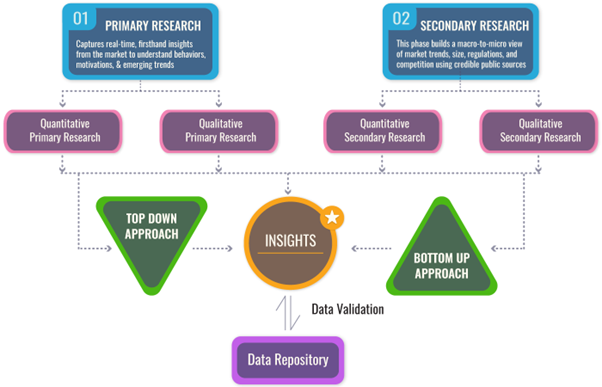
DUAL MODELING: TOP-DOWN + BOTTOM-UP
To ensure robust market estimation, we apply two complementary sizing approaches:
Top-Down Modeling:- Start with broader industry value (e.g., global or regional TAM)
- Apply filters by segment, geography, end-user, or use case
- Adjust with primary insights and validation benchmarks
- Ideal for investor-grade market scans and opportunity mapping
- Aggregate from the ground up using sales volumes, pricing, and unit economics
- Use internal modeling templates aligned with stakeholder data
- Incorporate distributor-level or region-specific inputs
- Most accurate for emerging segments and granular sub-markets
DATA VALIDATION: IN-HOUSE REPOSITORY
We close the loop with proprietary data intelligence built from ongoing projects, industry monitoring, and historical benchmarking. This repository includes:
- Multi-sector market and pricing models
- Key trendlines from past interviews and forecasts
- Benchmarked adoption rates, churn patterns, and ROI indicators
- Industry-specific deviation flags and cross-check logic
- Catches inconsistencies early
- Aligns projections across studies
- Enables consistent, high-trust deliverables