

Orthokeratology Market Size and Forecast (2026–2034), Global and Regional Growth, Trend, Share and Industry Analysis Report Coverage; By Product Type (Overnight Orthokeratology Lenses, Daytime Wear Lenses); By Application (Myopia Control, Vision Correction); By End User (Hospitals, Ophthalmology Clinics, Optometry Centers); By Age Group (Children, Adults), and Geography
2026-05-06
Healthcare
Swetal (Research Analyst)
Description
Orthokeratology Market Overview
The global Orthokeratology market was valued at USD 0.44933 billion in 2026 and is projected to reach USD 0.64829 billion by 2034, expanding at a CAGR of 4.7% during the forecast period. The market is witnessing steady growth driven by the increasing prevalence of refractive vision disorders, rising awareness about non-surgical vision correction methods, and growing adoption of myopia management solutions, particularly among children.
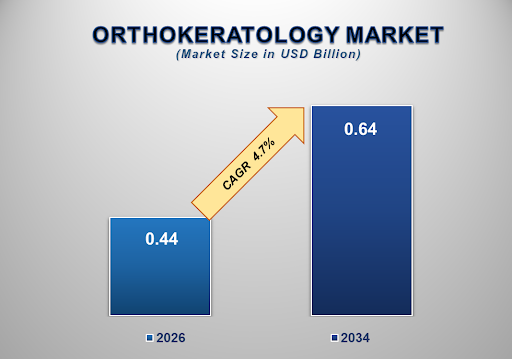
Orthokeratology, commonly referred to as Ortho-K, is a non-surgical vision correction technique that involves the use of specially designed rigid gas-permeable contact lenses worn overnight to temporarily reshape the cornea. This allows individuals to achieve clear vision during the day without the need for glasses or daytime contact lenses.
The increasing incidence of Myopia (nearsightedness), especially among children and adolescents, has significantly contributed to the demand for orthokeratology solutions. Factors such as increased screen time, reduced outdoor activities, and changing lifestyles are accelerating the prevalence of myopia globally.
Orthokeratology is gaining popularity as an effective method for controlling the progression of myopia in children. Unlike traditional corrective methods, Ortho-K lenses not only improve vision but also help slow down the worsening of refractive errors over time.
Additionally, the growing preference for non-invasive and reversible treatment options is driving market adoption. As awareness increases and advancements in lens technology continue, the orthokeratology market is expected to grow steadily through 2034.
Orthokeratology Market Drivers and Opportunities
Rising Prevalence of Myopia and Vision Disorders Is Driving Market Growth
The increasing prevalence of Myopia is one of the primary drivers of the orthokeratology market. Myopia has become a significant global health concern, particularly among younger populations.
Lifestyle changes, including prolonged use of digital devices, limited exposure to natural light, and urban living environments, have contributed to the rising incidence of myopia. Early onset of myopia often leads to higher degrees of refractive error in adulthood, increasing the risk of serious eye conditions.
Orthokeratology offers an effective solution for managing myopia progression, making it highly attractive for pediatric patients. Healthcare professionals are increasingly recommending Ortho-K lenses as part of comprehensive myopia management strategies.
As awareness of myopia-related complications grows, the demand for preventive and corrective solutions like orthokeratology is expected to increase significantly.
Growing Preference for Non-Surgical Vision Correction Methods Is Fueling Market Expansion
Consumers are increasingly seeking alternatives to surgical procedures such as LASIK due to concerns related to cost, risks, and permanence. Orthokeratology provides a non-invasive and reversible solution for vision correction.
Unlike surgical interventions, Ortho-K lenses allow users to temporarily correct vision without altering the eye permanently. This flexibility is particularly appealing to younger patients and individuals who are not suitable candidates for surgery.
Additionally, the convenience of not needing glasses or contact lenses during the day enhances user comfort and lifestyle flexibility. This is especially beneficial for athletes, professionals, and individuals engaged in active lifestyles.
The increasing demand for safe, convenient, and reversible vision correction methods is driving the adoption of orthokeratology solutions.
Advancements in Lens Technology and Expansion of Eye Care Services Present Significant Opportunities
Technological advancements in lens design and materials are creating new growth opportunities in the orthokeratology market. Modern Ortho-K lenses are designed with improved oxygen permeability, enhanced comfort, and better fitting capabilities.
Advanced diagnostic tools and imaging technologies are enabling eye care professionals to customize lenses based on individual corneal profiles, improving treatment outcomes and patient satisfaction.
Additionally, the expansion of eye care services and the increasing availability of specialized optometry clinics are supporting market growth. Training programs and awareness campaigns are also helping to increase adoption among healthcare providers.
Emerging markets present significant opportunities due to rising healthcare investments and increasing awareness about vision care. As technology continues to evolve and accessibility improves, the orthokeratology market is expected to expand further.
Orthokeratology Market Scope
Orthokeratology Market Report Segmentation Analysis
The global orthokeratology market industry analysis is segmented by product type, by application, by end user, by age group, and by region.
Overnight Orthokeratology Lenses Segment Is Expected to Dominate the Market During the Forecast Period
The overnight orthokeratology lenses segment accounted for approximately 68.2% of the global market, making it the dominant category.
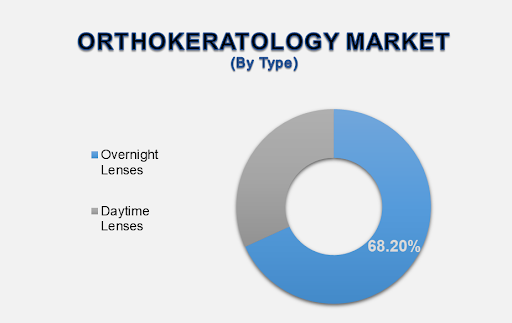
These lenses are worn during sleep and reshape the cornea overnight, allowing users to have clear vision during the day without corrective eyewear. Their convenience and effectiveness make them the preferred choice among patients and practitioners.
Myopia Control Segment Is Expected to Lead the Market by Application
The **Myopia control segment dominates the market as orthokeratology is widely used to slow the progression of myopia, particularly in children.
This application is gaining importance due to increasing awareness about long-term eye health and preventive care.
Ophthalmology Clinics Segment Is Expected to Dominate the End-User Market
Ophthalmology clinics hold the largest share, as they are the primary centers for diagnosis, lens fitting, and follow-up care for orthokeratology treatments.
The Children’s Segment Is Expected to Dominate the Age Group Market
The children segment accounts for the largest share due to the high effectiveness of orthokeratology in controlling myopia progression during early stages of life.
The following segments are part of an in-depth analysis of the global Orthokeratology market:
Orthokeratology Market Share Analysis By Region
North America is projected to hold the largest share of the global orthokeratology market over the forecast period.
North America accounted for approximately 37.4% of the global market in 2026, driven by advanced healthcare infrastructure, high awareness, and strong adoption of innovative vision correction technologies.
Asia Pacific is expected to register the highest CAGR during the forecast period due to the rapidly increasing prevalence of Myopia, particularly in countries such as China and India.
Orthokeratology Market Competition Landscape Analysis
The market is moderately competitive, with companies focusing on product innovation, lens customization, and expansion of clinical services.
Global Orthokeratology Market Recent Developments News:
∙ In March 2026 – New advanced Ortho-K lens designs improved comfort and treatment effectiveness.
∙ In November 2025 – Expansion of optometry services increased accessibility of orthokeratology treatments.
∙ In August 2025 – Increased awareness campaigns promoted myopia control solutions globally.The Global Orthokeratology Market is dominated by a few large companies, such as
∙ CooperVision Inc.
∙ Euclid Vision Corporation
∙ Paragon Vision Sciences
∙ Bausch + Lomb
∙ Menicon Co., Ltd.
∙ GP Specialists
∙ Brighten Optix
∙ Alpha Corporation
∙ TruForm Optics
∙ Contamac Ltd.
∙ Others
Frequently Asked Questions
Swetal (Research Analyst)
Swetal is a Research Analyst with 4+ years of experience specializing in healthcare market research, medical devices, healthcare IT, and medical technology industry analysis. Her expertise includes competitive intelligence, secondary research, market trend forecasting, and healthcare business insights across global healthcare ecosystems.
She contributes to advanced market research reports by analyzing regulatory frameworks, emerging healthcare technologies, competitive landscapes, and innovation trends shaping the medical industry. With a strong focus on accurate market intelligence, strategic insights, and healthcare industry trends, Swetal supports businesses in making informed, data-backed decisions in a rapidly transforming healthcare environment.
Global Orthokeratology Market Introduction and Market Overview
Objectives of the Study
Global Orthokeratology Market Scope and Market Estimation
Global Orthokeratology Overall Market Size (US$ Million), Market CAGR (%), Market Forecast (2026 - 2034)
Global Orthokeratology Market Revenue Share (%) and Growth Rate (Y-o-Y) from 2021 - 2034
Market Segmentation
Product Type of Global Orthokeratology Market
Application of Global Orthokeratology Market
End User of Global Orthokeratology Market
Age Group of Global Orthokeratology Market
Region of Global Orthokeratology Market
Executive Summary
Demand Side Trends
Key Market Trends
Market Demand (US$ Million) Analysis 2021 – 2025 and Forecast, 2026 – 2034
Demand and Opportunity Assessment
Key Developments
Overview of Tariff, Regulatory Landscape and Standards
Market Entry Strategies
Market Dynamics
Drivers
Limitations
Opportunities
Impact Analysis of Drivers and Restraints
Porter’s Five Forces Analysis
PEST Analysis
Global Orthokeratology Market Estimates & Historical Trend Analysis (2021 - 2025)
Global Orthokeratology Market Estimates & Forecast Trend Analysis, by Product Type
Global Orthokeratology Market Revenue (US$ Million) Estimates and Forecasts, by Product Type, 2021 - 2034
Overnight Orthokeratology Lenses
Daytime Wear Lenses
Global Orthokeratology Market Estimates & Forecast Trend Analysis, by Application
Global Orthokeratology Market Revenue (US$ Million) Estimates and Forecasts, by Application, 2021 - 2034
Myopia Control
Vision Correction
Global Orthokeratology Market Estimates & Forecast Trend Analysis, by End User
Global Orthokeratology Market Revenue (US$ Million) Estimates and Forecasts, by End User, 2021 - 2034
Hospitals
Ophthalmology Clinics
Optometry Centers
Global Orthokeratology Market Estimates & Forecast Trend Analysis, by Age Group
Global Orthokeratology Market Revenue (US$ Million) Estimates and Forecasts, by Age Group, 2021 - 2034
Children
Adults
Global Orthokeratology Market Estimates & Forecast Trend Analysis, by Region
Global Orthokeratology Market Revenue (US$ Million) Estimates and Forecasts, by Region, 2021 - 2034
North America
Europe
Asia Pacific
Middle East & Africa
Latin America
North America Orthokeratology Market: Estimates & Forecast Trend Analysis
North America Orthokeratology Market Assessments & Key Findings
North America Orthokeratology Market Introduction
North America Orthokeratology Market Size Estimates and Forecast (US$ Million) (2021 - 2034)
By Product Type
By Application
By End User
By Age Group
By Country
The U.S.
Canada
Europe Orthokeratology Market: Estimates & Forecast Trend Analysis
Europe Orthokeratology Market Assessments & Key Findings
Europe Orthokeratology Market Introduction
Europe Orthokeratology Market Size Estimates and Forecast (US$ Million) (2021 - 2034)
By Product Type
By Application
By End User
By Age Group
By Country
Germany
Italy
U.K.
France
Spain
Switzerland
Rest of Europe
Asia Pacific Orthokeratology Market: Estimates & Forecast Trend Analysis
Asia Pacific Market Assessments & Key Findings
Asia Pacific Orthokeratology Market Introduction
Asia Pacific Orthokeratology Market Size Estimates and Forecast (US$ Million) (2021 - 2034)
By Product Type
By Application
By End User
By Age Group
By Country
China
Japan
India
Australia
South Korea
Rest of Asia Pacific
Middle East & Africa Orthokeratology Market: Estimates & Forecast Trend Analysis
Middle East & Africa Market Assessments & Key Findings
Middle East & Africa Orthokeratology Market Introduction
Middle East & Africa Orthokeratology Market Size Estimates and Forecast (US$ Million) (2021 - 2034)
By Product Type
By Application
By End User
By Age Group
By Country
UAE
Saudi Arabia
South Africa
Rest of MEA
Latin America Orthokeratology Market: Estimates & Forecast Trend Analysis
Latin America Market Assessments & Key Findings
Latin America Orthokeratology Market Introduction
Latin America Orthokeratology Market Size Estimates and Forecast (US$ Million) (2021 - 2034)
By Product Type
By Application
By End User
By Age Group
By Country
Brazil
Mexico
Argentina
Rest of LATAM
Competition Landscape
Global Orthokeratology Market Product Mapping
Global Orthokeratology Market Concentration Analysis, by Leading Players / Innovators / Emerging Players / New Entrants
Global Orthokeratology Market Tier Structure Analysis
Global Orthokeratology Market Concentration & Company Market Shares (%) Analysis, 2025
Company Profiles
CooperVision Inc.
Company Overview & Key Stats
Financial Performance & KPIs
Product Portfolio
SWOT Analysis
Business Strategy & Recent Developments
*Similar details would be provided for all the players mentioned below
Euclid Vision Corporation
Paragon Vision Sciences
Bausch + Lomb
Menicon Co., Ltd.
GP Specialists
Brighten Optix
Alpha Corporation
TruForm Optics
Contamac Ltd.
Others
Research Findings & Conclusion
Assumption & Acronyms Used
Research Methodology
External Databases
Internal Proprietary Database
Primary Research
Secondary Research
Assumptions
Limitations
Report FAQs
Our Research Methodology
"Insight without rigor is just noise."
We follow a comprehensive, multi-phase research framework designed to deliver accurate, strategic, and decision-ready intelligence. Our process integrates primary and secondary research , both quantitative and qualitative , along with dual modeling techniques ( top-down and bottom-up) and a final layer of validation through our proprietary in-house repository.
PRIMARY RESEARCH
Primary research captures real-time, firsthand insights from the market to understand behaviors, motivations, and emerging trends.
1. Quantitative Primary Research
Objective: Generate statistically significant data directly from market participants.
Approaches:- Structured surveys with customers, distributors, and field agents
- Mobile-based data collection for point-of-sale audits and usage behavior
- Phone-based interviews (CATI) for market sizing and product feedback
- Online polling around industry events and digital campaigns
- Purchase frequency by customer type
- Channel performance across geographies
- Feature demand by application or demographic
2. Qualitative Primary Research
Objective: Explore decision-making drivers, pain points, and market readiness.
Approaches:- In-depth interviews (IDIs) with executives, product managers, and key decision-makers
- Focus groups among end users and early adopters
- Site visits and observational research for consumer products
- Informal field-level discussions for regional and cultural nuances
SECONDARY RESEARCH
This phase helps establish a macro-to-micro understanding of market trends, size, regulation, and competitive dynamics, sourced from credible and public domain information.
1. Quantitative Secondary Research
Objective: Model market value and segment-level forecasts based on published data.
Sources include:- Financial reports and investor summaries
- Government trade data, customs records, and regulatory statistics
- Industry association publications and economic databases
- Channel performance and pricing data from marketplace listings
- Revenue splits, pricing trends, and CAGR estimates
- Supply-side capacity and volume tracking
- Investment analysis and funding benchmarks
2. Qualitative Secondary Research
Objective: Capture strategic direction, innovation signals, and behavioral trends.
Sources include:- Company announcements, roadmaps, and product pipelines
- Publicly available whitepapers, conference abstracts, and academic research
- Regulatory body publications and policy briefs
- Social and media sentiment scanning for early-stage shifts
- Strategic shifts in market positioning
- Unmet needs and white spaces
- Regulatory triggers and compliance impact
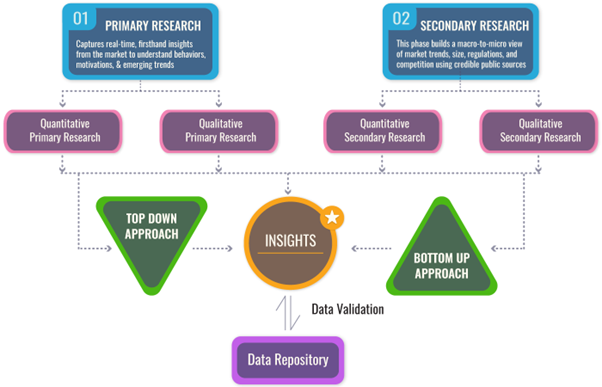
DUAL MODELING: TOP-DOWN + BOTTOM-UP
To ensure robust market estimation, we apply two complementary sizing approaches:
Top-Down Modeling:- Start with broader industry value (e.g., global or regional TAM)
- Apply filters by segment, geography, end-user, or use case
- Adjust with primary insights and validation benchmarks
- Ideal for investor-grade market scans and opportunity mapping
- Aggregate from the ground up using sales volumes, pricing, and unit economics
- Use internal modeling templates aligned with stakeholder data
- Incorporate distributor-level or region-specific inputs
- Most accurate for emerging segments and granular sub-markets
DATA VALIDATION: IN-HOUSE REPOSITORY
We close the loop with proprietary data intelligence built from ongoing projects, industry monitoring, and historical benchmarking. This repository includes:
- Multi-sector market and pricing models
- Key trendlines from past interviews and forecasts
- Benchmarked adoption rates, churn patterns, and ROI indicators
- Industry-specific deviation flags and cross-check logic
- Catches inconsistencies early
- Aligns projections across studies
- Enables consistent, high-trust deliverables