

Over-the-Counter Drugs Market Size and Forecast (2026–2034), Global and Regional Growth, Trend, Share and Industry Analysis Report Coverage: By Product Type (Vitamins, Minerals & Supplements (VMS), Weight Management, Gastrointestinal, Dermatology, Cough, Cold & Flu, Analgesics, Ophthalmic, Sleep Aids, Oral Care, Ear Care, Wound Care, Women's Health, and Others (Antihistamines, Smoking Cessation, etc.)), By Formulation (Powders and Granules, Tablet and Capsules, Creams, Gels & Ointments, Sprays and Inhalers, Lozenges, and Others (Liquids, Gummies, Transdermal Patches, etc.)), By Distribution Channel (Retail Pharmacies, Hospital Pharmacies, Online Pharmacies, and Others (Drug Stores & Supermarkets, Convenience Stores, etc.)), and Geography
2026-07-30
Healthcare
Swetal (Research Analyst)
Description
Over-the-Counter Drugs Market
Overview
The global
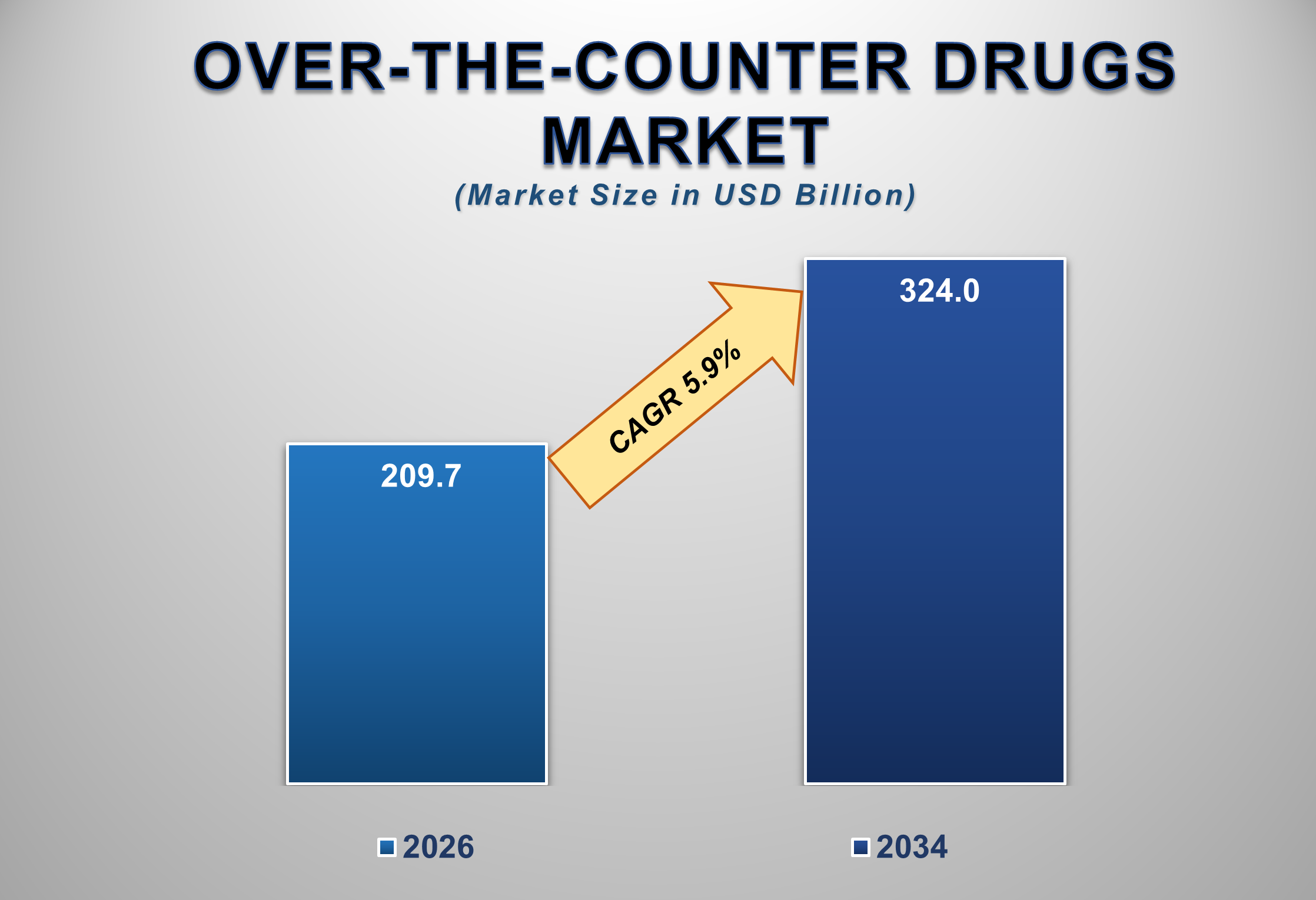
over-the-counter drugs market was valued at USD 209.7 billion in 2026 and is
projected to reach USD 324.0 billion by 2034, expanding at a CAGR of 5.9%
during the forecast period. The over-the-counter drug market is experiencing an
important change in its dynamics due to the increased emphasis on
self-healthcare among healthcare systems and the consumer preference for
convenient options when addressing various illnesses. The increasing popularity
of preventive care, increasing use of vitamins and dietary supplements, and the
growing requirement for OTC drugs for pain relief, cough and cold,
gastroenterological diseases, allergies, and dermatological illnesses are
contributing factors to this growth. In parallel, digital health solutions,
e-pharmacies, and Rx-to-OTC switching programs are offering more possibilities
for consumer reach and business development in the sector. The market players
have started developing novel product formats such as gummies, patches,
dissolving pills, and combinations.
The
over-the-counter drugs market holds some very interesting and promising
prospects for pharmaceutical companies, consumer healthcare companies, contract
manufacturers, wholesalers, and retail pharmacy chains. An increasing
consumption of OTC drugs in new markets is driven by higher incomes,
development of pharmacy networks, and greater health awareness among consumers,
whereas in mature markets the benefits are coming from trends like
premiumization and preventive wellness. Companies are making efforts to
strengthen their position in the market by adopting omni-channel approaches to
sales, localizing manufacturing, forming partnerships, and expanding the
product range into growth sectors. Moreover, developments in consumer
analytics, digitization of supply chains, and personal marketing are aiding
organizations in discovering market opportunities, product launches, and
customer engagement in the OTC drugs market.
Over-the-Counter Drugs Market Drivers
and Opportunities
Rising Consumer
Preference for Self-Medication and Preventive Healthcare Is Driving Market
Growth
The increase in the
use of self-medication is likely to become an important factor fuelling the
global OTC drugs market. People are adopting an active approach in treating
their health issues independently without any help from healthcare providers
because of the increasing costs of seeking healthcare services, long wait
periods, better knowledge about health issues, and increased availability of
OTC drugs through retail pharmacies and even online stores. The problem is more
common in developing countries, where healthcare systems are underdeveloped.
According to the research published in the Journal of Contemporary Clinical
Practice, self-medicating through the use of OTC medicines is quite prevalent
in India, particularly among residents of rural areas that lack adequate
healthcare facilities. Although self-medication may offer a quick solution,
improper application of these practices poses various health risks, including
antibiotic resistance, adverse drug reactions, and polypharmacy. The findings
of the research revealed that over 50% of the individuals had engaged in
self-medicating practices for common ailments like cough and cold (58.0%),
fever (47.0%), and body ache (41.0%).
Self-medication
usage trends are part of the rising consumerism in healthcare that has created
an increased demand for over-the-counter drugs in areas such as pain
medication, cough and cold medicines, GI drugs, and vitamins, among others.
While the need for proper use cannot be overemphasized, the rising preference
for convenient, affordable, and accessible healthcare is expected to improve
the sales of OTC drugs and compel companies to diversify their product ranges
and distribution channels.
Expansion of
Retail and Online Pharmacy Networks Fueling Market Expansion
The rise in the number of organized retail pharmacy chains as well as the emergence of digital pharmacies is resulting in an exponential increase in the worldwide market for over-the-counter (OTC) drugs. This increased penetration of retailers into the market, higher product availability, and greater consumer convenience are helping OTC drugs become easily available. Furthermore, private label healthcare products have been introduced by retailers, as a result of which consumers can avail themselves of cost-effective self-care solutions. In February 2026, Zota Health Care Limited made a move that would be an important milestone for the company's growth strategy via its subsidiary called "Everyday Herbal Beauty Care Limited." As per the plan for the company’s forward integration, the subsidiary is planning to start a national retail chain with the trade name "All Day Stores" (ADS). The "All Day Stores" format has been planned with a vision of providing customers a diverse and cost-effective range of personal care, household, cosmetic, OTC, Ayurvedic, surgical, and nutraceutical products under the All-Day brand range of products. The introduction of such retail expansion plans will contribute to the increase in access and affordability of OTC medications, owing to an extended product range being made available to consumers through pharmacies. With the ongoing growth in online pharmacy sales and omnichannel retailing, visibility of products and convenience of purchasing for consumers have been on the rise, thus promoting self-medication products. The ongoing investments of many firms in the expansion of their retail presence and improved supply chain operations are leading to higher availability of OTC drugs.
Growing
Rx-to-OTC Switches Creating New Revenue Streams Present Significant
Opportunities
The rising trend of OTC products through regulatory approval and monographs is generating considerable revenue opportunities for pharmaceutical companies and consumer health companies. With increased regulatory approval of new active ingredients and the expanding list of products that can be purchased without many barriers to prescriptions, there are ample opportunities to make profitable products through innovations and differentiation, as well as to satisfy the rising preference of consumers towards self-care. In July 2026, the FDA released a notice regarding the inclusion of 6% BEMT in the OTC monograph for sunscreens. Bemotrizinol (BEMT) has long been used as a sunscreen ingredient in Europe, Japan, and in other parts of the world for more than two decades. An OTC monograph order was filed by DSM Nutritional Products, LLC, in September 2024, requesting the addition of BEMT up to 6%. These advances in regulation help open up opportunities for the business by widening the scope of the allowed ingredients for use in OTC formulations and making it possible to bring into the market unique formulations that offer exceptional performance. Although this case is an example of the general trend towards regulatory expansion instead of Rx-to-OTC switching, it highlights the possibilities of opening up new product lines, strengthening innovation pipelines, and creating new income sources through evolving regulations. As more changes will be made in the OTC regulations by the regulatory authorities and new ingredients are approved, there is much expected in terms of more product introductions and higher growth rates in the global OTC drugs market.
Over-the-Counter Drugs Market Scope
|
Report Attributes |
Description |
|
Market Size in
2026 |
USD 209.7 Billion |
|
Market Forecast
in 2034 |
USD 324.0
Billion |
|
CAGR % 2026-2034 |
5.9% |
|
Base Year |
2025 |
|
Historic Data |
2021-2025 |
|
Forecast Period |
2026-2034 |
|
Report USP |
Distribution
Channel & Retail Network Analysis, OTC Product Portfolio & Innovation
Assessment, Consumer
Purchasing Behavior, Pricing Analysis, Whitespace Assessment, Company Share,
Company Heatmap, Growth Factors and more |
|
Segments Covered |
●
By
Product Type ●
By
Formulation ●
By
Distribution Channel |
|
Regional Scope |
●
North
America ●
Europe ●
APAC ●
Latin
America ●
Middle
East and Africa |
|
Country Scope |
●
U.S. ●
Canada ●
U.K. ●
Germany ●
France ●
Italy ●
Spain ●
Russia ●
China ●
India ●
Japan ●
South
Korea ●
Australia
●
Mexico ●
Brazil ●
Saudi
Arabia ●
UAE ●
South
Africa
|
Over-the-Counter Drugs Market Report
Segmentation Analysis
The global
over-the-counter drugs market industry analysis is segmented by product type,
by formulation, by distribution channel, and by region.
Vitamins,
Minerals & Supplements (VMS) Segment Is Expected to Dominate the
Over-the-Counter Drugs Market During the Forecast Period
The vitamins,
minerals, and supplements (VMS) segment is showing rapid growth in the OTC
drugs market owing to consumer focus on preventive healthcare, strengthening
their immune systems, and improving overall wellness. Due to the increased
level of consumer awareness about their health and suggestions made by
healthcare professionals and pharmacists, consumers are advised to take
supplements for their health care. Consumers' confidence in VMS products keeps
on growing due to the established reputation of the leading brands in this
category. Nature Made is the top national broadline vitamin and supplement
brand with over 50 years of experience in providing high-quality products made
of scientifically backed ingredients that were awarded the title of Best OTC
Medicine & Health Products 2026-2027 by U.S. News & World Report, the
world's authority on healthcare rankings and consumer information. In
collaboration with The Harris Poll, one of the top market research firms
globally, U.S. News surveyed 357 pharmacists and 129 dermatologists working in
the United States in March 2026. Nature Made received the highest number of No.
1 rankings and became the first choice in 12 categories, confirming its status
as the #1 Pharmacist Recommended vitamin and supplement brand. This kind of
industry recognition serves to show that there is more and more confidence in
the efficacy of scientifically supported VMS products on the part of consumers
and professionals involved in the field of healthcare, and that drives further adoption
of such products by various populations. With a shift towards preventive
healthcare and reliable brands among consumers, one may expect the expansion of
product lines and investments into science-based formulations by manufacturers,
which would ensure continuous growth of the VMS segment and make it one of the
fastest-growing product categories within the global OTC drugs industry.
Tablet and
Capsule Segments Are Expected to Lead the Over-the-Counter Drugs Market by
Formulation
The tablets and
capsules segment is expected to have a major share in the OTC drugs market
because of its easy usage, accurate dosing, long shelf life, and cost-effective
production process. The formulations are quite popular amongst those
individuals who have common medical issues like pain, fever, allergies,
digestive issues, and nutritional deficiency; hence, they are the most common
OTC drugs that are purchased by people from retail pharmacies and e-commerce
channels. Additionally, the emergence of innovative products like
sustained-release formulations, easy-to-digest capsules, and combination
therapies has helped improve the effectiveness and consumption of OTC drugs.
With the rise in the trend of self-medication worldwide and the requirement of
people for safe and cost-effective healthcare options, tablets and capsules are
expected to dominate the OTC drugs market during the forecast period.
Retail
Pharmacies Segment Is Expected to Dominate the Distribution Channel Segment
The retail
pharmacies category is anticipated to rule the global over-the-counter (OTC)
drugs market through distribution channels on account of their wide
geographical reach, easy availability of products, and high consumer trust.
Retail pharmacies act as a key source for the procurement of OTC drugs because
they offer ready access to different types of products such as pain relief
medicines, cold & cough medications, digestive medications, vitamins, and
personal care products. The availability of pharmacists at the retail
pharmacies helps customers to make informed purchase decisions, thereby
contributing to the sales growth of the products. In addition, the increasing
presence of chain pharmacy outlets, branded products, and omnichannel retailing
has improved product availability and increased consumer convenience. Though
online pharmacies are growing rapidly, the ability of retail pharmacies to
provide instant access to medicines and assistance to consumers ensures that
they continue to lead the OTC drugs market in the coming years.
The following
segments are part of an in-depth analysis of the global over-the-counter drugs
market:
|
Market Segments |
|
|
By
Product Type |
●
Vitamins,
Minerals & Supplements (VMS) ●
Weight
Management ●
Gastrointestinal ●
Dermatology ●
Cough, Cold
& Flu ●
Analgesics ●
Ophthalmic ●
Sleep Aids ●
Oral Care ●
Ear Care ●
Wound Care ●
Women's
Health ●
Others
(Antihistamines, Smoking Cessation, etc.) |
|
By
Formulation |
●
Powders and
Granules ●
Tablet and
Capsules ●
Creams, Gels
& Ointments ●
Sprays and
Inhalers ●
Lozenges ●
Others
(Liquids, Gummies, Transdermal Patches, etc.) |
|
By
Distribution Channel |
●
Retail
Pharmacies ●
Hospital
Pharmacies ●
Online
Pharmacies ●
Others (Drug
Stores & Supermarkets, Convenience Stores, etc.) |
Over-the-Counter Drugs Market Share
Analysis By Region
North America is
projected to hold the largest share of the global over-the-counter drugs market
over the forecast period
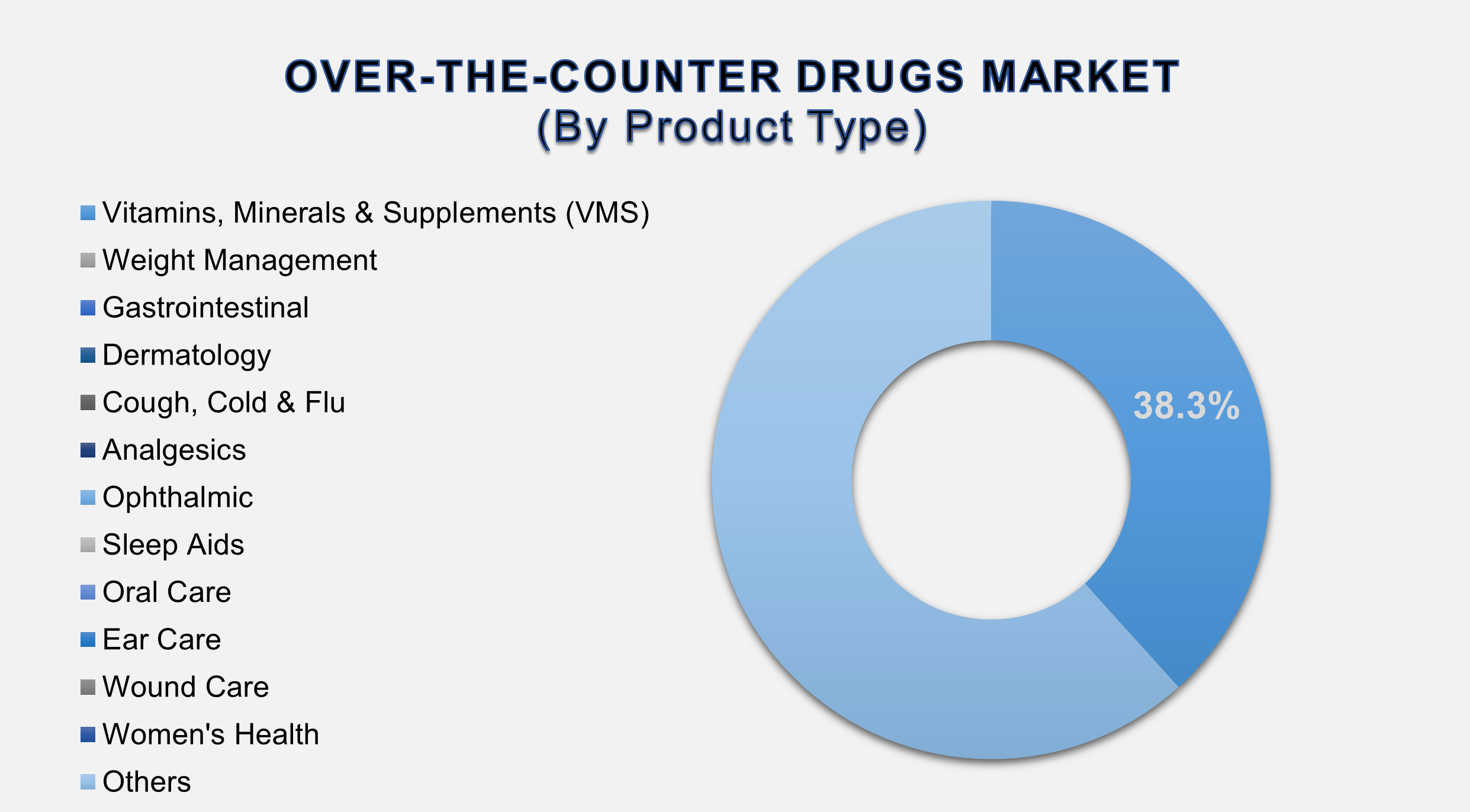
North America
accounted for approximately 38.3% of the global over-the-counter drugs market
in 2026, making it the largest regional market. The role played by North
America in the worldwide market of over-the-counter (OTC) drugs is anticipated
due to the presence of healthcare facilities, consumers’ knowledge regarding
self-medication, OTC medicines, and regulations in this region. North America
has the advantage of being home to numerous top-notch pharmaceutical companies
and distribution channels through retail pharmacies, as well as the increasing
demand for preventive healthcare and wellness products like vitamins and
minerals. In addition, the costs associated with healthcare and consumers’
preference for OTC drugs have driven the OTC market in both the USA and Canada.
It is expected that
the Asia Pacific region will witness maximum growth in the global OTC drugs
market due to factors such as availability of a large population, higher income
levels, rapid urbanization, and improved healthcare accessibility. Awareness regarding
health issues, the practice of self-medicating, and the development of
organized pharmacy retail and online pharmacies would be some of the major
factors that would create demand for OTC drugs in countries such as India,
China, Japan, and South Korea. Moreover, efforts by the government to improve
healthcare accessibility and the increasing prevalence of certain lifestyle
diseases would create huge opportunities for the OTC drugs market.
Over-the-Counter
Drugs Market Competition Landscape Analysis
The
over-the-counter (OTC) medicines market around the world is extremely
competitive; major pharmaceutical and consumer health care firms concentrate on
innovations and diversification to consolidate their position in the market.
Manufacturers are coming up with new formulations, extending brands, developing
innovative packaging, and utilizing digital marketing along with expanding
their distribution channels. In addition to this, companies are entering into
mergers and acquisitions to add more OTC products to their range owing to the
rising demand for self-care and preventive care products.
Global
Over-the-Counter Drugs Market Recent Developments News:
● In June 2026 – The U.S. Food and Drug Administration (FDA) today approved another over-the-counter (OTC) intranasal naloxone product, Rextovy, a 4 milligram (mg) naloxone hydrochloride nasal spray for the emergency treatment of opioid overdose.
● In June 2026 – Pharmacy Times, the leading multimedia resource for pharmacy professionals, released its 2026 OTC Guide, the most comprehensive and trusted directory of pharmacist-recommended OTC health products in the United States.
● In April 2025 – Kingsway Pharmaceuticals Unveils PBZ OTC, the First New Topical Antihistamine in 50 Years, at Target Stores Nationwide.
The Global Over-the-Counter Drugs Market is dominated by a few large companies,
such as
●
Bayer AG
●
Boehringer Ingelheim
●
Dr. Reddy's Laboratories
●
Glenmark Pharmaceuticals
●
Haleon
●
Hisamitsu Pharmaceutical
●
Kenvue
●
Nestlé Health Science
●
Opella
●
Perrigo Company plc
●
Pfizer Inc.
●
Prestige Consumer Healthcare
●
Procter & Gamble
●
Reckitt Benckiser Group plc
●
Sanofi S.A.
●
Sun Pharmaceutical Industries
●
Takeda Pharmaceutical
●
Teva Pharmaceutical Industries
●
Viatris
● Other Prominent Players
Frequently Asked Questions
Swetal (Research Analyst)
Swetal is a Research Analyst with 4+ years of experience specializing in healthcare market research, medical devices, healthcare IT, and medical technology industry analysis. Her expertise includes competitive intelligence, secondary research, market trend forecasting, and healthcare business insights across global healthcare ecosystems.
She contributes to advanced market research reports by analyzing regulatory frameworks, emerging healthcare technologies, competitive landscapes, and innovation trends shaping the medical industry. With a strong focus on accurate market intelligence, strategic insights, and healthcare industry trends, Swetal supports businesses in making informed, data-backed decisions in a rapidly transforming healthcare environment.
1.
Global
Over-the-Counter Drugs Market Introduction and Market Overview
1.1. Objectives of the Study
1.2. Market Segmentation
1.2.1.Product Type of the Global Over-the-Counter
Drugs Market
1.2.2.Formulation of Global Over-the-Counter
Drugs Market
1.2.3.Distribution Channel of Global Over-the-Counter
Drugs Market
1.2.4.Region of Global Over-the-Counter
Drugs Market
1.3. Competition Coverage List of
Market Participants
1.4. Market Definition: Over-the-Counter
Drugs Market
2.
Executive Summary
2.1. Global Over-the-Counter Drugs
Market Estimation & Forecast
2.1.1.Global Over-the-Counter Drugs
Market Size (US$ Million) Estimates & Historical Trend Analysis (2021 -
2025)
2.1.2.Global Over-the-Counter Drugs
Overall Market Size (US$ Million), Growth Rate (Y-o-Y), Market CAGR (%), Market
forecast (2026 - 2034)
2.2. Snapshot of Global Over-the-Counter
Drugs Market
2.3. Global Over-the-Counter Drugs
Market Revenue Share (%) 2025
2.4. REGIONAL OUTLINE: Revenue CAGR,
by Region
2.5. Key Competitors & Key
Insights
3.
Market Overview (Qualitative
Analysis)
3.1. Demand Side Trends
3.2. Supply Side Trends /
Manufacturing Trends
3.3. Demand and Opportunity
Assessment, 2026 - 2034
3.4. Market Dynamics
3.4.1.Drivers
3.4.2.Limitations
3.4.3.Opportunities
3.4.4.Impact Analysis of Drivers and
Restraints
3.5. Key Developments
3.6. Regulatory Landscape
3.7. Pricing Analysis
3.8. Supply Chain Analysis
3.9. Porter’s Five Forces Analysis
3.9.1.Bargaining Power of Suppliers
3.9.2.Bargaining Power of Buyers
3.9.3.Threat of Substitutes
3.9.4.Threat of New Entrants
3.9.5.Competitive Rivalry
3.10. PEST Analysis
3.10.1. Political Factors
3.10.2. Economic Factors
3.10.3. Social Factors
3.10.4. Technology Factors
4.
Global Over-the-Counter Drugs
Market Estimates & Forecast Trend Analysis, by Product Type
4.1. Global Over-the-Counter Drugs
Market Assessments & Key Findings, by Product Type
4.2. Global Over-the-Counter Drugs
Market Revenue (US$ Million) Estimates and Forecasts, by Product Type, 2021 -
2034
4.2.1.Vitamins, Minerals &
Supplements (VMS)
4.2.2.Weight Management
4.2.3.Gastrointestinal
4.2.4.Dermatology
4.2.5.Cough, Cold & Flu
4.2.6.Analgesics
4.2.7.Ophthalmic
4.2.8.Sleep Aids
4.2.9.Oral Care
4.2.10. Ear Care
4.2.11. Wound Care
4.2.12. Women's Health
4.2.13. Others (Antihistamines, Smoking
Cessation, etc.)
5.
Global Over-the-Counter Drugs
Market Estimates & Forecast Trend Analysis, by Formulation
5.1. Global Over-the-Counter Drugs
Market Assessments & Key Findings, by Formulation
5.2. Global Over-the-Counter Drugs
Market Revenue (US$ Million) Estimates and Forecasts, by Formulation, 2021 -
2034
5.2.1.Powders and Granules
5.2.2.Tablet and Capsules
5.2.3.Creams, Gels & Ointments
5.2.4.Sprays and Inhalers
5.2.5.Lozenges
5.2.6.Others (Liquids, Gummies,
Transdermal Patches, etc.)
6.
Global Over-the-Counter Drugs
Market Estimates & Forecast Trend Analysis, by Distribution Channel
6.1. Global Over-the-Counter Drugs
Market Assessments & Key Findings, by Distribution Channel
6.2. Global Over-the-Counter Drugs
Market Revenue (US$ Million) Estimates and Forecasts, by Distribution Channel, 2021
- 2034
6.2.1.Retail Pharmacies
6.2.2.Hospital Pharmacies
6.2.3.Online Pharmacies
6.2.4.Others (Drug Stores &
Supermarkets, Convenience Stores, etc.)
7.
Global Over-the-Counter Drugs
Market Estimates & Forecast Trend Analysis, by Region
7.1. Global Over-the-Counter Drugs
Market Assessments & Key Findings, by Region
7.2. Global Over-the-Counter Drugs
Market Revenue (US$ Million) Estimates and Forecasts, by Region, 2021 - 2034
7.2.1.North America
7.2.2.Europe
7.2.3.Asia Pacific
7.2.4.Middle East & Africa
7.2.5.Latin America
8.
North
America Over-the-Counter Drugs Market: Estimates & Forecast Trend Analysis
8.1.
North
America Over-the-Counter Drugs Market Assessments & Key Findings
8.1.1.North America Over-the-Counter
Drugs Market Introduction
8.1.2.North America Over-the-Counter
Drugs Market Size Estimates and Forecast (US$ Million) (2021 - 2034)
8.1.2.1. By Product Type
8.1.2.2. By Formulation
8.1.2.3. By Distribution Channel
8.1.2.4. By Country
8.1.2.4.1. The U.S.
8.1.2.4.2. Canada
9.
Europe
Over-the-Counter Drugs Market: Estimates & Forecast Trend Analysis
9.1. Europe Over-the-Counter Drugs
Market Assessments & Key Findings
9.1.1.Europe Over-the-Counter Drugs
Market Introduction
9.1.2.Europe Over-the-Counter Drugs
Market Size Estimates and Forecast (US$ Million) (2021 - 2034)
9.1.2.1. By Product Type
9.1.2.2. By Formulation
9.1.2.3. By Distribution Channel
9.1.2.4.
By
Country
9.1.2.4.1.
Germany
9.1.2.4.2.
Italy
9.1.2.4.3.
U.K.
9.1.2.4.4.
France
9.1.2.4.5.
Spain
9.1.2.4.6.
Switzerland
9.1.2.4.7. Rest
of Europe
10. Asia Pacific Over-the-Counter
Drugs Market: Estimates & Forecast
Trend Analysis
10.1. Asia Pacific Market Assessments
& Key Findings
10.1.1. Asia Pacific Over-the-Counter
Drugs Market Introduction
10.1.2. Asia Pacific Over-the-Counter
Drugs Market Size Estimates and Forecast (US$ Million) (2021 - 2034)
10.1.2.1. By Product Type
10.1.2.2. By Formulation
10.1.2.3. By Distribution Channel
10.1.2.4. By Country
10.1.2.4.1. China
10.1.2.4.2. Japan
10.1.2.4.3. India
10.1.2.4.4. Australia
10.1.2.4.5. South Korea
10.1.2.4.6. Rest of Asia Pacific
11. Middle East & Africa Over-the-Counter
Drugs Market: Estimates & Forecast
Trend Analysis
11.1. Middle East & Africa Market
Assessments & Key Findings
11.1.1. Middle
East & Africa Over-the-Counter
Drugs Market Introduction
11.1.2. Middle
East & Africa Over-the-Counter
Drugs Market Size Estimates and Forecast (US$ Million) (2021 - 2034)
11.1.2.1. By Product Type
11.1.2.2. By Formulation
11.1.2.3. By Distribution Channel
11.1.2.4. By Country
11.1.2.4.1. South Africa
11.1.2.4.2. UAE
11.1.2.4.3. Saudi Arabia
11.1.2.4.4. Rest of MEA
12. Latin America
Over-the-Counter Drugs Market: Estimates
& Forecast Trend Analysis
12.1. Latin America Market Assessments
& Key Findings
12.1.1. Latin America Over-the-Counter
Drugs Market Introduction
12.1.2. Latin America Over-the-Counter
Drugs Market Size Estimates and Forecast (US$ Million) (2021 - 2034)
12.1.2.1. By Product Type
12.1.2.2. By Formulation
12.1.2.3. By Distribution Channel
12.1.2.4. By Country
12.1.2.4.1. Brazil
12.1.2.4.2. Mexico
12.1.2.4.3. Argentina
12.1.2.4.4. Rest of LATAM
13. Competition Landscape
13.1. Global Over-the-Counter Drugs
Market Product Mapping
13.2. Global Over-the-Counter Drugs
Market Concentration Analysis, by Leading Players / Innovators / Emerging
Players / New Entrants
13.3. Global Over-the-Counter Drugs
Market Tier Structure Analysis
13.4. Global Over-the-Counter Drugs
Market Concentration & Company Market Shares (%) Analysis, 2025
14. Company Profiles
14.1. Bayer AG
14.1.1. Company Overview & Key Stats
14.1.2. Financial Performance & KPIs
14.1.3. Product Portfolio
14.1.4. SWOT Analysis
14.1.5. Business Strategy & Recent
Developments
* Similar details would be provided
for all the players mentioned below
14.2.
Boehringer Ingelheim
14.3.
Dr. Reddy's Laboratories
14.4.
Glenmark Pharmaceuticals
14.5.
Haleon
14.6.
Hisamitsu Pharmaceutical
14.7.
Kenvue
14.8.
Nestlé Health Science
14.9.
Opella
14.10.
Perrigo Company plc
14.11.
Pfizer Inc.
14.12.
Prestige Consumer Healthcare
14.13.
Procter & Gamble
14.14.
Reckitt Benckiser Group plc
14.15.
Sanofi S.A.
14.16.
Sun Pharmaceutical Industries
14.17.
Takeda Pharmaceutical
14.18.
Teva Pharmaceutical Industries
14.19. Viatris
14.20. Other Prominent Players
15. Research
Findings & Conclusion
16. Assumption & Acronyms Used
17. Research
Methodology
17.1. External Transportations /
Databases
17.2. Internal Proprietary Database
17.3. Primary Research
17.4. Secondary Research
17.5. Assumptions
17.6. Limitations
17.7. Report FAQs
Our Research Methodology
"Insight without rigor is just noise."
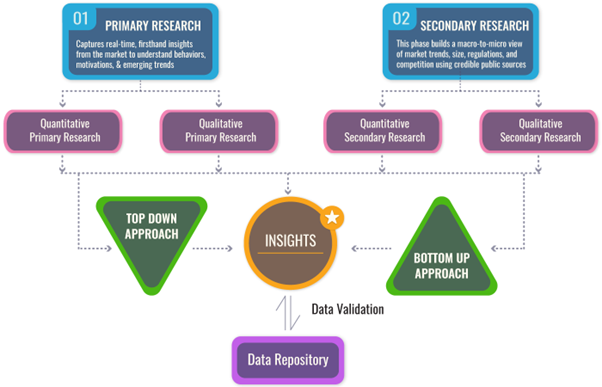
We follow a comprehensive, multi-phase research framework designed to deliver accurate, strategic, and decision-ready intelligence. Our process integrates primary and secondary research , both quantitative and qualitative , along with dual modeling techniques ( top-down and bottom-up) and a final layer of validation through our proprietary in-house repository.
PRIMARY RESEARCH
Primary research captures real-time, firsthand insights from the market to understand behaviors, motivations, and emerging trends.
1. Quantitative Primary Research
Objective: Generate statistically significant data directly from market participants.
Approaches:- Structured surveys with customers, distributors, and field agents
- Mobile-based data collection for point-of-sale audits and usage behavior
- Phone-based interviews (CATI) for market sizing and product feedback
- Online polling around industry events and digital campaigns
- Purchase frequency by customer type
- Channel performance across geographies
- Feature demand by application or demographic
2. Qualitative Primary Research
Objective: Explore decision-making drivers, pain points, and market readiness.
Approaches:- In-depth interviews (IDIs) with executives, product managers, and key decision-makers
- Focus groups among end users and early adopters
- Site visits and observational research for consumer products
- Informal field-level discussions for regional and cultural nuances
SECONDARY RESEARCH
This phase helps establish a macro-to-micro understanding of market trends, size, regulation, and competitive dynamics, sourced from credible and public domain information.
1. Quantitative Secondary Research
Objective: Model market value and segment-level forecasts based on published data.
Sources include:- Financial reports and investor summaries
- Government trade data, customs records, and regulatory statistics
- Industry association publications and economic databases
- Channel performance and pricing data from marketplace listings
- Revenue splits, pricing trends, and CAGR estimates
- Supply-side capacity and volume tracking
- Investment analysis and funding benchmarks
2. Qualitative Secondary Research
Objective: Capture strategic direction, innovation signals, and behavioral trends.
Sources include:- Company announcements, roadmaps, and product pipelines
- Publicly available whitepapers, conference abstracts, and academic research
- Regulatory body publications and policy briefs
- Social and media sentiment scanning for early-stage shifts
- Strategic shifts in market positioning
- Unmet needs and white spaces
- Regulatory triggers and compliance impact
DUAL MODELING: TOP-DOWN + BOTTOM-UP
To ensure robust market estimation, we apply two complementary sizing approaches:
Top-Down Modeling:- Start with broader industry value (e.g., global or regional TAM)
- Apply filters by segment, geography, end-user, or use case
- Adjust with primary insights and validation benchmarks
- Ideal for investor-grade market scans and opportunity mapping
- Aggregate from the ground up using sales volumes, pricing, and unit economics
- Use internal modeling templates aligned with stakeholder data
- Incorporate distributor-level or region-specific inputs
- Most accurate for emerging segments and granular sub-markets
DATA VALIDATION: IN-HOUSE REPOSITORY
We close the loop with proprietary data intelligence built from ongoing projects, industry monitoring, and historical benchmarking. This repository includes:
- Multi-sector market and pricing models
- Key trendlines from past interviews and forecasts
- Benchmarked adoption rates, churn patterns, and ROI indicators
- Industry-specific deviation flags and cross-check logic
- Catches inconsistencies early
- Aligns projections across studies
- Enables consistent, high-trust deliverables