

Packaging Testing Services Market Size and Forecast (2020 - 2033), Global and Regional Growth, Trend, Share, and Industry Analysis Report Coverage: By Testing Type (Physical, Mechanical, Chemical, and Microbiological), By Material (Plastic, Glass, Metal, Paper & Paperboard, and Others), By End-Use Industry (Food & Beverage, Healthcare & Pharmaceuticals, Personal Care & Cosmetics, Chemicals, and Others) And Geography
2025-12-12
Packaging Industry
Jaya Bundele (Research Analyst)
Description
Packaging
Testing Services Market Overview
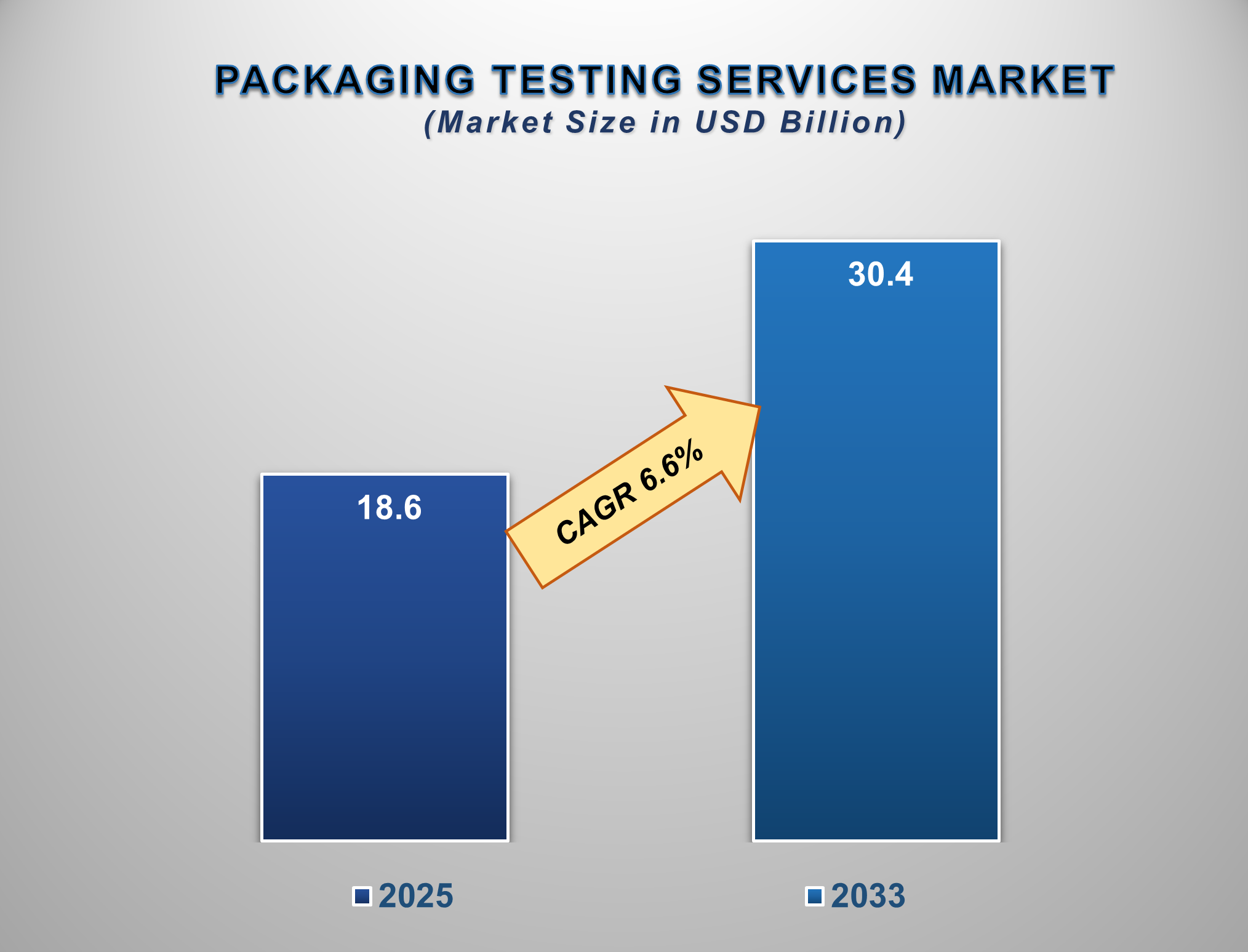
The Packaging Testing Services Market is positioned for robust growth from 2025 to 2033, fueled by stringent regulatory standards, rising consumer awareness about product safety, and the global expansion of packaged goods. The market is projected to be valued at approximately USD 18.6 billion in 2025 and is forecasted to reach nearly USD 30.4 billion by 2033, exhibiting a compound annual growth rate (CAGR) of 6.6% during this period.
Packaging testing services are essential for
evaluating the performance, durability, safety, and compliance of packaging
materials and finished packages. These services ensure that products are
protected throughout the supply chain, maintain their integrity, and are safe
for the end-consumer. The market's expansion is underpinned by factors such as
the increasing complexity of global supply chains, the growing demand for
sustainable packaging, and strict regulations in the pharmaceutical and food
& beverage industries. Technological advancements in testing equipment,
such as the integration of automation and data analytics, are enhancing testing
accuracy and efficiency. North America and Europe are mature markets with a
strong focus on regulatory compliance, while the Asia-Pacific region is
expected to witness the fastest growth, driven by rapid industrialization, a
booming e-commerce sector, and rising quality standards.
Packaging Testing Services Market Drivers and
Opportunities
Stringent Regulatory Compliance and Focus on Product Safety
Are the Primary Market Drivers
The implementation of strict global and regional
regulations governing packaging safety, particularly in the food, beverage, and
pharmaceutical sectors, is the most significant driver for the packaging
testing services market. Agencies like the FDA (U.S.), EMA (Europe), and others
mandate rigorous testing for migration of substances, material composition, and
child-resistant features. Concurrently, rising consumer awareness about product
contamination and quality is pressuring brands to invest in independent
verification of their packaging's safety and integrity. This dual pressure from
regulators and consumers creates a non-discretionary and sustained demand for
comprehensive testing services to avoid costly recalls, legal liabilities, and
brand damage.
Growth of E-commerce and Sustainable Packaging Is Driving
Market Evolution
The explosive growth of the e-commerce industry
has created a critical need for packaging that can withstand the rigors of the
logistics environment. This has led to a surge in demand for mechanical and
physical testing services, such as vibration, shock, and compression testing,
to ensure products arrive undamaged. Simultaneously, the global shift towards
sustainable packaging materials like bioplastics, recycled paper, and novel
composites requires extensive testing to validate their performance, barrier properties,
and safety compared to traditional materials. This trend is pushing testing
laboratories to develop new protocols and capabilities to handle innovative,
eco-friendly packaging solutions.
Expansion in Emerging Economies and Outsourcing Trends
Present Significant Opportunities
The rapid growth of manufacturing, especially in
the food, pharmaceutical, and consumer goods sectors in Asia-Pacific, Latin
America, and the Middle East, presents a major growth frontier. As local
companies aim to export to regulated markets and multinationals set up
production facilities, the demand for internationally accredited testing
services skyrockets. This offers a massive opportunity for global testing
service providers to expand their footprint. Furthermore, the increasing trend
of outsourcing testing functions to specialized third-party laboratories,
rather than maintaining in-house capabilities, is a key strategic opportunity.
This allows manufacturers to access expert knowledge, state-of-the-art
equipment, and accredited services in a cost-effective manner.
Packaging Testing Services Market Scope
|
Report Attributes |
Description |
|
Market Size in 2025 |
USD 18.6 Billion |
|
Market Forecast in 2033 |
USD 30.4 Billion |
|
CAGR % 2025-2033 |
6.6% |
|
Base Year |
2024 |
|
Historic Data |
2020-2024 |
|
Forecast Period |
2025-2033 |
|
Report USP |
Product Portfolio,
Technological Analysis, Company Market Share, Company Heatmap, Pricing
Analysis, Growth Factors and more |
|
Segments Covered |
●
By Testing Type ●
By Material ●
By End-user
Industry |
|
Regional Scope |
●
North America, ●
Europe, ●
APAC, ●
Latin America ●
Middle East and
Africa |
|
Country Scope |
1)
U.S. 2)
Canada 3)
Germany 4)
UK 5)
France 6)
Spain 7)
Italy 8)
Switzerland 9)
China 10)
Japan 11)
India 12)
Australia 13)
South Korea 14)
Brazil 15)
Mexico 16)
Argentina 17)
South Africa 18)
Saudi Arabia 19)
UAE |
Packaging Testing Services Market Report
Segmentation Analysis
The global Packaging Testing
Services Market industry analysis is segmented by Testing Type, by Material, by
End-Use Industry, and by Region.
The Physical &
Mechanical Testing segment is anticipated to command a dominant market share in
2025.
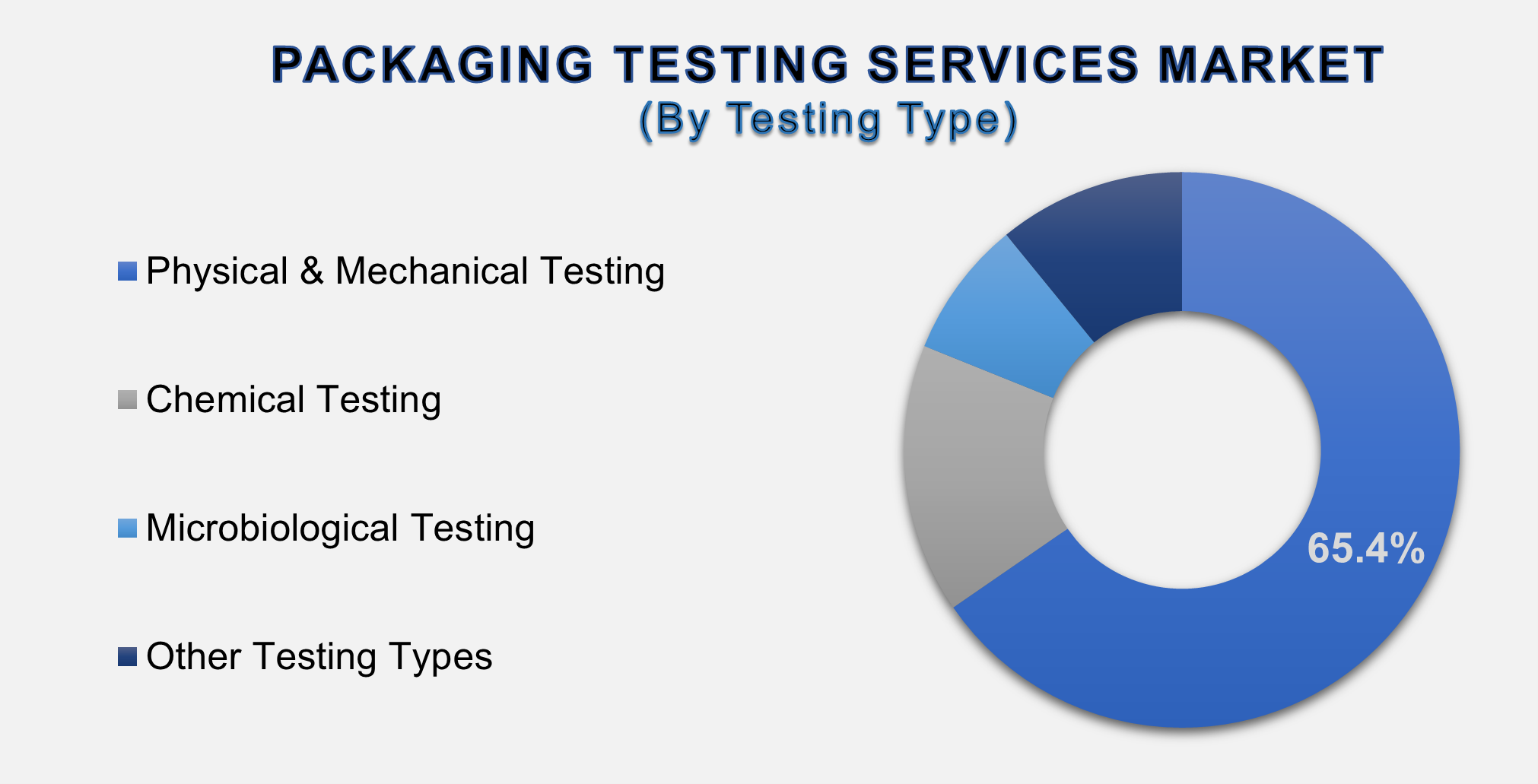
The Testing Type segment is categorized into Physical, Mechanical, Chemical, and Microbiological. The Physical & Mechanical Testing segment commands a dominant market share, as it forms the foundation of package integrity and performance. These tests are crucial across all industries to ensure packaging can protect its contents from real-world stresses. Key tests include compression strength (for stacking in warehouses), drop/impact resistance (for handling and shipping), vibration testing (for transport), and tear resistance. The growth of e-commerce and complex global supply chains has made these tests indispensable for minimizing in-transit damage and associated financial losses.
The Healthcare &
Pharmaceuticals segment is projected to be the fastest-growing.
The
End-Use Industry segment is divided into Food & Beverage, Healthcare &
Pharmaceuticals, Personal Care & Cosmetics, Chemicals, and Others. The
Healthcare & Pharmaceuticals segment is projected to be the fastest-growing
end-user due to the exceptionally high stakes of product safety and stringent
regulatory oversight. Packaging for drugs, medical devices, and vaccines must
undergo rigorous testing for sterility, container closure integrity,
drug-package interaction (leachables & extractables), and stability. The
rapid development of biologics, complex injectables, and the need for
ultra-cold chain packaging for certain pharmaceuticals are driving demand for
highly specialized and sensitive testing services to ensure patient safety and
regulatory approval.
The Plastic material
segment is projected to exhibit strong growth.
The
Material segment includes Plastic, Glass, Metal, Paper & Paperboard, and
Others. The Plastic segment exhibits strong growth and remains a major focus
for testing services due to its ubiquitous use and the dual challenges of
ensuring its safety and evolving towards sustainability. While its dominance is
challenged by environmental concerns, it remains a primary packaging material.
This drives demand for tests on recyclability, recycled content validation, and
migration of substances from complex multi-layer plastics. Furthermore, the
development and testing of new bioplastics and compostable polymers require
extensive analysis to verify their performance and safety, ensuring this
segment remains a key revenue generator for testing laboratories.
The following segments are
part of an in-depth analysis of the global Packaging Testing Services Market:
|
Market
Segments |
|
|
By Testing
Type |
●
Physical &
Mechanical Testing ●
Chemical Testing ●
Microbiological
Testing ●
Other Testing Types |
|
By Material |
●
Plastic ●
Glass ●
Metal ●
Paper &
Paperboard ●
Others |
|
By End-user Industry |
●
Food & Beverage ●
Healthcare &
Pharmaceuticals ●
Personal Care &
Cosmetics ●
Chemicals ●
Others |
Packaging Testing Services Market Share Analysis
by Region
The North America region
is anticipated to hold the largest portion of the Packaging Testing Services
Market globally throughout the forecast period.
North
America's dominance is attributed to its mature and highly regulated consumer
markets, particularly in the food and pharmaceutical sectors. The presence of
major global brands, a strong culture of litigation and product liability, and
strict enforcement by agencies like the FDA and EPA creates a mandatory and high-value demand for accredited testing
services. The region also has a high concentration of leading testing service
providers and a robust logistics and e-commerce sector that relies heavily on
package performance validation.
In
addition, the Asia-Pacific region is
anticipated to be the fastest-growing region, driven by its position as the
global manufacturing hub. The rapid expansion of its domestic middle class with
higher quality expectations, coupled with increasing exports to regulated Western
markets, is compelling manufacturers to invest in quality assurance.
Governments in countries like China and India are also strengthening their own
regulatory frameworks for product and packaging safety, further propelling the
need for professional testing services and attracting significant investment
from international testing firms.
Packaging Testing Services Market Competition
Landscape Analysis
The global packaging testing
services market is fragmented and competitive, featuring a mix of large
multinational testing, inspection, and certification (TIC) corporations and
specialized regional players. Competition is based on accreditation, technical
expertise, global network, turnaround time, and price. Key strategies include
geographic expansion into high-growth markets, acquisitions of smaller
specialized labs to broaden service portfolios, and heavy investment in new
testing methodologies for sustainable and advanced materials. Building
long-term partnerships with major fast-moving consumer goods (FMCG) and
pharmaceutical companies is also a critical success factor.
Global Packaging Testing Services Market Recent
Developments News:
- In January 2025, SGS SA opened a new state-of-the-art packaging
testing facility in India, focusing on e-commerce durability and
pharmaceutical integrity testing.
- In November 2024, Eurofins Scientific acquired a specialized
laboratory in the United States to strengthen its capabilities in
extractables and leachables (E&L) testing for pharmaceutical
packaging.
- In August 2024, Intertek Group plc launched a new digital platform
that provides clients with real-time tracking and analytics for their
packaging testing projects.
- In May 2024, Bureau Veritas introduced a new suite of testing
services specifically designed to validate the composability and
recyclability claims of sustainable packaging materials.
The Global Packaging Testing Services Market Is
Dominated by a Few Large Companies, such as
●
SGS SA
●
Bureau Veritas SA
●
Intertek Group plc
●
Eurofins Scientific SE
●
TUV SUD AG
●
ALS Limited
●
Mérieux NutriSciences
●
Microbac Laboratories,
Inc.
●
CRYOPAK (An ADP
Company)
●
National Technical
Systems (NTS)
● Other Prominent Players
Frequently Asked Questions
Jaya Bundele (Research Analyst)
Jaya Bundele is a skilled Research Analyst with 4+ years of experience in market intelligence, consumer insights, competitive analysis, and industry forecasting across the consumer goods, agriculture, and food & beverage sectors. She specializes in market sizing, trend analysis, growth opportunity mapping, and strategic secondary research for global and regional markets.
Her expertise lies in transforming complex industry data into actionable business strategies that help organizations identify emerging trends, understand customer behavior, and gain a competitive edge. With a strong focus on data-driven insights, business intelligence, and future market trends, Jaya delivers high-quality research solutions aligned with evolving industry demands and market dynamics.
1. Global Packaging Testing
Services Market Introduction and Market Overview
1.1.
Objectives
of the Study
1.2.
Global
Packaging Testing Services Market Scope and Market Estimation
1.2.1.Global Electronic Toll
Collection Overall Market Size (US$ Mn), Market CAGR (%), Market forecast (2025
- 2033)
1.2.2.Global Packaging Testing
Services Market Revenue Share (%) and Growth Rate (Y-o-Y) from 2020 - 2033
1.3.
Market
Segmentation
1.3.1.Testing Type of Global Packaging
Testing Services Market
1.3.2.Material of Global Packaging
Testing Services Market
1.3.3.End-user Industry of Global
Packaging Testing Services Market
1.3.4.Region of Global Packaging
Testing Services Market
2. Executive
Summary
2.1.
Demand
Side Trends
2.2.
Key
Market Trends
2.3.
Market
Demand (US$ Mn) Analysis 2020 – 2024 and forecast, 2025 – 2033
2.4.
Demand
and Opportunity Assessment
2.5.
Technological
Advancements
2.6.
Regulatory
Scenario by Region
2.7.
Key
Developments
2.8.
Market
Entry Strategies
2.9.
Market
Dynamics
2.9.1.Drivers
2.9.2.Limitations
2.9.3.Opportunities
2.9.4.Impact Analysis of Drivers
and Restraints
2.10.
Porter’s
Five Forces Analysis
2.11.
PEST
Analysis
3. Global
Packaging Testing Services Market
Estimates & Historical Trend Analysis (2020 - 2024)
4. Global
Packaging Testing Services Market
Estimates & Forecast Trend Analysis, by Testing
Type
4.1.
Global
Packaging Testing Services Market Revenue (US$ Mn) Estimates and Forecasts, by Testing
Type, 2020 - 2033
4.1.1.Physical & Mechanical
Testing
4.1.2.Chemical Testing
4.1.3.Microbiological Testing
4.1.4.Other Testing Types
5. Global
Packaging Testing Services Market
Estimates & Forecast Trend Analysis, by Material
5.1.
Global
Packaging Testing Services Market Revenue (US$ Mn) Estimates and Forecasts, by Material,
2020 - 2033
5.1.1.Plastic
5.1.2.Glass
5.1.3.Metal
5.1.4.Paper & Paperboard
5.1.5.Others
6. Global
Packaging Testing Services Market
Estimates & Forecast Trend Analysis, by End-user
Industry
6.1.
Global
Packaging Testing Services Market Revenue (US$ Mn) Estimates and Forecasts, by End-user
Industry 2020 - 2033
6.1.1.Food & Beverage
6.1.2.Healthcare &
Pharmaceuticals
6.1.3.Personal Care &
Cosmetics
6.1.4.Chemicals
6.1.5.Others
7. Global
Packaging Testing Services Market
Estimates & Forecast Trend Analysis, by region
7.1.
Global
Packaging Testing Services Market Revenue (US$ Mn) Estimates and Forecasts, by region,
2020 - 2033
7.1.1.North America
7.1.2.Europe
7.1.3.Asia Pacific
7.1.4.Middle East & Africa
7.1.5.Latin America
8. North America Packaging
Testing Services Market: Estimates
& Forecast Trend Analysis
8.1.
North
America Packaging Testing Services Market Assessments & Key Findings
8.1.1.North America Packaging
Testing Services Market Introduction
8.1.2.North America Packaging
Testing Services Market Size Estimates and Forecast (US$ Billion) (2020 - 2033)
8.1.2.1. By Testing
Type
8.1.2.2. By Material
8.1.2.3. By End-user
Industry
8.1.2.4.
By
Country
8.1.2.4.1. The U.S.
8.1.2.4.2. Canada
9. Europe Packaging
Testing Services Market: Estimates
& Forecast Trend Analysis
9.1.
Europe
Packaging Testing Services Market Assessments & Key Findings
9.1.1.Europe Packaging Testing
Services Market Introduction
9.1.2.Europe Packaging Testing
Services Market Size Estimates and Forecast (US$ Billion) (2020 - 2033)
9.1.2.1. By Testing
Type
9.1.2.2. By Material
9.1.2.3. By End-user
Industry
9.1.2.4.
By
Country
9.1.2.4.1.
Germany
9.1.2.4.2.
Italy
9.1.2.4.3.
U.K.
9.1.2.4.4.
France
9.1.2.4.5.
Spain
9.1.2.4.6.
Switzerland
9.1.2.4.7. Rest
of Europe
10. Asia Pacific Packaging
Testing Services Market: Estimates
& Forecast Trend Analysis
10.1.
Asia
Pacific Market Assessments & Key Findings
10.1.1.
Asia
Pacific Packaging Testing Services Market Introduction
10.1.2.
Asia
Pacific Packaging Testing Services Market Size Estimates and Forecast (US$ Billion)
(2020 - 2033)
10.1.2.1. By Testing
Type
10.1.2.2. By Material
10.1.2.3. By End-user
Industry
10.1.2.4.
By
Country
10.1.2.4.1. China
10.1.2.4.2. Japan
10.1.2.4.3. India
10.1.2.4.4. Australia
10.1.2.4.5. South Korea
10.1.2.4.6. Rest of Asia Pacific
11. Middle East & Africa Packaging
Testing Services Market: Estimates
& Forecast Trend Analysis
11.1.
Middle
East & Africa Market Assessments & Key Findings
11.1.1.
Middle East & Africa Packaging Testing Services Market
Introduction
11.1.2.
Middle East & Africa Packaging Testing Services Market
Size Estimates and Forecast (US$ Billion) (2020 - 2033)
11.1.2.1. By Testing
Type
11.1.2.2. By Material
11.1.2.3. By End-user
Industry
11.1.2.4.
By
Country
11.1.2.4.1. UAE
11.1.2.4.2. Saudi
Arabia
11.1.2.4.3. South
Africa
11.1.2.4.4. Rest
of MEA
12. Latin America
Packaging Testing Services Market:
Estimates & Forecast Trend Analysis
12.1.
Latin
America Market Assessments & Key Findings
12.1.1.
Latin
America Packaging Testing Services Market Introduction
12.1.2.
Latin
America Packaging Testing Services Market Size Estimates and Forecast (US$ Billion)
(2020 - 2033)
12.1.2.1. By Testing
Type
12.1.2.2. By Material
12.1.2.3. By End-user
Industry
12.1.2.4.
By
Country
12.1.2.4.1. Brazil
12.1.2.4.2. Argentina
12.1.2.4.3. Mexico
12.1.2.4.4. Rest
of LATAM
13. Country Wise Market:
Introduction
14.
Competition
Landscape
14.1.
Global
Packaging Testing Services Market Product Mapping
14.2.
Global
Packaging Testing Services Market Concentration Analysis, by Leading Players /
Innovators / Emerging Players / New Entrants
14.3.
Global
Packaging Testing Services Market Tier Structure Analysis
14.4.
Global
Packaging Testing Services Market Concentration & Company Market Shares (%)
Analysis, 2024
15.
Company
Profiles
15.1.
GE Healthcare
15.1.1.
Company
Overview & Key Stats
15.1.2.
Financial
Performance & KPIs
15.1.3.
Product
Portfolio
15.1.4.
SWOT
Analysis
15.1.5.
Business
Strategy & Recent Developments
* Similar details would be provided for all the players
mentioned below
15.2. Siemens
Healthineers
15.3. Philips
15.4. Canon Medical
Systems Corporation
15.5. Fujifilm
Holdings Corporation
15.6. Hitachi, Ltd.
15.7. Medtronic plc
15.8. Nihon Kohden
Corporation
15.9. Elekta AB
15.10. Brainlab AG
15.11. Shimadzu
Corporation
15.12. MinFound
Medical Systems Co., Ltd.
15.13. NeuroLogica
Corp (Samsung)
15.14. Other
Prominent Players
16. Research
Methodology
16.1.
External
Transportations / Databases
16.2.
Internal
Proprietary Database
16.3.
Primary
Research
16.4.
Secondary
Research
16.5.
Assumptions
16.6.
Limitations
16.7.
Report
FAQs
17. Research
Findings & Conclusion
Our Research Methodology
"Insight without rigor is just noise."
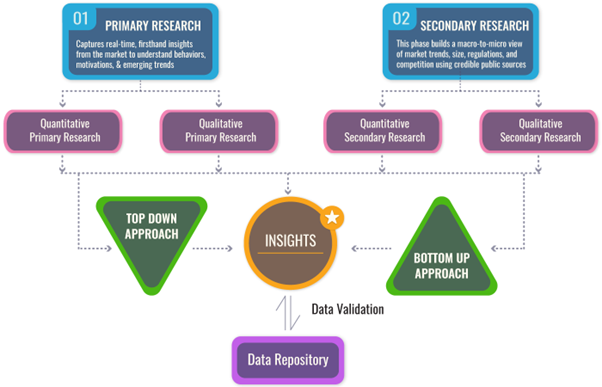
We follow a comprehensive, multi-phase research framework designed to deliver accurate, strategic, and decision-ready intelligence. Our process integrates primary and secondary research , both quantitative and qualitative , along with dual modeling techniques ( top-down and bottom-up) and a final layer of validation through our proprietary in-house repository.
PRIMARY RESEARCH
Primary research captures real-time, firsthand insights from the market to understand behaviors, motivations, and emerging trends.
1. Quantitative Primary Research
Objective: Generate statistically significant data directly from market participants.
Approaches:- Structured surveys with customers, distributors, and field agents
- Mobile-based data collection for point-of-sale audits and usage behavior
- Phone-based interviews (CATI) for market sizing and product feedback
- Online polling around industry events and digital campaigns
- Purchase frequency by customer type
- Channel performance across geographies
- Feature demand by application or demographic
2. Qualitative Primary Research
Objective: Explore decision-making drivers, pain points, and market readiness.
Approaches:- In-depth interviews (IDIs) with executives, product managers, and key decision-makers
- Focus groups among end users and early adopters
- Site visits and observational research for consumer products
- Informal field-level discussions for regional and cultural nuances
SECONDARY RESEARCH
This phase helps establish a macro-to-micro understanding of market trends, size, regulation, and competitive dynamics, sourced from credible and public domain information.
1. Quantitative Secondary Research
Objective: Model market value and segment-level forecasts based on published data.
Sources include:- Financial reports and investor summaries
- Government trade data, customs records, and regulatory statistics
- Industry association publications and economic databases
- Channel performance and pricing data from marketplace listings
- Revenue splits, pricing trends, and CAGR estimates
- Supply-side capacity and volume tracking
- Investment analysis and funding benchmarks
2. Qualitative Secondary Research
Objective: Capture strategic direction, innovation signals, and behavioral trends.
Sources include:- Company announcements, roadmaps, and product pipelines
- Publicly available whitepapers, conference abstracts, and academic research
- Regulatory body publications and policy briefs
- Social and media sentiment scanning for early-stage shifts
- Strategic shifts in market positioning
- Unmet needs and white spaces
- Regulatory triggers and compliance impact
DUAL MODELING: TOP-DOWN + BOTTOM-UP
To ensure robust market estimation, we apply two complementary sizing approaches:
Top-Down Modeling:- Start with broader industry value (e.g., global or regional TAM)
- Apply filters by segment, geography, end-user, or use case
- Adjust with primary insights and validation benchmarks
- Ideal for investor-grade market scans and opportunity mapping
- Aggregate from the ground up using sales volumes, pricing, and unit economics
- Use internal modeling templates aligned with stakeholder data
- Incorporate distributor-level or region-specific inputs
- Most accurate for emerging segments and granular sub-markets
DATA VALIDATION: IN-HOUSE REPOSITORY
We close the loop with proprietary data intelligence built from ongoing projects, industry monitoring, and historical benchmarking. This repository includes:
- Multi-sector market and pricing models
- Key trendlines from past interviews and forecasts
- Benchmarked adoption rates, churn patterns, and ROI indicators
- Industry-specific deviation flags and cross-check logic
- Catches inconsistencies early
- Aligns projections across studies
- Enables consistent, high-trust deliverables