

Postpartum Body Shaping Garment Market Size and Forecast (2020–2033), Global and Regional Growth, Trend, Share, and Industry Analysis Report Coverage: By Product (Postpartum Belly Bands, Shaping Shorts & Briefs, Full-Body Shapers), By Material (Cotton-Based, Synthetic Fabrics, Blended Fabrics), By Distribution Channel (Online Retail, Pharmacies & Specialty Stores, Hospitals & Maternity Clinics), And Geography
2026-01-14
Healthcare
Swetal (Research Analyst)
Description
Postpartum
Body Shaping Garment Market Overview
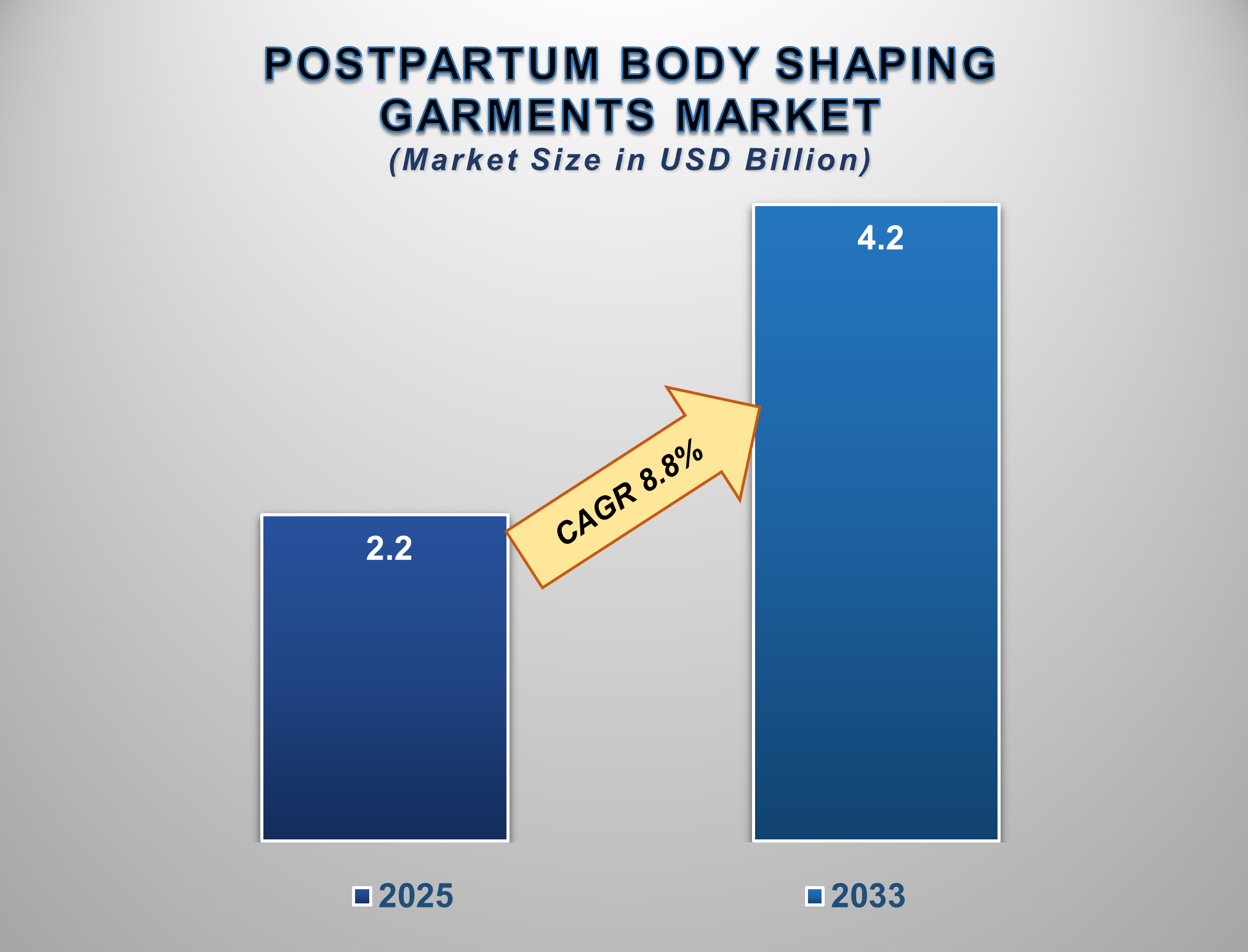
The Postpartum Body Shaping Garment Market is expected to witness steady growth from 2025 to 2033, driven by rising awareness of postnatal health, increasing emphasis on body recovery after childbirth, and growing acceptance of postpartum wellness products. The market is estimated to be valued at approximately USD 2.2 billion in 2025 and is projected to reach around USD 4.2 billion by 2033, expanding at a CAGR of 8.8% during the forecast period.
Postpartum body-shaping
garments are specialized compression wear designed to support abdominal
muscles, improve posture, reduce swelling, and aid physical recovery following
childbirth. These garments help provide core stabilization, enhance comfort,
and support gradual body reshaping during the postpartum period. Increasing
cesarean section rates, higher maternal age, and rising focus on maternal
self-care are contributing to strong demand across both developed and emerging
economies.
Healthcare professionals and maternity care providers are
increasingly recommending postpartum shaping garments as part of postnatal
recovery programs. Advancements in breathable fabrics, ergonomic designs, and
skin-friendly materials have improved comfort and usability, driving higher
adoption. North America and Europe dominate the market due to high awareness
and spending on maternity products, while Asia-Pacific is expected to
experience the fastest growth, supported by
rising birth rates, growing e-commerce penetration, and expanding middle-class
populations.
Postpartum Body Shaping Garment Market Drivers
and Opportunities
Rising Focus on Postnatal Recovery and Maternal Wellness
Drives Market Growth
Growing awareness regarding the importance of
postnatal recovery is a key driver of the postpartum body shaping garment market. New mothers are increasingly seeking
products that provide abdominal support, reduce back pain, and assist in muscle
recovery after delivery. Postpartum garments help stabilize weakened core
muscles and support healing, especially after cesarean sections. Rising
maternal healthcare awareness, social media influence, and endorsement by
healthcare professionals are further accelerating demand across global markets.
Increasing Cesarean Deliveries and Demand for Non-Medical
Support Solutions
The rising number of cesarean section births
globally has increased the need for supportive recovery solutions. Postpartum
body shaping garments provide gentle compression that helps reduce discomfort,
improve mobility, and support incision recovery. Unlike pharmaceutical
interventions, these garments offer a noninvasive, cost-effective solution for postpartum care. Their ability
to enhance posture and reduce lower back strain further supports adoption among
new mothers.
Product Innovation and Growth of Online Retail Create New
Opportunities
Continuous innovation in fabric technology, such
as moisture-wicking, antimicrobial, and stretchable materials, is creating
growth opportunities for manufacturers. Additionally, the rapid expansion of
online retail platforms has significantly improved product accessibility and
consumer awareness. Emerging markets in Asia-Pacific, Latin America, and the
Middle East present untapped potential due to rising disposable income, growing
urbanization, and increasing focus on maternal health and wellness.
Manufacturers are increasingly using advanced
synthetic and blended fabrics that combine high elasticity with breathability,
allowing consistent compression without restricting movement. Moisture-wicking
and antimicrobial fabric treatments are being incorporated to improve hygiene
and reduce skin irritation during extended wear. For example, Belly Bandit has
developed medical-grade compression fabrics with adjustable tension zones to
support post-cesarean recovery, while Leonisa utilizes seamless knitting and
microfibers that adapt to body changes throughout the postpartum period. Spanx
and Ingrid & Isabel have invested in lightweight, stretch-recovery
materials that maintain shape after repeated use. Additionally, the use of
eco-friendly and recycled fabrics is gaining traction as companies respond to
sustainability demands. These fabric advancements enhance durability, comfort,
and clinical effectiveness, driving higher adoption among new mothers globally.
Postpartum Body Shaping Garment Market Scope
|
Report Attributes |
Description |
|
Market Size in 2025 |
USD 2.2 Billion |
|
Market Forecast in 2033 |
USD 4.2 Billion |
|
CAGR % 2025-2033 |
8.8% |
|
Base Year |
2024 |
|
Historic Data |
2020-2024 |
|
Forecast Period |
2025-2033 |
|
Report USP |
Product Portfolio,
Technological Analysis, Company Market Share, Company Heatmap, Pricing
Analysis, Growth Factors, and more |
|
Segments Covered |
●
By Product ●
By Material ●
By Distribution
Channel |
|
Regional Scope |
●
North America ●
Europe ●
APAC ●
Latin America ●
Middle East and
Africa |
|
Country Scope |
1)
U.S. 2)
Canada 3)
Germany 4)
UK 5)
France 6)
Spain 7)
Italy 8)
Switzerland 9)
China 10)
Japan 11)
India 12)
Australia 13)
South Korea 14)
Brazil 15)
Mexico 16)
Argentina 17)
South Africa 18)
Saudi Arabia 19)
UAE |
Postpartum Body Shaping Garment Market Report
Segmentation Analysis
The global
Postpartum Body Shaping Garment Market industry analysis is segmented by
Product, by Material, by Distribution Channel, and by Region.
Postpartum Belly Bands Are Expected to Witness the Fastest
Growth
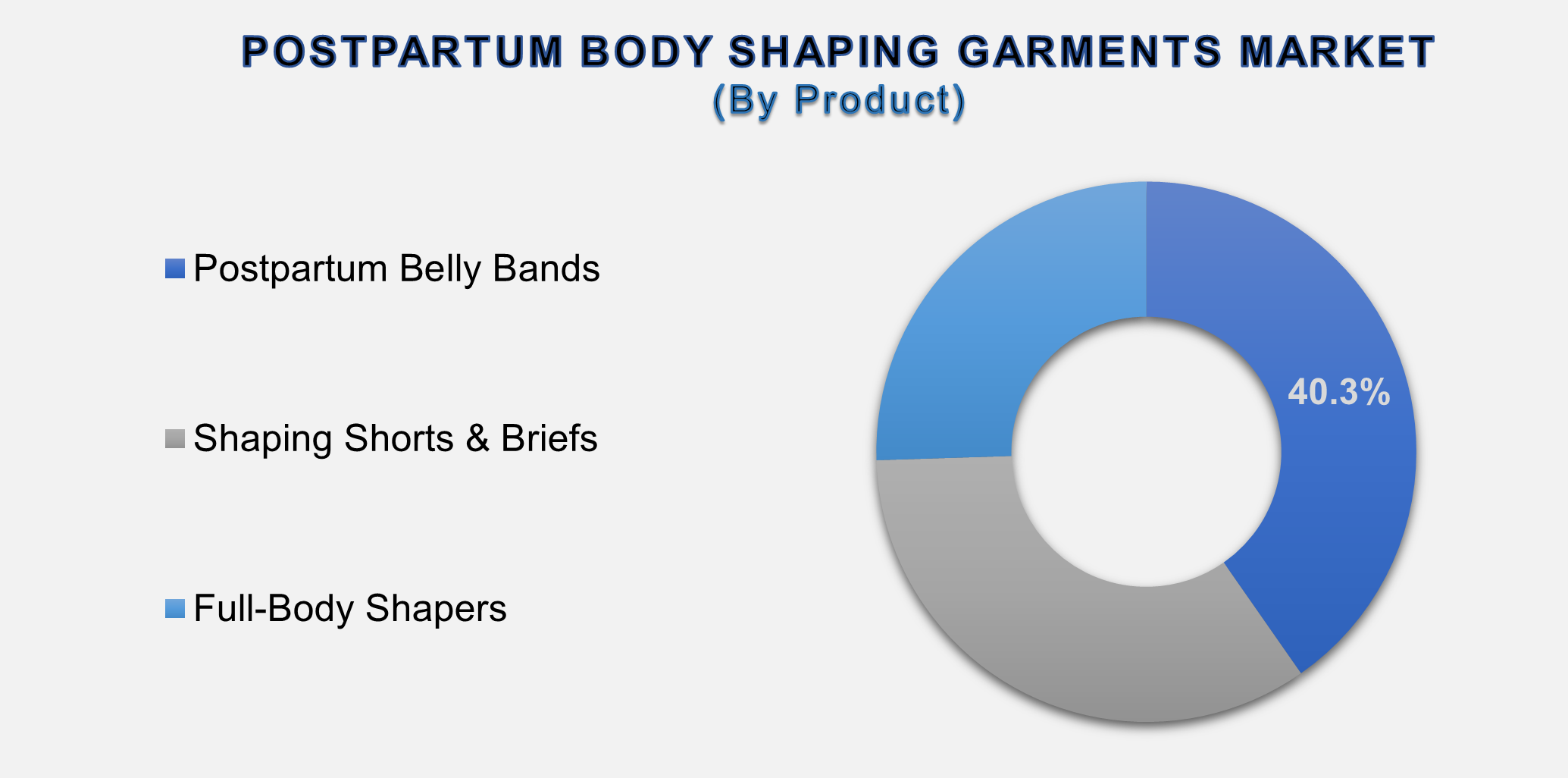
Postpartum belly bands are experiencing the fastest growth
within the postpartum body shaping garment market due to their simplicity,
affordability, and clinical benefits during early recovery. These products are
designed to provide targeted abdominal compression, which helps stabilize
weakened core muscles, reduce postpartum swelling, and support uterine
involution after childbirth. Belly bands are especially beneficial for women
recovering from cesarean deliveries, as they offer gentle incision support and
improve mobility without excessive pressure. Their adjustable design allows
mothers to customize compression levels as the body gradually heals, enhancing
comfort and usability. Healthcare professionals frequently recommend belly
bands as part of postnatal recovery routines, further driving adoption. In
addition, their discreet form factor enables wear under everyday clothing,
making them suitable for daily use. Growing awareness of postpartum health and
increased product availability across online and offline channels are
accelerating global demand for postpartum belly bands.
The Synthetic and Blended Fabrics Segment Is Anticipated to
Hold the Largest Market Share
Synthetic and blended fabrics are expected to hold the
largest share of the postpartum body shaping garment market due to their
superior performance characteristics. These materials offer high elasticity and
shape retention, ensuring consistent compression even after repeated use and
washing. Moisture-wicking and breathable properties help regulate body
temperature and reduce skin irritation, which is crucial during the sensitive
postpartum period. Blended fabrics, combining natural fibers like cotton with advanced
synthetics, strike an optimal balance between comfort and durability. Ongoing
advancements in textile engineering have led to softer, lightweight fabrics
with seamless construction, improving wearability for extended hours. Many
leading manufacturers are also incorporating antimicrobial and hypoallergenic
treatments to enhance hygiene and skin safety. These functional advantages,
combined with cost efficiency and wide availability, make synthetic and blended
fabrics the preferred choice among both manufacturers and consumers.
Online Retail Is Expected to Be the Leading Distribution
Channel
Online retail is projected to emerge as the leading
distribution channel for postpartum body shaping garments due to its
convenience, accessibility, and broad product selection. New mothers
increasingly prefer online platforms, as they
allow discreet purchasing, easy comparison of brands, and access to detailed
sizing guides and customer reviews. E-commerce channels also enable
manufacturers to offer personalized recommendations, subscription models, and
direct-to-consumer pricing, improving customer engagement and loyalty. The
availability of doorstep delivery and flexible return policies further enhances
buyer confidence, particularly for fit-sensitive garments. Social media
marketing and influencer endorsements have played a significant role in
educating consumers about postpartum recovery products, driving online sales
growth. Additionally, the rapid expansion of e-commerce infrastructure in
emerging markets is improving product accessibility, positioning online retail
as a key growth driver for the postpartum body shaping garment market.
The
following segments are part of an in-depth analysis of the global Postpartum
Body Shaping Garment Market:
|
Market
Segments |
|
|
By
Product |
●
Postpartum Belly
Bands ●
Shaping Shorts &
Briefs ●
Full-Body Shapers |
|
By Material |
●
Cotton-Based ●
Synthetic Fabrics ●
Blended Fabrics |
|
By Distribution Channel |
●
Online Retail ●
Pharmacies &
Specialty Stores ●
Hospitals &
Maternity Clinics |
Postpartum Body Shaping Garment Market Share
Analysis by Region
North America Is Expected to Dominate the Global Postpartum
Body Shaping Garment Market
North America
dominates the market due to high awareness of postpartum care, strong consumer
spending on maternity products, and widespread availability of premium brands.
The U.S. leads regional demand, supported by
advanced maternal healthcare services and strong online retail penetration.
Europe follows with an increasing focus on
maternal wellness and postnatal rehabilitation. Asia-Pacific is expected to
register the fastest growth, driven by high
birth rates, an expanding middle-class
population, and increasing adoption of modern maternity care practices.
Postpartum Body Shaping Garment Market
Competition Landscape Analysis
The global postpartum body shaping garment
market is moderately fragmented, with key players focusing on product
innovation, comfort optimization, and digital marketing strategies. Companies
are expanding their online presence, launching eco-friendly materials, and
collaborating with maternity clinics to strengthen brand visibility.
Global Postpartum Body Shaping Garment Market Recent
Developments News:
o In March 2025, Belly
Bandit launched a breathable postpartum compression wrap designed for
post-cesarean recovery. The product offers adjustable compression to support
abdominal healing, reduce discomfort, and improve mobility. Its lightweight,
breathable fabric enhances comfort for extended daily wear during recovery.
- In October 2024, Leonisa introduced a
sustainable postpartum shapewear line made from recycled fabrics. This
launch reflects the company’s focus on eco-friendly manufacturing while
maintaining effective compression, comfort, and durability, appealing to environmentally
conscious consumers seeking responsible postpartum recovery solutions.
- In August 2024, Motherhood Maternity expanded its postpartum
recovery portfolio with clinically tested shaping garments recommended by
obstetric professionals. These products are designed to provide safe
compression, improve posture, and support muscle recovery, strengthening
the brand’s position in evidence-based maternity care products.
The Global Postpartum Body Shaping Garment
Market Is Dominated by a Few Large Companies, such as
●
Belly Bandit
●
Leonisa
●
Motherhood Maternity
●
Medela AG
●
Bravado Designs
●
Ingrid & Isabel
●
Kindred Bravely
●
UpSpring Baby
●
Spanx, Inc.
●
Seraphine
●
Bao Bei Body
●
La Leche League
Partners
● Other Prominent Players
Frequently Asked Questions
Swetal (Research Analyst)
Swetal is a Research Analyst with 4+ years of experience specializing in healthcare market research, medical devices, healthcare IT, and medical technology industry analysis. Her expertise includes competitive intelligence, secondary research, market trend forecasting, and healthcare business insights across global healthcare ecosystems.
She contributes to advanced market research reports by analyzing regulatory frameworks, emerging healthcare technologies, competitive landscapes, and innovation trends shaping the medical industry. With a strong focus on accurate market intelligence, strategic insights, and healthcare industry trends, Swetal supports businesses in making informed, data-backed decisions in a rapidly transforming healthcare environment.
1. Global Postpartum Body
Shaping Garment Market Introduction and Market Overview
1.1.
Objectives
of the Study
1.2.
Global
Postpartum Body Shaping Garment Market Scope and Market Estimation
1.2.1.Global Electronic Toll
Collection Overall Market Size (US$ Bn), Market CAGR (%), Market forecast (2025
- 2033)
1.2.2.Global Postpartum Body
Shaping Garment Market Revenue Share (%) and Growth Rate (Y-o-Y) from 2020 - 2033
1.3.
Market
Segmentation
1.3.1.Product of Global Postpartum
Body Shaping Garment Market
1.3.2.Material of Global Postpartum
Body Shaping Garment Market
1.3.3.Distribution Channel of Global
Postpartum Body Shaping Garment Market
1.3.4.Region of Global Postpartum
Body Shaping Garment Market
2. Executive
Summary
2.1.
Demand
Side Trends
2.2.
Key
Market Trends
2.3.
Market
Demand (US$ Bn) Analysis 2020 – 2024 and forecast, 2025 – 2033
2.4.
Demand
and Opportunity Assessment
2.5.
Key
Developments
2.6.
Market
Entry Strategies
2.7.
Market
Dynamics
2.7.1.Drivers
2.7.2.Limitations
2.7.3.Opportunities
2.7.4.Impact Analysis of Drivers
and Restraints
2.8.
Porter’s
Five Forces Analysis
2.9.
PEST
Analysis
3. Global
Postpartum Body Shaping Garment Market
Estimates & Historical Trend Analysis (2020 - 2024)
4. Global
Postpartum Body Shaping Garment Market
Estimates & Forecast Trend Analysis, by Product
4.1.
Global
Postpartum Body Shaping Garment Market Revenue (US$ Bn) Estimates and
Forecasts, by Product, 2020 - 2033
4.1.1.Postpartum Belly Bands
4.1.2.Shaping Shorts &
Briefs
4.1.3.Full-Body Shapers
5. Global
Postpartum Body Shaping Garment Market
Estimates & Forecast Trend Analysis, by Material
5.1.
Global
Postpartum Body Shaping Garment Market Revenue (US$ Bn) Estimates and
Forecasts, by Material, 2020 - 2033
5.1.1.Cotton-Based
5.1.2.Synthetic Fabrics
5.1.3.Blended Fabrics
6. Global
Postpartum Body Shaping Garment Market
Estimates & Forecast Trend Analysis, by Distribution
Channel
6.1.
Global
Postpartum Body Shaping Garment Market Revenue (US$ Bn) Estimates and
Forecasts, by Distribution Channel 2020 - 2033
6.1.1.Online Retail
6.1.2.Pharmacies & Specialty
Stores
6.1.3.Hospitals & Maternity
Clinics
7. Global
Postpartum Body Shaping Garment Market
Estimates & Forecast Trend Analysis, by region
7.1.
Global
Postpartum Body Shaping Garment Market Revenue (US$ Bn) Estimates and
Forecasts, by region, 2020 - 2033
7.1.1.North America
7.1.2.Europe
7.1.3.Asia Pacific
7.1.4.Middle East & Africa
7.1.5.Latin America
8. North America Postpartum
Body Shaping Garment Market: Estimates
& Forecast Trend Analysis
8.1.
North
America Postpartum Body Shaping Garment Market Assessments & Key Findings
8.1.1.North America Postpartum
Body Shaping Garment Market Introduction
8.1.2.North America Postpartum
Body Shaping Garment Market Size Estimates and Forecast (US$ Billion) (2020 - 2033)
8.1.2.1. By Product
8.1.2.2. By Material
8.1.2.3. By Distribution
Channel
8.1.2.4.
By
Country
8.1.2.4.1. The U.S.
8.1.2.4.2. Canada
9. Europe Postpartum
Body Shaping Garment Market: Estimates
& Forecast Trend Analysis
9.1.
Europe
Postpartum Body Shaping Garment Market Assessments & Key Findings
9.1.1.Europe Postpartum Body
Shaping Garment Market Introduction
9.1.2.Europe Postpartum Body
Shaping Garment Market Size Estimates and Forecast (US$ Billion) (2020 - 2033)
9.1.2.1. By Product
9.1.2.2. By Material
9.1.2.3. By Distribution
Channel
9.1.2.4.
By
Country
9.1.2.4.1.
Germany
9.1.2.4.2.
Italy
9.1.2.4.3.
U.K.
9.1.2.4.4.
France
9.1.2.4.5.
Spain
9.1.2.4.6.
Switzerland
9.1.2.4.7. Rest
of Europe
10. Asia Pacific Postpartum
Body Shaping Garment Market: Estimates
& Forecast Trend Analysis
10.1.
Asia
Pacific Market Assessments & Key Findings
10.1.1.
Asia
Pacific Postpartum Body Shaping Garment Market Introduction
10.1.2.
Asia
Pacific Postpartum Body Shaping Garment Market Size Estimates and Forecast (US$
Billion) (2020 - 2033)
10.1.2.1. By Product
10.1.2.2. By Material
10.1.2.3. By Distribution
Channel
10.1.2.4.
By
Country
10.1.2.4.1. China
10.1.2.4.2. Japan
10.1.2.4.3. India
10.1.2.4.4. Australia
10.1.2.4.5. South Korea
10.1.2.4.6. Rest of Asia Pacific
11. Middle East & Africa Postpartum
Body Shaping Garment Market: Estimates
& Forecast Trend Analysis
11.1.
Middle
East & Africa Market Assessments & Key Findings
11.1.1.
Middle East & Africa Postpartum Body Shaping Garment
Market Introduction
11.1.2.
Middle East & Africa Postpartum Body Shaping Garment
Market Size Estimates and Forecast (US$ Billion) (2020 - 2033)
11.1.2.1. By Product
11.1.2.2. By Material
11.1.2.3. By Distribution
Channel
11.1.2.4.
By
Country
11.1.2.4.1. UAE
11.1.2.4.2. Saudi
Arabia
11.1.2.4.3. South
Africa
11.1.2.4.4. Rest
of MEA
12. Latin America
Postpartum Body Shaping Garment Market:
Estimates & Forecast Trend Analysis
12.1.
Latin
America Market Assessments & Key Findings
12.1.1.
Latin
America Postpartum Body Shaping Garment Market Introduction
12.1.2.
Latin
America Postpartum Body Shaping Garment Market Size Estimates and Forecast (US$
Billion) (2020 - 2033)
12.1.2.1. By Product
12.1.2.2. By Material
12.1.2.3. By Distribution
Channel
12.1.2.4.
By
Country
12.1.2.4.1. Brazil
12.1.2.4.2. Argentina
12.1.2.4.3. Mexico
12.1.2.4.4. Rest
of LATAM
13. Country Wise Market:
Introduction
14.
Competition
Landscape
14.1.
Global
Postpartum Body Shaping Garment Market Product Mapping
14.2.
Global
Postpartum Body Shaping Garment Market Concentration Analysis, by Leading
Players / Innovators / Emerging Players / New Entrants
14.3.
Global
Postpartum Body Shaping Garment Market Tier Structure Analysis
14.4.
Global
Postpartum Body Shaping Garment Market Concentration & Company Market
Shares (%) Analysis, 2024
15.
Company
Profiles
15.1.
Belly Bandit
15.1.1.
Company
Overview & Key Stats
15.1.2.
Financial
Performance & KPIs
15.1.3.
Product
Portfolio
15.1.4.
SWOT
Analysis
15.1.5.
Business
Strategy & Recent Developments
* Similar details would be provided for all the players
mentioned below
15.2. Leonisa
15.3. Motherhood
Maternity
15.4. Medela AG
15.5. Bravado
Designs
15.6. Ingrid &
Isabel
15.7. Kindred
Bravely
15.8. UpSpring Baby
15.9. Spanx, Inc.
15.10. Seraphine
15.11. Bao Bei Body
15.12. La Leche
League Partners
15.13. Other
Prominent Players
16. Research
Methodology
16.1.
External
Transportations / Databases
16.2.
Internal
Proprietary Database
16.3.
Primary
Research
16.4.
Secondary
Research
16.5.
Assumptions
16.6.
Limitations
16.7.
Report
FAQs
17. Research
Findings & Conclusion
Our Research Methodology
"Insight without rigor is just noise."
We follow a comprehensive, multi-phase research framework designed to deliver accurate, strategic, and decision-ready intelligence. Our process integrates primary and secondary research , both quantitative and qualitative , along with dual modeling techniques ( top-down and bottom-up) and a final layer of validation through our proprietary in-house repository.
PRIMARY RESEARCH
Primary research captures real-time, firsthand insights from the market to understand behaviors, motivations, and emerging trends.
1. Quantitative Primary Research
Objective: Generate statistically significant data directly from market participants.
Approaches:- Structured surveys with customers, distributors, and field agents
- Mobile-based data collection for point-of-sale audits and usage behavior
- Phone-based interviews (CATI) for market sizing and product feedback
- Online polling around industry events and digital campaigns
- Purchase frequency by customer type
- Channel performance across geographies
- Feature demand by application or demographic
2. Qualitative Primary Research
Objective: Explore decision-making drivers, pain points, and market readiness.
Approaches:- In-depth interviews (IDIs) with executives, product managers, and key decision-makers
- Focus groups among end users and early adopters
- Site visits and observational research for consumer products
- Informal field-level discussions for regional and cultural nuances
SECONDARY RESEARCH
This phase helps establish a macro-to-micro understanding of market trends, size, regulation, and competitive dynamics, sourced from credible and public domain information.
1. Quantitative Secondary Research
Objective: Model market value and segment-level forecasts based on published data.
Sources include:- Financial reports and investor summaries
- Government trade data, customs records, and regulatory statistics
- Industry association publications and economic databases
- Channel performance and pricing data from marketplace listings
- Revenue splits, pricing trends, and CAGR estimates
- Supply-side capacity and volume tracking
- Investment analysis and funding benchmarks
2. Qualitative Secondary Research
Objective: Capture strategic direction, innovation signals, and behavioral trends.
Sources include:- Company announcements, roadmaps, and product pipelines
- Publicly available whitepapers, conference abstracts, and academic research
- Regulatory body publications and policy briefs
- Social and media sentiment scanning for early-stage shifts
- Strategic shifts in market positioning
- Unmet needs and white spaces
- Regulatory triggers and compliance impact

DUAL MODELING: TOP-DOWN + BOTTOM-UP
To ensure robust market estimation, we apply two complementary sizing approaches:
Top-Down Modeling:- Start with broader industry value (e.g., global or regional TAM)
- Apply filters by segment, geography, end-user, or use case
- Adjust with primary insights and validation benchmarks
- Ideal for investor-grade market scans and opportunity mapping
- Aggregate from the ground up using sales volumes, pricing, and unit economics
- Use internal modeling templates aligned with stakeholder data
- Incorporate distributor-level or region-specific inputs
- Most accurate for emerging segments and granular sub-markets
DATA VALIDATION: IN-HOUSE REPOSITORY
We close the loop with proprietary data intelligence built from ongoing projects, industry monitoring, and historical benchmarking. This repository includes:
- Multi-sector market and pricing models
- Key trendlines from past interviews and forecasts
- Benchmarked adoption rates, churn patterns, and ROI indicators
- Industry-specific deviation flags and cross-check logic
- Catches inconsistencies early
- Aligns projections across studies
- Enables consistent, high-trust deliverables