

Poultry Diagnostic Testing Market Size and Forecast (2020 - 2033), Global and Regional Growth, Trend, Share, and Industry Analysis Report Coverage: By Test Type (PCR Tests, ELISA Tests, Other Molecular Tests), By Disease Type (Avian Influenza, Newcastle Disease, Salmonella, Infectious Bronchitis, Others), By End-User (Veterinary Hospitals & Clinics, Poultry Farms, Diagnostic Laboratories, Research Institutes), and Geography
2025-12-12
Healthcare
Swetal (Research Analyst)
Description
Poultry
Diagnostic Testing Market Overview
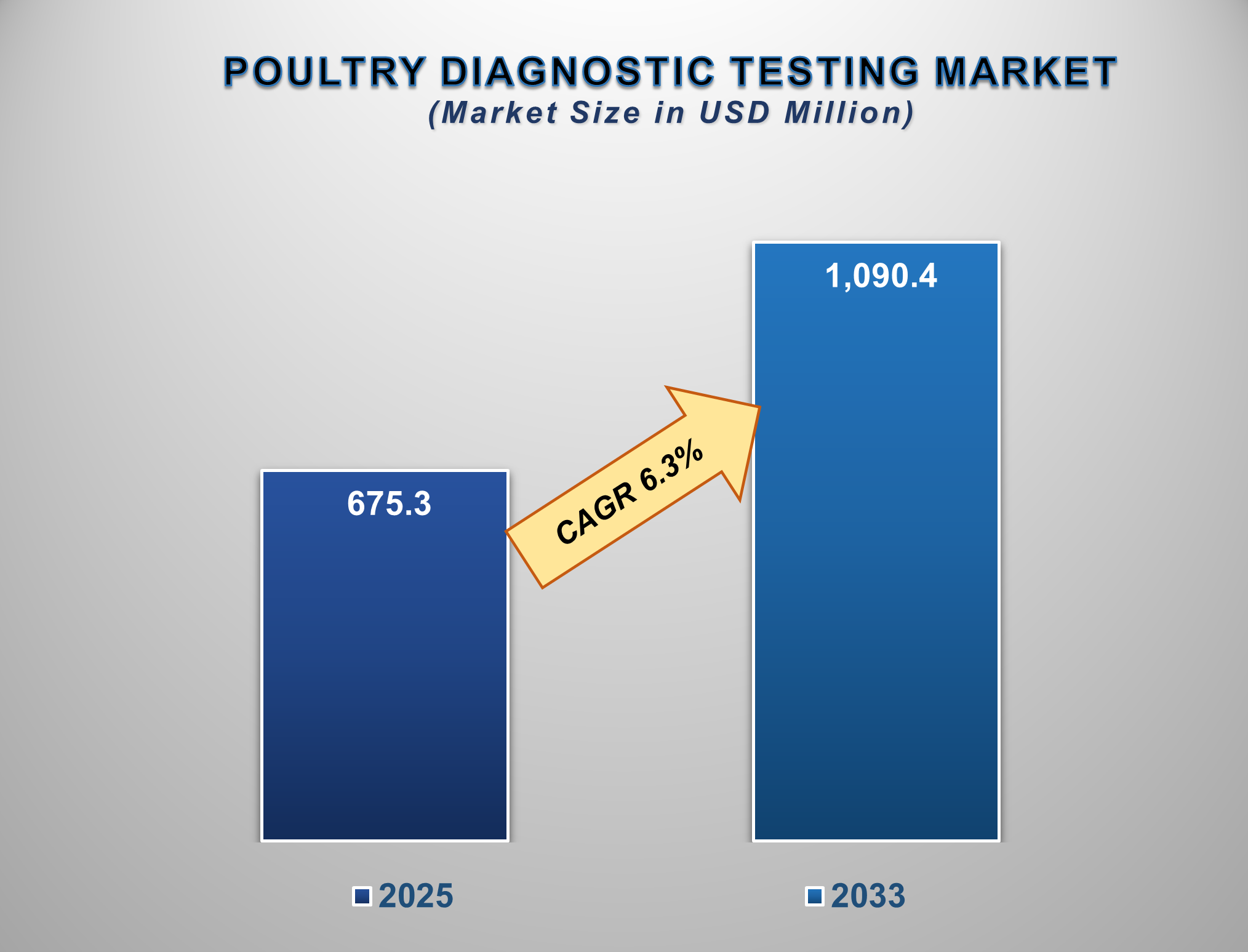
The Poultry Diagnostic Testing Market is poised for robust growth from 2025 to 2033, driven by the escalating need to ensure food security, control disease outbreaks, and maintain the health of poultry flocks globally. The market is projected to be valued at approximately USD 675.3 million in 2025 and is forecasted to reach nearly USD 1,090.4 million by 2033, exhibiting a compound annual growth rate (CAGR) of 6.3% during this period.
Poultry diagnostic testing involves a range of
assays and tools used to detect pathogens, antibodies, and diseases in poultry
populations. The market's expansion is underpinned by the rising global
consumption of poultry meat and eggs, which intensifies the economic impact of
avian diseases. Outbreaks of diseases like Avian Influenza (Bird Flu) and
Newcastle disease can lead to massive flock
culling, trade restrictions, and significant financial losses, making early and
accurate diagnosis critical. Furthermore, the growing implementation of
stringent food safety regulations and the increasing awareness of zoonotic
diseases—those transmissible from animals to humans, such as Salmonella—are compelling farmers and producers to adopt regular and
reliable testing protocols. Technological advancements leading to faster, more
accurate, and more portable diagnostic kits
are further propelling market adoption. North America holds the largest market
share, while the Asia-Pacific region is expected to be the fastest-growing,
fueled by expanding poultry production and the modernization
of farming practices.
Poultry Diagnostic Testing Market Drivers and
Opportunities
Rising Prevalence of Avian Diseases and Zoonotic Threats is
the Primary Market Driver
The increasing global incidence and economic
burden of avian diseases represent the most significant driver for the poultry
diagnostic testing market. The persistent threat of Highly Pathogenic Avian
Influenza (HPAI) outbreaks across continents has created an urgent and
sustained demand for robust surveillance and diagnostic systems. These diseases
not only cause high mortality in flocks but also disrupt international trade
and pose serious public health risks. Similarly, the control of foodborne
pathogens like Salmonella and Campylobacter in poultry products is a top
priority for food safety authorities worldwide. Regulatory mandates for routine
monitoring and control programs for such pathogens are making diagnostic
testing an integral and non-negotiable part of modern poultry farming, thereby
driving consistent market growth.
Expansion of Intensive Poultry Farming and Biosecurity
Measures is Driving Market Evolution
The global shift towards large-scale, intensive
poultry production systems is a major catalyst for market growth. In these
concentrated animal feeding operations (CAFOs), the risk of rapid disease
spread is high, making proactive health monitoring essential for operational
and financial sustainability. Investments in biosecurity are increasing, and
diagnostic testing forms the backbone of these protocols, enabling early
detection, isolation of outbreaks, and prevention of catastrophic losses.
Furthermore, the growing consumer demand for "clean" and high-quality
poultry products is pushing producers to implement stringent testing from farm
to fork. This trend is encouraging the adoption of advanced diagnostic
solutions beyond basic testing, creating a more sophisticated and evolving
market.
Technological Advancements and Pen-Side Testing Present
Significant Opportunities
The continuous innovation in diagnostic
technologies, particularly the development of rapid, pen-side tests, presents a
significant growth frontier. Key opportunities lie in creating point-of-care
(POC) devices that can deliver results within minutes, allowing for immediate
on-farm decision-making. The integration of molecular techniques like PCR and
next-generation sequencing (NGS) into more user-friendly and affordable formats
is another key area. For manufacturers, investing in R&D for multiplex assays
(testing for multiple pathogens simultaneously), automation, and data
management platforms that can track flock health over time are key strategies.
The untapped potential in emerging economies, where small-scale farmers are
gradually formalizing, also presents a substantial opportunity for market
expansion through cost-effective and accessible testing solutions.
Poultry Diagnostic Testing Market Scope
|
Report Attributes |
Description |
|
Market Size in 2025 |
USD 675.3 Million |
|
Market Forecast in 2033 |
USD 1,090.4 Million |
|
CAGR % 2025-2033 |
6.3% |
|
Base Year |
2024 |
|
Historic Data |
2020-2024 |
|
Forecast Period |
2025-2033 |
|
Report USP |
Product Portfolio,
Technological Analysis, Company Market Share, Company Heatmap, Pricing
Analysis, Growth Factors and more |
|
Segments Covered |
●
By Test Type ●
By Disease Type ●
By End-user |
|
Regional Scope |
●
North America, ●
Europe, ●
APAC, ●
Latin America ●
Middle East and
Africa |
|
Country Scope |
1)
U.S. 2)
Canada 3)
Germany 4)
UK 5)
France 6)
Spain 7)
Italy 8)
Switzerland 9)
China 10)
Japan 11)
India 12)
Australia 13)
South Korea 14)
Brazil 15)
Mexico 16)
Argentina 17)
South Africa 18)
Saudi Arabia 19)
UAE |
Poultry Diagnostic Testing Market Report
Segmentation Analysis
The global Poultry Diagnostic
Testing Market industry analysis is segmented by Test Type, by Disease Type, by
End-User, and by region.
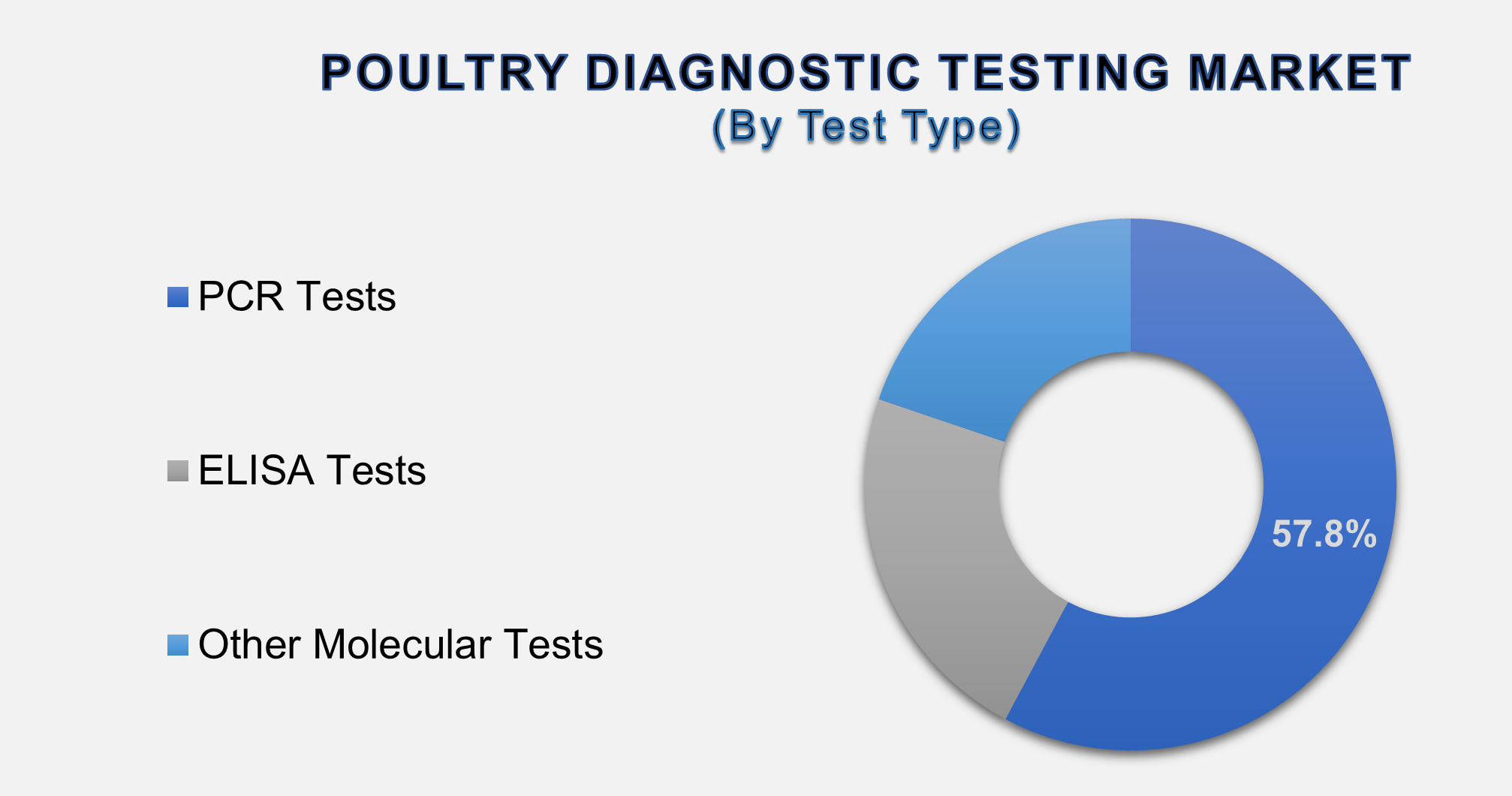
The PCR Tests segment is
anticipated to command a dominant market share in 2025.
The Test Type segment is categorized into PCR Tests, ELISA Tests, and Other Molecular Tests. The PCR (Polymerase Chain Reaction) Tests segment commands a dominant market share due to its superior sensitivity, specificity, and speed. In the face of devastating and fast-spreading diseases like Avian Influenza, the ability to accurately identify the specific viral strain within hours is crucial for implementing control measures. PCR-based methods have become the gold standard for definitive diagnosis, especially for viral pathogens, as they can detect low levels of the pathogen's genetic material even before clinical signs appear. While ELISA tests remain vital for large-scale serological surveillance (detecting antibodies), the need for precise, early detection in high-stakes situations solidifies the position of PCR as the leading technology in the diagnostic landscape, particularly in reference laboratories and for confirming outbreaks.
The Poultry Farms segment
is projected to be the fastest-growing.
The
End-User segment is divided into Veterinary Hospitals & Clinics, Poultry
Farms, Diagnostic Laboratories, and Research Institutes. The Poultry Farms
segment is projected to be the fastest-growing end-user, driven by the trend of
in-house testing and the growing emphasis on proactive flock health management.
Large integrated poultry producers are increasingly establishing their own
on-site diagnostic capabilities to gain immediate insights into flock status,
reduce dependency on external labs, and lower the turnaround time for results.
This allows for quicker interventions, such as adjusting vaccination protocols
or isolating affected barns, thereby minimizing economic losses. The
availability of simpler, more user-friendly test kits and portable analyzers is
empowering farms to conduct routine monitoring themselves, making diagnostic
testing a direct and integral part of daily farm operations and biosecurity
protocols.
The Avian Influenza
segment is projected to exhibit strong growth.
The
Disease Type segment includes Avian Influenza, Newcastle Disease, Salmonella,
Infectious Bronchitis, and Others. The Avian Influenza application segment
exhibits strong growth due to its persistent and severe global impact. Avian
Influenza viruses, particularly H5N1 strains, have caused recurring pandemics
in bird populations, leading to the culling of hundreds of millions of birds
and causing massive disruptions in the global poultry industry. The virus's
ability to mutate and its potential zoonotic threat keep it at the forefront of
veterinary and public health concerns. Consequently, national and international
authorities have implemented mandatory surveillance and testing programs for
Avian Influenza. The continuous circulation of the virus in wild bird
populations, which can spread it to commercial flocks, ensures that testing
volumes for this specific disease will remain high and are likely to grow,
driving this segment steadily.
The following segments are
part of an in-depth analysis of the global Poultry Diagnostic Testing Market:
|
Market
Segments |
|
|
By Test Type |
●
PCR Tests ●
ELISA Tests ●
Other Molecular
Tests |
|
By Disease
Type |
●
Avian Influenza ●
Newcastle Disease ●
Salmonella ●
Infectious
Bronchitis ●
Others |
|
By End-user |
●
Veterinary Hospitals
& Clinics ●
Poultry Farms ●
Diagnostic
Laboratories ●
Research Institutes |
Poultry Diagnostic Testing Market Share Analysis
by Region
The North America region
is anticipated to hold the largest portion of the Poultry Diagnostic Testing
Market globally throughout the forecast period.
North
America's dominance is attributed to its highly developed and consolidated
poultry industry, strict government regulations for disease control and food
safety, and the presence of leading market players. The region has experienced
several significant Avian Influenza outbreaks, which have led to reinforced
surveillance and testing mandates. High awareness among producers, advanced
veterinary infrastructure, and substantial investments in animal health R&D
in the U.S. and Canada solidify North America's position as the largest
regional market.
In
addition, the Asia-Pacific region is poised to
be the fastest-growing market for poultry diagnostic testing. This growth is
fueled by the region's massive and expanding poultry production, particularly
in countries like China, India, and Thailand. Rising disposable incomes are
increasing the consumption of poultry products, which in turn pressures
producers to enhance biosecurity and health monitoring. Governments in the
region are also modernizing their veterinary services and implementing more
rigorous food safety standards, creating immense growth potential for
diagnostic test kits and services.
Poultry Diagnostic Testing Market Competition
Landscape Analysis
The global poultry diagnostic
testing market is moderately consolidated and features a mix of large
multinational animal health corporations and specialized diagnostic companies.
Competition is based on test accuracy, reliability, product portfolio breadth,
pricing, and distribution network. Key strategies include continuous innovation
in assay development, strategic acquisitions to broaden technological
capabilities, and partnerships with government bodies and large integrated
poultry producers to secure long-term testing contracts. Expansion into
high-growth emerging markets is also a critical focus for leading players.
Global Poultry Diagnostic
Testing Market Recent Developments News:
- In February 2025, IDEXX Laboratories, Inc. launched a new multiplex
real-time PCR panel for the simultaneous detection of three major
respiratory pathogens in poultry.
- In November 2024, Thermo Fisher Scientific completed the acquisition
of a specialized veterinary diagnostics firm to strengthen its portfolio
in poultry pathogen detection.
- In September 2024, Zoetis Inc. partnered with a leading Asian poultry
integrator to implement a comprehensive, data-driven health monitoring
system across its farms.
- In June 2024, QIAGEN received regulatory approval in multiple
countries for its latest pen-side rapid test for Newcastle Disease Virus,
aimed at providing results in under 20 minutes.
The Global Poultry
Diagnostic Testing Market Is Dominated by a Few Large Companies, such as
●
IDEXX Laboratories,
Inc.
●
Zoetis Inc.
●
Thermo Fisher
Scientific Inc.
●
QIAGEN N.V.
●
bioMérieux SA
●
Heska Corporation
●
Virbac
●
IDvet
●
Boehringer Ingelheim
International GmbH
●
Ceva Santé Animale
●
Megacor Diagnostik
GmbH
●
BioCheck
●
GD Animal Health
●
AgroBio Inc.
●
Lillidale Animal
Health
● Other Prominent Players
Frequently Asked Questions
Swetal (Research Analyst)
Swetal is a Research Analyst with 4+ years of experience specializing in healthcare market research, medical devices, healthcare IT, and medical technology industry analysis. Her expertise includes competitive intelligence, secondary research, market trend forecasting, and healthcare business insights across global healthcare ecosystems.
She contributes to advanced market research reports by analyzing regulatory frameworks, emerging healthcare technologies, competitive landscapes, and innovation trends shaping the medical industry. With a strong focus on accurate market intelligence, strategic insights, and healthcare industry trends, Swetal supports businesses in making informed, data-backed decisions in a rapidly transforming healthcare environment.
1. Global Poultry Diagnostic
Testing Market Introduction and Market Overview
1.1.
Objectives
of the Study
1.2.
Global
Poultry Diagnostic Testing Market Scope and Market Estimation
1.2.1.Global Electronic Toll
Collection Overall Market Size (US$ Mn), Market CAGR (%), Market forecast (2025
- 2033)
1.2.2.Global Poultry Diagnostic
Testing Market Revenue Share (%) and Growth Rate (Y-o-Y) from 2020 - 2033
1.3.
Market
Segmentation
1.3.1.Test Type of Global Poultry
Diagnostic Testing Market
1.3.2.Disease Type of Global Poultry
Diagnostic Testing Market
1.3.3.End-user of Global Poultry
Diagnostic Testing Market
1.3.4.Region of Global Poultry
Diagnostic Testing Market
2. Executive
Summary
2.1.
Demand
Side Trends
2.2.
Key
Market Trends
2.3.
Market
Demand (US$ Mn) Analysis 2020 – 2024 and forecast, 2025 – 2033
2.4.
Demand
and Opportunity Assessment
2.5.
Technological
Advancements
2.6.
Pricing
Analysis
2.7.
Regulatory
Scenario by Region
2.8.
Key
Developments
2.9.
Market
Entry Strategies
2.10.
Market
Dynamics
2.10.1.
Drivers
2.10.2.
Limitations
2.10.3.
Opportunities
2.10.4.
Impact
Analysis of Drivers and Restraints
2.11.
Porter’s
Five Forces Analysis
2.12.
PEST
Analysis
3. Global
Poultry Diagnostic Testing Market
Estimates & Historical Trend Analysis (2020 - 2024)
4. Global
Poultry Diagnostic Testing Market
Estimates & Forecast Trend Analysis, by Test Type
4.1.
Global
Poultry Diagnostic Testing Market Revenue (US$ Mn) Estimates and Forecasts, by Test
Type, 2020 - 2033
4.1.1.PCR Tests
4.1.2.ELISA Tests
4.1.3.Other Molecular Tests
5. Global
Poultry Diagnostic Testing Market
Estimates & Forecast Trend Analysis, by Disease
Type
5.1.
Global
Poultry Diagnostic Testing Market Revenue (US$ Mn) Estimates and Forecasts, by Disease
Type, 2020 - 2033
5.1.1.Avian Influenza
5.1.2.Newcastle Disease
5.1.3.Salmonella
5.1.4.Infectious Bronchitis
5.1.5.Others
6. Global
Poultry Diagnostic Testing Market
Estimates & Forecast Trend Analysis, by End-user
6.1.
Global
Poultry Diagnostic Testing Market Revenue (US$ Mn) Estimates and Forecasts, by End-user
2020 - 2033
6.1.1.Veterinary Hospitals &
Clinics
6.1.2.Poultry Farms
6.1.3.Diagnostic Laboratories
6.1.4.Research Institutes
7. Global
Poultry Diagnostic Testing Market
Estimates & Forecast Trend Analysis, by region
7.1.
Global
Poultry Diagnostic Testing Market Revenue (US$ Mn) Estimates and Forecasts, by region,
2020 - 2033
7.1.1.North America
7.1.2.Europe
7.1.3.Asia Pacific
7.1.4.Middle East & Africa
7.1.5.Latin America
8. North America Poultry
Diagnostic Testing Market: Estimates
& Forecast Trend Analysis
8.1.
North
America Poultry Diagnostic Testing Market Assessments & Key Findings
8.1.1.North America Poultry
Diagnostic Testing Market Introduction
8.1.2.North America Poultry
Diagnostic Testing Market Size Estimates and Forecast (US$ Billion) (2020 - 2033)
8.1.2.1. By Test Type
8.1.2.2. By Disease
Type
8.1.2.3. By End-user
8.1.2.4.
By
Country
8.1.2.4.1. The U.S.
8.1.2.4.2. Canada
9. Europe Poultry
Diagnostic Testing Market: Estimates
& Forecast Trend Analysis
9.1.
Europe
Poultry Diagnostic Testing Market Assessments & Key Findings
9.1.1.Europe Poultry Diagnostic
Testing Market Introduction
9.1.2.Europe Poultry Diagnostic
Testing Market Size Estimates and Forecast (US$ Billion) (2020 - 2033)
9.1.2.1. By Test Type
9.1.2.2. By Disease
Type
9.1.2.3. By End-user
9.1.2.4.
By
Country
9.1.2.4.1.
Germany
9.1.2.4.2.
Italy
9.1.2.4.3.
U.K.
9.1.2.4.4.
France
9.1.2.4.5.
Spain
9.1.2.4.6.
Switzerland
9.1.2.4.7. Rest
of Europe
10. Asia Pacific Poultry
Diagnostic Testing Market: Estimates
& Forecast Trend Analysis
10.1.
Asia
Pacific Market Assessments & Key Findings
10.1.1.
Asia
Pacific Poultry Diagnostic Testing Market Introduction
10.1.2.
Asia
Pacific Poultry Diagnostic Testing Market Size Estimates and Forecast (US$ Billion)
(2020 - 2033)
10.1.2.1. By Test Type
10.1.2.2. By Disease
Type
10.1.2.3. By End-user
10.1.2.4.
By
Country
10.1.2.4.1. China
10.1.2.4.2. Japan
10.1.2.4.3. India
10.1.2.4.4. Australia
10.1.2.4.5. South Korea
10.1.2.4.6. Rest of Asia Pacific
11. Middle East & Africa Poultry
Diagnostic Testing Market: Estimates
& Forecast Trend Analysis
11.1.
Middle
East & Africa Market Assessments & Key Findings
11.1.1.
Middle East & Africa Poultry Diagnostic Testing Market
Introduction
11.1.2.
Middle East & Africa Poultry Diagnostic Testing Market
Size Estimates and Forecast (US$ Billion) (2020 - 2033)
11.1.2.1. By Test Type
11.1.2.2. By Disease
Type
11.1.2.3. By End-user
11.1.2.4.
By
Country
11.1.2.4.1. UAE
11.1.2.4.2. Saudi
Arabia
11.1.2.4.3. South
Africa
11.1.2.4.4. Rest
of MEA
12. Latin America
Poultry Diagnostic Testing Market:
Estimates & Forecast Trend Analysis
12.1.
Latin
America Market Assessments & Key Findings
12.1.1.
Latin
America Poultry Diagnostic Testing Market Introduction
12.1.2.
Latin
America Poultry Diagnostic Testing Market Size Estimates and Forecast (US$ Billion)
(2020 - 2033)
12.1.2.1. By Test Type
12.1.2.2. By Disease
Type
12.1.2.3. By End-user
12.1.2.4.
By
Country
12.1.2.4.1. Brazil
12.1.2.4.2. Argentina
12.1.2.4.3. Mexico
12.1.2.4.4. Rest
of LATAM
13. Country Wise Market:
Introduction
14.
Competition
Landscape
14.1.
Global
Poultry Diagnostic Testing Market Product Mapping
14.2.
Global
Poultry Diagnostic Testing Market Concentration Analysis, by Leading Players /
Innovators / Emerging Players / New Entrants
14.3.
Global
Poultry Diagnostic Testing Market Tier Structure Analysis
14.4.
Global
Poultry Diagnostic Testing Market Concentration & Company Market Shares (%)
Analysis, 2024
15.
Company
Profiles
15.1.
IDEXX Laboratories, Inc.
15.1.1.
Company
Overview & Key Stats
15.1.2.
Financial
Performance & KPIs
15.1.3.
Product
Portfolio
15.1.4.
SWOT
Analysis
15.1.5.
Business
Strategy & Recent Developments
* Similar details would be provided for all the players
mentioned below
15.2. Zoetis Inc.
15.3. Thermo Fisher
Scientific Inc.
15.4. QIAGEN N.V.
15.5. bioMérieux SA
15.6. Heska
Corporation
15.7. Virbac
15.8. IDvet
15.9. Boehringer
Ingelheim International GmbH
15.10. Ceva Santé
Animale
15.11. Megacor
Diagnostik GmbH
15.12. Biochek
15.13. GD Animal
Health
15.14. AgroBio Inc.
15.15. Lillidale
Animal Health
15.16. Other
Prominent Player
16. Research
Methodology
16.1.
External
Transportations / Databases
16.2.
Internal
Proprietary Database
16.3.
Primary
Research
16.4.
Secondary
Research
16.5.
Assumptions
16.6.
Limitations
16.7.
Report
FAQs
17. Research
Findings & Conclusion
Our Research Methodology
"Insight without rigor is just noise."
We follow a comprehensive, multi-phase research framework designed to deliver accurate, strategic, and decision-ready intelligence. Our process integrates primary and secondary research , both quantitative and qualitative , along with dual modeling techniques ( top-down and bottom-up) and a final layer of validation through our proprietary in-house repository.
PRIMARY RESEARCH
Primary research captures real-time, firsthand insights from the market to understand behaviors, motivations, and emerging trends.
1. Quantitative Primary Research
Objective: Generate statistically significant data directly from market participants.
Approaches:- Structured surveys with customers, distributors, and field agents
- Mobile-based data collection for point-of-sale audits and usage behavior
- Phone-based interviews (CATI) for market sizing and product feedback
- Online polling around industry events and digital campaigns
- Purchase frequency by customer type
- Channel performance across geographies
- Feature demand by application or demographic
2. Qualitative Primary Research
Objective: Explore decision-making drivers, pain points, and market readiness.
Approaches:- In-depth interviews (IDIs) with executives, product managers, and key decision-makers
- Focus groups among end users and early adopters
- Site visits and observational research for consumer products
- Informal field-level discussions for regional and cultural nuances
SECONDARY RESEARCH
This phase helps establish a macro-to-micro understanding of market trends, size, regulation, and competitive dynamics, sourced from credible and public domain information.
1. Quantitative Secondary Research
Objective: Model market value and segment-level forecasts based on published data.
Sources include:- Financial reports and investor summaries
- Government trade data, customs records, and regulatory statistics
- Industry association publications and economic databases
- Channel performance and pricing data from marketplace listings
- Revenue splits, pricing trends, and CAGR estimates
- Supply-side capacity and volume tracking
- Investment analysis and funding benchmarks
2. Qualitative Secondary Research
Objective: Capture strategic direction, innovation signals, and behavioral trends.
Sources include:- Company announcements, roadmaps, and product pipelines
- Publicly available whitepapers, conference abstracts, and academic research
- Regulatory body publications and policy briefs
- Social and media sentiment scanning for early-stage shifts
- Strategic shifts in market positioning
- Unmet needs and white spaces
- Regulatory triggers and compliance impact
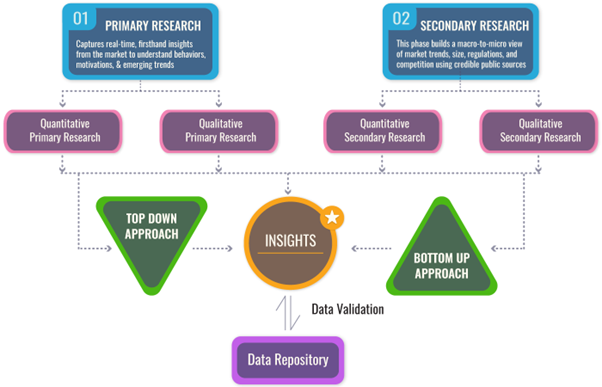
DUAL MODELING: TOP-DOWN + BOTTOM-UP
To ensure robust market estimation, we apply two complementary sizing approaches:
Top-Down Modeling:- Start with broader industry value (e.g., global or regional TAM)
- Apply filters by segment, geography, end-user, or use case
- Adjust with primary insights and validation benchmarks
- Ideal for investor-grade market scans and opportunity mapping
- Aggregate from the ground up using sales volumes, pricing, and unit economics
- Use internal modeling templates aligned with stakeholder data
- Incorporate distributor-level or region-specific inputs
- Most accurate for emerging segments and granular sub-markets
DATA VALIDATION: IN-HOUSE REPOSITORY
We close the loop with proprietary data intelligence built from ongoing projects, industry monitoring, and historical benchmarking. This repository includes:
- Multi-sector market and pricing models
- Key trendlines from past interviews and forecasts
- Benchmarked adoption rates, churn patterns, and ROI indicators
- Industry-specific deviation flags and cross-check logic
- Catches inconsistencies early
- Aligns projections across studies
- Enables consistent, high-trust deliverables