

Power Take Off Market Size and Forecast (2026–2034), Global and Regional Growth, Trend, Share and Industry Analysis Report Coverage; By PTO Type (Mechanical PTO, Hydraulic PTO, Electric PTO); By Application (Agriculture, Construction, Transportation & Logistics, Energy & Mining, Marine); By End User (OEMs, Aftermarket); By Region; and Geography
2026-09-29
Automotive & Transportation (Mobility)
Ekta Chaurasia (Team Lead)
Description
Power Take Off Market Overview
The global Power
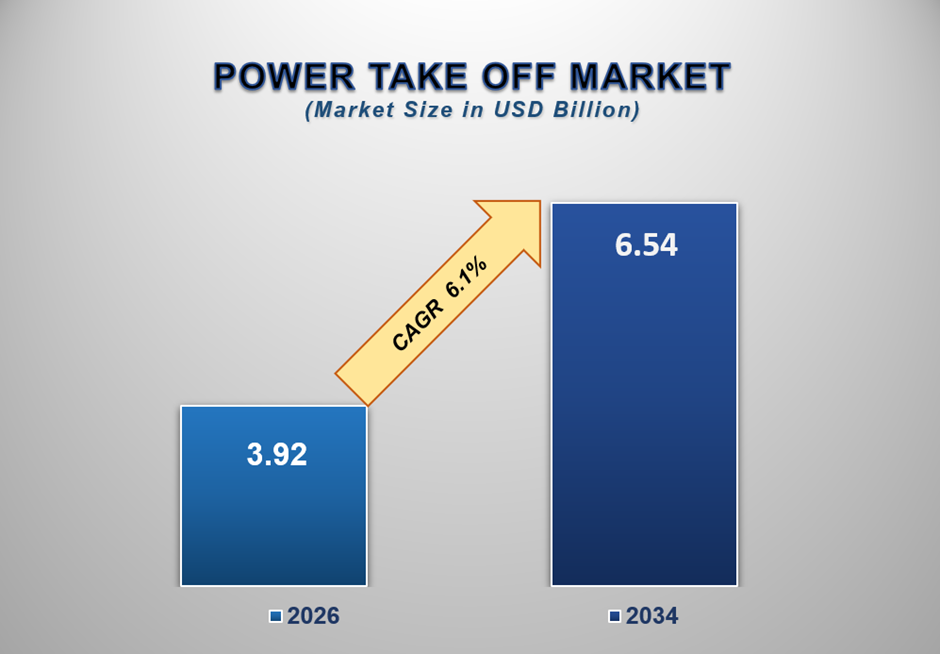
Take Off Market was valued at USD 3.92 billion in 2026 and is
projected to reach USD 6.54 billion by 2034, expanding at a CAGR of
6.1% during the forecast period.
Power Take Off
(PTO) systems are auxiliary power transmission devices that extract mechanical
power from a vehicle, tractor, industrial engine, or transmission and redirect
it toward equipment that requires an independent source of rotational or
hydraulic power. Depending on the vehicle architecture and application, PTO
systems can drive hydraulic pumps, compressors, generators, winches, lifting
mechanisms, blowers, water pumps, refuse compactors, aerial platforms, dump
bodies, and agricultural implements. Their ability to utilize an existing
engine or transmission rather than requiring a separate power unit makes PTO
technology important for improving equipment utilization and reducing the need
for additional engines or motors.
The market is
closely connected with agricultural mechanization, commercial vehicle
production, construction equipment, municipal fleets, industrial hydraulics,
mining machinery, and specialized transportation. In agriculture, PTO systems
transfer tractor power to implements such as mowers, balers, spreaders, pumps,
tillers, and other attachments. In commercial vehicles, PTOs are extensively
used to operate hydraulic pumps and auxiliary equipment on dump trucks, tow
trucks, refuse collection vehicles, fire trucks, utility vehicles, cranes,
aerial platforms, and other vocational vehicles. This broad application base
provides the market with demand across multiple economic cycles rather than
tying growth to a single end-use industry.
Mechanical PTO
systems continue to represent the technological foundation of the industry
because of their established reliability, high torque capability, comparatively
straightforward construction, and compatibility with a broad range of
transmissions and agricultural machinery. Hydraulic PTO configurations are
increasingly important where controlled power delivery, remote actuation,
variable hydraulic flow, and high-duty-cycle auxiliary functions are required.
Electric PTOs are emerging as a strategically important technology as
manufacturers seek to provide auxiliary power on hybrid and battery-electric
vehicles without operating the primary vehicle engine solely to drive
accessories.
The transition
toward electric and hybrid commercial vehicles is therefore reshaping rather
than eliminating the PTO market. Conventional PTOs depend on mechanical power
from an engine or transmission, whereas electric PTO architectures can operate
auxiliary equipment using electrical energy supplied by a vehicle battery or
dedicated electrical system. Parker Chelsea, for example, currently offers
integrated ePTO solutions, including the e910 Series for light-to-medium-duty
applications and the e970 Series for higher-power applications. These systems
demonstrate how PTO manufacturers are adapting auxiliary power transmission to
electrified vehicle architectures.
Commercial
vehicle bodybuilders and fleet operators are also placing greater emphasis on
compact installation, noise reduction, serviceability, torque management, and
compatibility with increasingly complex vehicle packaging. PTO selection is
application-specific because transmission configuration, mounting location,
output speed, torque requirement, duty cycle, available space, and pump or
driveline interface must be matched accurately. Parker's current PTO
application guidance emphasizes matching the PTO to the specific transmission,
vehicle, duty cycle, power, and speed requirements, illustrating the
increasingly application-engineered nature of the market.
Agricultural
mechanization remains one of the strongest structural demand generators.
PTO-enabled tractors allow one power unit to operate several implements,
improving capital utilization for farmers and contractors. The increasing use
of higher-horsepower tractors, precision farming equipment, harvesting systems,
irrigation equipment, and specialized implements is encouraging demand for PTO
assemblies capable of transmitting higher torque while maintaining operational
reliability. Available market estimates indicate that agriculture represented
approximately 38.5% of PTO market revenue in 2025, making it the largest
application category in one recent market assessment.
Construction and
municipal applications provide another substantial source of demand. PTO
systems are used to operate hydraulic pumps and auxiliary systems on dump
bodies, cranes, aerial work platforms, refuse compactors, firefighting
equipment, recovery vehicles, and utility trucks. The growth of infrastructure
investment and specialized vocational fleets increases the number of vehicles
requiring auxiliary hydraulic power. At the same time, fleet owners
increasingly prefer integrated systems that reduce installation complexity and
improve compatibility between the chassis, PTO, pump, and body equipment.
The competitive
environment remains fragmented across global hydraulic and power-transmission
specialists, commercial vehicle suppliers, agricultural equipment
manufacturers, and regional PTO producers. Leading companies compete through
transmission compatibility, torque capacity, compact packaging, product
breadth, customization, durability, distribution coverage, and aftermarket
support. The increasing importance of electric PTOs is also creating a new
competitive dimension in which manufacturers must demonstrate expertise in
electric motors, thermal management, power electronics, control systems, and
vehicle integration.
Power Take Off Market Drivers and
Opportunities
Increasing
Agricultural Mechanization and High-Utilization Equipment Fleets Are
Strengthening PTO Demand
Agricultural
mechanization is one of the fundamental drivers of Power Take Off demand
because PTO technology enables tractors to power multiple implements without
requiring a dedicated engine on every attachment. This architecture improves
equipment versatility and allows operators to deploy the same tractor across
mowing, baling, tillage, spraying, harvesting, pumping, spreading, and other
agricultural activities. As farms become more mechanized, the requirement for
reliable and compatible PTO interfaces increases accordingly.
The expansion of
mechanized farming in emerging economies is particularly important for
long-term demand. Agricultural modernization in Asia Pacific and Latin America
is increasing the adoption of tractors and PTO-driven implements, while
established agricultural markets in North America and Europe are increasingly
focused on higher-capacity equipment, precision farming, automation, and
improved productivity. These two trends generate demand at different technology
levels but ultimately support the same PTO ecosystem.
Higher-power
tractors and increasingly sophisticated implements are also raising performance
requirements. PTO systems must accommodate greater torque, appropriate
rotational speeds, thermal loads, and continuous operating cycles.
Manufacturers therefore increasingly differentiate products through gear
ratios, torque ratings, lubrication systems, engagement mechanisms, compact
housings, and durability improvements.
The replacement
market adds another layer of stability. Agricultural machinery can remain
operational for many years, creating recurring requirements for PTO repair and
replacement components. Independent service providers and distributors
consequently contribute significantly to the market by supporting older
equipment and enabling operators to extend machinery life rather than replacing
complete vehicles or tractors.
Growth of
Vocational Vehicles, Construction Equipment, and Hydraulic Auxiliary Systems Is
Expanding PTO Applications
PTO demand is
also benefiting from the expansion of vocational and specialized commercial
vehicles. A single truck platform may be configured as a dump truck, refuse
collection vehicle, fire truck, tow truck, crane carrier, aerial platform,
utility vehicle, or mobile service vehicle. Many of these configurations
require hydraulic or mechanical auxiliary power, making the PTO a critical
interface between the vehicle powertrain and the mounted equipment.
Construction and
infrastructure activity further expands this demand. Hydraulic systems are
widely used for lifting, tipping, pumping, winching, drilling, material
handling, and other functions. PTO systems allow these hydraulic circuits to
draw power directly from the vehicle or equipment powertrain. This makes PTO
integration particularly valuable in applications where an independent
auxiliary engine would increase weight, cost, maintenance requirements, and
packaging complexity.
The commercial
vehicle industry is simultaneously moving toward more integrated vehicle-body
systems. OEMs and bodybuilders increasingly seek factory-compatible PTO
solutions that can be specified during vehicle configuration rather than added
through extensive modifications after delivery. Recent market research
indicates that OEM channels represent the majority of PTO revenue, reflecting
the importance of factory integration and vehicle compatibility.
Noise reduction,
compact packaging, installation time, and reliability are becoming increasingly
important purchasing criteria. Parker's current Chelsea portfolio, for example,
includes PTOs designed for specific transmission families and vocational applications,
while newer products emphasize simplified installation, compact housing,
hydraulic shifting, and compatibility with a range of pump outputs.
Electrification,
Intelligent Controls, and Application-Specific ePTO Systems Present Significant
Market Opportunities
Vehicle
electrification represents one of the most important technology opportunities
for the PTO industry. Battery-electric and hybrid vehicles require auxiliary
equipment to operate without unnecessarily running an internal-combustion
engine. Electric PTOs can provide an independent source of power for hydraulic
pumps, compressors, refrigeration systems, lifting equipment, and other
auxiliary loads.
This creates
opportunities for suppliers to move beyond conventional mechanical gear
assemblies toward integrated electromechanical systems. The next generation of
PTO products can combine electric motors, inverters, controllers, sensors,
thermal-management systems, and hydraulic pumps into compact modules. Such
integration can help reduce parasitic engine operation, noise, local emissions,
and unnecessary idling in vocational applications.
Recent industry
activity indicates that this transition is already moving from development into
commercial deployment. Bezares reported in July 2026 that it had delivered and
installed four e-Tronik ePTO systems for a major customer in the United Kingdom,
reflecting increasing demand from vehicle manufacturers and bodybuilders
seeking electrically powered hydraulic solutions.
Another
opportunity lies in intelligent PTO monitoring. Sensors and electronic control
systems can monitor torque, speed, temperature, pressure, engagement cycles,
and operating conditions. Such information can support predictive maintenance
and reduce unplanned downtime for fleets operating refuse trucks, utility
vehicles, construction machinery, and other high-utilization equipment.
Power Take Off Market Scope
|
Report Attributes |
Description |
|
Market Size in 2026 |
USD 3.92 Billion |
|
Market Forecast in 2034 |
USD 6.54 Billion |
|
CAGR % 2026-2034 |
6.1% |
|
Base Year |
2025 |
|
Historic Data |
2021-2025 |
|
Forecast Period |
2026-2034 |
|
Report USP |
Production, Consumption,
Company Share, Company Heatmap, Company Production, Service Type, Growth Factors,
and more |
|
Segments Covered |
PTO Type, Application, End User |
|
Regional Scope |
● North America |
|
Country Scope |
U.S. |
Power Take Off Market Report
Segmentation Analysis
The global Power
Take Off Market industry analysis is segmented by PTO type, application,
end user, and region.
The
Mechanical PTO Segment Is Expected to Maintain Its Dominant Position During the
Forecast Period
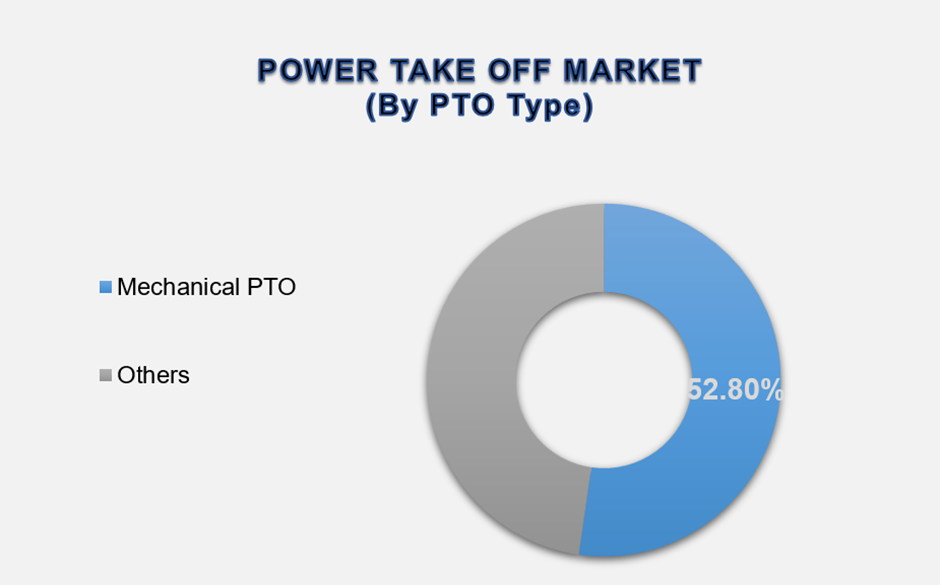
The Mechanical
PTO segment accounted for approximately 52.8% of the market in the
available segment benchmark and remains the largest product category because of
its established use across agricultural tractors, commercial vehicles,
construction equipment, and industrial machinery. Mechanical PTO systems are
valued for their direct power transmission capability, relatively mature
engineering, high torque-handling capacity, and broad compatibility with
existing transmission architectures.
Mechanical
systems are particularly important in applications where continuous and
predictable power delivery is required. Agricultural tractors, heavy-duty
trucks, dump vehicles, winches, pumps, and industrial equipment continue to use
mechanical PTO arrangements because these systems can efficiently transmit
engine or transmission power to auxiliary equipment. The established service
infrastructure surrounding mechanical PTOs also supports their continued
adoption.
The Hydraulic
PTO segment accounted for approximately 33.4% in the same market
benchmark and is positioned strongly in applications requiring hydraulic power
for cylinders, pumps, lifting mechanisms, tipping bodies, cranes, compactors,
and other auxiliary equipment. Hydraulic PTO architectures offer flexibility in
routing power and are particularly useful on commercial vehicles where the
driven equipment may be positioned away from the transmission.
The Electric
PTO segment represented approximately 13.8% in the benchmark and is
expected to experience increasing strategic importance as commercial vehicles
and off-highway equipment become electrified. Although its installed base
remains smaller than mechanical and hydraulic PTO technologies, electric PTOs
can operate auxiliary functions without continuously running an
internal-combustion engine, supporting lower idling, reduced noise, and
improved compatibility with battery-electric platforms.
The
Agriculture Segment Is Expected to Dominate the Market by Application
The Agriculture
segment accounted for approximately 38.6% of the market in the available
application benchmark, making it the largest PTO application category. PTO
systems are fundamental to tractors because they provide a standardized
mechanism for transmitting engine power to external implements. Their use across
mowing, baling, harvesting, and tillage, irrigation, spreading, spraying, and
other agricultural activities gives PTO systems a broad installed base.
The continued
modernization of farm machinery is increasing the technical requirements placed
on PTO systems. Higher-horsepower tractors and sophisticated implements require
improved torque management, durable gear systems, reliable engagement, and
compatibility with increasingly automated equipment. Precision agriculture is
also creating demand for systems that can integrate with electronically
controlled tractor architectures.
The Construction
segment represented approximately 24.3% of the market in the benchmark.
Construction vehicles use PTO systems to power hydraulic pumps and auxiliary
equipment for tipping, lifting, drilling, pumping, winching, and other
operations. Infrastructure investment and the growth of specialized vocational
fleets continue to provide demand for high-torque PTO assemblies.
The Transportation
& Logistics segment accounted for approximately 16.4%, supported
by demand from vocational trucks, utility vehicles, recovery vehicles,
refrigerated systems, and specialized logistics equipment. PTO-enabled systems
allow commercial vehicle platforms to perform functions beyond transportation
while using the vehicle's existing powertrain.
The Energy
& Mining segment represented approximately 12.1%, supported by
demand for pumps, compressors, drilling-related equipment, service vehicles,
and other high-duty-cycle machinery. Mining and energy applications often
require PTO systems with high torque capacity and strong durability under harsh
operating conditions.
The Marine
segment accounted for approximately 8.6% and includes auxiliary
equipment applications in commercial and specialized marine machinery. PTO
systems can support pumps, generators, winches, compressors, and other onboard
equipment where mechanical power extraction is advantageous.
The OEM
Segment Is Expected to Continue Leading the Market by End User
The OEM
segment accounted for approximately 71.2% of the market in the available
end-user benchmark. OEM demand is supported by the increasing preference for
integrated PTO configurations that are engineered alongside the vehicle,
transmission, hydraulic system, and body equipment. Factory integration allows
manufacturers to validate compatibility, torque requirements, engagement
controls, and packaging before vehicle delivery.
OEM-installed
PTO systems are also attractive because they reduce the risk associated with
aftermarket modification of the transmission or chassis. Commercial vehicle
manufacturers and bodybuilders increasingly specify PTO configurations
according to the intended vocational application, including dump trucks,
cranes, refuse vehicles, utility vehicles, recovery trucks, and municipal
equipment.
The Aftermarket
segment accounted for approximately 28.8% in the same benchmark. Its
growth is supported by replacement requirements, equipment refurbishment, fleet
life extension, retrofit applications, and demand for higher-capacity or more
efficient PTO systems.
Aftermarket
demand is especially relevant in mature agricultural and commercial vehicle
markets where equipment remains in operation well beyond its original warranty
period. Distributors and service centers play an important role in supplying
replacement PTOs, gears, clutches, shafts, adapters, seals, and control
components.
The North
American Region Is Expected to Maintain a Leading Position in the Global Market
North America
accounted for approximately 34.4% of the global Power Take Off market in
the available regional benchmark, making it one of the strongest regional
markets for PTO systems. The region benefits from extensive agricultural
mechanization, a large vocational truck base, developed construction activity,
mature aftermarket networks, and the presence of major PTO and hydraulic-system
manufacturers.
The United
States represents the principal demand center within North America. PTO
applications span agricultural tractors, dump trucks, refuse vehicles, and fire
and emergency vehicles, tow trucks, utility fleets, aerial platforms, and
construction machinery. The region is also an important testing ground for
electric PTO technologies as fleet operators seek to reduce engine idling and
meet increasingly stringent efficiency and emissions requirements.
Europe holds a
strong position due to its advanced commercial vehicle manufacturing ecosystem,
agricultural equipment industry, hydraulic technology base, and regulatory
emphasis on efficiency and emissions reduction. European manufacturers are
increasingly investigating electrically powered auxiliary systems, particularly
for municipal and urban vocational vehicles where noise and localized emissions
are important considerations.
Asia Pacific
represents an important growth market because of rising agricultural
mechanization, expanding construction activity, growing commercial vehicle
production, and infrastructure development. China, India, Japan, South Korea,
and Australia have distinct PTO demand profiles. China and India offer
significant growth potential through agricultural and industrial mechanization,
while Japan and South Korea have advanced commercial vehicle and machinery
industries. Australia provides substantial demand from mining, agriculture,
construction, and heavy-duty transport.
Latin America is
supported by agricultural production, mechanized farming, commercial
transportation, mining, and infrastructure development. Brazil and Argentina
are particularly important because of their large agricultural sectors and
extensive use of tractor-driven equipment.
The Middle East
and Africa region offers opportunities through construction, mining, oil and
gas, municipal services, agriculture, and specialized transportation. Demand
varies significantly by country, with Saudi Arabia and the UAE supported by
infrastructure and industrial investment, while South Africa combines mining,
agriculture, construction, and commercial vehicle applications.
The following segments are part of an in-depth analysis of the global Power Take Off Market:
|
Market Segments |
|
|
By
PTO Type |
• Mechanical PTO • Hydraulic PTO • Electric PTO |
|
By Application |
• Agriculture • Construction • Transportation & Logistics • Energy & Mining • Marine |
|
By End User |
• OEMs • Aftermarket |
Power Take Off Market Share Analysis
By Region
North America
Is Expected to Maintain a Strong Market Position Due to Agricultural
Mechanization and Vocational Vehicle Demand
North America
remains one of the most mature markets for PTO systems. The region's
agricultural sector uses PTO-enabled tractors extensively, while commercial
vehicle fleets require PTOs for refuse collection, construction, towing,
utility services, firefighting, aerial work, and other specialized
applications. Available industry estimates place North America's share at
approximately 34.4% in one recent market assessment.
The United
States represents the largest national market within the region because it
combines large-scale agricultural machinery, vocational trucks, construction
fleets, municipal equipment, and established hydraulic-system suppliers. The
aftermarket is also significant because operators often retain trucks and
agricultural equipment for long operating periods.
Europe Is
Advancing Toward Compact, Efficient, and Electrified PTO Architectures
Europe has a
highly developed PTO ecosystem supported by manufacturers of commercial
vehicles, agricultural equipment, hydraulic systems, transmissions, and
auxiliary equipment. Demand is reinforced by agricultural mechanization and
sophisticated municipal and industrial fleets.
Environmental
requirements are influencing product development. Electric PTOs can allow
auxiliary systems to operate without keeping an internal-combustion engine
running, which is particularly relevant for refuse trucks, utility vehicles,
urban service vehicles, and other equipment that spends significant time
stationary while auxiliary functions are operating.
Asia Pacific
Offers Strong Growth Potential Through Mechanization and Infrastructure
Expansion
Asia Pacific is
expected to remain one of the most important growth regions over the forecast
period. Increasing tractor adoption, agricultural modernization, infrastructure
development, commercial vehicle production, and construction activity are
creating multiple sources of PTO demand.
India and China
are particularly important because of their large agricultural machinery
markets and expanding industrial bases. Japan and South Korea contribute
through technologically advanced vehicle and machinery production, while
Australia generates demand through agriculture, mining, construction, and
heavy-duty transport.
The region is
also becoming increasingly important for specialized PTO development. Recent
Bezares products have been designed for Australian and New Zealand commercial
vehicle applications as well as narrower chassis configurations associated with
Asian truck manufacturers.
Latin America
Is Benefiting From Agricultural and Infrastructure Investment
Latin America
provides a strong opportunity for PTO manufacturers because of the region's
dependence on mechanized agriculture and its expanding infrastructure and
logistics requirements. Brazil and Argentina are major agricultural markets
where tractors and PTO-powered implements are widely used.
The region's
commercial vehicle sector also creates demand for hydraulic PTO systems used on
dump trucks, cranes, utility vehicles, agricultural transport, and other
specialized platforms. Replacement and aftermarket activity is expected to
remain important as fleets age and operators prioritize equipment life
extension.
Middle East
and Africa Are Creating Specialized Demand Through Construction, Mining and
Agriculture
Middle East and
Africa demand is supported by large construction projects, mining activities,
oil and gas services, agricultural mechanization, and municipal fleet
development. Saudi Arabia and the UAE provide demand associated with
infrastructure, industrial projects, logistics, and specialized service
vehicles, while South Africa represents an important market for mining,
agriculture, construction, and commercial transportation.
The region
provides opportunities for ruggedized PTO systems designed to operate under
demanding environmental conditions. Product durability, thermal performance,
service availability, and ease of maintenance remain important purchasing
considerations.
Power Take
Off Market Competition Landscape Analysis
The global Power
Take Off market is moderately competitive, with major international suppliers
competing alongside regional manufacturers and specialized hydraulic-system
companies. Competition is primarily based on product compatibility, torque
capacity, operating reliability, product breadth, customization capability,
geographic distribution, aftermarket support, and technological innovation.
Parker
Hannifin's Chelsea division maintains a broad PTO portfolio covering truck and
mobile vocational applications, including transmission-mounted, split-shaft,
front-engine, and other configurations. Parker also provides
application-selection tools intended to match PTO specifications to vehicle and
transmission requirements.
Bezares is
strengthening its position through application-specific PTO development. In
2026, the company introduced products for the Eaton EA-11109 gearbox, Isuzu
MYR9S transmission, Kenworth trucks using Eaton transmissions, and the new 3400
Series designed to improve installation compatibility across commercial vehicle
platforms.
Hyva maintains a
broad range of PTO solutions for truck gearboxes and hydraulic applications.
Its product portfolio demonstrates the importance of torque, ratio, rotation
direction, mounting position, and output configuration in selecting a PTO for a
specific commercial vehicle.
Interpump Group
is another important participant through its hydraulic and power-transmission
businesses. Its 2025 annual report highlights Muncie Power's electronically
controlled PTO clutch modules, which gradually activate clutch systems to
prevent torque peaks and proportionally modulate current. This illustrates the
industry's movement toward electronically managed PTO operation.
The competitive
environment is also being influenced by electrification. Traditional PTO
manufacturers are increasingly developing ePTO systems and electrically
controlled auxiliary power solutions to serve battery-electric and hybrid
commercial vehicles. This creates opportunities for established PTO
manufacturers to leverage their knowledge of hydraulics and vehicle integration
while adding electrical and electronic capabilities.
Major
competitive participants include Parker Hannifin Corporation, Muncie Power
Products, Dana Incorporated, Eaton Corporation, ZF Friedrichshafen, Bezares,
OMFB, Interpump Group, Hyva, Weichai Power, SUNFAB Hydraulics, Hydrocar,
Kozanoğlu Kozmaksan, and other regional suppliers.
Global Power
Take Off Market Recent Developments News
●
August 4, 2026 – Bezares: Bezares introduced the new 3400 Series PTO, featuring a more
compact housing intended to improve installation flexibility on commercial
vehicles, particularly in North American, Oceania, and Asian truck applications
where chassis space can be constrained.
●
July 30, 2026 – Bezares: The company developed the 4300 Series PTO specifically for
Kenworth trucks equipped with Eaton transmissions in Australia. The optimized
housing geometry addresses interference between the PTO, hydraulic pump,
exhaust system, and surrounding vehicle components.
●
July 28, 2026 – Bezares: Bezares launched a new PTO compatible with the Isuzu MYR9S
nine-speed manual overdrive transmission, targeting commercial vehicles in
Australia, New Zealand, and other markets using the transmission.
●
July 3, 2026 – Bezares: The company reported delivery and installation of four e-Tronik
ePTO systems in the United Kingdom for a major customer, supporting the
growing use of electrically powered hydraulic auxiliary systems in commercial
vehicles.
●
June 2, 2026 – Bezares: Bezares upgraded its PTO test bench with new hardware, software,
automation, and data-analysis capabilities to improve product validation and
testing accuracy.
●
March 2, 2026 – Bezares: The company launched a new PTO specifically developed for the Eaton
EA-11109 gearbox, expanding its application coverage for the Hispanic
American commercial vehicle market.
The Global
Power Take Off Market is Dominated by a Few Large Companies, Such As
- Parker Hannifin Corporation
- Muncie Power Products, Inc.
- Dana Incorporated
- Eaton Corporation plc
- ZF Friedrichshafen AG
- Bezares S.A.
- OMFB S.p.A.
- Interpump Group S.p.A.
- Hyva Holding B.V.
- Weichai Power Co., Ltd.
- SUNFAB Hydraulics AB
- Hydrocar S.r.l.
- Kozanoğlu Kozmaksan Ltd.
- Allison Transmission, Inc.
- WPT Power Corporation
- Others
Frequently Asked Questions
Ekta Chaurasia (Team Lead)
Ekta Chaurasia is a highly experienced Team Lead at M2Square Consultancy with over 7 years of expertise in market research, strategic consulting, competitive benchmarking, and business intelligence solutions. She specializes in ICT, semiconductors & electronics, automotive & transportation, and industrial machinery markets.
She leads end-to-end global research projects focused on market trends, industry analysis, growth forecasting, customer insights, and strategic decision-making. Known for her analytical leadership and industry expertise, Ekta helps businesses uncover growth opportunities, evaluate competitive landscapes, and stay ahead in rapidly evolving markets through accurate and insight-driven research.
1.
Global Power Take Off
Market Introduction and Market Overview
1.1. Objectives of the Study
1.2. Global Power Take Off Market Scope and Market Estimation
1.2.1.
Global Power Take Off Market
Size (US$ Million), Market CAGR (%), Market Forecast (2026 - 2034)
1.2.2.
Global Power Take Off Market
Revenue Share (%) and Growth Rate (Y-o-Y) Analysis (2021 - 2034)
1.3. Market Segmentation
1.3.1.
PTO Type of Global Power Take
Off Market
1.3.2.
Application of Global Power
Take Off Market
1.3.3.
End User of Global Power Take
Off Market
1.3.4.
Region of Global Power Take Off
Market
1.4. Competition Coverage List of Market Participants
1.5. Market Definition: Power Take Off Market
2.
Executive Summary
2.1. Demand Side Trends
2.2. Key Market Trends
2.3. Market Demand (US$ Million) Analysis 2021 – 2025 and Forecast, 2026
– 2034
2.4. Demand and Opportunity Assessment
2.5. Key Developments
2.6. Overview of Regulatory Landscape, Compliance Framework, and Industry
Standards
2.7. Market Entry Strategies
2.8. Market Dynamics
2.8.1.
Drivers
2.8.2.
Limitations
2.8.3.
Opportunities
2.8.4.
Impact Analysis of Drivers and
Restraints
2.9. Porter's Five Forces Analysis
2.10.
PEST Analysis
3.
Global Power Take Off
Market Estimates & Historical Trend Analysis (2021 - 2025)
4.
Global Power Take Off
Market Estimates & Forecast Trend Analysis, by PTO Type
4.1. Global Power Take Off Market Revenue (US$ Million) Estimates and
Forecasts, by PTO Type, 2021 - 2034
4.1.1.
Mechanical PTO
4.1.2.
Hydraulic PTO
4.1.3.
Electric PTO
5.
Global Power Take Off
Market Estimates & Forecast Trend Analysis, by Application
5.1. Global Power Take Off Market Revenue (US$ Million) Estimates and
Forecasts, by Application, 2021 - 2034
5.1.1.
Agriculture
5.1.2.
Construction
5.1.3.
Transportation & Logistics
5.1.4.
Energy & Mining
5.1.5.
Marine
6.
Global Power Take Off
Market Estimates & Forecast Trend Analysis, by End User
6.1. Global Power Take Off Market Revenue (US$ Million) Estimates and
Forecasts, by End User, 2021 - 2034
6.1.1.
OEMs
6.1.2.
Aftermarket
7.
Global Power Take Off
Market Estimates & Forecast Trend Analysis, by Region
7.1. Global Power Take Off Market Revenue (US$ Million) Estimates and
Forecasts, by Region, 2021 - 2034
7.1.1.
North America
7.1.2.
Europe
7.1.3.
Asia Pacific
7.1.4.
Middle East & Africa
7.1.5.
Latin America
8.
North America Power Take
Off Market: Estimates & Forecast Trend Analysis
8.1. North America Power Take Off Market Assessments & Key Findings
8.1.1.
North America Power Take Off
Market Introduction
8.1.2.
North America Power Take Off
Market Size Estimates and Forecast (US$ Million) (2021 - 2034)
8.1.2.1.
By PTO Type
8.1.2.2.
By Application
8.1.2.3.
By End User
8.1.2.4.
By Country
8.1.2.4.1.
The U.S.
8.1.2.4.2.
Canad
9.
Europe Power Take Off
Market: Estimates & Forecast Trend Analysis
9.1. Europe Power Take Off Market Assessments & Key Findings
9.1.1.
Europe Power Take Off Market
Introduction
9.1.2.
Europe Power Take Off Market
Size Estimates and Forecast (US$ Million) (2021 - 2034)
9.1.2.1.
By PTO Type
9.1.2.2.
By Application
9.1.2.3.
By End User
9.1.2.4.
By Country
9.1.2.4.1.
Germany
9.1.2.4.2.
Italy
9.1.2.4.3.
The U.K.
9.1.2.4.4.
France
9.1.2.4.5.
Spain
9.1.2.4.6.
Switzerland
9.1.2.4.7.
Rest of Europe
10. Asia Pacific Power Take Off Market: Estimates & Forecast Trend
Analysis
10.1.
Asia Pacific Power Take Off
Market Assessments & Key Findings
10.1.1.
Asia Pacific Power Take Off
Market Introduction
10.1.2.
Asia Pacific Power Take Off
Market Size Estimates and Forecast (US$ Million) (2021 - 2034)
10.1.2.1.
By PTO Type
10.1.2.2.
By Application
10.1.2.3.
By End User
10.1.2.4.
By Country
10.1.2.4.1.
China
10.1.2.4.2.
Japan
10.1.2.4.3.
India
10.1.2.4.4.
Australia
10.1.2.4.5.
South Korea
10.1.2.4.6.
Rest of Asia Pacific
11. Middle East & Africa Power Take Off Market: Estimates &
Forecast Trend Analysis
11.1.
Middle East & Africa Power
Take Off Market Assessments & Key Findings
11.1.1.
Middle East & Africa Power
Take Off Market Introduction
11.1.2.
Middle East & Africa Power
Take Off Market Size Estimates and Forecast (US$ Million) (2021 - 2034)
11.1.2.1.
By PTO Type
11.1.2.2.
By Application
11.1.2.3.
By End User
11.1.2.4.
By Country
11.1.2.4.1.
UAE
11.1.2.4.2.
Saudi Arabia
11.1.2.4.3.
South Africa
11.1.2.4.4.
Rest of Middle East &
Africa
12. Latin America Power Take Off Market: Estimates & Forecast Trend
Analysis
12.1.
Latin America Power Take Off
Market Assessments & Key Findings
12.1.1.
Latin America Power Take Off
Market Introduction
12.1.2.
Latin America Power Take Off
Market Size Estimates and Forecast (US$ Million) (2021 - 2034)
12.1.2.1.
By PTO Type
12.1.2.2.
By Application
12.1.2.3.
By End User
12.1.2.4.
By Country
12.1.2.4.1.
Brazil
12.1.2.4.2.
Mexico
12.1.2.4.3.
Argentina
12.1.2.4.4.
Rest of Latin America
13. Competition Landscape
13.1.
Global Power Take Off Market
Product Mapping
13.2.
Global Power Take Off Market
Concentration Analysis, by Leading Players / Innovators / Emerging Players /
New Entrants
13.3.
Global Power Take Off Market
Tier Structure Analysis
13.4.
Global Power Take Off Market
Concentration & Company Market Shares (%) Analysis, 2026
14. Company Profiles
14.1.
Parker Hannifin Corporation
14.1.1.
Company Overview & Key
Stats
14.1.2.
Financial Performance &
KPIs
14.1.3.
Product Portfolio
14.1.4.
SWOT Analysis
14.1.5.
Business Strategy & Recent
Developments
*Similar details would be provided for all
the players mentioned below
14.2.
Muncie Power Products, Inc.
14.3.
Dana Incorporated
14.4.
Eaton Corporation plc
14.5.
ZF Friedrichshafen AG
14.6.
Bezares S.A.
14.7.
OMFB S.p.A.
14.8.
Interpump Group S.p.A.
14.9.
Hyva Holding B.V.
14.10.
Weichai Power Co., Ltd.
14.11.
SUNFAB Hydraulics AB
14.12.
Hydrocar S.r.l.
14.13.
Kozanoğlu Kozmaksan Ltd.
14.14.
Allison Transmission, Inc.
14.15.
WPT Power Corporation
14.16.
Others
15. Research Findings & Conclusion
16. Assumptions & Acronyms Used
17. Research Methodology
17.1.
External Databases
17.2.
Internal Proprietary Database
17.3.
Primary Research
17.4.
Secondary Research
17.5.
Assumptions
17.6.
Limitations
17.7.
Report FAQs
Our Research Methodology
"Insight without rigor is just noise."
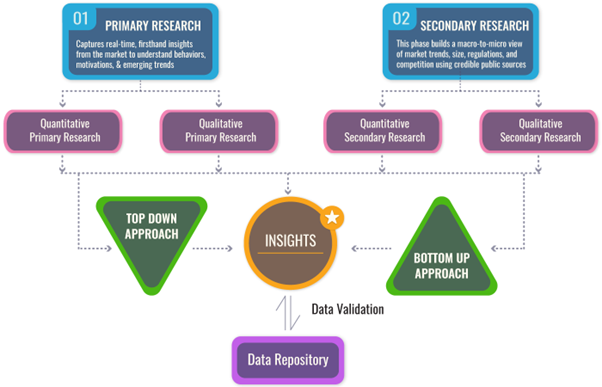
We follow a comprehensive, multi-phase research framework designed to deliver accurate, strategic, and decision-ready intelligence. Our process integrates primary and secondary research , both quantitative and qualitative , along with dual modeling techniques ( top-down and bottom-up) and a final layer of validation through our proprietary in-house repository.
PRIMARY RESEARCH
Primary research captures real-time, firsthand insights from the market to understand behaviors, motivations, and emerging trends.
1. Quantitative Primary Research
Objective: Generate statistically significant data directly from market participants.
Approaches:- Structured surveys with customers, distributors, and field agents
- Mobile-based data collection for point-of-sale audits and usage behavior
- Phone-based interviews (CATI) for market sizing and product feedback
- Online polling around industry events and digital campaigns
- Purchase frequency by customer type
- Channel performance across geographies
- Feature demand by application or demographic
2. Qualitative Primary Research
Objective: Explore decision-making drivers, pain points, and market readiness.
Approaches:- In-depth interviews (IDIs) with executives, product managers, and key decision-makers
- Focus groups among end users and early adopters
- Site visits and observational research for consumer products
- Informal field-level discussions for regional and cultural nuances
SECONDARY RESEARCH
This phase helps establish a macro-to-micro understanding of market trends, size, regulation, and competitive dynamics, sourced from credible and public domain information.
1. Quantitative Secondary Research
Objective: Model market value and segment-level forecasts based on published data.
Sources include:- Financial reports and investor summaries
- Government trade data, customs records, and regulatory statistics
- Industry association publications and economic databases
- Channel performance and pricing data from marketplace listings
- Revenue splits, pricing trends, and CAGR estimates
- Supply-side capacity and volume tracking
- Investment analysis and funding benchmarks
2. Qualitative Secondary Research
Objective: Capture strategic direction, innovation signals, and behavioral trends.
Sources include:- Company announcements, roadmaps, and product pipelines
- Publicly available whitepapers, conference abstracts, and academic research
- Regulatory body publications and policy briefs
- Social and media sentiment scanning for early-stage shifts
- Strategic shifts in market positioning
- Unmet needs and white spaces
- Regulatory triggers and compliance impact
DUAL MODELING: TOP-DOWN + BOTTOM-UP
To ensure robust market estimation, we apply two complementary sizing approaches:
Top-Down Modeling:- Start with broader industry value (e.g., global or regional TAM)
- Apply filters by segment, geography, end-user, or use case
- Adjust with primary insights and validation benchmarks
- Ideal for investor-grade market scans and opportunity mapping
- Aggregate from the ground up using sales volumes, pricing, and unit economics
- Use internal modeling templates aligned with stakeholder data
- Incorporate distributor-level or region-specific inputs
- Most accurate for emerging segments and granular sub-markets
DATA VALIDATION: IN-HOUSE REPOSITORY
We close the loop with proprietary data intelligence built from ongoing projects, industry monitoring, and historical benchmarking. This repository includes:
- Multi-sector market and pricing models
- Key trendlines from past interviews and forecasts
- Benchmarked adoption rates, churn patterns, and ROI indicators
- Industry-specific deviation flags and cross-check logic
- Catches inconsistencies early
- Aligns projections across studies
- Enables consistent, high-trust deliverables