

Powered Air Purifying Respirators Market Size and Forecast (2026–2034), Global and Regional Growth, Trend, Share and Industry Analysis Report Coverage; By Product Type (Half Mask PAPRs, Full Face Mask PAPRs, Helmet/Hood PAPRs, Others); By Component (Filters & Cartridges, Blowers, Batteries, Facepieces, Others); By Application (Healthcare, Industrial Manufacturing, Oil & Gas, Mining, Chemical Processing, Construction, Others); By End User (Hospitals & Healthcare Facilities, Industrial Enterprises, Emergency Response Organizations, Defense & Military, Others), and Geography
2026-06-18
Healthcare
Swetal (Research Analyst)
Description
Powered Air Purifying Respirators
Market Overview
The global Powered
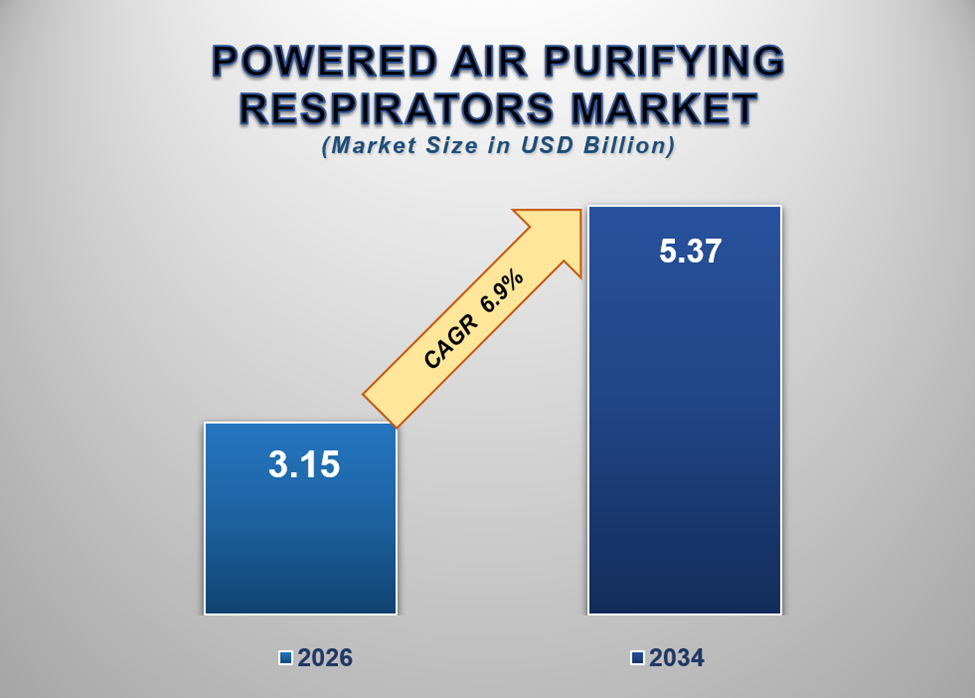
Air Purifying Respirators market was valued at USD 3.15 billion in 2026
and is projected to reach USD 5.37 billion by 2034, expanding at a CAGR
of 6.9% during the forecast period. The market is witnessing strong
growth due to increasing awareness regarding occupational safety, rising demand
for advanced respiratory protection equipment, expanding industrial safety
regulations, and growing adoption of respiratory protection systems across
healthcare and hazardous industrial environments.
Powered air
purifying respirators (PAPRs) are battery-powered respiratory protection
devices designed to filter contaminated air and provide clean, breathable air
to users operating in hazardous environments. These systems utilize blowers and
high-efficiency filters to remove airborne contaminants, including dust, fumes,
gases, vapors, pathogens, and toxic particles.
PAPRs are widely
utilized across healthcare, pharmaceutical manufacturing, chemical processing,
oil & gas operations, mining, construction, emergency response, and
industrial manufacturing sectors where respiratory protection is critical for
worker safety.
The increasing
global focus on workplace safety and employee health protection is
significantly accelerating the adoption of advanced respiratory protection
equipment. Governments and occupational safety organizations worldwide are
implementing stringent regulations regarding respiratory hazard management
across industrial and healthcare facilities.
The healthcare
sector represents a major growth contributor due to increasing awareness
regarding infection control, airborne disease prevention, and healthcare worker
safety. PAPRs are extensively used during infectious disease management,
high-risk medical procedures, and biohazard containment operations.
Additionally,
rising industrialization and expansion of hazardous manufacturing activities
are generating substantial demand for respiratory protection systems capable of
ensuring worker safety in environments exposed to harmful airborne
contaminants.
Technological
advancements in lightweight respirator designs, battery efficiency, airflow
management systems, ergonomic facepieces, and smart respiratory monitoring
technologies are further improving user comfort and operational performance.
As occupational health standards and respiratory safety awareness continue increasing globally, the powered air purifying respirators market is expected to witness sustained growth through 2034.
Powered Air Purifying Respirators
Market Drivers and Opportunities
Increasing
Occupational Safety Regulations and Industrial Hazard Exposure Are Driving
Market Growth
The growing
implementation of occupational health and safety regulations is one of the
primary drivers of the powered air purifying respirators market. Industries
involving hazardous airborne contaminants are increasingly required to provide
certified respiratory protection equipment for employees.
Workers
operating within chemical plants, pharmaceutical manufacturing facilities,
mining operations, welding environments, oil refineries, and construction sites
are frequently exposed to toxic fumes, dust particles, gases, and airborne
pathogens that can severely impact respiratory health.
Powered air
purifying respirators provide superior respiratory protection compared to
conventional respirators by delivering filtered airflow with reduced breathing
resistance and enhanced user comfort.
Additionally,
increasing workplace safety audits, regulatory inspections, and compliance
requirements are encouraging industrial organizations to invest in advanced
respiratory protection systems.
The rising incidence of occupational respiratory diseases and growing awareness regarding long-term health risks associated with airborne contaminants are also significantly supporting market growth.
Growing
Demand from Healthcare and Infection Control Applications Is Fueling Market
Expansion
The increasing
utilization of PAPRs within healthcare environments is significantly
contributing to market expansion. Hospitals and healthcare facilities
increasingly prioritize respiratory protection systems for infection prevention
and healthcare worker safety.
PAPRs are widely
used during infectious disease treatment, surgical procedures, isolation unit
operations, laboratory research, and emergency medical response activities
where airborne contamination risks are elevated.
The growing
focus on pandemic preparedness, hospital safety protocols, and biohazard
management is accelerating the procurement of advanced respiratory protection
equipment globally.
Additionally,
healthcare professionals increasingly prefer PAPRs because they offer higher
protection factors, improved comfort during prolonged use, and compatibility
with users who cannot achieve proper fit with traditional respirators.
The expansion of pharmaceutical manufacturing and biotechnology research facilities is also generating increasing demand for respiratory protection systems within controlled environments and cleanroom operations.
Technological
Advancements and Smart Respiratory Systems Present Significant Opportunities
Technological
advancements in respiratory protection systems present substantial
opportunities for the powered air purifying respirators market.
Manufacturers
are increasingly developing lightweight, ergonomically optimized PAPRs with
improved airflow systems, extended battery life, reduced operational noise, and
enhanced wearer comfort.
The integration
of smart sensors, wireless connectivity, airflow monitoring systems, and
real-time contamination detection technologies is transforming respiratory
safety equipment into intelligent worker protection platforms.
Additionally,
increasing demand for reusable and sustainable respiratory protection solutions
is encouraging the development of durable, rechargeable, and cost-efficient
respirator systems.
Growing
investments in defense modernization, emergency preparedness programs,
hazardous material response teams, and disaster management infrastructure are
also creating new opportunities for advanced respiratory protection
technologies.
Emerging
economies are witnessing rising industrialization and increasing workplace
safety awareness, further supporting the adoption of respiratory protection
equipment across manufacturing and infrastructure sectors.
As global industries continue prioritizing employee safety and respiratory health management, demand for advanced powered air purifying respirators is expected to rise significantly.
Powered Air Purifying Respirators
Market Scope
|
Report Attributes |
Description |
|
Market Size in 2026 |
USD 3.15 Billion |
|
Market Forecast in 2034 |
USD 5.37 Billion |
|
CAGR % 2026-2034 |
6.9% |
|
Base Year |
2025 |
|
Historic Data |
2021-2025 |
|
Forecast Period |
2026-2034 |
|
Report USP |
Production, Consumption,
Company Share, Company Heatmap, Company Production, Service Type, Growth
Factors and more |
|
Segments Covered |
∙ By Product Type |
|
Regional Scope |
● North America |
|
Country Scope |
U.S. |
Powered Air
Purifying Respirators Market Report Segmentation Analysis
The global powered air purifying respirators market industry analysis is segmented by product type, by component, by application, by end user, and by region.
Full Face
Mask PAPRs Segment Is Expected to Dominate the Market During the Forecast
Period
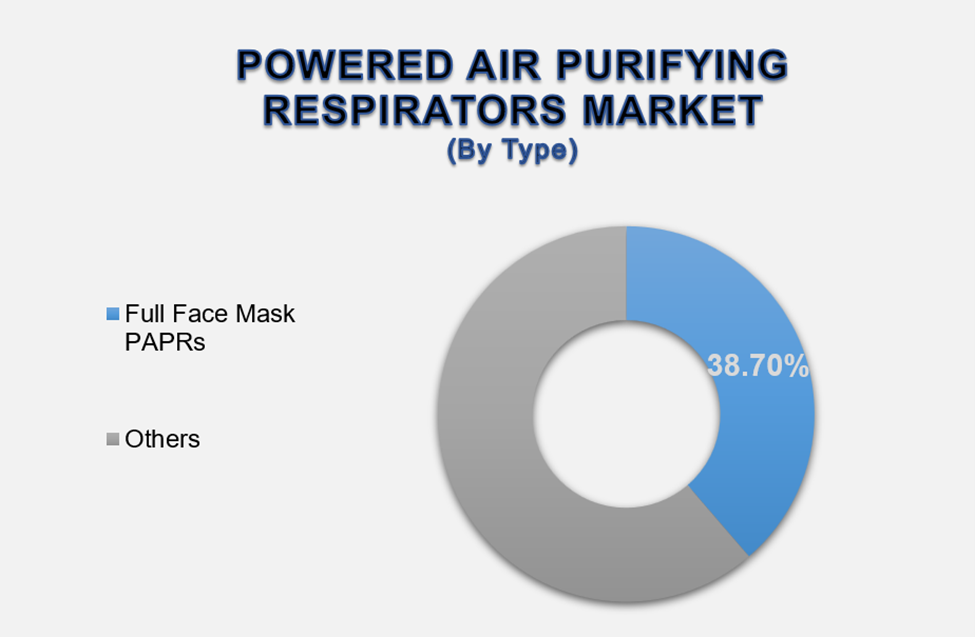
The full face
mask PAPRs segment accounted for approximately 38.7% of the global market,
making it the dominant product category.
Full-face mask
PAPRs provide comprehensive respiratory and facial protection against hazardous
airborne contaminants, chemical splashes, and infectious particles.
These systems
are extensively utilized across healthcare facilities, chemical industries,
pharmaceutical manufacturing, and hazardous industrial environments requiring
maximum protection levels.
The growing emphasis on worker safety and infection control is significantly supporting the adoption of full-face respiratory protection systems globally.
Filters &
Cartridges Segment Is Expected to Lead the Market by Component
Filters and
cartridges dominate the component segment due to their essential role in
contaminant filtration and respiratory protection performance.
High-efficiency
particulate air (HEPA) filters and specialized chemical cartridges are
increasingly utilized for removing hazardous particles, gases, vapors, and
biological contaminants.
The increasing
replacement demand for disposable and reusable filtration components is
significantly contributing to segment growth.
Additionally, advancements in filtration efficiency and lightweight filter materials are improving respirator performance and user comfort.
The
Healthcare Segment Is Expected to Dominate the Market by Application
Healthcare
represents the leading application segment within the powered air purifying
respirators market due to increasing infection prevention measures and
healthcare worker protection requirements.
Hospitals,
isolation units, laboratories, and emergency medical facilities extensively
utilize PAPRs during high-risk medical procedures and infectious disease
management operations.
The growing
focus on hospital preparedness, pandemic response infrastructure, and biohazard
safety protocols is significantly accelerating segment growth.
Additionally, rising investments in healthcare safety equipment and protective technologies are further supporting market expansion.
Hospitals
& Healthcare Facilities Segment Is Expected to Lead the End User Market
Hospitals and
healthcare facilities account for the largest market share due to rising
utilization of advanced respiratory protection systems within clinical
environments.
Healthcare
institutions increasingly prioritize respiratory safety for doctors, nurses,
laboratory personnel, and emergency responders exposed to airborne pathogens
and infectious diseases.
The expansion of healthcare infrastructure and increasing adoption of infection control technologies globally are significantly contributing to segment growth.
The following
segments are part of an in-depth analysis of the global Powered Air Purifying
Respirators market:
|
Market
Segments |
|
|
By Product Type |
∙
Half Mask PAPRs |
|
By Component |
∙
Filters & Cartridges |
|
By Application |
|
|
By
End User |
∙
Hospitals & Healthcare Facilities |
Powered Air
Purifying Respirators Market Share Analysis By Region
North America is
projected to hold the largest share of the global powered air purifying
respirators market over the forecast period.
North America
accounted for approximately 37.4% of the global market in 2026, driven
by stringent occupational safety regulations, advanced healthcare
infrastructure, and high adoption of industrial safety equipment.
The United
States remains the dominant contributor due to strong workplace safety
compliance standards, extensive healthcare investments, and growing demand for
respiratory protection systems across industrial sectors.
Europe also
represents a significant market due to strict worker protection regulations,
increasing industrial safety awareness, and rising investments in healthcare
infection control technologies.
Asia Pacific is
expected to register the highest CAGR during the forecast period due to rapid
industrialization, expanding healthcare infrastructure, increasing
manufacturing activities, and rising occupational health awareness.
China, India, Japan, and South Korea are witnessing substantial growth in industrial safety equipment adoption and respiratory protection investments, further accelerating regional market expansion.
Powered Air
Purifying Respirators Market Competition Landscape Analysis
The powered air
purifying respirators market is highly competitive and technology-driven, with
leading companies focusing on advanced filtration systems, ergonomic respirator
designs, smart respiratory monitoring technologies, and lightweight wearable protection
solutions.
Manufacturers
are increasingly investing in battery innovation, airflow optimization systems,
reusable respirator technologies, and integrated communication features to
improve operational performance and user comfort.
Strategic collaborations between healthcare institutions, industrial safety providers, emergency response organizations, and respiratory equipment manufacturers are becoming increasingly common as organizations seek to strengthen respiratory safety capabilities and expand market reach.
Global
Powered Air Purifying Respirators Market Recent Developments News:
∙ In March 2026 – Healthcare facilities
expanded procurement of advanced PAPRs for infection control and emergency
preparedness programs.
∙ In January 2026 – Lightweight battery-powered respirator systems with
enhanced airflow management technologies gained increased commercialization.
∙ In October 2025 – Smart respiratory protection systems integrating real-time
monitoring and wireless connectivity witnessed rising adoption globally.
∙ In August 2025 – Industrial manufacturers accelerated investments in worker
respiratory safety and hazardous environment protection technologies.
∙ In June 2025 – Emergency response agencies expanded deployment of advanced
PAPRs for disaster response and hazardous material management operations.
The Global
Powered Air Purifying Respirators Market is dominated by a few large companies,
such as
∙ 3M Company
∙ Honeywell International Inc.
∙ MSA Safety Incorporated
∙ Drägerwerk AG & Co. KGaA
∙ Avon Protection plc
∙ Bullard
∙ ILC Dover LP
∙ Optrel AG
∙ Kimberly-Clark Corporation
∙ Gentex Corporation
∙ Sundström Safety AB
∙ CleanSpace Technology Pty Ltd.
∙ MAXAIR Systems
∙ Bio-Medical Devices International, Inc.
∙ Allegro Industries
∙ Others
Frequently Asked Questions
Swetal (Research Analyst)
Swetal is a Research Analyst with 4+ years of experience specializing in healthcare market research, medical devices, healthcare IT, and medical technology industry analysis. Her expertise includes competitive intelligence, secondary research, market trend forecasting, and healthcare business insights across global healthcare ecosystems.
She contributes to advanced market research reports by analyzing regulatory frameworks, emerging healthcare technologies, competitive landscapes, and innovation trends shaping the medical industry. With a strong focus on accurate market intelligence, strategic insights, and healthcare industry trends, Swetal supports businesses in making informed, data-backed decisions in a rapidly transforming healthcare environment.
1.
Global Powered Air
Purifying Respirators Market Introduction and Market Overview
1.1. Objectives of the Study
1.2. Global Powered Air Purifying Respirators Market Scope and Market
Estimation
1.2.1.
Global Powered Air Purifying
Respirators Overall Market Size (US$ Million), Market CAGR (%), Market Forecast
(2026 - 2034)
1.2.2.
Global Powered Air Purifying
Respirators Market Revenue Share (%) and Growth Rate (Y-o-Y) from 2021 - 2034
1.3. Market Segmentation
1.3.1.
Product Type of Global Powered
Air Purifying Respirators Market
1.3.2.
Component of Global Powered Air
Purifying Respirators Market
1.3.3.
Application of Global Powered
Air Purifying Respirators Market
1.3.4.
End User of Global Powered Air
Purifying Respirators Market
1.3.5.
Region of Global Powered Air
Purifying Respirators Market
2.
Executive Summary
2.1. Demand Side Trends
2.2. Key Market Trends
2.3. Market Demand (US$ Million) Analysis 2021 – 2025 and Forecast, 2026
– 2034
2.4. Demand and Opportunity Assessment
2.5. Key Developments
2.6. Overview of Tariff, Regulatory Landscape and Standards
2.7. Market Entry Strategies
2.8. Market Dynamics
2.8.1.
Drivers
2.8.2.
Limitations
2.8.3.
Opportunities
2.8.4.
Impact Analysis of Drivers and
Restraints
2.9. Porter’s Five Forces Analysis
2.10.
PEST Analysis
3.
Global Powered Air
Purifying Respirators Market Estimates & Historical Trend Analysis (2021 -
2025)
4.
Global Powered Air
Purifying Respirators Market Estimates & Forecast Trend Analysis, by
Product Type
4.1. Global Powered Air Purifying Respirators Market Revenue (US$
Million) Estimates and Forecasts, by Product Type, 2021 - 2034
4.1.1.
Half Mask PAPRs
4.1.2.
Full Face Mask PAPRs
4.1.3.
Helmet/Hood PAPRs
4.1.4.
Others
5.
Global Powered Air
Purifying Respirators Market Estimates & Forecast Trend Analysis, by
Component
5.1. Global Powered Air Purifying Respirators Market Revenue (US$
Million) Estimates and Forecasts, by Component, 2021 - 2034
5.1.1.
Filters & Cartridges
5.1.2.
Blowers
5.1.3.
Batteries
5.1.4.
Facepieces
5.1.5.
Others
6.
Global Powered Air
Purifying Respirators Market Estimates & Forecast Trend Analysis, by
Application
6.1. Global Powered Air Purifying Respirators Market Revenue (US$
Million) Estimates and Forecasts, by Application, 2021 - 2034
6.1.1.
Healthcare
6.1.2.
Industrial Manufacturing
6.1.3.
Oil & Gas
6.1.4.
Mining
6.1.5.
Chemical Processing
6.1.6.
Construction
6.1.7.
Others
7.
Global Powered Air
Purifying Respirators Market Estimates & Forecast Trend Analysis, by End
User
7.1. Global Powered Air Purifying Respirators Market Revenue (US$
Million) Estimates and Forecasts, by End User, 2021 - 2034
7.1.1.
Hospitals & Healthcare
Facilities
7.1.2.
Industrial Enterprises
7.1.3.
Emergency Response
Organizations
7.1.4.
Defense & Military
7.1.5.
Others
8.
Global Powered Air
Purifying Respirators Market Estimates & Forecast Trend Analysis, by Region
8.1. Global Powered Air Purifying Respirators Market Revenue (US$
Million) Estimates and Forecasts, by Region, 2021 - 2034
8.1.1.
North America
8.1.2.
Europe
8.1.3.
Asia Pacific
8.1.4.
Middle East & Africa
8.1.5.
Latin America
9.
North America Powered
Air Purifying Respirators Market: Estimates & Forecast Trend Analysis
9.1. North America Powered Air Purifying Respirators Market Assessments
& Key Findings
9.1.1.
North America Powered Air
Purifying Respirators Market Introduction
9.1.2.
North America Powered Air
Purifying Respirators Market Size Estimates and Forecast (US$ Million) (2021 -
2034)
9.1.2.1.
By Product Type
9.1.2.2.
By Component
9.1.2.3.
By Application
9.1.2.4.
By End User
9.1.2.5.
By Country
9.1.2.5.1.
The U.S.
9.1.2.5.2.
Canada
10. Europe Powered Air Purifying Respirators Market: Estimates &
Forecast Trend Analysis
10.1.
Europe Powered Air Purifying
Respirators Market Assessments & Key Findings
10.1.1.
Europe Powered Air Purifying
Respirators Market Introduction
10.1.2.
Europe Powered Air Purifying
Respirators Market Size Estimates and Forecast (US$ Million) (2021 - 2034)
10.1.2.1.
By Product Type
10.1.2.2.
By Component
10.1.2.3.
By Application
10.1.2.4.
By End User
10.1.2.5.
By Country
10.1.2.5.1.
Germany
10.1.2.5.2.
Italy
10.1.2.5.3.
U.K.
10.1.2.5.4.
France
10.1.2.5.5.
Spain
10.1.2.5.6.
Switzerland
10.1.2.5.7.
Rest of Europe
11. Asia Pacific Powered Air Purifying Respirators Market: Estimates
& Forecast Trend Analysis
11.1.
Asia Pacific Market Assessments
& Key Findings
11.1.1.
Asia Pacific Powered Air
Purifying Respirators Market Introduction
11.1.2.
Asia Pacific Powered Air
Purifying Respirators Market Size Estimates and Forecast (US$ Million) (2021 -
2034)
11.1.2.1.
By Product Type
11.1.2.2.
By Component
11.1.2.3.
By Application
11.1.2.4.
By End User
11.1.2.5.
By Country
11.1.2.5.1.
China
11.1.2.5.2.
Japan
11.1.2.5.3.
India
11.1.2.5.4.
Australia
11.1.2.5.5.
South Korea
11.1.2.5.6.
Rest of Asia Pacific
12. Middle East & Africa Powered Air Purifying Respirators Market:
Estimates & Forecast Trend Analysis
12.1.
Middle East & Africa Market
Assessments & Key Findings
12.1.1.
Middle East & Africa
Powered Air Purifying Respirators Market Introduction
12.1.2.
Middle East & Africa
Powered Air Purifying Respirators Market Size Estimates and Forecast (US$
Million) (2021 - 2034)
12.1.2.1.
By Product Type
12.1.2.2.
By Component
12.1.2.3.
By Application
12.1.2.4.
By End User
12.1.2.5.
By Country
12.1.2.5.1.
UAE
12.1.2.5.2.
Saudi Arabia
12.1.2.5.3.
South Africa
12.1.2.5.4.
Rest of MEA
13. Latin America Powered Air Purifying Respirators Market: Estimates
& Forecast Trend Analysis
13.1.
Latin America Market
Assessments & Key Findings
13.1.1.
Latin America Powered Air
Purifying Respirators Market Introduction
13.1.2.
Latin America Powered Air
Purifying Respirators Market Size Estimates and Forecast (US$ Million) (2021 -
2034)
13.1.2.1.
By Product Type
13.1.2.2.
By Component
13.1.2.3.
By Application
13.1.2.4.
By End User
13.1.2.5.
By Country
13.1.2.5.1.
Brazil
13.1.2.5.2.
Mexico
13.1.2.5.3.
Argentina
13.1.2.5.4.
Rest of LATAM
14. Competition Landscape
14.1.
Global Powered Air Purifying
Respirators Market Product Mapping
14.2.
Global Powered Air Purifying
Respirators Market Concentration Analysis, by Leading Players / Innovators /
Emerging Players / New Entrants
14.3.
Global Powered Air Purifying
Respirators Market Tier Structure Analysis
14.4.
Global Powered Air Purifying
Respirators Market Concentration & Company Market Shares (%) Analysis, 2025
15. Company Profiles
15.1.
3M Company
15.1.1.
Company Overview & Key
Stats
15.1.2.
Financial Performance &
KPIs
15.1.3.
Product Portfolio
15.1.4.
SWOT Analysis
15.1.5.
Business Strategy & Recent
Developments
*Similar details would be provided for all
the players mentioned below
15.2.
Honeywell International Inc.
15.3.
MSA Safety Incorporated
15.4.
Drägerwerk AG & Co. KGaA
15.5.
Avon Protection plc
15.6.
Bullard
15.7.
ILC Dover LP
15.8.
Optrel AG
15.9.
Kimberly-Clark Corporation
15.10.
Gentex Corporation
15.11.
Sundström Safety AB
15.12.
CleanSpace Technology Pty Ltd.
15.13.
MAXAIR Systems
15.14.
Bio-Medical Devices
International, Inc.
15.15.
Allegro Industries
15.16.
Others
16. Research Findings & Conclusion
17. Assumption & Acronyms Used
18. Research Methodology
18.1.
External Databases
18.2.
Internal Proprietary Database
18.3.
Primary Research
18.4.
Secondary Research
18.5.
Assumptions
18.6.
Limitations
18.7.
Report FAQs
Our Research Methodology
"Insight without rigor is just noise."
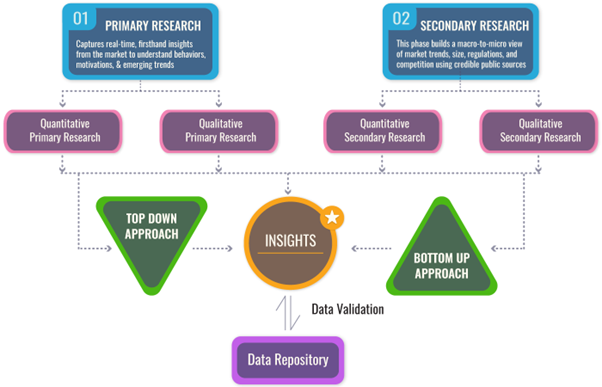
We follow a comprehensive, multi-phase research framework designed to deliver accurate, strategic, and decision-ready intelligence. Our process integrates primary and secondary research , both quantitative and qualitative , along with dual modeling techniques ( top-down and bottom-up) and a final layer of validation through our proprietary in-house repository.
PRIMARY RESEARCH
Primary research captures real-time, firsthand insights from the market to understand behaviors, motivations, and emerging trends.
1. Quantitative Primary Research
Objective: Generate statistically significant data directly from market participants.
Approaches:- Structured surveys with customers, distributors, and field agents
- Mobile-based data collection for point-of-sale audits and usage behavior
- Phone-based interviews (CATI) for market sizing and product feedback
- Online polling around industry events and digital campaigns
- Purchase frequency by customer type
- Channel performance across geographies
- Feature demand by application or demographic
2. Qualitative Primary Research
Objective: Explore decision-making drivers, pain points, and market readiness.
Approaches:- In-depth interviews (IDIs) with executives, product managers, and key decision-makers
- Focus groups among end users and early adopters
- Site visits and observational research for consumer products
- Informal field-level discussions for regional and cultural nuances
SECONDARY RESEARCH
This phase helps establish a macro-to-micro understanding of market trends, size, regulation, and competitive dynamics, sourced from credible and public domain information.
1. Quantitative Secondary Research
Objective: Model market value and segment-level forecasts based on published data.
Sources include:- Financial reports and investor summaries
- Government trade data, customs records, and regulatory statistics
- Industry association publications and economic databases
- Channel performance and pricing data from marketplace listings
- Revenue splits, pricing trends, and CAGR estimates
- Supply-side capacity and volume tracking
- Investment analysis and funding benchmarks
2. Qualitative Secondary Research
Objective: Capture strategic direction, innovation signals, and behavioral trends.
Sources include:- Company announcements, roadmaps, and product pipelines
- Publicly available whitepapers, conference abstracts, and academic research
- Regulatory body publications and policy briefs
- Social and media sentiment scanning for early-stage shifts
- Strategic shifts in market positioning
- Unmet needs and white spaces
- Regulatory triggers and compliance impact
DUAL MODELING: TOP-DOWN + BOTTOM-UP
To ensure robust market estimation, we apply two complementary sizing approaches:
Top-Down Modeling:- Start with broader industry value (e.g., global or regional TAM)
- Apply filters by segment, geography, end-user, or use case
- Adjust with primary insights and validation benchmarks
- Ideal for investor-grade market scans and opportunity mapping
- Aggregate from the ground up using sales volumes, pricing, and unit economics
- Use internal modeling templates aligned with stakeholder data
- Incorporate distributor-level or region-specific inputs
- Most accurate for emerging segments and granular sub-markets
DATA VALIDATION: IN-HOUSE REPOSITORY
We close the loop with proprietary data intelligence built from ongoing projects, industry monitoring, and historical benchmarking. This repository includes:
- Multi-sector market and pricing models
- Key trendlines from past interviews and forecasts
- Benchmarked adoption rates, churn patterns, and ROI indicators
- Industry-specific deviation flags and cross-check logic
- Catches inconsistencies early
- Aligns projections across studies
- Enables consistent, high-trust deliverables