

Preclinical Imaging Market Size and Forecast (2026–2034), Global and Regional Growth, Trend, Share and Industry Analysis Report Coverage: By Modality (Optical Imaging Systems, Nuclear Imaging Systems (PET/SPECT), Micro-MRI, Micro-CT, Micro-Ultrasound, Photoacoustic Imaging Systems, Hybrid & Multi-modal Platforms, and Others) By Application (Oncology, Neurology, Cardiovascular Disorders, Immunology & Infectious Diseases, Metabolic Disorders, and Others), By End User (Pharmaceutical & Biotechnology Companies, Academic & Research Institutions, Contract Research Organizations, and Government & Non-profit Labs) and Geography
2026-08-03
Healthcare
Swetal (Research Analyst)
Description
Preclinical Imaging Market
Overview
The global
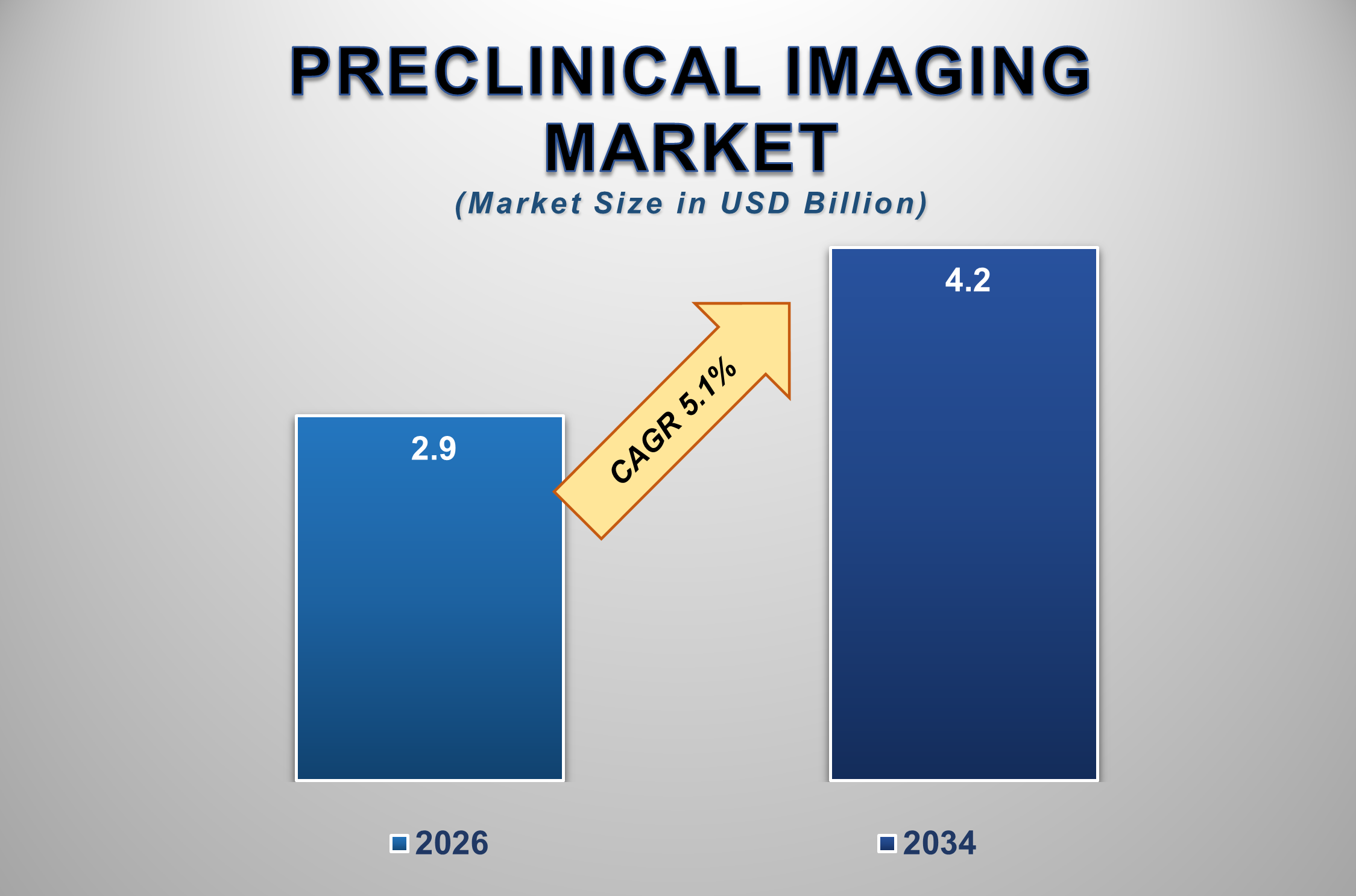
preclinical imaging market was valued at USD 2.9 billion in 2026 and is
projected to reach USD 4.2 billion by 2034, expanding at a CAGR of 5.1% during
the forecast period. The preclinical
imaging industry involves the technologies that are utilized for studying
biological processes, disease progression, and treatment responses in small
animals. Technologies like optical imaging, micro-MRI, micro-CT,
micro-PET/SPECT, ultrasound, and photoacoustic imaging have become important
tools in drug development, tumor research, investigation of brain functioning,
heart disease diagnosis, regenerative medicine, and clinical studies.
The growth of the
market is driven by the increasing number of R&D operations performed in
biotechnology and pharmaceutical industries as well as by the advancement of
imaging techniques. The cooperation of research institutes with CROs is also
boosting the need for the implementation of preclinical technologies to
increase the efficiency of research and shorten the time of the research
process.
Preclinical Imaging Market Drivers
and Opportunities
Rising
Investment in Drug Discovery and Preclinical Research is Driving Market Growth
The rise in
investments in the fields of preclinical research and drug discovery from
groups in the fields of pharmaceuticals, biotech companies, and universities
has resulted in a significant increase in the demand for preclinical imaging
systems. With the advancing focus on rapid development of more therapeutics
such as small molecules that perform multiple functions and new types of
biological drugs intended for tough disease targets, modern imaging techniques
have turned out to be vital in terms of drug efficacy and safety evaluation as
well as drug distribution and workings in animals. The process of preclinical
imaging allows for consistent and non-invasive tracking of the mutation process
and how effective each of the drugs was. Taking this development into
consideration, in April 2026, ELRIG announced that Drug Discovery USA 2026 will
be held at Pfizer, which is located in Cambridge, Massachusetts.
Growing Demand
for Multimodal and High-Resolution Imaging Technologies Fueling Market
Expansion
The rising
intricacy of drug development, cancerology, neurobiology, and heart and
vascular disease calls for multimodal high-definition preclinical imaging
technologies. Researchers increasingly need different data about an object
derived from one study; thus, integrated imaging systems comprising micro-CT,
micro-PET/SPECT, MRI, optical imaging, and photoacoustic imaging began to
emerge rapidly. Such multimodal systems produce complementary datasets, which
enhance the accuracy of disease characterizations, biomarker discoveries, and
therapeutic efficiency evaluations and reduce the demand for numerous separate
experiments. Meanwhile, innovations in detection technologies, image
reconstruction algorithms, and AI-based image analysis markedly improve imaging
accuracy, sensitivity, quantitative precision, and the effectiveness of work.
Expansion of
Precision Medicine and Translational Research Presents Significant
Opportunities
The rapid growth of
precision medicine and translational research is creating significant growth
prospects for the preclinical imaging market. There is an increased focus on
developing targeted therapies, gene and cell therapies, immunotherapy, and
personalized medicine options, which rely on advanced imaging technologies
capable of noninvasively monitoring key aspects of the disease process.
Preclinical imaging is a crucial instrument for connecting laboratory
discoveries to clinical applications and producing reliable in vivo data that
ensures accurate target validation and supports regulatory submissions.
Moreover, rising collaboration with pharmaceutical and biotechnology companies,
universities, and research organizations, as well as improved support for
translational research, is accelerating the adoption of multimodal imaging
systems.
Preclinical Imaging Market Scope
|
Report Attributes |
Description |
|
Market Size in
2026 |
USD 2.9
Billion |
|
Market Forecast
in 2034 |
USD 4.2
Billion |
|
CAGR % 2026-2034 |
5.1% |
|
Base Year |
2025 |
|
Historic Data |
2021-2025 |
|
Forecast Period |
2026-2034 |
|
Report USP |
Pricing and
Cost Structure Analysis, Product Innovation Benchmarking, Whitespace
Assessment, Company Share, Company Heatmap, Growth Factors, and more |
|
Segments Covered |
●
By
Modality ●
By
Application ●
By End
User |
|
Regional Scope |
●
North
America ●
Europe ●
APAC ●
Latin
America ●
Middle
East and Africa |
|
Country Scope |
●
U.S. ●
Canada ●
U.K. ●
Germany ●
France ●
Italy ●
Spain ●
Russia ●
China ●
India ●
Japan ●
South
Korea ●
Australia
●
Mexico ●
Brazil ●
Saudi
Arabia ●
UAE ●
South
Africa
|
Preclinical Imaging Market Report
Segmentation Analysis
The global
preclinical imaging market industry analysis is segmented by modality,
application, end user, and region.
Optical Imaging
Systems Segment Is Expected to Dominate the Preclinical Imaging Market During
the Forecast Period
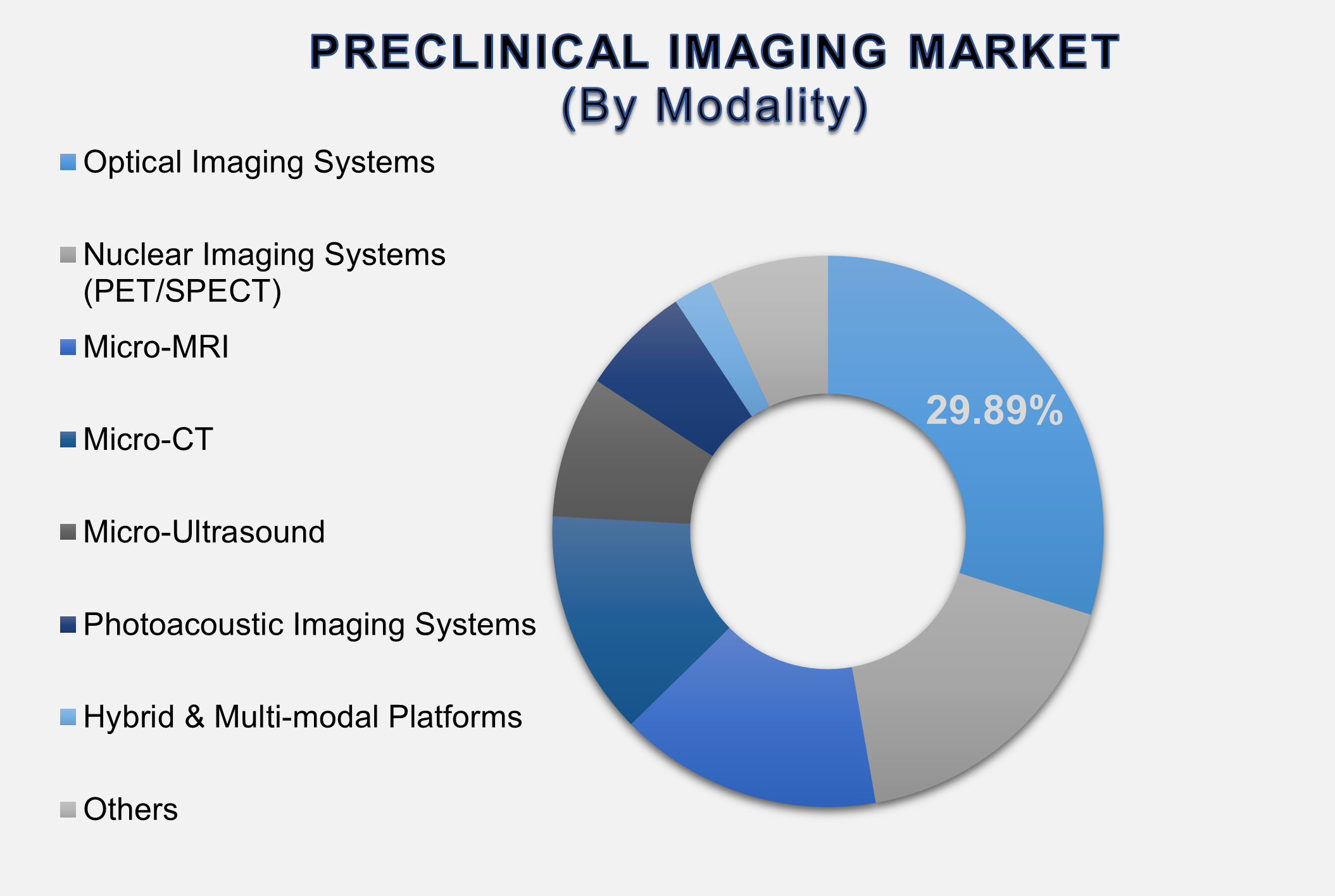
Due to their
non-invasive nature, high sensitivity, real-time imaging capabilities, and
cost-efficiency, it is expected that optical imaging systems' market shares
will be the highest among the preclinical imaging market during the forecast
period. Optical devices like bioluminescence imaging and fluorescence imaging
are widely used in oncology, immunology, infectious diseases, and stem cell
research to observe biological processes. Being able to measure disease
development, response to therapy, and gene activities on a fast basis, this
technology has become important in early drug discovery and other related
fields. The trend towards multimodal imaging contributes significantly to
optical systems since it allows the merging of them with MRI, microtomography,
and PET/SPECT technologies. Thus, Bruker at PIC 2026 introduced the new
initiative “Excellence in Every Modality," which presupposes one-stop
approaches in the imaging of the particular test subject applying MRI and other
technologies so that the obtained results are more qualitative and numerous.
Oncology Segment
Is Expected to Lead the Preclinical Imaging Market by Application
Given the growing
globalization of cancer drug discovery and the development of pipelines on
targeted therapies, immunotherapy drugs, radiopharmaceuticals, and cell &
gene therapy, it is anticipated that the oncology segment will account for the
largest share of preclinical imaging in terms of application. With preclinical
imaging enabling longitudinal and non-invasive tracking of tumor growth,
metastasis, and treatment response in animal models, drug efficacy,
biodistribution, and biomarker expression can be accurately assessed. The rise
in the usage of multimodal imaging and PDX models, as well as AI-based analysis
of preclinical data, is also of high support.
Pharmaceutical
& Biotechnology Companies Segment Is Expected to Dominate the End User
Segment
The preclinical imaging market is expected to be controlled by the segment of pharmaceutical & biotechnology companies, given the increase in investment in areas like drug discovery, biologics, precision medicine, and translational research. Preclinical imaging is used by these companies to check the safety, effectiveness, pharmacokinetics, and biodistribution of their drug candidates in animal models selected for these types of studies.
The following
segments are part of an in-depth analysis of the global preclinical imaging
market:
|
Market Segments |
|
|
By
Modality |
●
Optical
Imaging Systems ●
Nuclear
Imaging Systems (PET/SPECT) ●
Micro-MRI ●
Micro-CT ●
Micro-Ultrasound ●
Photoacoustic
Imaging Systems ●
Hybrid &
Multi-modal Platforms ●
Others |
|
By
Application |
●
Oncology ●
Neurology ●
Cardiovascular
Disorders ●
Immunology
& Infectious Diseases ●
Metabolic
Disorders ●
Others |
|
By End
User |
●
Pharmaceutical
& Biotechnology Companies ●
Academic
& Research Institutions ●
Contract
Research Organizations ●
Government
& Non-profit Labs |
Preclinical Imaging Market Share
Analysis by Region
North America is
projected to hold the largest share of the global preclinical imaging market
over the forecast period
North America will
command the largest share of the global market for preclinical imaging due to
heavy investments made in the R&D segment, a developed life science sector,
and the presence of major preclinical imaging vendors in this region. Moreover,
the availability of significant funds for translational research and the quick
adoption of advanced imaging modalities are additional advantages for this
region. As such innovations continue, FUJIFILM VisualSonics Inc. introduced the
Vevo F2 LAZR-X20 Photoacoustic Imaging Platform in June 2025, which uses
intelligent high-power lasers to offer detailed characterization and high
anatomical accuracy.
Preclinical
Imaging Market Competition Landscape Analysis
The preclinical
imaging market consists of companies involved in the development of modern
imaging systems, software, imaging reagents, and affiliated services for
pharmaceutical and biotechnology companies as well as research and academic
facilities. By utilizing multimodal high-resolution imaging technologies and
applying artificial intelligence in their products, companies are able to boost
their competitive capabilities. Incorporating innovation in the field of
optical imaging and expanding the number of strategic alliances, product
launches, and distribution networks also augment the preclinical imaging
market.
Global
Preclinical Imaging Market Recent Developments News:
●
In April 2026
- Bruker At PIC 2026, Bruker showcased its "Excellence in Every
Modality" initiative, demonstrating an integrated workflow combining MRI,
SPECT/CT, and Optical Imaging with PMOD software for unified quantitative
analysis and enhanced multimodal preclinical imaging research.
●
In April 2026
- Bruker continued to expand its multimodal preclinical imaging ecosystem by
promoting seamless integration of MRI, PET/SPECT, CT, optical imaging, and PMOD
quantitative analysis workflows for longitudinal animal studies at
international scientific meetings.
●
In June 2025 -
FUJIFILM VisualSonics launched the Vevo F2 LAZR-X20 Photoacoustic Imaging
Platform, an advanced multimodal ultrasound and photoacoustic imaging system
featuring intelligent laser technology for high-resolution tissue
characterization and improved anatomical accuracy in preclinical animal models.
●
In April 2025
- Revvity introduced the VivoJect Image-Guided Injection System at AACR 2025,
enabling precise image-guided injections in preclinical animal models to
improve reproducibility and efficiency in oncology and translational research
workflows.
The global
preclinical imaging market is dominated by a few large companies, such as
●
Advanced Molecular Vision, Inc.
●
Aspect Imaging Ltd
●
AXT Pty Ltd
●
Bruker Corporation
●
Cubresa Inc.
●
FUJIFILM Holdings Corporation
●
IVIM Technology Corp.
●
Mediso Ltd
●
MILabs B.V.
●
Miltenyi Biotec B.V. & Co. KG
●
MR Solutions Ltd
●
PerkinElmer Inc.
●
Photon etc.
●
Rigaku Corporation
●
Scanco Medical AG
●
Siemens Healthineers AG
●
Thermo Fisher Scientific Inc.
●
Trifoil Imaging
●
United Imaging Healthcare Co. Ltd
●
VisualSonics Inc. (FUJIFILM Sonosite)
● Other Prominent Players
Frequently Asked Questions
Swetal (Research Analyst)
Swetal is a Research Analyst with 4+ years of experience specializing in healthcare market research, medical devices, healthcare IT, and medical technology industry analysis. Her expertise includes competitive intelligence, secondary research, market trend forecasting, and healthcare business insights across global healthcare ecosystems.
She contributes to advanced market research reports by analyzing regulatory frameworks, emerging healthcare technologies, competitive landscapes, and innovation trends shaping the medical industry. With a strong focus on accurate market intelligence, strategic insights, and healthcare industry trends, Swetal supports businesses in making informed, data-backed decisions in a rapidly transforming healthcare environment.
1.
Global
Preclinical Imaging Market Introduction and Market Overview
1.1. Objectives of the Study
1.2. Market Segmentation
1.2.1.Modality of the Global Preclinical
Imaging Market
1.2.2.Application of the Global Preclinical
Imaging Market
1.2.3.End User of the Global Preclinical
Imaging Market
1.2.4.Region of the Global Preclinical
Imaging Market
1.3. Competition Coverage List of
Market Participants
1.4. Market Definition: Preclinical
Imaging Market
2.
Executive Summary
2.1. Global Preclinical Imaging Market
Estimation & Forecast
2.1.1.Global Preclinical Imaging Market
Size (US$ Million) Estimates & Historical Trend Analysis (2021 - 2025)
2.1.2.Global Preclinical Imaging Overall
Market Size (US$ Million), Growth Rate (Y-o-Y), Market CAGR (%), Market Forecast
(2026 - 2034)
2.2. Snapshot of Global Preclinical
Imaging Market
2.3. Global Preclinical Imaging Market
Revenue Share (%) 2025
2.4. REGIONAL OUTLINE: Revenue CAGR,
by Region
2.5. Key Competitors & Key
Insights
3.
Market Overview (Qualitative
Analysis)
3.1. Demand Side Trends
3.2. Supply Side Trends /
Manufacturing Trends
3.3. Demand and Opportunity
Assessment, 2026 - 2034
3.4. Market Dynamics
3.4.1.Drivers
3.4.2.Limitations
3.4.3.Opportunities
3.4.4.Impact Analysis of Drivers and
Restraints
3.5. Key Developments
3.6. Regulatory Landscape
3.7. Pricing Analysis
3.8. Supply Chain Analysis
3.9. Porter’s Five Forces Analysis
3.9.1.Bargaining Power of Suppliers
3.9.2.Bargaining Power of Buyers
3.9.3.Threat of Substitutes
3.9.4.Threat of New Entrants
3.9.5.Competitive Rivalry
3.10. PEST Analysis
3.10.1. Political Factors
3.10.2. Economic Factors
3.10.3. Social Factors
3.10.4. Technology Factors
4.
Global Preclinical Imaging Market
Estimates & Forecast Trend Analysis, by Modality
4.1. Global Preclinical Imaging Market
Assessments & Key Findings, by Modality
4.2. Global Preclinical Imaging Market
Revenue (US$ Million) Estimates and Forecasts, by Modality, 2021 - 2034
4.2.1.Optical Imaging Systems
4.2.2.Nuclear Imaging Systems
(PET/SPECT)
4.2.3.Micro-MRI
4.2.4.Micro-CT
4.2.5.Micro-Ultrasound
4.2.6.Photoacoustic Imaging Systems
4.2.7.Hybrid & Multi-modal
Platforms
4.2.8.Others
5.
Global Preclinical Imaging Market
Estimates & Forecast Trend Analysis, by Application
5.1. Global Preclinical Imaging Market
Assessments & Key Findings, by Application
5.2. Global Preclinical Imaging Market
Revenue (US$ Million) Estimates and Forecasts, by Application, 2021 - 2034
5.2.1.Oncology
5.2.2.Neurology
5.2.3.Cardiovascular Disorders
5.2.4.Immunology & Infectious
Diseases
5.2.5.Metabolic Disorders
5.2.6.Others
6.
Global Preclinical Imaging Market
Estimates & Forecast Trend Analysis, by End User
6.1. Global Preclinical Imaging Market
Assessments & Key Findings, by End User
6.2. Global Preclinical Imaging Market
Revenue (US$ Million) Estimates and Forecasts, by End User, 2021 - 2034
6.2.1.Pharmaceutical &
Biotechnology Companies
6.2.2.Academic & Research
Institutions
6.2.3.Contract Research Organizations
6.2.4.Government & Non-profit Labs
7.
Global Preclinical Imaging Market
Estimates & Forecast Trend Analysis, by Region
7.1. Global Preclinical Imaging Market
Assessments & Key Findings, by Region
7.2. Global Preclinical Imaging Market
Revenue (US$ Million) Estimates and Forecasts, by Region, 2021 - 2034
7.2.1.North America
7.2.2.Europe
7.2.3.Asia Pacific
7.2.4.Middle East & Africa
7.2.5.Latin America
8.
North
America Preclinical Imaging Market: Estimates & Forecast Trend Analysis
8.1.
North
America Preclinical Imaging Market Assessments & Key Findings
8.1.1.North America Preclinical
Imaging Market Introduction
8.1.2.North America Preclinical
Imaging Market Size Estimates and Forecast (US$ Million) (2021 - 2034)
8.1.2.2. By Application
8.1.2.3. By End
User
8.1.2.4. By Country
8.1.2.4.1. The U.S.
8.1.2.4.2. Canada
9.
Europe
Preclinical Imaging Market: Estimates & Forecast Trend Analysis
9.1. Europe Preclinical Imaging Market
Assessments & Key Findings
9.1.1.Europe Preclinical Imaging Market
Introduction
9.1.2.Europe Preclinical Imaging Market
Size Estimates and Forecast (US$ Million) (2021 - 2034)
9.1.2.1. By Modality
9.1.2.2. By Application
9.1.2.3. By End User
9.1.2.4. By Country
9.1.2.4.1.
Germany
9.1.2.4.2.
Italy
9.1.2.4.3.
U.K.
9.1.2.4.4.
France
9.1.2.4.5.
Spain
9.1.2.4.6.
Switzerland
9.1.2.4.7. Rest
of Europe
10. Asia Pacific Preclinical
Imaging Market: Estimates &
Forecast Trend Analysis
10.1. Asia Pacific Market Assessments
& Key Findings
10.1.1. Asia Pacific Preclinical Imaging
Market Introduction
10.1.2. Asia Pacific Preclinical Imaging
Market Size Estimates and Forecast (US$ Million) (2021 - 2034)
10.1.2.1. By Modality
10.1.2.2. By Application
10.1.2.3. By End User
10.1.2.4. By Country
10.1.2.4.1. China
10.1.2.4.2. Japan
10.1.2.4.3. India
10.1.2.4.4. Australia
10.1.2.4.5. South Korea
10.1.2.4.6. Rest of Asia Pacific
11. Middle East & Africa Preclinical
Imaging Market: Estimates &
Forecast Trend Analysis
11.1. Middle East & Africa Market
Assessments & Key Findings
11.1.1. Middle
East & Africa Preclinical
Imaging Market Introduction
11.1.2. Middle
East & Africa Preclinical
Imaging Market Size Estimates and Forecast (US$ Million) (2021 - 2034)
11.1.2.1. By Modality
11.1.2.2. By Application
11.1.2.3. By End User
11.1.2.4. By Country
11.1.2.4.1. South Africa
11.1.2.4.2. UAE
11.1.2.4.3. Saudi Arabia
11.1.2.4.4. Rest of MEA
12. Latin America
Preclinical Imaging Market: Estimates
& Forecast Trend Analysis
12.1. Latin America Market Assessments
& Key Findings
12.1.1. Latin America Preclinical
Imaging Market Introduction
12.1.2. Latin America Preclinical
Imaging Market Size Estimates and Forecast (US$ Million) (2021 - 2034)
12.1.2.1. By Modality
12.1.2.2. By Application
12.1.2.3. By End User
12.1.2.4. By Country
12.1.2.4.1. Brazil
12.1.2.4.2. Mexico
12.1.2.4.3. Argentina
12.1.2.4.4. Rest of LATAM
13. Competition Landscape
13.1. Global Preclinical Imaging Market
Product Mapping
13.2. Global Preclinical Imaging Market
Concentration Analysis, by Leading Players / Innovators / Emerging Players /
New Entrants
13.3. Global Preclinical Imaging Market
Tier Structure Analysis
13.4. Global Preclinical Imaging Market
Concentration & Company Market Shares (%) Analysis, 2025
14. Company Profiles
14.1. Advanced Molecular Vision, Inc.
14.1.1. Company Overview & Key Stats
14.1.2. Financial Performance & KPIs
14.1.3. Product Portfolio
14.1.4. SWOT Analysis
14.1.5. Business Strategy & Recent
Developments
* Similar details would be provided
for all the players mentioned below
14.2. Aspect Imaging Ltd
14.3. AXT Pty Ltd
14.4. Bruker Corporation
14.5. Cubresa Inc.
14.6. FUJIFILM Holdings Corporation
14.7. IVIM Technology Corp.
14.8. Mediso Ltd
14.9. MILabs B.V.
14.10. Miltenyi Biotec B.V. & Co.
KG
14.11. MR Solutions Ltd
14.12. PerkinElmer Inc.
14.13. Photon etc.
14.14. Rigaku Corporation
14.15. Scanco Medical AG
14.16. Siemens Healthineers AG
14.17. Thermo Fisher Scientific Inc.
14.18. Trifoil Imaging
14.19. United Imaging Healthcare Co.
Ltd
14.20. VisualSonics Inc. (FUJIFILM
Sonosite)
14.21. Other Prominent Players
15. Research
Findings & Conclusion
16. Assumptions & Acronyms Used
17. Research
Methodology
17.1. External Transportation /
Databases
17.2. Internal Proprietary Database
17.3. Primary Research
17.4. Secondary Research
17.5. Assumptions
17.6. Limitations
17.7. Report FAQs
Our Research Methodology
"Insight without rigor is just noise."
We follow a comprehensive, multi-phase research framework designed to deliver accurate, strategic, and decision-ready intelligence. Our process integrates primary and secondary research , both quantitative and qualitative , along with dual modeling techniques ( top-down and bottom-up) and a final layer of validation through our proprietary in-house repository.
PRIMARY RESEARCH
Primary research captures real-time, firsthand insights from the market to understand behaviors, motivations, and emerging trends.
1. Quantitative Primary Research
Objective: Generate statistically significant data directly from market participants.
Approaches:- Structured surveys with customers, distributors, and field agents
- Mobile-based data collection for point-of-sale audits and usage behavior
- Phone-based interviews (CATI) for market sizing and product feedback
- Online polling around industry events and digital campaigns
- Purchase frequency by customer type
- Channel performance across geographies
- Feature demand by application or demographic
2. Qualitative Primary Research
Objective: Explore decision-making drivers, pain points, and market readiness.
Approaches:- In-depth interviews (IDIs) with executives, product managers, and key decision-makers
- Focus groups among end users and early adopters
- Site visits and observational research for consumer products
- Informal field-level discussions for regional and cultural nuances
SECONDARY RESEARCH
This phase helps establish a macro-to-micro understanding of market trends, size, regulation, and competitive dynamics, sourced from credible and public domain information.
1. Quantitative Secondary Research
Objective: Model market value and segment-level forecasts based on published data.
Sources include:- Financial reports and investor summaries
- Government trade data, customs records, and regulatory statistics
- Industry association publications and economic databases
- Channel performance and pricing data from marketplace listings
- Revenue splits, pricing trends, and CAGR estimates
- Supply-side capacity and volume tracking
- Investment analysis and funding benchmarks
2. Qualitative Secondary Research
Objective: Capture strategic direction, innovation signals, and behavioral trends.
Sources include:- Company announcements, roadmaps, and product pipelines
- Publicly available whitepapers, conference abstracts, and academic research
- Regulatory body publications and policy briefs
- Social and media sentiment scanning for early-stage shifts
- Strategic shifts in market positioning
- Unmet needs and white spaces
- Regulatory triggers and compliance impact
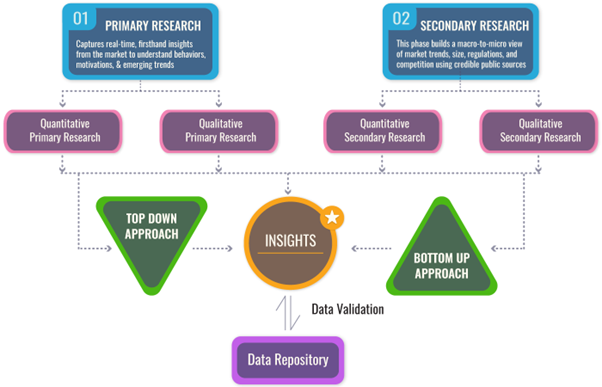
DUAL MODELING: TOP-DOWN + BOTTOM-UP
To ensure robust market estimation, we apply two complementary sizing approaches:
Top-Down Modeling:- Start with broader industry value (e.g., global or regional TAM)
- Apply filters by segment, geography, end-user, or use case
- Adjust with primary insights and validation benchmarks
- Ideal for investor-grade market scans and opportunity mapping
- Aggregate from the ground up using sales volumes, pricing, and unit economics
- Use internal modeling templates aligned with stakeholder data
- Incorporate distributor-level or region-specific inputs
- Most accurate for emerging segments and granular sub-markets
DATA VALIDATION: IN-HOUSE REPOSITORY
We close the loop with proprietary data intelligence built from ongoing projects, industry monitoring, and historical benchmarking. This repository includes:
- Multi-sector market and pricing models
- Key trendlines from past interviews and forecasts
- Benchmarked adoption rates, churn patterns, and ROI indicators
- Industry-specific deviation flags and cross-check logic
- Catches inconsistencies early
- Aligns projections across studies
- Enables consistent, high-trust deliverables