

Rabies Vaccine Market Size and Forecast (2020 - 2033), Global and Regional Growth, Trend, Share and Industry Analysis Report Coverage: Product Type (Chick Embryo Cells Rabies Vaccine, Vero Cell Rabies Vaccine, Human Diploid Cell Vaccine, Human Rabies Immune Globulin (HRIG), and Others), Prophylaxis Type (Pre-exposure prophylaxis and Post-exposure prophylaxis), Application (Human and Animal), End User (Hospitals, Veterinary clinics, and Others), and Geography
2026-02-05
Life Sciences
Swetal (Research Analyst)
Description
Rabies
Vaccine Market Overview
The global Rabies
Vaccine Market is experiencing strong growth, driven by a surge in animal bite
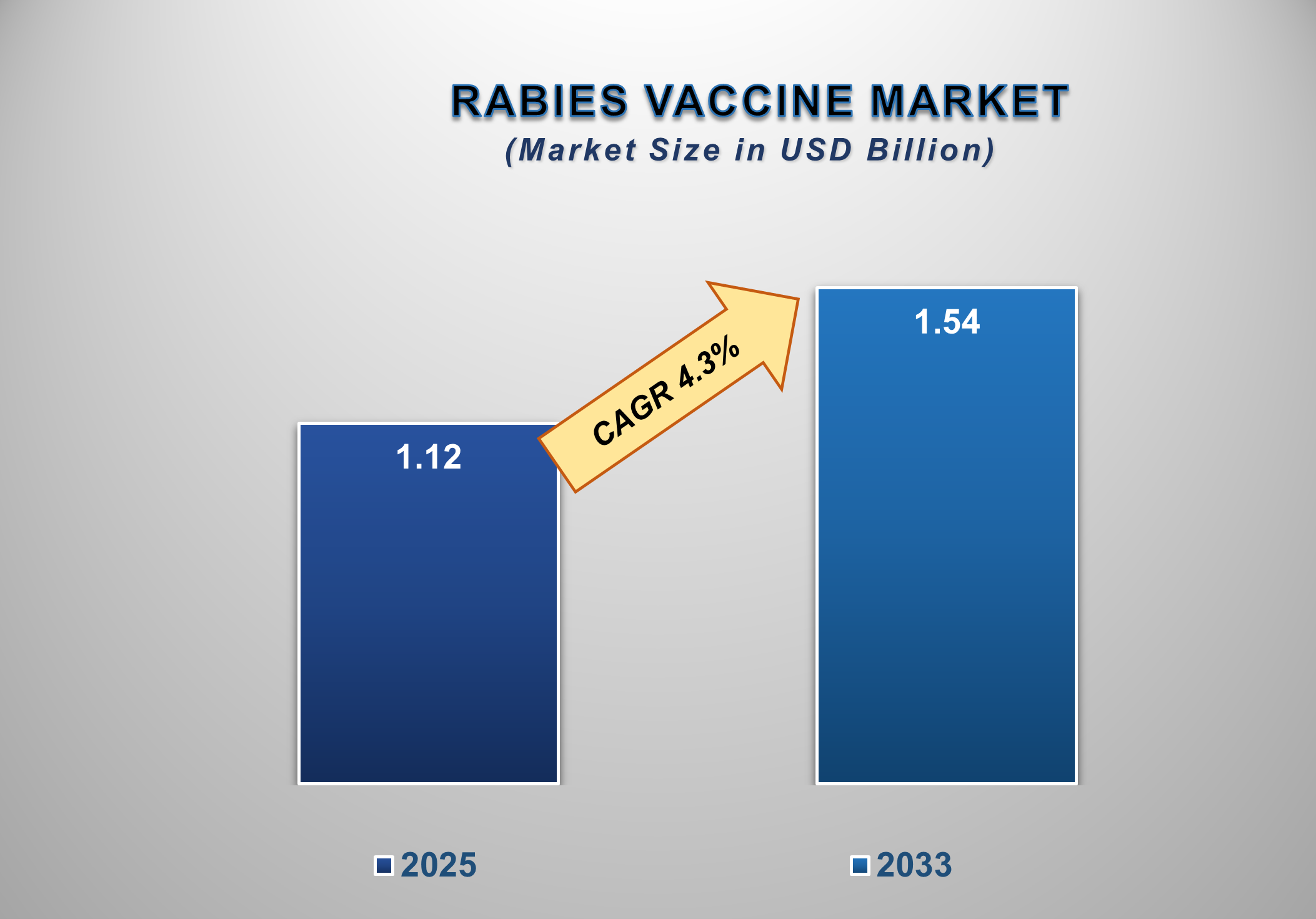
incidents. Valued at USD 1.12 billion in 2025, the market is projected
to reach USD 1.54 billion by 2033, growing at a CAGR of 4.3% during the
forecast period.
The rabies vaccine market is a specialized but
crucial section of the global vaccines and biologics market and is driven by
the deadly nature of rabies and its ongoing presence in many regions of the
world. The key components of prevention and treatment for rabies are
vaccination and post-exposure prophylaxis (PEP), as the disease is nearly
always lethal once symptoms develop. Consequently, the demand for rabies
vaccinations is stable and comparatively non-cyclical.
Rabies immune globulin (HRIG), animal rabies
vaccinations, and human rabies vaccines are all widely available. The majority
of benefit comes from human vaccines, especially those used for PEP after
animal bites. Cell-culture vaccines are the most popular type of vaccine
technology. Because of its superior safety profile, scalability, and WHO
recommendation, Vero cell rabies vaccines are the most commonly used worldwide.
For instance, Vero cell-based vaccines are supplied throughout Asia, Africa,
and Latin America by companies like Sanofi, Bharat Biotech, and Serum Institute
of India. Human diploid cell vaccines (HDCV), which are more prevalent in North
America and Europe despite being more expensive, and chick embryo cell
vaccinations are also utilized.
Human Rabies Immune Globulin (HRIG) accounts
for a larger portion of revenue than volume due to its high cost per dosage.
Particularly in developed markets like the US, HRIG is given in addition to
vaccinations in cases of severe (Category III) exposures. In certain nations,
alternatives to HRIG in the form of monoclonal antibodies have recently
surfaced.
Asia-Pacific dominates the market geographically and accounts for most of the
world's demand due to the high frequency of rabies in nations like China and
India. While North America and Europe are developed markets driven by travel
vaccination, occupational exposure, and pet vaccination regulations, Africa and
Latin America represent expanding markets supported by public health
initiatives.
As a result, the market for rabies vaccines is
distinguished by consistent growth in the mid-single digits, significant
government and non-governmental organization involvement, and a growing
emphasis on affordable delivery options such as intradermal dosage. Its impact
on public health and steady demand profile make it strategically significant
even though it is not a high-growth sector.
Rabies
Vaccine Market Drivers and Opportunities
Persistent Global Rabies
Burden
The majority of human cases of rabies are
caused by dog-mediated transmission, and the disease is still endemic in many
regions of Asia and Africa. Millions of animal bites occur each year in
countries like China, India, and several African countries, creating a constant
need for post-exposure prophylaxis (PEP). Vaccination is not optional but
necessary because rabies is nearly always lethal once symptoms appear. Compared
to other preventive vaccines, demand for rabies vaccines is comparatively
inelastic due to this medical necessity. For instance, state hospitals and
private clinics in India alone deliver tens of millions of rabies vaccine doses
annually, supporting large-scale procurement contracts for domestic producers.
Strong Government and Public Health Involvement
The majority of human cases of rabies are
caused by dog-mediated transmission, and the disease is still endemic in many
regions of Asia and Africa. Millions of animal bites occur each year in
countries like China, India, and several African countries, creating a constant
need for post-exposure prophylaxis (PEP). Vaccination is not optional but
necessary because rabies is nearly always lethal once symptoms appear. Compared
to other preventive vaccines, demand for rabies vaccines is comparatively
inelastic due to this medical necessity. For instance, state hospitals and
private clinics in India alone deliver tens of millions of rabies vaccine doses
annually, supporting large-scale procurement contracts for domestic producers.
WHO Recommendations and Standardized Protocols
The shift away from earlier nerve-tissue
vaccines has been expedited by the WHO's support of contemporary cell-culture
rabies vaccines. Nowadays, vaccinations made from chick embryo cells and Vero
cells are the norm worldwide, increasing demand for replacements in developing
nations. Furthermore, WHO-approved intradermal dose schedules lower the
quantity of vaccine needed for each patient, increasing accessibility without
sacrificing effectiveness. Intradermal regimens decrease dose volume, but they
increase treatment coverage and patient reach, which ultimately promotes market
sustainability rather than diminishing value.
Growing Awareness and Reporting of Animal Bites
Animal bite reports have grown due to improved
disease surveillance, urbanization, and public awareness. Nowadays, more
people, particularly in metropolitan and peri-urban areas, seek medical
attention following exposure. Vaccine uptake is directly increased by this
change in behavior. For example, public education initiatives in Southeast Asia
have greatly raised the proportion of bite victims who finish their PEP
regimens, which is advantageous for vaccine providers.
Mandatory Pet Vaccination and Veterinary Demand
Strict laws requiring pets to be vaccinated
against rabies support a steady market for veterinary rabies vaccines in
developed economies. Recurring demand, especially in North America and Europe,
is guaranteed by annual or triennial booster requirements. Premium pricing and
predictable renewal cycles are advantageous to animal health-focused companies.
Rabies Vaccine Market Scope
|
Report Attributes |
Description |
|
Market Size in
2025 |
USD 1.12
Billion |
|
Market Forecast
in 2033 |
USD 1.54
Billion |
|
CAGR % 2025-2033 |
4.3% |
|
Base Year |
2024 |
|
Historic Data |
2020-2024 |
|
Forecast Period |
2025-2033 |
|
Report USP |
Comprehensive
global Rabies Vaccine Market size and forecast analysis, product type and
application assessment, end-user consumption trends, regional and
country-level market insights, competitive landscape and market share
analysis, technological advancements, growth drivers, challenges,
opportunities, and strategic insights for rabies vaccines manufacturers,
retailers, and investors. |
|
Segments Covered |
●
By
Product Type ●
By
Prophylaxis Type ●
By
Application ●
By End
User |
|
Regional Scope |
●
North
America ●
Europe ●
APAC ●
Latin
America ●
Middle
East and Africa |
|
Country Scope |
1)
U.S. 2)
Canada
3)
U.K. 4)
Germany
5)
France
6)
Italy 7)
Spain 8)
Switzerland
9)
China
10)
India
11)
Japan 12)
South
Korea 13)
Australia 14)
Mexico
15)
Brazil
16)
Argentina
17)
Saudi
Arabia 18)
UAE 19)
South
Africa |
Rabies Vaccine
Market Report Segmentation Analysis
The global Rabies
Vaccine Market analysis is segmented by Product Type, Prophylaxis Type,
Application, End User, and Region.
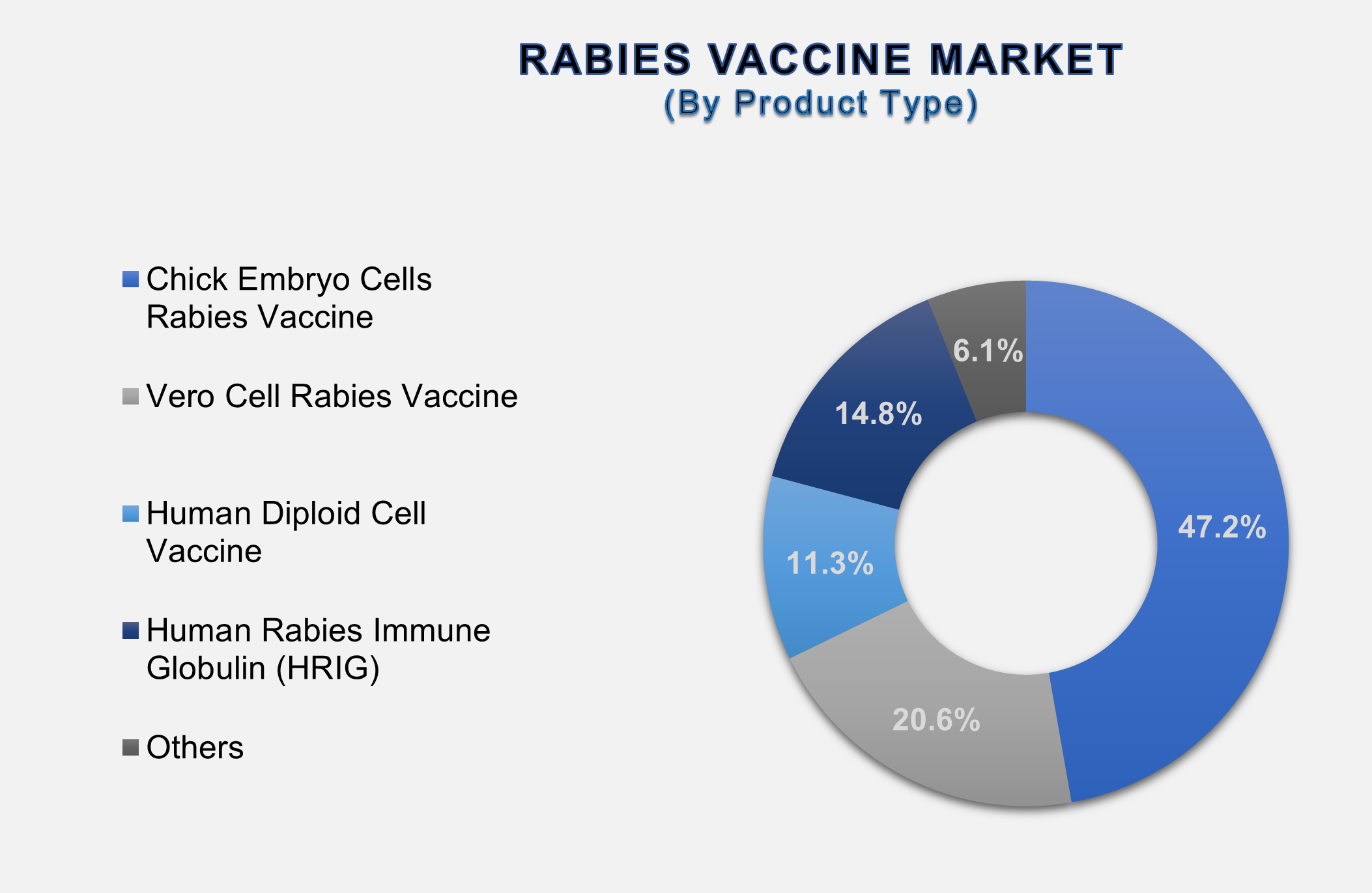
The chick embryo
cells rabies vaccine segment dominated the market in 2025 and is projected to
grow at the highest CAGR during the forecast period.
By Product Type,
the Rabies Vaccine Market is segmented into chick embryo cell rabies vaccine,
Vero cell rabies vaccine, human diploid cell vaccine, human rabies immune
globulin (HRIG), and others. The chick embryo cells rabies vaccine segment
accounts for the largest share of the global Rabies Vaccine Market. Proven
clinical efficacy, lower production costs than human diploid cell vaccines,
established regulatory acceptance, and widespread use in public immunization
programs—particularly in emerging markets where affordability, scalability, and
dependable supply are crucial—are major factors driving the development of
chick embryo cell rabies vaccines.
Post-exposure prophylaxis holds the highest share
of the Prophylaxis Type Segment over the forecast period
Based on prophylaxis type, the market is bifurcated into pre-exposure
prophylaxis and post-exposure prophylaxis. The post-exposure prophylaxis
segment accounts for the largest share of the market. A life-saving treatment
regimen known as post-exposure prophylaxis (PEP) for rabies is given right away
following possible exposure to the virus, usually through an animal bite or
scratch. In order to kill the virus before it reaches the brain system, it
entails extensive wound cleaning, the delivery of the rabies vaccination, and,
in cases of severe exposure, the use of monoclonal antibodies or rabies immune
globulin (HRIG).
The Human
Segment will probably dominate the market during the forecast period
In terms of
application, the Rabies Vaccine Market is segmented into human and animal. The
human segment holds the largest share of the Rabies Vaccine Market. Exposure to
animal bites, travel to endemic areas, and occupational risk groups, including
veterinarians and laboratory workers, are the main factors driving the human
end-user segment of the rabies vaccine market. The majority of demand is based
on post-exposure prophylaxis, which is supported globally by public health
initiatives and government-funded healthcare systems.
Hospitals hold the highest share of the end-user
segment over the forecast period
Based on the end
user, the market is bifurcated into hospitals, veterinary clinics, and others.
The hospital segment accounts for the largest share of the market. Hospitals
are the initial point of care for post-exposure prophylaxis (PEP) after animal
attacks, making them the main end-user category in the rabies vaccine market.
In accordance with established treatment protocols, they deliver rabies
vaccinations, rabies immune globulin, and wound care. Both public and private
hospitals are essential to the prevention and treatment of rabies because they
manage large patient volumes, especially in endemic areas, and are backed by
government procurement programs, emergency services, and round-the-clock
availability.
The following
segments are part of an in-depth analysis of the global Rabies Vaccine Market:
|
Market Segments |
|
|
By
Product Type |
●
Chick
Embryo Cells Rabies Vaccine ●
Vero Cell
Rabies Vaccine ●
Human
Diploid Cell Vaccine ●
Human
Rabies Immune Globulin (HRIG) ●
Others |
|
By
Prophylaxis Type |
●
Pre-exposure
prophylaxis ●
Post-exposure
prophylaxis |
|
By
Application |
●
Animal ●
Human |
|
By End
User |
●
Hospitals ●
Veterinary
clinics ●
Others |
Rabies Vaccine Market Share Analysis by
Region
The North America
region is projected to hold the largest share of the global Rabies Vaccine
Market over the forecast period.
The
North America region is projected to hold the largest share of the global
Rabies Vaccine Market over the forecast period and is also expected to be the
fastest-growing region. The rabies vaccines market in North America is mature
but stable, driven by regulations requiring pet vaccinations, immunizations
tied to travel and employment, and stringent public health procedures for
handling animal bites. Although human rabies infections are uncommon,
post-exposure prophylaxis (PEP) is nevertheless frequently used after possible
contact with animals, including skunks, raccoons, and bats. Strong regulatory
monitoring, the presence of large producers, and expensive per-dose vaccine and
HRIG prices are characteristics of the area. The market has been growing steadily
since hospitals, travel clinics, and veterinary practices have a consistent
need.
Global
Rabies Vaccine Market Recent Developments News:
●
In April 2025,
China's National Medical Products Administration approved AIM Vaccine Co.,
Ltd.'s serum-free iterative rabies vaccine for market registration, potentially
making it the first of its kind globally and increasing product
diversification.
●
In September
2025, MSD Animal Health, through
its Afya Program, announced that it had contributed more than 7 million NOBIVAC® rabies
vaccinations globally to promote canine vaccination in underserved, endemic
areas, supporting public-private efforts toward elimination targets.
The
Global Rabies Vaccine Market is dominated by a few large companies, such as
●
Sanofi
●
Merck &
Co. (MSD)
●
GlaxoSmithKline
(GSK)
●
Bharat Biotech
●
Serum
Institute of India
●
Cadila
Pharmaceuticals (Zydus)
●
Biological E.
Limited
●
CSL Seqirus
●
Boehringer
Ingelheim
●
Zoetis
●
Elanco
●
Merck Animal
Health (Intervet)
●
IDT Biologika
●
Bharat
Immunologicals & Biologicals Corp. (BIBCOL)
●
Shenzhen
Kangtai Biological Products
●
Changchun BCHT
Biotechnology
●
Chengda Bio
(China)
●
Intravacc
●
Vaxxinova
● Indian Immunologicals Limited
Frequently Asked Questions
Swetal (Research Analyst)
Swetal is a Research Analyst with 4+ years of experience specializing in healthcare market research, medical devices, healthcare IT, and medical technology industry analysis. Her expertise includes competitive intelligence, secondary research, market trend forecasting, and healthcare business insights across global healthcare ecosystems.
She contributes to advanced market research reports by analyzing regulatory frameworks, emerging healthcare technologies, competitive landscapes, and innovation trends shaping the medical industry. With a strong focus on accurate market intelligence, strategic insights, and healthcare industry trends, Swetal supports businesses in making informed, data-backed decisions in a rapidly transforming healthcare environment.
1. Global
Rabies Vaccine Market Introduction and Market Overview
1.1.
Objectives of the Study
1.2.
Global Rabies Vaccine Market Scope and
Market Estimation
1.2.1.Global Rabies
Vaccine Overall Market Size (US$ Bn), Market CAGR (%), Market forecast (2025 - 2033)
1.2.2.Global Rabies
Vaccine Market Revenue Share (%) and Growth Rate (Y-o-Y) from 2020 - 2033
1.3.
Market Segmentation
1.3.1.Product Type
of Global Rabies Vaccine Market
1.3.2.Prophylaxis
Type of Global Rabies Vaccine Market
1.3.3.Application
of Global Rabies Vaccine Market
1.3.4.End User
of Global Rabies Vaccine Market
1.3.5.Region of
Global Rabies Vaccine Market
2. Executive Summary
2.1.
Demand Side Trends
2.2.
Key Market Trends
2.3.
Market Demand (US$ Bn) Analysis 2020 –
2024 and Forecast, 2025 – 2033
2.4.
Demand and Opportunity Assessment
2.5.
Market Dynamics
2.5.1.Drivers
2.5.2.Limitations
2.5.3.Opportunities
2.5.4.Impact
Analysis of Drivers and Restraints
2.6.
Porter’s Five Forces Analysis
2.7.
PEST Analysis
2.8.
Key Regulation
2.9.
Key Developments
2.10. Value
Chain / Ecosystem Analysis
3. Global Rabies Vaccine Market Estimates &
Historical Trend Analysis (2020 - 2024)
4.
Global
Rabies Vaccine Market Estimates & Forecast Trend Analysis, by Product Type
4.1.
Global Rabies Vaccine Market Revenue
(US$ Bn) Estimates and Forecasts, by Product Type, 2020 - 2033
4.1.1.Chick
Embryo Cells Rabies Vaccine
4.1.2.Vero Cell
Rabies Vaccine
4.1.3.Human
Diploid Cell Vaccine
4.1.4.Human
Rabies Immune Globulin (HRIG)
4.1.5.Others
5.
Global
Rabies Vaccine Market Estimates & Forecast Trend Analysis, by Prophylaxis Type
5.1.
Global Rabies Vaccine Market Revenue
(US$ Bn) Estimates and Forecasts, by Prophylaxis Type, 2020 - 2033
5.1.1.Pre-exposure
prophylaxis
5.1.2.Post-exposure
prophylaxis
6.
Global
Rabies Vaccine Market Estimates & Forecast Trend Analysis, by Application
6.1.
Global Rabies Vaccine Market Revenue
(US$ Bn) Estimates and Forecasts, by Application, 2020 - 2033
6.1.1.Animal
6.1.2.Human
7.
Global
Rabies Vaccine Market Estimates & Forecast Trend Analysis, by End User
7.1.
Global Rabies Vaccine Market Revenue
(US$ Bn) Estimates and Forecasts, by End User, 2020 - 2033
7.1.1.Hospitals
7.1.2.Veterinary
clinics
7.1.3.Others
8. Global Rabies Vaccine Market Estimates &
Forecast Trend Analysis,
by Region
8.1.
Global Rabies Vaccine Market Revenue
(US$ Bn) Estimates and Forecasts, by Region, 2020 - 2033
8.1.1.North
America
8.1.2.Europe
8.1.3.Asia
Pacific
8.1.4.Middle
East & Africa
8.1.5.Latin
America
9. North
America Rabies
Vaccine Market: Estimates &
Forecast Trend Analysis
9.1.
North America Rabies Vaccine Market
Assessments & Key Findings
9.1.1.North
America Rabies Vaccine Market Introduction
9.1.2.North
America Rabies Vaccine Market Size Estimates and Forecast (US$ Billion) (2020 -
2033)
9.1.2.1. By Product Type
9.1.2.2. By Prophylaxis Type
9.1.2.3. By Application
9.1.2.4. By End User
9.1.2.5.
By Country
9.1.2.5.1.
The U.S.
9.1.2.5.2.
Canada
10. Europe
Rabies
Vaccine Market: Estimates &
Forecast Trend Analysis
10.1. Europe
Rabies Vaccine Market Assessments & Key Findings
10.1.1.
Europe Rabies Vaccine Market
Introduction
10.1.2.
Europe Rabies Vaccine Market Size
Estimates and Forecast (US$ Billion) (2020 - 2033)
10.1.2.1. By Product Type
10.1.2.2. By Prophylaxis Type
10.1.2.3. By Application
10.1.2.4. By End User
10.1.2.5. By
Country
10.1.2.5.1. Germany
10.1.2.5.2. Italy
10.1.2.5.3. U.K.
10.1.2.5.4. France
10.1.2.5.5. Spain
10.1.2.5.6. Russia
10.1.2.5.7. Rest of Europe
11. Asia
Pacific Rabies
Vaccine Market: Estimates &
Forecast Trend Analysis
11.1. Asia
Pacific Rabies Vaccine Market Assessments & Key Findings
11.1.1.
Asia Pacific Rabies Vaccine Market
Introduction
11.1.2.
Asia Pacific Rabies Vaccine Market
Size Estimates and Forecast (US$ Billion) (2020 - 2033)
11.1.2.1. By Product Type
11.1.2.2. By Prophylaxis Type
11.1.2.3. By Application
11.1.2.4. By End User
11.1.2.5.
By Country
11.1.2.5.1.
China
11.1.2.5.2.
Japan
11.1.2.5.3.
India
11.1.2.5.4.
Australia
11.1.2.5.5.
South Korea
11.1.2.5.6. Rest
of Asia Pacific
12. Middle
East & Africa Rabies
Vaccine Market: Estimates &
Forecast Trend Analysis
12.1. Middle
East & Africa Rabies Vaccine Market Assessments & Key Findings
12.1.1.
Middle East
& Africa Rabies Vaccine Market Introduction
12.1.2.
Middle East
& Africa Rabies Vaccine Market Size Estimates and Forecast
(US$ Billion) (2020 - 2033)
12.1.2.1. By Product Type
12.1.2.2. By Prophylaxis Type
12.1.2.3. By Application
12.1.2.4. By End User
12.1.2.5.
By Country
12.1.2.5.1.
UAE
12.1.2.5.2.
Saudi Arabia
12.1.2.5.3.
South Africa
12.1.2.5.4. Rest of MEA
13. Latin
America Rabies
Vaccine Market: Estimates &
Forecast Trend Analysis
13.1. Latin
America Event Industry Assessments & Key Findings
13.1.1.
Latin America Rabies Vaccine Market
Introduction
13.1.2.
Latin America Rabies Vaccine Market
Size Estimates and Forecast (US$ Billion) (2020 - 2033)
13.1.2.1. By Product Type
13.1.2.2. By Prophylaxis Type
13.1.2.3. By Application
13.1.2.4. By End User
13.1.2.5.
By Country
13.1.2.5.1.
Brazil
13.1.2.5.2.
Mexico
13.1.2.5.3.
Argentina
13.1.2.5.4. Rest of LATAM
14. Country
Wise Market: Introduction
15.
Competition Landscape
15.1. Global
Rabies Vaccine Market Product Mapping
15.2. Global
Rabies Vaccine Market Concentration Analysis, by Leading Players / Innovators /
Emerging Players / New Entrants
15.3. Global
Rabies Vaccine Market Tier Structure Analysis
15.4. Global
Rabies Vaccine Market Concentration & Company Market Shares (%) Analysis,
2024
16.
Company Profiles
16.1.
Sanofi
16.1.1.
Company Overview & Key Stats
16.1.2.
Financial Performance & KPIs
16.1.3.
Product Portfolio
16.1.4.
SWOT Analysis
16.1.5.
Business Strategy & Recent
Developments
*
Similar details would be provided for all the players mentioned below
16.2.
Merck & Co. (MSD)
16.3.
GlaxoSmithKline (GSK)
16.4.
Bharat Biotech
16.5.
Serum Institute of India
16.6.
Cadila Pharmaceuticals (Zydus)
16.7.
Biological E. Limited
16.8.
CSL Seqirus
16.9.
Boehringer Ingelheim
16.10.
Zoetis
16.11.
Elanco
16.12.
Merck Animal Health (Intervet)
16.13.
IDT Biologika
16.14.
Bharat Immunologicals &
Biologicals Corp. (BIBCOL)
16.15.
Shenzhen Kangtai Biological Products
16.16.
Changchun BCHT Biotechnology
16.17.
Chengda Bio (China)
16.18.
Intravacc
16.19.
Vaxxinova
16.20.
Other Prominent
Players
17. Research Methodology
17.1. External
Transportations / Databases
17.2. Internal
Proprietary Database
17.3. Primary
Research
17.4. Secondary
Research
17.5. Assumptions
17.6. Limitations
17.7. Report
FAQs
18. Research Findings & Conclusion
Our Research Methodology
"Insight without rigor is just noise."
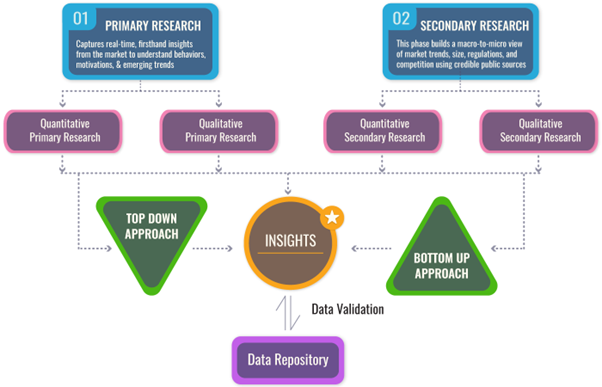
We follow a comprehensive, multi-phase research framework designed to deliver accurate, strategic, and decision-ready intelligence. Our process integrates primary and secondary research , both quantitative and qualitative , along with dual modeling techniques ( top-down and bottom-up) and a final layer of validation through our proprietary in-house repository.
PRIMARY RESEARCH
Primary research captures real-time, firsthand insights from the market to understand behaviors, motivations, and emerging trends.
1. Quantitative Primary Research
Objective: Generate statistically significant data directly from market participants.
Approaches:- Structured surveys with customers, distributors, and field agents
- Mobile-based data collection for point-of-sale audits and usage behavior
- Phone-based interviews (CATI) for market sizing and product feedback
- Online polling around industry events and digital campaigns
- Purchase frequency by customer type
- Channel performance across geographies
- Feature demand by application or demographic
2. Qualitative Primary Research
Objective: Explore decision-making drivers, pain points, and market readiness.
Approaches:- In-depth interviews (IDIs) with executives, product managers, and key decision-makers
- Focus groups among end users and early adopters
- Site visits and observational research for consumer products
- Informal field-level discussions for regional and cultural nuances
SECONDARY RESEARCH
This phase helps establish a macro-to-micro understanding of market trends, size, regulation, and competitive dynamics, sourced from credible and public domain information.
1. Quantitative Secondary Research
Objective: Model market value and segment-level forecasts based on published data.
Sources include:- Financial reports and investor summaries
- Government trade data, customs records, and regulatory statistics
- Industry association publications and economic databases
- Channel performance and pricing data from marketplace listings
- Revenue splits, pricing trends, and CAGR estimates
- Supply-side capacity and volume tracking
- Investment analysis and funding benchmarks
2. Qualitative Secondary Research
Objective: Capture strategic direction, innovation signals, and behavioral trends.
Sources include:- Company announcements, roadmaps, and product pipelines
- Publicly available whitepapers, conference abstracts, and academic research
- Regulatory body publications and policy briefs
- Social and media sentiment scanning for early-stage shifts
- Strategic shifts in market positioning
- Unmet needs and white spaces
- Regulatory triggers and compliance impact
DUAL MODELING: TOP-DOWN + BOTTOM-UP
To ensure robust market estimation, we apply two complementary sizing approaches:
Top-Down Modeling:- Start with broader industry value (e.g., global or regional TAM)
- Apply filters by segment, geography, end-user, or use case
- Adjust with primary insights and validation benchmarks
- Ideal for investor-grade market scans and opportunity mapping
- Aggregate from the ground up using sales volumes, pricing, and unit economics
- Use internal modeling templates aligned with stakeholder data
- Incorporate distributor-level or region-specific inputs
- Most accurate for emerging segments and granular sub-markets
DATA VALIDATION: IN-HOUSE REPOSITORY
We close the loop with proprietary data intelligence built from ongoing projects, industry monitoring, and historical benchmarking. This repository includes:
- Multi-sector market and pricing models
- Key trendlines from past interviews and forecasts
- Benchmarked adoption rates, churn patterns, and ROI indicators
- Industry-specific deviation flags and cross-check logic
- Catches inconsistencies early
- Aligns projections across studies
- Enables consistent, high-trust deliverables