

Respiratory Inhaler Devices Market Size and Forecast (2020 - 2033), Global and Regional Growth, Trend, Share and Industry Analysis Report Coverage; Product (Metered dose inhalers, Dry powder inhalers, and Soft mist inhalers), Application (Asthma, Chronic obstructive pulmonary disease, and Others), Distribution Channel (Hospitals pharmacies, Drug stores and retail pharmacies, and Online providers), and Geography
2026-02-23
Life Sciences
Swetal (Research Analyst)
Description
Respiratory
Inhaler Devices Market Overview
The global
respiratory inhaler devices market is experiencing steady growth, driven by the
rising prevalence of chronic respiratory diseases such as asthma and chronic
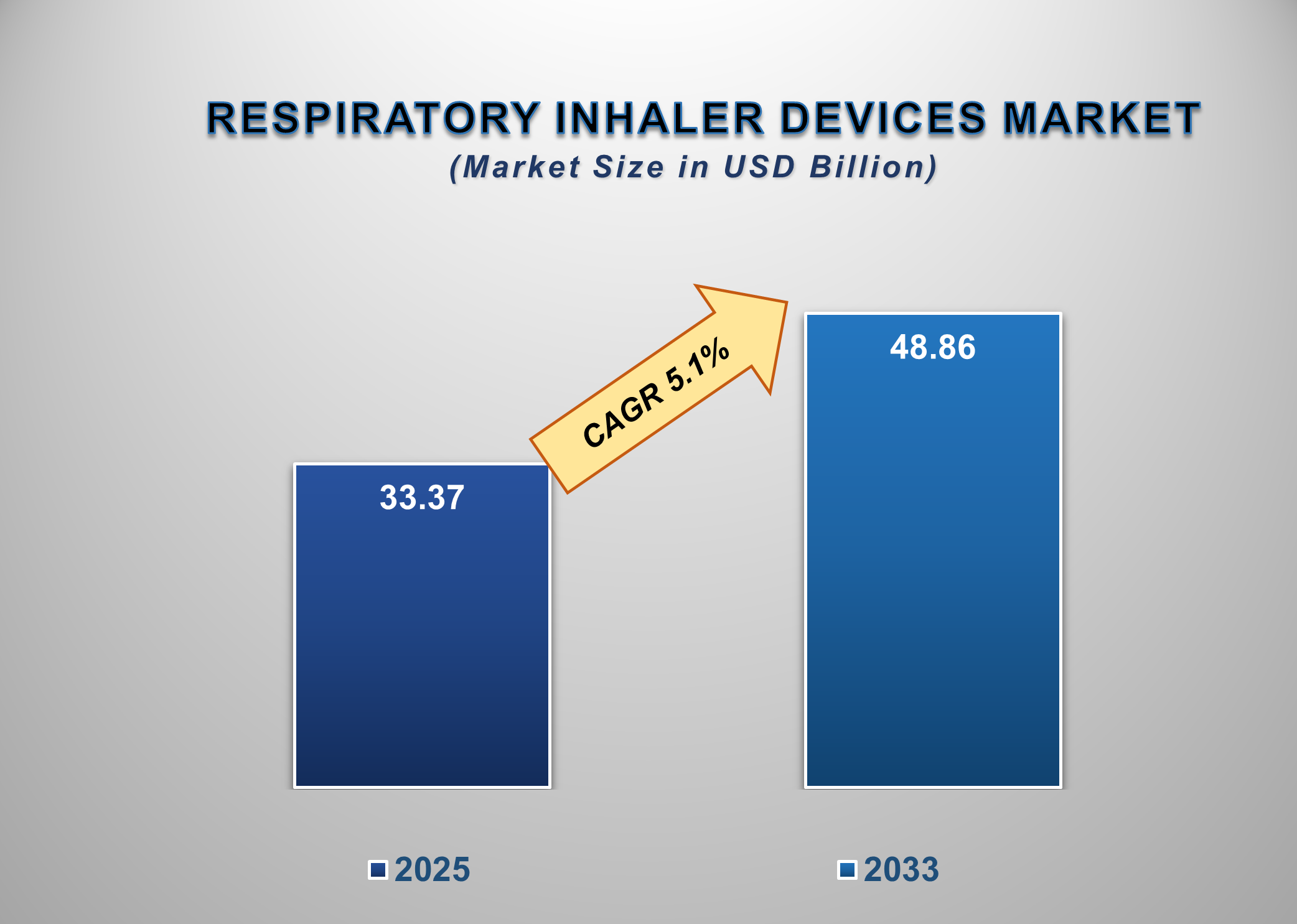
obstructive pulmonary disease (COPD). Valued at USD 33.37 billion in 2025, the
market is projected to reach USD 48.86 billion by 2033, growing at a CAGR of
5.1% during the forecast period.
The market is expanding steadily within the
broader respiratory care sector due to increasing air pollution, rising tobacco
consumption in developing countries, occupational exposure to harmful
particles, and an aging global population. According to global health
estimates, hundreds of millions of people worldwide suffer from asthma and
COPD, creating sustained demand for inhalation-based drug delivery systems.
Respiratory inhaler devices are categorized
into metered dose inhalers (MDIs), dry powder inhalers (DPIs), and soft mist
inhalers (SMIs). MDIs hold the largest market share due to their affordability,
widespread clinical use, and strong physician familiarity. DPIs are gaining
popularity because they are breath-actuated and do not require propellants,
aligning with environmental sustainability goals. SMIs, although holding a
smaller share, are growing rapidly due to improved drug delivery efficiency and
user-friendly designs.
Technological advancements, including smart
inhalers integrated with digital monitoring systems, are improving patient
adherence and treatment outcomes. Pharmaceutical companies are investing in
innovative inhalation platforms and combination therapies. Regulatory support
for eco-friendly propellants and generic inhalers is further supporting market
growth.
Geographically, North America holds a dominant
share due to advanced healthcare infrastructure and high disease awareness,
while Asia-Pacific is expected to witness the fastest growth during the
forecast period. Due to increased access to healthcare, urbanization, and
increased awareness of respiratory diseases, the Asia-Pacific region is
predicted to grow at the fastest rate. Accordingly, it is anticipated that the
market for respiratory inhaler devices will increase moderately but steadily
over the next ten years, helped along by ongoing innovation, growing patient
populations, and a growing emphasis on managing chronic diseases effectively.
Respiratory Inhaler
Devices Market Drivers and Opportunities
Rising Prevalence of Chronic Respiratory Diseases
One of the main factors
propelling the market for respiratory inhaler devices is the rising incidence
of long-term respiratory conditions like asthma and chronic obstructive
pulmonary disease (COPD). Global health estimates indicate that about 390
million individuals globally suffer from COPD, while over 260 million people
have asthma. Inhalers are crucial for efficient medication delivery since
certain illnesses require long-term, frequently lifelong care through
inhalation therapy. The occurrence of respiratory diseases has been greatly
influenced by urbanization, industrialization, and exposure to environmental
contaminants such as particulate matter and harmful gases. Demand is also increased by the fact that elderly
populations are more susceptible to respiratory conditions. The steady demand
for inhaler devices worldwide is directly supported by the expanding patient
population.
Increasing Air Pollution and Smoking Rates
The demand for inhaler devices is being driven
by the huge increase in respiratory health issues caused by rising air
pollution levels and tobacco use. Every year, millions of premature deaths are
caused by air pollution, with particulate matter (PM2.5 and PM10) playing a
role in the development of COPD, bronchitis, and asthma. Air quality has been
worse due to rapid industrialization, car emissions, and urbanization,
especially in growing nations in Latin America and the Asia-Pacific.
Furthermore, smoking continues to be a significant risk factor for COPD and
other respiratory diseases, particularly in developing nations. Respiratory
risk is further increased by occupational exposure to dust, chemicals, and
fumes in industrial settings. The long-term need for respiratory inhaler
devices is being driven by these environmental and lifestyle variables, which
are also increasing the number of patients worldwide.
Growing Adoption of Smart and Digitally Connected
Inhalers
The respiratory inhaler devices market is
poised for substantial development due to the growing popularity of smart
inhalers. Sensors and connectivity components of smart inhalers detect
consumption trends, keep an eye on patient compliance, and deliver real-time
feedback via mobile apps. With the aid of these tools, medical professionals
can better manage patients' illnesses and track how well treatments are
working. A significant problem is poor adherence to inhaler medication;
research indicates that about 50% of patients do not use inhalers correctly or
regularly. By facilitating individualized treatment programs and increasing
compliance, smart inhalers help to overcome this difficulty. Smart inhaler
demand is predicted to rise internationally as a result of the integration of
digital health technology, the expanding use of telehealth, and the increased
emphasis on remote patient monitoring.
Respiratory Inhaler Devices Market Scope
|
Report Attributes |
Description |
|
Market Size in
2025 |
USD 33.37
Billion |
|
Market Forecast
in 2033 |
USD 48.86
Billion |
|
CAGR % 2025-2033 |
5.1% |
|
Base Year |
2024 |
|
Historic Data |
2020-2024 |
|
Forecast Period |
2025-2033 |
|
Report USP |
Comprehensive
global Respiratory Inhaler Devices Market size and forecast analysis, product
product and system type assessment, distribution channel performance
evaluation, end-user consumption and deployment trends, utility-scale vs
residential & commercial segment insights, regional and country-level
market dynamics, competitive landscape and market share analysis,
technological advancements in PV, CSP and energy storage integration, digital
transformation and smart grid impact, growth drivers, challenges,
opportunities, and strategic insights for solar product manufacturers,
project developers, EPC contractors, investors, utilities, and policy makers |
|
Segments Covered |
●
By
Product ●
By
Application ●
By
Distribution Channel |
|
Regional Scope |
●
North
America ●
Europe ●
APAC ●
Latin
America ●
Middle
East and Africa |
|
Country Scope |
1)
U.S. 2)
Canada
3)
U.K. 4)
Germany
5)
France
6)
Italy 7)
Spain 8)
Switzerland
9)
China
10)
India
11)
Japan 12)
South
Korea 13)
Australia 14)
Mexico
15)
Brazil
16)
Argentina
17)
Saudi
Arabia 18)
UAE 19)
South
Africa |
Respiratory
Inhaler Devices Market Report Segmentation Analysis
The global
Respiratory Inhaler Devices Market analysis is segmented by Product,
Application, Distribution Channel, and Region.
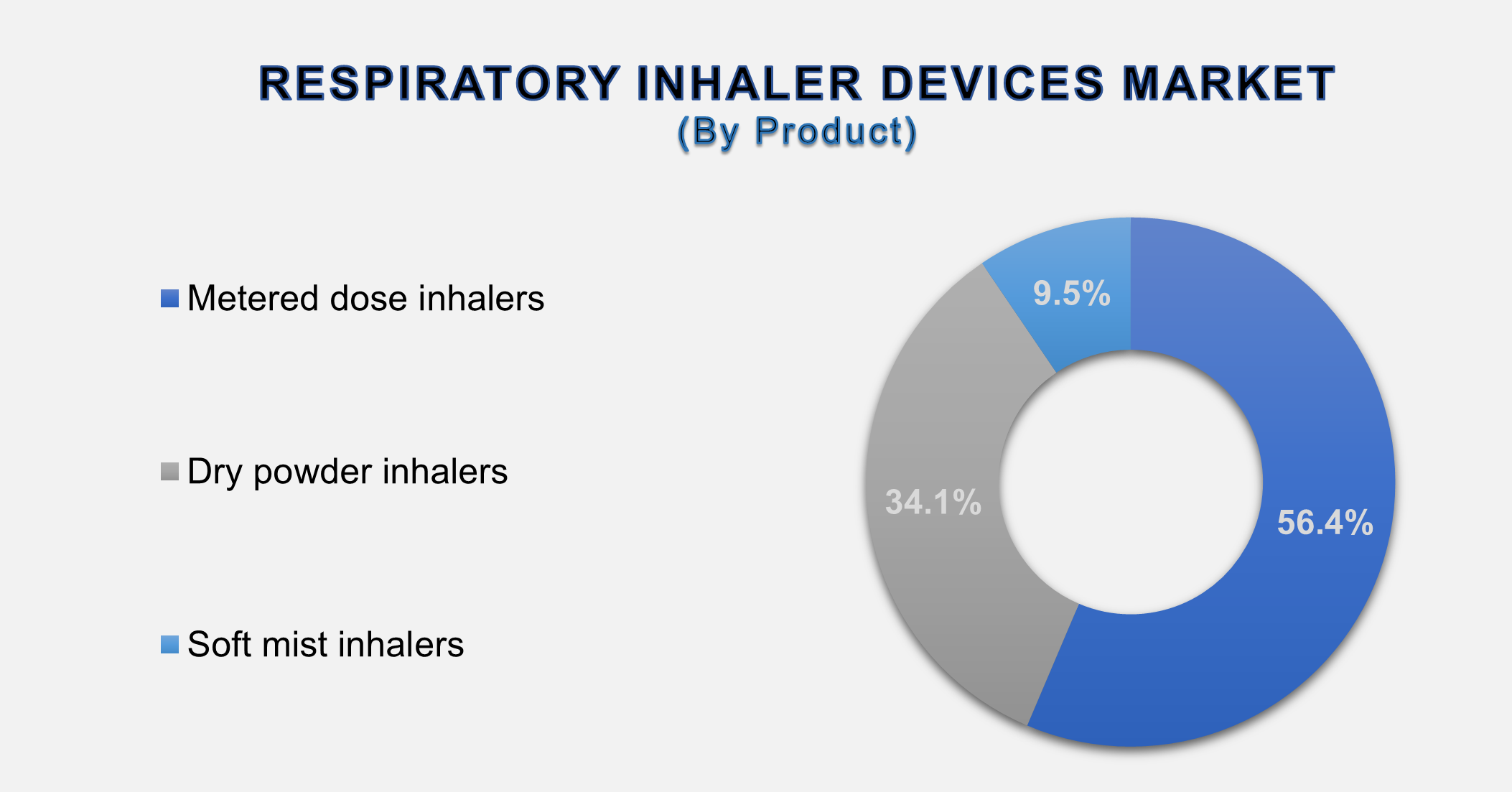
The Metered Dose
Inhalers segment dominated the market in 2025 and is projected to grow at the
highest CAGR during the forecast period.
By Product, the
Respiratory Inhaler Devices Market is segmented into metered dose inhalers, dry
powder inhalers, and soft mist inhalers. The metered dose inhalers segment
accounts for the largest share of the global respiratory inhaler devices
market. Metered Dose Inhalers (MDIs) are the most widely used respiratory
inhaler devices and hold the largest share of the global market due to their
reliability, affordability, and ease of use. These devices deliver a precise,
pre-measured dose of medication in aerosol form using a propellant, ensuring
accurate drug delivery directly to the lungs. MDIs are commonly prescribed for
both quick-relief and maintenance treatment of asthma and chronic obstructive
pulmonary disease (COPD). Their portability, rapid onset of action, and compact
size make them suitable for patients of all age groups. Continuous innovations,
including dose counters and environmentally friendly propellants, are further
supporting their market dominance.
The Asthma
Segment will probably dominate the market during the forecast period
In terms of
Application, the Respiratory Inhaler Devices Market is segmented into asthma,
chronic obstructive pulmonary disease, and others. The asthma segment holds the
largest share of the Respiratory Inhaler Devices Market. Asthma, a chronic
inflammatory illness that affects the airways and causes symptoms including
coughing, chest tightness, wheezing, and shortness of breath, is one of the
main applications driving demand in the respiratory inhaler devices market.
Asthma is a serious public health issue, affecting nearly 260 million people
globally, according to global health statistics. Since inhaler devices
administer medication directly to the lungs for both immediate symptom relief
and long-term control, they are the main therapy option. Both rescue inhalers,
such as bronchodilators, and maintenance inhalers, like corticosteroids, are
commonly utilized. Asthma prevalence has increased due to environmental
pollution, allergens, and urbanization, which has supported the ongoing need
for respiratory inhaler devices worldwide.
Drug Stores & Retail Pharmacies hold the
highest share of the Distribution Channel Segment over the forecast period
Based on
Distribution Channel, the market is bifurcated into hospital pharmacies, drug
store & retail pharmacies, and online providers. Drug stores and retail
pharmacies account for a significant share of the respiratory inhaler devices
market due to their accessibility and convenience. These outlets serve as
primary points of purchase for patients managing chronic respiratory conditions
such as asthma and COPD. Retail pharmacies ensure consistent availability of
both prescription and over-the-counter inhalers, enabling timely access to
treatment. The expansion of pharmacy chains, particularly in urban and
semi-urban areas, has improved product availability and patient reach.
Pharmacists also play a critical role in educating patients on proper inhaler
usage, which improves treatment adherence and outcomes.
The following
segments are part of an in-depth analysis of the global Respiratory Inhaler
Devices Market:
|
Market Segments |
|
|
By
Product |
●
Metered
dose inhalers ●
Dry powder
inhalers ●
Soft mist
inhalers |
|
By
Application |
●
Asthma ●
Chronic
obstructive pulmonary disease ●
Others |
|
By
Distribution Channel |
●
Hospitals
pharmacies ●
Drugstore
and retail pharmacies ●
Online
providers |
Respiratory Inhaler Devices Market Share
Analysis by Region
The North America
region is projected to hold the largest share of the global Respiratory Inhaler
Devices Market over the forecast period.
North
America is projected to hold the largest share of the global respiratory
inhaler devices market during the forecast period. The high prevalence of
respiratory diseases, advanced healthcare infrastructure, and widespread
adoption of advanced medical technologies are key factors driving regional
growth. The United States accounts for the largest share due to a significant
patient population suffering from asthma and COPD. Favorable reimbursement
policies, high healthcare spending, and increased awareness of respiratory
disease management further support market expansion. Additionally, the presence
of major pharmaceutical and medical device companies promotes continuous
innovation. The growing elderly population and increasing adoption of smart
inhalers strengthen North America’s position as a technologically advanced
market.
Global
Respiratory Inhaler Devices Market Recent Developments News:
●
In September
2024, Molex agreed to acquire Vectura, an inhalation drug delivery company, to
expand its inhaled therapeutics and respiratory device capabilities. This
acquisition strengthens Molex’s presence in respiratory drug delivery and
inhaler technology platforms.
● In October 2024, Aptar Pharma acquired
device-technology assets from SipNose to expand its respiratory and nasal drug
delivery portfolio. This move supports innovation in inhalation and dry powder
inhaler technologies and strengthens its global respiratory device offering.
The Global Respiratory Inhaler Devices Market is dominated by a
few large companies, such as
●
GlaxoSmithKline
plc
●
AstraZeneca
plc
●
Novartis AG
●
Boehringer
Ingelheim International GmbH
●
Teva
Pharmaceutical Industries Ltd.
●
Cipla Ltd.
●
Chiesi
Farmaceutici S.p.A.
●
Merck &
Co., Inc.
●
Koninklijke
Philips NV.
●
OMRON
Corporation
●
Viatris Inc.
●
Zydus
Lifesciences Limited
●
Glenmark
Pharmaceuticals Limited
●
Sumitomo
Pharma Co., Ltd.
●
AptarGroup,
Inc.
●
Vectura Group
Limited
●
Propeller
Health
●
Beximco
Pharmaceuticals Ltd.
●
PARI Medical
Holding
● Rossmax International Ltd.
Frequently Asked Questions
Swetal (Research Analyst)
Swetal is a Research Analyst with 4+ years of experience specializing in healthcare market research, medical devices, healthcare IT, and medical technology industry analysis. Her expertise includes competitive intelligence, secondary research, market trend forecasting, and healthcare business insights across global healthcare ecosystems.
She contributes to advanced market research reports by analyzing regulatory frameworks, emerging healthcare technologies, competitive landscapes, and innovation trends shaping the medical industry. With a strong focus on accurate market intelligence, strategic insights, and healthcare industry trends, Swetal supports businesses in making informed, data-backed decisions in a rapidly transforming healthcare environment.
1.
Global Respiratory Inhaler Devices Market Introduction and Market
Overview
1.1.
Objectives of the Study
1.2.
Global Respiratory Inhaler Devices Market Scope and Market
Estimation
1.2.1.Global Respiratory
Inhaler Devices Overall Market Size (US$ Bn), Market CAGR (%), Market forecast
(2025 - 2033)
1.2.2.Global Respiratory
Inhaler Devices Market Revenue Share (%) and Growth Rate (Y-o-Y) from 2020 - 2033
1.3.
Market Segmentation
1.3.1.Product of
Global Respiratory Inhaler Devices Market
1.3.2.Application of
Global Respiratory Inhaler Devices Market
1.3.3.Distribution
Channel of Global Respiratory Inhaler Devices Market
1.3.4.Region of
Global Respiratory Inhaler Devices Market
2.
Executive
Summary
2.1.
Demand Side Trends
2.2.
Key Market Trends
2.3.
Market Demand (US$ Bn) Analysis 2020 – 2024 and Forecast, 2025 – 2033
2.4.
Demand and Opportunity Assessment
2.5.
Market Dynamics
2.5.1.Drivers
2.5.2.Limitations
2.5.3.Opportunities
2.5.4.Impact
Analysis of Drivers and Restraints
2.6.
Porter’s Five Forces Analysis
2.7.
PEST Analysis
2.8.
Key Regulation
2.9.
Key Developments
2.10. Value
Chain / Ecosystem Analysis
3.
Global
Respiratory Inhaler Devices Market Estimates & Historical Trend Analysis (2020 - 2024)
4. Global Respiratory Inhaler Devices Market Estimates & Forecast Trend Analysis, by Product
4.1.
Global Respiratory Inhaler Devices Market Revenue (US$ Bn)
Estimates and Forecasts, by Product, 2020 - 2033
4.1.1.Metered dose
inhalers
4.1.2.Dry powder
inhalers
4.1.3.Soft mist
inhalers
5. Global Respiratory Inhaler Devices Market Estimates & Forecast Trend Analysis, by Application
5.1.
Global Respiratory Inhaler Devices Market Revenue (US$ Bn)
Estimates and Forecasts, by Application, 2020 - 2033
5.1.1.Asthma
5.1.2.Chronic
obstructive pulmonary disease
5.1.3.Others
6. Global Respiratory Inhaler Devices Market Estimates & Forecast Trend Analysis, by Distribution Channel
6.1.
Global Respiratory Inhaler Devices Market Revenue (US$ Bn)
Estimates and Forecasts, by Distribution Channel, 2020 - 2033
6.1.1.Hospitals
pharmacies
6.1.2.Drug store
and retail pharmacies
6.1.3.Online
providers
7.
Global
Respiratory Inhaler Devices Market Estimates & Forecast Trend Analysis, by Region
7.1.
Global Respiratory Inhaler Devices Market Revenue (US$ Bn)
Estimates and Forecasts, by Region, 2020 - 2033
7.1.1.North America
7.1.2.Europe
7.1.3.Asia Pacific
7.1.4.Middle East
& Africa
7.1.5.Latin America
8.
North America Respiratory
Inhaler Devices Market: Estimates &
Forecast Trend Analysis
8.1.
North America Respiratory Inhaler Devices Market Assessments &
Key Findings
8.1.1.North America
Respiratory Inhaler Devices Market Introduction
8.1.2.North America
Respiratory Inhaler Devices Market Size Estimates and Forecast (US$ Billion) (2020
- 2033)
8.1.2.1. By Product
8.1.2.2. By Application
8.1.2.3. By Distribution Channel
8.1.2.4.
By Country
8.1.2.4.1.
The U.S.
8.1.2.4.2.
Canada
9.
Europe Respiratory
Inhaler Devices Market: Estimates &
Forecast Trend Analysis
9.1.
Europe Respiratory Inhaler Devices Market Assessments & Key
Findings
9.1.1.Europe Respiratory
Inhaler Devices Market Introduction
9.1.2.Europe Respiratory
Inhaler Devices Market Size Estimates and Forecast (US$ Billion) (2020 - 2033)
9.1.2.1. By Product
9.1.2.2. By Application
9.1.2.3. By Distribution Channel
9.1.2.4. By
Country
9.1.2.4.1.
Germany
9.1.2.4.2.
Italy
9.1.2.4.3.
U.K.
9.1.2.4.4.
France
9.1.2.4.5.
Spain
9.1.2.4.6.
Russia
9.1.2.4.7.
Rest
of Europe
10.
Asia Pacific Respiratory
Inhaler Devices Market: Estimates &
Forecast Trend Analysis
10.1. Asia
Pacific Respiratory Inhaler Devices Market Assessments & Key Findings
10.1.1.
Asia Pacific Respiratory Inhaler Devices Market Introduction
10.1.2.
Asia Pacific Respiratory Inhaler Devices Market Size Estimates and
Forecast (US$ Billion) (2020 - 2033)
10.1.2.1. By Product
10.1.2.2. By Application
10.1.2.3. By Distribution Channel
10.1.2.4.
By Country
10.1.2.4.1.
China
10.1.2.4.2.
Japan
10.1.2.4.3.
India
10.1.2.4.4.
Australia
10.1.2.4.5.
South Korea
10.1.2.4.6. Rest
of Asia Pacific
11.
Middle East & Africa Respiratory Inhaler Devices Market: Estimates & Forecast Trend Analysis
11.1. Middle
East & Africa Respiratory Inhaler Devices Market Assessments & Key
Findings
11.1.1.
Middle East & Africa Respiratory
Inhaler Devices Market Introduction
11.1.2.
Middle East & Africa Respiratory
Inhaler Devices Market Size Estimates and Forecast (US$ Billion) (2020 - 2033)
11.1.2.1. By Product
11.1.2.2. By Application
11.1.2.3. By Distribution Channel
11.1.2.4.
By Country
11.1.2.4.1.
UAE
11.1.2.4.2.
Saudi Arabia
11.1.2.4.3.
South Africa
11.1.2.4.4. Rest of MEA
12.
Latin America Respiratory
Inhaler Devices Market: Estimates &
Forecast Trend Analysis
12.1. Latin
America Event Industry Assessments & Key Findings
12.1.1.
Latin America Respiratory Inhaler Devices Market Introduction
12.1.2.
Latin America Respiratory Inhaler Devices Market Size Estimates
and Forecast (US$ Billion) (2020 - 2033)
12.1.2.1. By Product
12.1.2.2. By Application
12.1.2.3. By Distribution Channel
12.1.2.4.
By Country
12.1.2.4.1.
Brazil
12.1.2.4.2.
Mexico
12.1.2.4.3.
Argentina
12.1.2.4.4. Rest of LATAM
13.
Country Wise Market: Introduction
14. Competition
Landscape
14.1. Global
Respiratory Inhaler Devices Market Product Mapping
14.2. Global
Respiratory Inhaler Devices Market Concentration Analysis, by Leading Players /
Innovators / Emerging Players / New Entrants
14.3. Global
Respiratory Inhaler Devices Market Tier Structure Analysis
14.4. Global
Respiratory Inhaler Devices Market Concentration & Company Market Shares
(%) Analysis, 2024
15. Company
Profiles
15.1.
GlaxoSmithKline plc
15.1.1.
Company Overview & Key Stats
15.1.2.
Financial Performance & KPIs
15.1.3.
Product Portfolio
15.1.4.
SWOT Analysis
15.1.5.
Business Strategy & Recent Developments
*
Similar details would be provided for all the players mentioned below
15.2.
AstraZeneca plc
15.3.
Novartis AG
15.4.
Boehringer Ingelheim International GmbH
15.5.
Teva Pharmaceutical Industries Ltd.
15.6.
Cipla Ltd.
15.7.
Chiesi Farmaceutici S.p.A.
15.8.
Merck & Co., Inc.
15.9.
Koninklijke Philips N.V.
15.10.
OMRON Corporation
15.11.
Viatris Inc.
15.12.
Zydus Lifesciences Limited
15.13.
Glenmark Pharmaceuticals Limited
15.14.
Sumitomo Pharma Co., Ltd.
15.15.
AptarGroup, Inc.
15.16.
Vectura Group Limited
15.17.
Propeller Health
15.18.
Beximco Pharmaceuticals Ltd.
15.19.
PARI Medical Holding
15.20.
Other Prominent Players
16.
Research
Methodology
16.1. External
Transportations / Databases
16.2. Internal
Proprietary Database
16.3. Primary
Research
16.4. Secondary
Research
16.5. Assumptions
16.6. Limitations
16.7. Report
FAQs
17.
Research
Findings & Conclusion
Our Research Methodology
"Insight without rigor is just noise."
We follow a comprehensive, multi-phase research framework designed to deliver accurate, strategic, and decision-ready intelligence. Our process integrates primary and secondary research , both quantitative and qualitative , along with dual modeling techniques ( top-down and bottom-up) and a final layer of validation through our proprietary in-house repository.
PRIMARY RESEARCH
Primary research captures real-time, firsthand insights from the market to understand behaviors, motivations, and emerging trends.
1. Quantitative Primary Research
Objective: Generate statistically significant data directly from market participants.
Approaches:- Structured surveys with customers, distributors, and field agents
- Mobile-based data collection for point-of-sale audits and usage behavior
- Phone-based interviews (CATI) for market sizing and product feedback
- Online polling around industry events and digital campaigns
- Purchase frequency by customer type
- Channel performance across geographies
- Feature demand by application or demographic
2. Qualitative Primary Research
Objective: Explore decision-making drivers, pain points, and market readiness.
Approaches:- In-depth interviews (IDIs) with executives, product managers, and key decision-makers
- Focus groups among end users and early adopters
- Site visits and observational research for consumer products
- Informal field-level discussions for regional and cultural nuances
SECONDARY RESEARCH
This phase helps establish a macro-to-micro understanding of market trends, size, regulation, and competitive dynamics, sourced from credible and public domain information.
1. Quantitative Secondary Research
Objective: Model market value and segment-level forecasts based on published data.
Sources include:- Financial reports and investor summaries
- Government trade data, customs records, and regulatory statistics
- Industry association publications and economic databases
- Channel performance and pricing data from marketplace listings
- Revenue splits, pricing trends, and CAGR estimates
- Supply-side capacity and volume tracking
- Investment analysis and funding benchmarks
2. Qualitative Secondary Research
Objective: Capture strategic direction, innovation signals, and behavioral trends.
Sources include:- Company announcements, roadmaps, and product pipelines
- Publicly available whitepapers, conference abstracts, and academic research
- Regulatory body publications and policy briefs
- Social and media sentiment scanning for early-stage shifts
- Strategic shifts in market positioning
- Unmet needs and white spaces
- Regulatory triggers and compliance impact
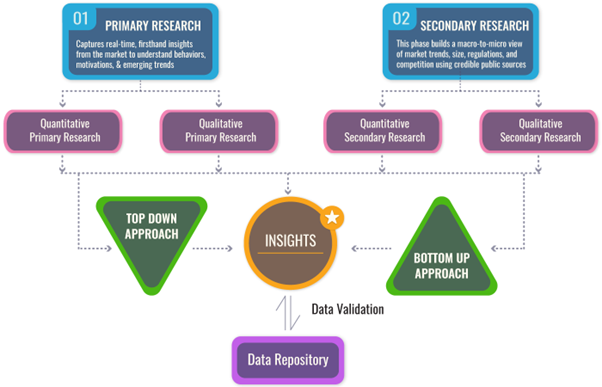
DUAL MODELING: TOP-DOWN + BOTTOM-UP
To ensure robust market estimation, we apply two complementary sizing approaches:
Top-Down Modeling:- Start with broader industry value (e.g., global or regional TAM)
- Apply filters by segment, geography, end-user, or use case
- Adjust with primary insights and validation benchmarks
- Ideal for investor-grade market scans and opportunity mapping
- Aggregate from the ground up using sales volumes, pricing, and unit economics
- Use internal modeling templates aligned with stakeholder data
- Incorporate distributor-level or region-specific inputs
- Most accurate for emerging segments and granular sub-markets
DATA VALIDATION: IN-HOUSE REPOSITORY
We close the loop with proprietary data intelligence built from ongoing projects, industry monitoring, and historical benchmarking. This repository includes:
- Multi-sector market and pricing models
- Key trendlines from past interviews and forecasts
- Benchmarked adoption rates, churn patterns, and ROI indicators
- Industry-specific deviation flags and cross-check logic
- Catches inconsistencies early
- Aligns projections across studies
- Enables consistent, high-trust deliverables