

RV Insurance Market Size and Forecast (2026–2034), Global and Regional Growth, Trend, Share, and Industry Analysis Report Coverage; By RV Type (Motorhomes, Travel Trailers, Fifth-Wheel Trailers, Pop-Up Campers, Others); By Coverage Type (Collision Coverage, Comprehensive Coverage, Liability Coverage, Uninsured/Underinsured Motorist Coverage, Others); By Distribution Channel (Insurance Agents & Brokers, Direct Insurance Companies, Online Platforms, Others); By End User (Individual RV Owners, Rental & Fleet Operators, Commercial Users, Others); and Geography
2026-09-02
Business & Financial Services
Ekta Chaurasia (Team Lead)
Description
RV Insurance Market Overview
The global RV
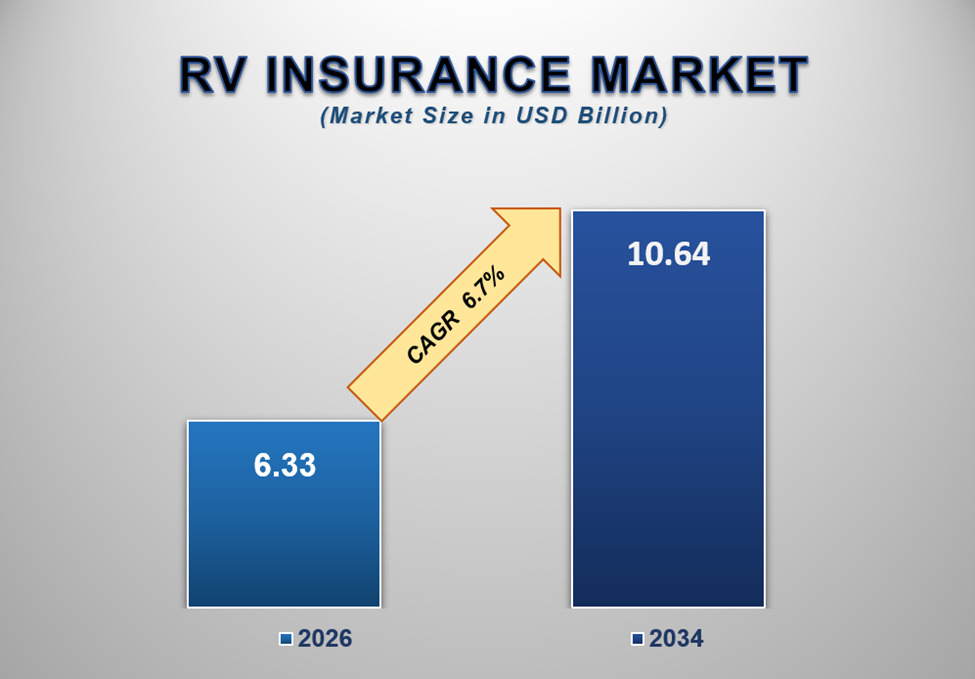
Insurance Market was valued at USD 6.33 billion in 2026 and is
projected to reach USD 10.64 billion by 2034, expanding at a CAGR of
6.7% during the forecast period. The market is experiencing steady growth
due to increasing recreational vehicle ownership, rising participation in
road-based leisure travel, growing awareness of specialized vehicle protection,
increasing RV rental activity, expansion of digital insurance distribution, and
rising costs associated with vehicle repair and replacement.
RV insurance
provides financial protection for recreational vehicles against risks such as
collisions, theft, weather-related damage, vandalism, liability claims, and
other covered incidents. Depending on the policy, coverage can extend to
motorhomes, travel trailers, fifth-wheel trailers, campers, and other
recreational vehicles.
The expanding
recreational vehicle industry is creating a broader customer base for
specialized insurance products. RV owners increasingly recognize that standard
automobile insurance may not adequately address the unique risks associated
with recreational vehicles, particularly when vehicles are used for extended
travel, camping, temporary accommodation, or seasonal storage.
Motorhomes
represent an important source of insurance demand because they combine vehicle
transportation with living and accommodation functions. Travel trailers and
fifth-wheel trailers are also generating substantial demand as consumers
increasingly use towable recreational vehicles for vacations and outdoor
activities.
The growing
popularity of domestic tourism, camping, road trips, outdoor recreation, and
extended leisure travel is encouraging more consumers to purchase recreational
vehicles. Increased RV utilization subsequently creates demand for insurance
coverage designed around different usage patterns.
RV owners may
require protection not only for the vehicle itself but also for permanently
installed equipment, personal belongings, appliances, recreational equipment,
and other contents carried inside the vehicle. This is encouraging insurers to
develop broader and more flexible coverage options.
The expansion of
RV rental platforms is creating additional opportunities for insurance
providers. Rental operators and fleet owners require specialized coverage to
manage risks associated with multiple vehicles, frequent users, varying travel
patterns, and increased vehicle utilization.
Digital
transformation is also changing how RV insurance is purchased and managed.
Online quotation systems, digital policy administration, mobile applications,
virtual claims processing, and data-driven underwriting are making specialized
insurance products more accessible.
Insurers are
increasingly using telematics, customer data, vehicle information, claims
history, and usage patterns to improve risk assessment and develop more
personalized pricing structures.
The increasing
cost of RV repairs and replacement parts is further strengthening the
importance of adequate insurance coverage. Advanced vehicle systems,
specialized interiors, electronics, appliances, and recreational equipment can
increase the financial impact of accidents and other damage.
As recreational
vehicle ownership, outdoor leisure activities, rental services, and digital
insurance distribution continue expanding, the global RV insurance market is
expected to maintain consistent growth through 2034.
RV Insurance Market Drivers and
Opportunities
Increasing
Recreational Vehicle Ownership Is Driving Market Growth
The growing
adoption of recreational vehicles is one of the primary factors supporting
expansion of the RV insurance market.
Consumers are
increasingly purchasing motorhomes, travel trailers, fifth-wheel trailers,
campers, and other RVs for vacations, camping, long-distance travel, and
outdoor recreation.
As the number of
recreational vehicles on the road increases, the potential customer base for
specialized insurance coverage expands accordingly.
RV owners face
risks that differ from those associated with conventional passenger vehicles.
Vehicles may remain parked for extended periods, travel across different
regions, carry personal belongings, or be used as temporary accommodation.
These
characteristics increase the need for insurance policies specifically designed
around recreational vehicle ownership and usage.
The expansion of
RV ownership is therefore expected to remain a major source of premium growth
throughout the forecast period.
Growing
Outdoor Recreation and Road-Trip Culture Is Supporting Market Expansion
The increasing
popularity of camping, road trips, outdoor tourism, and nature-based recreation
is encouraging consumers to invest in recreational vehicles.
RV travel
provides consumers with flexibility in transportation and accommodation, making
it attractive for families, retirees, adventure travelers, and long-distance
leisure travelers.
Longer RV trips
can increase exposure to road accidents, weather events, theft, and other
risks, creating a greater requirement for appropriate insurance protection.
The growing
development of campgrounds, RV parks, recreational infrastructure, and travel
routes is further supporting RV utilization.
Insurance
companies are responding by offering policies that can be tailored to seasonal
usage, full-time RV living, vacation travel, storage periods, and other
ownership patterns.
The continued
growth of RV-oriented tourism is expected to provide a stable foundation for
insurance demand.
Digital
Insurance Distribution and Customized Coverage Create Significant Opportunities
The increasing
adoption of digital insurance channels is creating new opportunities for RV
insurance providers.
Online platforms
allow customers to obtain quotations, compare policy options, review coverage
conditions, purchase policies, submit documents, and manage claims without
relying entirely on physical insurance offices.
Insurers are
also using digital technologies to simplify underwriting and provide faster
policy issuance.
Data analytics
and telematics offer additional opportunities. Vehicle usage information,
driving behavior, mileage, location, claims history, and other data can support
more accurate risk assessment.
Insurers can
also develop customized products for different customer groups, including
occasional RV travelers, full-time RV residents, rental operators, and
commercial fleet users.
The growing
integration of digital distribution, automated claims management, telematics,
and personalized insurance products is expected to strengthen competition and
expand access to RV insurance.
RV Insurance Market Scope
|
Report Attributes |
Description |
|
Market Size in 2026 |
USD
6.33 Billion |
|
Market Forecast in 2034 |
USD 10.64 Billion |
|
CAGR % 2026-2034 |
6.7% |
|
Base Year |
2025 |
|
Historic Data |
2021-2025 |
|
Forecast Period |
2026-2034 |
|
Report USP |
Production, Consumption,
Company Share, Company Heatmap, Company Production, Service Type, Growth
Factors and more |
|
Segments Covered |
· By RV Type · By Coverage Type · By Distribution Channel · By End User |
|
Regional Scope |
● North America |
|
Country Scope |
U.S. |
RV Insurance Market Report
Segmentation Analysis
The global RV
insurance market industry analysis is segmented into RV type, coverage type,
distribution channel, end user, and region.
Motorhomes
Segment Is Expected to Dominate the Market During the Forecast Period
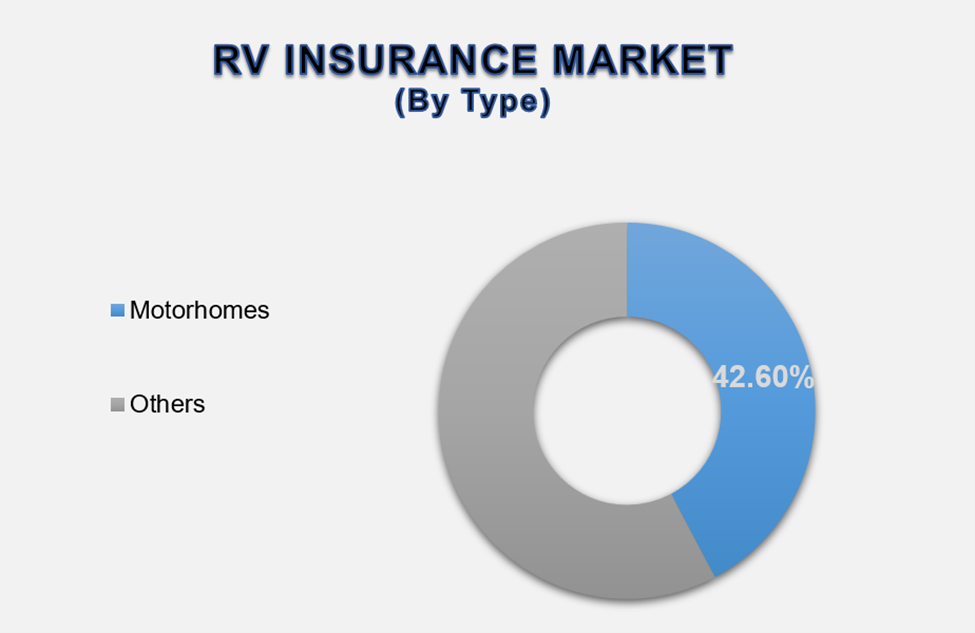
The Motorhomes
segment accounted for approximately 42.6% of the global market, making
it the leading RV category.
Motorhomes
represent a major source of insurance demand because they combine
transportation and residential functions within a single recreational vehicle.
These vehicles
are often significantly more expensive than conventional passenger vehicles and
can contain built-in kitchens, sleeping areas, bathrooms, appliances,
entertainment systems, and other equipment.
The higher
overall value and complexity of motorhomes can increase the financial exposure
associated with accidents, theft, weather damage, and other insured events.
Motorhome owners
may also require coverage for personal belongings, attached equipment, and
temporary accommodation expenses following covered incidents.
The increasing
popularity of extended road travel and full-time RV lifestyles is expected to
continue supporting demand for motorhome insurance.
Collision
Coverage Segment Is Expected to Lead the Market by Coverage Type
The Collision
Coverage segment is expected to account for a significant share of the RV
insurance market.
Collision
coverage protects insured recreational vehicles against damage resulting from
covered collisions with other vehicles or objects.
Because RVs are
frequently operated on highways, rural roads, campgrounds, and unfamiliar
routes, owners face potential accident risks during travel.
The
comparatively large size and weight of many recreational vehicles can also
increase repair costs following accidents.
Insurers are
therefore offering collision protection as an important component of broader RV
insurance packages.
Insurance
Agents & Brokers Segment Is Expected to Dominate the Market by Distribution
Channel
The Insurance
Agents & Brokers segment represents an important distribution channel
because RV insurance can involve multiple coverage considerations that benefit
from professional guidance.
Agents and
brokers can help customers evaluate vehicle value, usage patterns, liability
requirements, personal-property protection, deductibles, and additional
coverage options.
This channel
remains particularly relevant for high-value motorhomes and customers requiring
customized policies.
However, online
platforms are gaining importance as consumers increasingly seek faster
quotations, digital documentation, and convenient policy management.
Individual RV
Owners Segment Is Expected to Dominate the Market by End User
The Individual
RV Owners segment is expected to represent the largest share of the RV
insurance market.
Private
consumers constitute a major portion of the recreational vehicle customer base
and purchase insurance to protect their vehicles against accidents, theft,
weather damage, liability exposure, and other risks.
Individual
owners may use RVs for weekend travel, seasonal vacations, camping,
long-distance road trips, or full-time recreational living.
The increasing
number of consumers participating in RV-based recreation is consequently
supporting insurance demand among individual owners.
The following segments are part of an in-depth analysis of the global RV Insurance Market:
|
Market Segments |
|
|
By Type |
· Motorhomes · Travel Trailers · Fifth-Wheel
Trailers · Pop-Up Campers · Others |
|
By
Coverage Type |
· Collision Coverage · Comprehensive
Coverage · Liability Coverage ·
Uninsured/Underinsured Motorist Coverage · Others |
|
By Distribution Channel |
· Insurance Agents
& Brokers · Direct Insurance
Companies · Online Platforms · Others |
|
By End User |
· Individual RV
Owners · Rental & Fleet
Operators · Commercial Users · Others |
RV Insurance Market Share Analysis By
Region
North America is projected to hold the largest share of the global RV insurance
market over the forecast period.
North America
benefits from a well-established recreational vehicle industry, extensive road
infrastructure, high RV ownership, strong outdoor recreation culture, and
developed insurance markets. The United States remains the dominant
contributor due to its large RV population, established camping infrastructure,
and an extensive network of insurance providers specializing in recreational
vehicles.
Canada represents another important market, supported by strong
participation in camping, outdoor recreation, and road-based leisure travel.
Europe represents a significant market due to increasing interest in
motorhomes, caravanning, camping tourism, and cross-border road travel. Germany,
the U.K., France, Italy, Spain, and Switzerland are important markets,
supported by established recreational tourism infrastructure and growing
consumer interest in flexible travel.
Asia Pacific is expected to experience strong growth during the forecast period.
Rising disposable incomes, expanding domestic tourism, increasing interest in
outdoor recreation, and the gradual development of RV culture are supporting
market opportunities. China, Japan, South Korea, India, and Australia
are key contributors.
Australia
represents an important opportunity due to its established caravanning and
recreational vehicle culture and extensive road-trip tourism. China and India
are also developing opportunities as recreational tourism and premium leisure
activities expand.
Latin America is expected to witness steady growth as outdoor tourism develops
and consumers increasingly adopt recreational travel activities. Brazil,
Mexico, and Argentina represent important regional markets.
The Middle
East & Africa is an emerging market supported
by tourism development, luxury leisure activities, increasing vehicle
ownership, and growing interest in organized outdoor recreation.
RV Insurance
Market Competition Landscape Analysis
The global RV
insurance market is competitive, with insurers focusing on coverage
flexibility, pricing, claims management, customer service, digital
distribution, specialized RV expertise, and additional protection options.
Insurance
providers are developing policies designed around different RV categories and
usage patterns. Coverage may be customized according to vehicle value, travel
frequency, storage conditions, personal belongings, liability requirements, and
other customer-specific factors.
Digital
transformation is becoming increasingly important as insurers introduce online
quotations, mobile policy management, digital claims submission, automated
document processing, and virtual customer assistance.
Insurance
companies are also using data analytics and telematics to improve underwriting
and risk assessment.
Partnerships
with RV manufacturers, dealerships, rental companies, roadside-assistance
providers, and travel organizations are providing insurers with additional
customer-acquisition opportunities.
The increasing
number of RV owners and growing diversity of recreational vehicle usage are
expected to encourage insurers to develop more specialized products and
strengthen their digital capabilities.
Global RV
Insurance Market Recent Developments News
· In April
2026 – RV insurance providers expanded digital quotation and
policy-management capabilities to simplify insurance purchasing for
recreational vehicle owners.
· In February
2026 – Insurance companies increased customized coverage options for
motorhomes and towable recreational vehicles to address differences in vehicle
value and usage patterns.
· In November
2025 – Insurers expanded partnerships with RV dealerships and recreational
vehicle service networks to strengthen customer acquisition and claims support.
· In August
2025 – Insurance providers increased the use of data-driven underwriting
tools to improve risk assessment for recreational vehicle policies.
· In June
2025 – Digital insurance platforms expanded online claims and
customer-service capabilities for RV owners seeking faster policy
administration.
The Global RV
Insurance Market is Dominated by a Few Large Companies, Such As
· Progressive
Corporation
· GEICO
· Good Sam
Insurance Agency
· National
General Holdings Corp.
· Foremost
Insurance Group
· Allstate
Corporation
· State Farm
Mutual Automobile Insurance Company
· Nationwide
Mutual Insurance Company
· American
Family Insurance
· Farmers
Insurance Group
· RV America
Insurance
· Roamly
Insurance Group
· Blue Sky
Insurance
· Aon plc
· Marsh McLennan
· Others
Frequently Asked Questions
Ekta Chaurasia (Team Lead)
Ekta Chaurasia is a highly experienced Team Lead at M2Square Consultancy with over 7 years of expertise in market research, strategic consulting, competitive benchmarking, and business intelligence solutions. She specializes in ICT, semiconductors & electronics, automotive & transportation, and industrial machinery markets.
She leads end-to-end global research projects focused on market trends, industry analysis, growth forecasting, customer insights, and strategic decision-making. Known for her analytical leadership and industry expertise, Ekta helps businesses uncover growth opportunities, evaluate competitive landscapes, and stay ahead in rapidly evolving markets through accurate and insight-driven research.
1.
Global RV Insurance
Market Introduction and Market Overview
1.1. Objectives of the Study
1.2. Global RV Insurance Market Scope and Market Estimation
1.2.1.
Global RV Insurance Market Size
(US$ Million), Market CAGR (%), Market Forecast (2026 - 2034)
1.2.2.
Global RV Insurance Market
Revenue Share (%) and Growth Rate (Y-o-Y) Analysis (2021 - 2034)
1.3. Market Segmentation
1.3.1.
By RV Type of Global RV
Insurance Market
1.3.2.
By Coverage Type of Global RV
Insurance Market
1.3.3.
By Distribution Channel of
Global RV Insurance Market
1.3.4.
By End User of Global RV
Insurance Market
1.3.5.
Region of Global RV Insurance
Market
1.4. Competition Coverage List of Market Participants
1.5. Market Definition: RV Insurance Market
2.
Executive Summary
2.1. Demand Side Trends
2.2. Key Market Trends
2.3. Market Demand (US$ Million) Analysis 2021 – 2025 and Forecast, 2026
– 2034
2.4. Demand and Opportunity Assessment
2.5. Key Developments
2.6. Overview of Regulatory Landscape, Compliance Framework, and Industry
Standards
2.7. Market Entry Strategies
2.8. Market Dynamics
2.8.1.
Drivers
2.8.2.
Limitations
2.8.3.
Opportunities
2.8.4.
Impact Analysis of Drivers and
Restraints
2.9. Porter's Five Forces Analysis
2.10.
PEST Analysis
3.
Global RV Insurance
Market Estimates & Historical Trend Analysis (2021 - 2025)
4.
Global RV Insurance
Market Estimates & Forecast Trend Analysis, by RV Type
4.1. Global RV Insurance Market Revenue (US$ Million) Estimates and
Forecasts, by RV Type, 2021 - 2034
4.1.1.
Motorhomes
4.1.2.
Travel Trailers
4.1.3.
Fifth-Wheel Trailers
4.1.4.
Pop-Up Campers
4.1.5.
Others
5.
Global RV Insurance
Market Estimates & Forecast Trend Analysis, by Coverage Type
5.1. Global RV Insurance Market Revenue (US$ Million) Estimates and
Forecasts, by Coverage Type, 2021 - 2034
5.1.1.
Collision Coverage
5.1.2.
Comprehensive Coverage
5.1.3.
Liability Coverage
5.1.4.
Uninsured/Underinsured Motorist
Coverage
5.1.5.
Others
6.
Global RV Insurance
Market Estimates & Forecast Trend Analysis, by Distribution Channel
6.1. Global RV Insurance Market Revenue (US$ Million) Estimates and
Forecasts, by Distribution Channel, 2021 - 2034
6.1.1.
Insurance Agents & Brokers
6.1.2.
Direct Insurance Companies
6.1.3.
Online Platforms
6.1.4.
Others
7.
Global RV Insurance
Market Estimates & Forecast Trend Analysis, by End User
7.1. Global RV Insurance Market Revenue (US$ Million) Estimates and
Forecasts, by End User, 2021 - 2034
7.1.1.
Individual RV Owners
7.1.2.
Rental & Fleet Operators
7.1.3.
Commercial Users
7.1.4.
Others
8.
Global RV Insurance
Market Estimates & Forecast Trend Analysis, by Region
8.1. Global RV Insurance Market Revenue (US$ Million) Estimates and
Forecasts, by Region, 2021 - 2034
8.1.1.
North America
8.1.2.
Europe
8.1.3.
Asia Pacific
8.1.4.
Middle East & Africa
8.1.5.
Latin America
9.
North America RV
Insurance Market: Estimates & Forecast Trend Analysis
9.1. North America RV Insurance Market Assessments & Key Findings
9.1.1.
North America RV Insurance
Market Introduction
9.1.2.
North America RV Insurance
Market Size Estimates and Forecast (US$ Million) (2021 - 2034)
9.1.2.1.
By RV Type
9.1.2.2.
By Coverage Type
9.1.2.3.
By Distribution Channel
9.1.2.4.
By End User
9.1.2.5.
By Country
9.1.2.5.1.
The U.S.
9.1.2.5.2.
Canada
10. Europe RV Insurance Market: Estimates & Forecast Trend Analysis
10.1.
Europe RV Insurance Market
Assessments & Key Findings
10.1.1.
Europe RV Insurance Market
Introduction
10.1.2.
Europe RV Insurance Market Size
Estimates and Forecast (US$ Million) (2021 - 2034)
10.1.2.1.
By RV Type
10.1.2.2.
By Coverage Type
10.1.2.3.
By Distribution Channel
10.1.2.4.
By End User
10.1.2.5.
By Country
10.1.2.5.1.
Germany
10.1.2.5.2.
Italy
10.1.2.5.3.
The U.K.
10.1.2.5.4.
France
10.1.2.5.5.
Spain
10.1.2.5.6.
Switzerland
10.1.2.5.7.
Rest of Europe
11. Asia Pacific RV Insurance Market: Estimates & Forecast Trend
Analysis
11.1.
Asia Pacific RV Insurance
Market Assessments & Key Findings
11.1.1.
Asia Pacific RV Insurance
Market Introduction
11.1.2.
Asia Pacific RV Insurance
Market Size Estimates and Forecast (US$ Million) (2021 - 2034)
11.1.2.1.
By RV Type
11.1.2.2.
By Coverage Type
11.1.2.3.
By Distribution Channel
11.1.2.4.
By End User
11.1.2.5.
By Country
11.1.2.5.1.
China
11.1.2.5.2.
Japan
11.1.2.5.3.
India
11.1.2.5.4.
Australia
11.1.2.5.5.
South Korea
11.1.2.5.6.
Rest of Asia Pacific
12. Middle East & Africa RV Insurance Market: Estimates &
Forecast Trend Analysis
12.1.
Middle East & Africa RV
Insurance Market Assessments & Key Findings
12.1.1.
Middle East & Africa RV
Insurance Market Introduction
12.1.2.
Middle East & Africa RV
Insurance Market Size Estimates and Forecast (US$ Million) (2021 - 2034)
12.1.2.1.
By RV Type
12.1.2.2.
By Coverage Type
12.1.2.3.
By Distribution Channel
12.1.2.4.
By End User
12.1.2.5.
By Country
12.1.2.5.1.
UAE
12.1.2.5.2.
Saudi Arabia
12.1.2.5.3.
South Africa
12.1.2.5.4.
Rest of Middle East &
Africa
13. Latin America RV Insurance Market: Estimates & Forecast Trend
Analysis
13.1.
Latin America RV Insurance
Market Assessments & Key Findings
13.1.1.
Latin America RV Insurance
Market Introduction
13.1.2.
Latin America RV Insurance
Market Size Estimates and Forecast (US$ Million) (2021 - 2034)
13.1.2.1.
By RV Type
13.1.2.2.
By Coverage Type
13.1.2.3.
By Distribution Channel
13.1.2.4.
By End User
13.1.2.5.
By Country
13.1.2.5.1.
Brazil
13.1.2.5.2.
Mexico
13.1.2.5.3.
Argentina
13.1.2.5.4.
Rest of Latin America
14. Competition Landscape
14.1.
Global RV Insurance Market
Product Mapping
14.2.
Global RV Insurance Market
Concentration Analysis, by Leading Players / Innovators / Emerging Players /
New Entrants
14.3.
Global RV Insurance Market Tier
Structure Analysis
14.4.
Global RV Insurance Market
Concentration & Company Market Shares (%) Analysis, 2026
15. Company Profiles
15.1.
Progressive Corporation
15.1.1.
Company Overview & Key
Stats
15.1.2.
Financial Performance &
KPIs
15.1.3.
Product Portfolio
15.1.4.
SWOT Analysis
15.1.5.
Business Strategy & Recent
Developments
*Similar details would be provided for all
the players mentioned below
15.2.
GEICO
15.3.
Good Sam Insurance Agency
15.4.
National General Holdings Corp.
15.5.
Foremost Insurance Group
15.6.
Allstate Corporation
15.7.
State Farm Mutual Automobile
Insurance Company
15.8.
Nationwide Mutual Insurance
Company
15.9.
American Family Insurance
15.10.
Farmers Insurance Group
15.11.
RV America Insurance
15.12.
Roamly Insurance Group
15.13.
Blue Sky Insurance
15.14.
Aon plc
15.15.
Marsh McLennan
15.16.
Others
16. Research Findings & Conclusion
17. Assumptions & Acronyms Used
18. Research Methodology
18.1.
External Databases
18.2.
Internal Proprietary Database
18.3.
Primary Research
18.4.
Secondary Research
18.5.
Assumptions
18.6.
Limitations
18.7.
Report FAQs
Our Research Methodology
"Insight without rigor is just noise."
We follow a comprehensive, multi-phase research framework designed to deliver accurate, strategic, and decision-ready intelligence. Our process integrates primary and secondary research , both quantitative and qualitative , along with dual modeling techniques ( top-down and bottom-up) and a final layer of validation through our proprietary in-house repository.
PRIMARY RESEARCH
Primary research captures real-time, firsthand insights from the market to understand behaviors, motivations, and emerging trends.
1. Quantitative Primary Research
Objective: Generate statistically significant data directly from market participants.
Approaches:- Structured surveys with customers, distributors, and field agents
- Mobile-based data collection for point-of-sale audits and usage behavior
- Phone-based interviews (CATI) for market sizing and product feedback
- Online polling around industry events and digital campaigns
- Purchase frequency by customer type
- Channel performance across geographies
- Feature demand by application or demographic
2. Qualitative Primary Research
Objective: Explore decision-making drivers, pain points, and market readiness.
Approaches:- In-depth interviews (IDIs) with executives, product managers, and key decision-makers
- Focus groups among end users and early adopters
- Site visits and observational research for consumer products
- Informal field-level discussions for regional and cultural nuances
SECONDARY RESEARCH
This phase helps establish a macro-to-micro understanding of market trends, size, regulation, and competitive dynamics, sourced from credible and public domain information.
1. Quantitative Secondary Research
Objective: Model market value and segment-level forecasts based on published data.
Sources include:- Financial reports and investor summaries
- Government trade data, customs records, and regulatory statistics
- Industry association publications and economic databases
- Channel performance and pricing data from marketplace listings
- Revenue splits, pricing trends, and CAGR estimates
- Supply-side capacity and volume tracking
- Investment analysis and funding benchmarks
2. Qualitative Secondary Research
Objective: Capture strategic direction, innovation signals, and behavioral trends.
Sources include:- Company announcements, roadmaps, and product pipelines
- Publicly available whitepapers, conference abstracts, and academic research
- Regulatory body publications and policy briefs
- Social and media sentiment scanning for early-stage shifts
- Strategic shifts in market positioning
- Unmet needs and white spaces
- Regulatory triggers and compliance impact
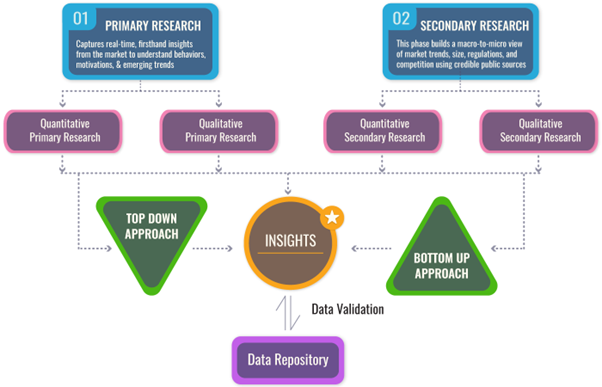
DUAL MODELING: TOP-DOWN + BOTTOM-UP
To ensure robust market estimation, we apply two complementary sizing approaches:
Top-Down Modeling:- Start with broader industry value (e.g., global or regional TAM)
- Apply filters by segment, geography, end-user, or use case
- Adjust with primary insights and validation benchmarks
- Ideal for investor-grade market scans and opportunity mapping
- Aggregate from the ground up using sales volumes, pricing, and unit economics
- Use internal modeling templates aligned with stakeholder data
- Incorporate distributor-level or region-specific inputs
- Most accurate for emerging segments and granular sub-markets
DATA VALIDATION: IN-HOUSE REPOSITORY
We close the loop with proprietary data intelligence built from ongoing projects, industry monitoring, and historical benchmarking. This repository includes:
- Multi-sector market and pricing models
- Key trendlines from past interviews and forecasts
- Benchmarked adoption rates, churn patterns, and ROI indicators
- Industry-specific deviation flags and cross-check logic
- Catches inconsistencies early
- Aligns projections across studies
- Enables consistent, high-trust deliverables