

Salon Management System Market Size and Forecast (2026–2034), Global and Regional Growth, Trend, Share and Industry Analysis Report Coverage; By Deployment (Cloud-Based, On-Premises); By Functionality (Appointment Scheduling, Billing & POS, Customer Relationship Management, Inventory Management, Employee & Payroll Management, Marketing & Loyalty, Analytics & Reporting, Others); By Enterprise Size (Small & Medium Enterprises, Large Enterprises); and Geography
2026-10-22
ICT
Ekta Chaurasia (Team Lead)
Description
Salon Management System Market
Overview
The global Salon
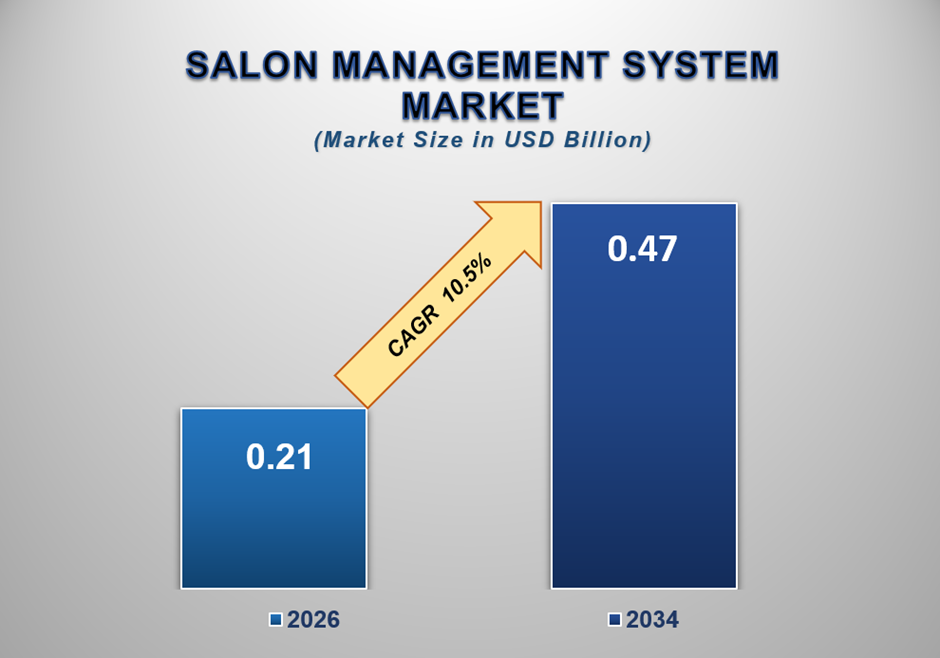
Management System Market was valued at USD 0.2103 billion in 2026
and is projected to reach USD 0.4746 billion by 2034, expanding at a CAGR
of 10.5% during the forecast period. The market is experiencing strong
growth as salons, beauty studios, spas, barbershops, and other personal-care
businesses increasingly replace manual administrative processes with integrated
digital platforms.
Salon management
systems are specialized software platforms designed to centralize day-to-day
business operations. Depending on the solution, they can combine appointment
scheduling, online booking, billing and point-of-sale functions, customer
records, employee management, inventory control, marketing automation, loyalty
programs, reporting, and payment processing. Current platforms from providers
such as Fresha, Vagaro, and Mangomint demonstrate the industry's movement
toward integrated systems rather than single-purpose scheduling tools.
The increasing
demand for online appointment scheduling is a major contributor to
market expansion. Customers increasingly expect salons to provide booking
access beyond normal business hours through websites, mobile interfaces, social
media links, and marketplace platforms. Automated reminders, digital confirmations,
waitlists, and self-service booking tools can also help salons manage
appointment flow and reduce administrative workload.
The growing
adoption of cloud-based salon management systems is further supporting
market growth. Cloud deployment allows salon owners and managers to access
operational information across devices and locations while reducing dependence
on locally installed infrastructure. This model is particularly relevant for independent
businesses and multi-location salon operators seeking centralized scheduling,
payment, customer, and performance information.
Customer
relationship management is becoming increasingly
important as salons compete for repeat visits and higher customer lifetime
value. Digital client profiles can retain service histories, preferences,
loyalty information, communication records, and other relevant details. Vendors
are also integrating automated communications and personalized marketing
capabilities to help salons improve customer engagement.
The expansion of
digital payments and integrated POS systems is creating another growth
avenue. Modern salon platforms increasingly connect appointment booking,
services, retail products, payments, memberships, gift cards, tipping, and
reporting within a unified workflow. This reduces the need for salon operators
to manage disconnected systems and enables more consistent transaction and
business data.
Artificial
intelligence is emerging as an important technology trend within the market. In
2026, vendors introduced AI-assisted reception, reporting, customer
communication, and predictive functions. Fresha launched AI Concierge for
automated calls, messages, booking, rescheduling, and common client questions,
while Vagaro introduced its AI receptionist Vera and AI-assisted reporting
capabilities. Zenoti also expanded predictive AI capabilities for areas such as
customer churn, staffing, and inventory forecasting.
Growing salon chains, increasing beauty-service digitization, higher expectations for convenient customer service, and the expansion of subscription-based software models are expected to support continued market growth through 2034.
Salon Management System Market
Drivers and Opportunities
Growing
Adoption of Online Appointment Booking Is Driving Market Growth
The increasing
shift from phone-based and manual appointment management toward digital
scheduling is one of the major factors supporting the salon management system
market.
Salon management
platforms allow businesses to maintain centralized calendars, manage staff
availability, accept online bookings, send automated reminders, process
cancellations, and operate waitlists. These capabilities help businesses handle
appointment demand while reducing the administrative effort associated with
manual scheduling.
The continued
expansion of online booking through websites, direct links, social platforms,
and marketplace channels is increasing the value of integrated salon management
systems. Fresha, for example, provides online bookings, direct booking links,
instant booking, notifications, waitlists, and rebooking capabilities within
its platform.
Cloud-Based
Salon Software Adoption Is Supporting Market Expansion
Cloud deployment
is becoming increasingly attractive for salons because it provides access to
operational information across multiple devices without requiring businesses to
maintain traditional local infrastructure.
Cloud-based
platforms can support real-time synchronization between front-desk teams,
stylists, managers, and multiple locations. They also allow software vendors to
deliver continuous feature updates and integrate third-party services such as
payment systems, messaging tools, e-commerce platforms, and marketing
applications.
The growing
preference for subscription-based software and lower infrastructure
requirements is expected to encourage adoption among small and medium-sized
salons.
Rising Demand
for Customer Personalization Creates New Opportunities
Customer
retention is an important business priority for salons because repeat visits,
memberships, packages, retail purchases, and referrals can contribute
significantly to revenue.
Salon management
systems provide structured customer profiles containing information such as
appointment history, service preferences, loyalty activity, and notes. These
capabilities allow businesses to create more personalized communications and
targeted promotions.
Advanced
platforms are also increasingly incorporating automated client engagement,
customer insights, and recommendations. This trend is creating opportunities
for vendors to differentiate through CRM capabilities rather than relying only
on scheduling and billing functions.
Artificial
Intelligence and Predictive Analytics Present Significant Opportunities
Artificial
intelligence is creating new opportunities across salon operations.
Recent platform
developments indicate that AI is moving beyond simple chat-based assistance
toward operational automation and predictive decision-making. Fresha's AI
Concierge can handle client calls and messages and manage appointment-related
requests, while Vagaro introduced Vera for receptionists and reporting
applications. Zenoti's 2026 Predictive Intelligence announcement also
highlights AI applications for guest churn, staffing optimization, and
inventory forecasting.
Future
opportunities include AI-powered demand forecasting, automated staff
scheduling, personalized product recommendations, dynamic marketing campaigns,
missed-call conversion, customer churn prediction, and inventory planning.
Salon Management System Market Scope
|
Report
Attributes |
Description |
|
Market Size in 2026 |
USD 0.21 Billion |
|
Market Forecast in 2034 |
USD 0.47 Billion |
|
CAGR % 2026-2034 |
10.5% |
|
Base Year |
2025 |
|
Historic Data |
2021-2025 |
|
Forecast Period |
2026-2034 |
|
Report USP |
Production, Consumption, Company Share, Company Heatmap, Company
Production, Service Type, Growth Factors and more |
|
Segments Covered |
·
By Deployment ·
By Functionality · By
Enterprise Size |
|
Regional Scope |
● North America |
|
Country Scope |
U.S. |
Salon Management System Market Report
Segmentation Analysis
The global salon
management system market industry analysis is segmented by deployment,
functionality, enterprise size, and region.
The
Cloud-Based Segment Is Expected to Lead the Market During the Forecast Period
The Cloud-Based
segment is expected to maintain a leading position in the global salon
management system market as businesses increasingly favor remotely accessible
and subscription-based software solutions.
Cloud-based
systems allow salon owners to access booking calendars, customer records, sales
information, reports, inventory data, and staff information from connected
devices. They are also well suited to businesses operating across multiple
locations because data can be synchronized through a centralized environment.
Continuous
software updates, easier integrations, lower infrastructure requirements, and
mobile accessibility are expected to further support cloud adoption.
The
Appointment Scheduling Segment Is Expected to Dominate the Market by
Functionality
The Appointment
Scheduling segment is expected to represent a major share of demand because
appointment management is central to salon operations.
Modern
scheduling systems extend beyond basic calendar management by supporting online
booking, automated reminders, deposits, cancellations, waitlists, staff
availability, resource allocation, multi-service appointments, and rebooking.
The increased
preference for 24/7 self-service booking is encouraging salons to adopt systems
that allow customers to select services and appointment times without direct
staff involvement.
Small &
Medium Enterprises Are Expected to Hold a Significant Market Position by
Enterprise Size
The Small
& Medium Enterprises segment represents a major addressable customer
base because independent salons, boutique beauty businesses, barbershops, and
small spa operators increasingly require affordable tools to manage scheduling,
payments, customers, and staff.
Cloud-based
subscription models are particularly relevant to smaller businesses because
they can provide access to integrated functionality without the need for
extensive in-house IT infrastructure.
Growing digital payment adoption, online customer acquisition, and social-media-driven appointment demand are expected to encourage further software adoption across small and medium-sized establishments.
The Following Segments Are Part of an In-Depth Analysis of the Global Salon Management System Market:
|
Market Segments |
|
|
By
Deployment |
● Cloud-Based ● On-Premises |
|
By Functionality |
● Appointment
Scheduling ● Billing & POS ● Customer Relationship
Management ● Inventory Management ● Employee &
Payroll Management ● Marketing &
Loyalty ● Analytics &
Reporting Others |
|
By
Enterprise Size |
● Small & Medium
Enterprises ● Large Enterprises |
Salon Management System Market Share
Analysis By Region
North America represents a significant market for salon management systems due to
the high level of software adoption across beauty, wellness, and personal-care
businesses. The region benefits from established salon chains, independent
beauty professionals, developed digital payment infrastructure, and strong
demand for cloud-based booking and business-management tools. Major software
providers such as Vagaro, Boulevard, Mindbody, and Zenoti operate extensively
across the beauty and wellness software ecosystem.
The United
States represents the major contributor to regional
demand, supported by widespread use of online booking, integrated POS, customer
management, digital marketing, and automated business reporting. Current
software platforms increasingly combine these functions into unified systems.
Europe maintains a substantial market share, supported by the expansion of
organized beauty businesses, rising digitalization of service operations, and
increasing demand for customer engagement technologies. The U.K., Germany,
France, Italy, and Spain remain important markets for salon, spa, and
beauty-service software.
The increasing
emphasis on efficient scheduling, digital customer records, payment automation,
and business analytics is encouraging European salon operators to adopt
integrated management platforms.
Asia Pacific is expected to witness strong growth during the forecast period.
The region benefits from large and expanding beauty-service markets, rapid
smartphone adoption, increasing digital payments, and growing adoption of
online appointment platforms. Industry research also identifies Asia Pacific as
one of the faster-growing regions for salon management software adoption.
China, India,
Japan, and South Korea are important markets within
the region. In particular, the expansion of organized salons and beauty chains,
increasing consumer demand for convenience, and growing use of digital business
tools are creating opportunities for software providers.
Latin America is expected to record steady growth due to increasing salon
digitization, greater adoption of digital payment methods, and the development
of organized beauty and wellness businesses. Brazil and Mexico are key
contributors to regional demand.
Middle East & Africa represents an emerging market, supported by the expansion of premium beauty services, wellness facilities, hospitality-linked spas, and digitally enabled personal-care businesses. Increasing investment in customer-experience technologies and cloud infrastructure is expected to create additional opportunities for salon management system providers.
Salon
Management System Market Competition Landscape Analysis
The salon
management system market is competitive, with software providers focusing on
integrated platforms that combine appointment scheduling, POS, CRM, payments,
staff management, inventory, marketing, and analytics.
A significant
competitive trend is the movement toward AI-enabled salon management.
Providers are increasingly adding AI-powered reception, automated customer
communication, intelligent reporting, predictive analytics, and workflow
automation to differentiate their platforms.
The industry is
also seeing increasing emphasis on multi-location management. Larger
salon groups require centralized dashboards, standardized service catalogs,
consolidated reporting, employee management, and synchronized customer
information across locations.
Another
important competitive factor is the integration of payments and commerce
into salon software. Platforms are increasingly connecting appointments with
product sales, memberships, packages, gift cards, tipping, deposits, and
checkout processes.
Companies are
also competing through simplified pricing structures, specialized workflows,
improved mobile experiences, third-party integrations, and automated marketing
tools. Mangomint, for example, revised its pricing structure in 2026 and
included several previously tiered capabilities such as memberships, forms, web
chat, and integrations within its core offering.
Strategic product development, artificial intelligence, cloud infrastructure, customer engagement, and expansion into adjacent beauty and wellness categories are expected to remain important competitive strategies through 2034.
Global Salon
Management System Market Recent Developments News
●
In September 2026 – Vagaro introduced its new Vagaro Home dashboard, bringing
appointments, online bookings, revenue, payroll, rent payments, and tasks into
a centralized workspace.
●
In August 2026 – Vagaro introduced Vera Receptionist, an AI-powered
assistant designed to respond to customer messages and inquiries after hours,
while also supporting booking-related interactions.
●
In August 2026 – Zenoti launched Predictive Intelligence, expanding its AI
capabilities toward guest churn prediction, workforce optimization, and
inventory forecasting for beauty and wellness businesses.
●
In May 2026 – Fresha launched AI Concierge, an AI-powered solution
designed to answer calls and messages and manage appointment booking,
rescheduling, cancellations, and customer questions.
●
In July 2026 – Mangomint announced a simplified pricing structure for salons and
spas and expanded the set of features available within its core plan, including
memberships, virtual waiting room, forms, web chat, and selected integrations.
● In February 2026 – Phorest highlighted the increasing role of artificial intelligence in salon, spa, and clinic operations, reflecting the industry's transition toward AI-supported business processes.
The Global
Salon Management System Market is Dominated by a Few Large Companies, Such As
●
Mindbody
●
Zenoti
●
Vagaro
●
Fresha
●
Phorest Salon Software
●
Boulevard
●
GlossGenius
●
Mangomint
●
DaySmart
●
Meevo
●
Salonist
●
Rosy
●
Shortcuts Software
●
Insight Salon Software
●
Acuity Scheduling
●
Millennium Systems
International
● Others
Frequently Asked Questions
Ekta Chaurasia (Team Lead)
Ekta Chaurasia is a highly experienced Team Lead at M2Square Consultancy with over 7 years of expertise in market research, strategic consulting, competitive benchmarking, and business intelligence solutions. She specializes in ICT, semiconductors & electronics, automotive & transportation, and industrial machinery markets.
She leads end-to-end global research projects focused on market trends, industry analysis, growth forecasting, customer insights, and strategic decision-making. Known for her analytical leadership and industry expertise, Ekta helps businesses uncover growth opportunities, evaluate competitive landscapes, and stay ahead in rapidly evolving markets through accurate and insight-driven research.
1.
Global Salon Management
System Market Introduction and Market Overview
1.1. Objectives of the Study
1.2. Global Salon Management System Market Scope and Market Estimation
1.2.1.
Global Salon Management System
Market Size (US$ Million), Market CAGR (%), Market Forecast (2026 - 2034)
1.2.2.
Global Salon Management System
Market Revenue Share (%) and Growth Rate (Y-o-Y) Analysis (2021 - 2034)
1.3. Market Segmentation
1.3.1.
By Deployment of Global Salon
Management System Market
1.3.2.
By Functionality of Global
Salon Management System Market
1.3.3.
By Enterprise Size of Global
Salon Management System Market
1.3.4.
Region of Global Salon
Management System Market
1.4. Competition Coverage List of Market Participants
1.5. Market Definition: Salon Management System Market
2.
Executive Summary
2.1. Demand Side Trends
2.2. Key Market Trends
2.3. Market Demand (US$ Million) Analysis 2021 – 2025 and Forecast, 2026
– 2034
2.4. Demand and Opportunity Assessment
2.5. Key Developments
2.6. Overview of Regulatory Landscape, Compliance Framework, and Industry
Standards
2.7. Market Entry Strategies
2.8. Market Dynamics
2.8.1.
Drivers
2.8.2.
Limitations
2.8.3.
Opportunities
2.8.4.
Impact Analysis of Drivers and
Restraints
2.9. Porter's Five Forces Analysis
2.10.
PEST Analysis
3.
Global Salon Management
System Market Estimates & Historical Trend Analysis (2021 – 2025)
4.
Global Salon Management
System Market Estimates & Forecast Trend Analysis, by Deployment
4.1. Global Salon Management System Market Revenue (US$ Million)
Estimates and Forecasts, by Deployment, 2021 - 2034
4.1.1.
Cloud-Based
4.1.2.
On-Premises
5.
Global Salon Management
System Market Estimates & Forecast Trend Analysis, by Functionality
5.1. Global Salon Management System Market Revenue (US$ Million)
Estimates and Forecasts, by Functionality, 2021 - 2034
5.1.1.
Appointment Scheduling
5.1.2.
Billing & POS
5.1.3.
Customer Relationship
Management
5.1.4.
Inventory Management
5.1.5.
Employee & Payroll
Management
5.1.6.
Marketing & Loyalty
5.1.7.
Analytics & Reporting
5.1.8.
Others
6.
Global Salon Management
System Market Estimates & Forecast Trend Analysis, by Enterprise Size
6.1. Global Salon Management System Market Revenue (US$ Million)
Estimates and Forecasts, by Enterprise Size, 2021 - 2034
6.1.1.
Small & Medium Enterprises
6.1.2.
Large Enterprises
7.
Global Salon Management
System Market Estimates & Forecast Trend Analysis, by Region
7.1. Global Salon Management System Market Revenue (US$ Million)
Estimates and Forecasts, by Region, 2021 - 2034
7.1.1.
North America
7.1.2.
Europe
7.1.3.
Asia Pacific
7.1.4.
Middle East & Africa
7.1.5.
Latin America
8.
North America Salon
Management System Market: Estimates & Forecast Trend Analysis
8.1. North America Salon Management System Market Assessments & Key
Findings
8.1.1.
North America Salon Management
System Market Introduction
8.1.2.
North America Salon Management
System Market Size Estimates and Forecast (US$ Million) (2021 - 2034)
8.1.2.1.
By Deployment
8.1.2.2.
By Functionality
8.1.2.3.
By Enterprise Size
8.1.2.4.
By Country
8.1.2.4.1.
The U.S.
8.1.2.4.2.
Canada
9.
Europe Salon Management
System Market: Estimates & Forecast Trend Analysis
9.1. Europe Salon Management System Market Assessments & Key Findings
9.1.1.
Europe Salon Management System
Market Introduction
9.1.2.
Europe Salon Management System
Market Size Estimates and Forecast (US$ Million) (2021 - 2034)
9.1.2.1.
By Deployment
9.1.2.2.
By Functionality
9.1.2.3.
By Enterprise Size
9.1.2.4.
By Country
9.1.2.4.1.
Germany
9.1.2.4.2.
Italy
9.1.2.4.3.
The U.K.
9.1.2.4.4.
France
9.1.2.4.5.
Spain
9.1.2.4.6.
Switzerland
9.1.2.4.7.
Rest of Europe
10. Asia Pacific Salon Management System Market: Estimates &
Forecast Trend Analysis
10.1.
Asia Pacific Salon Management
System Market Assessments & Key Findings
10.1.1.
Asia Pacific Salon Management
System Market Introduction
10.1.2.
Asia Pacific Salon Management
System Market Size Estimates and Forecast (US$ Million) (2021 - 2034)
10.1.2.1.
By Deployment
10.1.2.2.
By Functionality
10.1.2.3.
By Enterprise Size
10.1.2.4.
By Country
10.1.2.4.1.
China
10.1.2.4.2.
Japan
10.1.2.4.3.
India
10.1.2.4.4.
Australia
10.1.2.4.5.
South Korea
10.1.2.4.6.
Rest of Asia Pacific
11. Middle East & Africa Salon Management System Market: Estimates
& Forecast Trend Analysis
11.1.
Middle East & Africa Salon
Management System Market Assessments & Key Findings
11.1.1.
Middle East & Africa Salon
Management System Market Introduction
11.1.2.
Middle East & Africa Salon
Management System Market Size Estimates and Forecast (US$ Million) (2021 -
2034)
11.1.2.1.
By Deployment
11.1.2.2.
By Functionality
11.1.2.3.
By Enterprise Size
11.1.2.4.
By Country
11.1.2.4.1.
UAE
11.1.2.4.2.
Saudi Arabia
11.1.2.4.3.
South Africa
11.1.2.4.4.
Rest of Middle East &
Africa
12. Latin America Salon Management System Market: Estimates &
Forecast Trend Analysis
12.1.
Latin America Salon Management
System Market Assessments & Key Findings
12.1.1.
Latin America Salon Management
System Market Introduction
12.1.2.
Latin America Salon Management
System Market Size Estimates and Forecast (US$ Million) (2021 - 2034)
12.1.2.1.
By Deployment
12.1.2.2.
By Functionality
12.1.2.3.
By Enterprise Size
12.1.2.4.
By Country
12.1.2.4.1.
Brazil
12.1.2.4.2.
Mexico
12.1.2.4.3.
Argentina
12.1.2.4.4.
Rest of Latin America
13. Competition Landscape
13.1.
Global Salon Management System
Market Product Mapping
13.2.
Global Salon Management System
Market Concentration Analysis, by Leading Players / Innovators / Emerging
Players / New Entrants
13.3.
Global Salon Management System
Market Tier Structure Analysis
13.4.
Global Salon Management System
Market Concentration & Company Market Shares (%) Analysis, 2026
14. Company Profiles
14.1.
Mindbody
14.1.1.
Company Overview & Key
Stats
14.1.2.
Financial Performance &
KPIs
14.1.3.
Product Portfolio
14.1.4.
SWOT Analysis
14.1.5.
Business Strategy & Recent
Developments
*Similar details would be provided for all
the players mentioned below
14.2.
Zenoti
14.3.
Vagaro
14.4.
Fresha
14.5.
Phorest Salon Software
14.6.
Boulevard
14.7.
GlossGenius
14.8.
Mangomint
14.9.
DaySmart
14.10.
Meevo
14.11.
Salonist
14.12.
Rosy
14.13.
Shortcuts Software
14.14.
Insight Salon Software
14.15.
Acuity Scheduling
14.16.
Millennium Systems
International
14.17.
Others
15. Research Findings & Conclusion
16. Assumptions & Acronyms Used
17. Research Methodology
17.1.
External Databases
17.2.
Internal Proprietary Database
17.3.
Primary Research
17.4.
Secondary Research
17.5.
Assumptions
17.6.
Limitations
17.7.
Report FAQ
Our Research Methodology
"Insight without rigor is just noise."
We follow a comprehensive, multi-phase research framework designed to deliver accurate, strategic, and decision-ready intelligence. Our process integrates primary and secondary research , both quantitative and qualitative , along with dual modeling techniques ( top-down and bottom-up) and a final layer of validation through our proprietary in-house repository.
PRIMARY RESEARCH
Primary research captures real-time, firsthand insights from the market to understand behaviors, motivations, and emerging trends.
1. Quantitative Primary Research
Objective: Generate statistically significant data directly from market participants.
Approaches:- Structured surveys with customers, distributors, and field agents
- Mobile-based data collection for point-of-sale audits and usage behavior
- Phone-based interviews (CATI) for market sizing and product feedback
- Online polling around industry events and digital campaigns
- Purchase frequency by customer type
- Channel performance across geographies
- Feature demand by application or demographic
2. Qualitative Primary Research
Objective: Explore decision-making drivers, pain points, and market readiness.
Approaches:- In-depth interviews (IDIs) with executives, product managers, and key decision-makers
- Focus groups among end users and early adopters
- Site visits and observational research for consumer products
- Informal field-level discussions for regional and cultural nuances
SECONDARY RESEARCH
This phase helps establish a macro-to-micro understanding of market trends, size, regulation, and competitive dynamics, sourced from credible and public domain information.
1. Quantitative Secondary Research
Objective: Model market value and segment-level forecasts based on published data.
Sources include:- Financial reports and investor summaries
- Government trade data, customs records, and regulatory statistics
- Industry association publications and economic databases
- Channel performance and pricing data from marketplace listings
- Revenue splits, pricing trends, and CAGR estimates
- Supply-side capacity and volume tracking
- Investment analysis and funding benchmarks
2. Qualitative Secondary Research
Objective: Capture strategic direction, innovation signals, and behavioral trends.
Sources include:- Company announcements, roadmaps, and product pipelines
- Publicly available whitepapers, conference abstracts, and academic research
- Regulatory body publications and policy briefs
- Social and media sentiment scanning for early-stage shifts
- Strategic shifts in market positioning
- Unmet needs and white spaces
- Regulatory triggers and compliance impact
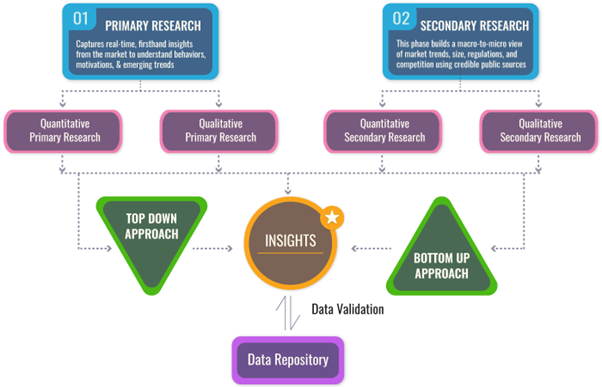
DUAL MODELING: TOP-DOWN + BOTTOM-UP
To ensure robust market estimation, we apply two complementary sizing approaches:
Top-Down Modeling:- Start with broader industry value (e.g., global or regional TAM)
- Apply filters by segment, geography, end-user, or use case
- Adjust with primary insights and validation benchmarks
- Ideal for investor-grade market scans and opportunity mapping
- Aggregate from the ground up using sales volumes, pricing, and unit economics
- Use internal modeling templates aligned with stakeholder data
- Incorporate distributor-level or region-specific inputs
- Most accurate for emerging segments and granular sub-markets
DATA VALIDATION: IN-HOUSE REPOSITORY
We close the loop with proprietary data intelligence built from ongoing projects, industry monitoring, and historical benchmarking. This repository includes:
- Multi-sector market and pricing models
- Key trendlines from past interviews and forecasts
- Benchmarked adoption rates, churn patterns, and ROI indicators
- Industry-specific deviation flags and cross-check logic
- Catches inconsistencies early
- Aligns projections across studies
- Enables consistent, high-trust deliverables