
Sample Preparation Market Size and Forecast (2026–2034), Global and Regional Growth, Trend, Share and Industry Analysis Report Coverage: By Device Type (Sample-Preparation Instruments (Extraction Systems, Automated Workstations, Evaporation Systems, Liquid-Handling Platforms, and Other Instruments), Consumables, Sample-Preparation Kits (Purification Kits, Isolation Kits, and Extraction Kits), Accessories & Software and Geography
2026-07-23
Healthcare
Swetal (Research Analyst)
Description
Sample Preparation Market Overview
The global sample
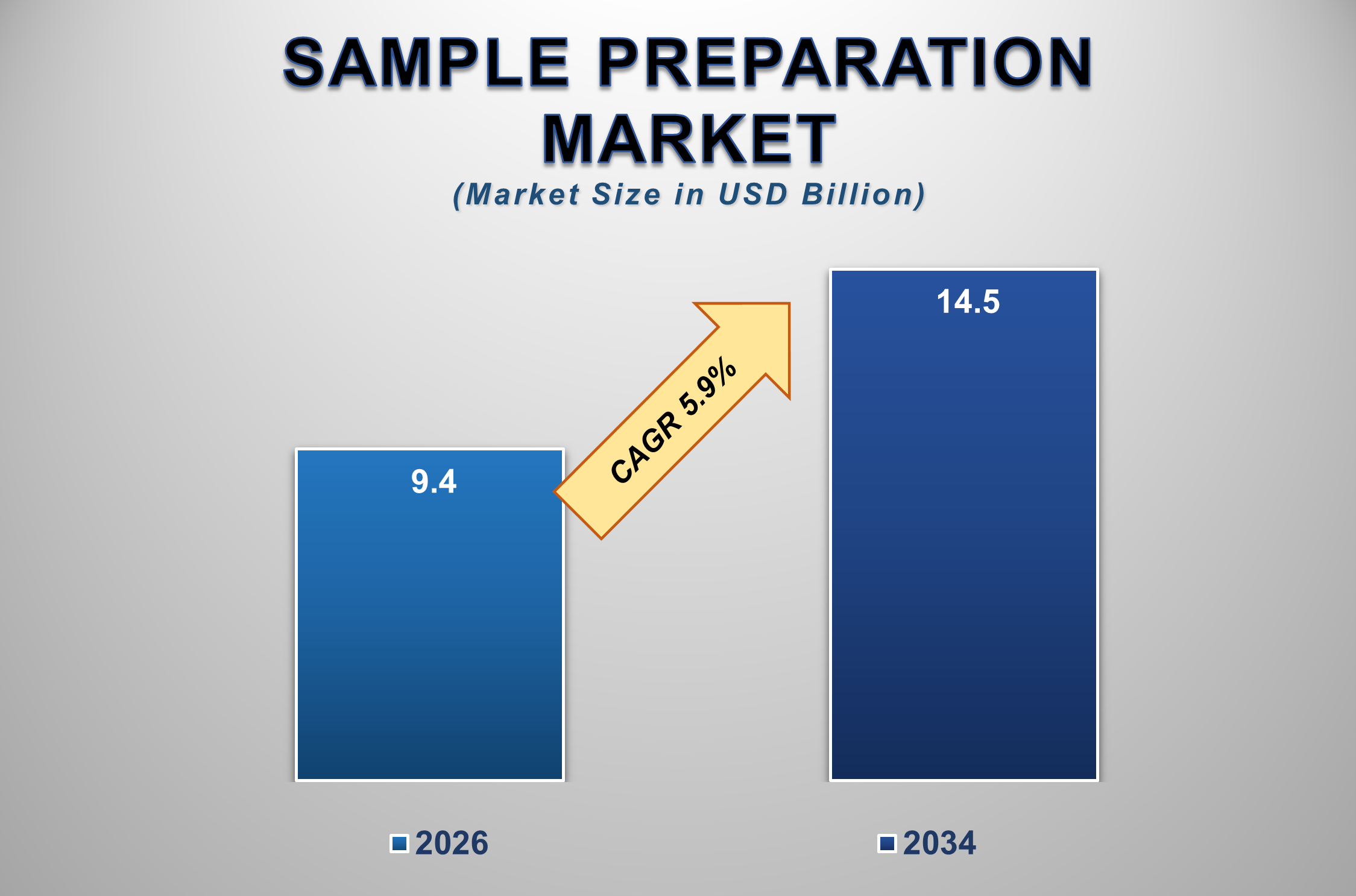
preparation market was valued at USD 9.4 billion in 2026 and is projected to
reach USD 14.5 billion by 2034, expanding at a CAGR of 5.9% during the forecast
period. The Sample Preparation Market comprises the tools, instruments, reagents,
and other products used in the extraction, preparation, concentration, and
purification of biological, chemical, environmental, food, and forensic samples
before their analysis and testing with the methods mentioned above. The sector
has been growing steadily owing to the increasing demand for genomics and
proteomics and precision medicine, as well as molecular diagnostics and the
introduction of automated processes in high-throughput laboratories. The
application of new technologies, including the use of automation,
microfluidics, magnetic bead extraction, and sample-to-answer systems, boosts
the efficiency and speed of laboratories performing various tests. Additional
factors that drive the market growth are increased investment in research in
life sciences and increased demand for accurate data analysis.
Sample Preparation Market Drivers and
Opportunities
Rising Adoption
of Molecular Diagnostics and Precision Medicine is Driving Market Growth
In addition, the
adoption of molecular diagnostics and precision medicine creates a rising
demand for solutions for sample preparation. For instance, PCR, NGS, digital
PCR, and companion diagnostics need the extraction of high-quality DNA, RNA,
and proteins to get correct results. Automated sample preparation has been
actively utilized by labs to improve their workflow efficiency because of the
growing number of tests in the field of oncology, rare diseases, infectious
diseases, and pharmacogenomics. It means that there is a rising need for
standardized and high-capacity workflows to perform reliable downstream
analysis, taking into account the evolution of technologies in precision
medicine.
One of the examples
of this is the new list of devices utilized in companion diagnostics issued by
the FDA in February 2026. The wide use of companion diagnostics implies the
necessity to extract accurate nucleic acid from tissue and liquid biopsies.
Increasing
Automation in Clinical and Research Laboratories Fueling Market Expansion
The rising usage of
laboratory automation technologies is largely increasing the demand for
automated sample preparation devices and reagents. In this respect, various
kinds of laboratories, including clinical labs, pharmaceutical firms, contract
research organizations (CROs), and academic research institutions, have started
using automated processes to increase their efficiency and decrease their
errors, while also enabling high-throughput tests. Due to the increasing number
of molecular diagnostics, genomics studies, biopharmaceutical drug development,
and clinical trials, along with laboratory labor force shortages, the
investment in robotics, liquid handlers, nucleic acid extraction, and magnetic
bead-based devices has risen sharply. With these new technologies, the
laboratories are able to work more samples and at a faster pace than ever
before while remaining productive and consistent. One of the examples of such a
product is the QIAcube Connect MDx, which was launched by QIAGEN in January
2025. This system automates nucleic acid extraction procedures using
standardized and reproducible workflows that are also appropriate for regulated
clinical testing. Such product development exemplifies the increased interest
in laboratory automation in the industry.
Expansion of
Decentralized Testing and Point-of-Care Diagnostics Presents Significant
Opportunities
The rise in
decentralized healthcare and point-of-care (POC) diagnostics represents a huge
opportunity for growth in the sample preparation market. With the trend in
diagnostic testing moving from centralized labs into hospitals, doctors'
offices, pharmacies, home health care, and other decentralized locations, there
is an increasing demand for small-scale, fast, and easy-to-use sample
preparation systems that need little in the way of technical skill.
Developments such as microfluidics, cartridge-based sample preparation systems,
and integrated sample-to-answer solutions help to increase the speed and
reliability of tests while decreasing the complexity of the procedure. These
innovations assist in making decisions based on test results and make it possible
to diagnose infections, monitor chronic diseases, and deliver emergency care in
a timely fashion, thus driving the growth of portable sample preparation
solutions. For example, the approval of the Cepheid Xpert HCV test by the U.S.
FDA in May 2025 for use on the GeneXpert Xpress System will allow for
near-patient molecular testing of hepatitis C. This test system provides
automated sample preparation, nucleic acid isolation, amplification, and
detection in a single cartridge and allows for quick delivery of results with
minimal hands-on time.
Sample Preparation Market Scope
|
Report Attributes |
Description |
|
Market Size in
2026 |
USD 9.4
Billion |
|
Market Forecast
in 2034 |
USD 14.5 Billion |
|
CAGR % 2026-2034 |
5.9% |
|
Base Year |
2025 |
|
Historic Data |
2021-2025 |
|
Forecast Period |
2026-2034 |
|
Report USP |
Pricing and
Cost Structure Analysis, Product Innovation Benchmarking, Whitespace
Assessment, Company Share, Company Heatmap, Growth Factors and more |
|
Segments Covered |
●
By
Product ●
By
Technology ●
By
Application ●
By
End-User |
|
Regional Scope |
●
North
America ●
Europe ●
APAC ●
Latin
America ●
Middle
East and Africa |
|
Country Scope |
●
U.S. ●
Canada ●
U.K. ●
Germany ●
France ●
Italy ●
Spain ●
Russia ●
China ●
India ●
Japan ●
South
Korea ●
Australia
●
Mexico ●
Brazil ●
Saudi
Arabia ●
UAE ●
South
Africa
|
Sample Preparation Market Report
Segmentation Analysis
The global sample
preparation market industry analysis is segmented by product, technology,
application, end user, and region.
Consumables
Segment Is Expected to Dominate the Sample Preparation Market During the
Forecast Period
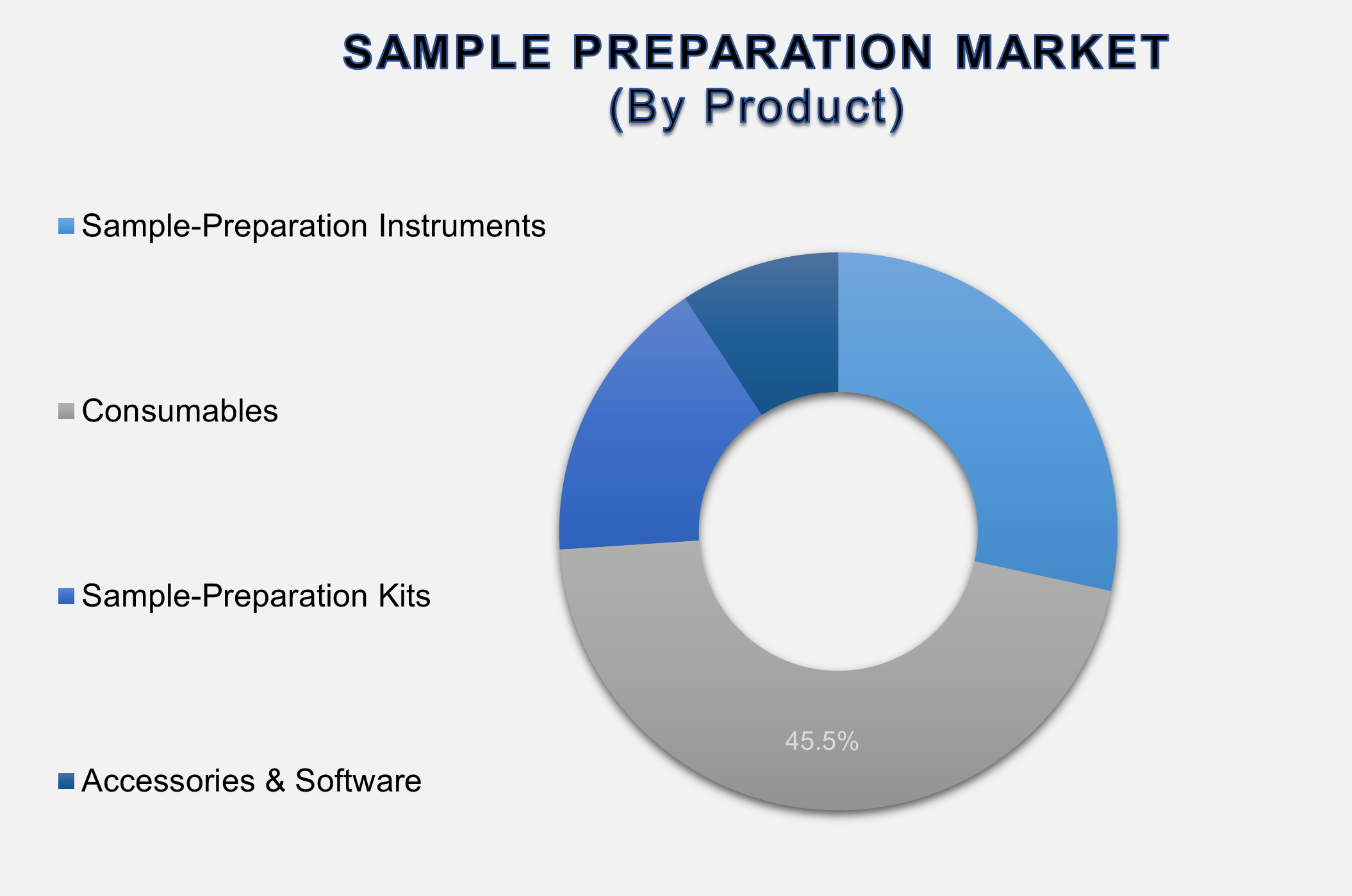
The consumables
category is estimated to capture the largest share of the sample preparation
market over the forecast period because of the regular consumption of these
products in clinical diagnostics, pharmaceuticals, biotechnology, academic
research, and forensics. As there is a need for various types of consumables
like extraction kits, reagents, magnetic beads, columns, buffers, filtration
systems, and sample collection tools in all the sample preparation workflows,
the requirement for continuous purchasing of these consumables remains.
Furthermore, increasing adoption of molecular diagnostics, next-generation
sequencing (NGS), PCR testing, and proteomics research is further increasing
the need for quality and standardized consumables, which will deliver accurate
and reproducible results without any contamination. Moreover, the increasing
trend of automation in the sample preparation process has been contributing to
the growth of the segment by increasing the requirement for instrument-specific
consumables that can improve the efficiency of workflow. In addition, the
segment is benefiting from continuous product innovations from the major market
players. For instance, in March 2025, QIAGEN launched various sample
preparation and library preparation solutions as an addition to the existing
portfolio of QIAseq to cater to high-throughput next-generation sequencing
applications.
Semi-Automated
Segment Is Expected to Lead the Sample Preparation Market by Technology
The semi-automated
segment will dominate the sample preparation market on account of technology
over the forecast period, owing to the capacity of these solutions to strike a
balance between automation, flexibility of use, and affordability. Semi-automated
solutions offer reduced manual handling along with the ability of laboratory
staff to have control over critical steps of the workflow, which makes them
ideal for use in clinical diagnostics, the pharmaceutical industry, biotech
companies, and academic laboratories. They provide improved reproducibility and
contamination minimization, as well as increased speed of preparation without
requiring high costs linked to full automation. This solution appeals most of
all to laboratories that make the transition from manually intensive to
automated processes. In addition, the growth of semi-automated solutions is
driven by an increase in innovation of products that improve sample preparation
and workflow. For example, in January 2025, QIAGEN announced the launch of the
QIAcube Connect MDx, a semi-automated solution for nucleic acid extraction
developed for molecular diagnostics laboratories.
Genomics Segment
Is Expected to Dominate the Application Segment
The genomics
category is anticipated to account for the largest share of the sample
preparation market by application in the forecast period, owing to the rising
use of next-generation sequencing (NGS), whole-genome sequencing, gene
expression analysis, and precision medicine. The process of genomics requires
good DNA and RNA isolation in order to facilitate accurate sequencing and
subsequent analysis. Therefore, sample preparation becomes an important
procedure in the genomics process. The rising investment in cancer genomics,
rare diseases, population genomics, and pathogen monitoring is likely to
further boost the demand for novel sample preparation technologies. Moreover,
the increasing use of automated extraction platforms and standardized library
preparation kits is increasing efficiency and reproducibility in genomics
laboratory processes. An example is the January 2025 expansion of the agreement
between Thermo Fisher Scientific and the UK Biobank Pharma Proteomics Project
to facilitate multi-omics research involving genomics and proteomics analysis.
This kind of project involves a lot of work in sample preparation because it
requires handling thousands of biological samples.
Pharmaceutical
Companies Segment Is Expected to Dominate the End User Segment
The pharmaceutical
companies' end-user category segment is expected to account for a significant
share of the sample preparation market during the years of the study. This will
happen due to the increasing spending of companies on drug discovery, biologics
discovery, precision medicine, and clinical trials. Sample preparation tools
are common in the pharmaceutical industry in genomic analysis, proteomics
analysis, and biomarker analysis. The growing use of high-throughput screening,
next-generation sequencing (NGS), and molecular diagnostics has led to the
demand for automated and precise sample preparation methods. One of the reasons
for the rise in the volume of sample preparation tools demanded is the growing
number of clinical trials and the development of companion diagnostics. For
example, Roche planned to buy Poseida Therapeutics in January 2025, which would
help the company boost its pipeline with cell therapies and precision medicine.
The following
segments are part of an in-depth analysis of the global sample preparation
market:
|
Market Segments |
|
|
By
Product |
●
Sample-Preparation
Instruments o
Extraction
Systems o
Automated Workstations o
Evaporation
Systems o
Liquid-Handling
Platforms o
Other
Instruments ●
Consumables ●
Sample-Preparation
Kits o
Purification
Kits o
Isolation
Kits o
Extraction
Kits ●
Accessories
& Software |
|
By
Technology |
●
Manual ●
Semi-Automated ●
Fully
Automated |
|
By Application |
●
Genomics ●
Proteomics ●
Epigenomics ●
Other
Application |
|
By
End-User |
●
Pharmaceutical
Companies ●
Biotechnology
Companies ●
Molecular
Diagnostics Labs ●
Academic
& Research Institutes ●
CROs &
CDMOs |
Sample Preparation Market Share
Analysis by Region
North America is
projected to hold the largest share of the global sample preparation market
over the forecast period
North America holds
the largest market share in the global sample preparation market during the
forecast period due to the advanced healthcare system and developed biotech and
pharmaceutical industries, in addition to the wide adoption of precision medicine
and molecular diagnostic tools. Large-scale investments in life science
research and development, drug discovery, genomics, and clinical diagnostics in
this region help to adopt modern sample preparation tools and technologies.
Besides, the increasing adoption of laboratory automation solutions and
participation of leading players in the market help to adopt advanced sample
preparation products in clinical and research laboratories. Furthermore, the
growing emphasis on genomics, biomarker discovery, and personalized medicine
and clinical studies, along with increased biopharmaceutical-related research
and development activities in this region, will help to grow the North American
market for sample preparation in the coming years.
Sample
Preparation Market Competition Landscape Analysis
The sample
preparation market includes the leading sponsors that are manufacturers of
sample preparation products, preparation instruments, consumables, reagents,
and automation systems and is aimed at serving pharmaceutical and biotechnology
companies, clinical diagnostic laboratories, academic and research institutes,
and contract research organizations, as well as forensic, food, and
environmental testing laboratories. Some of the players in this market are
making their competitive advantages stronger by constantly innovating nucleic
acid extraction systems, magnetic purification technologies made from
artificial materials, liquid handling systems, microfluidic and solid-phase
extraction, and sample-to-answer systems, among others. The companies in the sample
preparation market are also increasing their market share through strategic
partnerships, product launches, getting approvals from regulatory bodies,
mergers and acquisitions, and expanding their geographic presence through
R&D investments.
Global Sample
Preparation Market Recent Developments News:
●
In February
2026 - AnalytiChem, manufacturer of specialized laboratory equipment, reagents, and consumables, highlighted its growing product portfolio of reference materials,
specialized laboratory chemicals & reagents, consumables, and sample preparation solutions at Analytica 2026.
●
In February
2026 - Ultima Genomics, Inc., a developer of ultra-high-throughput sequencing
systems, continues its mission to enable sequencing at scale with the unveiling
of the UG200 Series and next-generation Solaris 2.0 workflows, which provide
higher output, better performance, and faster turnaround time with flexible
wafer configurations and lower instrumentation pricing.
●
In April 2025
- QIAGEN announced that plans are advancing to launch three new sample
preparation instruments during 2025 and 2026 to expand and strengthen its
portfolio for automated sample preparation.
●
In January
2025 - Thermo Fisher Scientific enhanced its AccelerOme automated sample
preparation platform with remote workflow download functionality, enabling
standardized protocol deployment across globally connected laboratory networks
from a centralized management hub.
The global
sample preparation market is dominated by a few large companies, such as
●
Thermo Fisher Scientific
●
Agilent Technologies Inc.
●
Analytik Jena GmbH
●
Becton, Dickinson and Company
●
Bio-Rad Laboratories Inc.
●
Biotage AB
●
Brooks Life Sciences
●
Danaher Corporation (Beckman Coulter &
Cytiva)
●
Eppendorf AG
●
Fluidigm Corporation
●
Hamilton Company
●
Illumina Inc.
●
LGC Biosearch Technologies
●
Merck KGaA (MilliporeSigma)
●
Norgen Biotek Corp.
●
PerkinElmer Inc.
●
Promega Corporation
●
QIAGEN N.V.
●
Takara Bio Inc.
●
Tecan Group Ltd.
● Other Prominent Players
Frequently Asked Questions
Swetal (Research Analyst)
Swetal is a Research Analyst with 4+ years of experience specializing in healthcare market research, medical devices, healthcare IT, and medical technology industry analysis. Her expertise includes competitive intelligence, secondary research, market trend forecasting, and healthcare business insights across global healthcare ecosystems.
She contributes to advanced market research reports by analyzing regulatory frameworks, emerging healthcare technologies, competitive landscapes, and innovation trends shaping the medical industry. With a strong focus on accurate market intelligence, strategic insights, and healthcare industry trends, Swetal supports businesses in making informed, data-backed decisions in a rapidly transforming healthcare environment.
1.
Global
Sample Preparation Market Introduction and Market Overview
1.1. Objectives of the Study
1.2. Market Segmentation
1.2.1.Product of the Global Sample
Preparation Market
1.2.2.Technology of the Global Sample
Preparation Market
1.2.3.Application of the Global Sample
Preparation Market
1.2.4.End-User of the Global Sample
Preparation Market
1.2.5.Region of Global Sample
Preparation Market
1.3. Competition Coverage List of
Market Participants
1.4. Market Definition: Sample
Preparation Market
2.
Executive Summary
2.1. Global Sample Preparation Market
Estimation & Forecast
2.1.1.Global Sample Preparation Market
Size (US$ Million) Estimates & Historical Trend Analysis (2021 - 2025)
2.1.2.Global Sample Preparation
Overall Market Size (US$ Million), Growth Rate (Y-o-Y), Market CAGR (%), Market
forecast (2026 - 2034)
2.2. Snapshot of Global Sample
Preparation Market
2.3. Global Sample Preparation Market
Revenue Share (%) 2025
2.4. REGIONAL OUTLINE: Revenue CAGR,
by Region
2.5. Key Competitors & Key
Insights
3.
Market Overview (Qualitative
Analysis)
3.1. Demand Side Trends
3.2. Supply Side Trends /
Manufacturing Trends
3.3. Demand and Opportunity
Assessment, 2026 - 2034
3.4. Market Dynamics
3.4.1.Drivers
3.4.2.Limitations
3.4.3.Opportunities
3.4.4.Impact Analysis of Drivers and
Restraints
3.5. Key Developments
3.6. Regulatory Landscape
3.7. Pricing Analysis
3.8. Supply Chain Analysis
3.9. Porter’s Five Forces Analysis
3.9.1.Bargaining Power of Suppliers
3.9.2.Bargaining Power of Buyers
3.9.3.Threat of Substitutes
3.9.4.Threat of New Entrants
3.9.5.Competitive Rivalry
3.10. PEST Analysis
3.10.1. Political Factors
3.10.2. Economic Factors
3.10.3. Social Factors
3.10.4. Technology Factors
4.
Global Sample Preparation Market
Estimates & Forecast Trend Analysis, by Product
4.1. Global Sample Preparation Market
Assessments & Key Findings, by Product
4.2. Global Sample Preparation Market
Revenue (US$ Million) Estimates and Forecasts, by Product, 2021 - 2034
4.2.1.Sample-Preparation Instruments
4.2.1.1.
Extraction
Systems
4.2.1.2.
Automated
Workstations
4.2.1.3.
Evaporation
Systems
4.2.1.4.
Liquid-Handling
Platforms
4.2.1.5.
Other
Instruments
4.2.2.Consumables
4.2.3.Sample-Preparation Kits
4.2.3.1.
Purification
Kits
4.2.3.2.
Isolation
Kits
4.2.3.3.
Extraction
Kits
4.2.4.Accessories & Software
5.
Global Sample Preparation Market
Estimates & Forecast Trend Analysis, by Technology
5.1. Global Sample Preparation Market
Assessments & Key Findings, by Technology
5.2. Global Sample Preparation Market
Revenue (US$ Million) Estimates and Forecasts, by Technology, 2021 - 2034
5.2.1.Manual
5.2.2.Semi-Automated
5.2.3.Fully Automated
6.
Global Sample Preparation Market
Estimates & Forecast Trend Analysis, by Application
6.1. Global Sample Preparation Market
Assessments & Key Findings, by Application
6.2. Global Sample Preparation Market
Revenue (US$ Million) Estimates and Forecasts, by Application, 2021 - 2034
6.2.1.Genomics
6.2.2.Proteomics
6.2.3.Epigenomics
6.2.4.Other Application
7.
Global Sample Preparation Market
Estimates & Forecast Trend Analysis, by End-User
7.1. Global Sample Preparation Market
Assessments & Key Findings, by End-User
7.2. Global Sample Preparation Market
Revenue (US$ Million) Estimates and Forecasts, by End-User, 2021 - 2034
7.2.1.Pharmaceutical Companies
7.2.2.Biotechnology Companies
7.2.3.Molecular Diagnostics Labs
7.2.4.Academic & Research
Institutes
7.2.5.CROs & CDMOs
8.
Global Sample Preparation Market
Estimates & Forecast Trend Analysis, by Region
8.1. Global Sample Preparation Market
Assessments & Key Findings, by Region
8.2. Global Sample Preparation Market
Revenue (US$ Million) Estimates and Forecasts, by Region, 2021 - 2034
8.2.1.North America
8.2.2.Europe
8.2.3.Asia Pacific
8.2.4.Middle East & Africa
8.2.5.Latin America
9.
North
America Sample Preparation Market: Estimates & Forecast Trend Analysis
9.1.
North
America Sample Preparation Market Assessments & Key Findings
9.1.1.North America Sample Preparation
Market Introduction
9.1.2.North America Sample Preparation
Market Size Estimates and Forecast (US$ Million) (2021 - 2034)
9.1.2.2.
By
Technology
9.1.2.3.
By
Application
9.1.2.4. By End-User
9.1.2.5. By Country
9.1.2.5.1. The U.S.
9.1.2.5.2. Canada
10. Europe Sample
Preparation Market: Estimates &
Forecast Trend Analysis
10.1. Europe Sample Preparation Market
Assessments & Key Findings
10.1.1. Europe Sample Preparation Market
Introduction
10.1.2. Europe Sample Preparation Market
Size Estimates and Forecast (US$ Million) (2021 - 2034)
10.1.2.1. By Product
10.1.2.2. By Technology
10.1.2.3. By Application
10.1.2.4. By End-User
10.1.2.5. By Country
10.1.2.5.1.
Germany
10.1.2.5.2.
Italy
10.1.2.5.3.
U.K.
10.1.2.5.4.
France
10.1.2.5.5.
Spain
10.1.2.5.6.
Switzerland
10.1.2.5.7. Rest
of Europe
11. Asia Pacific Sample
Preparation Market: Estimates &
Forecast Trend Analysis
11.1. Asia Pacific Market Assessments
& Key Findings
11.1.1. Asia Pacific Sample Preparation
Market Introduction
11.1.2. Asia Pacific Sample Preparation
Market Size Estimates and Forecast (US$ Million) (2021 - 2034)
11.1.2.1. By Product
11.1.2.2. By Technology
11.1.2.3. By Application
11.1.2.4. By End-User
11.1.2.5. By Country
11.1.2.5.1. China
11.1.2.5.2. Japan
11.1.2.5.3. India
11.1.2.5.4. Australia
11.1.2.5.5. South Korea
11.1.2.5.6. Rest of Asia Pacific
12. Middle East & Africa Sample
Preparation Market: Estimates &
Forecast Trend Analysis
12.1. Middle East & Africa Market
Assessments & Key Findings
12.1.1. Middle
East & Africa Sample
Preparation Market Introduction
12.1.2. Middle
East & Africa Sample
Preparation Market Size Estimates and Forecast (US$ Million) (2021 - 2034)
12.1.2.1. By Product
12.1.2.2. By Technology
12.1.2.3. By Application
12.1.2.4. By End-User
12.1.2.5. By Country
12.1.2.5.1. South Africa
12.1.2.5.2. UAE
12.1.2.5.3. Saudi Arabia
12.1.2.5.4. Rest of MEA
13. Latin America
Sample Preparation Market: Estimates
& Forecast Trend Analysis
13.1. Latin America Market Assessments
& Key Findings
13.1.1. Latin America Sample Preparation
Market Introduction
13.1.2. Latin America Sample Preparation
Market Size Estimates and Forecast (US$ Million) (2021 - 2034)
13.1.2.1. By Product
13.1.2.2. By Technology
13.1.2.3. By Application
13.1.2.4. By End-User
13.1.2.5. By Country
13.1.2.5.1. Brazil
13.1.2.5.2. Mexico
13.1.2.5.3. Argentina
13.1.2.5.4. Rest of LATAM
14. Competition Landscape
14.1. Global Sample Preparation Market
Product Mapping
14.2. Global Sample Preparation Market
Concentration Analysis, by Leading Players / Innovators / Emerging Players /
New Entrants
14.3. Global Sample Preparation Market
Tier Structure Analysis
14.4. Global Sample Preparation Market
Concentration & Company Market Shares (%) Analysis, 2025
15. Company Profiles
15.1. Thermo Fisher Scientific
15.1.1. Company Overview & Key Stats
15.1.2. Financial Performance & KPIs
15.1.3. Product Portfolio
15.1.4. SWOT Analysis
15.1.5. Business Strategy & Recent
Developments
* Similar details would be provided
for all the players mentioned below
15.2. Agilent Technologies Inc.
15.3. Analytik Jena GmbH
15.4. Becton, Dickinson and Company
15.5. Bio-Rad Laboratories Inc.
15.6. Biotage AB
15.7. Brooks Life Sciences
15.8. Danaher Corporation (Beckman
Coulter & Cytiva)
15.9. Eppendorf AG
15.10. Fluidigm Corporation
15.11. Hamilton Company
15.12. Illumina Inc.
15.13. LGC Biosearch Technologies
15.14. Merck KGaA (MilliporeSigma)
15.15. Norgen Biotek Corp.
15.16. PerkinElmer Inc.
15.17. Promega Corporation
15.18. QIAGEN N.V.
15.19. Takara Bio Inc.
15.20. Tecan Group Ltd.
15.21. Other Prominent Players
16. Research
Findings & Conclusion
17. Assumption & Acronyms Used
18. Research
Methodology
18.1. External Transportations /
Databases
18.2. Internal Proprietary Database
18.3. Primary Research
18.4. Secondary Research
18.5. Assumptions
18.6. Limitations
18.7. Report FAQs
Our Research Methodology
"Insight without rigor is just noise."
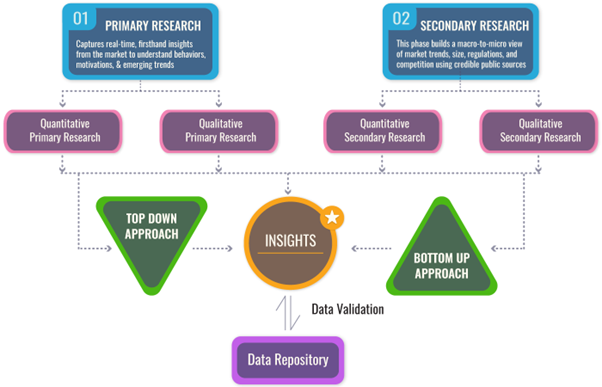
We follow a comprehensive, multi-phase research framework designed to deliver accurate, strategic, and decision-ready intelligence. Our process integrates primary and secondary research , both quantitative and qualitative , along with dual modeling techniques ( top-down and bottom-up) and a final layer of validation through our proprietary in-house repository.
PRIMARY RESEARCH
Primary research captures real-time, firsthand insights from the market to understand behaviors, motivations, and emerging trends.
1. Quantitative Primary Research
Objective: Generate statistically significant data directly from market participants.
Approaches:- Structured surveys with customers, distributors, and field agents
- Mobile-based data collection for point-of-sale audits and usage behavior
- Phone-based interviews (CATI) for market sizing and product feedback
- Online polling around industry events and digital campaigns
- Purchase frequency by customer type
- Channel performance across geographies
- Feature demand by application or demographic
2. Qualitative Primary Research
Objective: Explore decision-making drivers, pain points, and market readiness.
Approaches:- In-depth interviews (IDIs) with executives, product managers, and key decision-makers
- Focus groups among end users and early adopters
- Site visits and observational research for consumer products
- Informal field-level discussions for regional and cultural nuances
SECONDARY RESEARCH
This phase helps establish a macro-to-micro understanding of market trends, size, regulation, and competitive dynamics, sourced from credible and public domain information.
1. Quantitative Secondary Research
Objective: Model market value and segment-level forecasts based on published data.
Sources include:- Financial reports and investor summaries
- Government trade data, customs records, and regulatory statistics
- Industry association publications and economic databases
- Channel performance and pricing data from marketplace listings
- Revenue splits, pricing trends, and CAGR estimates
- Supply-side capacity and volume tracking
- Investment analysis and funding benchmarks
2. Qualitative Secondary Research
Objective: Capture strategic direction, innovation signals, and behavioral trends.
Sources include:- Company announcements, roadmaps, and product pipelines
- Publicly available whitepapers, conference abstracts, and academic research
- Regulatory body publications and policy briefs
- Social and media sentiment scanning for early-stage shifts
- Strategic shifts in market positioning
- Unmet needs and white spaces
- Regulatory triggers and compliance impact
DUAL MODELING: TOP-DOWN + BOTTOM-UP
To ensure robust market estimation, we apply two complementary sizing approaches:
Top-Down Modeling:- Start with broader industry value (e.g., global or regional TAM)
- Apply filters by segment, geography, end-user, or use case
- Adjust with primary insights and validation benchmarks
- Ideal for investor-grade market scans and opportunity mapping
- Aggregate from the ground up using sales volumes, pricing, and unit economics
- Use internal modeling templates aligned with stakeholder data
- Incorporate distributor-level or region-specific inputs
- Most accurate for emerging segments and granular sub-markets
DATA VALIDATION: IN-HOUSE REPOSITORY
We close the loop with proprietary data intelligence built from ongoing projects, industry monitoring, and historical benchmarking. This repository includes:
- Multi-sector market and pricing models
- Key trendlines from past interviews and forecasts
- Benchmarked adoption rates, churn patterns, and ROI indicators
- Industry-specific deviation flags and cross-check logic
- Catches inconsistencies early
- Aligns projections across studies
- Enables consistent, high-trust deliverables