

Security Service Edge Market Size and Forecast (2020 - 2033), Global and Regional Growth, Trend, Share, and Industry Analysis Report Coverage: By Component (Solutions and Services), By Organization Size (Large Enterprises and Small & Medium-sized Enterprises), By Vertical (BFSI, IT & Telecommunications, Government, Healthcare, Retail & E-commerce, Manufacturing, and Others) And Geography
2025-12-05
ICT
Ekta Chaurasia (Team Lead)
Description
Security Service Edge Market Overview
The Security Service Edge (SSE) Market is poised for explosive growth from 2025 to 2033, fueled by the permanent shift to hybrid work models, widespread cloud adoption, and the increasing sophistication of cyber threats targeting distributed users and data. The market is projected to be valued at approximately USD 4.5 billion in 2025 and is forecasted to reach nearly USD 10.1 billion by 2033, exhibiting a remarkable compound annual growth rate (CAGR) of 10.9% during this period.

Security Service Edge is a foundational
cloud-based security framework that delivers integrated, secure access to the
web, cloud services, and private applications. SSE converges key security
functions, including Zero Trust Network Access
(ZTNA), Secure Web Gateway (SWG), Cloud Access Security Broker (CASB), and
Firewall as a Service (FWaaS), into a single,
unified platform. The market's expansion is driven by the critical need to
secure a borderless workforce, reduce the complexity and cost of traditional security
appliances, and enforce consistent data security and compliance policies
regardless of user location.
Factors such as the escalating frequency of data
breaches, stringent regulatory requirements, and the strategic convergence of
SSE with SD-WAN into the broader SASE (Secure Access Service Edge) framework
are key contributors to market growth. North America currently holds the
largest market share due to early technology adoption and a high concentration
of cybersecurity vendors, while the Asia-Pacific region is expected to be the
fastest-growing market, fueled by rapid digital transformation and increasing cybersecurity
investments.
Security
Service Edge Market Drivers and Opportunities
The Paradigm Shift to Hybrid Work and Cloud-Centric Operations is the Primary Market Driver
The most significant driver for the SSE market
is the irreversible transition to hybrid and remote work models. This has
dismantled the traditional corporate network perimeter, making legacy security
architectures like VPNs inadequate and vulnerable. Organizations are urgently
seeking solutions that can provide secure, seamless, and performant access to
applications hosted in public clouds or data centers for users working from
anywhere. SSE directly addresses this need by moving security enforcement to
the cloud, closer to the user and the data, enabling a "never trust,
always verify" Zero Trust approach that is essential for modern business
continuity.
Escalating Cyber Threats and Stringent Data
Protection Regulations are Accelerating Adoption
The rising volume and sophistication of
cyberattacks, including phishing, ransomware, and data exfiltration, are
compelling organizations to rethink their security posture. Simultaneously,
stringent data privacy and compliance regulations like GDPR, CCPA, and others
mandate robust data protection measures. SSE solutions provide centralized
visibility and control over data access and movement across all cloud services
and internet traffic, helping organizations prevent data loss and demonstrate
compliance. This powerful combination of threat mitigation and regulatory
adherence is a major catalyst for market growth.
The Convergence with SD-WAN and the Proliferation of AI-driven security Present Significant Opportunities
The strategic convergence of SSE with
Software-Defined Wide Area Network (SD-WAN) to form the complete SASE
architecture presents a massive opportunity for vendors and service providers.
As enterprises modernize their networks, the demand for integrated SASE
offerings is skyrocketing. Furthermore, the integration of Artificial
Intelligence (AI) and Machine Learning (ML) within SSE platforms offers a
substantial growth frontier. Opportunities lie in developing AI-powered
capabilities for advanced threat detection, anomalous user behavior analytics, and automated policy enforcement, which can
significantly improve security efficacy and reduce the burden on IT teams.
Security Service Edge
Market Scope
|
Report Attributes |
Description |
|
Market Size in 2025 |
USD 4.5 Billion |
|
Market Forecast in 2033 |
USD 10.1 Billion |
|
CAGR % 2025-2033 |
10.9% |
|
Base Year |
2024 |
|
Historic Data |
2020-2024 |
|
Forecast Period |
2025-2033 |
|
Report USP |
Product Portfolio,
Technological Analysis, Company Market Share, Company Heatmap, Pricing
Analysis, Growth Factors and more |
|
Segments Covered |
●
By Component ●
By Organisation
Size ●
By Vertical |
|
Regional Scope |
●
North America, ●
Europe, ●
APAC, ●
Latin America ●
Middle East and
Africa |
|
Country Scope |
1)
U.S. 2)
Canada 3)
Germany 4)
UK 5)
France 6)
Spain 7)
Italy 8)
Switzerland 9)
China 10)
Japan 11)
India 12)
Australia 13)
South Korea 14)
Brazil 15)
Mexico 16)
Argentina 17)
South Africa 18)
Saudi Arabia 19)
UAE |
Security Service Edge
Market Report Segmentation Analysis
The global Security Service Edge
Market industry analysis is segmented by Component, by Organization Size, by
Vertical, and by Region.
The Solutions segment is
anticipated to command a dominant market share in 2025.
The Component segment is categorized into
Solutions and Services. The Solutions segment, which includes the integrated
platform and its core functionalities (ZTNA, SWG, CASB), is the largest revenue
generator. This is due to the critical need for the core security technology
itself. The Services segment (including professional and managed services) is
also growing rapidly as organizations seek expertise for implementation,
integration, and ongoing management of their complex SSE environment.
The Large Enterprises segment is projected to be
the major adopter, but SMEs present high growth potential.
The Organization Size segment is divided into
Large Enterprises and Small & Medium-sized Enterprises (SMEs). Large
Enterprises currently lead the market share due to their complex, distributed
IT environments, larger security budgets, and urgent need to secure a global
workforce. However, the SME segment is expected to grow at a significant rate,
as cloud-based SSE offers a cost-effective, scalable, and easy-to-manage
security solution that does not require heavy upfront investment in hardware,
making enterprise-grade security accessible to smaller organizations.
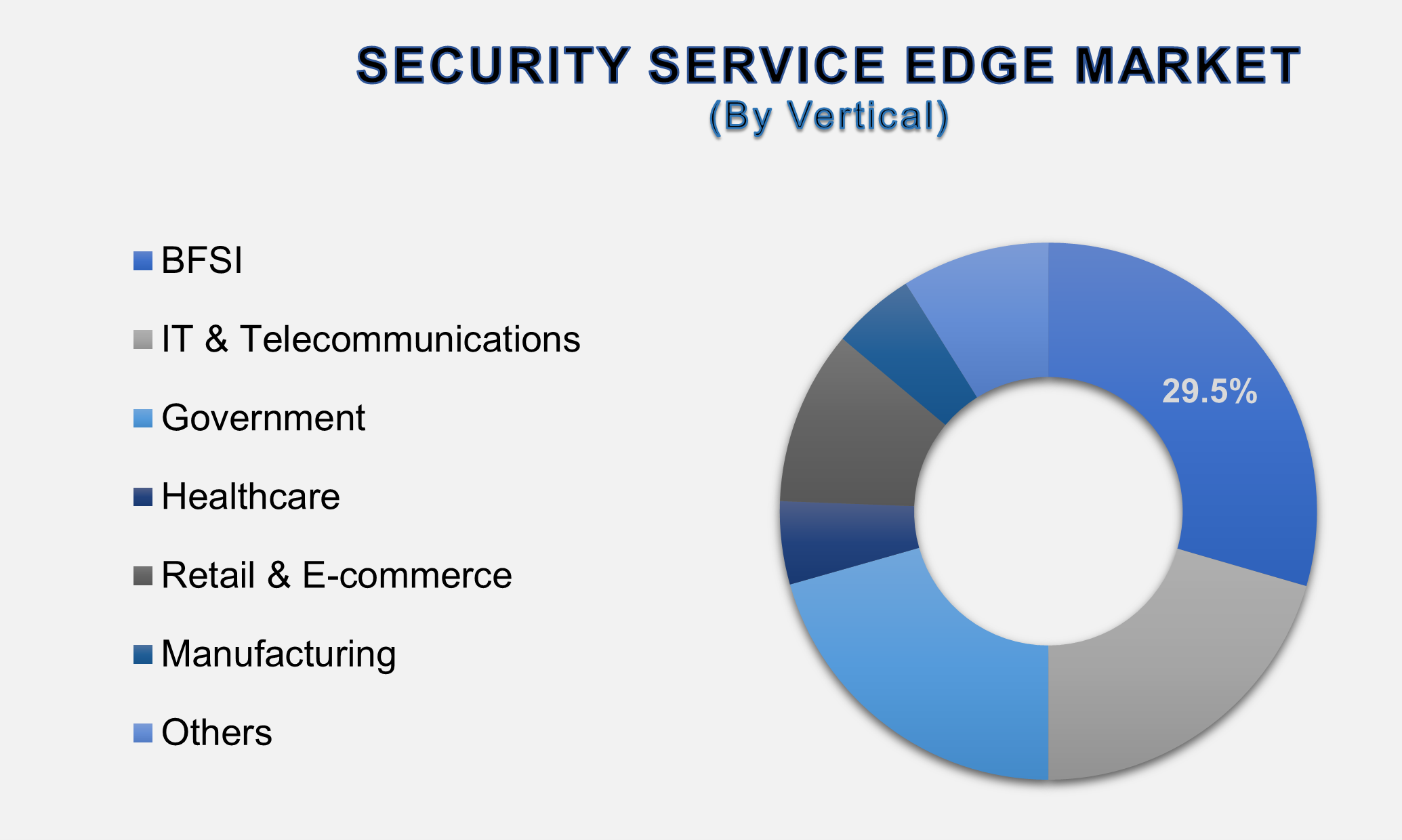
The BFSI and IT & Telecommunications
verticals hold the largest market share.
The BFSI (Banking, Financial Services, and
Insurance) and IT & Telecommunications verticals are the dominant adopters
of Security Service Edge (SSE) due to their unique and pressing security needs
in a distributed digital landscape. For the BFSI sector, the primary drivers
are the unparalleled sensitivity of financial data and the stringent, global
regulatory compliance mandates (such as GDPR, PCI DSS, and SOX). SSE directly
addresses these by enforcing a Zero Trust model, ensuring that no user or device
is inherently trusted, and providing granular control and visibility over data
access and movement. This is critical for protecting against sophisticated
threats like credential phishing and data exfiltration, which target highly
valuable financial information and customer records.
Simultaneously, the IT & Telecommunications
industry is inherently cloud-native and operates with a highly distributed,
remote, and mobile workforce. These companies are not only securing their own
internal operations but are also often the providers of the infrastructure and
services upon which other businesses rely. SSE solutions offer them a scalable,
high-performance security framework that eliminates the backhauling bottlenecks
of traditional VPNs, providing seamless and secure access to development environments,
cloud platforms, and internal applications from any location. The convergence
of their need to protect intellectual property, manage vast amounts of customer
data, and ensure constant service availability makes the integrated,
cloud-delivered security of SSE not just advantageous but a strategic
imperative for both verticals, solidifying their position as the largest market
shareholders.
The following segments are part of an in-depth analysis of
the global Security Service Edge Market:
|
Market
Segments |
|
|
By
Component |
●
Solutions ●
Services |
|
By
Organisation Size |
●
Large Enterprises ●
Small &
Medium-sized Enterprises (SMEs) |
|
By Vertical |
●
BFSI ●
IT &
Telecommunications ●
Government ●
Healthcare ●
Retail &
E-commerce ●
Manufacturing ●
Others |
Security Service Edge
Market Share Analysis by Region
The North America region is anticipated to hold
the largest portion of the Security Service Edge Market globally throughout the
forecast period.
North America's dominance is attributed to its
mature cybersecurity landscape, high concentration of leading SSE vendors, and
early and widespread adoption of cloud technologies. The region's large base of
enterprises with advanced digital transformation initiatives and a strong
regulatory environment mandating data protection further consolidates
its leading position. High awareness of Zero Trust principles and the need to
secure remote work are key factors driving the market in the U.S. and Canada.
In addition, the Asia-Pacific Security Service
Edge market is poised to be the fastest-growing. This growth is driven by rapid
economic digitalization, a booming SME sector, and increasing government focus
on national cybersecurity. Countries like China, India, Japan, and Australia
are witnessing massive investments in cloud infrastructure and a surge in
hybrid work models. The growing awareness of cyber threats and the need for
scalable, cloud-first security solutions are creating immense opportunities for
SSE providers in this dynamic region.
Security Service Edge
Market Competition Landscape Analysis
The global SSE market is
highly competitive and fragmented, featuring a mix of established cybersecurity
giants, pure-play SSE specialists, and networking vendors expanding into
security. Competition is intense and based on platform comprehensiveness, global
Points of Presence (PoP) coverage, performance, ease of use, and integration
capabilities with broader SASE and XDR ecosystems. Key strategies include
continuous feature innovation (especially in AI/ML and data loss prevention),
strategic acquisitions to fill portfolio gaps, and forming partnerships with
managed security service providers (MSSPs) to extend market reach, particularly
into the mid-market.
Global Security Service
Edge Market Recent Developments News:
- In March 2025, Palo Alto Networks announced the integration of
advanced AI-driven data classification directly into its Prisma SASE
platform, enabling automatic discovery and protection of sensitive data
across all cloud applications.
- In January 2025, Zscaler, Inc. launched a new dedicated SSE solution
tailored for the operational technology (OT) and Internet of Things (IoT)
environments, extending Zero Trust to connected devices.
- In November 2024, Netskope enhanced its NewEdge network with new
global points of presence in Latin America and Southeast Asia, focusing on
improved performance and low-latency access for regional customers.
- In September 2024, Cato Networks introduced a managed SASE service in
partnership with a global telecommunications provider, offering a fully
bundled network and security solution for multinational corporations.
The Global Security
Service Edge Market Is Dominated by a Few Large Companies, such as
●
Palo Alto Networks
(Prisma SASE)
●
Zscaler, Inc.
●
Broadcom (Symantec)
●
Cisco Systems, Inc.
●
Fortinet, Inc.
●
Netskope
●
Proofpoint, Inc.
●
Cato Networks
●
Forcepoint
●
Skyhigh Security
(McAfee Enterprise)
●
iboss
●
Check Point Software
Technologies Ltd.
●
Akamai Technologies
(Linode)
●
Trend Micro
Incorporated
●
Open Systems
●
Lookout, Inc.
● Other Prominent Players
Frequently Asked Questions
Ekta Chaurasia (Team Lead)
Ekta Chaurasia is a highly experienced Team Lead at M2Square Consultancy with over 7 years of expertise in market research, strategic consulting, competitive benchmarking, and business intelligence solutions. She specializes in ICT, semiconductors & electronics, automotive & transportation, and industrial machinery markets.
She leads end-to-end global research projects focused on market trends, industry analysis, growth forecasting, customer insights, and strategic decision-making. Known for her analytical leadership and industry expertise, Ekta helps businesses uncover growth opportunities, evaluate competitive landscapes, and stay ahead in rapidly evolving markets through accurate and insight-driven research.
1. Global Security Service
Edge Market Introduction and Market Overview
1.1.
Objectives
of the Study
1.2.
Global
Security Service Edge Market Scope and Market Estimation
1.2.1.Global Electronic Toll
Collection Overall Market Size (US$ Bn), Market CAGR (%), Market forecast (2025
- 2033)
1.2.2.Global Security Service
Edge Market Revenue Share (%) and Growth Rate (Y-o-Y) from 2020 - 2033
1.3.
Market
Segmentation
1.3.1.Component of Global Security
Service Edge Market
1.3.2.Organization Size of
Global Security Service Edge Market
1.3.3.Vertical of Global Security
Service Edge Market
1.3.4.Region of Global Security
Service Edge Market
2.
Executive Summary
2.1.
Demand
Side Trends
2.2.
Key
Market Trends
2.3.
Market
Demand (US$ Bn) Analysis 2020 – 2024 and forecast, 2025 – 2033
2.4.
Demand
and Opportunity Assessment
2.5.
Technological
Advancements
2.6.
Key
Developments
2.7.
Market
Entry Strategies
2.8.
Market
Dynamics
2.8.1.Drivers
2.8.2.Limitations
2.8.3.Opportunities
2.8.4.Impact Analysis of Drivers
and Restraints
2.9.
Porter’s
Five Forces Analysis
2.10.
PEST
Analysis
3. Global
Security Service Edge Market Estimates
& Historical Trend Analysis (2020 - 2024)
4. Global
Security Service Edge Market Estimates
& Forecast Trend Analysis, by Component
4.1.
Global
Security Service Edge Market Revenue (US$ Bn) Estimates and Forecasts, by Component,
2020 - 2033
4.1.1.Solutions
4.1.2.Services
5. Global
Security Service Edge Market Estimates
& Forecast Trend Analysis, by Organization Size
5.1.
Global
Security Service Edge Market Revenue (US$ Bn) Estimates and Forecasts, by Organization
Size, 2020 - 2033
5.1.1.Large Enterprises
5.1.2.Small & Medium-sized
Enterprises (SMEs)
6. Global
Security Service Edge Market Estimates
& Forecast Trend Analysis, by Vertical
6.1.
Global
Security Service Edge Market Revenue (US$ Bn) Estimates and Forecasts, by Vertical
2020 - 2033
6.1.1.BFSI
6.1.2.IT &
Telecommunications
6.1.3.Government
6.1.4.Healthcare
6.1.5.Retail & E-commerce
6.1.6.Manufacturing
6.1.7.Others
7. Global
Security Service Edge Market Estimates
& Forecast Trend Analysis, by region
7.1.
Global
Security Service Edge Market Revenue (US$ Bn) Estimates and Forecasts, by region,
2020 - 2033
7.1.1.North America
7.1.2.Europe
7.1.3.Asia Pacific
7.1.4.Middle East & Africa
7.1.5.Latin America
8. North America Security
Service Edge Market: Estimates &
Forecast Trend Analysis
8.1. North America Security
Service Edge Market Assessments & Key Findings
8.1.1.North America Security
Service Edge Market Introduction
8.1.2.North America Security
Service Edge Market Size Estimates and Forecast (US$ Billion) (2020 - 2033)
8.1.2.1.
By Component
8.1.2.2.
By Organization Size
8.1.2.3.
By Vertical
8.1.2.4. By Country
8.1.2.4.1. The U.S.
8.1.2.4.2. Canada
9. Europe Security
Service Edge Market: Estimates &
Forecast Trend Analysis
9.1. Europe Security Service
Edge Market Assessments & Key Findings
9.1.1.Europe Security Service
Edge Market Introduction
9.1.2.Europe Security Service
Edge Market Size Estimates and Forecast (US$ Billion) (2020 - 2033)
9.1.2.1.
By Component
9.1.2.2.
By Organization Size
9.1.2.3.
By Vertical
9.1.2.4. By Country
9.1.2.4.1.
Germany
9.1.2.4.2.
Italy
9.1.2.4.3.
U.K.
9.1.2.4.4.
France
9.1.2.4.5.
Spain
9.1.2.4.6.
Switzerland
9.1.2.4.7. Rest
of Europe
10. Asia Pacific Security
Service Edge Market: Estimates &
Forecast Trend Analysis
10.1. Asia Pacific Market
Assessments & Key Findings
10.1.1.
Asia
Pacific Security Service Edge Market Introduction
10.1.2.
Asia
Pacific Security Service Edge Market Size Estimates and Forecast (US$ Billion)
(2020 - 2033)
10.1.2.1.
By Component
10.1.2.2.
By Organization Size
10.1.2.3.
By Vertical
10.1.2.4. By Country
10.1.2.4.1. China
10.1.2.4.2. Japan
10.1.2.4.3. India
10.1.2.4.4. Australia
10.1.2.4.5. South Korea
10.1.2.4.6. Rest of Asia Pacific
11. Middle East & Africa Security
Service Edge Market: Estimates &
Forecast Trend Analysis
11.1. Middle East & Africa
Market Assessments & Key Findings
11.1.1. Middle
East & Africa
Security Service Edge Market Introduction
11.1.2. Middle
East & Africa
Security Service Edge Market Size Estimates and Forecast (US$ Billion) (2020 - 2033)
11.1.2.1.
By Component
11.1.2.2.
By Organization Size
11.1.2.3.
By Vertical
11.1.2.4. By Country
11.1.2.4.1. UAE
11.1.2.4.2. Saudi
Arabia
11.1.2.4.3. South
Africa
11.1.2.4.4. Rest
of MEA
12. Latin America
Security Service Edge Market: Estimates
& Forecast Trend Analysis
12.1. Latin America Market
Assessments & Key Findings
12.1.1. Latin America Security
Service Edge Market Introduction
12.1.2. Latin America Security
Service Edge Market Size Estimates and Forecast (US$ Billion) (2020 - 2033)
12.1.2.1.
By Component
12.1.2.2.
By Organization Size
12.1.2.3.
By Vertical
12.1.2.4. By Country
12.1.2.4.1. Brazil
12.1.2.4.2. Argentina
12.1.2.4.3. Mexico
12.1.2.4.4. Rest
of LATAM
13.
Country
Wise Market: Introduction
14.
Competition
Landscape
14.1. Global Security Service
Edge Market Product Mapping
14.2. Global Security Service
Edge Market Concentration Analysis, by Leading Players / Innovators / Emerging
Players / New Entrants
14.3. Global Security Service
Edge Market Tier Structure Analysis
14.4. Global Security Service
Edge Market Concentration & Company Market Shares (%) Analysis, 2024
15.
Company
Profiles
15.1.
Palo Alto Networks (Prisma SASE)
15.1.1.
Company
Overview & Key Stats
15.1.2.
Financial
Performance & KPIs
15.1.3.
Product
Portfolio
15.1.4.
SWOT
Analysis
15.1.5.
Business
Strategy & Recent Developments
* Similar details would be provided for all the players
mentioned below
15.2.
Zscaler, Inc.
15.3.
Broadcom (Symantec)
15.4.
Cisco Systems, Inc.
15.5.
Fortinet, Inc.
15.6.
Netskope
15.7.
Proofpoint, Inc.
15.8.
Cato Networks
15.9.
Forcepoint
15.10.
Skyhigh Security (McAfee Enterprise)
15.11.
iboss
15.12.
Check Point Software Technologies Ltd.
15.13.
Akamai Technologies (Linode)
15.14.
Trend Micro Incorporated
15.15.
Open Systems
15.16.
Lookout, Inc.
15.17.
Other Prominent Players
16. Research
Methodology
16.1. External Transportations /
Databases
16.2. Internal Proprietary
Database
16.3. Primary Research
16.4. Secondary Research
16.5. Assumptions
16.6. Limitations
16.7. Report FAQs
17. Research
Findings & Conclusion
Our Research Methodology
"Insight without rigor is just noise."
We follow a comprehensive, multi-phase research framework designed to deliver accurate, strategic, and decision-ready intelligence. Our process integrates primary and secondary research , both quantitative and qualitative , along with dual modeling techniques ( top-down and bottom-up) and a final layer of validation through our proprietary in-house repository.
PRIMARY RESEARCH
Primary research captures real-time, firsthand insights from the market to understand behaviors, motivations, and emerging trends.
1. Quantitative Primary Research
Objective: Generate statistically significant data directly from market participants.
Approaches:- Structured surveys with customers, distributors, and field agents
- Mobile-based data collection for point-of-sale audits and usage behavior
- Phone-based interviews (CATI) for market sizing and product feedback
- Online polling around industry events and digital campaigns
- Purchase frequency by customer type
- Channel performance across geographies
- Feature demand by application or demographic
2. Qualitative Primary Research
Objective: Explore decision-making drivers, pain points, and market readiness.
Approaches:- In-depth interviews (IDIs) with executives, product managers, and key decision-makers
- Focus groups among end users and early adopters
- Site visits and observational research for consumer products
- Informal field-level discussions for regional and cultural nuances
SECONDARY RESEARCH
This phase helps establish a macro-to-micro understanding of market trends, size, regulation, and competitive dynamics, sourced from credible and public domain information.
1. Quantitative Secondary Research
Objective: Model market value and segment-level forecasts based on published data.
Sources include:- Financial reports and investor summaries
- Government trade data, customs records, and regulatory statistics
- Industry association publications and economic databases
- Channel performance and pricing data from marketplace listings
- Revenue splits, pricing trends, and CAGR estimates
- Supply-side capacity and volume tracking
- Investment analysis and funding benchmarks
2. Qualitative Secondary Research
Objective: Capture strategic direction, innovation signals, and behavioral trends.
Sources include:- Company announcements, roadmaps, and product pipelines
- Publicly available whitepapers, conference abstracts, and academic research
- Regulatory body publications and policy briefs
- Social and media sentiment scanning for early-stage shifts
- Strategic shifts in market positioning
- Unmet needs and white spaces
- Regulatory triggers and compliance impact
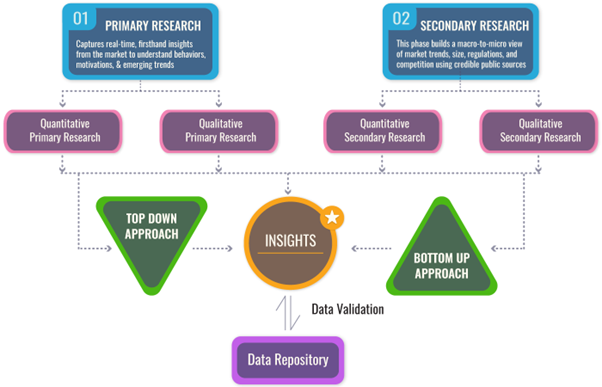
DUAL MODELING: TOP-DOWN + BOTTOM-UP
To ensure robust market estimation, we apply two complementary sizing approaches:
Top-Down Modeling:- Start with broader industry value (e.g., global or regional TAM)
- Apply filters by segment, geography, end-user, or use case
- Adjust with primary insights and validation benchmarks
- Ideal for investor-grade market scans and opportunity mapping
- Aggregate from the ground up using sales volumes, pricing, and unit economics
- Use internal modeling templates aligned with stakeholder data
- Incorporate distributor-level or region-specific inputs
- Most accurate for emerging segments and granular sub-markets
DATA VALIDATION: IN-HOUSE REPOSITORY
We close the loop with proprietary data intelligence built from ongoing projects, industry monitoring, and historical benchmarking. This repository includes:
- Multi-sector market and pricing models
- Key trendlines from past interviews and forecasts
- Benchmarked adoption rates, churn patterns, and ROI indicators
- Industry-specific deviation flags and cross-check logic
- Catches inconsistencies early
- Aligns projections across studies
- Enables consistent, high-trust deliverables