

Single Trip Travel Insurance Market Size and Forecast (2020-2033), Global and Regional Growth, Trend, Share and Industry Analysis Report Coverage; Coverage Type (Medical Coverage, Trip Cancellation, Baggage Loss, Travel Delay, Personal Liability, and Others), Distribution Channel (Insurance Intermediaries, Insurance Companies, Banks, Insurance brokers, and Insurance Aggregators), End User (Senior Citizens, Education Travelers, Business Travelers, Family Travelers, and Others), and Geography
2026-02-05
Business & Financial Services
Ekta Chaurasia (Team Lead)
Description
Single
Trip Travel Insurance Market Overview
The global Single
Trip Travel Insurance Market is experiencing strong growth, driven by the rapid
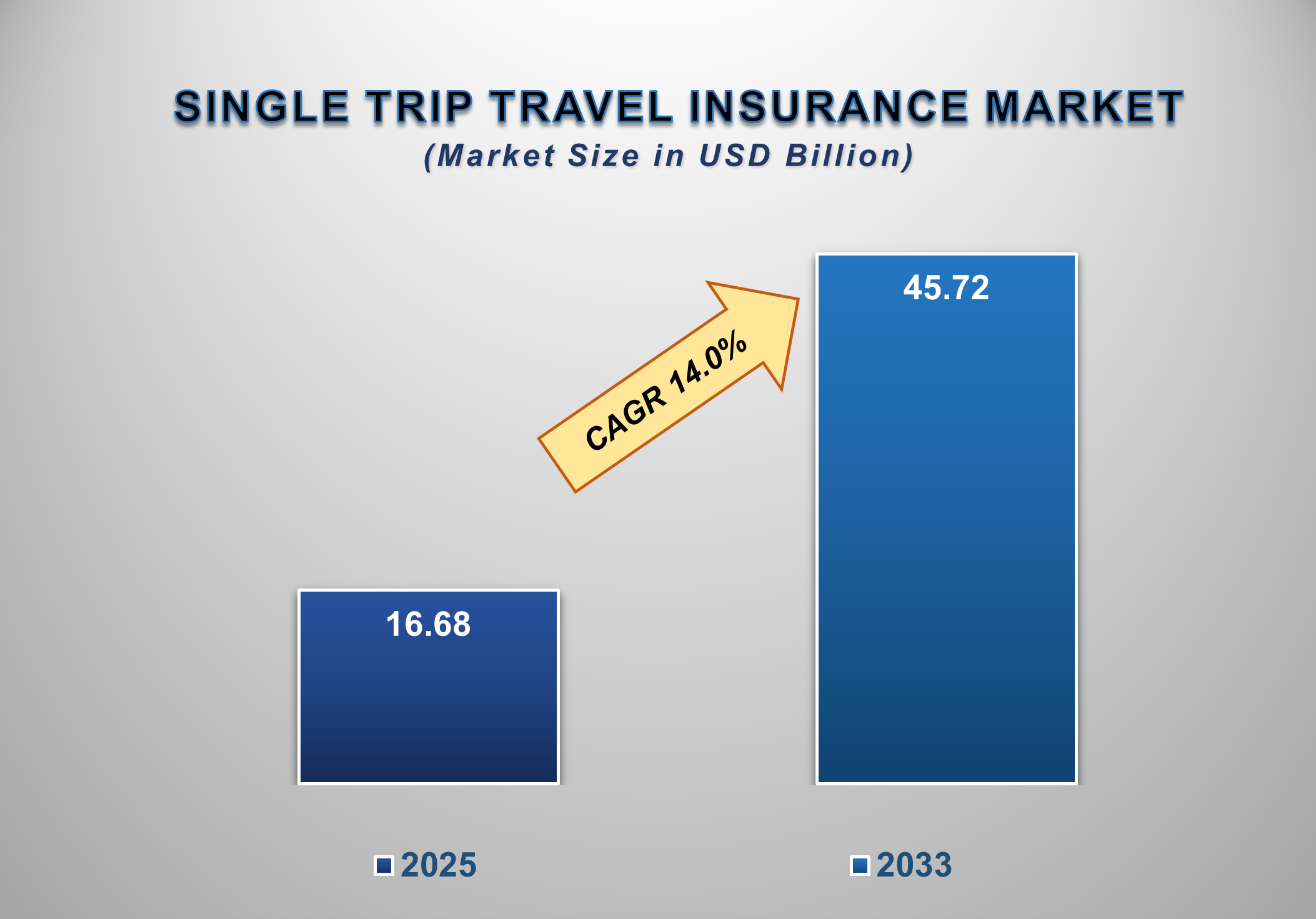
digitalization of travel services. Valued at USD 16.68 billion in 2025,
the market is projected to reach USD 45.72 billion by 2033, growing at a CAGR
of 14.0% during the forecast period.
The Single Trip Travel Insurance Market
includes insurance policies designed to protect travelers during a single
journey. These policies protect against unanticipated circumstances such as
medical emergencies, trip cancellations, baggage loss, travel delays, and
personal liability. Families, students, business travelers, and infrequent
travelers who don't travel often enough to warrant yearly multi-trip plans all
favor these arrangements.
Market growth is driven by rising domestic and international travel, increasing
awareness of travel-related risks, and the high cost of medical care abroad.
Demand is also supported by the fact that many nations' visa regulations
necessitate travel medical insurance. Adoption of single trip policies has also
increased due to the rising frequency of non-refundable travel reservations and
airline delays.
Digitalization plays a key role in market
expansion, as online platforms, aggregators, and mobile applications enable
faster and more convenient policy comparison and purchase. Travelers can now
customize plans according to destination, trip duration, and risk profile
thanks to insurers' growing offerings of modular and customized coverage
choices.
North America and Europe have substantial regional market shares due to high
travel spending and insurance penetration, while Asia-Pacific is developing
into a rapidly increasing industry driven by rising middle-class populations
and outbound travel. The market for single trip travel insurance is anticipated
to increase steadily overall due to changing travel habits, advances in
technology, and growing customer concern for financial security and comfort
when traveling.
Single
Trip Travel Insurance Market Drivers and Opportunities
Growth in Global Travel
Activity
One of the main factors propelling the single
trip travel insurance industry is the consistent rise in both domestic and
international travel. More individuals are traveling for business, pleasure,
education, and visiting friends and family due to rising disposable incomes,
growing middle-class populations, and more affordable air travel. Compared to
annual multi-trip plans, single trip travel insurance is still the more popular
and economical choice because many of these travelers only take one or two trips
annually.
Rising Healthcare Costs Abroad
The need for single trip travel insurance is
largely driven by the high and unpredictable medical costs in foreign nations.
In regions like North America and Europe, even simple medical procedures can be
expensive, and emergency hospital stays or evacuations can have a significant
financial impact. Medical coverage is the biggest and most crucial part of
single trip travel insurance premiums since travelers are becoming more aware
of its significance.
Visa and Regulatory Requirements
When applying for a visa, many
countries—especially those in Europe and certain regions of Asia—require proof
of travel medical insurance. The adoption of single trip travel insurance is
directly influenced by these mandatory regulations, particularly among
tourists, students, and short-term business visitors. A steady supply of policy
purchases is guaranteed by compliance-driven demand.
Digital Distribution and Ease of Purchase
The buying process has become easier due to
the rapid expansion of digital platforms, online aggregators, and insurer
websites. In a matter of minutes, travelers can quickly examine coverage
options, costs, and benefits, frequently when making travel or lodging
arrangements. This ease of use has greatly improved penetration, especially
among younger, tech-savvy customers.
Customization and Modular Policy Offerings
Insurance companies have a great chance to
provide highly customizable single trip travel insurance policies. More and
more travelers are looking for coverage that is customized to meet their unique
needs, including senior traveler requirements, trip duration, destination-based
hazards, and adventurous activities. Insurance companies can differentiate
their products and raise premium value by offering modular add-ons like
adventure sports coverage, increased medical limits, or flexible cancellation
choices.
Expansion in Emerging Markets
There are substantial growth prospects in
emerging economies, especially in the Asia-Pacific, Latin America, and portions
of the Middle East. Favorable conditions for market expansion are being created
by rising overseas travel, growing awareness of insurance benefits, and
advancements in digital infrastructure. Insurance companies can take advantage
of unmet demand in these areas by localizing their products, prices, and
distribution methods.
Single Trip Travel Insurance Market Scope
|
Report Attributes |
Description |
|
Market Size in
2025 |
USD 16.68
Billion |
|
Market Forecast
in 2033 |
USD 45.72
Billion |
|
CAGR % 2025-2033 |
14.0% |
|
Base Year |
2024 |
|
Historic Data |
2020-2024 |
|
Forecast Period |
2025-2033 |
|
Report USP |
Comprehensive
global Single Trip Travel Insurance Market size and forecast analysis,
Coverage Type and distribution channel assessment, end-user consumption
trends, retail and online sales performance evaluation, regional and
country-level market insights, competitive landscape and market share
analysis, technological advancements in digital underwriting and claims
processing, digital transformation and e-commerce impact, growth drivers,
challenges, opportunities, and strategic insights for insurers, brokers,
travel platforms, and investors |
|
Segments Covered |
●
By
Coverage Type ●
By
Distribution Channel ●
By End
User |
|
Regional Scope |
●
North
America ●
Europe ●
APAC ●
Latin
America ●
Middle
East and Africa |
|
Country Scope |
1)
U.S. 2)
Canada
3)
U.K. 4)
Germany
5)
France
6)
Italy 7)
Spain 8)
Switzerland
9)
China
10)
India
11)
Japan 12)
South
Korea 13)
Australia 14)
Mexico
15)
Brazil
16)
Argentina
17)
Saudi
Arabia 18)
UAE 19)
South
Africa |
Single Trip
Travel Insurance Market Report Segmentation Analysis
The global Single
Trip Travel Insurance Market analysis is segmented by Coverage Type,
Distribution Channel, End User, and Region.
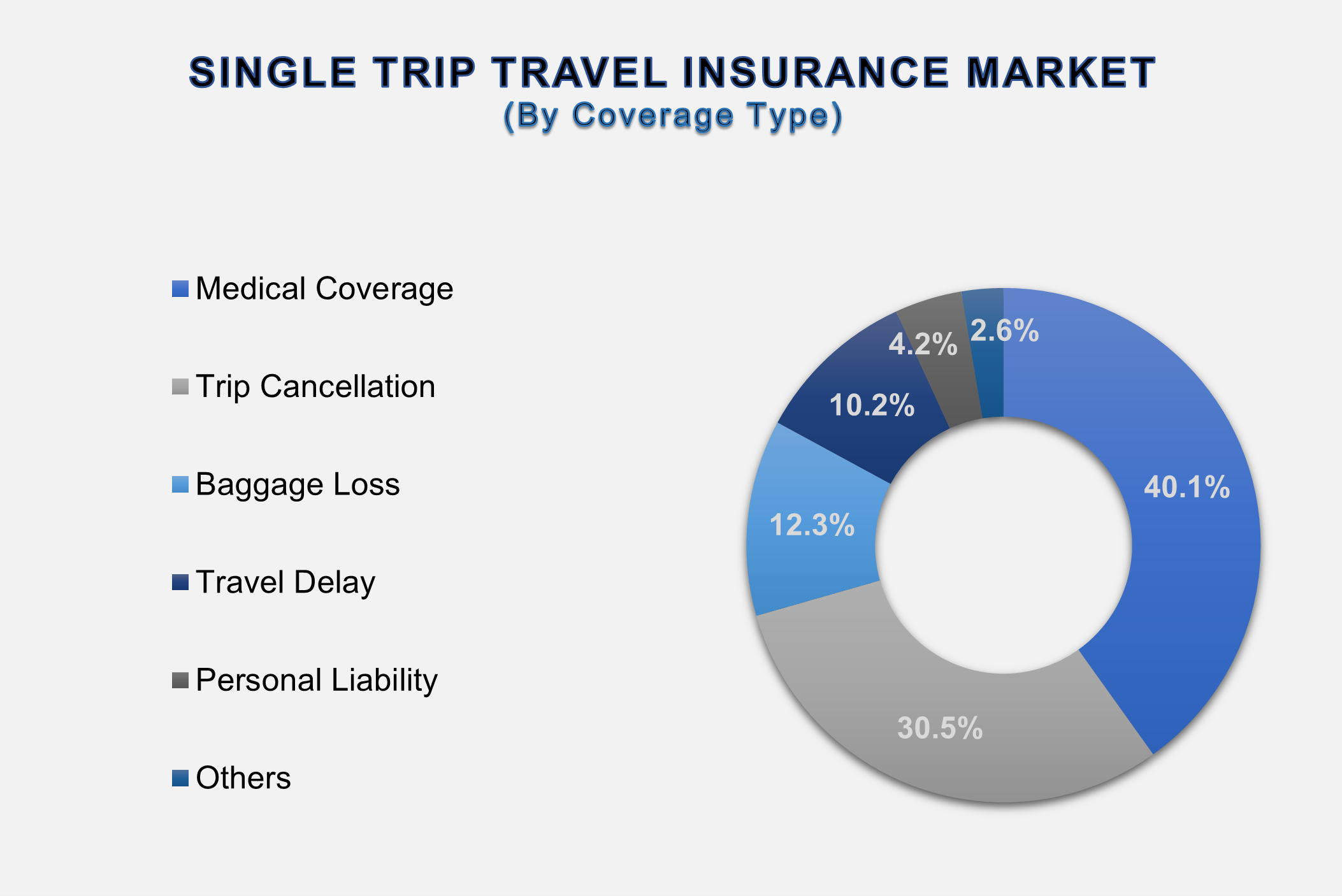
The Medical
Coverage segment dominated the market in 2025 and is projected to grow at the
highest CAGR during the forecast period.
By Coverage Type,
the Single Trip Travel Insurance Market is segmented into Medical Coverage,
Trip Cancellation, Baggage Loss, Travel Delay, Personal Liability, and Others.
The medical coverage segment accounts for the largest share of the global
Single Trip Travel Insurance Market. The single trip travel insurance market's
largest and most important sector is medical coverage. It offers financial
security against unforeseen medical costs incurred while traveling, such as
emergency care, hospital stays, outpatient care, and, frequently, medical
evacuation or repatriation. Demand for this market is heavily influenced by the
high cost of healthcare in other nations and the restricted coverage offered by
local health insurance policies. Its adoption is further supported by the fact
that a number of nations require travel medical insurance in order to approve
visas. Medical coverage is still the mainstay of single trip travel insurance
policies due to rising global mobility and growing traveler knowledge of health
hazards.
Insurance
Intermediaries hold the highest share of the Distribution Channel Segment over
the forecast period
Based on Distribution Channel, the market is bifurcated into Insurance
Intermediaries, Insurance Companies, Banks, Insurance brokers, and Insurance
Aggregators. The insurance intermediaries segment accounts for the largest
share of the market. By facilitating policy selection and purchase and acting
as an interface between insurers and end users, insurance intermediaries play a
critical role. Intermediaries are essential to the single trip travel insurance
market. Brokers, agents, and travel insurance aggregators that provide
individualized guidance, product comparisons, and customized coverage
alternatives are included in this category. Intermediaries assist travelers in
understanding complicated insurance terms, coverage limitations, and exclusions
in order to boost trust and adoption rates. Competitive pricing and customized
solutions are made possible by their solid connections with insurers and the availability
of a variety of goods. Intermediaries are rapidly using online tools and mobile
applications to expand their customer base, expedite sales procedures, and
boost overall service efficiency as a result of the expansion of digital
platforms.
The Family
Travelers Segment will probably dominate the market during the forecast period
In terms of End
User, the Single Trip Travel Insurance Market is segmented into Senior
Citizens, Education Travelers, Business Travelers, Family Travelers, and
Others. The family travelers segment holds the largest share of the Single Trip
Travel Insurance Market. In the single trip travel insurance market, family
travelers constitute a significant end-user group due to their requirement for
comprehensive cover for several people under a single policy. Families usually
give priority to coverage such as medical emergencies, vacation cancellation,
baggage loss, and travel delays to protect against unforeseen disruptions.
Insurance is a crucial necessity when traveling with kids or senior family
members increases risk exposure. Families who take sporadic vacations like
single trip plans because they provide flexible and affordable coverage for
certain trips. This segment's consistent demand is sustained by rising family
vacation travel and increased awareness of financial protection.
The following
segments are part of an in-depth analysis of the global Single Trip Travel
Insurance Market:
|
Market Segments |
|
|
By
Coverage Type |
●
Medical
Coverage ●
Trip
Cancellation ●
Baggage
Loss ●
Travel
Delay ●
Personal
Liability ●
Others |
|
By
Distribution Channel |
●
Banks ●
Insurance
brokers ●
Insurance
Aggregators ●
Insurance
Intermediaries ●
Insurance
Companies |
|
By End
User |
●
Senior
Citizens ●
Education
Travelers ●
Business
Travelers ●
Family
Travelers ●
Others |
Single Trip Travel Insurance Market Share
Analysis by Region
The Asia-Pacific
region is projected to hold the largest share of the global Single Trip Travel
Insurance Market over the forecast period.
The
Asia-Pacific region is projected to hold the largest share of the global Single
Trip Travel Insurance Market over the forecast period and is also expected to
be the fastest-growing region. Growing middle-class populations, increased
outbound tourism, and rising disposable incomes are the main drivers of the
Asia-Pacific region's economy. Travel, both domestically and internationally,
is rapidly increasing in countries like China, India, Japan, Australia, and
Southeast Asian countries. Adoption is being encouraged by increased knowledge
of travel-related concerns, growing healthcare expenditures overseas, and the
need for visa insurance. Access to insurance products has improved due to the
rapid expansion of digital platforms, smartphone apps, and online travel
agents. In order to capture growth throughout the area, insurers are
concentrating on regional offers and competitive pricing as the frequency of
travel rises.
Global
Single Trip Travel Insurance Market Recent Developments News:
●
In June 2024,
for USD 600 million, Zurich Insurance Group consented to purchase American
International Group's worldwide personal travel insurance and support division,
which includes the Travel Guard brand, to expand its global reach and retail customer base, especially in
the US market.
●
In December
2024, Allianz Global Assistance introduced a new digital travel insurance
platform that improves user experience and digital sales by enabling passengers
to rapidly create and purchase policies via smartphones.
●
In January
2025, Zurich Insurance (Singapore) Ltd. and ComfortDelGro Corporation
collaborated to introduce Zurich Travel Comfort, which is incorporated into the
CDG Zig ride-hailing app and improves accessibility to travel insurance within
a digital ecosystem.
The
Global Single Trip Travel Insurance Market is dominated by a few large
companies, such as
●
Allianz Global
Assistance
●
AIG Travel
●
AXA Assistance
●
Generali
Global Assistance
●
Zurich
Insurance Group
●
Berkshire
Hathaway Travel Protection
●
Seven Corners
●
Travelex
Insurance Services
●
World Nomads
●
IMG
(International Medical Group)
●
CSA Travel
Protection
●
Cover-More
Group
●
John Hancock
Insurance Agency
●
Nationwide
Insurance
●
The Hartford
●
GeoBlue
●
HTH Worldwide
●
RoamRight
●
USI Affinity
● InsureMyTrip
Frequently Asked Questions
Ekta Chaurasia (Team Lead)
Ekta Chaurasia is a highly experienced Team Lead at M2Square Consultancy with over 7 years of expertise in market research, strategic consulting, competitive benchmarking, and business intelligence solutions. She specializes in ICT, semiconductors & electronics, automotive & transportation, and industrial machinery markets.
She leads end-to-end global research projects focused on market trends, industry analysis, growth forecasting, customer insights, and strategic decision-making. Known for her analytical leadership and industry expertise, Ekta helps businesses uncover growth opportunities, evaluate competitive landscapes, and stay ahead in rapidly evolving markets through accurate and insight-driven research.
1.
Global Single Trip Travel Insurance Market Introduction and Market
Overview
1.1.
Objectives of the Study
1.2.
Global Single Trip Travel Insurance Market Scope and Market
Estimation
1.2.1.Global Single
Trip Travel Insurance Overall Market Size (US$ Bn), Market CAGR (%), Market
forecast (2025 - 2033)
1.2.2.Global Single
Trip Travel Insurance Market Revenue Share (%) and Growth Rate (Y-o-Y) from 2020
- 2033
1.3.
Market Segmentation
1.3.1.Coverage Type
of Global Single Trip Travel Insurance Market
1.3.2.Distribution
Channel of Global Single Trip Travel Insurance Market
1.3.3.End User of
Global Single Trip Travel Insurance Market
1.3.4.Region of
Global Single Trip Travel Insurance Market
2.
Executive
Summary
2.1.
Demand Side Trends
2.2.
Key Market Trends
2.3.
Market Demand (US$ Bn) Analysis 2020 – 2024 and Forecast, 2025 – 2033
2.4.
Demand and Opportunity Assessment
2.5.
Market Dynamics
2.5.1.Drivers
2.5.2.Limitations
2.5.3.Opportunities
2.5.4.Impact
Analysis of Drivers and Restraints
2.6.
Porter’s Five Forces Analysis
2.7.
PEST Analysis
2.8.
Key Regulation
2.9.
Key Developments
2.10. Value
Chain / Ecosystem Analysis
3.
Global
Single Trip Travel Insurance Market Estimates & Historical Trend Analysis (2020 - 2024)
4. Global Single Trip Travel Insurance Market Estimates & Forecast Trend Analysis, by Coverage Type
4.1.
Global Single Trip Travel Insurance Market Revenue (US$ Bn)
Estimates and Forecasts, by Coverage Type, 2020 - 2033
4.1.1.Medical
Coverage
4.1.2.Trip
Cancellation
4.1.3.Baggage Loss
4.1.4.Travel Delay
4.1.5.Personal
Liability
4.1.6.Others
5. Global Single Trip Travel Insurance Market Estimates & Forecast Trend Analysis, by Distribution Channel
5.1.
Global Single Trip Travel Insurance Market Revenue (US$ Bn)
Estimates and Forecasts, by Distribution Channel, 2020 - 2033
5.1.1.Banks
5.1.2.Insurance
brokers
5.1.3.Insurance
Aggregators
5.1.4.Insurance
Intermediaries
5.1.5.Insurance
Companies
6. Global Single Trip Travel Insurance Market Estimates & Forecast Trend Analysis, by End User
6.1.
Global Single Trip Travel Insurance Market Revenue (US$ Bn)
Estimates and Forecasts, by End User, 2020 - 2033
6.1.1.Senior
Citizens
6.1.2.Education
Travelers
6.1.3.Business
Travelers
6.1.4.Family
Travelers
6.1.5.Others
7.
Global
Single Trip Travel Insurance Market Estimates & Forecast Trend Analysis, by Region
7.1.
Global Single Trip Travel Insurance Market Revenue (US$ Bn)
Estimates and Forecasts, by Region, 2020 - 2033
7.1.1.North America
7.1.2.Europe
7.1.3.Asia Pacific
7.1.4.Middle East
& Africa
7.1.5.Latin America
8.
North America Single
Trip Travel Insurance Market: Estimates
& Forecast Trend Analysis
8.1.
North America Single Trip Travel Insurance Market Assessments
& Key Findings
8.1.1.North America
Single Trip Travel Insurance Market Introduction
8.1.2.North America
Single Trip Travel Insurance Market Size Estimates and Forecast (US$ Billion) (2020
- 2033)
8.1.2.1. By Coverage Type
8.1.2.2. By Distribution Channel
8.1.2.3. By End User
8.1.2.4.
By Country
8.1.2.4.1.
The U.S.
8.1.2.4.2.
Canada
9.
Europe Single
Trip Travel Insurance Market: Estimates
& Forecast Trend Analysis
9.1.
Europe Single Trip Travel Insurance Market Assessments & Key
Findings
9.1.1.Europe Single
Trip Travel Insurance Market Introduction
9.1.2.Europe Single
Trip Travel Insurance Market Size Estimates and Forecast (US$ Billion) (2020 - 2033)
9.1.2.1. By Coverage Type
9.1.2.2. By Distribution Channel
9.1.2.3. By End User
9.1.2.4. By
Country
9.1.2.4.1.
Germany
9.1.2.4.2.
Italy
9.1.2.4.3.
U.K.
9.1.2.4.4.
France
9.1.2.4.5.
Spain
9.1.2.4.6.
Russia
9.1.2.4.7.
Rest
of Europe
10.
Asia Pacific Single
Trip Travel Insurance Market: Estimates
& Forecast Trend Analysis
10.1. Asia
Pacific Single Trip Travel Insurance Market Assessments & Key Findings
10.1.1.
Asia Pacific Single Trip Travel Insurance Market Introduction
10.1.2.
Asia Pacific Single Trip Travel Insurance Market Size Estimates
and Forecast (US$ Billion) (2020 - 2033)
10.1.2.1. By Coverage Type
10.1.2.2. By Distribution Channel
10.1.2.3. By End User
10.1.2.4.
By Country
10.1.2.4.1.
China
10.1.2.4.2.
Japan
10.1.2.4.3.
India
10.1.2.4.4.
Australia
10.1.2.4.5.
South Korea
10.1.2.4.6. Rest
of Asia Pacific
11.
Middle East & Africa Single Trip Travel Insurance Market: Estimates & Forecast Trend Analysis
11.1. Middle
East & Africa Single Trip Travel Insurance Market Assessments & Key
Findings
11.1.1.
Middle East & Africa Single
Trip Travel Insurance Market Introduction
11.1.2.
Middle East & Africa Single
Trip Travel Insurance Market Size Estimates and Forecast (US$ Billion) (2020 - 2033)
11.1.2.1. By Coverage Type
11.1.2.2. By Distribution Channel
11.1.2.3. By End User
11.1.2.4.
By Country
11.1.2.4.1.
UAE
11.1.2.4.2.
Saudi Arabia
11.1.2.4.3.
South Africa
11.1.2.4.4. Rest of MEA
12.
Latin America Single
Trip Travel Insurance Market: Estimates
& Forecast Trend Analysis
12.1. Latin
America Event Industry Assessments & Key Findings
12.1.1.
Latin America Single Trip Travel Insurance Market Introduction
12.1.2.
Latin America Single Trip Travel Insurance Market Size Estimates
and Forecast (US$ Billion) (2020 - 2033)
12.1.2.1. By Coverage Type
12.1.2.2. By Distribution Channel
12.1.2.3. By End User
12.1.2.4.
By Country
12.1.2.4.1.
Brazil
12.1.2.4.2.
Mexico
12.1.2.4.3.
Argentina
12.1.2.4.4. Rest of LATAM
13.
Country Wise Market: Introduction
14. Competition
Landscape
14.1. Global
Single Trip Travel Insurance Market Product Mapping
14.2. Global
Single Trip Travel Insurance Market Concentration Analysis, by Leading Players
/ Innovators / Emerging Players / New Entrants
14.3. Global
Single Trip Travel Insurance Market Tier Structure Analysis
14.4. Global
Single Trip Travel Insurance Market Concentration & Company Market Shares
(%) Analysis, 2024
15. Company
Profiles
15.1.
Allianz Global Assistance
15.1.1.
Company Overview & Key Stats
15.1.2.
Financial Performance & KPIs
15.1.3.
Product Portfolio
15.1.4.
SWOT Analysis
15.1.5.
Business Strategy & Recent Developments
*
Similar details would be provided for all the players mentioned below
15.2.
AIG Travel
15.3.
AXA Assistance
15.4.
Generali Global Assistance
15.5.
Zurich Insurance Group
15.6.
Berkshire Hathaway Travel Protection
15.7.
Seven Corners
15.8.
Travelex Insurance Services
15.9.
World Nomads
15.10.
IMG (International Medical Group)
15.11.
CSA Travel Protection
15.12.
Cover-More Group
15.13.
John Hancock Insurance Agency
15.14.
Nationwide Insurance
15.15.
The Hartford
15.16.
GeoBlue
15.17.
HTH Worldwide
15.18.
RoamRight
15.19.
USI Affinity
15.20.
Other Prominent Players
16.
Research
Methodology
16.1. External
Transportations / Databases
16.2. Internal
Proprietary Database
16.3. Primary
Research
16.4. Secondary
Research
16.5. Assumptions
16.6. Limitations
16.7. Report
FAQs
17.
Research
Findings & Conclusion
Our Research Methodology
"Insight without rigor is just noise."
We follow a comprehensive, multi-phase research framework designed to deliver accurate, strategic, and decision-ready intelligence. Our process integrates primary and secondary research , both quantitative and qualitative , along with dual modeling techniques ( top-down and bottom-up) and a final layer of validation through our proprietary in-house repository.
PRIMARY RESEARCH
Primary research captures real-time, firsthand insights from the market to understand behaviors, motivations, and emerging trends.
1. Quantitative Primary Research
Objective: Generate statistically significant data directly from market participants.
Approaches:- Structured surveys with customers, distributors, and field agents
- Mobile-based data collection for point-of-sale audits and usage behavior
- Phone-based interviews (CATI) for market sizing and product feedback
- Online polling around industry events and digital campaigns
- Purchase frequency by customer type
- Channel performance across geographies
- Feature demand by application or demographic
2. Qualitative Primary Research
Objective: Explore decision-making drivers, pain points, and market readiness.
Approaches:- In-depth interviews (IDIs) with executives, product managers, and key decision-makers
- Focus groups among end users and early adopters
- Site visits and observational research for consumer products
- Informal field-level discussions for regional and cultural nuances
SECONDARY RESEARCH
This phase helps establish a macro-to-micro understanding of market trends, size, regulation, and competitive dynamics, sourced from credible and public domain information.
1. Quantitative Secondary Research
Objective: Model market value and segment-level forecasts based on published data.
Sources include:- Financial reports and investor summaries
- Government trade data, customs records, and regulatory statistics
- Industry association publications and economic databases
- Channel performance and pricing data from marketplace listings
- Revenue splits, pricing trends, and CAGR estimates
- Supply-side capacity and volume tracking
- Investment analysis and funding benchmarks
2. Qualitative Secondary Research
Objective: Capture strategic direction, innovation signals, and behavioral trends.
Sources include:- Company announcements, roadmaps, and product pipelines
- Publicly available whitepapers, conference abstracts, and academic research
- Regulatory body publications and policy briefs
- Social and media sentiment scanning for early-stage shifts
- Strategic shifts in market positioning
- Unmet needs and white spaces
- Regulatory triggers and compliance impact
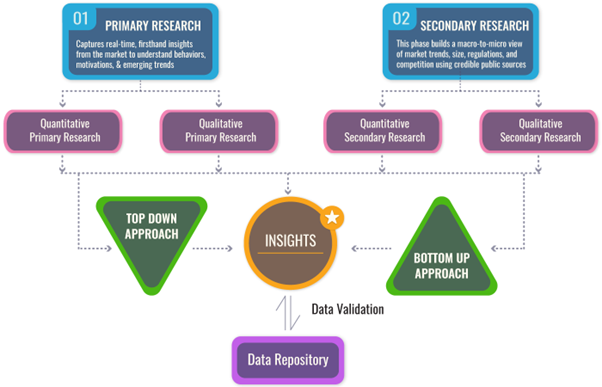
DUAL MODELING: TOP-DOWN + BOTTOM-UP
To ensure robust market estimation, we apply two complementary sizing approaches:
Top-Down Modeling:- Start with broader industry value (e.g., global or regional TAM)
- Apply filters by segment, geography, end-user, or use case
- Adjust with primary insights and validation benchmarks
- Ideal for investor-grade market scans and opportunity mapping
- Aggregate from the ground up using sales volumes, pricing, and unit economics
- Use internal modeling templates aligned with stakeholder data
- Incorporate distributor-level or region-specific inputs
- Most accurate for emerging segments and granular sub-markets
DATA VALIDATION: IN-HOUSE REPOSITORY
We close the loop with proprietary data intelligence built from ongoing projects, industry monitoring, and historical benchmarking. This repository includes:
- Multi-sector market and pricing models
- Key trendlines from past interviews and forecasts
- Benchmarked adoption rates, churn patterns, and ROI indicators
- Industry-specific deviation flags and cross-check logic
- Catches inconsistencies early
- Aligns projections across studies
- Enables consistent, high-trust deliverables