

Smart Bed Market Size and Forecast (2025–2033), Global and Regional Growth, Trend, Share, and Industry Analysis Report Coverage: By Distribution Channel (Supermarket/Hypermarket, Specialty Stores, Online, Others), By Sales Channel (B2C, B2B), By Application (Residential, Hospital, Hospitality, Others), and Geography
2026-01-02
ICT
Ekta Chaurasia (Team Lead)
Description
Smart Bed Market Overview
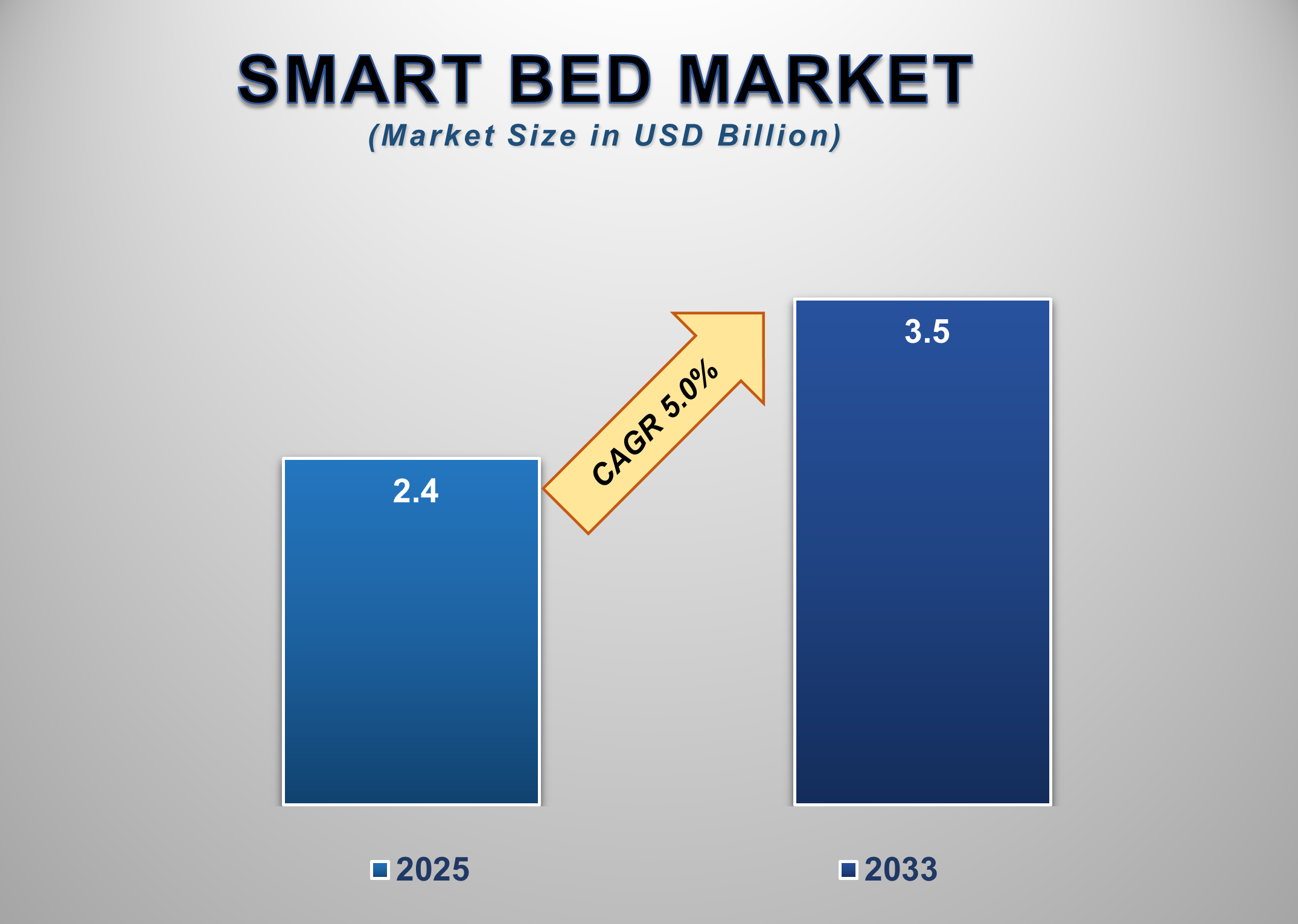
The Global Smart Bed Market is poised to grow from USD 2.4 billion in 2025 to USD 3.5 billion by 2033, reflecting a CAGR of 5.0% during the forecast period. Smart beds, integrated with sensors, connectivity solutions, and comfort optimization technologies, are gaining traction as consumers increasingly prioritize sleep quality and health monitoring. The market benefits from rising incidences of sleep disorders, greater awareness of sleep’s impact on overall well-being, and strong adoption of connected home technologies. In North America, holding 42.3% of the market in 2025, high consumer spending power and early adoption of advanced sleep solutions contribute significantly to demand. Meanwhile, the Asia Pacific is set to experience the fastest growth, supported by expanding urban populations, improving healthcare infrastructure, and rising adoption of smart home devices.
The market also benefits from product innovations focused on biometric tracking, position adjustment, anti-snore functionality, and seamless integration with mobile apps and IoT platforms. Demand from hospitals and hospitality environments is growing as institutions adopt smart beds to enhance patient care and customer experience. Despite higher costs limiting access in price-sensitive markets, technological advancements, declining sensor prices, and expanding online distribution channels are expected to accelerate global penetration. Overall, the smart bed market is entering a phase of stable, sustained growth backed by continuous innovation and rising consumer inclination toward health-centric home solutions.
Smart Bed Market Drivers and OpportunitiesRising Health and Wellness Consciousness Is Driving the Smart Bed Market Growth
Increasing consumer awareness regarding sleep health is a major
factor driving the smart bed market. The growing prevalence of insomnia, sleep
apnea, and lifestyle-related sleep disorders is encouraging consumers to invest
in advanced sleep technologies. Smart beds equipped with sensors can monitor
sleep cycles, heart rate, respiratory rate, and movement patterns, providing
valuable insights into consumer sleep quality. With an aging global population,
demand for beds that can assist with mobility, adjust to comfort needs, and
track vital signs is rising significantly. Additionally, smart beds complement
the booming health-monitoring ecosystem, in which consumers increasingly rely
on wearables, mobile applications, and connected home devices. The integration
of smart beds with these platforms enhances the continuity of health tracking,
making them a natural extension of the digital wellness landscape. Moreover,
the desire for personalized comfort solutions is accelerating adoption. Smart
beds with dual-zone temperature management, automatic firmness adjustment, and
anti-snore technology are particularly attractive to couples and individuals
with chronic health issues. Hospitals are also adopting smart beds to monitor
patients remotely, reduce nursing workload, and improve clinical outcomes. As
global wellness spending continues to rise, smart beds are emerging as a
premium yet essential component of holistic home health management. These
combined forces establish health and wellness consciousness as a primary driver
of long-term market expansion.
Growing Penetration of Smart Home Technologies Is Fueling
Market Growth
The rapid expansion of smart home ecosystems is significantly
boosting demand for smart beds. Households increasingly adopt interconnected
devices such as smart lights, thermostats, assistants, and security systems,
creating an environment where smart furniture naturally fits. Smart beds
integrate seamlessly with ecosystems from Google, Amazon, and Apple, enabling
users to control bed settings, monitor sleep data, and receive personalized
recommendations through voice commands or apps. This interconnected experience
enhances home automation and lifestyle convenience, making smart beds more
desirable, especially among tech-savvy consumers. Falling prices of sensors,
connectivity modules, and actuators have reduced the cost of manufacturing
smart beds, making them more accessible than in previous years. The expansion
of Internet penetration and improvements in wireless connectivity, including
Wi-Fi 6 and emerging 6G technologies, further support stable, real-time
monitoring and control. In hospitality settings, smart beds are increasingly
deployed to offer personalized guest experiences, while corporate wellness
programs are incorporating sleep optimization tools for employees. These trends
align with a broader global shift toward intelligent living spaces and
AI-enabled home environments. As smart homes continue to evolve, smart beds
will become a natural extension of the automated lifestyle, fueling market
growth through convenience, connected health insights, and enhanced consumer
engagement.
Growing Commercial Adoption of Smart Beds Is Creating
Significant Market Opportunities
Commercial adoption, especially in hospitals and hospitality
sectors, presents major untapped opportunities for the smart bed market.
Healthcare institutions are increasingly deploying smart beds to enhance
patient monitoring, reduce manual interventions, and improve clinical outcomes.
With rising healthcare digitalization, smart beds equipped with features such
as real-time vital tracking, automated patient repositioning, and fall
detection systems are becoming essential for modern hospitals. They help reduce
nursing workload, improve patient comfort, and support data-driven care
delivery, aligning with global trends in smart healthcare facilities. In
hospitality, premium hotels and wellness resorts are investing in smart beds to
enhance the guest experience, offering personalized comfort settings,
temperature control, and sleep analytics as differentiators. This trend is
supported by the growing demand for wellness tourism and high-end experiential
stays. The corporate sector is also beginning to explore sleep optimization
beds as part of employee well-being initiatives, especially in industries
requiring long working hours or high cognitive performance. As these commercial
sectors continue to prioritize wellness, efficiency, and customer satisfaction,
the adoption of smart beds is expected to accelerate.
Smart Bed Market Scope
|
Report Attributes |
Description |
|
Market Size in 2025 |
USD 2.4 billion |
|
Market Forecast in 2033 |
USD 3.5 billion |
|
CAGR % 2025-2033 |
5.0% |
|
Base Year |
2024 |
|
Historic Data |
2020-2024 |
|
Forecast Period |
2025-2033 |
|
Report USP |
Production, Consumption,
Company Share, Company Heatmap, Company Production Capacity, Growth Factors,
and more |
|
Segments Covered |
●
by Distribution
Channel, Sales Channel, Application |
|
Regional Scope |
●
North America, ●
Europe, ●
APAC, ●
Latin America ●
Middle East and
Africa |
|
Country Scope |
1)
U.S. 2)
Canada 3)
Germany 4)
UK 5)
France 6)
Spain 7)
Italy 8)
Switzerland 9)
China 10)
Japan 11)
India 12)
Australia 13)
South Korea 14)
Brazil 15)
Mexico 16)
Argentina 17)
South Africa 18)
Saudi Arabia 19)
UAE |
Smart Bed Market Report
Segmentation Analysis
The Global Smart Bed Market is segmented by Distribution Channel,
Sales Channel, Application, and Geography.
Supermarket/Hypermarket
Segment Accounted for the Largest Market Share in the Global Smart Bed Market
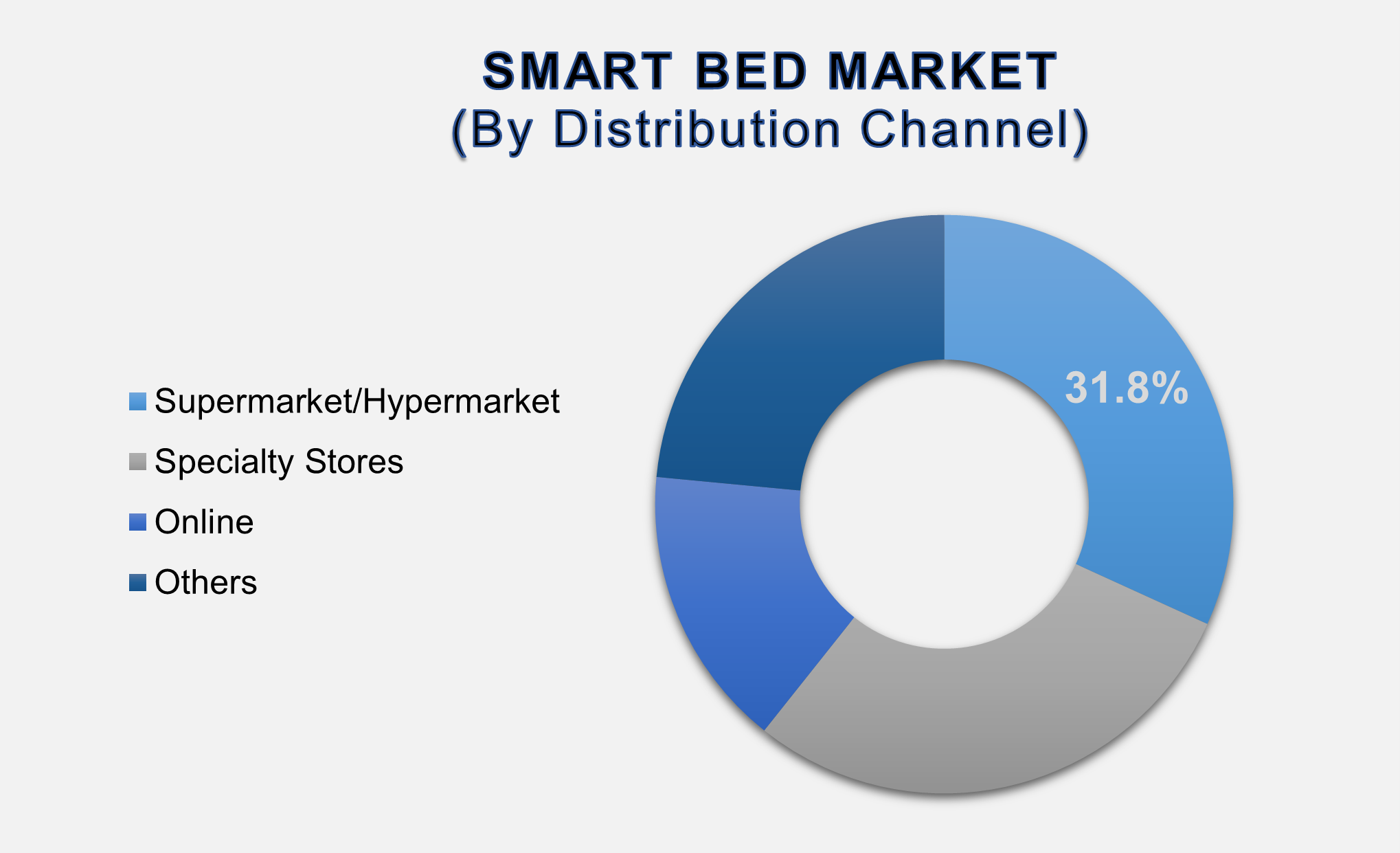
The supermarket/hypermarket segment accounted for the largest market share in the global smart bed market in 2025, contributing 31.8% of global revenues. These retail formats offer extensive product visibility, enabling customers to physically assess bed comfort, adjustability, materials, and integrated smart features, an essential factor for high-value purchases such as smart beds. The presence of dedicated furniture and smart home zones in major supermarkets and hypermarkets enhances consumer engagement. Retailers increasingly feature interactive displays and demonstrations that help buyers understand features like sleep tracking, tilt adjustments, and integrated sensors, driving higher conversion rates. Additionally, supermarkets provide trusted brands, easy financing options, and promotional discounts, which help attract a wide consumer base. As urban retail infrastructure expands across developing regions, especially in the Asia Pacific and Latin America, supermarkets are expected to remain a dominant distribution channel. The integration of omnichannel strategies, such as in-store ordering for home delivery, further boosts growth. Despite the rising penetration of online channels, the need for physical assessment will continue to keep supermarkets and hypermarkets at the forefront of smart bed distribution in the medium term.
B2C Segment Accounted for
the Largest Market Share in the Global Smart Bed Market
The B2C segment accounted for the
largest market share in the global smart bed market in 2025. Growth is
primarily supported by rising consumer demand for personalized sleep solutions
and increasing adoption of smart home technologies. Consumers are increasingly
investing in advanced bedding solutions that deliver biometric tracking,
anti-snore functionality, dual-zone temperature control, and app-based
customization. High awareness regarding sleep quality, particularly in
developed markets, is accelerating the adoption of B2C smart beds for
residential use. Rapid expansion of online retail and brand-owned stores has
made smart beds more accessible, enabling consumers to explore and compare
features conveniently. Promotional strategies, influencer marketing, and rising
interest in at-home wellness technologies further strengthen B2C sales.
Additionally, the integration of financing options and trial periods for
premium bed systems has improved consumer confidence, facilitating higher
adoption. While the B2B segment, including hospitals and hospitality, continues
to grow, B2C demand remains the primary revenue driver for the smart bed
industry.
Residential Segment
Accounted for the Largest Market Share in the Global Smart Bed Market
The residential segment accounted
for the largest market share in the global smart bed market in 2025. Increasing
consumer focus on home wellness, sleep improvement, and personalized comfort
solutions is propelling adoption. As smart home ecosystems continue to expand,
smart beds are becoming a natural extension of connected households. Features
such as adjustable firmness, integrated sleep monitoring, circadian lighting
synchronization, and voice-controlled adjustments enhance the overall home
experience, making them highly attractive to consumers seeking modern lifestyle
upgrades. Demand is particularly strong among middle- and high-income
households, driven by rising health consciousness and the desire for convenient
home comfort technologies. Online platforms and retail stores continue to
expand awareness by showcasing smart bed features through demos and interactive
tools. Moreover, dual-income households and elderly populations increasingly
prefer smart beds for their health-tracking and mobility-support features.
While healthcare and hospitality applications are growing steadily, residential
usage continues to dominate due to widespread consumer demand and ongoing
product innovation targeted at home environments.
The following segments are
part of an in-depth analysis of the global Smart Bed market:
|
Market Segments |
|
|
By
Distribution Channel |
●
Supermarket/Hypermarket ●
Specialty Stores ●
Online ●
Others |
|
By Sales Channel |
●
B2C ●
B2B |
|
By Application |
●
Residential ●
Hospital ●
Hospitality ●
Others |
Smart Bed Market Share
Analysis by Region
North America is
anticipated to hold the biggest portion of the Smart Bed Market globally
throughout the forecast period.
North
America dominated the global smart bed market in 2025 with a 42.3% revenue
share. High consumer awareness, advanced healthcare infrastructure, and strong
adoption of smart home technologies are major factors driving the region’s
leadership. The United States represents the largest market due to the rising
prevalence of sleep disorders, significant spending on home wellness, and the
presence of leading manufacturers. Integration of AI-driven sleep analysis and
connectivity features aligns well with North America’s tech-savvy consumer
base. Additionally, hospitals in the region increasingly utilize smart beds to
improve patient monitoring, reduce manual intervention, and enhance overall
care quality.
Asia Pacific is projected to grow
at the fastest CAGR during the forecast period. Expanding urbanization, rising
disposable incomes, and increasing adoption of smart home appliances contribute
to strong regional growth. China, Japan, South Korea, and India are emerging as
high-potential markets due to rapid digitization, higher healthcare investment,
and the growing middle-class population seeking modern home solutions. In
Europe, demand is supported by consumer lifestyle improvements and steady
adoption in healthcare facilities, especially in Germany, the UK, and France.
Overall, regional growth dynamics remain positive, with APAC emerging as a key
engine of future market expansion.
Smart Bed Market
Competition Landscape Analysis
The Global Smart Bed Market is
moderately consolidated, with key players focusing on technological innovation,
strategic partnerships, and product differentiation. Companies are integrating
AI-powered analytics, IoT connectivity, biometric sensors, and mobile app
ecosystems to enhance user experience. Partnerships with healthcare providers,
hotels, and wellness centers allow manufacturers to expand into commercial
applications.
Global Smart Bed Market
Recent Developments News:
- In August 2020,
Hi Interiors Srl introduced the HiAm smart bed, a four-poster bed
featuring a 70-inch screen, integrated audio system, ambient reading
lights, and a 4K projector. Designed to enhance entertainment and
well-being, the bed combines advanced technology with bedroom comfort.
- In January 2021,
Corsicana Mattress Co. partnered with Retail Service Systems (RSS) to
launch Sleep2Win smart beds. The collaboration focuses on providing
customizable sleep technology that adapts to individual sleep patterns for
optimized rest and recovery.
The Global Smart Bed Market Is
Dominated by a Few Large Companies, such as
●
Sleep Number
●
Tempur Sealy
International
●
Kingsdown
●
Reverie
●
Serta Simmons Bedding
●
Eight Sleep
●
Leggett & Platt
●
Hilding Anders
●
Responsive Surface
Technology
●
Luna
●
Bryte
●
RUF Betten
●
DeRUCCI
●
Ergomotion
●
Natural Form
●
Glideaway
●
Aspirus
●
Smart Nora
●
Beddit
●
Withings
● Others
Frequently Asked Questions
Ekta Chaurasia (Team Lead)
Ekta Chaurasia is a highly experienced Team Lead at M2Square Consultancy with over 7 years of expertise in market research, strategic consulting, competitive benchmarking, and business intelligence solutions. She specializes in ICT, semiconductors & electronics, automotive & transportation, and industrial machinery markets.
She leads end-to-end global research projects focused on market trends, industry analysis, growth forecasting, customer insights, and strategic decision-making. Known for her analytical leadership and industry expertise, Ekta helps businesses uncover growth opportunities, evaluate competitive landscapes, and stay ahead in rapidly evolving markets through accurate and insight-driven research.
1. Global Smart Bed Market
Introduction and Market Overview
1.1.
Objectives
of the Study
1.2.
Global
Smart Bed Market Scope and Market Estimation
1.2.1.Global Smart Bed Overall
Market Size (US$ Bn), Market CAGR (%), Market forecast (2025 - 2033)
1.2.2.Global Smart Bed Market
Revenue Share (%) and Growth Rate (Y-o-Y) from 2020 - 2033
1.3.
Market
Segmentation
1.3.1.Distribution Channel of
Global Smart Bed Market
1.3.2.Sales Channel of Global Smart
Bed Market
1.3.3.Application of Global Smart
Bed Market
1.3.4.Region of Global Smart Bed
Market
2. Executive
Summary
2.1.
Demand
Side Trends
2.2.
Key
Market Trends
2.3.
Market
Demand (US$ Bn) Analysis 2020 – 2024 and Forecast, 2025 – 2033
2.4.
Demand
and Opportunity Assessment
2.5.
Key
Developments
2.6.
Overview
of Tariff, Regulatory Landscape and Standards
2.7.
Market
Entry Strategies
2.8.
Market
Dynamics
2.8.1.Drivers
2.8.2.Limitations
2.8.3.Opportunities
2.8.4.Impact Analysis of Drivers
and Restraints
2.9.
Porter’s
Five Forces Analysis
2.10.
PEST
Analysis
3. Global
Smart Bed Market Estimates
& Historical Trend Analysis (2020 - 2024)
4. Global
Smart Bed Market Estimates
& Forecast Trend Analysis, by Distribution Channel
4.1.
Global
Smart Bed Market Revenue (US$ Bn) Estimates and Forecasts, by Distribution
Channel, 2020 - 2033
4.1.1.Supermarket/Hypermarket
4.1.2.Specialty Stores
4.1.3.Online
4.1.4.Others
5. Global
Smart Bed Market Estimates
& Forecast Trend Analysis, by Sales Channel
5.1.
Global
Smart Bed Market Revenue (US$ Bn) Estimates and Forecasts, by Sales Channel,
2020 - 2033
5.1.1.B2C
5.1.2.B2B
6. Global
Smart Bed Market Estimates
& Forecast Trend Analysis, by Application
6.1.
Global
Smart Bed Market Revenue (US$ Bn) Estimates and Forecasts, by Application, 2020
- 2033
6.1.1.Residential
6.1.2.Hospital
6.1.3.Hospitality
6.1.4.Others
7. Global
Smart Bed Market Estimates
& Forecast Trend Analysis, by Region
7.1.
Global
Smart Bed Market Revenue (US$ Bn) Estimates and Forecasts, by Region, 2020 - 2033
7.1.1.North America
7.1.2.Europe
7.1.3.Asia Pacific
7.1.4.Middle East & Africa
7.1.5.Latin America
8. North America Smart
Bed Market: Estimates & Forecast
Trend Analysis
8.1.
North
America Smart Bed Market Assessments & Key Findings
8.1.1.North America Smart Bed
Market Introduction
8.1.2.North America Smart Bed
Market Size Estimates and Forecast (US$ Billion) (2020 - 2033)
8.1.2.1. By Distribution
Channel
8.1.2.2. By Sales
Channel
8.1.2.3. By Application
8.1.2.4.
By
Country
8.1.2.4.1. The U.S.
8.1.2.4.2. Canada
9. Europe Smart
Bed Market: Estimates & Forecast
Trend Analysis
9.1.
Europe
Smart Bed Market Assessments & Key Findings
9.1.1.Europe Smart Bed Market
Introduction
9.1.2.Europe Smart Bed Market
Size Estimates and Forecast (US$ Billion) (2020 - 2033)
9.1.2.1. By Distribution
Channel
9.1.2.2. By Sales
Channel
9.1.2.3. By Application
9.1.2.4.
By
Country
9.1.2.4.1.
Germany
9.1.2.4.2.
Italy
9.1.2.4.3.
U.K.
9.1.2.4.4.
France
9.1.2.4.5.
Spain
9.1.2.4.6.
Switzerland
9.1.2.4.7. Rest
of Europe
10. Asia Pacific Smart
Bed Market: Estimates & Forecast
Trend Analysis
10.1.
Asia
Pacific Market Assessments & Key Findings
10.1.1.
Asia
Pacific Smart Bed Market Introduction
10.1.2.
Asia
Pacific Smart Bed Market Size Estimates and Forecast (US$ Billion) (2020 - 2033)
10.1.2.1. By Distribution
Channel
10.1.2.2. By Sales
Channel
10.1.2.3. By Application
10.1.2.4.
By
Country
10.1.2.4.1. China
10.1.2.4.2. Japan
10.1.2.4.3. India
10.1.2.4.4. Australia
10.1.2.4.5. South Korea
10.1.2.4.6. Rest of Asia Pacific
11. Middle East & Africa Smart
Bed Market: Estimates & Forecast
Trend Analysis
11.1.
Middle
East & Africa Market Assessments & Key Findings
11.1.1.
Middle East & Africa Smart Bed Market Introduction
11.1.2.
Middle East & Africa Smart Bed Market Size Estimates and
Forecast (US$ Billion) (2020 - 2033)
11.1.2.1. By Distribution
Channel
11.1.2.2. By Sales
Channel
11.1.2.3. By Application
11.1.2.4.
By
Country
11.1.2.4.1. UAE
11.1.2.4.2. Saudi
Arabia
11.1.2.4.3. South
Africa
11.1.2.4.4. Rest
of MEA
12. Latin America
Smart Bed Market: Estimates &
Forecast Trend Analysis
12.1.
Latin
America Market Assessments & Key Findings
12.1.1.
Latin
America Smart Bed Market Introduction
12.1.2.
Latin
America Smart Bed Market Size Estimates and Forecast (US$ Billion) (2020 - 2033)
12.1.2.1. By Distribution
Channel
12.1.2.2. By Sales
Channel
12.1.2.3. By Application
12.1.2.4.
By
Country
12.1.2.4.1. Brazil
12.1.2.4.2. Argentina
12.1.2.4.3. Mexico
12.1.2.4.4. Rest
of LATAM
13. Country Wise Market:
Introduction
14.
Competition
Landscape
14.1.
Global
Smart Bed Market Product Mapping
14.2.
Global
Smart Bed Market Concentration Analysis, by Leading Players / Innovators /
Emerging Players / New Entrants
14.3.
Global
Smart Bed Market Tier Structure Analysis
14.4.
Global
Smart Bed Market Concentration & Company Market Shares (%) Analysis, 2024
15.
Company
Profiles
15.1.
Sleep Number
15.1.1.
Company
Overview & Key Stats
15.1.2.
Financial
Performance & KPIs
15.1.3.
Product
Portfolio
15.1.4.
SWOT
Analysis
15.1.5.
Business
Strategy & Recent Developments
* Similar details would be provided for all the players
mentioned below
15.2. Tempur
Sealy International
15.3. Kingsdown
15.4. Reverie
15.5. Serta
Simmons Bedding
15.6. Eight
Sleep
15.7. Leggett
& Platt
15.8. Hilding
Anders
15.9. Responsive
Surface Technology
15.10. Luna
15.11. Bryte
15.12. RUF
Betten
15.13. DeRUCCI
15.14. Ergomotion
15.15. Natural
Form
15.16. Glideaway
15.17. Aspirus
15.18. Smart
Nora
15.19. Beddit
15.20. Withings
15.21. Others
16. Research
Methodology
16.1.
External
Transportations / Databases
16.2.
Internal
Proprietary Database
16.3.
Primary
Research
16.4.
Secondary
Research
16.5.
Assumptions
16.6.
Limitations
16.7.
Report
FAQs
17. Research
Findings & Conclusion
Our Research Methodology
"Insight without rigor is just noise."
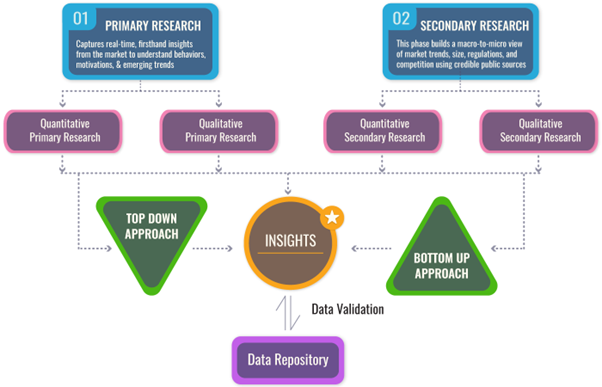
We follow a comprehensive, multi-phase research framework designed to deliver accurate, strategic, and decision-ready intelligence. Our process integrates primary and secondary research , both quantitative and qualitative , along with dual modeling techniques ( top-down and bottom-up) and a final layer of validation through our proprietary in-house repository.
PRIMARY RESEARCH
Primary research captures real-time, firsthand insights from the market to understand behaviors, motivations, and emerging trends.
1. Quantitative Primary Research
Objective: Generate statistically significant data directly from market participants.
Approaches:- Structured surveys with customers, distributors, and field agents
- Mobile-based data collection for point-of-sale audits and usage behavior
- Phone-based interviews (CATI) for market sizing and product feedback
- Online polling around industry events and digital campaigns
- Purchase frequency by customer type
- Channel performance across geographies
- Feature demand by application or demographic
2. Qualitative Primary Research
Objective: Explore decision-making drivers, pain points, and market readiness.
Approaches:- In-depth interviews (IDIs) with executives, product managers, and key decision-makers
- Focus groups among end users and early adopters
- Site visits and observational research for consumer products
- Informal field-level discussions for regional and cultural nuances
SECONDARY RESEARCH
This phase helps establish a macro-to-micro understanding of market trends, size, regulation, and competitive dynamics, sourced from credible and public domain information.
1. Quantitative Secondary Research
Objective: Model market value and segment-level forecasts based on published data.
Sources include:- Financial reports and investor summaries
- Government trade data, customs records, and regulatory statistics
- Industry association publications and economic databases
- Channel performance and pricing data from marketplace listings
- Revenue splits, pricing trends, and CAGR estimates
- Supply-side capacity and volume tracking
- Investment analysis and funding benchmarks
2. Qualitative Secondary Research
Objective: Capture strategic direction, innovation signals, and behavioral trends.
Sources include:- Company announcements, roadmaps, and product pipelines
- Publicly available whitepapers, conference abstracts, and academic research
- Regulatory body publications and policy briefs
- Social and media sentiment scanning for early-stage shifts
- Strategic shifts in market positioning
- Unmet needs and white spaces
- Regulatory triggers and compliance impact
DUAL MODELING: TOP-DOWN + BOTTOM-UP
To ensure robust market estimation, we apply two complementary sizing approaches:
Top-Down Modeling:- Start with broader industry value (e.g., global or regional TAM)
- Apply filters by segment, geography, end-user, or use case
- Adjust with primary insights and validation benchmarks
- Ideal for investor-grade market scans and opportunity mapping
- Aggregate from the ground up using sales volumes, pricing, and unit economics
- Use internal modeling templates aligned with stakeholder data
- Incorporate distributor-level or region-specific inputs
- Most accurate for emerging segments and granular sub-markets
DATA VALIDATION: IN-HOUSE REPOSITORY
We close the loop with proprietary data intelligence built from ongoing projects, industry monitoring, and historical benchmarking. This repository includes:
- Multi-sector market and pricing models
- Key trendlines from past interviews and forecasts
- Benchmarked adoption rates, churn patterns, and ROI indicators
- Industry-specific deviation flags and cross-check logic
- Catches inconsistencies early
- Aligns projections across studies
- Enables consistent, high-trust deliverables