

Smart Retinal Implants Market Size and Forecast (2026–2034), Global and Regional Growth, Trend, Share and Industry Analysis Report Coverage: By Product Type (Epiretinal Implants, Subretinal Implants, Suprachoroidal Implants, and Cortical Visual Prostheses), By Implant Platform (Wired Systems, Wireless Systems, and Hybrid Systems), By Disease Indication (Retinitis Pigmentosa, Geographic Atrophy Due to Age-Related Macular Degeneration, and Others), By End User (Hospitals and Ophthalmic Surgery Centers, Specialty Eye Clinics, and Academic and Research Institutes) and Geography
2026-08-10
Healthcare
Swetal (Research Analyst)
Description
Smart Retinal Implants Market
Overview
The global smart
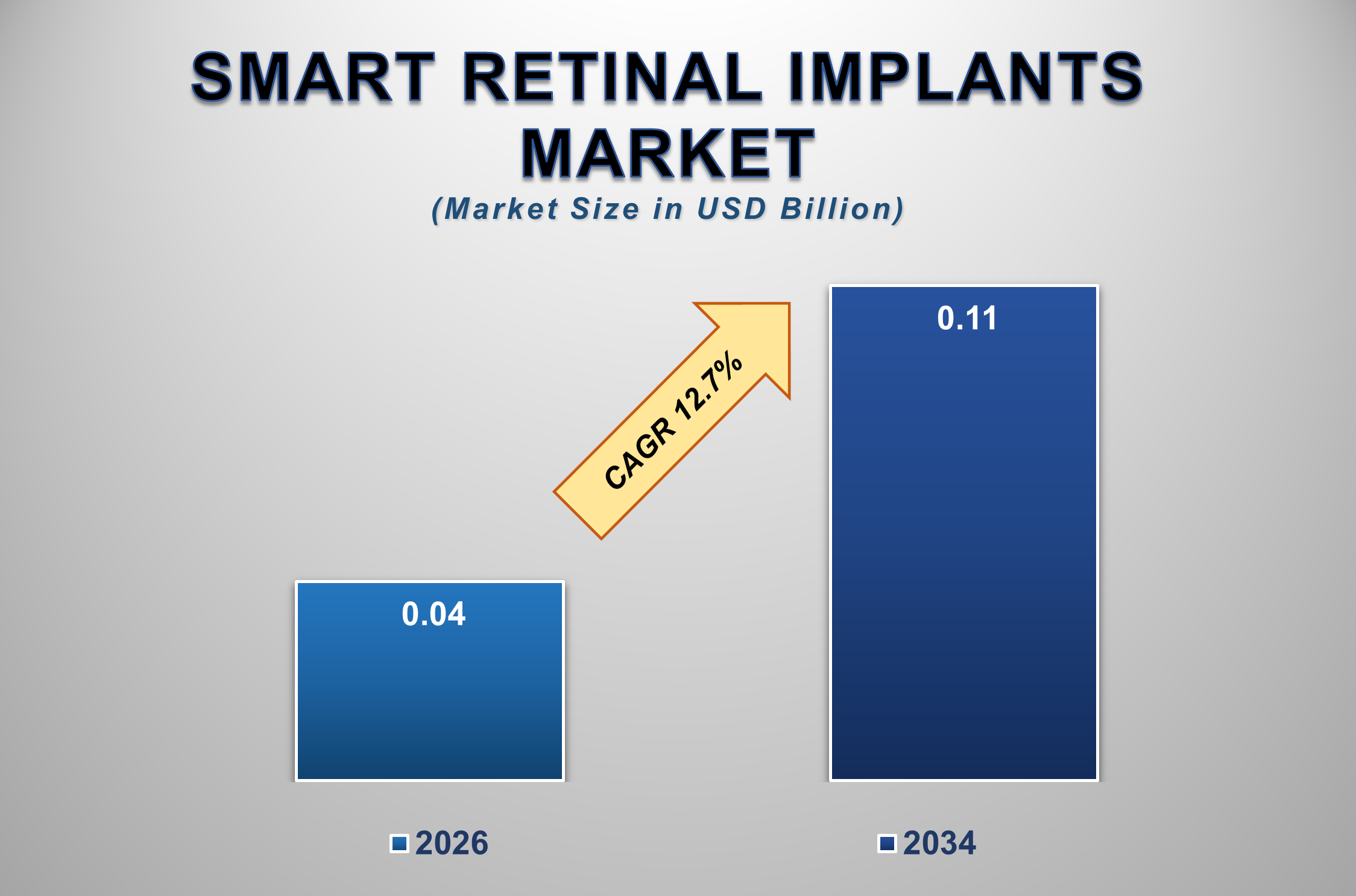
retinal implants market was valued at USD 0.04 billion in 2026 and is projected
to reach USD 0.11 billion by 2034, expanding at a CAGR of 12.7% during the
forecast period. The smart retinal
implants market is gaining momentum with the improving influence of innovative
technologies in the field of neuroprosthetics, microelectronics, AI, and
bioengineering, focusing on the recovery of some vision in patients suffering
from serious retinal disorders (e.g., retinitis pigmentosa and advanced AMD).
The Smart Retinal Implants are made with the help of implantable networks of
electrodes, visual systems, and radio technologies, as well as external visual
processing systems for stimulating retinal neurons that remain after the
disease to enhance one’s sight ability. There are several factors facilitating
the growing demand for these medical devices. There have also been advanced
developments of devices due to such factors as increasing rates of incidence of
hereditary diseases of the retina, raising levels of investments in the field
of ophthalmology, and the fulfillment of more clinical trials of modern retinal
prostheses. Moreover, the integration of different technologies works
effectively and improves the functioning of devices and the performance of
wounded patients, as well as making devices safer in the long term. At the same
time, there are several issues (e.g., high prices and the number of patients
who can undergo the surgical procedure to receive such devices).
Smart Retinal Implants Market Drivers
and Opportunities
Rising Prevalence of
Retinal Degenerative Diseases and Vision Loss is Driving Market Growth
Retinal
degenerative diseases and vision loss are the main reasons behind the boost in
the smart retinal implants market. With the increase in population aging,
prevalence of diabetes, and increases in life expectancy, complications that
arise due to aging, like age-related macular degeneration (AMD), diabetic
retinopathy (DR), diabetic macular edema (DME), retinal vein obstruction (RVO),
and inherited retinal disorders, have become quite frequent. As a result of the
mentioned maladies, progressive and irreversible vision loss occurs, and
innovative vision restoration technologies, like smart retinal implants, are
gaining traction in the market. The implantable neuroprosthetic devices can be
considered an effective medical option for advanced retinal degeneration
patients suffering from limited or no alternatives in the treatment of their
illnesses. Supporting this trend, a March 2026 study published in JAMA
Ophthalmology has reported the existence of a substantial burden of retinal
diseases in the United States. In accordance with the results of the study, the
age-standardized rates of the diseases are as follows: age-related macular
degeneration (AMD), 5,677 cases per 100,000 population; diabetic retinopathy
(DR), 2,710; diabetic macular edema (DME), 317; retinal vein occlusion (RVO),
214. The study pointed out that the burden of the diseases is more serious
among males and varies with respect to race and geographic location. It has
been estimated that by 2022, there will be 21.9 million adults aged 40 and older
suffering from AMD, reflecting a crude prevalence of 13.6%, while 10 million
adults suffer from diabetic eye disease, including approximately 1.8 million
having the threatening vision disease. Additionally, around 1.1 million people
are suffering from DME, and about 0.9 million are suffering from RVO. The
growing number of patients with serious retinal damage and vision loss gives
hope for the expansion of advanced retinal prostheses, which results in further
research, adoption, and commercialization of smart retinal implants.
Technological
Advancements in Retinal Prosthetics and Neurostimulation Fueling Market
Expansion
The development of
retinal prosthetics and neurostimulation technology is considerably enhancing
the efficiency, safety, and clinical effectiveness of modern retinal
prostheses, creating the possibility of restoring limited vision in patients
with serious retinal diseases. The advancement of microelectronics, dense
matrices of electrodes, wireless communication, and biocompatible materials has
made it possible to design small, reliable, and highly accurate retinal
prostheses that have excellent visual performance and work for longer periods
of time. Simultaneously, the combination of artificial intelligence (AI)-based
image processing systems and advanced computer vision algorithms enables
external cameras to adapt visual signals in real time, enhancing object
recognition and navigation abilities. The progression of wireless power
transmission technology and low-power electronics is decreasing the complexity
of the hardware and incurring fewer potential complications with regard to
infection due to the external devices and increasing comfort for the patient.
All these advances, together with the optimization of the minimally invasive
surgical techniques and the personalization of the neuromodulation processes,
allow for more accurate placement of the implant, easier performance of the
procedure itself, and better results after the surgery. Research in the area of
flexible bioelectronics, photovoltaic retinal prostheses, closed-loop
stimulation, brain-retina interface technologies, and other areas focused on
bioelectronics will help further increase the capabilities of the future
generations of smart retinal prostheses. In the end, thanks to those advances,
clinicians become more confident, the eligibility criteria are broadened, and
the commercialization and implementation of various smart retinal implants are
proceeding faster than ever.
Integration of
AI and Next-Generation Bionic Vision Technologies Presents Significant
Opportunities
There are great
opportunities in the smart retinal implants market due to the advancement of
artificial intelligence (AI), computer vision, and sophisticated
neuroprosthetic technologies. Image processing through AI can help increase
contrast, identify faces and objects, improve edge detection, and improve the
visual information before being transmitted to retinal implants, thus enabling
patients suffering from degenerative disorders of the retina to experience,
among many others, improved functional vision. Together with new inventions of
high-density electrode arrays, wireless power supply, biocompatible materials,
and closed-loop neurostimulation systems, these new accomplishments are set to
narrow down the gap in visual quality and device functioning. One prominent
study includes joint projects of the Bionics Institute, the Centre for Eye
Research Australia (CERA), CSIRO, and the Australian National University (ANU)
in the research of a bionic eye for patients suffering from retinitis
pigmentosa. The system consists of a retinal implant, along with a video camera
included in smart glasses, and the images are converted to electrical impulses
that are sent to the retinal cells using the 44-electrode implant. With the
development of AI technologies for such innovative generation bionic vision
systems, it can be expected to achieve personalized image enhancement and
adaptive vision processing, which will allow the smart retinal implants market
to grow significantly.
Smart Retinal Implants Market Scope
|
Report Attributes |
Description |
|
Market Size in 2026 |
USD 0.04 Billion |
|
Market Forecast in 2034 |
USD 0.11 Billion |
|
CAGR % 2026-2034 |
12.7% |
|
Base Year |
2025 |
|
Historic Data |
2021-2025 |
|
Forecast Period |
2026-2034 |
|
Report USP |
Pricing and Cost Structure Analysis, Product
Innovation Benchmarking, Whitespace Assessment, Company Share, Company
Heatmap, Growth Factors, and more |
|
Segments Covered |
●
By
Product Type ●
By
Implant Platform ●
By
Disease Indication ●
By End
User |
|
Regional Scope |
●
North
America ●
Europe ●
APAC ●
Latin
America ●
Middle
East and Africa |
|
Country Scope |
●
U.S. ●
Canada ●
U.K. ●
Germany ●
France ●
Italy ●
Spain ●
Russia ●
China ●
India ●
Japan ●
South
Korea ●
Australia
●
Mexico ●
Brazil ●
Saudi
Arabia ●
UAE ●
South
Africa |
Smart Retinal Implants Market Report
Segmentation Analysis
The global smart
retinal implants market industry analysis is segmented by product type, by
implant platform, by disease indication, by end user, and by region.
Subretinal
Implants Segment Is Expected to Dominate the Smart Retinal Implants Market
During the Forecast Period
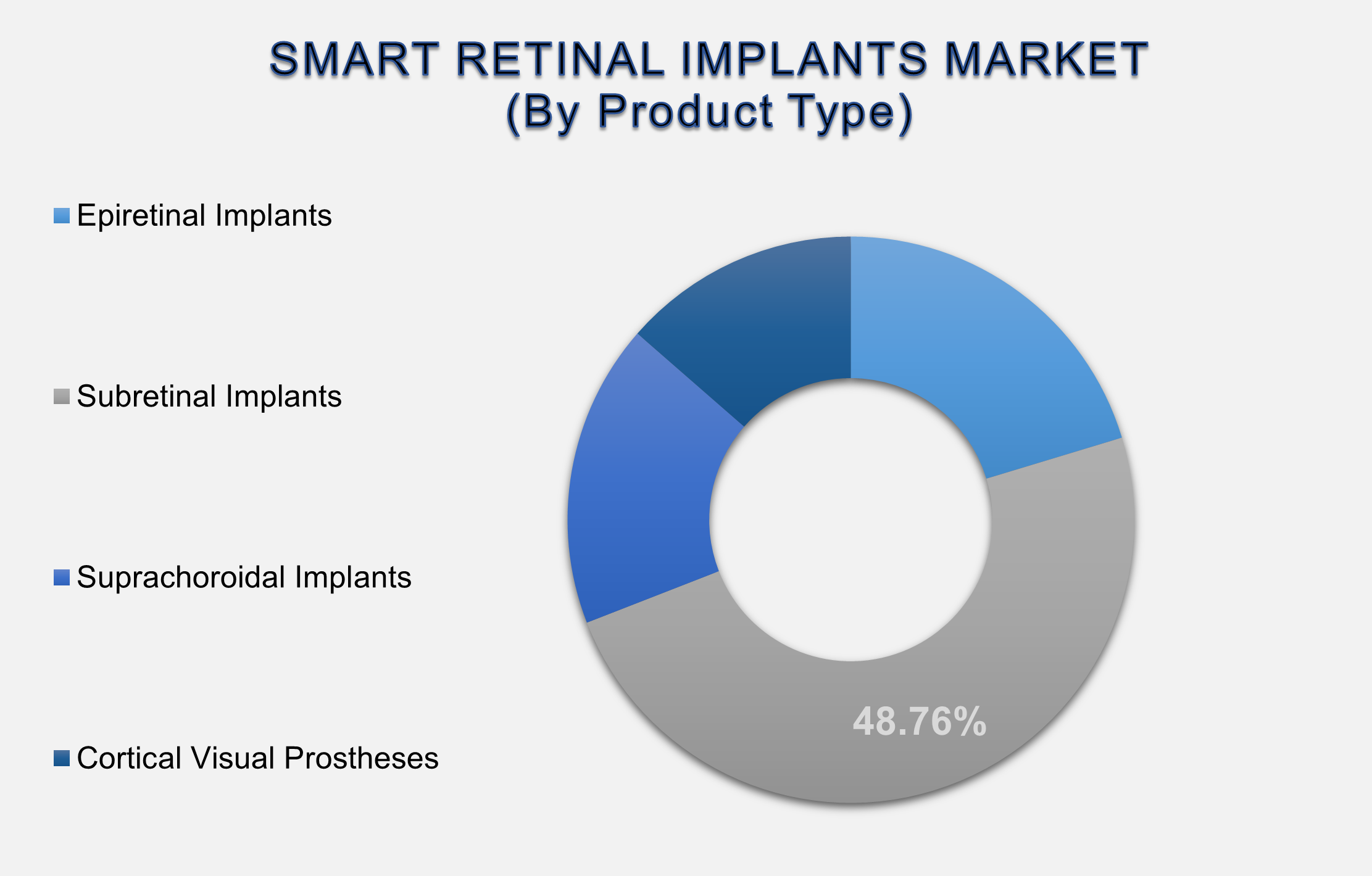
The subretinal implants segment will dominate
the market for smart retinal implants through the forecast period, and this is
due to the ability of these implants to stimulate retinal cells that remain in
the pathway of vision, thus allowing physiological vision and better
performance. These implants are increasingly recommended for the treatment of
various retinal degeneration disorders such as AMD and retinitis pigmentosa,
thanks to advances in technologies used for miniaturization, wireless energy
transfer, biocompatible materials, and high-resolution photovoltaic elements.
Their minimally invasive design and the fact that they are compatible with
external devices for capturing images result in their popularity and
considerably improve the comfort of patients and the effectiveness of their
use. The segment's growth is further enabled by substantial product
developments and regulatory approvals. For example, in July 2026, Science
Corporation announced the commercial launch of PRIMA in Europe--the first and only
therapy shown in clinical trials to restore normal central vision in patients
with complete or partial geographic atrophy (GA) secondary to AMD. After
obtaining CE Mark approval according to the EU Medical Device Regulation, PRIMA
became commercially available in 30 countries in Europe. The PRIMA system is
based on a very thin photovoltaic implant placed in the subretinal space, which
works wirelessly with specialized smart glasses to transmit infrared light to
the implant and cause electrical activation of retinal tissue. Wireless
integration and utilizing "zoom-in" capability for better letter
recognition are the chief advantages of subretinal implants and contribute to
maintaining the leadership position and the positive growth dynamics of the
subretinal implant segment throughout the forecast period.
Wireless Systems
Segment Is Expected to Lead the Smart Retinal Implants Market by Implant
Platform
During the forecast
period, the wireless systems segment is anticipated to dominate the smart
retinal implants market due to the latest technology developments enhancing the
efficiency of the devices, comfort for patients, and favorable treatment
results over a long period. Operating differently from the wired ones, the
wireless retinal implants do not use transdermal wires and external connectors,
eliminating the chances of infections or mechanical failures and improving the
patient's quality of life. The rise in investments for innovative
neuroprosthetics propels wireless technologies even farther. The latest retinal
implants begin to combine wireless technologies with cutting-edge artificial
intelligence-based image analysis, photovoltaic stimulation, and closed-loop
neurostimulation for better visual information transfer and stimulation pattern
improvement. Wireless implantable retinal prosthesis creations, as well as
advancements in batteryless power transmission, biocompatible materials, and
compact size of implants, open more application horizons for smart retinal
implants in the treatment of retinitis pigmentosa and age-related macular
degeneration. Being at the forefront of technology development and focusing on
minimally invasive, fully integrated wireless systems with advanced durability
and usability, manufacturers are paving the way for the dominance of wireless
systems in the market.
Retinitis
Pigmentosa Segment Is Expected to Lead the Smart Retinal Implants Market by
Disease Indication
The segment for
retinitis pigmentosa (RP) is likely to dominate the smart retinal implants
industry throughout the forecast period, driven by the disease's prevalence,
significant unmet demand, and the appropriateness of retinal implant
technologies for individuals with severe photoreceptor degeneration. RP is a
progressive hereditary retinal disease, affecting rods and cones while leaving
intact parts of the inner retinal neural apparatus. Such peculiarities render
patients exactly what they need for retinal prostheses aimed at
electrostimulating the remaining retinal cells. The lack of large-scale
curative approaches and the emergence of new technologies in retinal
neuroprosthesis, wireless implants, and artificial intelligence contribute to
the growing popularity of smart retinal implants among this category of
patients. The considerable prevalence of this condition plays a role in driving
the segment's leadership. As per MedlinePlus, retinitis pigmentosa represents
one of the most widely seen inherited diseases of the retina, with a prevalence
rate of around 1 in 3500 to 1 in 4000 in Europe and the USA. The progressive
nature of the disease, which leads to poor vision, ultimately leads to
increasing research and commercial ventures in the field of modern bionic
eyeball production. Development work on the high-density retinal implant with
wireless communication and advanced features will promote improved access and
outcomes in terms of treatment in the future.
Hospitals and
Ophthalmic Surgery Centers Segment Is Expected to Lead the Smart Retinal
Implants Market by End User
Based on their
end-user capacity, the hospitals and ophthalmic centers segment is predicted to
lead its peers in the smart retinal implants sector during the forecast period.
This prediction is due to the very arcane nature of procedures involving retinal
implants and the requirement for advanced clinical infrastructure to better
manage the patients being considered for these surgeries. Smart retinal implant
surgery consists of complex vitreoretinal surgery, advanced diagnostic imaging,
and multiple fields of expertise and requisite ways: retinal surgeons,
ophthalmologists, neurologists, rehabilitation practitioners, and biomedical
engineers work cooperatively on the same surgery. Hospitals and specialized
ophthalmic centers possess appropriately furnished operating rooms, OCTs,
fundus imaging systems, electrophysiology facilities, and rehabilitation
premises, which makes them preferable places for conducting retinal implants.
The segment is likely to be bolstered by an increase in the number of clinical trials,
regulatory-approved implantation programs, and advanced techniques for vision
restoration at tertiary hospitals and specialized eye centers. They offer
comprehensive patient assessment, surgery, device programming, visual
rehabilitation, and follow-up, which are essential for achieving perfect
efficiency in visual functioning. Growing investments in ophthalmic facilities,
the opening of specialized centers for retinal surgery, and increasing
cooperation between medical institutions and manufacturers of medical devices
are expected to lead to better accessibility of advanced retinal implants. As
the use of AI-based wireless and minimally invasive retinal prosthesis becomes
more widespread, hospitals and ophthalmic centers are likely to remain the main
users of the technology throughout the forecast period despite increasing
competition.
The following
segments are part of an in-depth analysis of the global Smart Retinal Implants
Market:
|
Market Segments |
|
|
By Product Type |
●
Epiretinal
Implants ●
Subretinal
Implants ●
Suprachoroidal
Implants ●
Cortical
Visual Prostheses |
|
By Implant Platform |
●
Wired
Systems ●
Wireless
Systems ●
Hybrid
Systems |
|
By Disease Indication |
●
Retinitis
Pigmentosa ●
Geographic
Atrophy Due to Age-Related Macular Degeneration ●
Others |
|
By End User |
●
Hospitals
and Ophthalmic Surgery Centers ●
Specialty
Eye Clinics ●
Academic and
Research Institutes |
Smart Retinal Implants Market Share
Analysis by Region
North America is
projected to hold the largest share of the global smart retinal implants market
over the forecast period
During the forecast
period, North America is expected to dominate the global market for smart
retinal implants, thanks to having an advanced healthcare system, a
concentration of top makers of medical devices, and the introduction and rapid
use of new technologies in eye care. The region is successful because of high
spending on research and development, generous funding of vision restoration
programs, and the presence of a completely developed ecosystem made of
educational institutions, specialized hospitals, and biotech companies dealing
with retinal implants and BCI. Furthermore, the increasing incidence of retinal
diseases, including retinitis pigmentosa and wet macular degeneration, as well
as the rising knowledge about new therapies, will continue to make the market
grow. America is leading the way in smart retinal implant technology due to
successful trials of new technologies that support the existence of such
revolutionary devices. Companies and researchers from the U.S. and Canada
develop the latest wireless retinal implant technology, image processing
technologies based on artificial intelligence, photovoltaic eye prostheses, and
minimally invasive systems. The availability of reputable institutions
conducting research on retinas, successful cooperation between hospitals and IT
developers, and the affordability of commercializing implants will boost the
usage of smart retinal implants in America over the next few years.
Smart Retinal
Implants Market Competition Landscape Analysis
The smart retinal
implant market competitors include medical device companies, neurosurgical
companies, ophthalmic technology firms, and research-based innovators involved
in developing advanced retinal prostheses and bionic vision systems for
eyesight restoration in cases of retinal diseases. Companies are competing
through incremental innovations in wireless implanted platforms, high-density
electrodes, AI technologies for image processing, photovoltaic stimulation
systems, and minimally invasive implantation techniques. Strategic activities
like research agreements, clinical trials, regulatory approvals, product
development, and active partnerships with academia and the healthcare sector
are allowing participants to enhance their position in the market.
Global Smart
Retinal Implants Market Recent Developments News:
●
In July
2026 - Science Corp. announced the
European Commercial launch of PRIMA, the only treatment to restore functional
central vision to patients with geographic atrophy caused by age-related
macular degeneration, a leading cause of blindness.
● In July 2026 - The US Food and Drug Administration allowed the startup to pursue a humanitarian device exemption pathway, which is intended for products that address rare conditions and offers a streamlined route to approval.
●
In October
2025 - A wireless retinal implant can restore central vision in patients with
advanced age-related macular degeneration (AMD), according to clinical trial
results published in the New England Journal of Medicine.
The global
smart retinal implants market is dominated by a few large companies, such as
●
Bionic Vision Technologies Pty Ltd
●
Boston Scientific Corporation
●
GenSight Biologics SA
●
iBionics Inc.
●
Intelligent Implants GmbH
●
Labtician Ophthalmics, Inc.
●
LambdaVision, Inc.
●
Nano Retina Ltd.
●
NIDEK CO., LTD.
●
Ocumetics Technology Corporation
●
Ophthorobotics AG
●
Optobionics Corporation
●
Pixium Vision SA
●
Retina Implant AG
●
Science Corporation
●
Second Sight Medical Products, Inc.
●
VisionCare Ophthalmic Technologies, Inc.
●
Vivani Medical
● Other Prominent Players
Frequently Asked Questions
Swetal (Research Analyst)
Swetal is a Research Analyst with 4+ years of experience specializing in healthcare market research, medical devices, healthcare IT, and medical technology industry analysis. Her expertise includes competitive intelligence, secondary research, market trend forecasting, and healthcare business insights across global healthcare ecosystems.
She contributes to advanced market research reports by analyzing regulatory frameworks, emerging healthcare technologies, competitive landscapes, and innovation trends shaping the medical industry. With a strong focus on accurate market intelligence, strategic insights, and healthcare industry trends, Swetal supports businesses in making informed, data-backed decisions in a rapidly transforming healthcare environment.
1.
Global
Smart Retinal Implants Market Introduction and Market Overview
1.1. Objectives of the Study
1.2. Market Segmentation
1.2.1.Product Type of the Global Smart
Retinal Implants Market
1.2.2.Implant Platform of the Global Smart
Retinal Implants Market
1.2.3.Disease Indication of the Global
Smart Retinal Implants Market
1.2.4.End User of the Global Smart
Retinal Implants Market
1.2.5.Region of the Global Smart
Retinal Implants Market
1.3. Competition Coverage List of
Market Participants
1.4. Market Definition: Smart Retinal
Implants Market
2.
Executive Summary
2.1. Global Smart Retinal Implants
Market Estimation & Forecast
2.1.1.Global Smart Retinal Implants
Market Size (US$ Million) Estimates & Historical Trend Analysis (2021 -
2025)
2.1.2.Global Smart Retinal Implants
Overall Market Size (US$ Million), Growth Rate (Y-o-Y), Market CAGR (%), Market
Forecast (2026 - 2034)
2.2. Snapshot of Global Smart Retinal
Implants Market
2.3. Global Smart Retinal Implants
Market Revenue Share (%) 2025
2.4. REGIONAL OUTLINE: Revenue CAGR,
by Region
2.5. Key Competitors & Key
Insights
3.
Market Overview (Qualitative
Analysis)
3.1. Demand Side Trends
3.2. Supply Side Trends /
Manufacturing Trends
3.3. Demand and Opportunity
Assessment, 2026 - 2034
3.4. Market Dynamics
3.4.1.Drivers
3.4.2.Limitations
3.4.3.Opportunities
3.4.4.Impact Analysis of Drivers and
Restraints
3.5. Key Developments
3.6. Regulatory Landscape
3.7. Pricing Analysis
3.8. Supply Chain Analysis
3.9. Porter’s Five Forces Analysis
3.9.1.Bargaining Power of Suppliers
3.9.2.Bargaining Power of Buyers
3.9.3.Threat of Substitutes
3.9.4.Threat of New Entrants
3.9.5.Competitive Rivalry
3.10. PEST Analysis
3.10.1. Political Factors
3.10.2. Economic Factors
3.10.3. Social Factors
3.10.4. Technology Factors
4.
Global Smart Retinal Implants
Market Estimates & Forecast Trend Analysis, by Product Type
4.1. Global Smart Retinal Implants
Market Assessments & Key Findings, by Product Type
4.2. Global Smart Retinal Implants
Market Revenue (US$ Million) Estimates and Forecasts, by Product Type, 2021 -
2034
4.2.1.Epiretinal Implants
4.2.2.Subretinal Implants
4.2.3.Suprachoroidal Implants
4.2.4.Cortical Visual Prostheses
5.
Global Smart Retinal Implants
Market Estimates & Forecast Trend Analysis, by Implant Platform
5.1. Global Smart Retinal Implants
Market Assessments & Key Findings, by Implant Platform
5.2. Global Smart Retinal Implants
Market Revenue (US$ Million) Estimates and Forecasts, by Implant Platform, 2021
- 2034
5.2.1.Wired Systems
5.2.2.Wireless Systems
5.2.3.Hybrid Systems
6.
Global Smart Retinal Implants
Market Estimates & Forecast Trend Analysis, by Disease Indication
6.1. Global Smart Retinal Implants
Market Assessments & Key Findings, by Disease Indication
6.2. Global Smart Retinal Implants
Market Revenue (US$ Million) Estimates and Forecasts, by Disease Indication,
2021 - 2034
6.2.1.Retinitis Pigmentosa
6.2.2.Geographic Atrophy Due to
Age-Related Macular Degeneration
6.2.3.Others
7.
Global Smart Retinal Implants
Market Estimates & Forecast Trend Analysis, by End User
7.1. Global Smart Retinal Implants
Market Assessments & Key Findings, by End User
7.2. Global Smart Retinal Implants
Market Revenue (US$ Million) Estimates and Forecasts, by End User, 2021 - 2034
7.2.1.Hospitals and Ophthalmic Surgery
Centers
7.2.2.Specialty Eye Clinics
7.2.3.Academic and Research Institutes
8.
Global Smart Retinal Implants
Market Estimates & Forecast Trend Analysis, by Region
8.1.
Global
Smart Retinal Implants Market Assessments & Key Findings, by Region
8.2.
Global
Smart Retinal Implants Market Revenue (US$ Million) Estimates and Forecasts, by
Region, 2021 - 2034
8.2.1.North America
8.2.2.Europe
8.2.3.Asia Pacific
8.2.4.Middle East & Africa
8.2.5.Latin America
9.
North
America Smart Retinal Implants Market: Estimates & Forecast Trend Analysis
9.1. North America Smart Retinal
Implants Market Assessments & Key Findings
9.1.1.North America Smart Retinal
Implants Market Introduction
9.1.2.North America Smart Retinal
Implants Market Size Estimates and Forecast (US$ Million) (2021 - 2034)
9.1.2.2. By Implant Platform
9.1.2.3. By Disease Indication
9.1.2.4. By End User
9.1.2.5. By Country
9.1.2.5.1. The U.S.
9.1.2.5.2. Canada
10. Europe Smart
Retinal Implants Market: Estimates
& Forecast Trend Analysis
10.1. Europe Smart Retinal Implants
Market Assessments & Key Findings
10.1.1. Europe Smart Retinal Implants
Market Introduction
10.1.2. Europe Smart Retinal Implants
Market Size Estimates and Forecast (US$ Million) (2021 - 2034)
10.1.2.1. By Product Type
10.1.2.2. By Implant Platform
10.1.2.3. By Disease Indication
10.1.2.4. By End User
10.1.2.5. By Country
10.1.2.5.1.
Germany
10.1.2.5.2.
Italy
10.1.2.5.3.
U.K.
10.1.2.5.4.
France
10.1.2.5.5.
Spain
10.1.2.5.6.
Switzerland
10.1.2.5.7. Rest
of Europe
11. Asia Pacific Smart
Retinal Implants Market: Estimates
& Forecast Trend Analysis
11.1. Asia Pacific Market Assessments
& Key Findings
11.1.1. Asia Pacific Smart Retinal
Implants Market Introduction
11.1.2. Asia Pacific Smart Retinal
Implants Market Size Estimates and Forecast (US$ Million) (2021 - 2034)
11.1.2.1. By Product Type
11.1.2.2. By Implant Platform
11.1.2.3. By Disease Indication
11.1.2.4. By End User
11.1.2.5. By Country
11.1.2.5.1. China
11.1.2.5.2. Japan
11.1.2.5.3. India
11.1.2.5.4. Australia
11.1.2.5.5. South Korea
11.1.2.5.6. Rest of Asia Pacific
12. Middle East & Africa Smart
Retinal Implants Market: Estimates
& Forecast Trend Analysis
12.1. Middle East & Africa Market
Assessments & Key Findings
12.1.1. Middle
East & Africa Smart
Retinal Implants Market Introduction
12.1.2. Middle
East & Africa Smart
Retinal Implants Market Size Estimates and Forecast (US$ Million) (2021 - 2034)
12.1.2.1. By Product Type
12.1.2.2. By Implant Platform
12.1.2.3. By Disease Indication
12.1.2.4. By End User
12.1.2.5. By Country
12.1.2.5.1. South Africa
12.1.2.5.2. UAE
12.1.2.5.3. Saudi Arabia
12.1.2.5.4. Rest of MEA
13. Latin America
Smart Retinal Implants Market:
Estimates & Forecast Trend Analysis
13.1. Latin America Market Assessments
& Key Findings
13.1.1. Latin America Smart Retinal
Implants Market Introduction
13.1.2. Latin America Smart Retinal
Implants Market Size Estimates and Forecast (US$ Million) (2021 - 2034)
13.1.2.1. By Product Type
13.1.2.2. By Implant Platform
13.1.2.3. By Disease Indication
13.1.2.4. By End User
13.1.2.5. By Country
13.1.2.5.1. Brazil
13.1.2.5.2. Mexico
13.1.2.5.3. Argentina
13.1.2.5.4. Rest of LATAM
14. Competition Landscape
14.1. Global Smart Retinal Implants
Market Product Mapping
14.2. Global Smart Retinal Implants
Market Concentration Analysis, by Leading Players / Innovators / Emerging
Players / New Entrants
14.3. Global Smart Retinal Implants
Market Tier Structure Analysis
14.4. Global Smart Retinal Implants
Market Concentration & Company Market Shares (%) Analysis, 2025
15. Company Profiles
15.1. Bionic Vision Technologies Pty
Ltd
15.1.1. Company Overview & Key Stats
15.1.2. Financial Performance & KPIs
15.1.3. Product Portfolio
15.1.4. SWOT Analysis
15.1.5. Business Strategy & Recent
Developments
* Similar details would be provided
for all the players mentioned below
15.2. Boston Scientific Corporation
15.3. GenSight Biologics SA
15.4. iBionics Inc.
15.5. Intelligent Implants GmbH
15.6. Labtician Ophthalmics, Inc.
15.7. LambdaVision, Inc.
15.8. Nano Retina Ltd.
15.9. NIDEK CO., LTD.
15.10. Ocumetics Technology Corporation
15.11. Ophthorobotics AG
15.12. Optobionics Corporation
15.13. Pixium Vision SA
15.14. Retina Implant AG
15.15. Science Corporation
15.16. Second Sight Medical Products,
Inc.
15.17. VisionCare Ophthalmic
Technologies, Inc.
15.18. Vivani Medical
15.19. Other Prominent Players
16. Research
Findings & Conclusion
17. Assumptions & Acronyms Used
18. Research
Methodology
18.1. External Transportation /
Databases
18.2. Internal Proprietary Database
18.3. Primary Research
18.4. Secondary Research
18.5. Assumptions
18.6. Limitations
18.7. Report FAQs
Our Research Methodology
"Insight without rigor is just noise."
We follow a comprehensive, multi-phase research framework designed to deliver accurate, strategic, and decision-ready intelligence. Our process integrates primary and secondary research , both quantitative and qualitative , along with dual modeling techniques ( top-down and bottom-up) and a final layer of validation through our proprietary in-house repository.
PRIMARY RESEARCH
Primary research captures real-time, firsthand insights from the market to understand behaviors, motivations, and emerging trends.
1. Quantitative Primary Research
Objective: Generate statistically significant data directly from market participants.
Approaches:- Structured surveys with customers, distributors, and field agents
- Mobile-based data collection for point-of-sale audits and usage behavior
- Phone-based interviews (CATI) for market sizing and product feedback
- Online polling around industry events and digital campaigns
- Purchase frequency by customer type
- Channel performance across geographies
- Feature demand by application or demographic
2. Qualitative Primary Research
Objective: Explore decision-making drivers, pain points, and market readiness.
Approaches:- In-depth interviews (IDIs) with executives, product managers, and key decision-makers
- Focus groups among end users and early adopters
- Site visits and observational research for consumer products
- Informal field-level discussions for regional and cultural nuances
SECONDARY RESEARCH
This phase helps establish a macro-to-micro understanding of market trends, size, regulation, and competitive dynamics, sourced from credible and public domain information.
1. Quantitative Secondary Research
Objective: Model market value and segment-level forecasts based on published data.
Sources include:- Financial reports and investor summaries
- Government trade data, customs records, and regulatory statistics
- Industry association publications and economic databases
- Channel performance and pricing data from marketplace listings
- Revenue splits, pricing trends, and CAGR estimates
- Supply-side capacity and volume tracking
- Investment analysis and funding benchmarks
2. Qualitative Secondary Research
Objective: Capture strategic direction, innovation signals, and behavioral trends.
Sources include:- Company announcements, roadmaps, and product pipelines
- Publicly available whitepapers, conference abstracts, and academic research
- Regulatory body publications and policy briefs
- Social and media sentiment scanning for early-stage shifts
- Strategic shifts in market positioning
- Unmet needs and white spaces
- Regulatory triggers and compliance impact
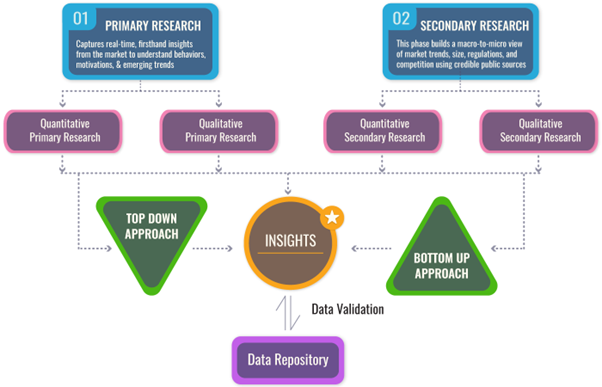
DUAL MODELING: TOP-DOWN + BOTTOM-UP
To ensure robust market estimation, we apply two complementary sizing approaches:
Top-Down Modeling:- Start with broader industry value (e.g., global or regional TAM)
- Apply filters by segment, geography, end-user, or use case
- Adjust with primary insights and validation benchmarks
- Ideal for investor-grade market scans and opportunity mapping
- Aggregate from the ground up using sales volumes, pricing, and unit economics
- Use internal modeling templates aligned with stakeholder data
- Incorporate distributor-level or region-specific inputs
- Most accurate for emerging segments and granular sub-markets
DATA VALIDATION: IN-HOUSE REPOSITORY
We close the loop with proprietary data intelligence built from ongoing projects, industry monitoring, and historical benchmarking. This repository includes:
- Multi-sector market and pricing models
- Key trendlines from past interviews and forecasts
- Benchmarked adoption rates, churn patterns, and ROI indicators
- Industry-specific deviation flags and cross-check logic
- Catches inconsistencies early
- Aligns projections across studies
- Enables consistent, high-trust deliverables