

Smoothwall HDPE Conduits Market Size and Forecast (2021 - 2034), Global and Regional Growth, Trend, Share and Industry Analysis Report Coverage; Application (Telecommunications, Power and Utilities, and Others), Installation Method (Open Trenching, Horizontal Directional Drilling, Micro Trenching, and Direct Burial), End Use Infrastructure (Urban Infrastructure, Rural and Remote Connectivity, Industrial and Commercial Developments, and Smart Cities and Digital Infrastructure), and Geography
2026-07-07
Energy & Power
Ekta Chaurasia (Team Lead)
Description
Smoothwall
HDPE Conduits Market Overview
The
global Smoothwall HDPE Conduits Market is experiencing strong growth, driven by
the increasing demand for reliable and durable cable protection systems across
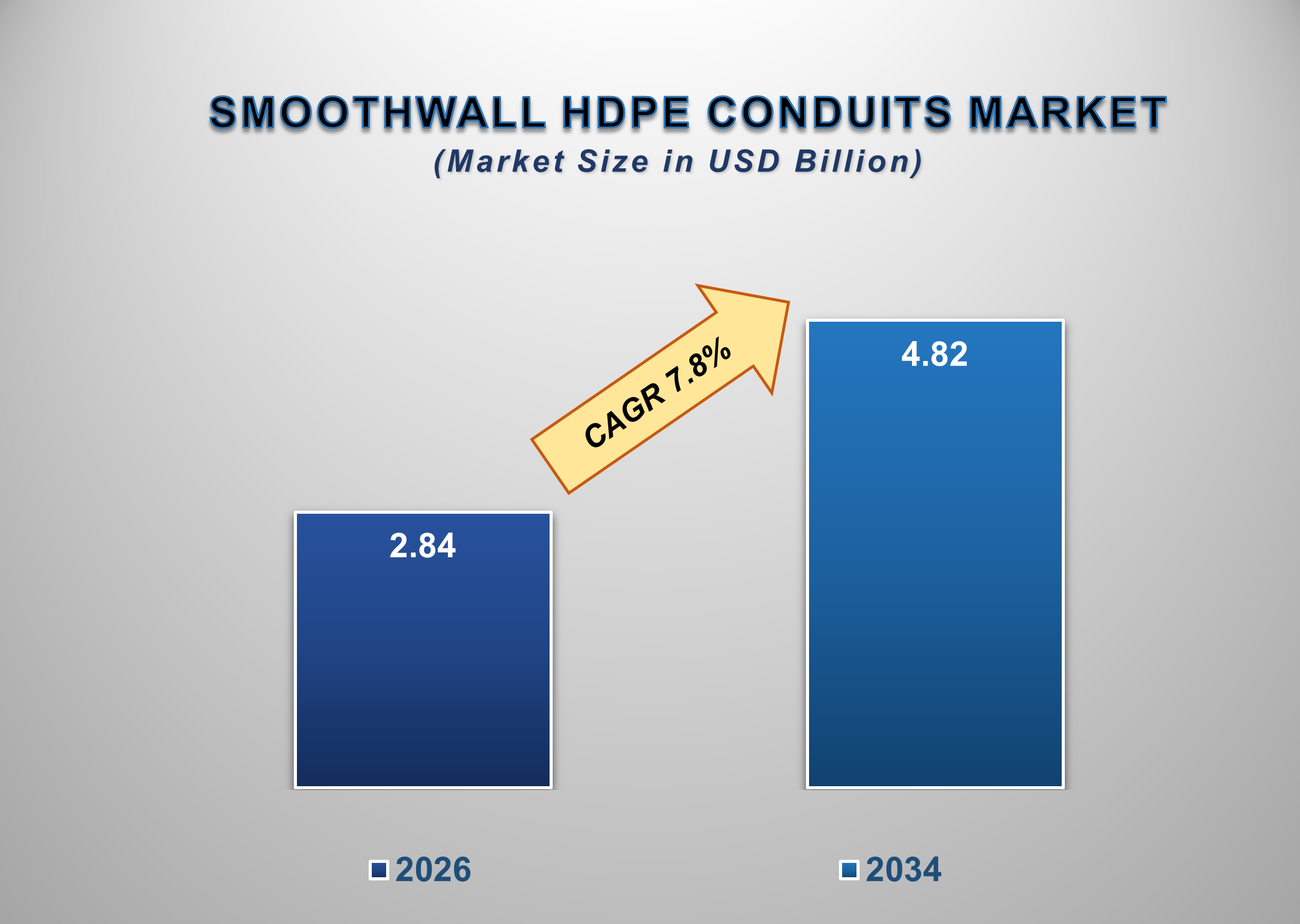
telecommunications and power infrastructure. Valued at USD 2.84 billion in 2026,
the market is projected to reach USD 4.82 billion by 2033, growing at a CAGR of
7.8% during the forecast period.
The market for
smoothwall HDPE conduits is expanding steadily due to the growing need for
dependable and long-lasting cable protection systems in power infrastructure
and telecommunications. When compared to more conventional materials like PVC
and metal conduits, smoothwall high-density polyethylene (HDPE) conduits are
frequently chosen because of their exceptional flexibility, high impact
resistance, corrosion resistance, and extended service life. These
characteristics make them perfect for usage in hostile environments and
underground, especially in electrical cable management systems and fiber optic
cable installations.
Smoothwall HDPE
conduits are in high demand in the telecommunications industry due to the fast
growth of broadband networks, fiber-to-the-home (FTTH) deployments, and the
worldwide development of 5G infrastructure. To improve connection and close the
digital divide, governments and businesses are making significant investments
in digital infrastructure, particularly in developing nations. Additionally,
the market expansion in the power and utilities segment is being supported by
the increasing need for subterranean power transmission and distribution
systems to enhance grid dependability and lower transmission losses.
The efficiency and
uptake of HDPE conduits are being further increased by technological
developments including the creation of multi-duct systems, pre-lubricated
conduits, and better installation methods like horizontal directional drilling
(HDD). Furthermore, new prospects for market expansion are being created by the
growing emphasis on smart cities and sustainable infrastructure development.
Asia-Pacific dominates
the industry regionally due to growing urbanization, infrastructure
development, and significant telecom investments in nations like China and
India. North America and Europe also constitute sizable markets due to
continuous network upgrades and the replacement of outdated infrastructure.
However, the market
has to contend with concerns like price fluctuations for raw materials and
competition from substitute conduit materials. Despite this, the long-term
prospects are still favorable due to ongoing global investments in energy
infrastructure, telecommunications, and digital transformation projects.
Smoothwall HDPE Conduits Market Drivers and Opportunities
Rapid Expansion of
Telecommunications Infrastructure
One of the main factors propelling the Smoothwall HDPE
Conduits Market is the rapid expansion of high-speed internet networks. The need for effective
cable protection systems has grown significantly due to fiber-to-the-home
(FTTH) deployments, broadband expansion projects, and the global rollout of 5G
technology. In telecom applications, smoothwall HDPE conduits
are highly favored because of their flexibility, light weight, and capacity to
offer fiber optic cables low-friction paths. To improve connectivity, telecom
companies and governments are making significant investments in digital
infrastructure, particularly in underserved and rural areas. Furthermore,
increasing data consumption, cloud services, and digital platforms are driving
network development, which in turn is propelling the adoption of HDPE conduits
throughout the world's telecom networks.
Growing Underground Power
Transmission and Grid Modernization
Smoothwall HDPE
conduits are in high demand due to the trend toward underground
power distribution systems.
Compared to overhead lines, utilities are increasingly using subterranean
cabling to increase dependability, decrease power outages, and lessen the
visual and environmental impact. Smoothwall HDPE conduits are ideal for
safeguarding electrical wires under challenging conditions because of their
superior resistance to moisture, chemicals, and mechanical stress. Durable
conduit systems are also becoming more and more necessary as a result of
continuing grid modernization projects, the integration of renewable energy
sources, and the growth of smart grids. While industrialized nations are
concentrating on updating outdated networks, emerging economies are investing
in bolstering their power infrastructure, all of which contribute to consistent
market growth.
Smart Cities and Digital
Infrastructure Development
The market for smoothwall HDPE conduits has
significant growth potential as smart cities and digital infrastructure
continue to evolve. Governments worldwide are investing in intelligent
infrastructure, such as smart grids, surveillance systems, and connected public
services. These projects require robust underground cable management systems,
thereby increasing the demand for HDPE conduits. Additionally, the development
of IoT-enabled networks and electric vehicle charging infrastructure further
supports market growth. Emerging economies, in particular, offer substantial
opportunities due to rapid urbanization and increasing investments in
infrastructure development.
Smoothwall HDPE Conduits Market Scope
|
Report Attributes |
Description |
|
Market Size in 2026 |
USD 2.84 Billion |
|
Market Forecast in 2034 |
USD 4.82 Billion |
|
CAGR % 2026-2034 |
7.8% |
|
Base Year |
2025 |
|
Historic Data |
2021-2025 |
|
Forecast Period |
2026-2034 |
|
Report USP |
Comprehensive
global smoothwall HDPE conduits market size and forecast analysis with
detailed segmentation by product Application, Installation Method, End Use
Infrastructure, and geography. The report provides in-depth insights into
market share, competitive landscape, and strategic positioning of key
players. It includes analysis of growth drivers, challenges, and emerging
opportunities influencing market expansion. The study evaluates technological
advancements in hyaluronic acid and biocompatible filler formulations,
evolving consumer preferences toward minimally invasive cosmetic procedures,
and increasing adoption across specialty and dermatology clinics.
Additionally, the report offers regional and country-level market trends,
regulatory landscape assessment, and strategic developments such as product
launches, partnerships, and expansions, enabling stakeholders, manufacturers,
investors, and healthcare providers to make informed business decisions |
|
Segments Covered |
●
By Application ●
By Installation Method ●
By End Use
Infrastructure |
|
Regional Scope |
●
North America ●
Europe ●
APAC ●
Latin America ●
Middle East and Africa |
|
Country Scope |
1)
U.S. 2)
Canada 3)
U.K. 4)
Germany 5)
France 6)
Italy 7)
Spain 8)
Switzerland 9)
China 10) India 11) Japan 12) South Korea 13) Australia 14) Mexico 15) Brazil 16) Argentina 17) Saudi Arabia 18) UAE 19) South Africa |
Smoothwall HDPE Conduits
Market Report Segmentation Analysis
The global smoothwall HDPE conduits
market analysis is segmented by Application, Installation Method, End Use
Infrastructure, and Region.
Telecommunications segment
dominated the market in 2025 and is projected to grow at the highest CAGR
during the forecast period.
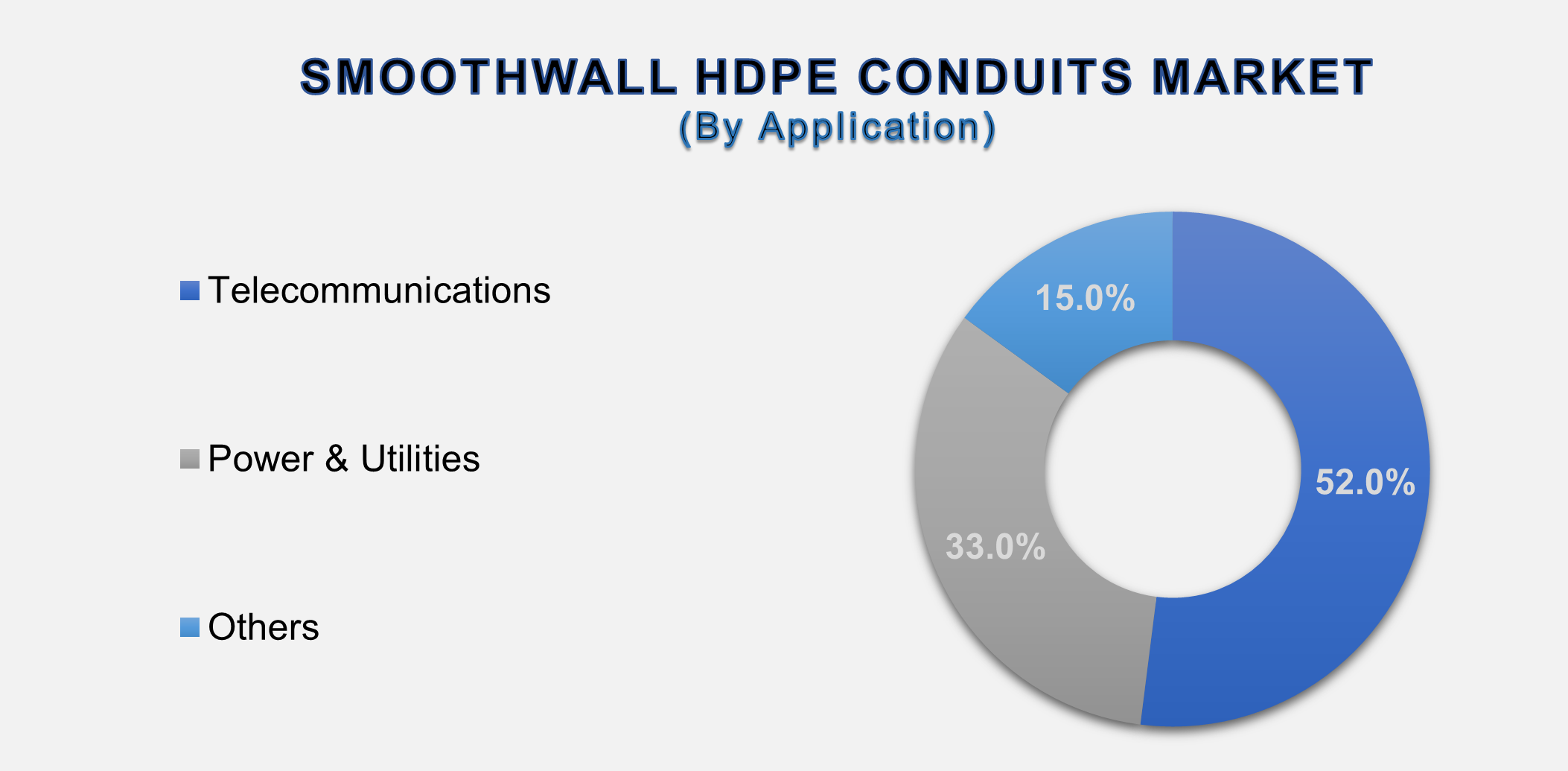
By Application, the Smoothwall HDPE
Conduits Market is segmented into telecommunications, power and utilities, and
others. Telecommunications dominate the Smoothwall HDPE Conduits Market. The rapid
growth of fiber optic networks and the rising need for high-speed connectivity
are the main drivers of market expansion. In addition to their smooth inner
surface, which makes cable pulling simple and shortens installation time, these
conduits are frequently used to safeguard fiber cables. Demand is being driven
primarily by the deployment of 5G infrastructure, increasing internet
penetration, and expanding data consumption. Growth is also supported by
government programs to increase broadband access in underserved and rural
areas. Smoothwall HDPE conduits are a great option for the implementation of
contemporary telecom infrastructure because of its strength, adaptability, and
resilience to environmental stress.
Open Trenching holds the
highest share of the Installation Method Segment over the forecast period
Based on Installation Method, the
market is bifurcated into open trenching,
horizontal directional drilling, micro trenching, and direct burial. The open
trenching segment accounts for the largest share of the market. The Smoothwall
HDPE Conduits Market's most popular installation technique is open trenching
because of its affordability, ease of use, and suitability for large-scale
infrastructure projects. This process entails digging a trench, installing
the conduits, and then backfilling the ground. It is frequently utilized in
power cable and telecommunications installations, particularly in locations
where surface disturbance is controllable. Open trenching is a preferred option
for urban and semi-urban developments because it provides simple access for
maintenance, repairs, and inspection. Although it requires more surface
restoration than trenchless approaches, it is still the most popular because to
its simple execution and cheaper equipment.
Urban Infrastructure holds the highest share of the End Use
Infrastructure Segment over the forecast period
Based on End Use Infrastructure, the
market is bifurcated into urban infrastructure, rural and remote connectivity,
industrial and commercial developments, and smart cities and digital
infrastructure. The urban infrastructure segment accounts for the largest share
of the market. Rapid urbanization and rising demand for dependable utility networks are
the main drivers of market expansion. Smoothwall HDPE conduits are essential
for cable protection in cities that need effective subterranean systems for
data transmission, power distribution, and telecommunications. They are ideal for dense urban environments with high
traffic and intricate layouts because of their strength, adaptability, and
corrosion resistance. Demand is also being increased by the creation of smart
cities, metro rail projects, and urban redevelopment programs. The demand for
well-organized and robust subterranean conduit systems is anticipated to rise
dramatically as cities continue to modernize and grow.
The following
segments are part of an in-depth analysis of the global Smoothwall HDPE
Conduits Market:
|
Market
Segments |
|
|
By
Application |
●
Telecommunications
●
Power
& Utilities ●
Others
|
|
By
Installation Method |
●
Open
Trenching ●
Horizontal
Directional Drilling (HDD) ●
Micro
Trenching ●
Direct
Burial |
|
By
End Use Infrastructure |
●
Urban
Infrastructure ●
Rural
& Remote Connectivity ●
Industrial
& Commercial Developments ●
Smart
Cities & Digital Infrastructure |
Smoothwall HDPE Conduits Market Share Analysis by Region
Europe region is projected
to hold the largest share of the global Smoothwall HDPE Conduits Market over
the forecast period.
Europe is projected to
hold the largest share of the global Smoothwall HDPE Conduits Market during the
forecast period. Advanced infrastructure development and continuous improvements
to power and telecommunications networks are the main drivers of regional
growth. The deployment of 5G, the growth of fiber optic networks, and the
growing emphasis on subterranean cabling to improve dependability and
aesthetics are all contributing to the region's high demand. The UK, France,
Germany, and other nations are making significant investments in smart grid and
digital infrastructure initiatives. Furthermore, the use of recyclable and
long-lasting materials like HDPE is being encouraged by strict environmental
rules. Stable market expansion throughout Europe is further supported by the
replacement of outdated utility infrastructure and the drive toward smart
cities.
Global Smoothwall HDPE Conduits Market Recent Developments News:
·
In February 2026, Orbia
(Dura-Line business) reported strong financial performance with growth in its
Connectivity Solutions segment (HDPE conduits), driven by rising demand for
fiber-optic infrastructure and telecom expansion.
·
In April 2025, Orbia (Dura-Line
business) maintained large-scale production capacity (over 400 million meters
of conduit annually), highlighting continued expansion and strong supply
capabilities to meet global telecom demand.
The Global Smoothwall HDPE Conduits Market is dominated by a few
large companies, such as
·
Dura-Line
·
JM Eagle
·
Advanced Drainage Systems
·
WL Plastics
·
National Pipe & Plastics
·
Atkore
·
Pipelife International
·
Orbia (Wavin)
·
Charter Plastics
·
Blue Diamond Industries
·
Prime Conduit
·
Endot Industries
·
Condux International
·
Comstar Supply
·
Petroflex North America
·
Central Conduit
·
Kisan Mouldings Ltd.
·
Jain Irrigation Systems Ltd.
·
Supreme Industries Ltd.
· Astral Limited
Frequently Asked Questions
Ekta Chaurasia (Team Lead)
Ekta Chaurasia is a highly experienced Team Lead at M2Square Consultancy with over 7 years of expertise in market research, strategic consulting, competitive benchmarking, and business intelligence solutions. She specializes in ICT, semiconductors & electronics, automotive & transportation, and industrial machinery markets.
She leads end-to-end global research projects focused on market trends, industry analysis, growth forecasting, customer insights, and strategic decision-making. Known for her analytical leadership and industry expertise, Ekta helps businesses uncover growth opportunities, evaluate competitive landscapes, and stay ahead in rapidly evolving markets through accurate and insight-driven research.
1.
Global
Smoothwall HDPE Conduits Market Introduction and Market Overview
1.1. Objectives of the Study
1.2. Market Segmentation
1.2.1.Application of Global Smoothwall HDPE Conduits
Market
1.2.2.Installation Method of Global Smoothwall HDPE
Conduits Market
1.2.3.End Use of Global Smoothwall HDPE Conduits
Market
1.2.4.Region of Global Smoothwall HDPE Conduits
Market
1.3. Competition Coverage List of
Market Participants
1.4. Market Definition: Smoothwall
HDPE Conduits Market
2.
Executive Summary
2.1. Global Smoothwall HDPE Conduits
Market Estimation & Forecast
2.1.1.Global Smoothwall HDPE Conduits
Market Size (US$ Million) Estimates & Historical Trend Analysis (2021 -
2025)
2.1.2.Global Smoothwall HDPE Conduits Overall
Market Size (US$ Million), Growth Rate (Y-o-Y), Market CAGR (%), Market
forecast (2026 - 2034)
2.2. Snapshot of Global Smoothwall
HDPE Conduits Market
2.3. Global Smoothwall HDPE Conduits
Market Revenue Share (%) 2025
2.4. REGIONAL OUTLINE: Revenue CAGR,
by Region
2.5. Key Competitors & Key
Insights
3.
Market Overview (Qualitative
Analysis)
3.1. Demand Side Trends
3.2. Supply Side Trends /
Manufacturing Trends
3.3. Demand and Opportunity
Assessment, 2026 - 2034
3.4. Market Dynamics
3.4.1.Drivers
3.4.2.Limitations
3.4.3.Opportunities
3.4.4.Impact Analysis of Drivers and
Restraints
3.5. Key Developments
3.6. Regulatory Landscape
3.7. Value Chain / Ecosystem Analysis
3.8. Porter’s Five Forces Analysis
3.8.1.Bargaining Power of Suppliers
3.8.2.Bargaining Power of Buyers
3.8.3.Threat of Substitutes
3.8.4.Threat of New Entrants
3.8.5.Competitive Rivalry
3.9. PEST Analysis
3.9.1.Political Factors
3.9.2.Economic Factors
3.9.3.Social Factors
3.9.4.Technology Factors
4.
Global Smoothwall HDPE Conduits
Market Estimates & Forecast Trend Analysis, by Application
4.1. Global Smoothwall HDPE Conduits
Market Assessments & Key Findings, by Application
4.2. Global Smoothwall HDPE Conduits
Market Revenue (US$ Million) Estimates and Forecasts, by Application, 2021 -
2034
4.2.1.Telecommunications
4.2.2.Power & Utilities
4.2.3.Others
5.
Global Smoothwall HDPE Conduits
Market Estimates & Forecast Trend Analysis, by Installation Method
5.1. Global Smoothwall HDPE Conduits
Market Assessments & Key Findings, by Installation Method
5.2. Global Smoothwall HDPE Conduits
Market Revenue (US$ Million) Estimates and Forecasts, by Installation Method, 2021
- 2034
5.2.1.Open Trenching
5.2.2.Horizontal Directional Drilling
(HDD)
5.2.3.Micro Trenching
5.2.4.Direct Burial
6.
Global Smoothwall HDPE Conduits
Market Estimates & Forecast Trend Analysis, by End Use
6.1. Global Smoothwall HDPE Conduits
Market Assessments & Key Findings, by End Use
6.2. Global Smoothwall HDPE Conduits
Market Revenue (US$ Million) Estimates and Forecasts, by End Use, 2021 - 2034
6.2.1.Urban Infrastructure
6.2.2.Rural & Remote Connectivity
6.2.3.Industrial & Commercial
Developments
6.2.4.Smart Cities & Digital
Infrastructure
7.
Global Smoothwall HDPE Conduits
Market Estimates & Forecast Trend Analysis, by Region
7.1. Global Smoothwall HDPE Conduits
Market Assessments & Key Findings, by Region
7.2. Global Smoothwall HDPE Conduits
Market Revenue (US$ Million) Estimates and Forecasts, by Region, 2021 - 2034
7.2.1.North America
7.2.2.Europe
7.2.3.Asia Pacific
7.2.4.Middle East & Africa
7.2.5.Latin America
8.
North
America Smoothwall HDPE Conduits Market: Estimates & Forecast Trend Analysis
8.1.
North
America Smoothwall HDPE Conduits Market Assessments & Key Findings
8.1.1.North America Smoothwall HDPE
Conduits Market Introduction
8.1.2.North America Smoothwall HDPE
Conduits Market Size Estimates and Forecast (US$ Million) (2021 - 2034)
8.1.2.1. By Application
8.1.2.2. By Installation Method
8.1.2.3. By End Use
8.1.2.4. By Country
8.1.2.4.1. The U.S.
8.1.2.4.2. Canada
9.
Europe
Smoothwall HDPE Conduits Market: Estimates & Forecast Trend Analysis
9.1. Europe Smoothwall HDPE Conduits
Market Assessments & Key Findings
9.1.1.Europe Smoothwall HDPE Conduits
Market Introduction
9.1.2.Europe Smoothwall HDPE Conduits
Market Size Estimates and Forecast (US$ Million) (2021 - 2034)
9.1.2.1. By Application
9.1.2.2. By Installation Method
9.1.2.3. By End Use
9.1.2.4. By Country
9.1.2.4.1.
Germany
9.1.2.4.2.
Italy
9.1.2.4.3.
U.K.
9.1.2.4.4.
France
9.1.2.4.5.
Spain
9.1.2.4.6.
Switzerland
9.1.2.4.7. Rest
of Europe
10. Asia Pacific Smoothwall
HDPE Conduits Market: Estimates &
Forecast Trend Analysis
10.1. Asia Pacific Market Assessments
& Key Findings
10.1.1. Asia Pacific Smoothwall HDPE
Conduits Market Introduction
10.1.2. Asia Pacific Smoothwall HDPE
Conduits Market Size Estimates and Forecast (US$ Million) (2021 - 2034)
10.1.2.1. By Application
10.1.2.2. By Installation Method
10.1.2.3. By End Use
10.1.2.4. By Country
10.1.2.4.1. China
10.1.2.4.2. Japan
10.1.2.4.3. India
10.1.2.4.4. Australia
10.1.2.4.5. South Korea
10.1.2.4.6. Rest of Asia Pacific
11. Middle East & Africa Smoothwall
HDPE Conduits Market: Estimates &
Forecast Trend Analysis
11.1. Middle East & Africa Market
Assessments & Key Findings
11.1.1. Middle
East & Africa Smoothwall
HDPE Conduits Market Introduction
11.1.2. Middle
East & Africa Smoothwall
HDPE Conduits Market Size Estimates and Forecast (US$ Million) (2021 - 2034)
11.1.2.1. By Application
11.1.2.2. By Installation Method
11.1.2.3. By End Use
11.1.2.4. By Country
11.1.2.4.1. South Africa
11.1.2.4.2. UAE
11.1.2.4.3. Saudi Arabia
11.1.2.4.4. Rest of MEA
12. Latin America
Smoothwall HDPE Conduits Market:
Estimates & Forecast Trend Analysis
12.1. Latin America Market Assessments
& Key Findings
12.1.1. Latin America Smoothwall HDPE
Conduits Market Introduction
12.1.2. Latin America Smoothwall HDPE
Conduits Market Size Estimates and Forecast (US$ Million) (2021 - 2034)
12.1.2.1. By Application
12.1.2.2. By Installation Method
12.1.2.3. By End Use
12.1.2.4. By Country
12.1.2.4.1. Brazil
12.1.2.4.2. Mexico
12.1.2.4.3. Argentina
12.1.2.4.4. Rest of LATAM
13. Competition Landscape
13.1. Global Smoothwall HDPE Conduits
Market Application Mapping
13.2. Global Smoothwall HDPE Conduits
Market Concentration Analysis, by Leading Players / Innovators / Emerging
Players / New Entrants
13.3. Global Smoothwall HDPE Conduits
Market Tier Structure Analysis
13.4. Global Smoothwall HDPE Conduits
Market Concentration & Company Market Shares (%) Analysis, 2025
14. Company Profiles
14.1. Dura-Line
14.1.1. Company Overview & Key Stats
14.1.2. Financial Performance & KPIs
14.1.3. Product Portfolio
14.1.4. SWOT Analysis
14.1.5. Business Strategy & Recent Developments
* Similar details would be provided for all
the players mentioned below
14.2. JM Eagle
14.3. Advanced Drainage Systems
14.4. WL Plastics
14.5. National Pipe & Plastics
14.6. Atkore
14.7. Pipelife International
14.8. Orbia (Wavin)
14.9. Charter Plastics
14.10. Blue Diamond Industries
14.11. Prime Conduit
14.12. Endot Industries
14.13. Condux International
14.14. Comstar Supply
14.15. Petroflex North America
14.16. Central Conduit
14.17. Kisan Mouldings Ltd.
14.18. Jain Irrigation Systems Ltd.
14.19. Supreme Industries Ltd.
14.20. Other Prominent
Players
15. Research
Findings & Conclusion
16. Assumption & Acronyms Used
17. Research
Methodology
17.1. External Transportations /
Databases
17.2. Internal Proprietary Database
17.3. Primary Research
17.4. Secondary Research
17.5. Assumptions
17.6. Limitations
17.7. Report FAQs
Our Research Methodology
"Insight without rigor is just noise."
We follow a comprehensive, multi-phase research framework designed to deliver accurate, strategic, and decision-ready intelligence. Our process integrates primary and secondary research , both quantitative and qualitative , along with dual modeling techniques ( top-down and bottom-up) and a final layer of validation through our proprietary in-house repository.
PRIMARY RESEARCH
Primary research captures real-time, firsthand insights from the market to understand behaviors, motivations, and emerging trends.
1. Quantitative Primary Research
Objective: Generate statistically significant data directly from market participants.
Approaches:- Structured surveys with customers, distributors, and field agents
- Mobile-based data collection for point-of-sale audits and usage behavior
- Phone-based interviews (CATI) for market sizing and product feedback
- Online polling around industry events and digital campaigns
- Purchase frequency by customer type
- Channel performance across geographies
- Feature demand by application or demographic
2. Qualitative Primary Research
Objective: Explore decision-making drivers, pain points, and market readiness.
Approaches:- In-depth interviews (IDIs) with executives, product managers, and key decision-makers
- Focus groups among end users and early adopters
- Site visits and observational research for consumer products
- Informal field-level discussions for regional and cultural nuances
SECONDARY RESEARCH
This phase helps establish a macro-to-micro understanding of market trends, size, regulation, and competitive dynamics, sourced from credible and public domain information.
1. Quantitative Secondary Research
Objective: Model market value and segment-level forecasts based on published data.
Sources include:- Financial reports and investor summaries
- Government trade data, customs records, and regulatory statistics
- Industry association publications and economic databases
- Channel performance and pricing data from marketplace listings
- Revenue splits, pricing trends, and CAGR estimates
- Supply-side capacity and volume tracking
- Investment analysis and funding benchmarks
2. Qualitative Secondary Research
Objective: Capture strategic direction, innovation signals, and behavioral trends.
Sources include:- Company announcements, roadmaps, and product pipelines
- Publicly available whitepapers, conference abstracts, and academic research
- Regulatory body publications and policy briefs
- Social and media sentiment scanning for early-stage shifts
- Strategic shifts in market positioning
- Unmet needs and white spaces
- Regulatory triggers and compliance impact

DUAL MODELING: TOP-DOWN + BOTTOM-UP
To ensure robust market estimation, we apply two complementary sizing approaches:
Top-Down Modeling:- Start with broader industry value (e.g., global or regional TAM)
- Apply filters by segment, geography, end-user, or use case
- Adjust with primary insights and validation benchmarks
- Ideal for investor-grade market scans and opportunity mapping
- Aggregate from the ground up using sales volumes, pricing, and unit economics
- Use internal modeling templates aligned with stakeholder data
- Incorporate distributor-level or region-specific inputs
- Most accurate for emerging segments and granular sub-markets
DATA VALIDATION: IN-HOUSE REPOSITORY
We close the loop with proprietary data intelligence built from ongoing projects, industry monitoring, and historical benchmarking. This repository includes:
- Multi-sector market and pricing models
- Key trendlines from past interviews and forecasts
- Benchmarked adoption rates, churn patterns, and ROI indicators
- Industry-specific deviation flags and cross-check logic
- Catches inconsistencies early
- Aligns projections across studies
- Enables consistent, high-trust deliverables