

Global Soundproof Curtains Market Size and Forecast (2025–2033), Global and Regional Growth, Trend, Share and Industry Analysis Report Coverage: By Type (Noise-Reducing, Sound-Insulating, Sound-Blocking), By Material (Wool-Based Materials, Plastic Foams, Composite, Others), By Distribution Channel (Online, Offline), and Geography
2026-01-02
Chemicals & Materials
Jaya Bundele (Research Analyst)
Description
Soundproof
Curtains Market Overview
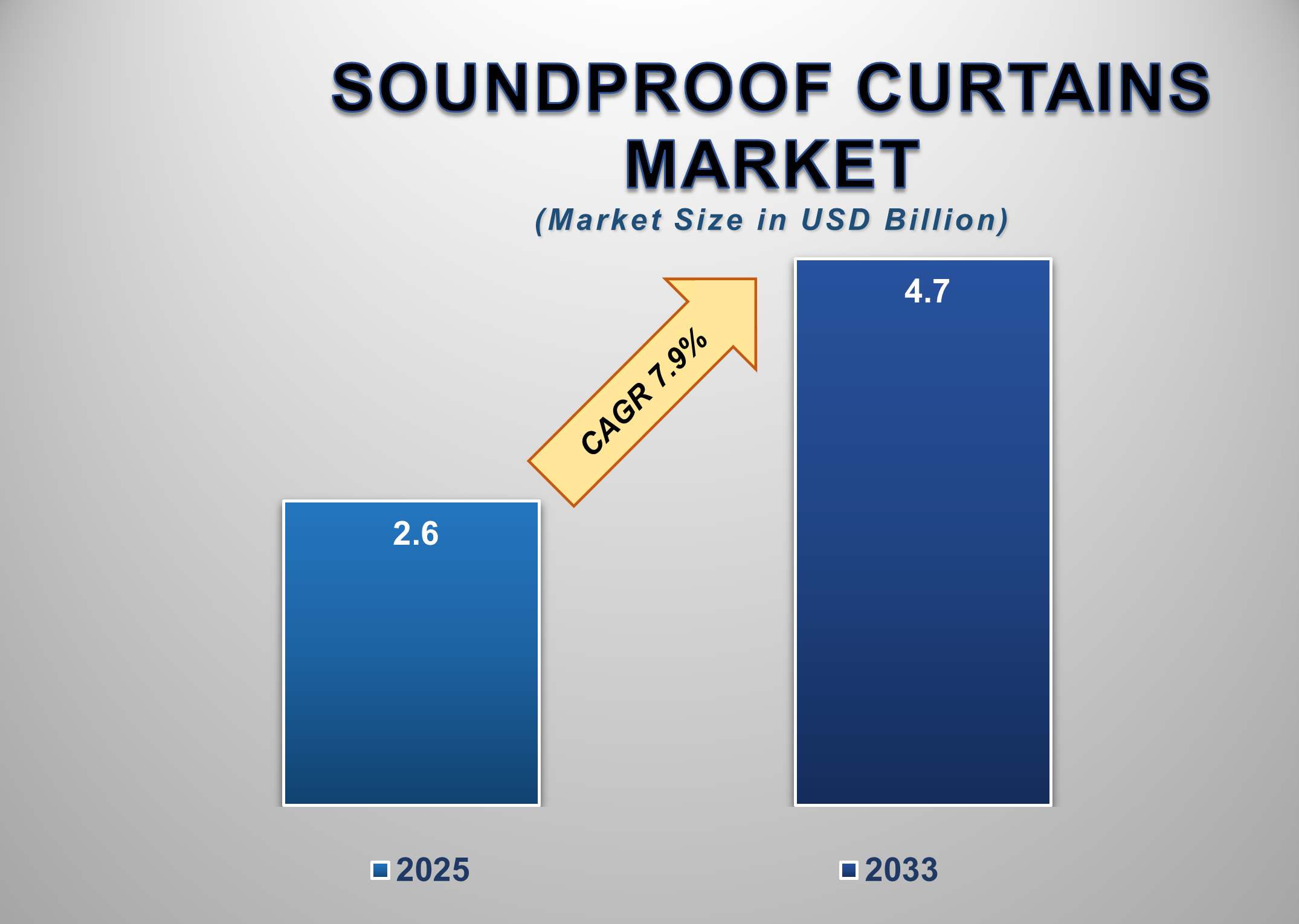
The Global Soundproof Curtains Market is undergoing steady expansion as rising urbanization, increasing noise pollution, and the growing emphasis on acoustic comfort drive widespread adoption across residential, commercial, and industrial environments. Valued at USD 2.6 billion in 2025, the market is projected to reach USD 4.7 billion by 2033, reflecting a robust CAGR of 7.9%. Soundproof curtains have become a preferred cost-effective alternative to structural acoustic solutions, offering flexibility, portability, and ease of installation. Their adoption is particularly high in metropolitan regions where traffic congestion, construction activities, and industrial operations significantly elevate ambient noise levels. As consumers increasingly prioritize healthier living environments, the demand for sound-blocking and noise-reducing products continues to surge.
Technological advancements in
acoustic textiles—such as multilayer composite fabrics, micro-fiber damping,
thermally insulated materials, and improved absorptive coatings—further
strengthen product performance and market penetration. Additionally, soundproof
curtains are benefiting from eco-friendly trends, with manufacturers adopting
recyclable wool, sustainable polyester blends, and natural fibers to gain a
competitive advantage among environmentally conscious consumers. Growth in
commercial sectors such as hospitality, recording studios, offices, and
educational institutions also contributes meaningfully, as organizations seek
economical solutions for improving workplace acoustics and occupant well-being.
Soundproof Curtains Market Drivers and
Opportunities
Rising Urban Noise Levels
and Growing Health Concerns Are Driving the Soundproof Curtains Market Growth
Rapid global urbanization has
resulted in a significant rise in noise pollution, driven by higher traffic
density, construction activities, transportation infrastructures such as
airports and railways, and expanding industrial operations in city environments.
This surge in noise levels has led to increased public awareness regarding the
adverse health impacts associated with prolonged exposure to excessive noise,
including stress, sleep disturbances, reduced productivity, and hearing
impairment. Consequently, consumers and businesses alike are actively seeking
effective noise mitigation solutions that are affordable, easy to install, and
aesthetically compatible with modern interiors—contributing substantially to
the demand for soundproof curtains. Soundproof curtains offer a practical and
cost-efficient alternative to permanent architectural solutions such as
insulation panels or double-glazed windows. Their ability to reduce sound
transmission by incorporating multilayer textile structures, dense materials,
acoustic foams, or wool-based absorptive fabrics makes them ideal for use in
residential apartments, home offices, hospitals, hotels, and educational
institutions. The post-pandemic rise of work-from-home culture has also
amplified the need for quieter personal environments, further stimulating
market demand. Moreover, governments across developed and emerging economies
are implementing stricter regulations related to environmental noise and
occupational safety.
Expansion of the
Hospitality, Commercial, and Industrial Sectors is Fueling Market Growth
The expansion of commercial and
industrial infrastructures—including hotels, offices, healthcare facilities,
cinemas, factories, and entertainment venues—is significantly contributing to
the rising adoption of soundproof curtains worldwide. In hospitality and
tourism environments, maintaining a quiet and comfortable ambiance is crucial
for enhancing guest experiences, especially in urban and airport-adjacent
areas. Hoteliers are increasingly integrating soundproofing solutions to reduce
noise transmission between rooms, hallways, and external environments. As
global tourism rebounds post-pandemic, this trend is expected to intensify. In
office environments, noise disruptions continue to be a major challenge,
impacting worker concentration, productivity, and job satisfaction. Modern
workspace designs featuring open layouts demand acoustic solutions that are
flexible and adaptable. Soundproof curtains offer an effective barrier for
meeting rooms, partitions, and private workspaces, making them valuable for corporate
offices and co-working environments. Similarly, educational institutions such
as schools and universities are incorporating soundproofing solutions to
improve audio clarity in classrooms, libraries, and auditoriums. Industrially,
manufacturing units and automotive facilities generate high noise levels that
require compliance with occupational safety guidelines. Soundproof curtains
provide a movable, customizable, and cost-effective solution for enclosing
noisy machinery, dividing workspaces, and minimizing employee exposure to
hazardous noise. Collectively, the growth of commercial end-user segments is
accelerating the market’s upward trajectory globally.
Increasing Popularity of
Home Renovation and Smart Interior Design Trends Is Creating Significant
Opportunities in the Soundproof Curtains Market
The rising popularity of home
renovation, modern interior aesthetics, and smart home design offers
substantial growth opportunities for the Soundproof Curtains Market. Consumers
today prioritize multifunctional home products that enhance comfort, privacy,
and aesthetics while aligning with modern design preferences. Soundproof
curtains, which combine acoustic damping with stylish appearances, are
increasingly being integrated into contemporary living spaces. Their ability to
serve dual purposes—noise control and interior enhancement—makes them appealing
for urban households, studio apartments, and home offices. The growing DIY home
improvement culture, supported by social media trends and online design
tutorials, is also encouraging consumers to adopt acoustic décor products.
Unlike structural soundproofing methods, curtains require minimal expertise to
install, making them ideal for quick and affordable home upgrades. Furthermore,
the increasing penetration of e-commerce platforms and direct-to-consumer (D2C)
brands provides vast opportunities for manufacturers to reach global audiences
and introduce innovative designs with customizable features. Manufacturers
offering eco-friendly options, including recyclable wool, natural fibers, and
sustainable textiles, can further capitalize on the rising preference for
environmentally responsible home décor.
Soundproof Curtains
Market Scope
|
Report Attributes |
Description |
|
Market Size in 2025 |
USD 2.6 Billion |
|
Market Forecast in 2033 |
USD 4.7 Billion |
|
CAGR % 2025-2033 |
7.9% |
|
Base Year |
2024 |
|
Historic Data |
2020-2024 |
|
Forecast Period |
2025-2033 |
|
Report USP |
Production, Consumption,
Company Share, Company Heatmap, Company Production Capacity, Growth Factors
and more |
|
Segments Covered |
●
by Type,
Material, Distribution Channel |
|
Regional Scope |
●
North America ●
Europe ●
APAC ●
Latin America ●
Middle East and
Africa |
|
Country Scope |
1)
U.S. 2)
Canada 3)
Germany 4)
UK 5)
France 6)
Spain 7)
Italy 8)
Switzerland 9)
China 10)
Japan 11)
India 12)
Australia 13)
South Korea 14)
Brazil 15)
Mexico 16)
Argentina 17)
South Africa 18)
Saudi Arabia 19)
UAE |
Soundproof Curtains
Market Report Segmentation Analysis
The global Soundproof Curtains
market is segmented by Type, Material, and Distribution Channel, and Geography.
Noise-Reducing Segment
Accounted for the Largest Market Share in the Global Soundproof Curtains Market
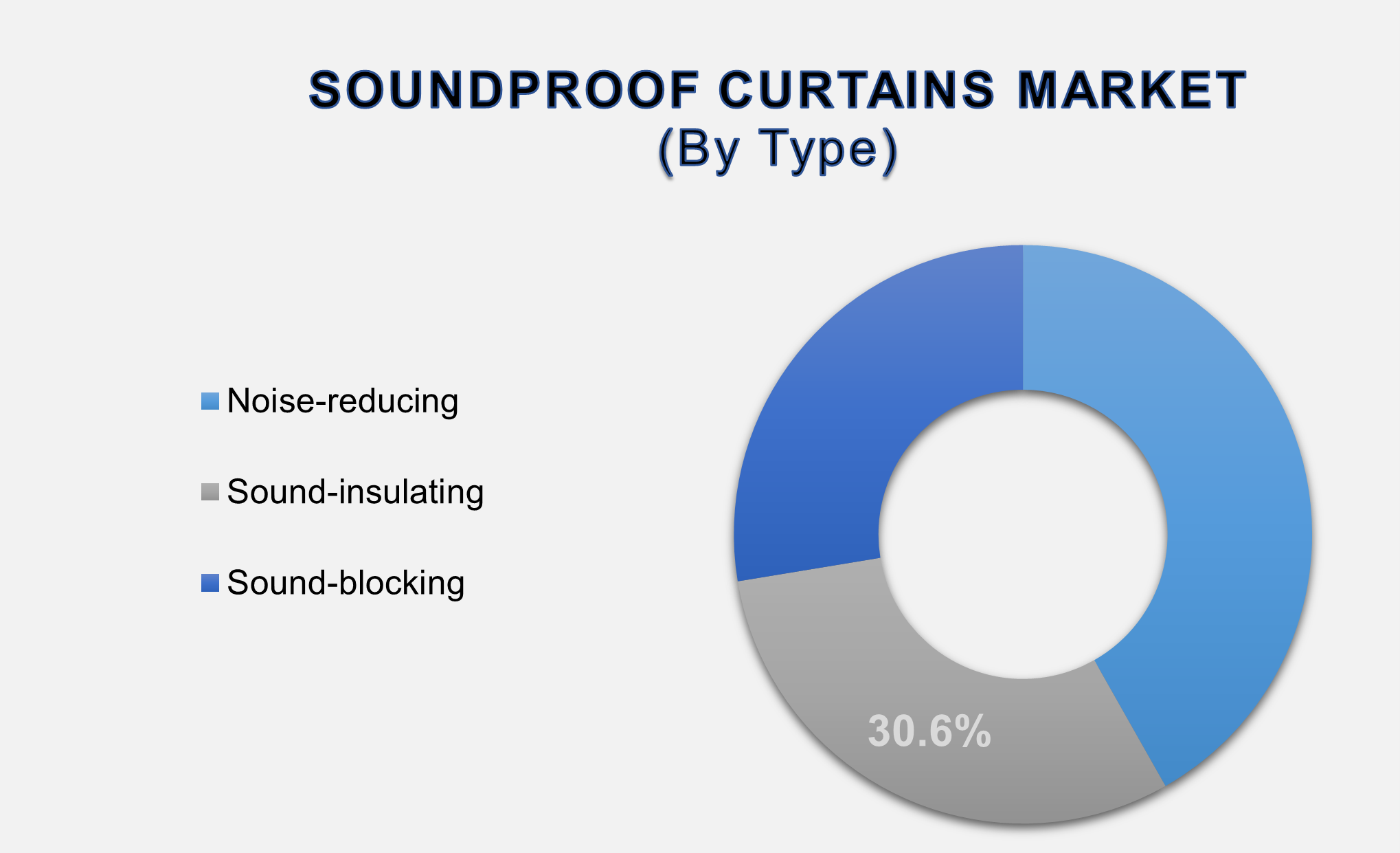
The Noise-Reducing segment held the largest share in the Global Soundproof Curtains Market, accounting for 41.8% in 2025, driven by its widespread adoption across residential, hospitality, and commercial office settings. These curtains are engineered with multi-layer polyester fabrics, wool blends, and dense acoustic fillers that effectively absorb mid-to-high-frequency noise, making them popular for bedrooms, home offices, and apartments in urban environments. Their cost-effectiveness compared to structural soundproofing options—such as wall insulation or double-glazing—further supports high usage among renters and homeowners seeking non-invasive solutions. The expanding work-from-home trend continues to strengthen the demand for noise-reducing curtains as consumers prioritize quiet environments for productivity and well-being. Additionally, manufacturers are launching aesthetically enhanced designs with blackout properties, thermal insulation, and eco-friendly fabrics, boosting segment attractiveness. With strong availability on e-commerce platforms and growing awareness of health impacts from urban noise, the noise-reducing segment is expected to maintain its lead throughout the forecast period.
Wool-Based Materials
Segment Leads the Global Soundproof Curtains Market Owing to Superior Acoustic
Absorption and Sustainability Benefits
The Wool-Based Materials segment
accounted for the largest share within the material category, supported by
wool’s exceptional acoustic absorption performance and rising consumer
preference for sustainable home décor products. Wool fibers possess inherent
density, crimp, and porosity, enabling them to trap sound waves effectively and
reduce reverberation across residential and commercial spaces. This makes
wool-based soundproof curtains a preferred choice for high-demand environments
such as hotel rooms, recording studios, office meeting areas, classrooms, and
luxury residences seeking advanced noise-control capabilities. Besides acoustic
performance, wool is also valued for its natural fire resistance, thermal
insulation, and moisture-regulating properties, enhancing overall comfort. The
global shift toward eco-friendly and recyclable interior textiles further
accelerates adoption, with manufacturers offering premium wool blends and
customizable designs to cater to upscale consumer segments. As green building
certifications become more prominent in the hospitality and corporate sectors,
the wool-based material segment is well positioned for sustained growth.
Online Distribution
Channel Segment Dominates the Global Soundproof Curtains Market Due to Strong
E-Commerce Expansion and Consumer Preference for Digital Purchasing
The Online distribution channel
holds the largest market share, driven by rapid e-commerce growth and the
increasing consumer preference for digital shopping platforms offering wide
product variety, transparent pricing, and detailed user reviews. Online marketplaces
such as Amazon, Walmart, Alibaba, and brand-owned D2C stores have significantly
boosted accessibility to soundproof curtains globally, especially in urban
regions where consumers actively search for quick home-acoustic solutions. The
segment also benefits from the availability of customizable curtain options,
advanced fabric descriptions, installation guides, and comparison tools that
support informed purchasing decisions. Additionally, online retail enables
manufacturers to launch new designs with minimal distribution costs while
targeting niche customer groups such as home-office users, renters, studio
owners, and interior décor enthusiasts. High discounts, bundled offers, and
convenient return policies further reinforce consumer adoption. With increasing
digital penetration across Asia-Pacific and North America, the online segment
is expected to remain the fastest-growing and most dominant distribution
channel throughout the forecast period.
The following segments are
part of an in-depth analysis of the global Soundproof Curtains Market:
|
Market
Segments |
|
|
By Type |
●
Noise-reducing ●
Sound-insulating ●
Sound-blocking |
|
By Material |
●
Wool-Based Materials ●
Plastic Foams ●
Composite ●
Others |
|
By
Distribution Channel |
●
Online ●
Offline |
Soundproof Curtains Market Share Analysis by
Region
The North America region
is projected to hold the largest share of the global Soundproof Curtains Market
over the forecast period.
North America currently dominates
the market with a 39.7% share, supported by advanced interior design trends,
strict noise control standards, and high adoption across residential and
commercial sectors. The United States leads regional demand due to widespread
home renovation activities, strong e-commerce penetration, and robust growth in
hospitality and office environments.
The Asia-Pacific region is
projected to grow at the highest CAGR, fueled by rapid urban development,
rising disposable incomes, expanding modern housing projects, and significant
construction activities in China, India, Japan, and Southeast Asia. Growing
awareness about noise-related health issues and adoption of Western interior
décor trends are further supporting market expansion.
Soundproof Curtains Market Competition Landscape
Analysis
The Soundproof
Curtains Market is moderately fragmented, with leading companies focusing on
product innovation, material enhancement, and global distribution expansion to
strengthen their competitiveness. Key players include Nicetown, Deconovo,
H.Versailtex, Magnetic Curtain, Quiet Curtain, Eclipse, Momo, HLC, Sure Fit,
Carr Home, Utopia Bedding, Best Home Fashion, AmazonBasics, BGment, Mushroom,
Linon Home Decor, Lush Decor, Milly Home, Vivhome, and Cocoweb.
Global Soundproof Curtains Market Recent
Developments News:
- In February 2025,
Impact Acoustic (Switzerland) launched Noren, a five-layer acoustic
curtain system made from recycled materials, offering high-performance
sound absorption for residential and commercial use.
- In October 2024,
3HLINEN Inc. (U.S.) introduced soundproof and thermal curtains for homes,
combining functional noise reduction and insulation with modern aesthetic
design.
- In May 2022, NiceTown (U.S.)
launched its online store featuring new products,
including custom 3-layer soundproof blackout curtains and waterproof
curtains, expanding its home décor offerings with a focus on functional,
customizable window treatments.
The Global Soundproof Curtains Market is
dominated by a few large companies, such as
●
Nicetown
●
Deconovo
●
H.Versailtex
●
Magnetic Curtain
●
Quiet Curtain
●
Eclipse
●
Momo
●
HLC
●
Sure Fit
●
Carr Home
●
Utopia Bedding
●
Best Home Fashion
●
AmazonBasics
●
BGment
●
Mushroom
●
Linon Home Decor
●
Lush Decor
●
Milly Home
●
Vivhome
●
Cocoweb
● Other Prominent Players
Frequently Asked Questions
Jaya Bundele (Research Analyst)
Jaya Bundele is a skilled Research Analyst with 4+ years of experience in market intelligence, consumer insights, competitive analysis, and industry forecasting across the consumer goods, agriculture, and food & beverage sectors. She specializes in market sizing, trend analysis, growth opportunity mapping, and strategic secondary research for global and regional markets.
Her expertise lies in transforming complex industry data into actionable business strategies that help organizations identify emerging trends, understand customer behavior, and gain a competitive edge. With a strong focus on data-driven insights, business intelligence, and future market trends, Jaya delivers high-quality research solutions aligned with evolving industry demands and market dynamics.
1. Global Soundproof Curtains
Market Introduction and Market Overview
1.1.
Objectives
of the Study
1.2.
Global
Soundproof Curtains Market Scope and Market Estimation
1.2.1.Global Soundproof Curtains
Market Overall Market Size (US$ Bn), Market CAGR (%), Market forecast (2025 - 2033)
1.2.2.Global Soundproof Curtains
Market Revenue Share (%) and Growth Rate (Y-o-Y) from 2020 - 2033
1.3.
Market
Segmentation
1.3.1.Type of Global Soundproof
Curtains Market
1.3.2.Material of Global Soundproof
Curtains Market
1.3.3.Distribution Channel of
Global Soundproof Curtains Market
1.3.4.Region of Global Soundproof
Curtains Market
2. Executive
Summary
2.1.
Demand
Side Trends
2.2.
Key
Market Trends
2.3.
Market
Demand (US$ Bn) Analysis 2020 – 2024 and Forecast, 2025 – 2033
2.4.
Demand
and Opportunity Assessment
2.5.
Demand
Supply Scenario
2.6.
Market
Dynamics
2.6.1.Drivers
2.6.2.Limitations
2.6.3.Opportunities
2.6.4.Impact Analysis of Drivers
and Restraints
2.7.
Emerging
Trends for Soundproof Curtains Market
2.8.
Porter’s
Five Forces Analysis
2.9.
PEST
Analysis
2.10.
Key
Regulation
3. Global
Soundproof Curtains Market Estimates
& Historical Trend Analysis (2020 - 2024)
4.
Global Soundproof Curtains
Market Estimates & Forecast Trend
Analysis, by Type
4.1.
Global
Soundproof Curtains Market Revenue (US$ Bn) Estimates and Forecasts, by Type, 2020
- 2033
4.1.1.Noise-reducing
4.1.2.Sound-insulating
4.1.3.Sound-blocking
5.
Global Soundproof Curtains
Market Estimates & Forecast Trend
Analysis, by Material
5.1.
Global
Soundproof Curtains Market Revenue (US$ Bn) Estimates and Forecasts, by Material,
2020 - 2033
5.1.1.Wool-Based Materials
5.1.2.Plastic Foams
5.1.3.Composite
5.1.4.Others
6.
Global Soundproof Curtains
Market Estimates & Forecast Trend
Analysis, by Distribution Channel
6.1.
Global
Soundproof Curtains Market Revenue (US$ Bn) Estimates and Forecasts, by Distribution
Channel, 2020 - 2033
6.1.1.Online
6.1.2.Offline
7. Global
Soundproof Curtains Market Estimates
& Forecast Trend Analysis, by region
1.1.
Global
Soundproof Curtains Market Revenue (US$ Bn) Estimates and Forecasts, by region,
2020 - 2033
1.1.1.North America
1.1.2.Europe
1.1.3.Asia Pacific
1.1.4.Middle East & Africa
1.1.5.Latin America
8. North America Soundproof
Curtains Market: Estimates &
Forecast Trend Analysis
8.1.
North
America Soundproof Curtains Market Assessments & Key Findings
8.1.1.North America Soundproof
Curtains Market Introduction
8.1.2.North America Soundproof
Curtains Market Size Estimates and Forecast (US$ Billion) (2020 - 2033)
8.1.2.1. By Type
8.1.2.2. By Material
8.1.2.3. By Distribution
Channel
8.1.2.4.
By
Country
8.1.2.4.1.
The
U.S.
8.1.2.4.2.
Canada
9. Europe Soundproof
Curtains Market: Estimates &
Forecast Trend Analysis
9.1.
Europe
Soundproof Curtains Market Assessments & Key Findings
9.1.1.Europe Soundproof Curtains
Market Introduction
9.1.2.Europe Soundproof Curtains
Market Size Estimates and Forecast (US$ Billion) (2020 - 2033)
9.1.2.1. By Type
9.1.2.2. By Material
9.1.2.3. By Distribution
Channel
9.1.2.4.
By
Country
9.1.2.4.1. Germany
9.1.2.4.2. Italy
9.1.2.4.3. U.K.
9.1.2.4.4. France
9.1.2.4.5. Spain
9.1.2.4.6. Switzerland
9.1.2.4.7.
Rest of Europe
10. Asia Pacific Soundproof
Curtains Market: Estimates &
Forecast Trend Analysis
10.1.
Asia
Pacific Market Assessments & Key Findings
10.1.1.
Asia
Pacific Soundproof Curtains Market Introduction
10.1.2.
Asia
Pacific Soundproof Curtains Market Size Estimates and Forecast (US$ Billion) (2020
- 2033)
10.1.2.1. By Type
10.1.2.2. By Material
10.1.2.3. By Distribution
Channel
10.1.2.4.
By
Country
10.1.2.4.1. China
10.1.2.4.2. Japan
10.1.2.4.3. India
10.1.2.4.4. Australia
10.1.2.4.5. South Korea
10.1.2.4.6.
Rest
of Asia Pacific
11. Middle East & Africa Soundproof
Curtains Market: Estimates &
Forecast Trend Analysis
11.1.
Middle
East & Africa Market Assessments & Key Findings
11.1.1.
Middle East & Africa Soundproof Curtains Market
Introduction
11.1.2.
Middle East & Africa Soundproof Curtains Market Size Estimates
and Forecast (US$ Billion) (2020 - 2033)
11.1.2.1. By Type
11.1.2.2. By Material
11.1.2.3. By Distribution
Channel
11.1.2.4.
By
Country
11.1.2.4.1. South
Africa
11.1.2.4.2. UAE
11.1.2.4.3. Saudi
Arabia
11.1.2.4.4.
Rest of MEA
12. Latin America
Soundproof Curtains Market: Estimates
& Forecast Trend Analysis
12.1.
Latin
America Market Assessments & Key Findings
12.1.1.
Latin
America Soundproof Curtains Market Introduction
12.1.2.
Latin
America Soundproof Curtains Market Size Estimates and Forecast (US$ Billion) (2020
- 2033)
12.1.2.1. By Type
12.1.2.2. By Material
12.1.2.3. By Distribution
Channel
12.1.2.4.
By
Country
12.1.2.4.1. Brazil
12.1.2.4.2. Mexico
12.1.2.4.3. Argentina
12.1.2.4.4.
Rest of LATAM
13. Country Wise Market:
Introduction
14.
Competition
Landscape
14.1.
Global
Soundproof Curtains Market Product Mapping
14.2.
Global
Soundproof Curtains Market Concentration Analysis, by Leading Players /
Innovators / Emerging Players / New Entrants
14.3.
Global
Soundproof Curtains Market Tier Structure Analysis
14.4.
Global
Soundproof Curtains Market Concentration & Company Market Shares (%)
Analysis, 2023
15.
Company
Profiles
15.1. Nicetown
15.1.1.
Company
Overview & Key Stats
15.1.2.
Financial
Performance & KPIs
15.1.3.
Product
Portfolio
15.1.4.
SWOT
Analysis
15.1.5.
Business
Strategy & Recent Developments
* Similar details would be provided for all
the players mentioned below
15.2. Deconovo
15.3. H.Versailtex
15.4. Magnetic
Curtain
15.5. Quiet Curtain
15.6. Eclipse
15.7. Momo
15.8. HLC
15.9. Sure Fit
15.10. Carr Home
15.11. Utopia
Bedding
15.12. Best Home
Fashion
15.13. AmazonBasics
15.14. BGment
15.15. Mushroom
15.16. Linon Home
Decor
15.17. Lush Decor
15.18. Milly Home
15.19. Vivhome
15.20. Cocoweb
15.21. Other
Prominent Players
16. Research
Methodology
16.1.
External
Transportations / Databases
16.2.
Internal
Proprietary Database
16.3.
Primary
Research
16.4.
Secondary
Research
16.5.
Assumptions
16.6.
Limitations
16.7.
Report
FAQs
17. Research
Findings & Conclusion
Our Research Methodology
"Insight without rigor is just noise."
We follow a comprehensive, multi-phase research framework designed to deliver accurate, strategic, and decision-ready intelligence. Our process integrates primary and secondary research , both quantitative and qualitative , along with dual modeling techniques ( top-down and bottom-up) and a final layer of validation through our proprietary in-house repository.
PRIMARY RESEARCH
Primary research captures real-time, firsthand insights from the market to understand behaviors, motivations, and emerging trends.
1. Quantitative Primary Research
Objective: Generate statistically significant data directly from market participants.
Approaches:- Structured surveys with customers, distributors, and field agents
- Mobile-based data collection for point-of-sale audits and usage behavior
- Phone-based interviews (CATI) for market sizing and product feedback
- Online polling around industry events and digital campaigns
- Purchase frequency by customer type
- Channel performance across geographies
- Feature demand by application or demographic
2. Qualitative Primary Research
Objective: Explore decision-making drivers, pain points, and market readiness.
Approaches:- In-depth interviews (IDIs) with executives, product managers, and key decision-makers
- Focus groups among end users and early adopters
- Site visits and observational research for consumer products
- Informal field-level discussions for regional and cultural nuances
SECONDARY RESEARCH
This phase helps establish a macro-to-micro understanding of market trends, size, regulation, and competitive dynamics, sourced from credible and public domain information.
1. Quantitative Secondary Research
Objective: Model market value and segment-level forecasts based on published data.
Sources include:- Financial reports and investor summaries
- Government trade data, customs records, and regulatory statistics
- Industry association publications and economic databases
- Channel performance and pricing data from marketplace listings
- Revenue splits, pricing trends, and CAGR estimates
- Supply-side capacity and volume tracking
- Investment analysis and funding benchmarks
2. Qualitative Secondary Research
Objective: Capture strategic direction, innovation signals, and behavioral trends.
Sources include:- Company announcements, roadmaps, and product pipelines
- Publicly available whitepapers, conference abstracts, and academic research
- Regulatory body publications and policy briefs
- Social and media sentiment scanning for early-stage shifts
- Strategic shifts in market positioning
- Unmet needs and white spaces
- Regulatory triggers and compliance impact
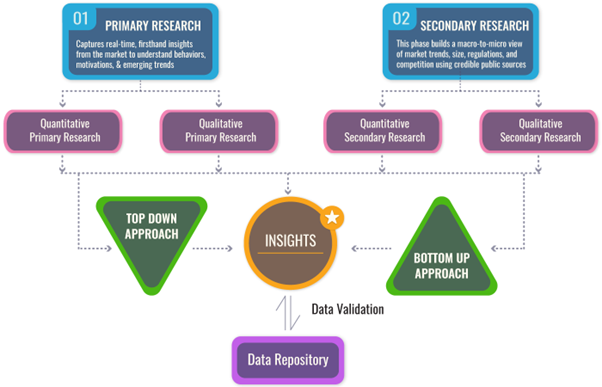
DUAL MODELING: TOP-DOWN + BOTTOM-UP
To ensure robust market estimation, we apply two complementary sizing approaches:
Top-Down Modeling:- Start with broader industry value (e.g., global or regional TAM)
- Apply filters by segment, geography, end-user, or use case
- Adjust with primary insights and validation benchmarks
- Ideal for investor-grade market scans and opportunity mapping
- Aggregate from the ground up using sales volumes, pricing, and unit economics
- Use internal modeling templates aligned with stakeholder data
- Incorporate distributor-level or region-specific inputs
- Most accurate for emerging segments and granular sub-markets
DATA VALIDATION: IN-HOUSE REPOSITORY
We close the loop with proprietary data intelligence built from ongoing projects, industry monitoring, and historical benchmarking. This repository includes:
- Multi-sector market and pricing models
- Key trendlines from past interviews and forecasts
- Benchmarked adoption rates, churn patterns, and ROI indicators
- Industry-specific deviation flags and cross-check logic
- Catches inconsistencies early
- Aligns projections across studies
- Enables consistent, high-trust deliverables