South Korea Antiepileptic Drugs Market Size and Forecast (2026–2034), Regional Growth, Trend, Share and Industry Analysis Report Coverage: By Drug Class (Sodium Channel Modulators, GABA-Enhancing Agents, Calcium Channel Modulators, and Others); By Route of Administration (Oral, Intravenous, Intramuscular, and Others); By Formulation (Tablets and Capsules, Oral Liquids and Suspensions, Injectable Formulations, and Others); By Distribution Channel (Hospital Pharmacies, Retail Pharmacies, and Online Pharmacies)
2026-11-12
Healthcare
Swetal (Research Analyst)
Description
South Korea Antiepileptic Drugs Market Overview
The South Korea antiepileptic drugs market is projected to expand from USD 0.43 billion in 2026 to USD 0.63 billion by 2034, registering a CAGR of 5.0% during 2026–2034. The South Korea antiepileptic drugs market is propelled by the constant need for the management of epilepsy, the need for seizure control treatment, and the availability of generics and innovative treatments. The South Korea antiepileptic drugs market is made up of traditional antiseizure drugs, such as carbamazepine and levetiracetam, in addition to innovative treatments aimed at meeting the needs of patients who have failed to benefit from traditional treatments. Domestic pharmaceutical companies contribute to the market through the production of generics, while SK Biopharmaceuticals provides an innovative edge to South Korea in terms of epilepsy drugs through cenobamate. Growth in the market will be driven by the affordability of treatment, reimbursement strategies, drug tolerance, and doctors’ preference for customized treatments depending on the type of seizures. Competition will be influenced by price and availability of generics in traditional drug categories.

South Korea Antiepileptic Drugs Market Growth Drivers
Growing need for Long-Term Epilepsy Management
Epilepsy is known to require a long-term pharmacological treatment regimen to control seizures and minimize the probability of seizure relapse, making the continuous demand for antiepileptics in South Korea necessary. The growing aging population and increasing prevalence of neurological conditions related to strokes and other brain diseases are additional factors that contribute to the necessity of managing epilepsy. According to a nationwide study conducted in South Korea and published in Seizure in July 2023, 82,390 new cases of epilepsy were followed, and approximately 8.8% of patients had reached the state of possible drug-resistant epilepsy after seven years. In a nationwide cohort study conducted across South Korea and published in Heliyon on March 7, 2024, the authors assessed 6,746 patients who started add-on antiepileptic treatment from 2016 to 2020. It was observed that 65.5% continued to be on their initial add-on drug regimen during the entire follow-up period of one year, on average for about 307 days. The continuous need for therapy reflects sustained demand for existing medications like levetiracetam and carbamazepine, as well as new therapies for those patients needing more effective or tolerable treatments.
Demand for newer antiseizure therapies
In South Korea, there is a demand for innovative treatment options since people with epilepsy need better seizure control due to inadequate management with conventional antiepileptic agents. Despite the significance of the current treatment drugs for epilepsy, there still exist drug-resistant cases that require alternative treatment options with better effectiveness levels and tolerable adverse effects. For instance, in November of 2025, South Korea's Ministry of Food and Drug Safety approved Cenobamate (Xcopri). This medication, produced by SK Biopharmaceuticals and distributed locally by Dong-A ST, can be used for the management of partial-onset seizures in adult epilepsy cases that are difficult to manage with current medications. Approval of this treatment came at a time when some of the patients in Korea had accessed this medication from abroad.
South Korea Antiepileptic Drug Market Restraint
Treatment Tolerability and Medication-Management Challenges
Poor tolerability and medication management issues may limit the South Korean market for antiepileptic drugs, considering that long-term treatment may involve such side effects as somnolence, dizziness, cognitive dysfunction, and mood changes. In addition, the possibility of drug interactions, complex dosing schedules, and other related issues can negatively affect medication adherence and cause discontinuation or switching of treatment. For patients needing several types of medicines, there will be even more difficulty in maintaining a regular treatment regimen, while healthcare providers should achieve a proper balance between seizure control, adverse effect concerns, and the personal needs of every patient. According to the results of the national South Korean cohort study published in Heliyon in March 2024, which involved 6,746 patients initiating an add-on antiepileptic treatment regimen, 41.0% of them switched from their initial add-on medication within 12 months. This situation may affect continuity of care and require closer clinical observations and follow-up, thus limiting further use of individual drugs.
South Korea Antiepileptic Drug Market Opportunities
Expansion of Innovative Epilepsy Treatments
The emergence of innovative antiepileptic drugs (AEDs), such as novel-generation anti-seizure medicines, target AEDs, and novel safety and tolerability antiepileptic drugs, offers several prospects for the expansion of South Korea's antiepileptic drugs market. The increasing requirement for improved seizure management, especially in the population suffering from drug-resistant epilepsy, leads to enhanced clinical trials by pharmaceutical companies to bring a novel product to the market. For example, in November 2025, South Korea's Ministry of Food and Drug Safety (MFDS) approved XCOPRI (cenobamate), which is being developed by SK Biopharmaceuticals Company as an addition to the treatment for partial-onset seizures in adults. Moreover, in August 2026, SK Biopharmaceuticals Company announced that it entered into an agreement for the in-licensing of Opakalim, an investigational Kv7 potassium channel activator in Phase 2/3 clinical development for focal-onset seizures.
International Commercialization of Korean-Developed Medicines
There is a large potential for future growth of South Korea's antiepileptic drug market from the international commercialization of the locally manufactured antiepileptic drugs. It would be possible for the South Korean pharmaceutical companies to take advantage of the rising global demand for state-of-the-art products used in seizure management by acquiring regulatory clearance, reaching licensing agreements and partnerships with other foreign firms based in North America, Europe, and Asia-Pacific. The recognition of the revolutionary Korean antiepileptic drugs in the global market could generate revenues through exports, licensing charges, and royalties to help improve the competitiveness of local pharmaceutical producers.
South Korea Antiepileptic Drugs Market Scope
South Korea Antiepileptic Drugs Market Report Segmentation Analysis
The Sodium Channel Modulators Segment Is Expected to Dominate the South Korea Antiepileptic Drugs Market During the Forecast Period
The sodium channel modulators are anticipated to hold a prominent share of South Korea’s antiepileptic drugs market because of their established utility in controlling seizures through regulation of the excess electrical activity in the brain. The drugs find extensive application in treating focal-onset seizures and some generalized types of seizures due to their proven clinical efficacy, wide physician acceptance, and use in the treatment regimen of epilepsy. The continuous need for seizure control, presence of multiple therapies, and established prescribing trends are expected to fuel the demand for the segment over the forecast period.

Oral Segment Is Expected to Dominate the South Korea Antiepileptic Drugs Market During the Forecast Period
Oral antiepileptics will be responsible for the biggest share in terms of the market, as they are widely prescribed for epilepsy as a means of therapy, are easy to use, and are suitable for long-term treatment in an ambulatory setting. Epilepsy requires constant medication to prevent attacks; thus, oral antiepileptic drugs in the form of tablets, capsules, and mouth solutions can be administered as an option for continuous treatment. Their convenience, accessibility in a wide range of drug types, dosage regulation, and suitability for ambulatory treatment contribute to their popularity in treating adult and pediatric patients. Injectable drugs, on the other hand, are used mostly for emergency treatment and in hospital settings. An epidemiological analysis of the prescription of 18 oral antiseizure drugs for epilepsy conducted by researchers from South Korea has been published in the Journal of Clinical Neurology in 2022.
Tablets and Capsules Segment Is Expected to Dominate the South Korea Antiepileptic Drugs Market During the Forecast Period
The segment of tablets and capsules is likely to hold the largest share in the South Korean antiepileptic drug market owing to the preference for solid oral dosage forms for regular and extended treatment of epilepsy. Solid oral dosage forms provide advantages in terms of ease of administration, precise dosage, easy storage, and suitability for prolonged outpatient treatment. The presence of several antiseizure drug products in the form of tablets and capsules, together with well-established prescribing practices and wide distribution via hospitals and retail pharmacies, ensures high popularity of this segment. Moreover, the availability of both branded and generic products increases access to treatment and facilitates medication adherence.
The Hospital Pharmacies Segment Is Expected to Dominate the South Korea Antiepileptic Drugs Market During the Forecast Period
Hospital pharmacies will be considered key players in the antiepileptic drugs market in South Korea due to the role played by hospitals in the diagnosis and management of seizures among people. Many epilepsy and neurology clinics will be involved in the management of patients who require extensive clinical evaluations as well as drug monitoring, thus generating more demand for the use of antiepileptic drugs via this distribution channel. In addition, the availability of trained health care professionals and other diagnostic tools increases the popularity of this channel for antiepileptic drugs. Additionally, patients who have just been diagnosed with seizures, drug-resistant seizures, or require complex treatment will seek hospital-based health care.
The following segments are part of an in-depth analysis of the South Korea Antiepileptic Drugs Market:
South Korea Antiepileptic Drugs Market Competition Landscape Analysis
Competition exists between local antiepileptic producers in South Korea and foreign companies that produce antiepileptic drugs. Competitive positioning depends on the product's efficacy, safety, cost, reimbursement coverage, brand strength, and distribution capacity. The local companies competing with foreign firms in the antiepileptic drug market include SK Biopharmaceuticals, Dong-A ST, Chong Kun Dang Pharmaceutical, Daewoong Pharmaceutical, and Hanmi Pharmaceutical. Competing foreign companies in the antiepileptic drug market include UCB, Eisai, Sanofi, GSK, and Jazz Pharmaceuticals. Competition in the market has been defined by the development of generic anticonvulsant drugs, increasing health insurance coverage, and innovations that address the unmet treatment needs of patients. While the local producers have been competing through generics and local marketing capabilities, foreign companies still have opportunities.
South Korea Antiepileptic Drugs Market Recent Developments News:
In October 2026, Seoul Economic Daily reported that South Korea would introduce national health insurance coverage for XCOPRI (cenobamate), an innovative epilepsy drug developed by SK Biopharmaceuticals and commercialized domestically by Dong-A ST, effective November 1, 2026. Despite receiving U.S. FDA approval in 2019, the drug had initially been commercialized overseas, requiring South Korean patients to import it. The insurance coverage is expected to improve patient access by reducing treatment costs and import-related challenges, strengthening the domestic commercialization prospects of Korean-developed innovative epilepsy therapies.
In October 2026, ChosunBiz reported that South Korea's Ministry of Health and Welfare designated Samjin Pharmaceutical's lorazepam as a delisting-prevention drug to secure continued supply for pediatric seizure and epilepsy treatment. The designation followed supply disruptions after another domestic manufacturer discontinued production, prompting Samjin Pharmaceutical to take responsibility for manufacturing. Government coverage of production costs is intended to maintain the availability of essential, low-priced medicines that face limited commercial incentives for manufacturers. This development highlights the importance of government intervention in ensuring pharmaceutical supply continuity and maintaining access to established antiseizure treatments, particularly for pediatric patients.
In August 2026, Reuters reported that Biohaven entered into a licensing agreement with South Korea's SK Biopharmaceuticals worth up to US$795 million for Biohaven's epilepsy drug platform, including Opakalim. The agreement expands SK Biopharmaceuticals' access to investigational epilepsy therapies and strengthens its pipeline beyond internally developed products. This collaboration highlights growing international partnerships in antiseizure drug development and provides opportunities for Korean pharmaceutical companies to expand their innovative drug portfolios, strengthen research capabilities, and participate in the commercialization of next-generation epilepsy treatments.
The South Korea Antiepileptic Drugs Market is dominated by a few large companies, such as
Daewoong Bio
Korea Pharma
SK Biopharmaceuticals
Bukwang Pharmaceutical
Dong-Koo Bio & Pharma
LG Chem
Myungmoon Pharmaceutical
Myungin Pharmaceutical
Whanin Pharmaceutical
Hanin Pharmaceutical
Handok
Dong-A ST
Bukhwang Pharmaceutical
Celltrion Pharm
Hyundai Pharmaceutical
Huons
Myeongmun Pharmaceutical
Korea United Pharm
Daehan New Pharm
Sam Chun Dang Pharm
Other Prominent Players
Frequently Asked Questions
Swetal (Research Analyst)
Swetal is a Research Analyst with 4+ years of experience specializing in healthcare market research, medical devices, healthcare IT, and medical technology industry analysis. Her expertise includes competitive intelligence, secondary research, market trend forecasting, and healthcare business insights across global healthcare ecosystems.
She contributes to advanced market research reports by analyzing regulatory frameworks, emerging healthcare technologies, competitive landscapes, and innovation trends shaping the medical industry. With a strong focus on accurate market intelligence, strategic insights, and healthcare industry trends, Swetal supports businesses in making informed, data-backed decisions in a rapidly transforming healthcare environment.
South Korea Antiepileptic Drugs Market Introduction and Market Overview
Objectives of the Study
Market Segmentation
Drug Class of the South Korea Antiepileptic Drugs Market
Route of Administration of the South Korea Antiepileptic Drugs Market
Formulation of the South Korea Antiepileptic Drugs Market
Distribution Channel of the South Korea Antiepileptic Drugs Market
Competition Coverage List of Market Participants
Market Definition: Antiepileptic Drugs Market
Executive Summary
South Korea Antiepileptic Drugs Market Estimation & Forecast
South Korea Antiepileptic Drugs Market Size (US$ Million) Estimates & Historical Trend Analysis (2021 - 2025)
South Korea Peptide Cancer Vaccine Overall Market Size (US$ Million), Growth Rate (Y-o-Y), Market CAGR (%), Market Forecast (2026 - 2034)
Snapshot of South Korea Antiepileptic Drugs Market
South Korea Antiepileptic Drugs Market Revenue Share (%) 2025
Key Competitors & Key Insights
Market Overview (Qualitative Analysis)
Demand Side Trends
Supply Side Trends / Manufacturing Trends
Demand and Opportunity Assessment, 2026 - 2034
Market Dynamics
Drivers
Limitations
Opportunities
Impact Analysis of Drivers and Restraints
Key Developments
Regulatory Landscape
Pricing Analysis
Supply Chain Analysis
Porter’s Five Forces Analysis
Bargaining Power of Suppliers
Bargaining Power of Buyers
Threat of Substitutes
Threat of New Entrants
Competitive Rivalry
PEST Analysis
Political Factors
Economic Factors
Social Factors
Technology Factors
South Korea Antiepileptic Drugs Market Estimates & Forecast Trend Analysis, by Drug Class
South Korea Antiepileptic Drugs Market Assessments & Key Findings, by Drug Class
South Korea Antiepileptic Drugs Market Revenue (US$ Million) Estimates and Forecasts, by Drug Class, 2021 - 2034
Sodium Channel Modulators
GABA-Enhancing Agents
Calcium Channel Modulators
Others
South Korea Antiepileptic Drugs Market Estimates & Forecast Trend Analysis, by Route of Administration
South Korea Antiepileptic Drugs Market Assessments & Key Findings, by Route of Administration
South Korea Antiepileptic Drugs Market Revenue (US$ Million) Estimates and Forecasts, by Route of Administration, 2021 - 2034
Oral
Intravenous
Intramuscular
Others
South Korea Antiepileptic Drugs Market Estimates & Forecast Trend Analysis, by Formulation
South Korea Antiepileptic Drugs Market Assessments & Key Findings, by Formulation
South Korea Antiepileptic Drugs Market Revenue (US$ Million) Estimates and Forecasts, by Formulation, 2021 - 2034
Tablets and Capsules
Oral Liquids and Suspensions
Injectable Formulations
Others
South Korea Antiepileptic Drugs Market Estimates & Forecast Trend Analysis, by Distribution Channel
South Korea Antiepileptic Drugs Market Assessments & Key Findings, by Distribution Channel
South Korea Antiepileptic Drugs Market Revenue (US$ Million) Estimates and Forecasts, by Distribution Channel, 2021 - 2034
Hospital Pharmacies
Retail Pharmacies
Online Pharmacies
Competition Landscape
South Korea Antiepileptic Drugs Market Product Mapping
South Korea Antiepileptic Drugs Market Concentration Analysis, by Leading Players / Innovators / Emerging Players / New Entrants
South Korea Antiepileptic Drugs Market Tier Structure Analysis
South Korea Antiepileptic Drugs Market Concentration & Company Market Shares (%) Analysis, 2025
Company Profiles
Daewoong Bio
Company Overview & Key Stats
Financial Performance & KPIs
Product Portfolio
SWOT Analysis
Business Strategy & Recent Developments
* Similar details would be provided for all the players mentioned below
Korea Pharma
SK Biopharmaceuticals
Bukwang Pharmaceutical
Dong-Koo Bio & Pharma
LG Chem
Myungmoon Pharmaceutical
Myungin Pharmaceutical
Whanin Pharmaceutical
Hanin Pharmaceutical
Handok
Dong-A ST
Bukhwang Pharmaceutical
Celltrion Pharm
Hyundai Pharmaceutical
Huons
Myeongmun Pharmaceutical
Korea United Pharm
Daehan New Pharm
Sam Chun Dang Pharm
Other Prominent Players
Research Findings & Conclusion
Assumptions & Acronyms Used
Research Methodology
External Transportation / Databases
Internal Proprietary Database
Primary Research
Secondary Research
Assumptions
Limitations
Report FAQs
Our Research Methodology
"Insight without rigor is just noise."
We follow a comprehensive, multi-phase research framework designed to deliver accurate, strategic, and decision-ready intelligence. Our process integrates primary and secondary research , both quantitative and qualitative , along with dual modeling techniques ( top-down and bottom-up) and a final layer of validation through our proprietary in-house repository.
PRIMARY RESEARCH
Primary research captures real-time, firsthand insights from the market to understand behaviors, motivations, and emerging trends.
1. Quantitative Primary Research
Objective: Generate statistically significant data directly from market participants.
Approaches:- Structured surveys with customers, distributors, and field agents
- Mobile-based data collection for point-of-sale audits and usage behavior
- Phone-based interviews (CATI) for market sizing and product feedback
- Online polling around industry events and digital campaigns
- Purchase frequency by customer type
- Channel performance across geographies
- Feature demand by application or demographic
2. Qualitative Primary Research
Objective: Explore decision-making drivers, pain points, and market readiness.
Approaches:- In-depth interviews (IDIs) with executives, product managers, and key decision-makers
- Focus groups among end users and early adopters
- Site visits and observational research for consumer products
- Informal field-level discussions for regional and cultural nuances
SECONDARY RESEARCH
This phase helps establish a macro-to-micro understanding of market trends, size, regulation, and competitive dynamics, sourced from credible and public domain information.
1. Quantitative Secondary Research
Objective: Model market value and segment-level forecasts based on published data.
Sources include:- Financial reports and investor summaries
- Government trade data, customs records, and regulatory statistics
- Industry association publications and economic databases
- Channel performance and pricing data from marketplace listings
- Revenue splits, pricing trends, and CAGR estimates
- Supply-side capacity and volume tracking
- Investment analysis and funding benchmarks
2. Qualitative Secondary Research
Objective: Capture strategic direction, innovation signals, and behavioral trends.
Sources include:- Company announcements, roadmaps, and product pipelines
- Publicly available whitepapers, conference abstracts, and academic research
- Regulatory body publications and policy briefs
- Social and media sentiment scanning for early-stage shifts
- Strategic shifts in market positioning
- Unmet needs and white spaces
- Regulatory triggers and compliance impact
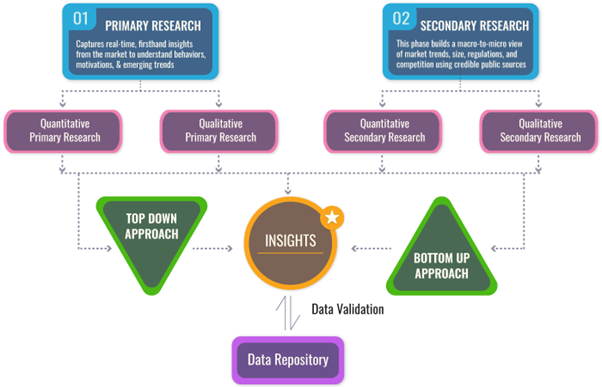
DUAL MODELING: TOP-DOWN + BOTTOM-UP
To ensure robust market estimation, we apply two complementary sizing approaches:
Top-Down Modeling:- Start with broader industry value (e.g., global or regional TAM)
- Apply filters by segment, geography, end-user, or use case
- Adjust with primary insights and validation benchmarks
- Ideal for investor-grade market scans and opportunity mapping
- Aggregate from the ground up using sales volumes, pricing, and unit economics
- Use internal modeling templates aligned with stakeholder data
- Incorporate distributor-level or region-specific inputs
- Most accurate for emerging segments and granular sub-markets
DATA VALIDATION: IN-HOUSE REPOSITORY
We close the loop with proprietary data intelligence built from ongoing projects, industry monitoring, and historical benchmarking. This repository includes:
- Multi-sector market and pricing models
- Key trendlines from past interviews and forecasts
- Benchmarked adoption rates, churn patterns, and ROI indicators
- Industry-specific deviation flags and cross-check logic
- Catches inconsistencies early
- Aligns projections across studies
- Enables consistent, high-trust deliverables