

South Korea Food Robotics Market Size and Forecast (2026–2034), Regional Growth, Trend, Share, and Industry Analysis Report Coverage: By Type (Articulated Robots, SCARA Robots, Delta Robots, and Collaborative Robots); By Application (Food Processing, Packaging, Palletizing, Sorting & Grading, and Others); By End User (Food Manufacturers, Food Service Providers, Beverage Industry, and Others)
2026-09-16
ICT
Ekta Chaurasia (Team Lead)
Description
South
Korea Food Robotics Market Overview
The South Korea
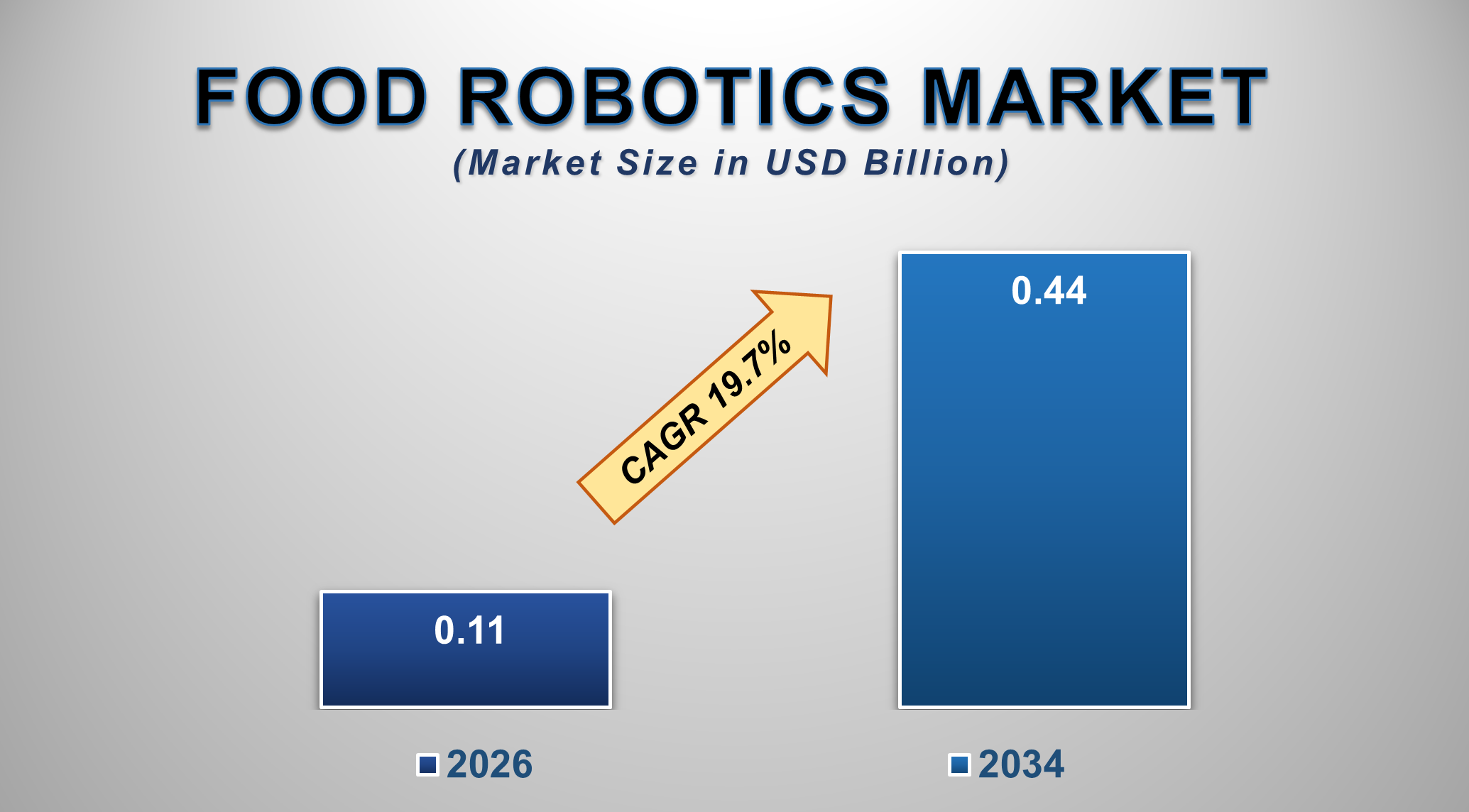
food robotics market is projected to expand from USD 0.11 billion in 2026 to
USD 0.44 billion by 2034, registering a CAGR of 19.7% during 2026–2034. The
South Korean market for food robotics is witnessing rapid developments as
restaurant operators, institutional kitchens, and food processing companies
embrace automation as a way of addressing labor shortages, increasing operating
expenses, and ensuring high-quality food products and hygiene. In addition to
traditional serving robots, automation technologies are being applied in other
kitchen functions, such as cooking, food preparation, raw ingredient
management, beverage preparation, and smart kitchens, as AI, computer vision,
and collaborative robotics are becoming common features in commercial
applications. With a thriving robotics sector and active government involvement
in food technology commercialization in South Korea, the outlook for local
manufacturers is favorable.
South
Korea Food Robotics Market Growth Drivers
Persistent Labor
Shortages and Rising Labor Costs
South Korea’s
food-service sector continues to face structural staffing shortages, increasing
the incentive to automate repetitive kitchen activities such as cooking,
frying, and food preparation. As reported by the Ministry of Employment and
Labor on April 2, 2024, the government allocated 4,490 foreign-worker positions
to the service sector, specifically including Korean restaurants that had
difficulty recruiting domestic workers. On August 20, 2024, the Ministry
further confirmed that the restaurant industry was experiencing “chronic” labor
shortages and expanded the foreign-worker pilot program to additional
restaurant categories. This persistent labor constraint is strengthening the
business case for food robotics, as automated systems can perform repetitive
kitchen tasks with fewer staffing requirements and help restaurants maintain
operating capacity despite recruitment challenges.
Increasing
Demand for Standardized, High-Throughput Food Preparation
An ever-growing
demand for automation that would help to achieve consistency in output as well
as work speed, especially during peak operating times. In accordance with what
was stated by Aniai in 2026, the Alpha Grill technology is used in Korean
burger, hospital food court, and airport food court operations, being able to
cook more than 200 products per hour while retaining pre-programmed parameters
of the cooking process. It was also emphasized by the Korean Ministry of
Agriculture, Food and Rural Affairs (MAFRA) that cooking and serving robots
should be considered as main areas of food technology application in the master
plan on food technology dated July 20, 2026.
South Korea Food Robotics Market
Restraints
High Upfront
Investment and Integration Complexity
The initial
financial burden and difficulties of integration represent significant
obstacles to the deployment of food robotics in South Korea, especially
regarding small and independent food-service establishments. The total
financial outlay does not merely encompass the costs of acquiring robotic
devices but also covers kitchen adjustments, system integration, programming,
training, maintenance, and changes in workflows. Moreover, robots tailored to
perform certain food-preparation operations may need to be adapted to a
company’s menu and operations. This makes the total financial burden of
adopting such robots more burdensome and can push back the payback period. For
this reason, although labor shortages are prompting companies to show interest
in robots, the high financial burden associated with their deployment
represents a hindrance to that end.
South Korea Food Robotics Market
Opportunities
AI- and
Vision-Enabled Adaptive Cooking Robots
Integration of AI,
computer vision, and real-time sensing will allow the food robotics market in
South Korea to transition from fixed and single-use automation to dynamic
cooking systems that will be able to adapt to differences in ingredients and
conditions of cooking. According to the Electronic Times news of October 9,
2025, KORAS Robotics created a cooking robot that can dynamically switch
between different grippers and choose suitable tools for the given ingredient
and cooking method, thereby allowing robots to do a greater variety of tasks.
Also, according to DBR news in November 2025, Beyond Honeycomb’s Grill X is
able to identify the conditions of the meat by using AI trained on 500,000 data
points about cooking and sensors for ingredients and flames in real time. These
trends will present opportunities for Korean food-robotics companies to handle
complex menus and improve their consistency across different ingredients and
automation in difficult-to-standardize cooking processes.
Expansion from
Serving Robots to Integrated Robotic Kitchens
The transition from
food and serving robots to integrated robot kitchens is providing food robotics
manufacturers in South Korea with an emerging opportunity. The increasing
demand for automation of all processes, such as the handling, preparing,
cooking, serving, and cleaning of food in kitchen settings, is shifting the
focus towards the integration of robotic systems in different aspects of the
kitchen process. With this trend, robotics manufacturers are encouraged to
design modular robotics systems that are capable of performing different
processes through central software and AI controls. As the adoption continues
to shift from front-of-house automation towards back-of-house automation,
integrated robotic kitchens have emerged with the potential to expand the
applications of robots.
South Korea Food Robotics Market
Scope
|
Report Attributes |
Description |
|
Market Size in 2026 |
USD 0.11 Billion |
|
Market Forecast in 2034 |
USD 0.44 Billion |
|
CAGR % 2026-2034 |
19.7% |
|
Market Concentration |
Fragmented |
|
Base Year |
2025 |
|
Historic Data |
2021-2025 |
|
Forecast Period |
2026-2034 |
|
Report USP |
Production, company share, company
heatmap, company production capacity, growth factors, and more |
|
Geography |
South Korea |
|
Segments Covered |
●
By Type ●
By
Application ●
By End
User |
|
Key Demand Side Trends |
●
Shift toward
labor-saving kitchen automation ●
Growing
preference for compact, space-efficient systems ●
Increasing
demand from high-volume foodservice locations |
|
Key Supply Side Trends |
●
Movement
from general-purpose cobots toward application-specific food robots ●
Integration
of AI, sensors, and recipe-control software ●
Expansion
toward multi-application and modular platforms |
|
Major Players |
●
Doosan
Robotics ●
Hanwha
Robotics ●
Aniai ●
Beyond
Honeycomb ●
RONIK ●
Robo Arete |
South Korea Food Robotics Market
Report Segmentation Analysis
Articulated
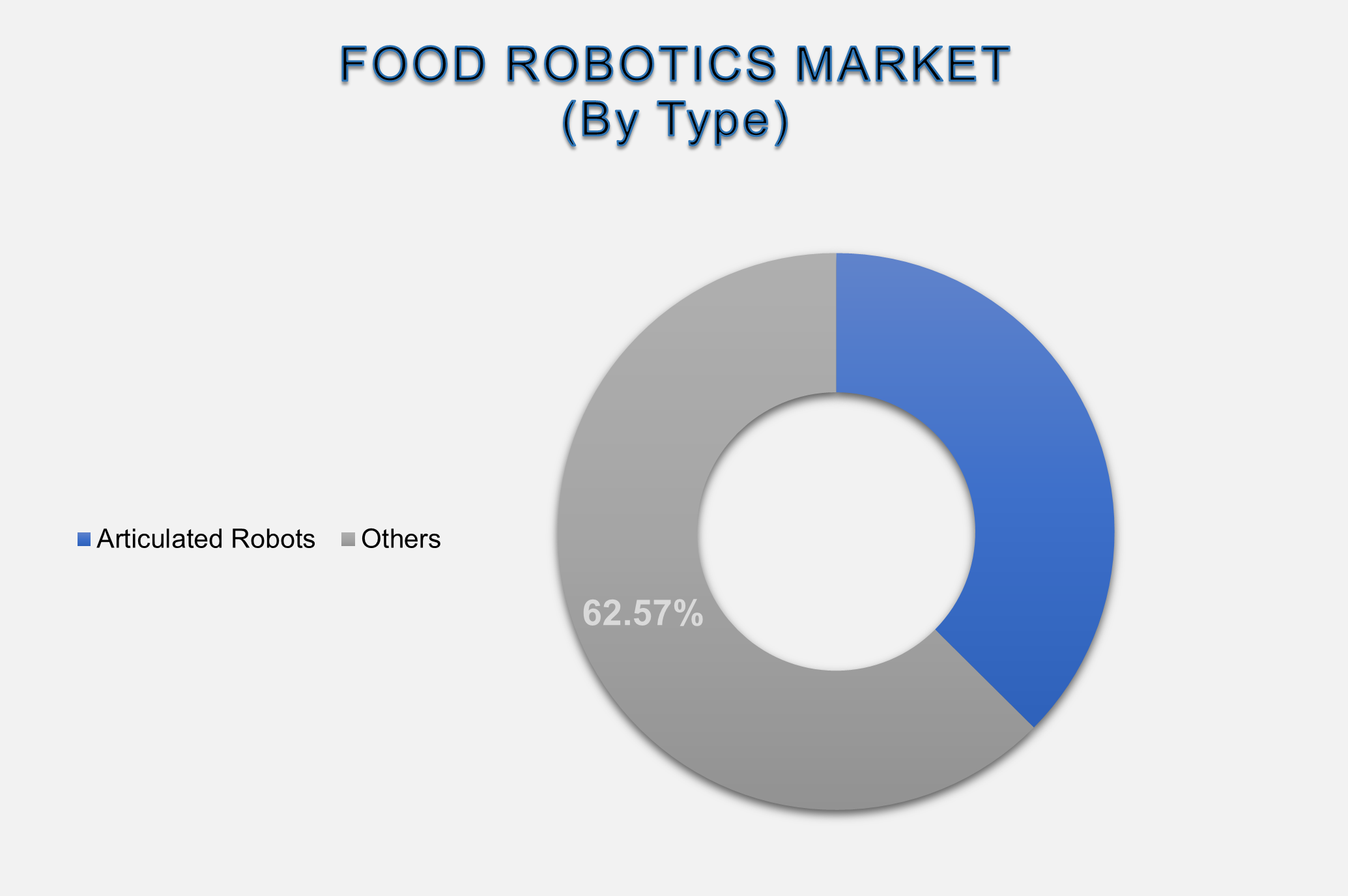
Robots Segment Is Expected to Dominate the South Korea Food Robotics Market
During the Forecast Period
Articulated robots are set to lead the South Korean food robotics market over the forecast period due to their flexibility, accuracy, and capability of executing a wide array of repetitive food handling and processing operations. Contrary to specialized robotic systems, the articulation of these robots makes it possible to program them for applications like ingredient handling, dispensing, cooking, frying, serving, packaging, and material transfer. This makes it possible for food service companies and food manufacturers in South Korea to make use of the same robotic system for various processes. The ability to integrate these robots with vision systems, sensors, and AI-controlled systems is likely to drive their use over the forecast period as companies look for ways to meet their labor shortage challenges, increase efficiency, and ensure that the quality of their food products is always standardized.
The Packaging
Segment Is Expected to Dominate the South Korea Food Robotics Market During the
Forecast Period
The segment of
packaging will continue to dominate the South Korean food robotics market in
the forecast period owing to the increasing need for rapid, efficient, and
consistent handling of food products at the processing and foodservice level.
Activities such as filling, sealing, labeling, sorting, picking, and
palletization in the packaging process are repetitive and voluminous, thus
making them ideal for robotic automation and ensuring that the throughput
levels are enhanced without compromising on packaging quality and hygiene. The
limited labor force and high labor costs in South Korea are driving the
adoption of automation in packaging processes, especially in situations where
continuity in production is required. With the use of vision systems and collaborative
robots, the scope of automation in packaging has widened to include products in
different sizes and formats. In the efforts by food manufacturers in South
Korea to enhance their productivity and safety levels, automation in the
packaging process has become an increasingly significant element of automation
expenditure.
The Food
Manufacturers Segment Is Expected to Dominate the South Korea Food Robotics
Market During the Forecast Period
It is predicted
that the food manufacturers segment will emerge as the leading segment in the
South Korean food robotics market, driven by the increased automation of
processes involved in the processing, preparation, packaging, sorting,
inspecting, and material handling in the food industry. Food manufacturing
companies operate large-scale manufacturing plants where there is a need for
repetition and high levels of accuracy, speed, hygiene, and quality control in
the process. There is an increase in labor costs and labor shortages, which is
prompting manufacturers to use robotics to replace manual work for processes
that involve a physical and repetitive nature. Moreover, the growing importance
of food safety and standardized food production is boosting the demand for
robots that can perform processes with low levels of human intervention.
The following
segments are part of an in-depth analysis of the South Korea Food Robotics
Market:
|
Market Segments |
|
|
By
Type |
●
Articulated
Robots ●
SCARA Robots ●
Delta Robots ●
Collaborative
Robots |
|
By
Application |
●
Food
Processing ●
Packaging ●
Palletizing ●
Sorting
& Grading ●
Others |
|
By End
User |
●
Food
Manufacturers ●
Food Service
Providers ●
Beverage
Industry ●
Others |
South Korea Food Robotics Market
Competition Landscape Analysis
The competitive
environment in the South Korean food robotics market can be described as one of
rivalry among international robotics manufacturers, automation solution
vendors, and local players developing dedicated robotic solutions for use in
food processing, packaging, handling, cooking, and serving tasks. The key
parameters that determine the competitive environment include robot
capabilities, payload and accuracy, versatility, vision and artificial
intelligence functions, hygiene, and after-sales services, as well as the
customizability of the system according to the needs of a particular food
manufacturing facility. Established industrial robotics companies have the
advantage of a wide range of products and well-developed relations with food
producers. In contrast, specialized and emerging companies compete based on
their AI vision technology, collaborative robots, autonomous food handling
systems, and specialized robotic solutions. Another factor shaping market
competitiveness is system integration capability, because food manufacturers
tend to need robots integrated with conveyors, packaging machinery, inspection
systems, and other equipment in existing production lines, rather than
stand-alone robots.
South Korea Food Robotics Market Recent
Developments News:
●
In July 2026,
South Korea’s Ministry of Agriculture, Food and Rural Affairs (MAFRA) announced
its first statutory master plan for the food-tech industry, placing robotics,
AI, and smart manufacturing at the center of the country’s food-sector
modernization strategy. The plan includes regionally focused food-tech
innovation clusters, expanded startup and investment support, and an increase
in participating food-manufacturing smart factories from 30 in 2024 to 187 by
2026, creating a stronger commercialization environment for food robotics.
●
In May 2026,
MiFood highlighted South Korea as a strategic testbed for next-generation food
and agricultural robotics, citing the country’s high acceptance of automation,
labor shortages, and growing investment in AI, service robotics, smart
factories, and autonomous systems. The company’s participation in the K-Startup
Grand Challenge provided access to Korea’s technology ecosystem, investors, and
potential corporate partners, underscoring the country’s role as a market for
testing and commercializing emerging robotic technologies.
●
In July 2026,
MAFRA identified cooking robots, food-serving robots, and food-delivery robots
as key examples of food-tech applications and outlined plans to support the
overseas expansion of technology-enabled Korean food concepts, including
robotic pizza and bibimbap chefs. The initiative indicates growing government
emphasis on moving food robotics beyond pilot applications toward commercially
scalable solutions and export-oriented food-tech models.
The South Korea
Food Robotics Market is dominated by a few large companies, such as
●
Doosan
Robotics
●
Hanwha
Robotics
●
Aniai
●
Beyond
Honeycomb
●
Robo Arete
●
Future Kitchen
●
RONIK
●
Robotable
●
Peoples League
●
Mandarin
Robotics
●
Wave Lifestyle
Tech
●
Shin Starr
Robotics
●
K2 System ENG
●
Fine-Techno
●
Polaris3D
●
RGT
●
ING Robotics
●
Neuromeka
●
HeroBot
●
Korea Robotics
● Other Prominent Players
Frequently Asked Questions
Ekta Chaurasia (Team Lead)
Ekta Chaurasia is a highly experienced Team Lead at M2Square Consultancy with over 7 years of expertise in market research, strategic consulting, competitive benchmarking, and business intelligence solutions. She specializes in ICT, semiconductors & electronics, automotive & transportation, and industrial machinery markets.
She leads end-to-end global research projects focused on market trends, industry analysis, growth forecasting, customer insights, and strategic decision-making. Known for her analytical leadership and industry expertise, Ekta helps businesses uncover growth opportunities, evaluate competitive landscapes, and stay ahead in rapidly evolving markets through accurate and insight-driven research.
1.
South
Korea Food Robotics Market Introduction and Market Overview
1.1. Objectives of the Study
1.2. Market Segmentation
1.2.1.Types of the South Korea Food
Robotics Market
1.2.2.Application of the South Korea Food
Robotics Market
1.2.3.End Users of the South Korea Food
Robotics Market
1.3. Competition Coverage List of
Market Participants
1.4. Market Definition: Food Robotics
Market
2.
Executive Summary
2.1. South Korea Food Robotics Market
Estimation & Forecast
2.1.1.South Korea Food Robotics Market
Size (US$ Million) Estimates & Historical Trend Analysis (2021 - 2025)
2.1.2.South Korea Food Robotics
Overall Market Size (US$ Million), Growth Rate (Y-o-Y), Market CAGR (%), Market
forecast (2026 - 2034)
2.2. Snapshot of South Korea Food
Robotics Market
2.3. South Korea Food Robotics Market
Revenue Share (%) 2025
2.4. Key Competitors & Key
Insights
3.
Market Overview (Qualitative
Analysis)
3.1. Demand Side Trends
3.2. Supply Side Trends /
Manufacturing Trends
3.3. Demand and Opportunity
Assessment, 2026 - 2034
3.4. Market Dynamics
3.4.1.Drivers
3.4.2.Limitations
3.4.3.Opportunities
3.4.4.Impact Analysis of Drivers and
Restraints
3.5. Key Developments
3.6. Regulatory Landscape
3.7. Pricing Analysis
3.8. Supply Chain Analysis
3.9. Porter’s Five Forces Analysis
3.9.1.Bargaining Power of Suppliers
3.9.2.Bargaining Power of Buyers
3.9.3.Threat of Substitutes
3.9.4.Threat of New Entrants
3.9.5.Competitive Rivalry
3.10. PEST Analysis
3.10.1. Political Factors
3.10.2. Economic Factors
3.10.3. Social Factors
3.10.4. Technology Factors
4.
South Korea Food Robotics Market
Estimates & Forecast Trend Analysis, by Type
4.1. South Korea Food Robotics Market
Assessments & Key Findings, by Type
4.2. South Korea Food Robotics Market
Revenue (US$ Million) Estimates and Forecasts, by Type, 2021 - 2034
4.2.1. Articulated Robots
4.2.2.SCARA Robots
4.2.3.Delta Robots
4.2.4.Collaborative Robots
5.
South Korea Food Robotics Market
Estimates & Forecast Trend Analysis, by Application
5.1. South Korea Food Robotics Market
Assessments & Key Findings, by Application
5.2. South Korea Food Robotics Market
Revenue (US$ Million) Estimates and Forecasts, by Application, 2021 - 2034
5.2.1.Food Processing
5.2.2.Packaging
5.2.3.Palletizing
5.2.4.Sorting & Grading
5.2.5.Others
6.
South Korea Food Robotics Market
Estimates & Forecast Trend Analysis, by End User
6.1. South Korea Food Robotics Market
Assessments & Key Findings, by End User
6.2. South Korea Food Robotics Market
Revenue (US$ Million) Estimates and Forecasts, by End User, 2021 - 2034
6.2.1.Food Manufacturers
6.2.2.Food Service Providers
6.2.3.Beverage Industry
6.2.4.Others
7. Competition Landscape
7.1. South Korea Food Robotics Market
Product Mapping
7.2. South Korea Food Robotics Market
Concentration Analysis, by Leading Players / Innovators / Emerging Players /
New Entrants
7.3. South Korea Food Robotics Market
Tier Structure Analysis
7.4. South Korea Food Robotics Market
Concentration & Company Market Shares (%) Analysis, 2025
8. Company Profiles
8.1. Doosan Robotics
8.1.1.Company Overview & Key Stats
8.1.2.Financial Performance & KPIs
8.1.3.Product Portfolio
8.1.4.SWOT Analysis
8.1.5.Business Strategy & Recent
Developments
* Similar details would be provided
for all the players mentioned below
8.2.
Hanwha Robotics
8.3.
Aniai
8.4.
Beyond Honeycomb
8.5.
Robo Arete
8.6.
Future Kitchen
8.7.
RONIK
8.8.
Robotable
8.9.
Peoples League
8.10.
Mandarin Robotics
8.11.
Wave Lifestyle Tech
8.12.
Shin Starr Robotics
8.13.
K2 System ENG
8.14.
Fine-Techno
8.15.
Polaris3D
8.16.
RGT
8.17.
ING Robotics
8.18.
Neuromeka
8.19.
HeroBot
8.20.
Korea Robotics
8.21. Other Prominent Players
9.
Research Findings &
Conclusion
10. Assumptions & Acronyms Used
11. Research
Methodology
11.1. External Transportation /
Databases
11.2. Internal Proprietary Database
11.3. Primary Research
11.4. Secondary Research
11.5. Assumptions
11.6. Limitations
11.7. Report FAQs
Our Research Methodology
"Insight without rigor is just noise."
We follow a comprehensive, multi-phase research framework designed to deliver accurate, strategic, and decision-ready intelligence. Our process integrates primary and secondary research , both quantitative and qualitative , along with dual modeling techniques ( top-down and bottom-up) and a final layer of validation through our proprietary in-house repository.
PRIMARY RESEARCH
Primary research captures real-time, firsthand insights from the market to understand behaviors, motivations, and emerging trends.
1. Quantitative Primary Research
Objective: Generate statistically significant data directly from market participants.
Approaches:- Structured surveys with customers, distributors, and field agents
- Mobile-based data collection for point-of-sale audits and usage behavior
- Phone-based interviews (CATI) for market sizing and product feedback
- Online polling around industry events and digital campaigns
- Purchase frequency by customer type
- Channel performance across geographies
- Feature demand by application or demographic
2. Qualitative Primary Research
Objective: Explore decision-making drivers, pain points, and market readiness.
Approaches:- In-depth interviews (IDIs) with executives, product managers, and key decision-makers
- Focus groups among end users and early adopters
- Site visits and observational research for consumer products
- Informal field-level discussions for regional and cultural nuances
SECONDARY RESEARCH
This phase helps establish a macro-to-micro understanding of market trends, size, regulation, and competitive dynamics, sourced from credible and public domain information.
1. Quantitative Secondary Research
Objective: Model market value and segment-level forecasts based on published data.
Sources include:- Financial reports and investor summaries
- Government trade data, customs records, and regulatory statistics
- Industry association publications and economic databases
- Channel performance and pricing data from marketplace listings
- Revenue splits, pricing trends, and CAGR estimates
- Supply-side capacity and volume tracking
- Investment analysis and funding benchmarks
2. Qualitative Secondary Research
Objective: Capture strategic direction, innovation signals, and behavioral trends.
Sources include:- Company announcements, roadmaps, and product pipelines
- Publicly available whitepapers, conference abstracts, and academic research
- Regulatory body publications and policy briefs
- Social and media sentiment scanning for early-stage shifts
- Strategic shifts in market positioning
- Unmet needs and white spaces
- Regulatory triggers and compliance impact
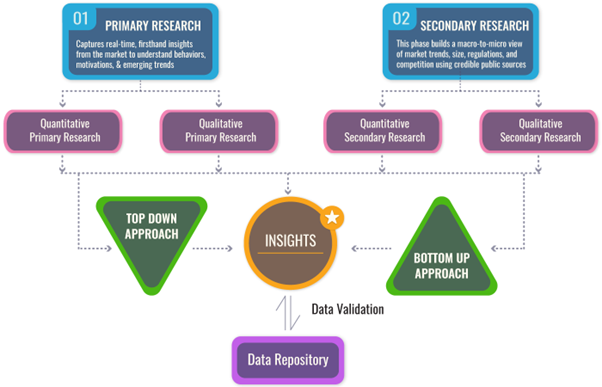
DUAL MODELING: TOP-DOWN + BOTTOM-UP
To ensure robust market estimation, we apply two complementary sizing approaches:
Top-Down Modeling:- Start with broader industry value (e.g., global or regional TAM)
- Apply filters by segment, geography, end-user, or use case
- Adjust with primary insights and validation benchmarks
- Ideal for investor-grade market scans and opportunity mapping
- Aggregate from the ground up using sales volumes, pricing, and unit economics
- Use internal modeling templates aligned with stakeholder data
- Incorporate distributor-level or region-specific inputs
- Most accurate for emerging segments and granular sub-markets
DATA VALIDATION: IN-HOUSE REPOSITORY
We close the loop with proprietary data intelligence built from ongoing projects, industry monitoring, and historical benchmarking. This repository includes:
- Multi-sector market and pricing models
- Key trendlines from past interviews and forecasts
- Benchmarked adoption rates, churn patterns, and ROI indicators
- Industry-specific deviation flags and cross-check logic
- Catches inconsistencies early
- Aligns projections across studies
- Enables consistent, high-trust deliverables