

Global Spa Services Market Size and Forecast (2025 – 2033), Global and Regional Growth, Trend, Share and Industry Analysis Report Coverage: By Facility (Day, Hotel/Resort, Medical, Others), By Service (Massage, Beauty/Grooming, Physical Fitness, Others), By Customer Experience (Luxury, Budget-Friendly), By End-User (Men, Women), and Geography
2025-12-17
Travel & Hospitality
Ekta Chaurasia (Team Lead)
Description
Spa Services Market Overview
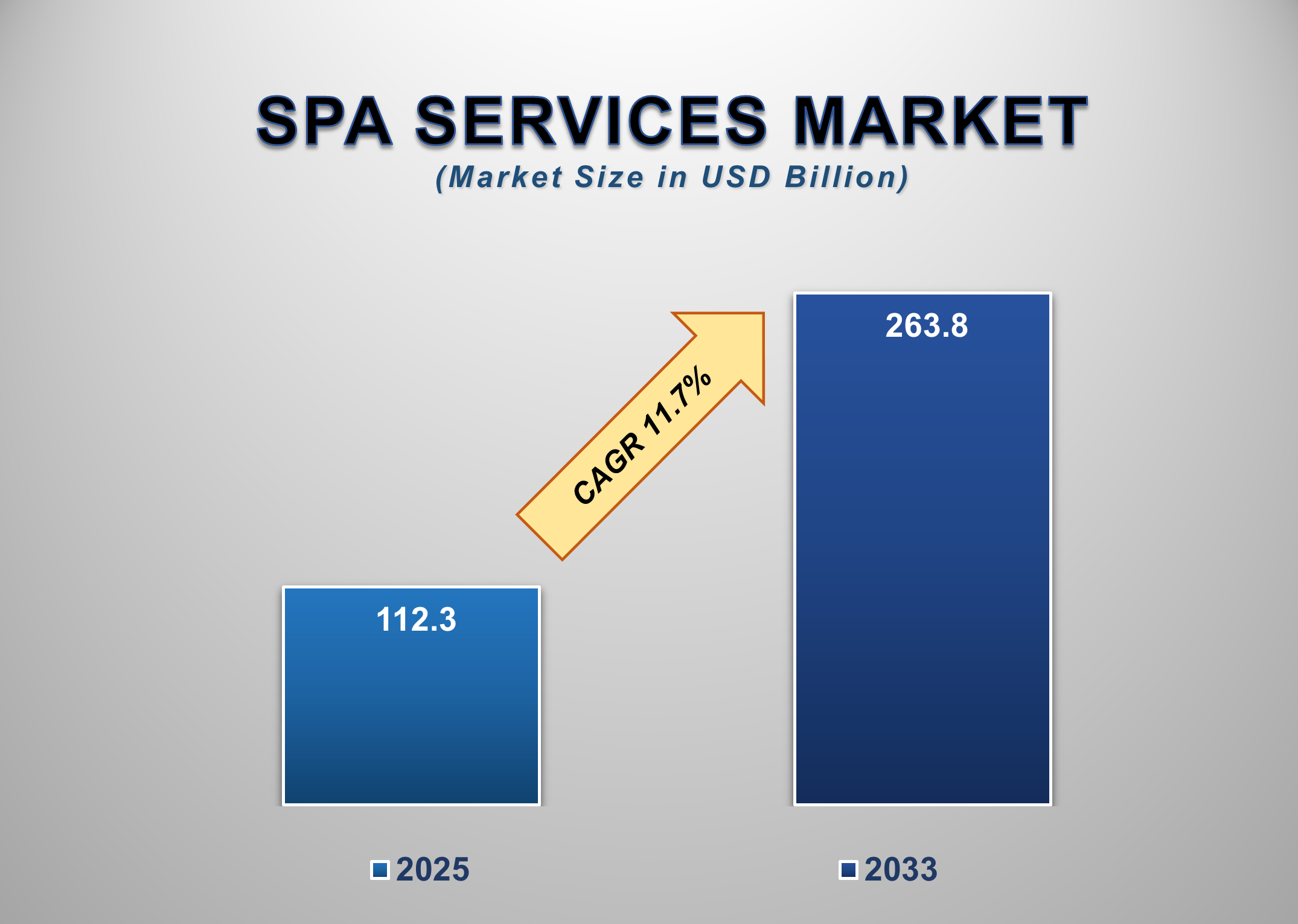
The Global Spa Services Market Size is projected to reach US$263.8 billion by 2033 from US$112.3 billion in 2025, growing at a CAGR of 11.7% during the forecast period (2025–2033). The increasing consumer inclination toward health and wellness, coupled with the rising prevalence of stress, anxiety, and lifestyle disorders, is driving the demand for spa services worldwide.
Technological innovations in spa treatments, such as advanced hydrotherapy, aromatherapy with customized essential oils, and high-tech skincare solutions, are further expanding the market reach. Rising disposable incomes, especially in emerging economies, coupled with expanding tourism and rising product availability through hotel/resort-based services, have also supported market growth. Moreover, the market is witnessing the growing trend of at-home spa offerings and mobile service platforms, aligning with consumer preferences for convenience and personalization.
Spa Services Market
Drivers and Opportunities
Increasing Stress and Health Awareness Is Boosting the Global
Spa Services Market Growth
The modern-day lifestyle, marked by high stress levels, sedentary work structures, and increasing prevalence of anxiety and sleep disorders, is significantly accelerating the demand for spa services worldwide. Consumers are increasingly seeking holistic and preventive care options, with spa services such as massage therapy, hydrotherapy, and aromatherapy gaining traction as natural solutions to mental and physical stress. According to the Global Wellness Institute, the wellness industry continues to expand rapidly, with spas serving as one of the primary gateways to stress management and general well-being. This shift is especially notable among urban professionals and millennials prioritizing self-care and work-life balance. Furthermore, government support and corporate wellness initiatives are also contributing to the growth of the market. Many organizations have introduced employee wellness programs that include subsidized spa treatments or on-site relaxation spaces. A growing number of medical studies demonstrating the effectiveness of spa therapies in relieving chronic pain, reducing inflammation, and improving quality of sleep is enhancing the credibility and adoption of spa services globally.
Technological Advancements in Spa Offerings Are Reshaping the Market Landscape
The incorporation of advanced technologies in spa services is
driving significant growth and differentiation in the market. Smart spa
infrastructure, virtual spa consultations, and AI-driven personalized wellness
programs are being adopted to enhance consumer experience and overall service
efficiency. Innovative offerings such as zero-gravity massage chairs, infrared
sauna pods, ultrasonic skin treatments, and digital detox experiences are
gaining widespread acceptance, particularly among high-income consumers. Smart
aromatherapy devices, virtual reality relaxation pods, and fitness-tracking
integrations are revolutionizing the spa experience, making it more immersive
and results-driven. Moreover, data analytics are being used by top spa chains
to track client preferences and wellness goals, improving personalization and
customer loyalty. As consumers become more tech-savvy, they seek seamless,
tailored experiences, from booking appointments via mobile apps to accessing
digital wellness plans post-treatment. These advancements have also given rise
to new spa models such as self-care kiosks, mobile wellness vans, and smart
spas in airports, which are expected to significantly contribute to the market
over the forecast period.
The Growing Global Tourism and Luxury Hospitality Sector Is
Creating Opportunities
Global tourism remains a key driver of the spa market, with
wellness tourism outpacing the growth of general tourism worldwide. Luxury
hotels and resorts are investing heavily in state-of-the-art spa facilities to
attract high-end travelers seeking relaxation and rejuvenation experiences.
Wellness-focused retreats and destination spas offering multi-day programs,
combining detoxification, yoga, nutrition, and personalized therapies, are
rapidly gaining popularity among affluent consumers and niche travel groups.
The developing trend of medical tourism is further facilitating growth, with
countries such as Thailand, India, and South Korea offering integrated wellness
and medical spa services to international visitors at competitive prices.
Additionally, partnerships between travel firms, luxury hotel chains, and
wellness brands are enhancing spa accessibility and increasing consumer
awareness globally. Emerging markets in Southeast Asia, the Middle East, and
Latin America are poised to benefit from rising investments in wellness
infrastructure, providing lucrative opportunities for both local and
international players in the coming decade.
Spa Services Market Scope
|
Report Attributes |
Description |
|
Market Size in 2025 |
USD 112.3 Billion |
|
Market Forecast in 2033 |
USD 263.8 Billion |
|
CAGR % 2025-2033 |
11.7% |
|
Base Year |
2024 |
|
Historic Data |
2020-2024 |
|
Forecast Period |
2025-2033 |
|
Report USP |
Production, Consumption,
company share, company heatmap, company production capacity, growth factors
and more |
|
Segments Covered |
●
By Spa Services ●
By Service ●
By Customer
Experience ●
By End-User |
|
Regional Scope |
●
North America, ●
Europe, ●
APAC, ●
Latin America ●
Middle East and
Africa |
|
Country Scope |
1)
U.S. 2)
Canada 3)
Germany 4)
UK 5)
France 6)
Spain 7)
Italy 8)
Switzerland 9)
China 10)
Japan 11)
India 12)
Australia 13)
South Korea 14)
Brazil 15)
Mexico 16)
Argentina 17)
South Africa 18)
Saudi Arabia 19)
UAE |
Spa Services Market
Report Segmentation Analysis
The Global Spa Services Market
Industry Analysis Is Segmented By Spa Services, By Service, By Customer
Experience, By End-User, and By Region.
Day Spas Segment Accounted for the Largest Market Share in
the Global Spa Services Market
By
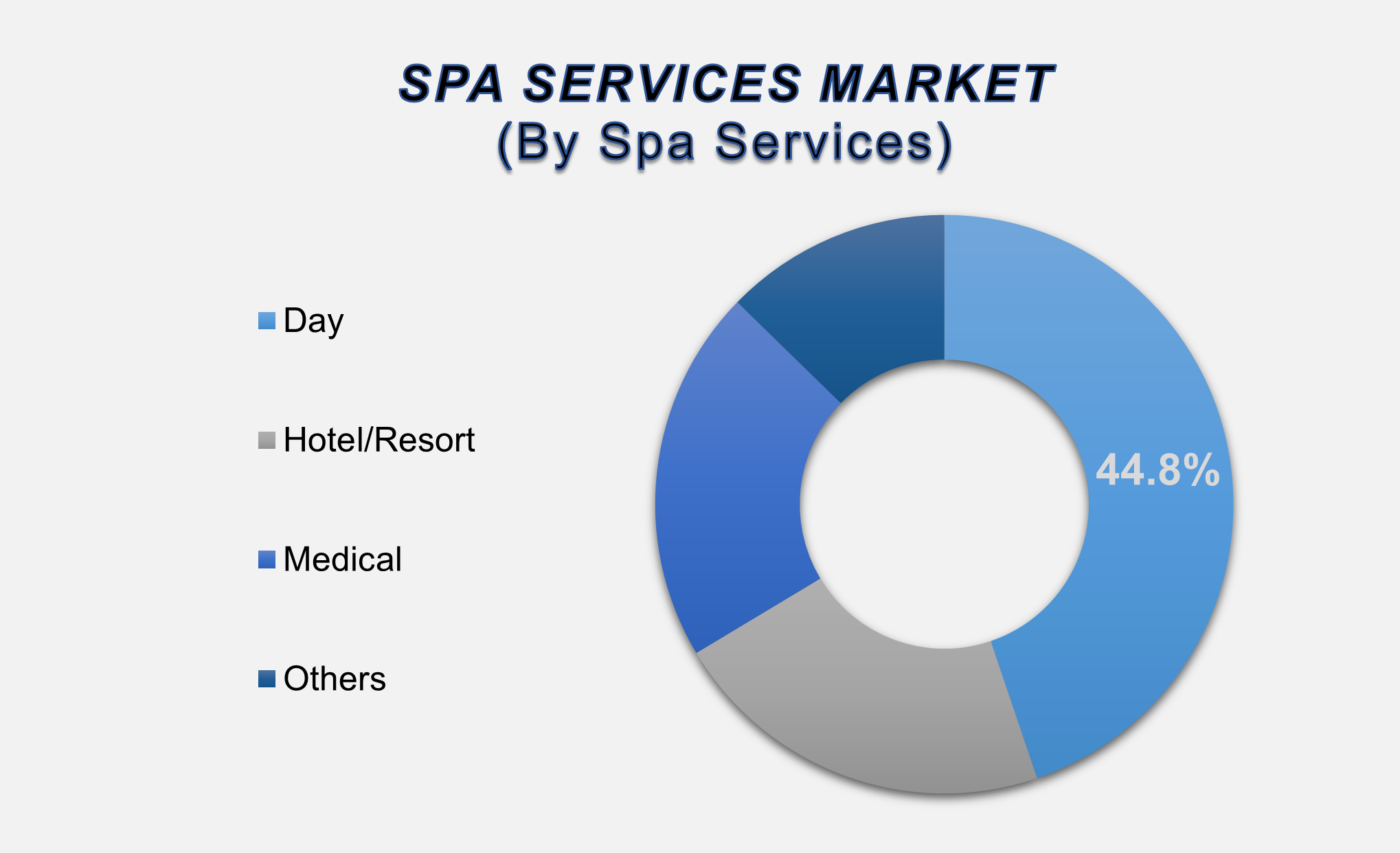
Facility, the market is segmented into Day, Hotel/Resort, Medical, and Others.
The Day Spas segment dominates the global market, accounting for the largest
share in 2025. Day spas have gained immense popularity among working
individuals and urban dwellers due to their accessibility, affordability, and
wide range of offerings, including massage
therapies, facials, detox treatments, and wellness consultations. Day spas are
particularly preferred by consumers seeking shorter, more frequent relaxation
experiences compared to multi-day resort retreats. The rising number of
standalone boutique spas in commercial hubs and residential areas has also
fueled segment expansion. Moreover, digital bookings and subscription-based
wellness packages offered by leading spa chains have further increased customer
reach. These establishments often collaborate with skincare and beauty brands
to provide premium service offerings, boosting the overall value proposition.
With the post-pandemic emphasis on mental health and self-care, day spas are
expected to retain their dominance in the spa services market in the coming
years.
Massage Services Segment Held the Largest Share by Service Type in 2025
By
Service, the market is segmented into Massage, Beauty/Grooming, Physical
Fitness, and Others. The Massage Services segment captured the majority share
in 2025, driven by growing consumer recognition of massage therapy's benefits
for pain management, stress reduction, and overall wellness. Widely available
across day spas, resorts, medical spas, and even mobile service platforms,
massage therapy remains the most requested spa service globally. An increasing
number of massage types—from deep tissue and Swedish to hot stone and
reflexology—allows personalization based on customer needs. Moreover,
advancements in massage equipment, including automated chairs and hydrotherapy
beds, are expanding service capabilities. Corporate wellness initiatives and
rising participation in sports and physical activities have also increased
demand for therapeutic and recovery massages. Government certification programs
and rising professional training standards are enhancing trust and reliability
among consumers, further supporting market growth.
Women
Segment Leads the Global Spa Services Market by End-User
By
End-User, the market is bifurcated into Men and Women. The Women segment
accounted for the highest market share in 2025, as women continue to be the
primary consumers of wellness and beauty services globally. Increasing focus on
personal grooming, skin health, and holistic well-being has positioned spa
services as an integral part of women’s self-care routines. According to global
spending trends, women allocate more of their income toward personal care
products and services compared to men, fueling spa market revenues. However,
the men’s spa segment is also rapidly growing, driven by rising awareness of
grooming and wellness among male consumers, especially in urban areas. Leading
spa chains are now designing gender-neutral and male-centric experiences, such as specialized massages, scalp treatments, and
fitness-oriented retreats, to broaden their reach. Nonetheless, women continue
to dominate the market due to longstanding consumer behavior trends and
evolving lifestyle preferences.
The following segments are
part of an in-depth analysis of the global Spa Services market:
|
Market Segments |
|
|
By Spa
Services |
●
Day ●
Hotel/Resort ●
Medical ●
Others |
|
By Service |
●
Massage ●
Beauty/Grooming ●
Physical Fitness ●
Others |
|
By Customer
Experience |
●
Luxury ●
Budget-friendly |
|
By End-User |
●
Men ●
Women |
Spa Services Market Share
Analysis by Region
North America is
anticipated to hold the biggest portion of the Spa Services Market globally
throughout the forecast period.
North America dominated the
global spa services market in 2025, accounting for 40.3% of the revenue share.
The region's dominance is underpinned by a well-established wellness culture,
high disposable incomes, and a strong presence of leading spa chains and luxury
hotels. The U.S. has one of the world’s largest markets for wellness tourism
and destination spa retreats. Mature markets such as Canada and Mexico also
demonstrate high growth potential with rising demand for stress management and
self-care therapies. Europe trails closely, benefiting from its rich spa
heritage, particularly in countries like Germany, France, and Hungary.
Asia Pacific is expected to
register the highest CAGR during the forecast period (2025–2033). Emerging
economies such as China, India, Thailand, and Indonesia are witnessing rapid
growth in spa infrastructure, driven by increasing urbanization, tourism promotions,
and growing health awareness. The region is also becoming a hotspot for
wellness retreats combining traditional practices like Ayurveda, Thai massage,
and hot spring therapy with modern spa techniques. Latin America and the Middle
East & Africa are also emerging as high-potential markets, supported by
rising tourism and investments in hospitality and wellness infrastructure.
Spa Services Market
Competition Landscape Analysis
The global spa services market is
moderately fragmented, with key players focusing on expanding geographic
presence, enhancing service portfolios, and integrating digital solutions to
improve customer experiences. Many companies are offering subscription-based
services, loyalty programs, and partnerships with wellness product brands to
maintain a competitive advantage.
Global Spa Services
Market Recent Developments News:
- In November 2024,
Woodhouse Spas launched a new treatment collection integrating advanced
skincare technology with premium relaxation experiences. The signature
Glacial Gloss facial utilizes cryotherapy to address redness, melasma, and
inflammation-related aging, supporting radiant skin while offering
personalized, accessible skincare at select locations.
- In November 2024,
Hand & Stone expanded its national presence by converting 30
former LaVida Massage locations across seven states, including its first
entry into Arkansas with a new Bentonville site. This conversion increased
the brand’s total count to 40 locations and included full training and
operational support for franchisees and staff to ensure a smooth brand
transition.
- In November 2024,
Çırağan Palace Kempinski Istanbul, in partnership with Sanitas Spa
& Wellness, reopened its fully redesigned spa and wellness center. The
upgraded facility includes a VIP Turkish bath, massage suites, a fitness
center, and an indoor pool, with signature treatments such as the Sultan’s
Bath, Sanitas Signature Massage, Thai Blend Massage, and Shiroibhyanga for
detoxification and holistic wellness.
The Global Spa Services Market Is
Dominated by a Few Large Companies, such as
●
Massage Envy
●
Hand & Stone
Massage and Facial Spa
●
The Woodhouse Day Spa
●
European Wax Center
●
Massage Heights
●
Canyon Ranch
●
Miraval Resorts
●
Six Senses
●
Four Seasons Hotels
and Resorts
●
Mandara Spa
●
Caudalie
●
L'Occitane en Provence
●
Aveda
●
Elemis
●
The Body Shop
●
Sephora
●
Bliss
●
Heyday
●
Soothe
●
Zeel
● Others
Frequently Asked Questions
Ekta Chaurasia (Team Lead)
Ekta Chaurasia is a highly experienced Team Lead at M2Square Consultancy with over 7 years of expertise in market research, strategic consulting, competitive benchmarking, and business intelligence solutions. She specializes in ICT, semiconductors & electronics, automotive & transportation, and industrial machinery markets.
She leads end-to-end global research projects focused on market trends, industry analysis, growth forecasting, customer insights, and strategic decision-making. Known for her analytical leadership and industry expertise, Ekta helps businesses uncover growth opportunities, evaluate competitive landscapes, and stay ahead in rapidly evolving markets through accurate and insight-driven research.
1. Global Spa Services Market
Introduction and Market Overview
1.1.
Objectives
of the Study
1.2.
Global
Spa Services Market Scope and Market Estimation
1.2.1.Global Spa Services Overall
Market Size (US$ Bn), Market CAGR (%), Market forecast (2025 - 2033)
1.2.2.Global Spa Services Market
Revenue Share (%) and Growth Rate (Y-o-Y) from 2020 - 2033
1.3.
Market
Segmentation
1.3.1.Spa Services of Global Spa
Services Market
1.3.2.Service of Global Spa
Services Market
1.3.3.Customer Experience of
Global Spa Services Market
1.3.4.End-User of Global Spa
Services Market
1.3.5.Region of Global Spa
Services Market
2. Executive
Summary
2.1.
Demand
Side Trends
2.2.
Key
Market Trends
2.3.
Market
Demand (US$ Bn) Analysis 2020 – 2024 and Forecast, 2025 – 2033
2.4.
Demand
and Opportunity Assessment
2.5.
Key
Developments
2.6.
Overview
of Tariff, Regulatory Landscape and Standards
2.7.
Market
Entry Strategies
2.8.
Market
Dynamics
2.8.1.Drivers
2.8.2.Limitations
2.8.3.Opportunities
2.8.4.Impact Analysis of Drivers
and Restraints
2.9.
Porter’s
Five Forces Analysis
2.10.
PEST
Analysis
3. Global
Spa Services Market Estimates
& Historical Trend Analysis (2020 - 2024)
4. Global
Spa Services Market Estimates
& Forecast Trend Analysis, by Spa Services
4.1.
Global
Spa Services Market Revenue (US$ Bn) Estimates and Forecasts, by Spa Services, 2020
- 2033
4.1.1.Day
4.1.2.Hotel/Resort
4.1.3.Medical
4.1.4.Others
5. Global
Spa Services Market Estimates
& Forecast Trend Analysis, by Service
5.1.
Global
Spa Services Market Revenue (US$ Bn) Estimates and Forecasts, by Service, 2020
- 2033
5.1.1.Massage
5.1.2.Beauty/Grooming
5.1.3.Physical Fitness
5.1.4.Others
6. Global
Spa Services Market Estimates
& Forecast Trend Analysis, by Customer Experience
6.1.
Global
Spa Services Market Revenue (US$ Bn) Estimates and Forecasts, by Customer
Experience, 2020 - 2033
6.1.1.Luxury
6.1.2.Budget-friendly
7. Global
Spa Services Market Estimates
& Forecast Trend Analysis, by End-User
7.1.
Global
Spa Services Market Revenue (US$ Bn) Estimates and Forecasts, by End-User, 2020
- 2033
7.1.1.Men
7.1.2.Women
8. Global
Spa Services Market Estimates
& Forecast Trend Analysis, by Region
8.1.
Global
Spa Services Market Revenue (US$ Bn) Estimates and Forecasts, by Region, 2020 -
2033
8.1.1.North America
8.1.2.Europe
8.1.3.Asia Pacific
8.1.4.Middle East & Africa
8.1.5.Latin America
9. North America Spa
Services Market: Estimates &
Forecast Trend Analysis
9.1.
North
America Spa Services Market Assessments & Key Findings
9.1.1.North America Spa Services
Market Introduction
9.1.2.North America Spa Services
Market Size Estimates and Forecast (US$ Billion) (2020 - 2033)
9.1.2.1. By Spa
Services
9.1.2.2. By Service
9.1.2.3. By Customer
Experience
9.1.2.4. By End-User
9.1.2.5.
By
Country
9.1.2.5.1. The U.S.
9.1.2.5.2. Canada
10. Europe Spa
Services Market: Estimates &
Forecast Trend Analysis
10.1.
Europe
Spa Services Market Assessments & Key Findings
10.1.1.
Europe
Spa Services Market Introduction
10.1.2.
Europe
Spa Services Market Size Estimates and Forecast (US$ Billion) (2020 - 2033)
10.1.2.1. By Spa
Services
10.1.2.2. By Service
10.1.2.3. By Customer
Experience
10.1.2.4. By End-User
10.1.2.5.
By
Country
10.1.2.5.1.
Germany
10.1.2.5.2.
Italy
10.1.2.5.3.
U.K.
10.1.2.5.4.
France
10.1.2.5.5.
Spain
10.1.2.5.6.
Switzerland
10.1.2.5.7. Rest
of Europe
11. Asia Pacific Spa
Services Market: Estimates &
Forecast Trend Analysis
11.1.
Asia
Pacific Market Assessments & Key Findings
11.1.1.
Asia
Pacific Spa Services Market Introduction
11.1.2.
Asia
Pacific Spa Services Market Size Estimates and Forecast (US$ Billion) (2020 - 2033)
11.1.2.1. By Spa
Services
11.1.2.2. By Service
11.1.2.3. By Customer
Experience
11.1.2.4. By End-User
11.1.2.5.
By
Country
11.1.2.5.1. China
11.1.2.5.2. Japan
11.1.2.5.3. India
11.1.2.5.4. Australia
11.1.2.5.5. South Korea
11.1.2.5.6. Rest of Asia Pacific
12. Middle East & Africa Spa
Services Market: Estimates &
Forecast Trend Analysis
12.1.
Middle
East & Africa Market Assessments & Key Findings
12.1.1.
Middle East & Africa Spa Services Market Introduction
12.1.2.
Middle East & Africa Spa Services Market Size Estimates
and Forecast (US$ Billion) (2020 - 2033)
12.1.2.1. By Spa
Services
12.1.2.2. By Service
12.1.2.3. By Customer
Experience
12.1.2.4. By End-User
12.1.2.5.
By
Country
12.1.2.5.1. UAE
12.1.2.5.2. Saudi
Arabia
12.1.2.5.3. South
Africa
12.1.2.5.4. Rest
of MEA
13. Latin America
Spa Services Market: Estimates &
Forecast Trend Analysis
13.1.
Latin
America Market Assessments & Key Findings
13.1.1.
Latin
America Spa Services Market Introduction
13.1.2.
Latin
America Spa Services Market Size Estimates and Forecast (US$ Billion) (2020 - 2033)
13.1.2.1. By Spa
Services
13.1.2.2. By Service
13.1.2.3. By Customer
Experience
13.1.2.4. By End-User
13.1.2.5.
By
Country
13.1.2.5.1. Brazil
13.1.2.5.2. Argentina
13.1.2.5.3. Mexico
13.1.2.5.4. Rest
of LATAM
14. Country Wise Market:
Introduction
15.
Competition
Landscape
15.1.
Global
Spa Services Market Product Mapping
15.2.
Global
Spa Services Market Concentration Analysis, by Leading Players / Innovators /
Emerging Players / New Entrants
15.3.
Global
Spa Services Market Tier Structure Analysis
15.4.
Global
Spa Services Market Concentration & Company Market Shares (%) Analysis, 2024
16.
Company
Profiles
16.1.
Massage Envy
16.1.1.
Company
Overview & Key Stats
16.1.2.
Financial
Performance & KPIs
16.1.3.
Product
Portfolio
16.1.4.
SWOT
Analysis
16.1.5.
Business
Strategy & Recent Developments
* Similar details would be provided for all the players
mentioned below
16.2. Hand
& Stone Massage and Facial Spa
16.3. The
Woodhouse Day Spa
16.4. European
Wax Center
16.5. Massage
Heights
16.6. Canyon
Ranch
16.7. Miraval
Resorts
16.8. Six
Senses
16.9. Four
Seasons Hotels and Resorts
16.10. Mandara
Spa
16.11. Caudalie
16.12. L'Occitane
en Provence
16.13. Aveda
16.14. Elemis
16.15. The Body
Shop
16.16. Sephora
16.17. Bliss
16.18. Heyday
16.19. Soothe
16.20. Zeel
16.21. Others
17. Research
Methodology
17.1.
External
Transportations / Databases
17.2.
Internal
Proprietary Database
17.3.
Primary
Research
17.4.
Secondary
Research
17.5.
Assumptions
17.6.
Limitations
17.7.
Report
FAQs
18. Research
Findings & Conclusion
Our Research Methodology
"Insight without rigor is just noise."
We follow a comprehensive, multi-phase research framework designed to deliver accurate, strategic, and decision-ready intelligence. Our process integrates primary and secondary research , both quantitative and qualitative , along with dual modeling techniques ( top-down and bottom-up) and a final layer of validation through our proprietary in-house repository.
PRIMARY RESEARCH
Primary research captures real-time, firsthand insights from the market to understand behaviors, motivations, and emerging trends.
1. Quantitative Primary Research
Objective: Generate statistically significant data directly from market participants.
Approaches:- Structured surveys with customers, distributors, and field agents
- Mobile-based data collection for point-of-sale audits and usage behavior
- Phone-based interviews (CATI) for market sizing and product feedback
- Online polling around industry events and digital campaigns
- Purchase frequency by customer type
- Channel performance across geographies
- Feature demand by application or demographic
2. Qualitative Primary Research
Objective: Explore decision-making drivers, pain points, and market readiness.
Approaches:- In-depth interviews (IDIs) with executives, product managers, and key decision-makers
- Focus groups among end users and early adopters
- Site visits and observational research for consumer products
- Informal field-level discussions for regional and cultural nuances
SECONDARY RESEARCH
This phase helps establish a macro-to-micro understanding of market trends, size, regulation, and competitive dynamics, sourced from credible and public domain information.
1. Quantitative Secondary Research
Objective: Model market value and segment-level forecasts based on published data.
Sources include:- Financial reports and investor summaries
- Government trade data, customs records, and regulatory statistics
- Industry association publications and economic databases
- Channel performance and pricing data from marketplace listings
- Revenue splits, pricing trends, and CAGR estimates
- Supply-side capacity and volume tracking
- Investment analysis and funding benchmarks
2. Qualitative Secondary Research
Objective: Capture strategic direction, innovation signals, and behavioral trends.
Sources include:- Company announcements, roadmaps, and product pipelines
- Publicly available whitepapers, conference abstracts, and academic research
- Regulatory body publications and policy briefs
- Social and media sentiment scanning for early-stage shifts
- Strategic shifts in market positioning
- Unmet needs and white spaces
- Regulatory triggers and compliance impact
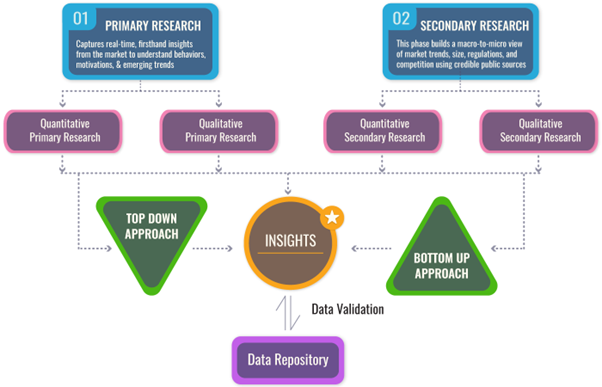
DUAL MODELING: TOP-DOWN + BOTTOM-UP
To ensure robust market estimation, we apply two complementary sizing approaches:
Top-Down Modeling:- Start with broader industry value (e.g., global or regional TAM)
- Apply filters by segment, geography, end-user, or use case
- Adjust with primary insights and validation benchmarks
- Ideal for investor-grade market scans and opportunity mapping
- Aggregate from the ground up using sales volumes, pricing, and unit economics
- Use internal modeling templates aligned with stakeholder data
- Incorporate distributor-level or region-specific inputs
- Most accurate for emerging segments and granular sub-markets
DATA VALIDATION: IN-HOUSE REPOSITORY
We close the loop with proprietary data intelligence built from ongoing projects, industry monitoring, and historical benchmarking. This repository includes:
- Multi-sector market and pricing models
- Key trendlines from past interviews and forecasts
- Benchmarked adoption rates, churn patterns, and ROI indicators
- Industry-specific deviation flags and cross-check logic
- Catches inconsistencies early
- Aligns projections across studies
- Enables consistent, high-trust deliverables