

Sports Medicine Biologics Market Size and Forecast (2026–2034), Global and Regional Growth, Trend, Share and Industry Analysis Report Coverage: By Product Type (Platelet-Rich Plasma Products, Bone Graft Substitutes, Bone Morphogenetic Proteins, Stem Cell-Based Products, Viscosupplementation Products, Amniotic And Placental Tissue Products, and Others), By Application (Knee, Shoulder, Foot and Ankle, Hip and Groin, Elbow and Wrist, Others), By End User (Hospitals, Ambulatory Surgical Centers, Specialty Orthopedic Clinics, Sports Medicine Centers, and Others) and Geography
2026-08-10
Healthcare
Swetal (Research Analyst)
Description
Sports Medicine Biologics Market
Overview
The global sports
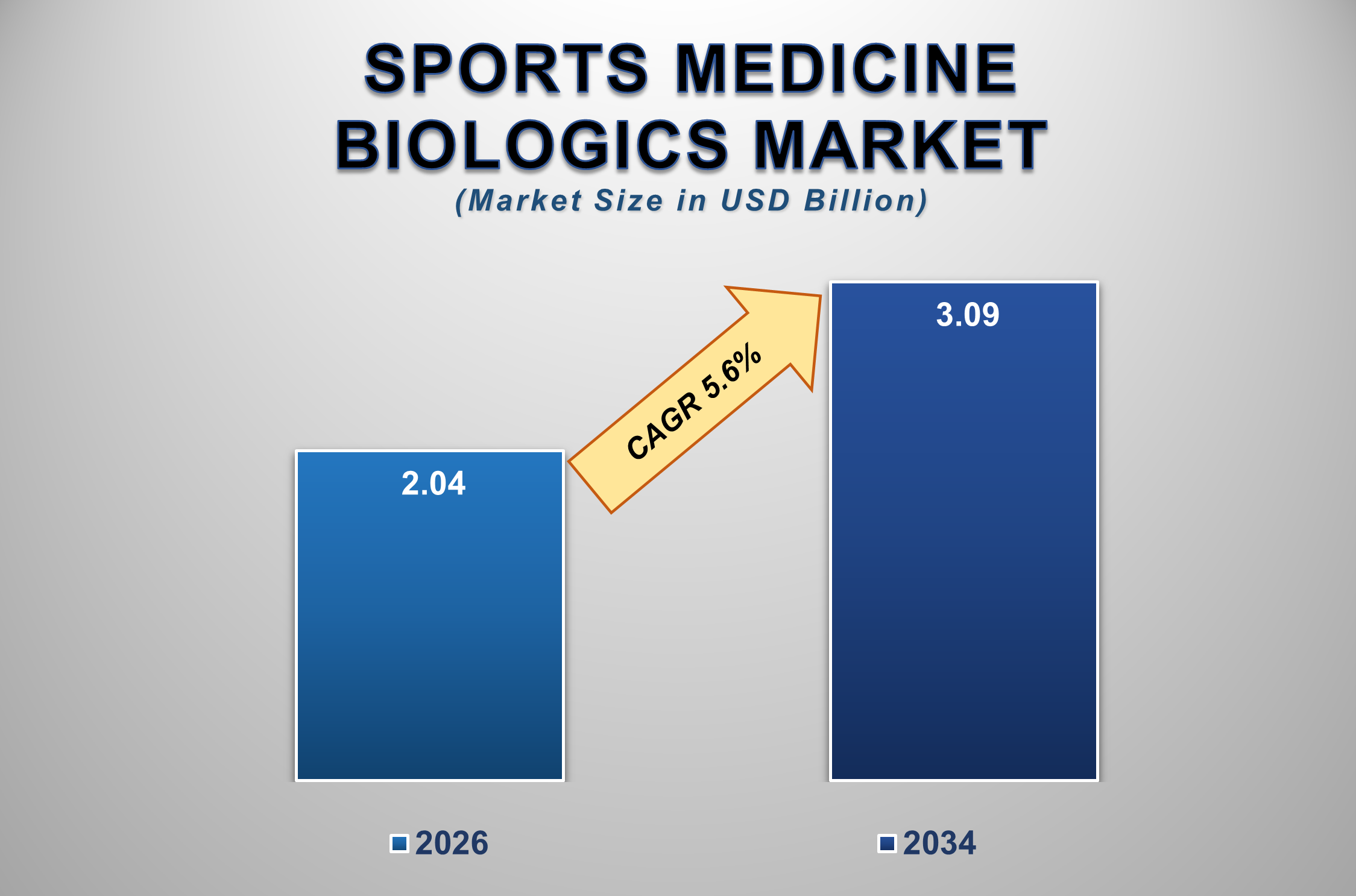
medicine biologics market was valued at USD 2.04 billion in 2026 and is
projected to reach USD 3.09 billion by 2034, expanding at a CAGR of 5.6% during
the forecast period. The sports medicine biologics market continues to show
growth as a result of the increase in sports injuries, growing participation in
sports and fitness activities, and rising demand for regenerative therapy that
speeds up recovery. Products like platelet-rich plasma (PRP), bone graft
substitute, stem cell therapy products, amnion-based products, and others are
becoming more and more popular for treating musculoskeletal injuries. Constant
development of technologies in the field of orthobiologics, increased
acceptance of this field in clinics, and stable investments in the field of
regenerative medicine have made a big impact on the growth of the market. North
America remains the leader in the industry thanks to the existing health care
system, the high number of surgeries being conducted there, and the surgical
industry in general, while Asia-Pacific is growing fast as well thanks to
improving health care conditions there and wider usage of advanced technologies
in medicine.
Sports Medicine Biologics Market
Drivers and Opportunities
Rising Incidence of
Sports-Related and Musculoskeletal Injuries Driving Market Growth
The sports medicine
biologics market continues to show growth as a result of the increase in sports
injuries, growing participation in sports and fitness activities, and rising
demand for regenerative therapy that speeds up recovery. Products like platelet-rich
plasma (PRP), bone graft substitute, stem cell therapy products, amnion-based
products, and others are becoming more and more popular for treating
musculoskeletal injuries. Constant development of technologies in the field of
orthobiologics, increased acceptance of this field in clinics, and stable
investments in the field of regenerative medicine have made a big impact on the
growth of the market. North America remains the leader in the industry thanks
to the existing health care system, the high number of surgeries being
conducted there, and the surgical industry in general, while Asia-Pacific is
growing fast as well thanks to improving health care conditions there and wider
usage of advanced technologies in medicine.
Growing Adoption
of Regenerative and Minimally Invasive Therapies Fueling Market Expansion
As patients and
healthcare practitioners show a preference for regenerative and minimally
invasive treatment options, the sports medicine biologics market has seen
growth. People have increased preference for biological treatments such as PRP
(platelet-rich plasma), stem cell treatments, bone graft substitutes, amniotic
tissue products, and hyaluronic acid injections owing to the benefits
associated with them. Regenerative treatments heal the body more effectively,
cause less damage to the affected area, and lessen pain associated with
postoperative recovery. New evolution has been brought about in orthobiological
products, and emerging evidence assures the safety and efficacy of regenerative
solutions.
Advancements in
Orthobiologics and Expansion into Emerging Markets Present Significant
Opportunities
Continuous
advancements in orthobiologic products such as next-generation PRP systems,
stem-cell-based therapies, and regenerative tissue products are opening up a
world of opportunities for marketers in the sports medicine biologics market.
Continuous research efforts to enhance the efficacy of biologics, speed up
tissue healing, and improve the outcome of treatments are maximizing the use of
biologics in the treatment of sports-related injuries. Emerging markets across
Asia Pacific, Latin America, and the Middle East consist of healthcare
investments in capacity expansion, providing more people with opportunities,
and offering advanced orthopedic technologies such as biologic medicines.
Sports Medicine Biologics Market
Scope
|
Report Attributes |
Description |
|
Market Size in 2026 |
USD 2.04 Billion |
|
Market Forecast in 2034 |
USD 3.09 Billion |
|
CAGR % 2026-2034 |
5.6% |
|
Base Year |
2025 |
|
Historic Data |
2021-2025 |
|
Forecast Period |
2026-2034 |
|
Report USP |
Pricing and Cost Structure Analysis, Product Innovation
Benchmarking, Whitespace Assessment, Company Share, Company Heatmap, Growth
Factors, and more |
|
Segments Covered |
●
By
Product Type ●
By
Application ●
By End
User |
|
Regional Scope |
●
North
America ●
Europe ●
APAC ●
Latin
America ●
Middle
East and Africa |
|
Country Scope |
●
U.S. ●
Canada ●
U.K. ●
Germany ●
France ●
Italy ●
Spain ●
Russia ●
China ●
India ●
Japan ●
South
Korea ●
Australia
●
Mexico ●
Brazil ●
Saudi
Arabia ●
UAE ●
South
Africa
|
Sports Medicine Biologics Market
Report Segmentation Analysis
The global sports
medicine biologics market industry analysis is segmented by product type, by
application, by end user, and by region.
Bone Graft
Substitutes Segment Is Expected to Dominate the Sports Medicine Biologics
Market During the Forecast Period
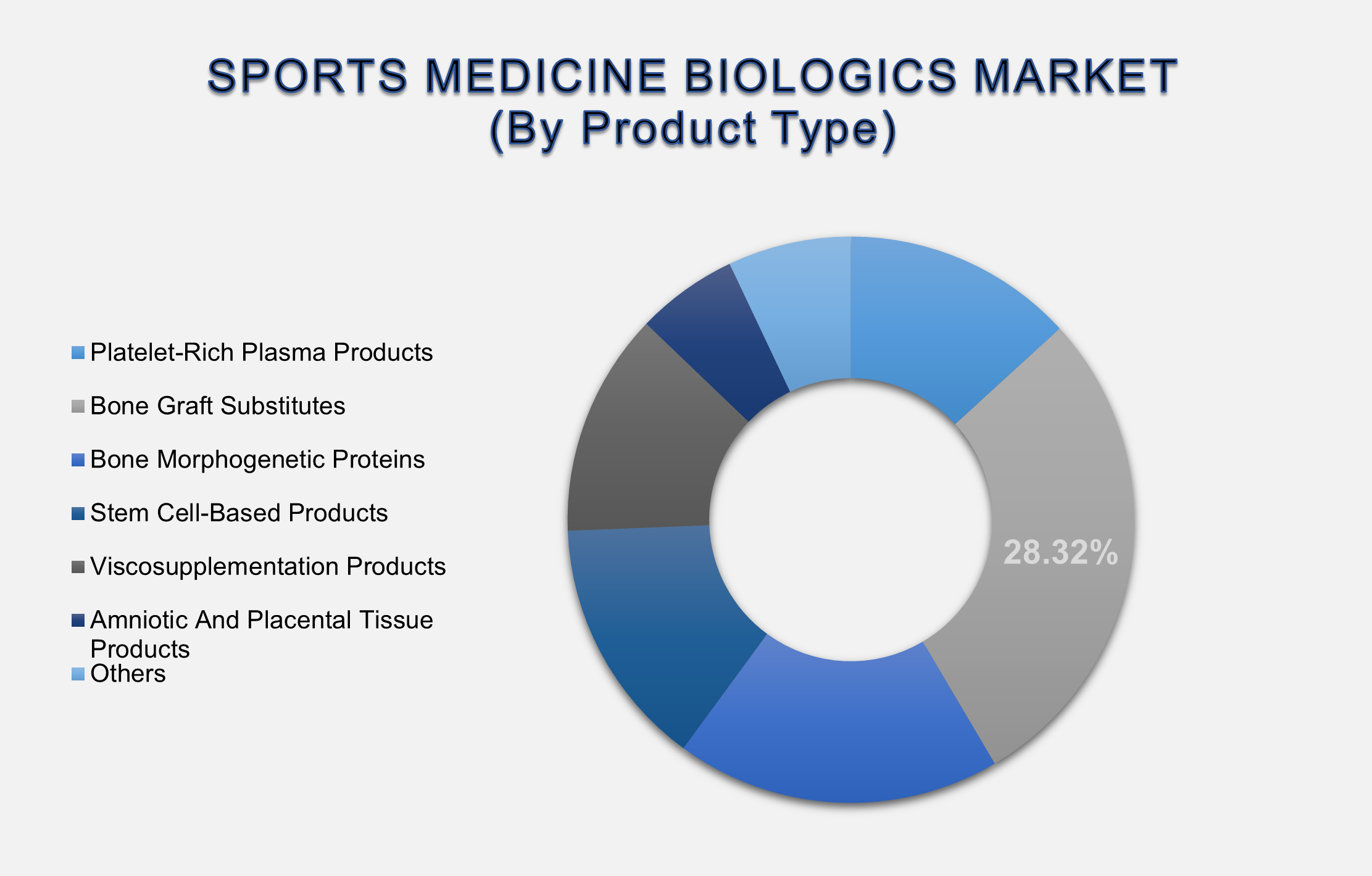
Bone graft
replacements will have the largest share in the sports medicine market during
the forecast period, as they are being used widely in orthopedic and sports
medicine applications. The products are being used in surgeries to treat bone
defects, fractures, ligament reconstruction, and joint preservation. The
biologics are being employed to facilitate the process of bone regeneration,
stabilize the patient’s condition, and reduce the need for harvesting
autografts to enhance patients’ outcomes and decrease their recovery times. The
boost of this segment is being supported by the rising demand for less invasive
orthopedic procedures and the growing number of sports injuries of the
musculoskeletal system. A stimulated segment growth is also underpinned by
innovation and approval of new products. For instance, the receipt of clearance
by Biomendex for its Adaptos Fuse Bone Graft from the U.S. FDA (510(k)).
Knee Segment Is
Expected to Lead the Sports Medicine Biologics Market by Application
The knee segment is
anticipated to lead the sports medicine biologics market based on usage
throughout the projected period, as a result of the high prevalence of knee
injuries among athletes and people involved in strenuous activities. Biologic
treatments are frequently necessary for injuries like anterior cruciate
ligament (ACL) ruptures, cartilage damage, meniscal injuries, and tendon
injuries in order to aid in tissue regeneration, fast healing, and substantial
improvement of joint function. The continued rise in athletic knee injuries,
along with the increased application of minimally invasive orthopedic
approaches, is increasing the desire for both PRP and non-PRP biologics like
bone substitute products, stem cell applications, and amniotic tissue products.
Furthermore, the segment is anticipated to retain its leading position thanks
to continuous technological advancements in regenerative medicine as well as
growing preference for fast recovery periods with minimal risk of complications
after surgery and an increased number of knee reconstructions and cartilage
stimulations.
Hospitals
Segment Is Expected to Lead the Sports Medicine Biologics Market by End User
In the course of
the forecast period, the hospitals segment is going to hold the leading
position in the Sports Medicine Biologics market. The performance of this
segment is going to be driven by a high number of procedures performed in the
hospital environment regarding orthopedics and sports medicine. Hospitals are
known to have highly developed surgical equipment, specialized orthopedic
departments, and the existence of a great number of specialists, which help to
treat complicated musculoskeletal problems with the help of biotechnological
therapy. The increase in the number of performed procedures such as ligament
reconstruction, cartilage treatment, bone grafting, and joint-preserving
procedures, and the growing interest in regenerative techniques, such as PRP,
stem-cell therapies, and bone graft substitutes, also promote the growth of the
segment.
The following
segments are part of an in-depth analysis of the global sports medicine
biologics market:
|
Market Segments |
|
|
By Product Type |
●
Platelet-Rich
Plasma Products ●
Bone Graft
Substitutes ●
Bone
Morphogenetic Proteins ●
Stem
Cell-Based Products ●
Viscosupplementation
Products ●
Amniotic And
Placental Tissue Products ●
Others |
|
By Application |
●
Knee ●
Shoulder ●
Foot And
Ankle ●
Hip and
Groin ●
Elbow and
Wrist ●
Others |
|
By End User |
●
Hospitals ●
Ambulatory
Surgical Centers ●
Specialty
Orthopedic Clinics ●
Sports Medicine
Centers ●
Others |
Sports Medicine Biologics Market
Share Analysis by Region
North America is
projected to hold the largest share of the global Sports Medicine Biologics
Market over the forecast period
North America will
likely register the highest share in the sports medicine biologics market
during the forecast years because of its well-structured healthcare system and
high rates of utilization of state-of-the-art orthopedic and regenerative
medical therapies and a growing number of sports-related injuries. This region
has some of the well-known companies such as Arthrex, Stryker, Zimmer Biomet,
Smith & Nephew, Bioventus, and Vericel, which keep working on product
improvement, research in clinical fields, and partnerships in order to improve
the range of their products in the orthobiologics market. A well-defined
regulatory framework and a capacity to be approved by such agencies as the U.S.
Food and Drug Administration (FDA) facilitate the process of introducing new
innovative biologic products to the market. In addition, the increasing number
of procedures performed in sports medicine, good reimbursement for certain
orthopedic therapies, and well-developed hospitals, as well as awareness and
education of sportsmen and physicians, are strengthening North America's
leadership in this market.
Sports Medicine
Biologics Market Competition Landscape Analysis
The competitive
arena of the sports medicine biologics market accounts for numerous market
leaders, including medical device producers, enterprises in regenerative
medicine, tissue banking groups, and developers of products in the field of
orthobiologics, which aim at innovating new biologic products for the treatment
of sport-related musculoskeletal traumas. Corporations operate in the market
through the constant creation of new products in the field of platelet-rich
plasma (PRP) systems, substitutes of bone grafts, stem cell therapies, amnion
and placenta-derived products, and regenerative biologics in general, which
create the potential for the tissue healing process. Most leading market
players intensify the competition in the market through implementing different
strategies, including new product introduction, approval of new medications,
research and development investments and studies, launching of clinical
studies, partnerships, mergers and acquisitions, as well as geographical
expansions that nowadays help them meet the increasing need for advanced
methods of treatment within the field of sports medicine.
Global Sports
Medicine Biologics Market Recent Developments News:
●
In January
2026 - Smith+Nephew, the global
medical technology company, announced it had completed the acquisition of Integrity Orthopaedics,
further strengthening its sports medicine shoulder repair business with the
most comprehensive suite of technologies available for rotator cuff repair
(RCR).
●
In April 2026 -
Organogenesis completed a rolling Biologics License Application (BLA)
submission to the US FDA for Renu (cryopreserved amniotic suspension
allograft), seeking approval for the management of symptomatic knee
osteoarthritis.
●
In April 2026
- Miracell, a leading stem cell technology company, announced that it has
obtained U.S. FDA 510(k) clearance for its stem cell extraction system, SMART
M-CELL, along with its dedicated kits, the BSC Blood Kit and BMSC Bone Marrow
Kit.
The global
sports medicine biologics market is dominated by a few large companies, such as
●
AlloSource
●
Anika Therapeutics, Inc.
●
Arthrex, Inc.
●
Bioventus Inc.
●
Integra LifeSciences Holdings Corporation
●
Isto Biologics
●
Johnson & Johnson (DePuy Synthes)
●
Kuros Biosciences AG
●
LifeNet Health, Inc.
●
MiMedx Group
●
MTF Biologics
●
Organogenesis Holdings Inc.
●
Orthofix Medical Inc.
●
RTI Surgical
●
Smith & Nephew plc
●
Stryker Corporation
●
SurGenTec
●
Vericel Corporation
●
Xtant Medical
●
Zimmer Biomet Holdings, Inc.
● Other Prominent Players
Frequently Asked Questions
Swetal (Research Analyst)
Swetal is a Research Analyst with 4+ years of experience specializing in healthcare market research, medical devices, healthcare IT, and medical technology industry analysis. Her expertise includes competitive intelligence, secondary research, market trend forecasting, and healthcare business insights across global healthcare ecosystems.
She contributes to advanced market research reports by analyzing regulatory frameworks, emerging healthcare technologies, competitive landscapes, and innovation trends shaping the medical industry. With a strong focus on accurate market intelligence, strategic insights, and healthcare industry trends, Swetal supports businesses in making informed, data-backed decisions in a rapidly transforming healthcare environment.
1.
Global
Sports Medicine Biologics Market Introduction and Market Overview
1.1. Objectives of the Study
1.2. Market Segmentation
1.2.1.Product Type of the Global Sports
Medicine Biologics Market
1.2.2.Application of the Global Sports
Medicine Biologics Market
1.2.3.End User of the Global Sports
Medicine Biologics Market
1.2.4.Region of the Global Sports
Medicine Biologics Market
1.3. Competition Coverage List of
Market Participants
1.4. Market Definition: Sports
Medicine Biologics Market
2.
Executive Summary
2.1. Global Sports Medicine Biologics
Market Estimation & Forecast
2.1.1.Global Sports Medicine Biologics
Market Size (US$ Million) Estimates & Historical Trend Analysis (2021 -
2025)
2.1.2.Global Anti-Pollution Nasal
Spray Overall Market Size (US$ Million), Growth Rate (Y-o-Y), Market CAGR (%),
Market Forecast (2026 - 2034)
2.2. Snapshot of Global Sports
Medicine Biologics Market
2.3. Global Sports Medicine Biologics
Market Revenue Share (%) 2025
2.4. REGIONAL OUTLINE: Revenue CAGR,
by Region
2.5. Key Competitors & Key
Insights
3.
Market Overview (Qualitative
Analysis)
3.1. Demand Side Trends
3.2. Supply Side Trends /
Manufacturing Trends
3.3. Demand and Opportunity
Assessment, 2026 - 2034
3.4. Market Dynamics
3.4.1.Drivers
3.4.2.Limitations
3.4.3.Opportunities
3.4.4.Impact Analysis of Drivers and
Restraints
3.5. Key Developments
3.6. Regulatory Landscape
3.7. Pricing Analysis
3.8. Supply Chain Analysis
3.9. Porter’s Five Forces Analysis
3.9.1.Bargaining Power of Suppliers
3.9.2.Bargaining Power of Buyers
3.9.3.Threat of Substitutes
3.9.4.Threat of New Entrants
3.9.5.Competitive Rivalry
3.10. PEST Analysis
3.10.1. Political Factors
3.10.2. Economic Factors
3.10.3. Social Factors
3.10.4. Technology Factors
4.
Global Sports Medicine Biologics
Market Estimates & Forecast Trend Analysis, by Product Type
4.1. Global Sports Medicine Biologics
Market Assessments & Key Findings, by Product Type
4.2. Global Sports Medicine Biologics
Market Revenue (US$ Million) Estimates and Forecasts, by Product Type, 2021 -
2034
4.2.1.Platelet-Rich Plasma Products
4.2.2.Bone Graft Substitutes
4.2.3.Bone Morphogenetic Proteins
4.2.4.Stem Cell-Based Products
4.2.5.Viscosupplementation Products
4.2.6.Amniotic And Placental Tissue
Products
4.2.7.Others
5.
Global Sports Medicine Biologics
Market Estimates & Forecast Trend Analysis, by Application
5.1. Global Sports Medicine Biologics
Market Assessments & Key Findings, by Application
5.2. Global Sports Medicine Biologics
Market Revenue (US$ Million) Estimates and Forecasts, by Application, 2021 -
2034
5.2.1.Knee
5.2.2.Shoulder
5.2.3.Foot And Ankle
5.2.4.Hip And Groin
5.2.5.Elbow And Wrist
5.2.6.Others
6.
Global Sports Medicine Biologics
Market Estimates & Forecast Trend Analysis, by End User
6.1. Global Sports Medicine Biologics
Market Assessments & Key Findings, by End User
6.2. Global Sports Medicine Biologics
Market Revenue (US$ Million) Estimates and Forecasts, by End User, 2021 - 2034
6.2.1.Hospitals
6.2.2.Ambulatory Surgical Centers
6.2.3.Specialty Orthopedic Clinics
6.2.4.Sports Medicine Centers
6.2.5.Others
7.
Global Sports Medicine Biologics
Market Estimates & Forecast Trend Analysis, by Region
7.1.
Global
Sports Medicine Biologics Market Assessments & Key Findings, by Region
7.2.
Global
Sports Medicine Biologics Market Revenue (US$ Million) Estimates and Forecasts,
by Region, 2021 - 2034
7.2.1.North America
7.2.2.Europe
7.2.3.Asia Pacific
7.2.4.Middle East & Africa
7.2.5.Latin America
8.
North
America Sports Medicine Biologics Market: Estimates & Forecast Trend Analysis
8.1. North America Sports Medicine
Biologics Market Assessments & Key Findings
8.1.1.North America Sports Medicine
Biologics Market Introduction
8.1.2.North America Sports Medicine
Biologics Market Size Estimates and Forecast (US$ Million) (2021 - 2034)
8.1.2.2. By Application
8.1.2.3. By End User
8.1.2.4. By Country
8.1.2.4.1. The U.S.
8.1.2.4.2. Canada
9.
Europe
Sports Medicine Biologics Market: Estimates & Forecast Trend Analysis
9.1. Europe Sports Medicine Biologics
Market Assessments & Key Findings
9.1.1.Europe Sports Medicine Biologics
Market Introduction
9.1.2.Europe Sports Medicine Biologics
Market Size Estimates and Forecast (US$ Million) (2021 - 2034)
9.1.2.1. By Product Type
9.1.2.2. By Application
9.1.2.3. By End User
9.1.2.4. By Country
9.1.2.4.1.
Germany
9.1.2.4.2.
Italy
9.1.2.4.3.
U.K.
9.1.2.4.4.
France
9.1.2.4.5.
Spain
9.1.2.4.6.
Switzerland
9.1.2.4.7. Rest
of Europe
10. Asia Pacific Sports
Medicine Biologics Market: Estimates
& Forecast Trend Analysis
10.1. Asia Pacific Market Assessments
& Key Findings
10.1.1. Asia Pacific Sports Medicine
Biologics Market Introduction
10.1.2. Asia Pacific Sports Medicine
Biologics Market Size Estimates and Forecast (US$ Million) (2021 - 2034)
10.1.2.1. By Product Type
10.1.2.2. By Application
10.1.2.3. By End User
10.1.2.4. By Country
10.1.2.4.1. China
10.1.2.4.2. Japan
10.1.2.4.3. India
10.1.2.4.4. Australia
10.1.2.4.5. South Korea
10.1.2.4.6. Rest of Asia Pacific
11. Middle East & Africa Sports
Medicine Biologics Market: Estimates
& Forecast Trend Analysis
11.1. Middle East & Africa Market
Assessments & Key Findings
11.1.1. Middle
East & Africa Sports
Medicine Biologics Market Introduction
11.1.2. Middle
East & Africa Sports
Medicine Biologics Market Size Estimates and Forecast (US$ Million) (2021 -
2034)
11.1.2.1. By Product Type
11.1.2.2. By Application
11.1.2.3. By End User
11.1.2.4. By Country
11.1.2.4.1. South Africa
11.1.2.4.2. UAE
11.1.2.4.3. Saudi Arabia
11.1.2.4.4. Rest of MEA
12. Latin America
Sports Medicine Biologics Market:
Estimates & Forecast Trend Analysis
12.1. Latin America Market Assessments
& Key Findings
12.1.1. Latin America Sports Medicine
Biologics Market Introduction
12.1.2. Latin America Sports Medicine
Biologics Market Size Estimates and Forecast (US$ Million) (2021 - 2034)
12.1.2.1. By Product Type
12.1.2.2. By Application
12.1.2.3. By End User
12.1.2.4. By Country
12.1.2.4.1. Brazil
12.1.2.4.2. Mexico
12.1.2.4.3. Argentina
12.1.2.4.4. Rest of LATAM
13. Competition Landscape
13.1. Global Sports Medicine Biologics
Market Product Mapping
13.2. Global Sports Medicine Biologics
Market Concentration Analysis, by Leading Players / Innovators / Emerging
Players / New Entrants
13.3. Global Sports Medicine Biologics
Market Tier Structure Analysis
13.4. Global Sports Medicine Biologics
Market Concentration & Company Market Shares (%) Analysis, 2025
14. Company Profiles
14.1. AlloSource
14.1.1. Company Overview & Key Stats
14.1.2. Financial Performance & KPIs
14.1.3. Product Portfolio
14.1.4. SWOT Analysis
14.1.5. Business Strategy & Recent
Developments
* Similar details would be provided
for all the players mentioned below
14.2. Anika Therapeutics, Inc.
14.3. Arthrex, Inc.
14.4. Bioventus Inc.
14.5. Integra LifeSciences Holdings
Corporation
14.6. Isto Biologics
14.7. Johnson & Johnson (DePuy
Synthes)
14.8. Kuros Biosciences AG
14.9. LifeNet Health, Inc.
14.10. MiMedx Group
14.11. MTF Biologics
14.12. Organogenesis Holdings Inc.
14.13. Orthofix Medical Inc.
14.14. RTI Surgical
14.15. Smith & Nephew plc
14.16. Stryker Corporation
14.17. SurGenTec
14.18. Vericel Corporation
14.19. Xtant Medical
14.20. Zimmer Biomet Holdings, Inc.
14.21. Other Prominent Players
15. Research
Findings & Conclusion
16. Assumptions & Acronyms Used
17. Research
Methodology
17.1. External Transportation /
Databases
17.2. Internal Proprietary Database
17.3. Primary Research
17.4. Secondary Research
17.5. Assumptions
17.6. Limitations
17.7. Report FAQs
Our Research Methodology
"Insight without rigor is just noise."
We follow a comprehensive, multi-phase research framework designed to deliver accurate, strategic, and decision-ready intelligence. Our process integrates primary and secondary research , both quantitative and qualitative , along with dual modeling techniques ( top-down and bottom-up) and a final layer of validation through our proprietary in-house repository.
PRIMARY RESEARCH
Primary research captures real-time, firsthand insights from the market to understand behaviors, motivations, and emerging trends.
1. Quantitative Primary Research
Objective: Generate statistically significant data directly from market participants.
Approaches:- Structured surveys with customers, distributors, and field agents
- Mobile-based data collection for point-of-sale audits and usage behavior
- Phone-based interviews (CATI) for market sizing and product feedback
- Online polling around industry events and digital campaigns
- Purchase frequency by customer type
- Channel performance across geographies
- Feature demand by application or demographic
2. Qualitative Primary Research
Objective: Explore decision-making drivers, pain points, and market readiness.
Approaches:- In-depth interviews (IDIs) with executives, product managers, and key decision-makers
- Focus groups among end users and early adopters
- Site visits and observational research for consumer products
- Informal field-level discussions for regional and cultural nuances
SECONDARY RESEARCH
This phase helps establish a macro-to-micro understanding of market trends, size, regulation, and competitive dynamics, sourced from credible and public domain information.
1. Quantitative Secondary Research
Objective: Model market value and segment-level forecasts based on published data.
Sources include:- Financial reports and investor summaries
- Government trade data, customs records, and regulatory statistics
- Industry association publications and economic databases
- Channel performance and pricing data from marketplace listings
- Revenue splits, pricing trends, and CAGR estimates
- Supply-side capacity and volume tracking
- Investment analysis and funding benchmarks
2. Qualitative Secondary Research
Objective: Capture strategic direction, innovation signals, and behavioral trends.
Sources include:- Company announcements, roadmaps, and product pipelines
- Publicly available whitepapers, conference abstracts, and academic research
- Regulatory body publications and policy briefs
- Social and media sentiment scanning for early-stage shifts
- Strategic shifts in market positioning
- Unmet needs and white spaces
- Regulatory triggers and compliance impact
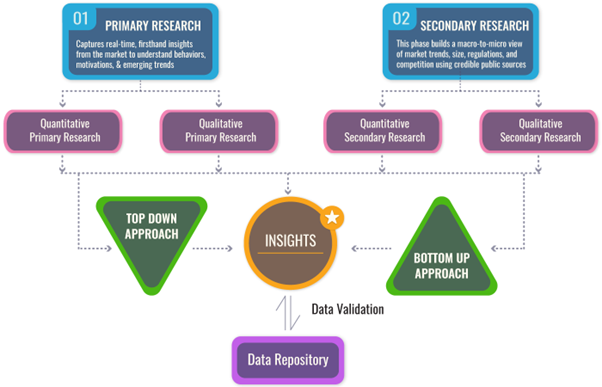
DUAL MODELING: TOP-DOWN + BOTTOM-UP
To ensure robust market estimation, we apply two complementary sizing approaches:
Top-Down Modeling:- Start with broader industry value (e.g., global or regional TAM)
- Apply filters by segment, geography, end-user, or use case
- Adjust with primary insights and validation benchmarks
- Ideal for investor-grade market scans and opportunity mapping
- Aggregate from the ground up using sales volumes, pricing, and unit economics
- Use internal modeling templates aligned with stakeholder data
- Incorporate distributor-level or region-specific inputs
- Most accurate for emerging segments and granular sub-markets
DATA VALIDATION: IN-HOUSE REPOSITORY
We close the loop with proprietary data intelligence built from ongoing projects, industry monitoring, and historical benchmarking. This repository includes:
- Multi-sector market and pricing models
- Key trendlines from past interviews and forecasts
- Benchmarked adoption rates, churn patterns, and ROI indicators
- Industry-specific deviation flags and cross-check logic
- Catches inconsistencies early
- Aligns projections across studies
- Enables consistent, high-trust deliverables