

Swimwear Market Size and Forecast (2025–2033), Global and Regional Growth, Trend, Share and Industry Analysis Report Coverage: By Material (Polyester/Nylon, Spandex, Others), By End-user (Men, Women, Kids), By Distribution Channel (Online, Offline), and Geography
2026-02-25
Consumer Products
Jaya Bundele (Research Analyst)
Description
Swimwear Market Overview
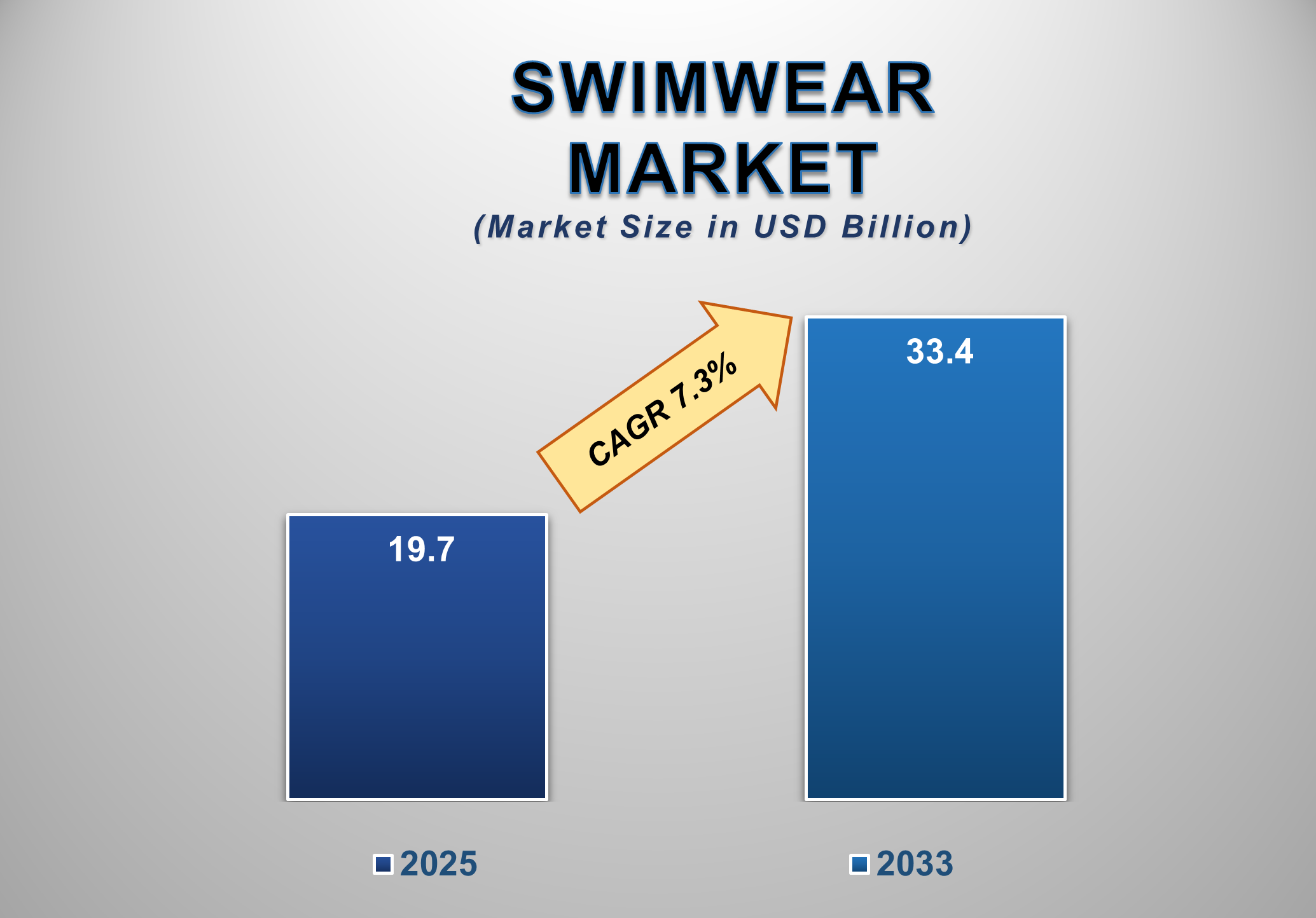
The global swimwear market was valued at USD 19.7 billion in 2025 and is projected to reach USD 33.4 billion by 2033, expanding at a healthy CAGR of 7.3% during the forecast period. Market growth is driven by rising participation in recreational swimming, increasing beach and resort tourism, growing fitness awareness, and the expanding influence of athleisure and lifestyle fashion trends. Swimwear has evolved beyond functional apparel into a fashion-forward category, supported by continuous innovation in fabric technology, design aesthetics, and performance enhancement.
Increasing disposable income,
especially across emerging economies, has led to higher spending on premium and
branded swimwear. The expansion of global tourism, cruise travel, and luxury
resorts has further strengthened demand across men’s, women’s, and kids’
swimwear segments. Additionally, the growing popularity of swimming as a
low-impact fitness activity among all age groups has increased year-round
demand, particularly in urban areas with indoor pools and wellness centers.
Swimwear Market Drivers
and Opportunities
Rising Global Tourism and
Recreational Water Activities Are Driving Market Growth
The steady rise in global tourism and recreational water-based
activities is a primary driver of the swimwear market. Coastal tourism, beach
holidays, water parks, cruises, and resort travel have increased significantly,
boosting demand for fashionable and functional swimwear. Countries with strong
tourism economies are witnessing consistent growth in swimwear consumption
across both domestic and international travelers. Swimming is increasingly
promoted as a wellness and fitness activity, especially among aging populations
and individuals seeking low-impact exercise options. Public swimming pools,
fitness clubs, hotels, and residential communities are investing in aquatic
facilities, further increasing swimwear adoption. Seasonal demand spikes during
summer months are being balanced by indoor swimming facilities, supporting more
stable year-round sales. Additionally, professional and competitive swimming
events, along with school-level swimming programs, continue to contribute to
demand for performance-oriented swimwear. Brands are focusing on comfort,
hydrodynamics, and durability to meet the needs of both recreational users and
professional athletes. As global travel and leisure activities continue to
recover and expand, swimwear demand is expected to remain resilient and
growth-oriented.
Expanding E-commerce and Fashion Influence Is Strengthening
Market Expansion
The rapid growth of e-commerce platforms and digital fashion
marketing is significantly accelerating the swimwear market. Online channels
provide consumers with access to a wide variety of styles, sizes, and price
ranges, enabling brands to reach global audiences efficiently. Virtual try-ons,
detailed size guides, easy returns, and influencer-driven promotions are
improving consumer confidence in online swimwear purchases. Social media
platforms such as Instagram, TikTok, and YouTube play a crucial role in shaping
swimwear trends, especially among younger demographics. Celebrity endorsements,
fashion influencers, and brand collaborations are driving rapid adoption of new
designs and collections. Swimwear brands are increasingly launching
limited-edition collections and direct-to-consumer platforms to enhance brand
visibility and customer engagement. Additionally, customization and
personalization options, including size inclusivity and body-positive designs,
are expanding the consumer base. The integration of sustainability messaging
through digital platforms is also resonating strongly with environmentally
conscious consumers. As online retail continues to outpace offline growth,
digital-first strategies are expected to be a major growth engine for the swimwear
market.
Sustainable and Eco-Friendly Swimwear Is Creating New Growth
Opportunities
Sustainability is emerging as a major opportunity in the global swimwear market. Consumers are increasingly demanding environmentally responsible products, prompting brands to invest in recycled polyester, regenerated nylon, and biodegradable packaging. Swimwear made from ocean plastics and recycled fishing nets is gaining popularity, particularly among younger and environmentally conscious buyers. Governments and environmental organizations are encouraging sustainable manufacturing practices, pushing brands to reduce water consumption, chemical usage, and carbon emissions. Certifications and transparent supply chains are becoming important purchasing criteria, especially in premium and mid-range segments. Brands that successfully combine sustainability with performance and fashion are gaining a competitive edge. Furthermore, innovation in fabric durability and longevity is reducing replacement cycles, aligning with sustainable consumption trends. As awareness of environmental impact continues to grow, sustainable swimwear is expected to transition from a niche offering to a mainstream market segment, unlocking long-term growth opportunities
Swimwear Market Scope
|
Report Attributes |
Description |
|
Market Size in 2025 |
USD 19.7 Billion |
|
Market Forecast in 2035 |
USD 33.4 Billion |
|
CAGR % 2025-2035 |
7.3% |
|
Base Year |
2024 |
|
Historic Data |
2020-2024 |
|
Forecast Period |
2025-2035 |
|
Report USP |
Production, Consumption,
Company Share, Company Heatmap, Company Production Capacity, Growth Factors,
and more |
|
Segments Covered |
●
By material,
end-user, and distribution channel |
|
Regional Scope |
●
North America, ●
Europe, ●
APAC, ●
Latin America ●
Middle East and
Africa |
|
Country Scope |
1)
U.S. 2)
Canada 3)
Germany 4)
UK 5)
France 6)
Spain 7)
Italy 8)
Switzerland 9)
China 10)
Japan 11)
India 12)
Australia 13)
South Korea 14)
Brazil 15)
Mexico 16)
Argentina 17)
South Africa 18)
Saudi Arabia 19)
UAE |
Swimwear Market Report
Segmentation Analysis
The Global Swimwear Market
Industry Analysis is segmented by material, end-user, and distribution channel,
and by region.
Polyester/Nylon Segment Dominates the Swimwear Market
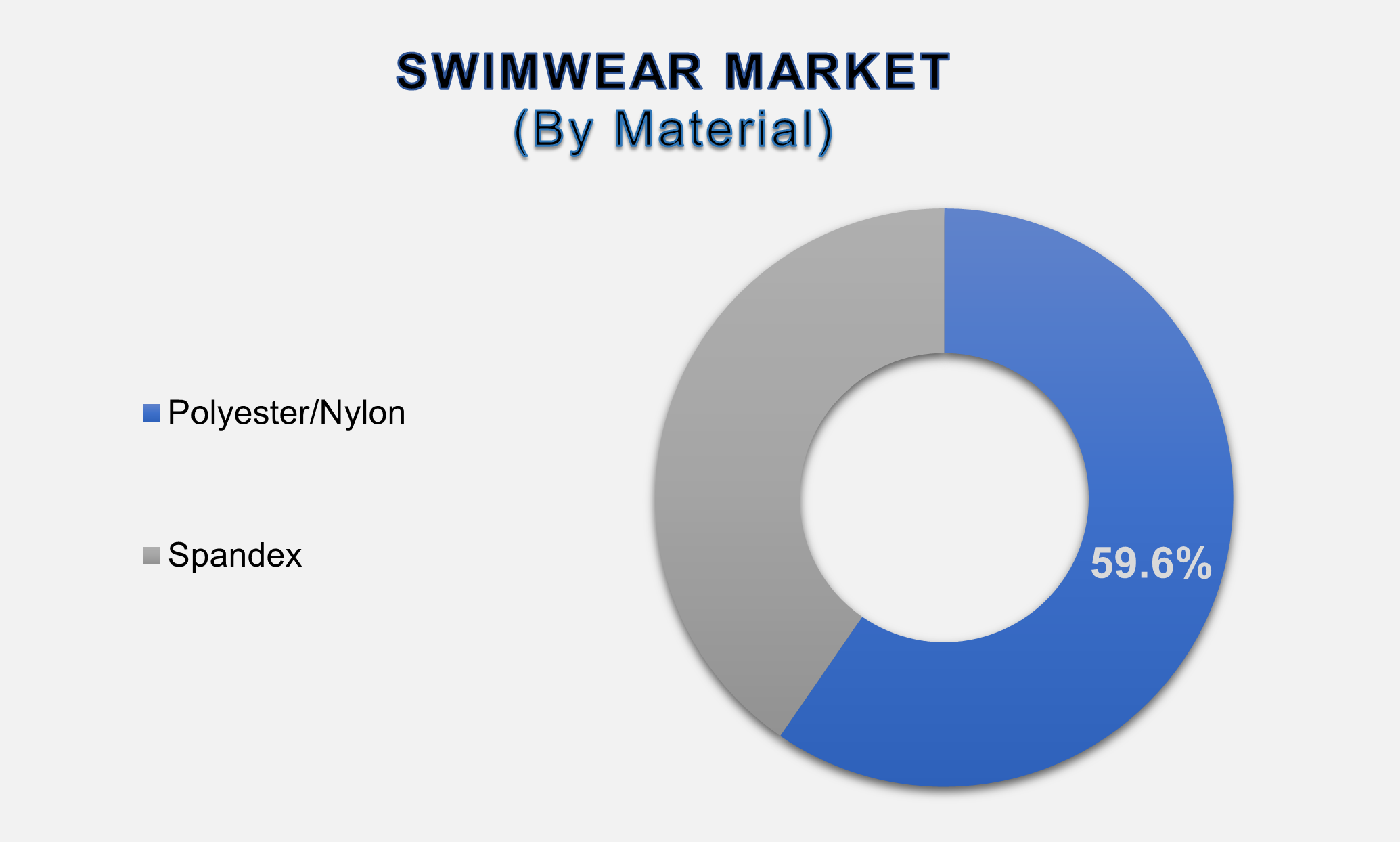
The polyester/nylon segment accounted for approximately 59.6% of the global swimwear market, driven by superior durability, elasticity, and resistance to chlorine and saltwater. These materials offer excellent shape retention, quick-drying properties, and long-lasting color performance, making them ideal for both recreational and professional swimwear. Manufacturers prefer polyester and nylon blends due to their versatility and compatibility with advanced fabric technologies such as UV protection and compression. These materials are widely used across men’s, women’s, and kids’ swimwear categories, supporting broad market adoption. Their affordability compared to premium alternatives further strengthens their dominance, especially in mass-market segments.
The Men’s Segment Holds a Significant Share Driven by Performance
Demand
The men's segment represents a substantial portion of global
swimwear demand, supported by growing participation in swimming, water sports,
and fitness activities. Men’s swimwear emphasizes performance, comfort, and
durability, with products such as swim trunks, jammers, and briefs widely
adopted across recreational and competitive settings. Rising health awareness,
increasing gym and pool memberships, and participation in triathlons and
aquatic sports are boosting demand for high-performance men’s swimwear. Brands
are increasingly offering ergonomic designs and performance-enhancing fabrics
to cater to this segment’s evolving preferences.
Online
Distribution Channel Is Experiencing Rapid Growth
Online
distribution channels are witnessing strong growth due to convenience, variety,
and competitive pricing. Digital platforms allow brands to launch collections
quickly, test new designs, and engage directly with consumers. Online-exclusive
launches, influencer marketing, and personalized recommendations are
accelerating adoption. The availability of global shipping and localized
e-commerce platforms is expanding market reach, particularly in emerging
economies. As consumer trust in online apparel shopping increases, online
channels are expected to outpace offline growth during the forecast period.
The following segments are
part of an in-depth analysis of the global Swimwear market:
|
Market Segments |
|
|
By Material |
●
Polyester/Nylon ●
Spandex |
|
By End-user |
●
Men ●
Women ●
Kids |
|
By
Distribution Channel |
●
Online ●
Offline |
Swimwear Market Share
Analysis by Region
North America is
anticipated to hold the biggest portion of the Swimwear Market globally
throughout the forecast period.
North America dominated the
global swimwear market, accounting for approximately 56.7% of the total market
share in 2025. The region’s leadership is driven by strong consumer spending
power, high participation in recreational swimming, and a well-established
beach and pool culture. The presence of major swimwear brands, advanced retail
infrastructure, and strong e-commerce penetration further supports market
dominance. Additionally, fitness-focused lifestyles and premium fashion
adoption contribute significantly to regional revenue.
Asia Pacific is expected to
register the highest CAGR during the forecast period, supported by rising
disposable incomes, expanding middle-class populations, and growing tourism
across countries such as China, India, Thailand, and Indonesia. Rapid urbanization,
increasing adoption of swimming as a fitness activity, and expansion of online
retail platforms are accelerating market growth. As international brands expand
their footprint and local players gain visibility, the Asia Pacific is emerging
as the fastest-growing swimwear market globally.
Swimwear Market
Competition Landscape Analysis
The swimwear market is moderately
fragmented, with the presence of global sportswear brands, specialized swimwear
manufacturers, and regional players. Leading companies focus on product
innovation, sustainable materials, brand collaborations, and digital marketing
strategies to strengthen their market position. Competitive differentiation is
increasingly driven by fabric performance, design aesthetics, inclusivity, and
sustainability initiatives.
Global Swimwear Market
Recent Developments News:
- In June 2023 – Skims, an American clothing brand,
launched two new lines of swimsuits, with founder Kim Kardashian
prominently featured in its campaign.
- In March 2023 – JCPenney collaborated with Sports
Illustrated (SI) to launch a range of swimwear for men and women,
featuring 'beach-to-street' styles.
- In September 2022 – The Summer House, an Indian
fashion brand, launched its new 'New Swim' collection made from ECONYL, a
regenerated nylon textile material.
- In December 2021 – Petty-boil, a U.S.-based
swimwear company, launched 'The Cheeky Collection,' a range of new
swimwear made with high-quality materials.
- In July 2021 – Oh Polly, a UK-based online women's
retailer, launched its new swimwear brand,
Neena Swim, during Miami Swim Week.
The Global Swimwear Market Is
Dominated by a Few Large Companies, such as
●
Pentland Group
●
Arena
●
Speedo International
●
TYR Sport
●
Nike
●
Adidas
●
Dolfin Swimwear
●
Zoke
●
Yingfa
●
Wacoal
●
La Perla Group
●
Seafolly
●
Billabong
●
Rip Curl
●
O'Neill
●
Quiksilver
●
Volcom
●
Gottex
●
Catalina Swimwear
●
Jantzen
● Others
Frequently Asked Questions
Jaya Bundele (Research Analyst)
Jaya Bundele is a skilled Research Analyst with 4+ years of experience in market intelligence, consumer insights, competitive analysis, and industry forecasting across the consumer goods, agriculture, and food & beverage sectors. She specializes in market sizing, trend analysis, growth opportunity mapping, and strategic secondary research for global and regional markets.
Her expertise lies in transforming complex industry data into actionable business strategies that help organizations identify emerging trends, understand customer behavior, and gain a competitive edge. With a strong focus on data-driven insights, business intelligence, and future market trends, Jaya delivers high-quality research solutions aligned with evolving industry demands and market dynamics.
1. Global Swimwear Market
Introduction and Market Overview
1.1.
Objectives
of the Study
1.2.
Global
Swimwear Market Scope and Market Estimation
1.2.1.Global Swimwear Overall
Market Size (US$ Bn), Market CAGR (%), Market forecast (2025 - 2033)
1.2.2.Global Swimwear Market
Revenue Share (%) and Growth Rate (Y-o-Y) from 2020 - 2033
1.3.
Market
Segmentation
1.3.1.Material of Global Swimwear
Market
1.3.2.End-user of Global Swimwear
Market
1.3.3.Distribution Channel of
Global Swimwear Market
1.3.4.Region of Global Swimwear
Market
2. Executive
Summary
2.1.
Demand
Side Trends
2.2.
Key
Market Trends
2.3.
Market
Demand (US$ Bn) Analysis 2020 – 2024 and Forecast, 2025 – 2033
2.4.
Demand
and Opportunity Assessment
2.5.
Key
Developments
2.6.
Overview
of Tariff, Regulatory Landscape and Standards
2.7.
Market
Entry Strategies
2.8.
Market
Dynamics
2.8.1.Drivers
2.8.2.Limitations
2.8.3.Opportunities
2.8.4.Impact Analysis of Drivers
and Restraints
2.9.
Porter’s
Five Forces Analysis
2.10.
PEST
Analysis
3. Global
Swimwear Market Estimates
& Historical Trend Analysis (2020 - 2024)
4. Global
Swimwear Market Estimates
& Forecast Trend Analysis, by Material
4.1.
Global
Swimwear Market Revenue (US$ Bn) Estimates and Forecasts, by Material, 2020 - 2033
4.1.1.Polyester/Nylon
4.1.2.Spandex
5. Global
Swimwear Market Estimates
& Forecast Trend Analysis, by End-user
5.1.
Global
Swimwear Market Revenue (US$ Bn) Estimates and Forecasts, by End-user, 2020 - 2033
5.1.1.Men
5.1.2.Women
5.1.3.Kids
6. Global
Swimwear Market Estimates
& Forecast Trend Analysis, by Distribution Channel
6.1.
Global
Swimwear Market Revenue (US$ Bn) Estimates and Forecasts, by Distribution
Channel, 2020 - 2033
6.1.1.Online
6.1.2.Offline
7. Global
Swimwear Market Estimates
& Forecast Trend Analysis, by Region
7.1.
Global
Swimwear Market Revenue (US$ Bn) Estimates and Forecasts, by Region, 2020 - 2033
7.1.1.North America
7.1.2.Europe
7.1.3.Asia Pacific
7.1.4.Middle East & Africa
7.1.5.Latin America
8. North America Swimwear
Market: Estimates & Forecast Trend
Analysis
8.1.
North
America Swimwear Market Assessments & Key Findings
8.1.1.North America Swimwear
Market Introduction
8.1.2.North America Swimwear
Market Size Estimates and Forecast (US$ Billion) (2020 - 2033)
8.1.2.1. By Material
8.1.2.2. By End-user
8.1.2.3. By Distribution
Channel
8.1.2.4.
By
Country
8.1.2.4.1. The U.S.
8.1.2.4.2. Canada
9. Europe Swimwear
Market: Estimates & Forecast Trend
Analysis
9.1.
Europe
Swimwear Market Assessments & Key Findings
9.1.1.Europe Swimwear Market
Introduction
9.1.2.Europe Swimwear Market
Size Estimates and Forecast (US$ Billion) (2020 - 2033)
9.1.2.1. By Material
9.1.2.2. By End-user
9.1.2.3. By Distribution
Channel
9.1.2.4.
By
Country
9.1.2.4.1.
Germany
9.1.2.4.2.
Italy
9.1.2.4.3.
U.K.
9.1.2.4.4.
France
9.1.2.4.5.
Spain
9.1.2.4.6.
Switzerland
9.1.2.4.7. Rest
of Europe
10. Asia Pacific Swimwear
Market: Estimates & Forecast Trend
Analysis
10.1.
Asia
Pacific Market Assessments & Key Findings
10.1.1.
Asia
Pacific Swimwear Market Introduction
10.1.2.
Asia
Pacific Swimwear Market Size Estimates and Forecast (US$ Billion) (2020 - 2033)
10.1.2.1. By Material
10.1.2.2. By End-user
10.1.2.3. By Distribution
Channel
10.1.2.4.
By
Country
10.1.2.4.1. China
10.1.2.4.2. Japan
10.1.2.4.3. India
10.1.2.4.4. Australia
10.1.2.4.5. South Korea
10.1.2.4.6. Rest of Asia Pacific
11. Middle East & Africa Swimwear
Market: Estimates & Forecast Trend
Analysis
11.1.
Middle
East & Africa Market Assessments & Key Findings
11.1.1.
Middle East & Africa Swimwear Market Introduction
11.1.2.
Middle East & Africa Swimwear Market Size Estimates and
Forecast (US$ Billion) (2020 - 2033)
11.1.2.1. By Material
11.1.2.2. By End-user
11.1.2.3. By Distribution
Channel
11.1.2.4.
By
Country
11.1.2.4.1. UAE
11.1.2.4.2. Saudi
Arabia
11.1.2.4.3. South
Africa
11.1.2.4.4. Rest
of MEA
12. Latin America
Swimwear Market: Estimates &
Forecast Trend Analysis
12.1.
Latin
America Market Assessments & Key Findings
12.1.1.
Latin
America Swimwear Market Introduction
12.1.2.
Latin
America Swimwear Market Size Estimates and Forecast (US$ Billion) (2020 - 2033)
12.1.2.1. By Material
12.1.2.2. By End-user
12.1.2.3. By Distribution
Channel
12.1.2.4.
By
Country
12.1.2.4.1. Brazil
12.1.2.4.2. Argentina
12.1.2.4.3. Mexico
12.1.2.4.4. Rest
of LATAM
13. Country Wise Market:
Introduction
14.
Competition
Landscape
14.1.
Global
Swimwear Market Product Mapping
14.2.
Global
Swimwear Market Concentration Analysis, by Leading Players / Innovators /
Emerging Players / New Entrants
14.3.
Global
Swimwear Market Tier Structure Analysis
14.4.
Global
Swimwear Market Concentration & Company Market Shares (%) Analysis, 2024
15.
Company
Profiles
15.1.
Pentland Group
15.1.1.
Company
Overview & Key Stats
15.1.2.
Financial
Performance & KPIs
15.1.3.
Product
Portfolio
15.1.4.
SWOT
Analysis
15.1.5.
Business
Strategy & Recent Developments
* Similar details would be provided for all the players
mentioned below
15.2. Arena
15.3. Speedo
International
15.4. TYR
Sport
15.5. Nike
15.6. Adidas
15.7. Dolfin
Swimwear
15.8. Zoke
15.9. Yingfa
15.10. Wacoal
15.11. La Perla
Group
15.12. Seafolly
15.13. Billabong
15.14. Rip Curl
15.15. O'Neill
15.16. Quiksilver
15.17. Volcom
15.18. Gottex
15.19. Catalina
Swimwear
15.20. Jantzen
15.21. Others
16. Research
Methodology
16.1.
External
Transportations / Databases
16.2.
Internal
Proprietary Database
16.3.
Primary
Research
16.4.
Secondary
Research
16.5.
Assumptions
16.6.
Limitations
16.7.
Report
FAQs
17. Research
Findings & Conclusion
Our Research Methodology
"Insight without rigor is just noise."
We follow a comprehensive, multi-phase research framework designed to deliver accurate, strategic, and decision-ready intelligence. Our process integrates primary and secondary research , both quantitative and qualitative , along with dual modeling techniques ( top-down and bottom-up) and a final layer of validation through our proprietary in-house repository.
PRIMARY RESEARCH
Primary research captures real-time, firsthand insights from the market to understand behaviors, motivations, and emerging trends.
1. Quantitative Primary Research
Objective: Generate statistically significant data directly from market participants.
Approaches:- Structured surveys with customers, distributors, and field agents
- Mobile-based data collection for point-of-sale audits and usage behavior
- Phone-based interviews (CATI) for market sizing and product feedback
- Online polling around industry events and digital campaigns
- Purchase frequency by customer type
- Channel performance across geographies
- Feature demand by application or demographic
2. Qualitative Primary Research
Objective: Explore decision-making drivers, pain points, and market readiness.
Approaches:- In-depth interviews (IDIs) with executives, product managers, and key decision-makers
- Focus groups among end users and early adopters
- Site visits and observational research for consumer products
- Informal field-level discussions for regional and cultural nuances
SECONDARY RESEARCH
This phase helps establish a macro-to-micro understanding of market trends, size, regulation, and competitive dynamics, sourced from credible and public domain information.
1. Quantitative Secondary Research
Objective: Model market value and segment-level forecasts based on published data.
Sources include:- Financial reports and investor summaries
- Government trade data, customs records, and regulatory statistics
- Industry association publications and economic databases
- Channel performance and pricing data from marketplace listings
- Revenue splits, pricing trends, and CAGR estimates
- Supply-side capacity and volume tracking
- Investment analysis and funding benchmarks
2. Qualitative Secondary Research
Objective: Capture strategic direction, innovation signals, and behavioral trends.
Sources include:- Company announcements, roadmaps, and product pipelines
- Publicly available whitepapers, conference abstracts, and academic research
- Regulatory body publications and policy briefs
- Social and media sentiment scanning for early-stage shifts
- Strategic shifts in market positioning
- Unmet needs and white spaces
- Regulatory triggers and compliance impact
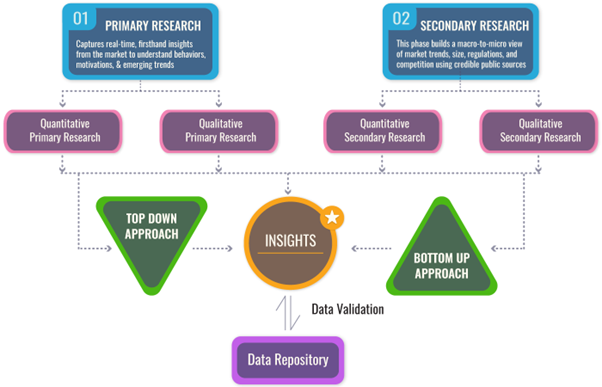
DUAL MODELING: TOP-DOWN + BOTTOM-UP
To ensure robust market estimation, we apply two complementary sizing approaches:
Top-Down Modeling:- Start with broader industry value (e.g., global or regional TAM)
- Apply filters by segment, geography, end-user, or use case
- Adjust with primary insights and validation benchmarks
- Ideal for investor-grade market scans and opportunity mapping
- Aggregate from the ground up using sales volumes, pricing, and unit economics
- Use internal modeling templates aligned with stakeholder data
- Incorporate distributor-level or region-specific inputs
- Most accurate for emerging segments and granular sub-markets
DATA VALIDATION: IN-HOUSE REPOSITORY
We close the loop with proprietary data intelligence built from ongoing projects, industry monitoring, and historical benchmarking. This repository includes:
- Multi-sector market and pricing models
- Key trendlines from past interviews and forecasts
- Benchmarked adoption rates, churn patterns, and ROI indicators
- Industry-specific deviation flags and cross-check logic
- Catches inconsistencies early
- Aligns projections across studies
- Enables consistent, high-trust deliverables